
The following slides contain a template that illustrates
![Measures of Quality – Course Evaluation scale [1=poor; 2=fair; 3=good; 4=very good; 5=excellent] Psych](https://slidetodoc.com/presentation_image/3c121e74b1560da0d05dba67a5146fe4/image-37.jpg "Measures of Quality – Course Evaluation scale [1=poor; 2=fair; 3=good; 4=very good; 5=excellent] Psych")
- Slides: 44
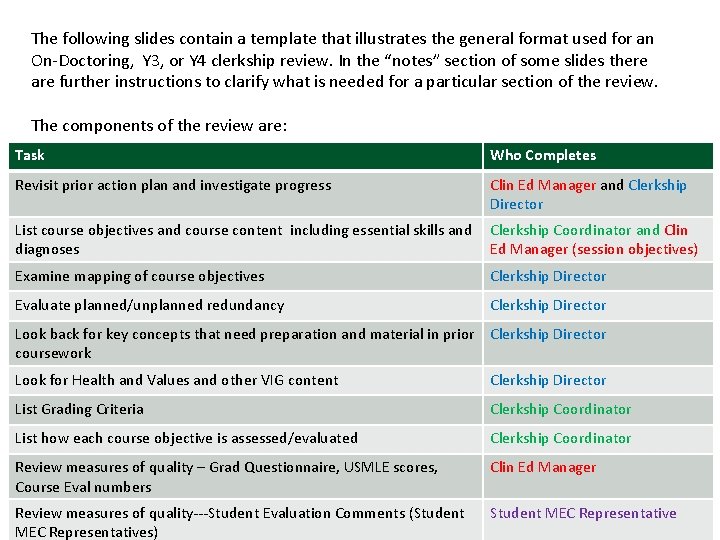
The following slides contain a template that illustrates the general format used for an On-Doctoring, Y 3, or Y 4 clerkship review. In the “notes” section of some slides there are further instructions to clarify what is needed for a particular section of the review. The components of the review are: Task Who Completes Revisit prior action plan and investigate progress Clin Ed Manager and Clerkship Director List course objectives and course content including essential skills and Clerkship Coordinator and Clin diagnoses Ed Manager (session objectives) Examine mapping of course objectives Clerkship Director Evaluate planned/unplanned redundancy Clerkship Director Look back for key concepts that need preparation and material in prior Clerkship Director coursework Look for Health and Values and other VIG content Clerkship Director List Grading Criteria Clerkship Coordinator List how each course objective is assessed/evaluated Clerkship Coordinator Review measures of quality – Grad Questionnaire, USMLE scores, Course Eval numbers Clin Ed Manager Review measures of quality---Student Evaluation Comments (Student MEC Representatives) Student MEC Representative
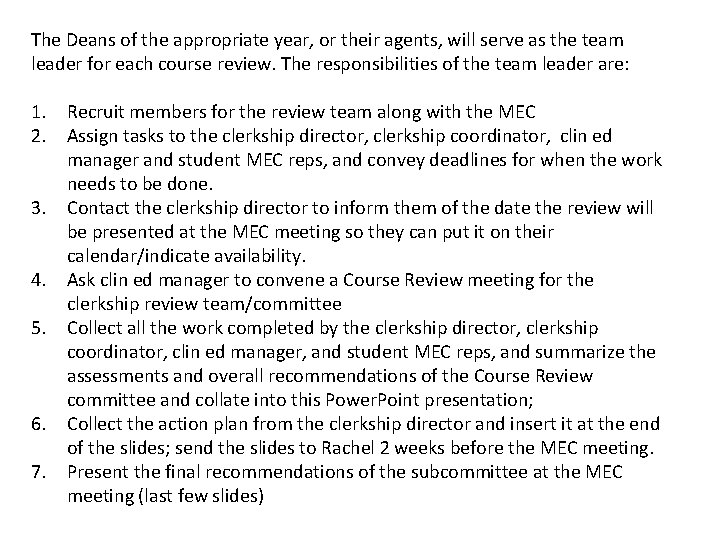
The Deans of the appropriate year, or their agents, will serve as the team leader for each course review. The responsibilities of the team leader are: 1. Recruit members for the review team along with the MEC 2. Assign tasks to the clerkship director, clerkship coordinator, clin ed manager and student MEC reps, and convey deadlines for when the work needs to be done. 3. Contact the clerkship director to inform them of the date the review will be presented at the MEC meeting so they can put it on their calendar/indicate availability. 4. Ask clin ed manager to convene a Course Review meeting for the clerkship review team/committee 5. Collect all the work completed by the clerkship director, clerkship coordinator, clin ed manager, and student MEC reps, and summarize the assessments and overall recommendations of the Course Review committee and collate into this Power. Point presentation; 6. Collect the action plan from the clerkship director and insert it at the end of the slides; send the slides to Rachel 2 weeks before the MEC meeting. 7. Present the final recommendations of the subcommittee at the MEC meeting (last few slides)
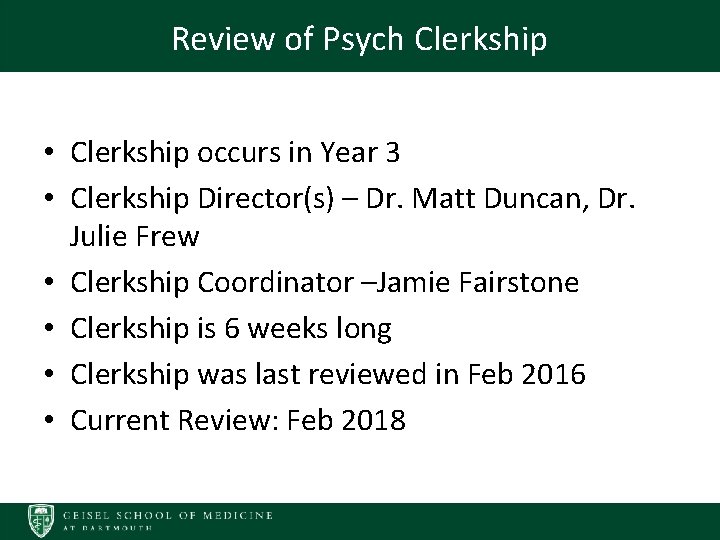
Review of Psych Clerkship • Clerkship occurs in Year 3 • Clerkship Director(s) – Dr. Matt Duncan, Dr. Julie Frew • Clerkship Coordinator –Jamie Fairstone • Clerkship is 6 weeks long • Clerkship was last reviewed in Feb 2016 • Current Review: Feb 2018
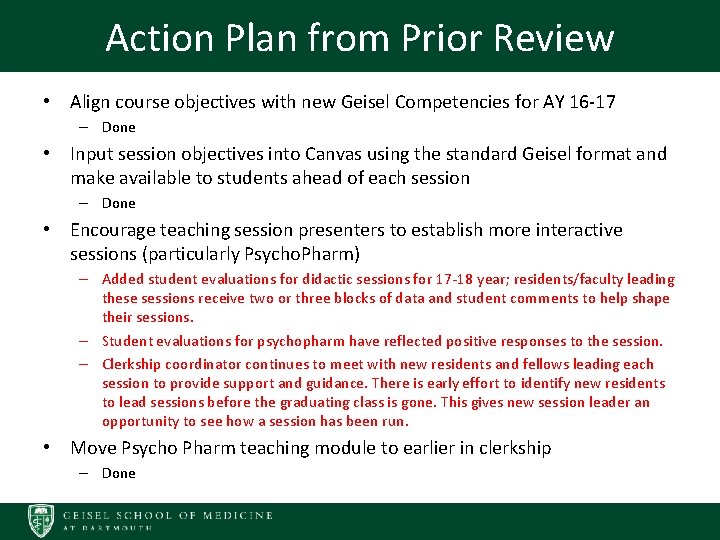
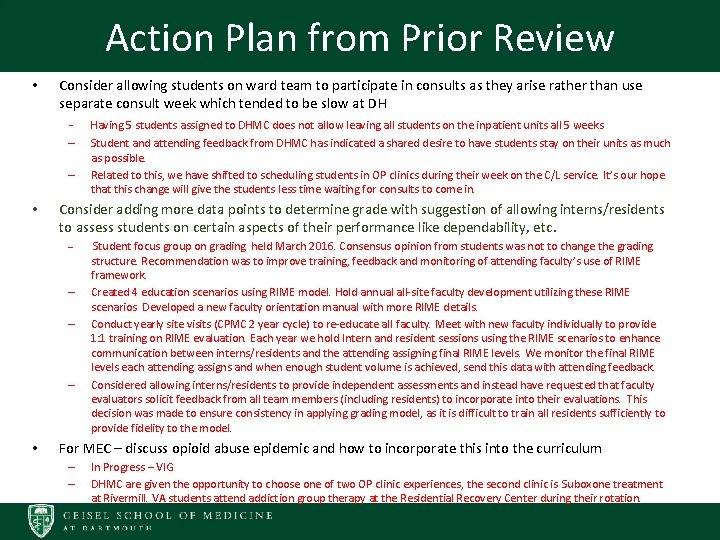
Action Plan from Prior Review • Align course objectives with new Geisel Competencies for AY 16 -17 – Done • Input session objectives into Canvas using the standard Geisel format and make available to students ahead of each session – Done • Encourage teaching session presenters to establish more interactive sessions (particularly Psycho. Pharm) – Added student evaluations for didactic sessions for 17 -18 year; residents/faculty leading these sessions receive two or three blocks of data and student comments to help shape their sessions. – Student evaluations for psychopharm have reflected positive responses to the session. – Clerkship coordinator continues to meet with new residents and fellows leading each session to provide support and guidance. There is early effort to identify new residents to lead sessions before the graduating class is gone. This gives new session leader an opportunity to see how a session has been run. • Move Psycho Pharm teaching module to earlier in clerkship – Done
Action Plan from Prior Review • Consider allowing students on ward team to participate in consults as they arise rather than use separate consult week which tended to be slow at DH - Having 5 students assigned to DHMC does not allow leaving all students on the inpatient units all 5 weeks – – • Consider adding more data points to determine grade with suggestion of allowing interns/residents to assess students on certain aspects of their performance like dependability, etc. – – • Student and attending feedback from DHMC has indicated a shared desire to have students stay on their units as much as possible. Related to this, we have shifted to scheduling students in OP clinics during their week on the C/L service. It’s our hope that this change will give the students less time waiting for consults to come in. Student focus group on grading held March 2016. Consensus opinion from students was not to change the grading structure. Recommendation was to improve training, feedback and monitoring of attending faculty’s use of RIME framework. Created 4 education scenarios using RIME model. Hold annual all-site faculty development utilizing these RIME scenarios Developed a new faculty orientation manual with more RIME details. Conduct yearly site visits (CPMC 2 year cycle) to re-educate all faculty. Meet with new faculty individually to provide 1: 1 training on RIME evaluation. Each year we hold Intern and resident sessions using the RIME scenarios to enhance communication between interns/residents and the attending assigning final RIME levels. We monitor the final RIME levels each attending assigns and when enough student volume is achieved, send this data with attending feedback. Considered allowing interns/residents to provide independent assessments and instead have requested that faculty evaluators solicit feedback from all team members (including residents) to incorporate into their evaluations. This decision was made to ensure consistency in applying grading model, as it is difficult to train all residents sufficiently to provide fidelity to the model. For MEC – discuss opioid abuse epidemic and how to incorporate this into the curriculum – – In Progress – VIG DHMC are given the opportunity to choose one of two OP clinic experiences, the second clinic is Suboxone treatment at Rivermill. VA students attend addiction group therapy at the Residential Recovery Center during their rotation.
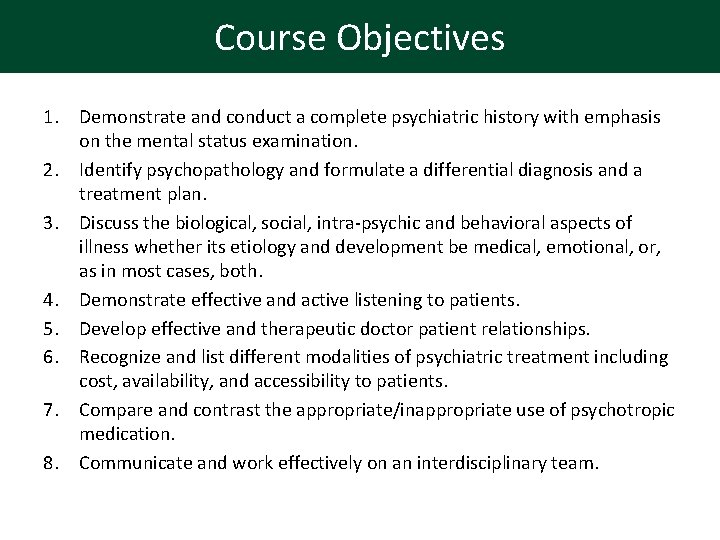
Course Objectives 1. Demonstrate and conduct a complete psychiatric history with emphasis on the mental status examination. 2. Identify psychopathology and formulate a differential diagnosis and a treatment plan. 3. Discuss the biological, social, intra-psychic and behavioral aspects of illness whether its etiology and development be medical, emotional, or, as in most cases, both. 4. Demonstrate effective and active listening to patients. 5. Develop effective and therapeutic doctor patient relationships. 6. Recognize and list different modalities of psychiatric treatment including cost, availability, and accessibility to patients. 7. Compare and contrast the appropriate/inappropriate use of psychotropic medication. 8. Communicate and work effectively on an interdisciplinary team.
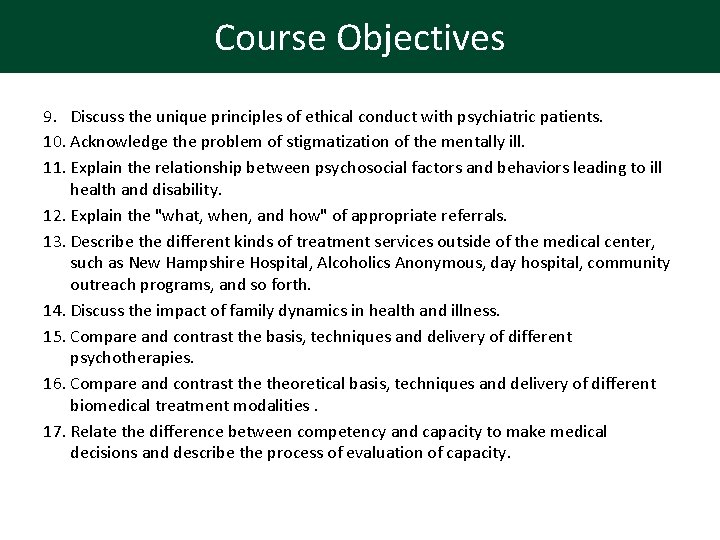
Course Objectives 9. Discuss the unique principles of ethical conduct with psychiatric patients. 10. Acknowledge the problem of stigmatization of the mentally ill. 11. Explain the relationship between psychosocial factors and behaviors leading to ill health and disability. 12. Explain the "what, when, and how" of appropriate referrals. 13. Describe the different kinds of treatment services outside of the medical center, such as New Hampshire Hospital, Alcoholics Anonymous, day hospital, community outreach programs, and so forth. 14. Discuss the impact of family dynamics in health and illness. 15. Compare and contrast the basis, techniques and delivery of different psychotherapies. 16. Compare and contrast theoretical basis, techniques and delivery of different biomedical treatment modalities. 17. Relate the difference between competency and capacity to make medical decisions and describe the process of evaluation of capacity.
Mapping of Course Objectives to Geisel Competencies • Appropriately mapped.
Course Objectives – Comments • Comments about objectives – Appropriate number – Describe course well – Change 12 “Explain the “what, when, and how” of appropriate referrals” to the following “Describe appropriate referrals for consultation and ongoing care in psychiatry including rationale, formulation of a consult question, selection of appropriate level of care, and assisting patients in navigating barriers to access to care. ”
Format of Course & Session Objectives • Course objectives are provided in the syllabus • Course objectives are written in the correct format except for 12 as noted above • Session objectives are provided in the course • Session objectives are written in the correct format however “resiliency session” does not have objectives in Canvas.
Issues of Redundancy • Are there major issues of redundancy with other courses? – No – Searched terms psychopathology, depression, mental illness and capacity and found very little if no overlap.
Look back for preparation on key concepts • Are there major issues that should be included with other courses? – Geriatric psychiatry topics, specifically atypical dementia would benefit from a more cohesive approach • Coordinate with Neurology
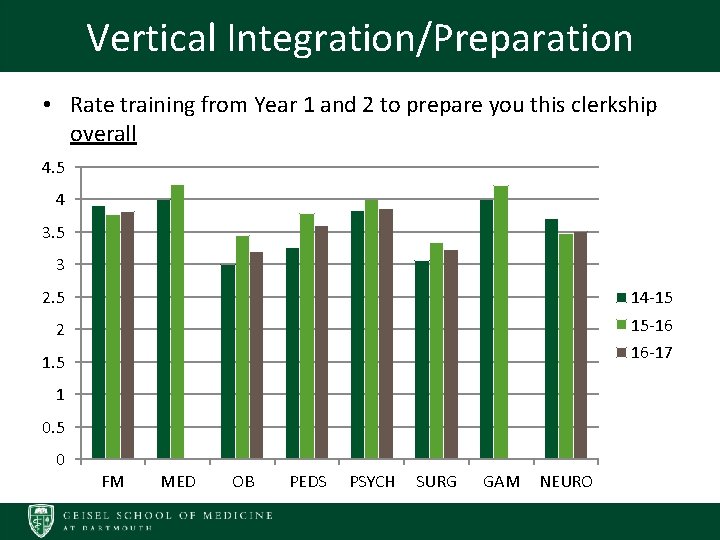
Vertical Integration/Preparation • Rate training from Year 1 and 2 to prepare you this clerkship overall 4. 5 4 3. 5 3 2. 5 14 -15 2 15 -16 16 -17 1. 5 1 0. 5 0 FM MED OB PEDS PSYCH SURG GAM NEURO
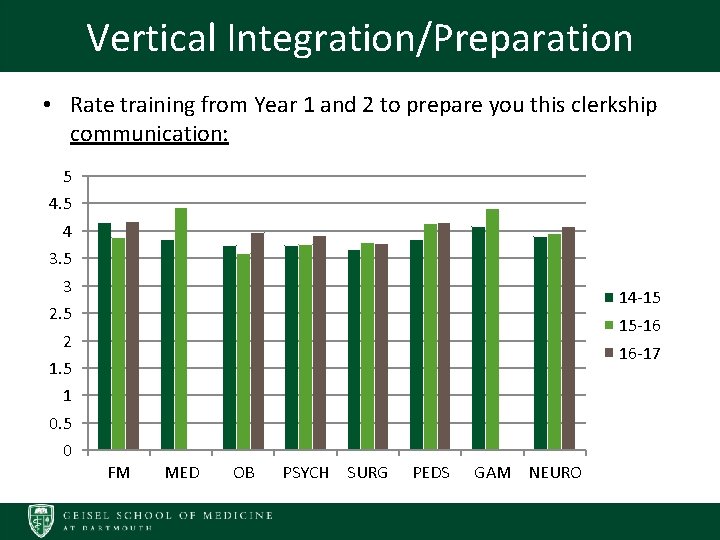
Vertical Integration/Preparation • Rate training from Year 1 and 2 to prepare you this clerkship communication: 5 4 3. 5 3 14 -15 2. 5 15 -16 2 16 -17 1. 5 1 0. 5 0 FM MED OB PSYCH SURG PEDS GAM NEURO
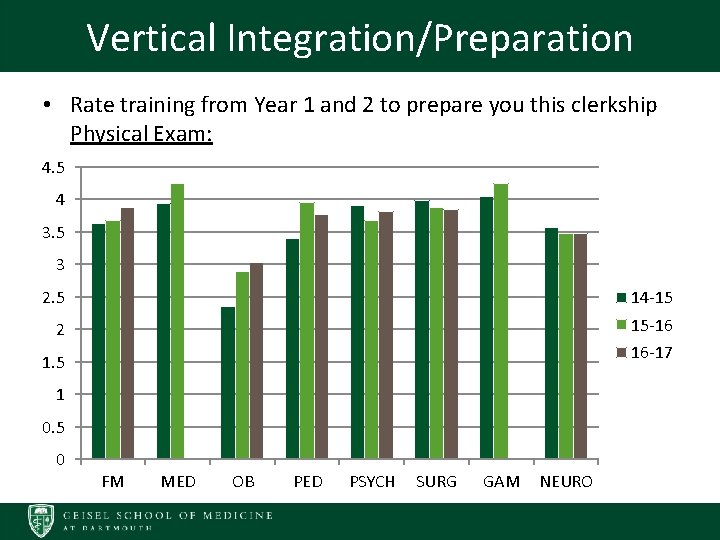
Vertical Integration/Preparation • Rate training from Year 1 and 2 to prepare you this clerkship Physical Exam: 4. 5 4 3. 5 3 2. 5 14 -15 2 15 -16 16 -17 1. 5 1 0. 5 0 FM MED OB PED PSYCH SURG GAM NEURO
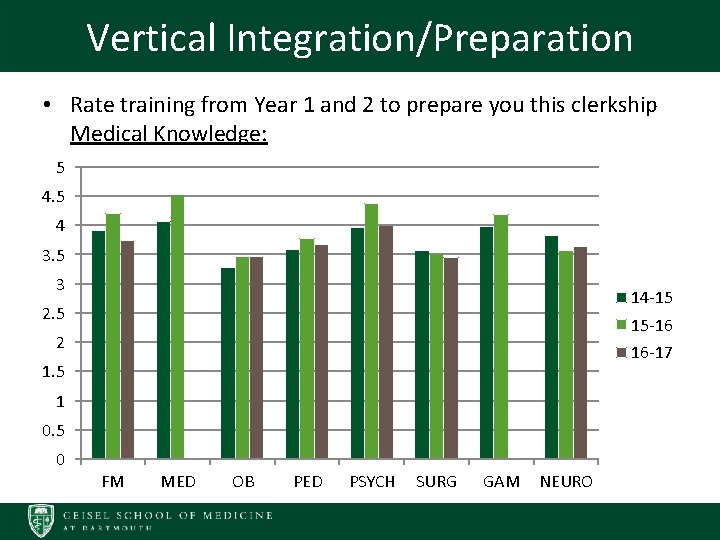
Vertical Integration/Preparation • Rate training from Year 1 and 2 to prepare you this clerkship Medical Knowledge: 5 4 3. 5 3 14 -15 2. 5 15 -16 2 16 -17 1. 5 1 0. 5 0 FM MED OB PED PSYCH SURG GAM NEURO
Pre-clinical Preparation • Psych Unit Group sessions in SBM helpful • More psycho-pharm in Year 2 recommended
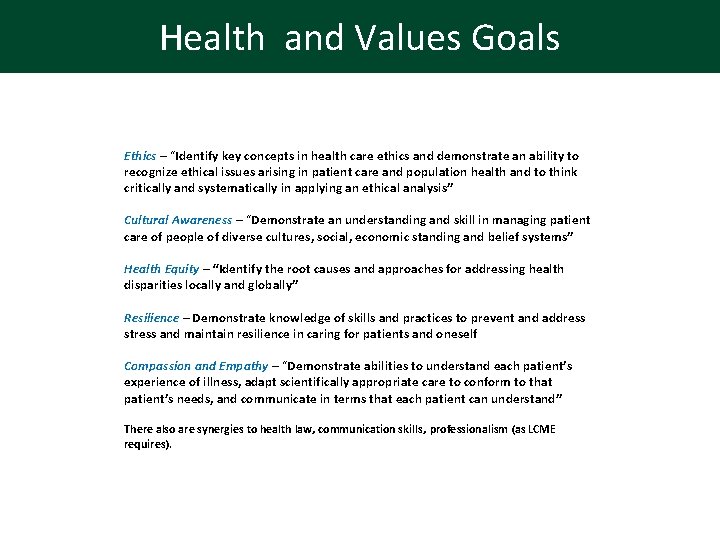
Health and Values Goals Ethics – “Identify key concepts in health care ethics and demonstrate an ability to recognize ethical issues arising in patient care and population health and to think critically and systematically in applying an ethical analysis” Cultural Awareness – “Demonstrate an understanding and skill in managing patient care of people of diverse cultures, social, economic standing and belief systems” Health Equity – “Identify the root causes and approaches for addressing health disparities locally and globally” Resilience – Demonstrate knowledge of skills and practices to prevent and address stress and maintain resilience in caring for patients and oneself Compassion and Empathy – “Demonstrate abilities to understand each patient’s experience of illness, adapt scientifically appropriate care to conform to that patient’s needs, and communicate in terms that each patient can understand” There also are synergies to health law, communication skills, professionalism (as LCME requires).
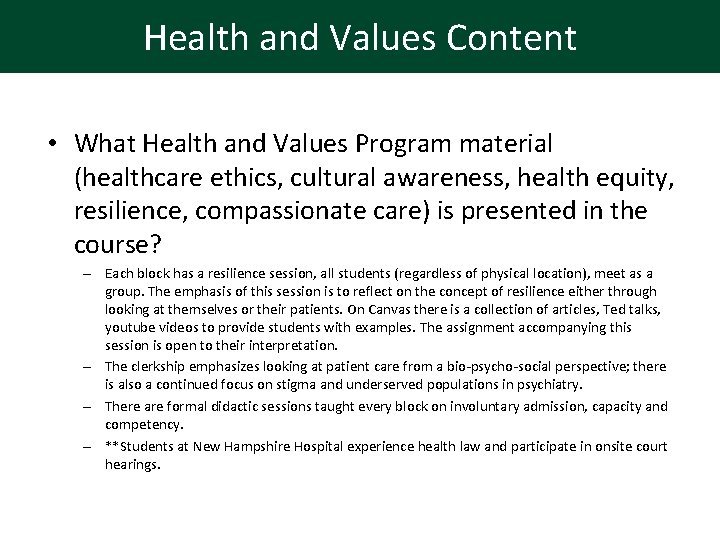
Health and Values Content • What Health and Values Program material (healthcare ethics, cultural awareness, health equity, resilience, compassionate care) is presented in the course? – Each block has a resilience session, all students (regardless of physical location), meet as a group. The emphasis of this session is to reflect on the concept of resilience either through looking at themselves or their patients. On Canvas there is a collection of articles, Ted talks, youtube videos to provide students with examples. The assignment accompanying this session is open to their interpretation. – The clerkship emphasizes looking at patient care from a bio-psycho-social perspective; there is also a continued focus on stigma and underserved populations in psychiatry. – There are formal didactic sessions taught every block on involuntary admission, capacity and competency. – **Students at New Hampshire Hospital experience health law and participate in onsite court hearings.
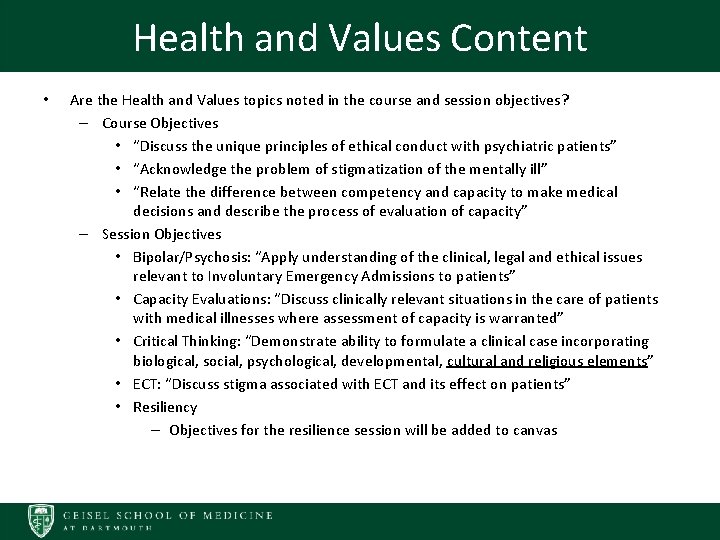
Health and Values Content • Are the Health and Values topics noted in the course and session objectives? – Course Objectives • “Discuss the unique principles of ethical conduct with psychiatric patients” • “Acknowledge the problem of stigmatization of the mentally ill” • “Relate the difference between competency and capacity to make medical decisions and describe the process of evaluation of capacity” – Session Objectives • Bipolar/Psychosis: “Apply understanding of the clinical, legal and ethical issues relevant to Involuntary Emergency Admissions to patients” • Capacity Evaluations: “Discuss clinically relevant situations in the care of patients with medical illnesses where assessment of capacity is warranted” • Critical Thinking: “Demonstrate ability to formulate a clinical case incorporating biological, social, psychological, developmental, cultural and religious elements” • ECT: “Discuss stigma associated with ECT and its effect on patients” • Resiliency – Objectives for the resilience session will be added to canvas
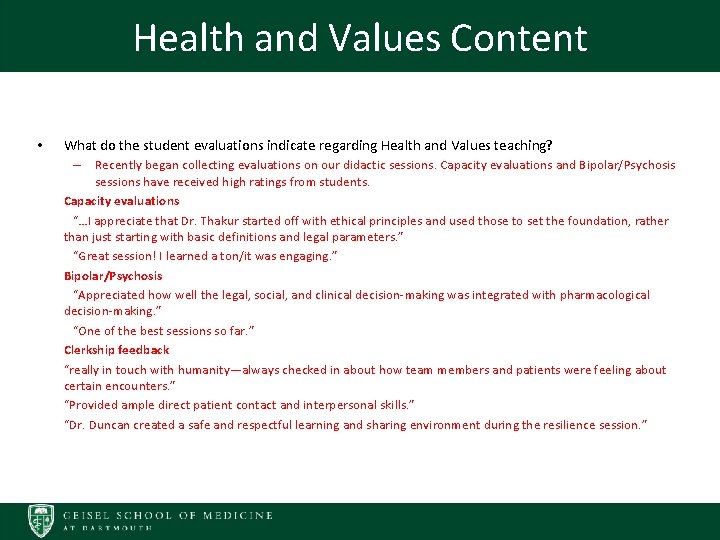
Health and Values Content • What do the student evaluations indicate regarding Health and Values teaching? Recently began collecting evaluations on our didactic sessions. Capacity evaluations and Bipolar/Psychosis sessions have received high ratings from students. Capacity evaluations “…I appreciate that Dr. Thakur started off with ethical principles and used those to set the foundation, rather than just starting with basic definitions and legal parameters. ” “Great session! I learned a ton/it was engaging. ” Bipolar/Psychosis “Appreciated how well the legal, social, and clinical decision-making was integrated with pharmacological decision-making. ” “One of the best sessions so far. ” Clerkship feedback “really in touch with humanity—always checked in about how team members and patients were feeling about certain encounters. ” “Provided ample direct patient contact and interpersonal skills. ” “Dr. Duncan created a safe and respectful learning and sharing environment during the resilience session. ” –
Nutrition Content What Nutrition content is presented in the clerkship? • No formal nutrition content noted Are Nutrition topics noted in the course and session objectives? • No nutrition content noted in course or session objectives
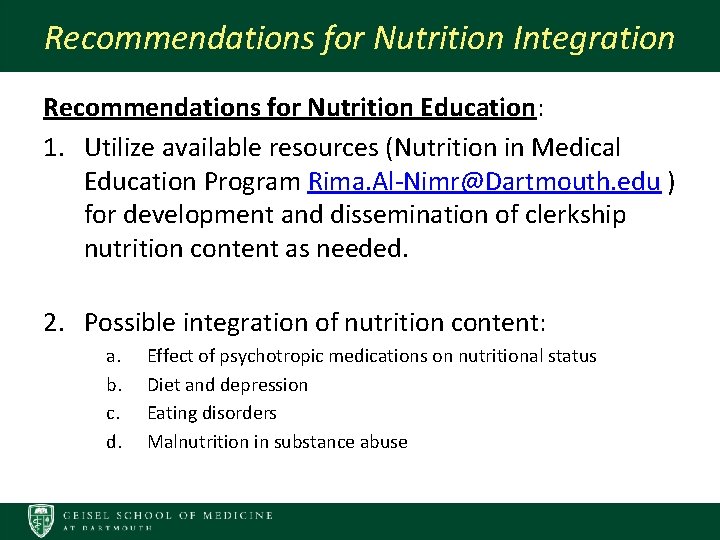
Recommendations for Nutrition Integration Recommendations for Nutrition Education: 1. Utilize available resources (Nutrition in Medical Education Program Rima. Al-Nimr@Dartmouth. edu ) for development and dissemination of clerkship nutrition content as needed. 2. Possible integration of nutrition content: a. b. c. d. Effect of psychotropic medications on nutritional status Diet and depression Eating disorders Malnutrition in substance abuse
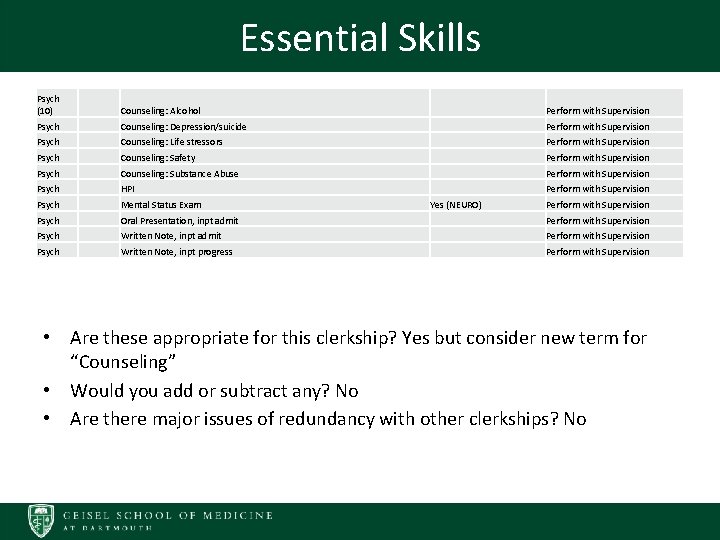
Essential Skills Psych (10) Counseling: Alcohol Perform with Supervision Psych Counseling: Depression/suicide Perform with Supervision Psych Counseling: Life stressors Perform with Supervision Psych Counseling: Safety Perform with Supervision Psych Counseling: Substance Abuse Perform with Supervision Psych HPI Perform with Supervision Psych Mental Status Exam Yes (NEURO) Perform with Supervision Psych Oral Presentation, inpt admit Perform with Supervision Psych Written Note, inpt progress Perform with Supervision • Are these appropriate for this clerkship? Yes but consider new term for “Counseling” • Would you add or subtract any? No • Are there major issues of redundancy with other clerkships? No
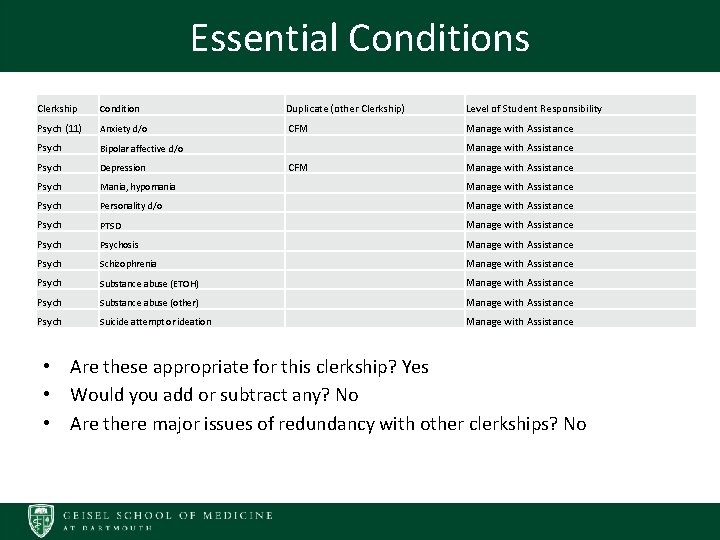
Essential Conditions Clerkship Condition Duplicate (other Clerkship) Level of Student Responsibility Psych (11) Anxiety d/o CFM Manage with Assistance Psych Bipolar affective d/o Manage with Assistance Psych Depression CFM Manage with Assistance Psych Mania, hypomania Manage with Assistance Psych Personality d/o Manage with Assistance Psych PTSD Manage with Assistance Psychosis Manage with Assistance Psych Schizophrenia Manage with Assistance Psych Substance abuse (ETOH) Manage with Assistance Psych Substance abuse (other) Manage with Assistance Psych Suicide attempt or ideation Manage with Assistance • Are these appropriate for this clerkship? Yes • Would you add or subtract any? No • Are there major issues of redundancy with other clerkships? No
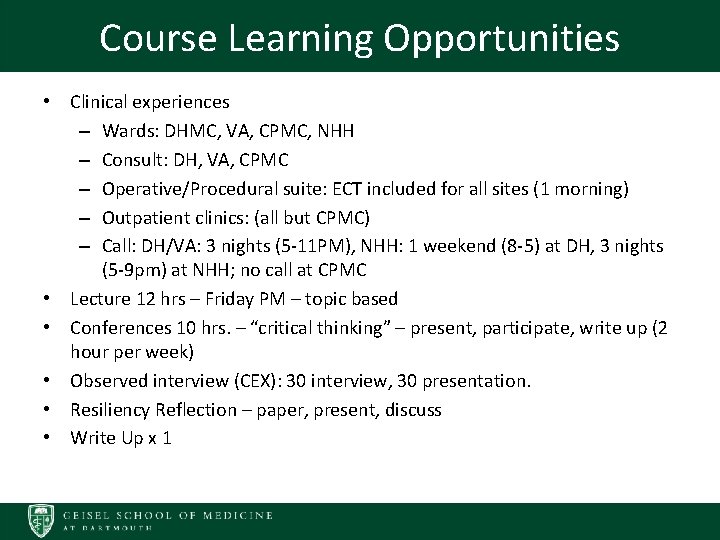
Course Learning Opportunities • Clinical experiences – Wards: DHMC, VA, CPMC, NHH – Consult: DH, VA, CPMC – Operative/Procedural suite: ECT included for all sites (1 morning) – Outpatient clinics: (all but CPMC) – Call: DH/VA: 3 nights (5 -11 PM), NHH: 1 weekend (8 -5) at DH, 3 nights (5 -9 pm) at NHH; no call at CPMC • Lecture 12 hrs – Friday PM – topic based • Conferences 10 hrs. – “critical thinking” – present, participate, write up (2 hour per week) • Observed interview (CEX): 30 interview, 30 presentation. • Resiliency Reflection – paper, present, discuss • Write Up x 1
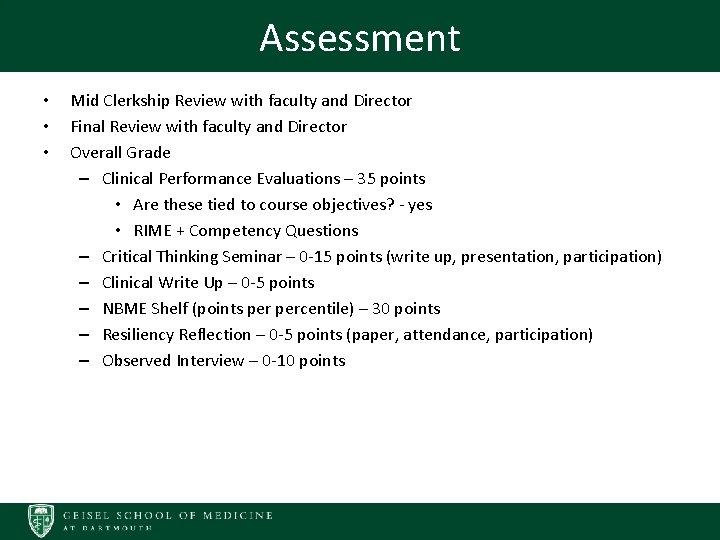
Assessment • • • Mid Clerkship Review with faculty and Director Final Review with faculty and Director Overall Grade – Clinical Performance Evaluations – 35 points • Are these tied to course objectives? - yes • RIME + Competency Questions – Critical Thinking Seminar – 0 -15 points (write up, presentation, participation) – Clinical Write Up – 0 -5 points – NBME Shelf (points percentile) – 30 points – Resiliency Reflection – 0 -5 points (paper, attendance, participation) – Observed Interview – 0 -10 points
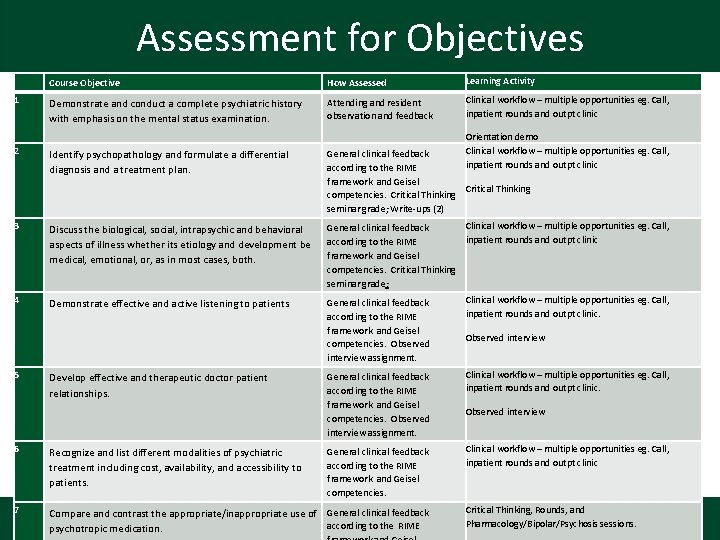
Assessment for Objectives Course Objective How Assessed Learning Activity 1 Demonstrate and conduct a complete psychiatric history with emphasis on the mental status examination. Attending and resident observation and feedback Clinical workflow – multiple opportunities eg. Call, inpatient rounds and outpt clinic Orientation demo Clinical workflow – multiple opportunities eg. Call, inpatient rounds and outpt clinic 2 Identify psychopathology and formulate a differential diagnosis and a treatment plan. General clinical feedback according to the RIME framework and Geisel Critical Thinking competencies. Critical Thinking seminar grade; Write-ups (2) 3 Discuss the biological, social, intrapsychic and behavioral aspects of illness whether its etiology and development be medical, emotional, or, as in most cases, both. Clinical workflow – multiple opportunities eg. Call, General clinical feedback inpatient rounds and outpt clinic according to the RIME framework and Geisel competencies. Critical Thinking seminar grade; 4 Demonstrate effective and active listening to patients General clinical feedback according to the RIME framework and Geisel competencies. Observed interview assignment. Clinical workflow – multiple opportunities eg. Call, inpatient rounds and outpt clinic. General clinical feedback according to the RIME framework and Geisel competencies. Clinical workflow – multiple opportunities eg. Call, inpatient rounds and outpt clinic 5 Develop effective and therapeutic doctor patient relationships. 6 Recognize and list different modalities of psychiatric treatment including cost, availability, and accessibility to patients. 7 Compare and contrast the appropriate/inappropriate use of General clinical feedback according to the RIME psychotropic medication. Observed interview Critical Thinking, Rounds, and Pharmacology/Bipolar/Psychosis sessions.
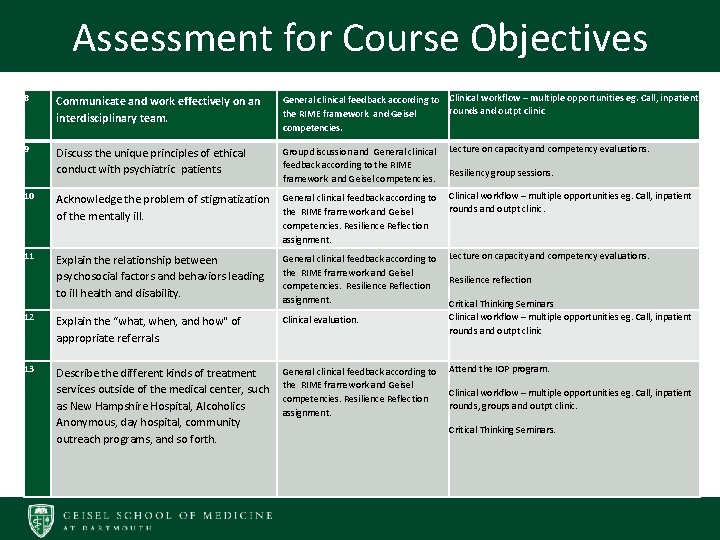
Assessment for Course Objectives 8 Communicate and work effectively on an interdisciplinary team. 9 Discuss the unique principles of ethical conduct with psychiatric patients. 10 General clinical feedback according to Clinical workflow – multiple opportunities eg. Call, inpatient rounds and outpt clinic the RIME framework and Geisel competencies. Group discussion and General clinical Lecture on capacity and competency evaluations. feedback according to the RIME Resiliency group sessions. framework and Geisel competencies. Acknowledge the problem of stigmatization General clinical feedback according to Clinical workflow – multiple opportunities eg. Call, inpatient rounds and outpt clinic. the RIME framework and Geisel of the mentally ill. competencies. Resilience Reflection assignment. 11 12 13 Explain the relationship between psychosocial factors and behaviors leading to ill health and disability. General clinical feedback according to the RIME framework and Geisel competencies. Resilience Reflection assignment. Explain the “what, when, and how" of appropriate referrals. Clinical evaluation. Describe the different kinds of treatment services outside of the medical center, such as New Hampshire Hospital, Alcoholics Anonymous, day hospital, community outreach programs, and so forth. General clinical feedback according to the RIME framework and Geisel competencies. Resilience Reflection assignment. Lecture on capacity and competency evaluations. Resilience reflection Critical Thinking Seminars Clinical workflow – multiple opportunities eg. Call, inpatient rounds and outpt clinic Attend the IOP program. Clinical workflow – multiple opportunities eg. Call, inpatient rounds, groups and outpt clinic. Critical Thinking Seminars.
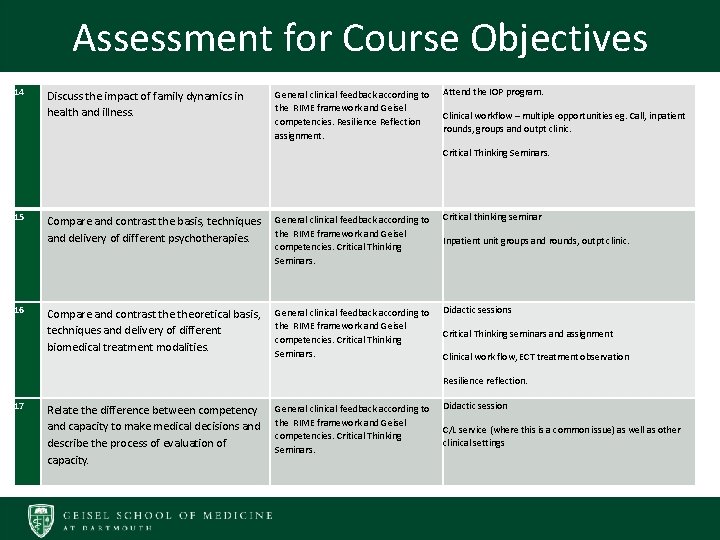
Assessment for Course Objectives 14 Discuss the impact of family dynamics in health and illness. General clinical feedback according to the RIME framework and Geisel competencies. Resilience Reflection assignment. Attend the IOP program. Clinical workflow – multiple opportunities eg. Call, inpatient rounds, groups and outpt clinic. Critical Thinking Seminars. 15 Compare and contrast the basis, techniques General clinical feedback according to Critical thinking seminar the RIME framework and Geisel and delivery of different psychotherapies. Inpatient unit groups and rounds, outpt clinic. competencies. Critical Thinking Seminars. 16 Compare and contrast theoretical basis, techniques and delivery of different biomedical treatment modalities. General clinical feedback according to the RIME framework and Geisel competencies. Critical Thinking Seminars. Didactic sessions Critical Thinking seminars and assignment Clinical work flow, ECT treatment observation Resilience reflection. 17 Relate the difference between competency and capacity to make medical decisions and describe the process of evaluation of capacity. General clinical feedback according to the RIME framework and Geisel competencies. Critical Thinking Seminars. Didactic session C/L service (where this is a common issue) as well as other clinical settings
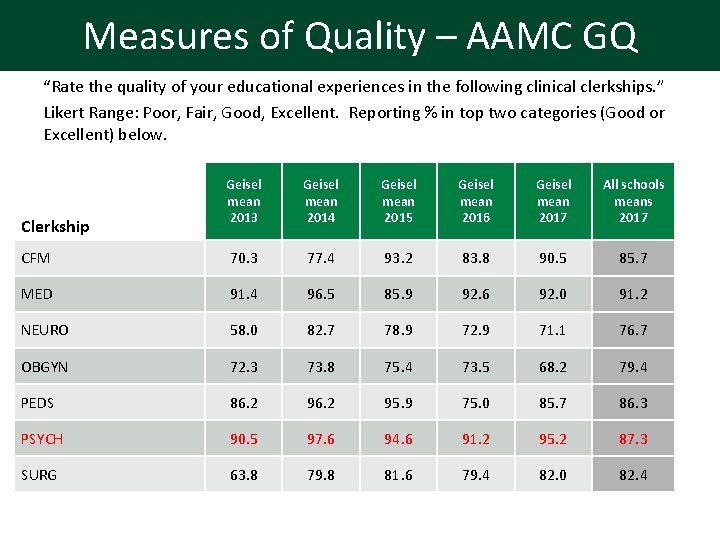
Measures of Quality – AAMC GQ “Rate the quality of your educational experiences in the following clinical clerkships. ” Likert Range: Poor, Fair, Good, Excellent. Reporting % in top two categories (Good or Excellent) below. Geisel mean 2013 Geisel mean 2014 Geisel mean 2015 Geisel mean 2016 CFM 70. 3 77. 4 93. 2 83. 8 MED 91. 4 96. 5 85. 9 92. 6 NEURO 58. 0 82. 7 78. 9 72. 9 OBGYN 72. 3 73. 8 75. 4 PEDS 86. 2 96. 2 PSYCH 90. 5 SURG 63. 8 Clerkship Measure s of Quality – AAMC GQ Geisel mean 2017 All schools means 2017 90. 5 85. 7 92. 0 91. 2 71. 1 76. 7 73. 5 68. 2 79. 4 95. 9 75. 0 85. 7 86. 3 97. 6 94. 6 91. 2 95. 2 87. 3 79. 8 81. 6 79. 4 82. 0 82. 4
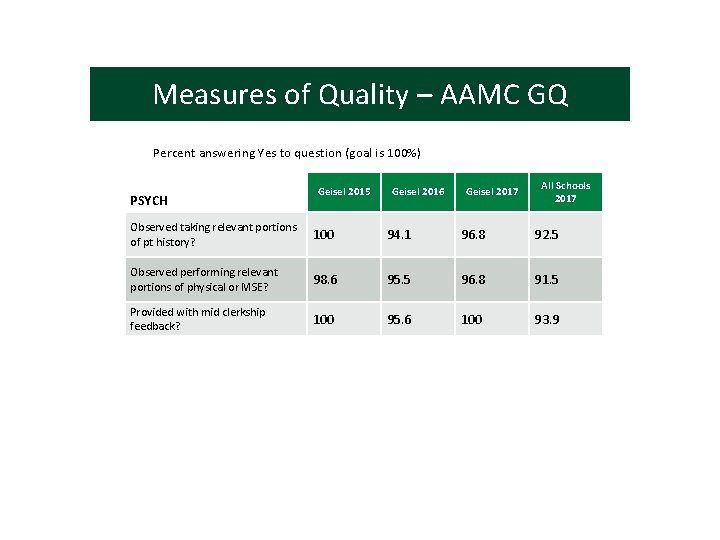
Measures of Quality – AAMC GQ Meas Percent answering Yes to question (goal is 100%) PSYCH Geisel 2015 Geisel 2016 ures of Qualit y – AAMC GQ Geisel 2017 Observed taking relevant portions of pt history? 100 94. 1 96. 8 Observed performing relevant portions of physical or MSE? 98. 6 95. 5 96. 8 Provided with mid clerkship feedback? 100 95. 6 100 All Schools 2017 92. 5 91. 5 93. 9
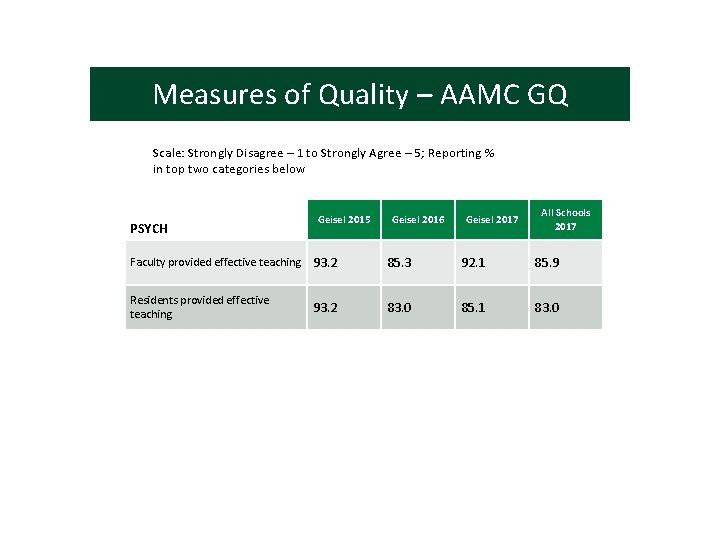
Measures of Quality – AAMC GQ Meas ures of Qualit y – AAMC GQ Scale: Strongly Disagree – 1 to Strongly Agree – 5; Reporting % in top two categories below PSYCH Geisel 2015 Geisel 2016 Geisel 2017 Faculty provided effective teaching 93. 2 85. 3 92. 1 Residents provided effective teaching 83. 0 85. 1 93. 2 All Schools 2017 85. 9 83. 0
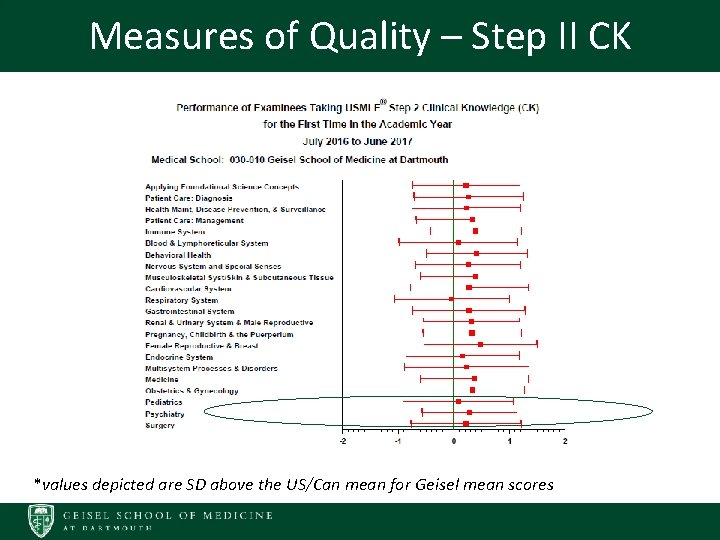
Measures of Quality – Step II CK *values depicted are SD above the US/Can mean for Geisel mean scores
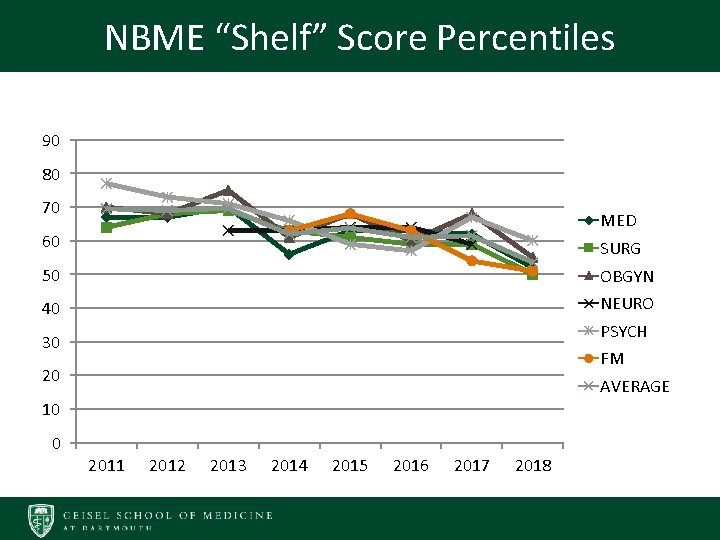
NBME “Shelf” Score Percentiles 90 80 70 MED 60 SURG 50 OBGYN 40 NEURO PSYCH 30 FM 20 AVERAGE 10 0 2011 2012 2013 2014 2015 2016 2017 2018
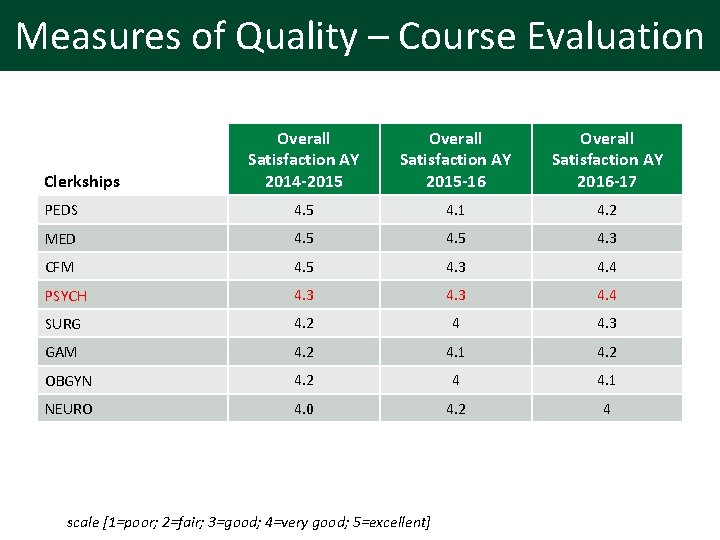
Measures of Quality – Course Evaluation Overall Measure Satisfaction AY 2016 -17 s of Quality – AAMC GQ Overall Satisfaction AY 2014 -2015 Overall Satisfaction AY 2015 -16 PEDS 4. 5 4. 1 MED 4. 5 CFM 4. 5 4. 3 PSYCH 4. 3 SURG 4. 2 4 GAM 4. 2 4. 1 OBGYN 4. 2 4 4. 1 NEURO 4. 0 4. 2 4 Clerkships scale [1=poor; 2=fair; 3=good; 4=very good; 5=excellent] 4. 2 4. 3 4. 4 4. 3 4. 2
Measures of Quality – Course Evaluation scale [1=poor; 2=fair; 3=good; 4=very good; 5=excellent] Psych 2014 -15 2015 -16 2016 -17 Overall Experience 4. 3 4. 4 Objectives well defined and clearly presented 4. 6 4. 5 4. 6 Expectations well defined and clear 4. 4 4. 5 Directors /Site Directors responsive to concerns 4. 8/4. 6 4. 9/4. 6 4. 7/4. 7 Volume adequate for learning 4. 4 4. 3 Variety of dx adequate for learning 4. 4 4. 3 4. 2 Quality of teaching by attendings 4. 3 4. 4 4. 5 Methods used to eval student learning made clear 4. 3 4. 5 Quality of mid-clerkship feedback 4. 2 4. 0 4. 1 Quality of teaching by residents 4. 3 4. 5 4. 4
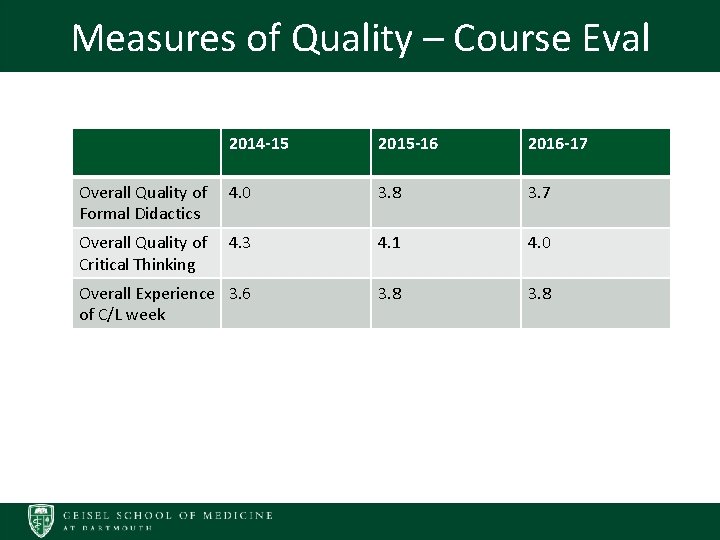
Measures of Quality – Course Eval 2014 -15 2015 -16 2016 -17 Overall Quality of 4. 0 Formal Didactics 3. 8 3. 7 Overall Quality of 4. 3 Critical Thinking 4. 1 4. 0 Overall Experience 3. 6 of C/L week 3. 8
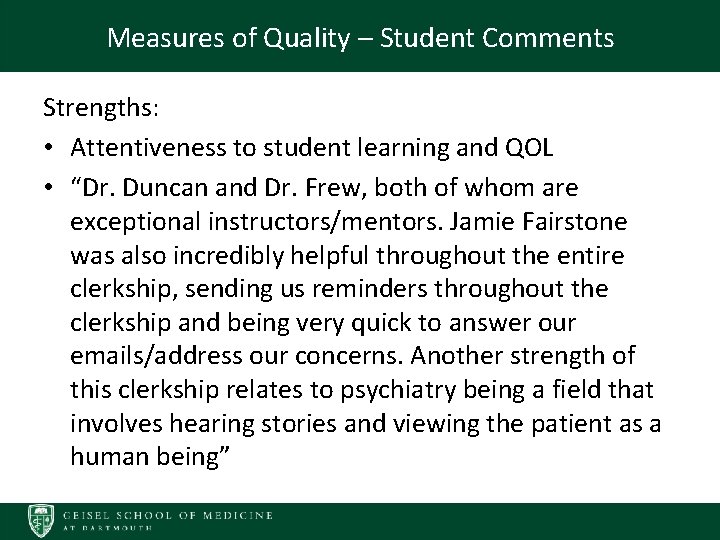
Measures of Quality – Student Comments Strengths: • Attentiveness to student learning and QOL • “Dr. Duncan and Dr. Frew, both of whom are exceptional instructors/mentors. Jamie Fairstone was also incredibly helpful throughout the entire clerkship, sending us reminders throughout the clerkship and being very quick to answer our emails/address our concerns. Another strength of this clerkship relates to psychiatry being a field that involves hearing stories and viewing the patient as a human being”
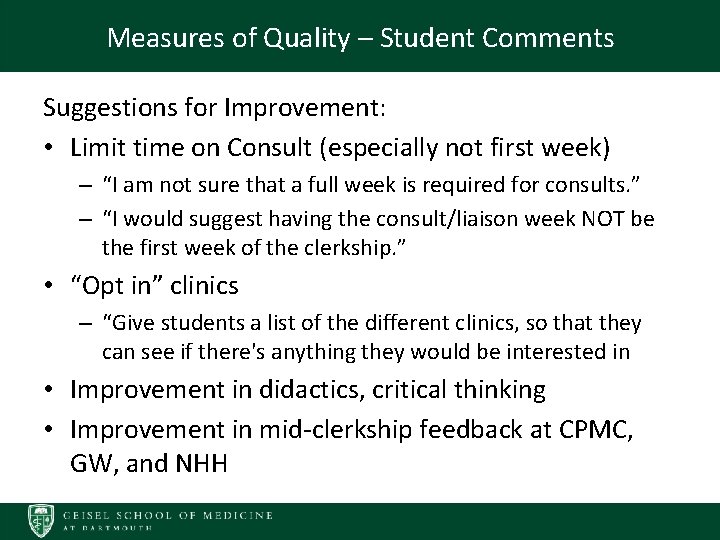
Measures of Quality – Student Comments Suggestions for Improvement: • Limit time on Consult (especially not first week) – “I am not sure that a full week is required for consults. ” – “I would suggest having the consult/liaison week NOT be the first week of the clerkship. ” • “Opt in” clinics – “Give students a list of the different clinics, so that they can see if there's anything they would be interested in • Improvement in didactics, critical thinking • Improvement in mid-clerkship feedback at CPMC, GW, and NHH
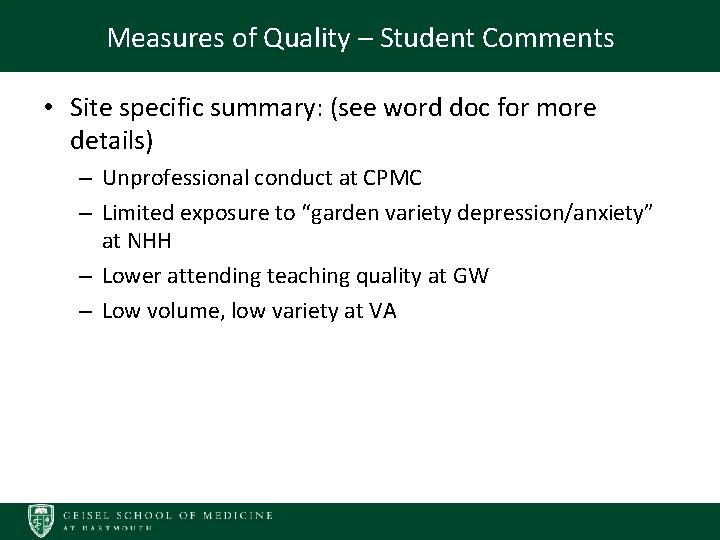
Measures of Quality – Student Comments • Site specific summary: (see word doc for more details) – Unprofessional conduct at CPMC – Limited exposure to “garden variety depression/anxiety” at NHH – Lower attending teaching quality at GW – Low volume, low variety at VA
Recommendations • Course Objectives: Change 12 “Explain the “what, when, and how” of appropriate referrals” to the following “Describe appropriate referrals for consultation and ongoing care in psychiatry including rationale, formulation of a consult question, selection of appropriate level of care, and assisting patients in navigating barriers to access to care. ” • Session Objectives: Need to add Resiliency Session objectives to your Canvas site • Essential Conditions and Skills: Consider more accurate term for “counseling” • Learning Environment: Continue to explore ways to improve the learning that takes place during the consult week • Pedagogy: Review coverage of the psychiatric assessment and treatment of atypical dementias and coordinate efforts with Neurology • Assessment of Learning Objectives: Update assessment and learning activities on slides 30 -32 and assure that each objective has an adequate assessment
Action Plan • • • Course Objectives: Change objective 12 as noted above if approved by MEC Session Objectives: Will add Resiliency Session objectives to our Canvas site Essential Conditions and Skills: Consider more accurate and specific term for “counseling” Learning Environment: Will continue to explore ways to improve the learning that takes place during the consult week – Will consider ideas for improving consult experience and/or ways to replace some time spent on the CL service with other clinical experiences. Pedagogy: Will review coverage of the psychiatric assessment and treatment of atypical dementias and coordinate efforts with Neurology Assessment of Learning Objectives: Will update assessment and learning activities on slides 30 -32 and assure that each objective has an adequate assessment
Action Plan