
The Focus of Six Sigma l Identifying critical
- Slides: 64
The Focus of Six Sigma l Identifying critical aspects of the business with problems or opportunities for improvement. l Targeting those critical areas and designating improvement efforts as Six Sigma Black Belt projects. l Selecting top people to work on the projects--full time. l Ensuring these people have the time, tools, and resources they need to succeed. 2
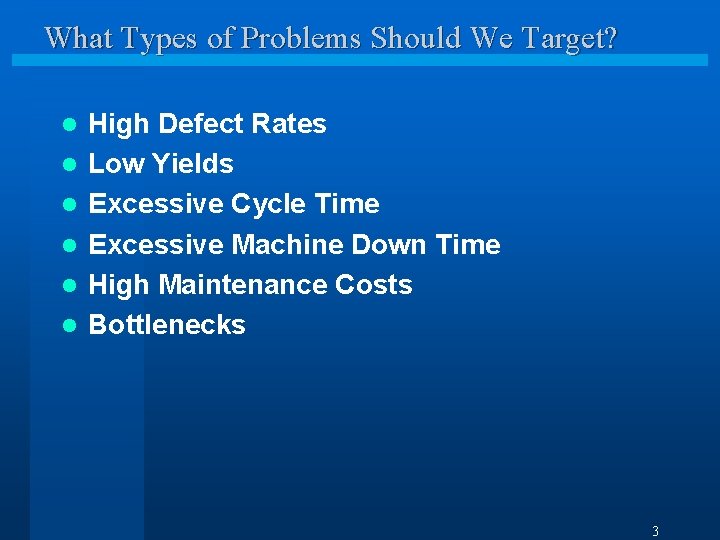
What Types of Problems Should We Target? l l l High Defect Rates Low Yields Excessive Cycle Time Excessive Machine Down Time High Maintenance Costs Bottlenecks 3
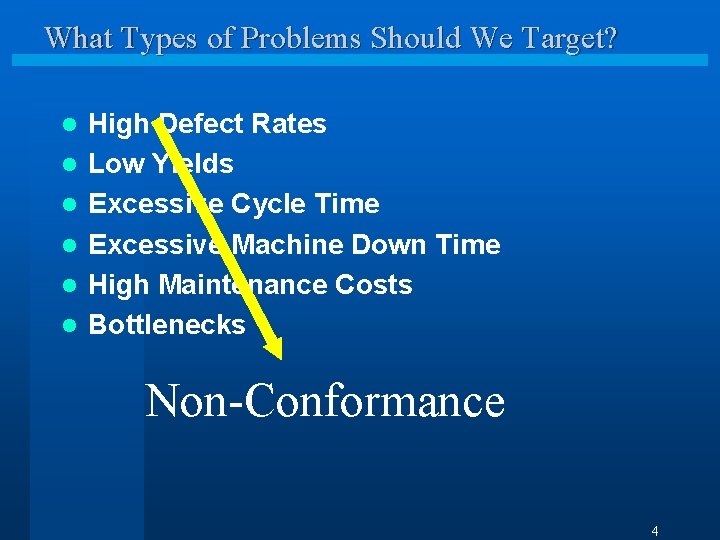
What Types of Problems Should We Target? l l l High Defect Rates Low Yields Excessive Cycle Time Excessive Machine Down Time High Maintenance Costs Bottlenecks Non-Conformance 4
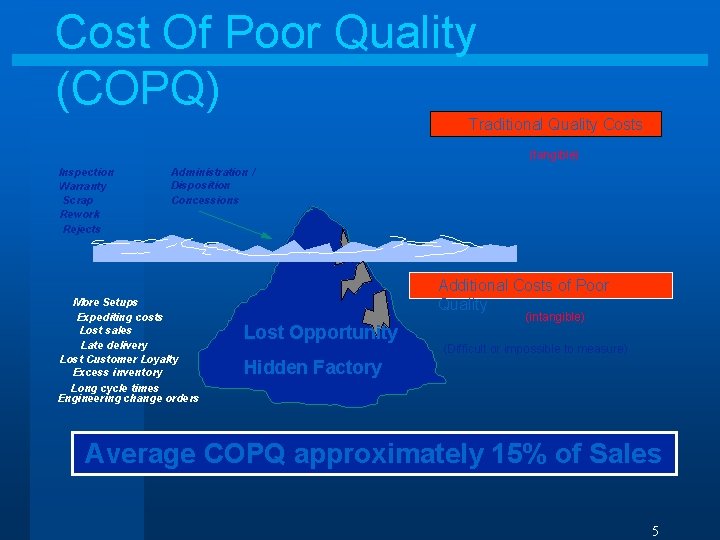
Cost Of Poor Quality (COPQ) Traditional Quality Costs (tangible) Inspection Warranty Scrap Rework Rejects Administration / Disposition Concessions More Setups Expediting costs Lost sales Late delivery Lost Customer Loyalty Excess inventory Long cycle times Engineering change orders Additional Costs of Poor Quality Lost Opportunity (intangible) (Difficult or impossible to measure) Hidden Factory Average COPQ approximately 15% of Sales 5
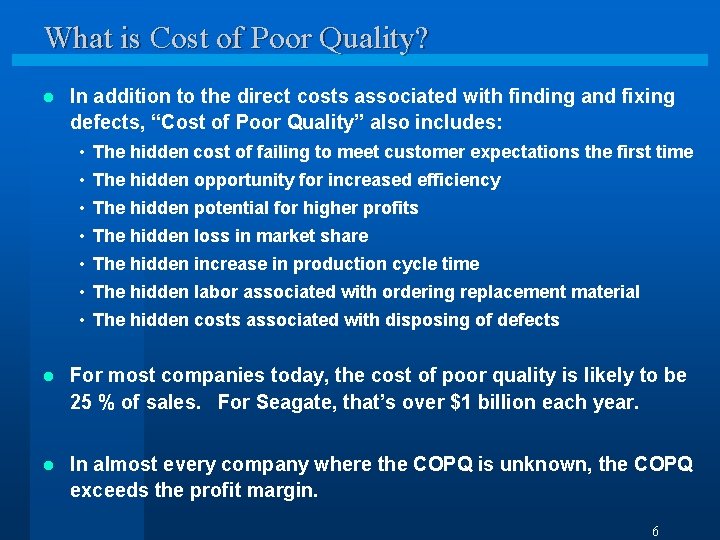
What is Cost of Poor Quality? l In addition to the direct costs associated with finding and fixing defects, “Cost of Poor Quality” also includes: • The hidden cost of failing to meet customer expectations the first time • The hidden opportunity for increased efficiency • The hidden potential for higher profits • The hidden loss in market share • The hidden increase in production cycle time • The hidden labor associated with ordering replacement material • The hidden costs associated with disposing of defects l For most companies today, the cost of poor quality is likely to be 25 % of sales. For Seagate, that’s over $1 billion each year. l In almost every company where the COPQ is unknown, the COPQ exceeds the profit margin. 6
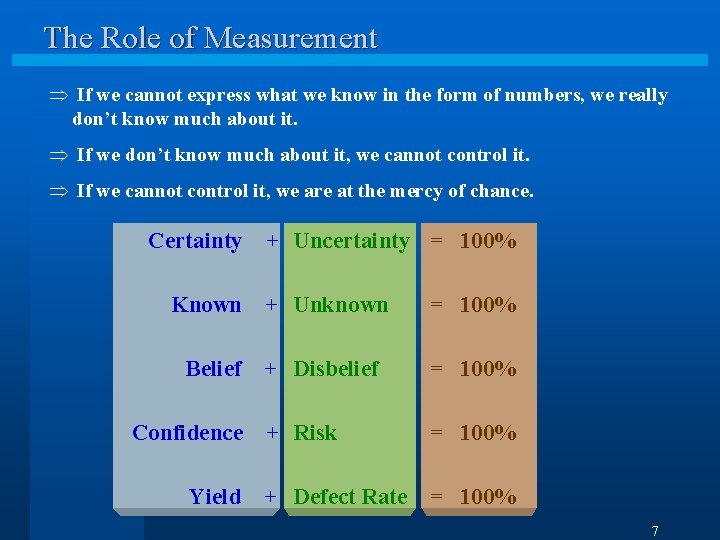
The Role of Measurement Þ If we cannot express what we know in the form of numbers, we really don’t know much about it. Þ If we don’t know much about it, we cannot control it. Þ If we cannot control it, we are at the mercy of chance. Certainty Known Belief Confidence Yield + Uncertainty = 100% + Unknown = 100% + Disbelief = 100% + Risk = 100% + Defect Rate = 100% 7
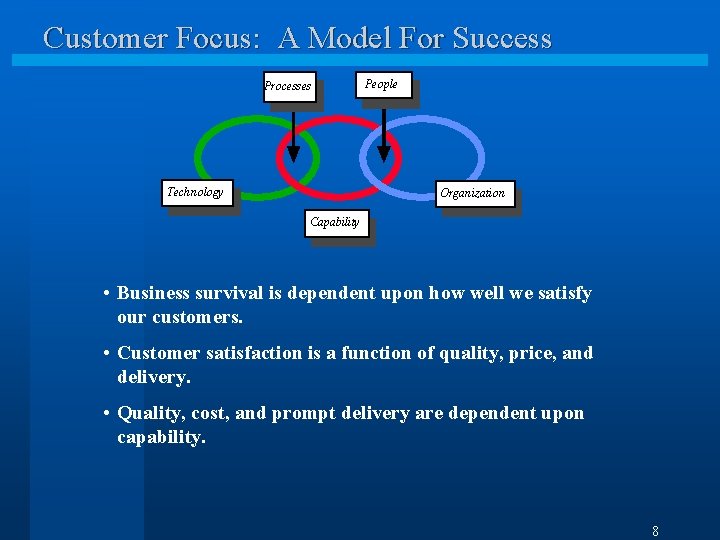
Customer Focus: A Model For Success People Processes Technology Organization Capability • Business survival is dependent upon how well we satisfy our customers. • Customer satisfaction is a function of quality, price, and delivery. • Quality, cost, and prompt delivery are dependent upon capability. 8
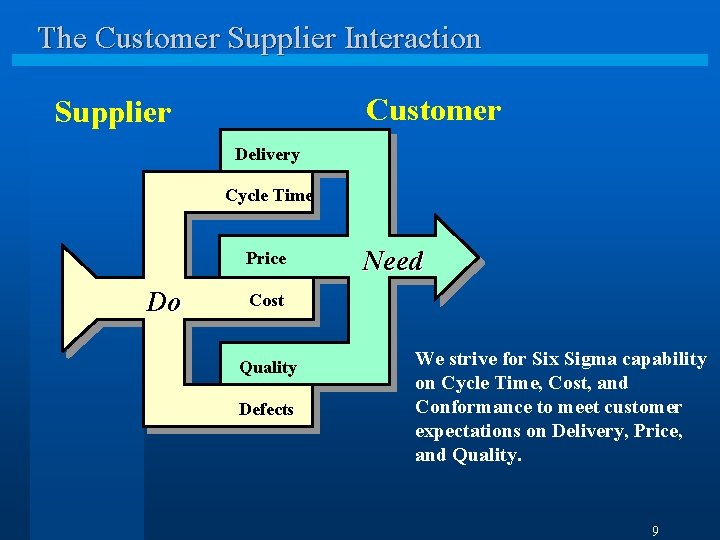
The Customer Supplier Interaction Customer Supplier Delivery Cycle Time Price Do Need Cost Quality Defects We strive for Six Sigma capability on Cycle Time, Cost, and Conformance to meet customer expectations on Delivery, Price, and Quality. 9
How Does Six Sigma Make the Difference? l l l Vision Philosophy Aggressive goal Metric (standard of measurement) Method Vehicle for: » » Customer focus Breakthrough improvement Continuous improvement People Involvement 10
Six Sigma Vision The Vision of Six Sigma is to delight customers by delivering world-class quality products through the achievement of Six Sigma levels of performance in everything we do. 11
Six Sigma Philosophy The philosophy of Six Sigma is to apply a structured, systematic approach to achieve breakthrough improvement across all areas of our business. 12
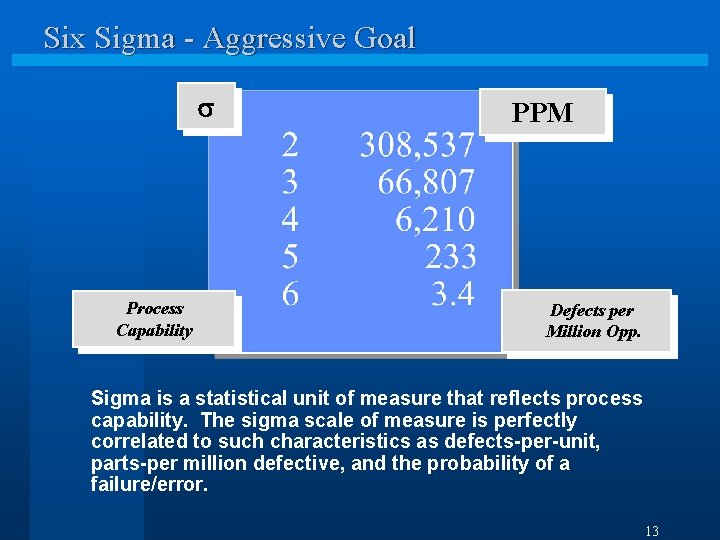
Six Sigma - Aggressive Goal Process Capability PPM Defects per Million Opp. Sigma is a statistical unit of measure that reflects process capability. The sigma scale of measure is perfectly correlated to such characteristics as defects-per-unit, parts-per million defective, and the probability of a failure/error. 13
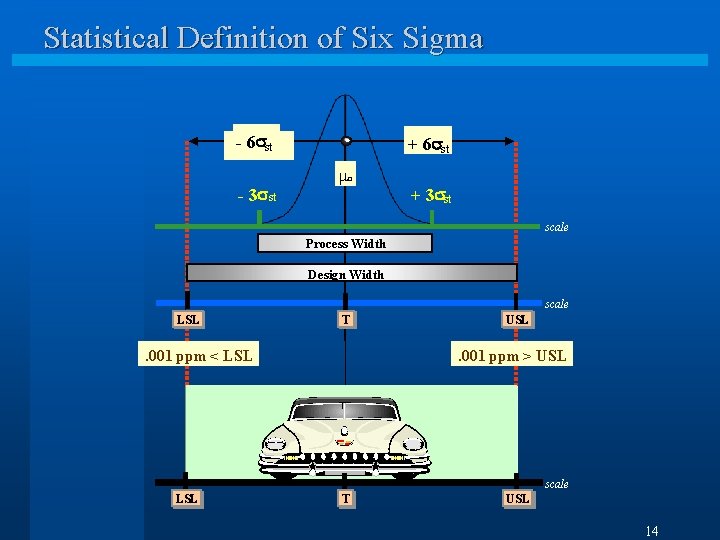
Statistical Definition of Six Sigma - 6 st - 3 st + 6 st mo + 3 st scale Process Width Design Width scale LSL TT . 001 ppm < LSL USL . 001 ppm > USL scale LSL TT USL 14
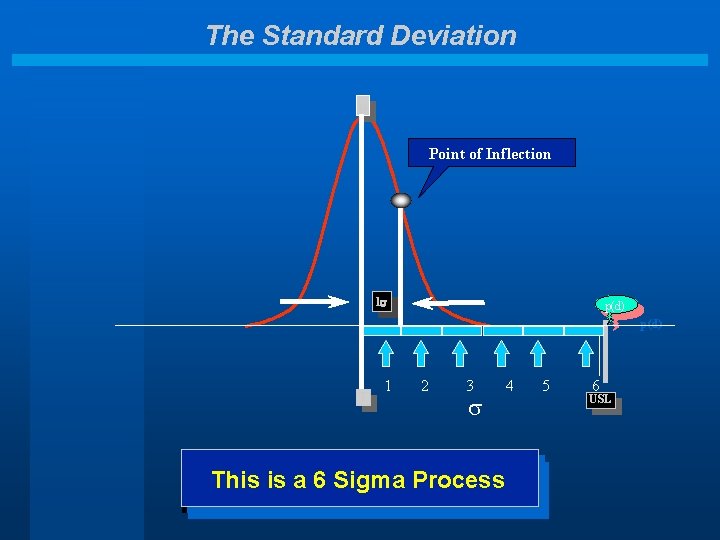
The Standard Deviation m Point of Inflection 1 p(d) T 1 2 3 3 This is a 6 Sigma Process 4 5 6 USL
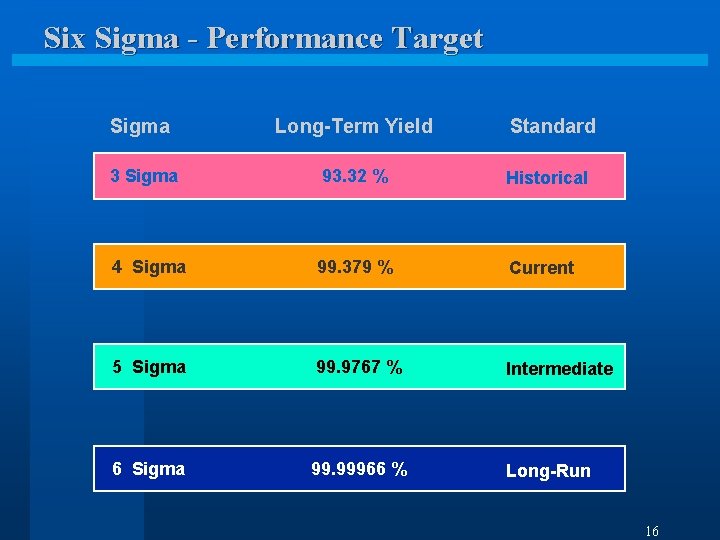
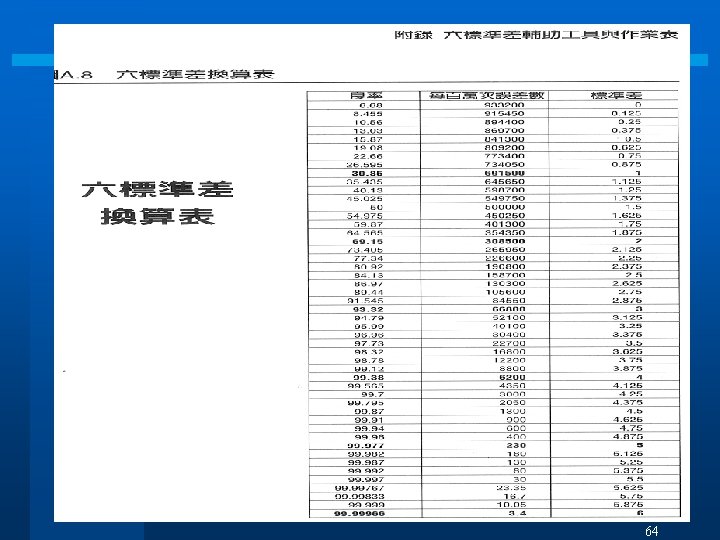
Six Sigma - Performance Target Sigma Long-Term Yield Standard 3 Sigma 93. 32 % Historical 4 Sigma 99. 379 % Current 5 Sigma 99. 9767 % Intermediate 6 Sigma 99. 99966 % Long-Run 16
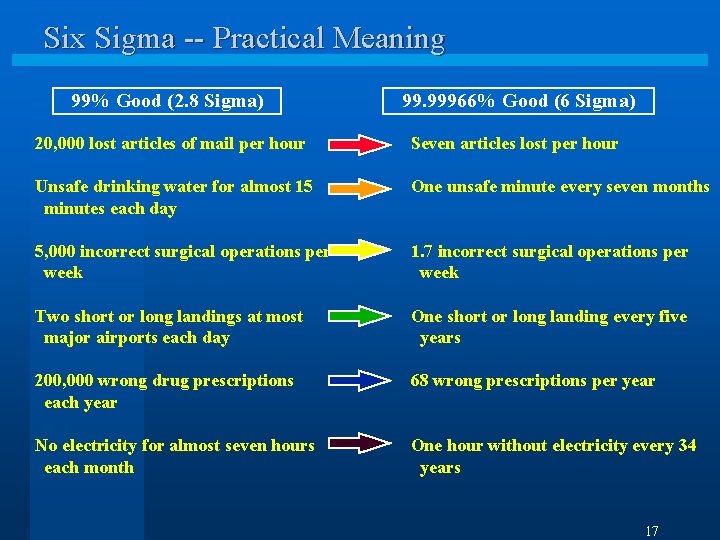
Six Sigma -- Practical Meaning 99% Good (2. 8 Sigma) 99. 99966% Good (6 Sigma) 20, 000 lost articles of mail per hour Seven articles lost per hour Unsafe drinking water for almost 15 minutes each day One unsafe minute every seven months 5, 000 incorrect surgical operations per week 1. 7 incorrect surgical operations per week Two short or long landings at most major airports each day One short or long landing every five years 200, 000 wrong drug prescriptions each year 68 wrong prescriptions per year No electricity for almost seven hours each month One hour without electricity every 34 years 17
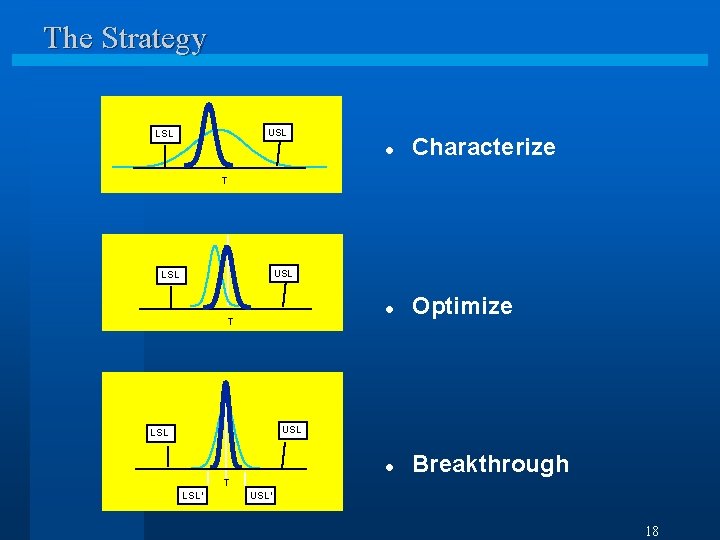
The Strategy USL LSL l Characterize l Optimize l Breakthrough T USL LSL T LSL’ USL’ 18
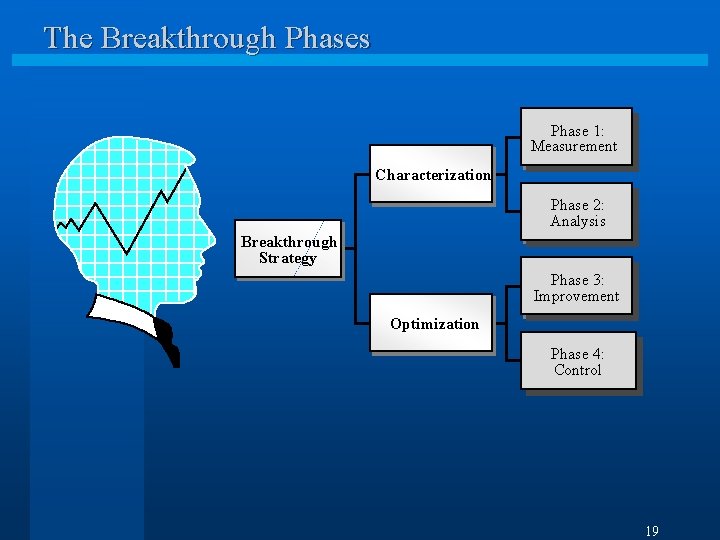
The Breakthrough Phases Phase 1: Measurement Characterization Phase 2: Analysis Breakthrough Strategy Phase 3: Improvement Optimization Phase 4: Control 19
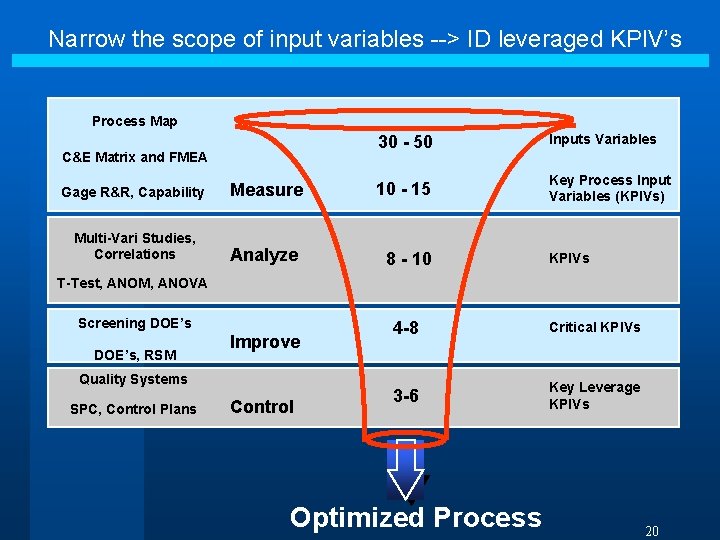
Narrow the scope of input variables --> ID leveraged KPIV’s Six Sigma--Methodology Process Map C&E Matrix and FMEA 30 - 50 Inputs Variables Key Process Input Variables (KPIVs) Gage R&R, Capability Measure 10 - 15 Multi-Vari Studies, Correlations Analyze 8 - 10 KPIVs T-Test, ANOM, ANOVA Screening DOE’s, RSM Improve Quality Systems SPC, Control Plans Control 4 -8 Critical KPIVs 3 -6 Key Leverage KPIVs Optimized Process 20
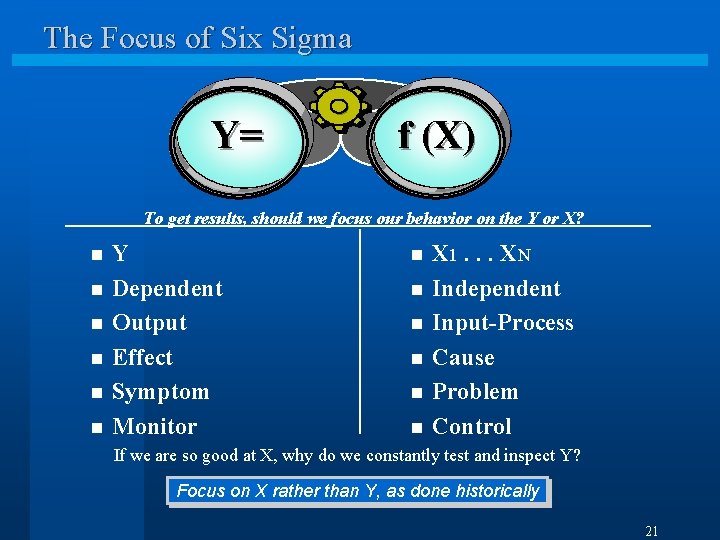
The Focus of Six Sigma Y= f (X) To get results, should we focus our behavior on the Y or X? n n n Y Dependent Output Effect Symptom Monitor n n n X 1. . . XN Independent Input-Process Cause Problem Control n If we are so good at X, why do we constantly test and inspect Y? Focus on X rather than Y, as done historically 21
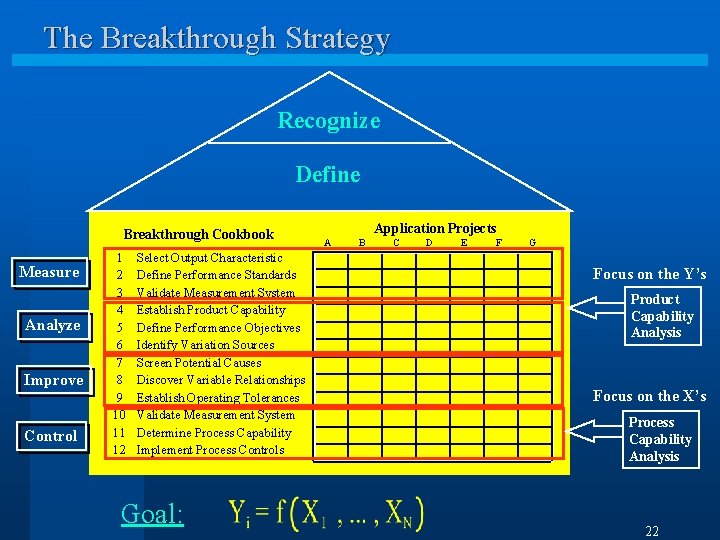
The Breakthrough Strategy Recognize Define Breakthrough Cookbook Measure Analyze Improve Control 1 2 3 4 5 6 7 8 9 10 11 12 Select Output Characteristic Define Performance Standards Validate Measurement System Establish Product Capability Define Performance Objectives Identify Variation Sources Screen Potential Causes Discover Variable Relationships Establish Operating Tolerances Validate Measurement System Determine Process Capability Implement Process Controls Goal: Application Projects A B C D E F G Focus on the Y’s Product Capability Analysis Focus on the X’s Process Capability Analysis 22
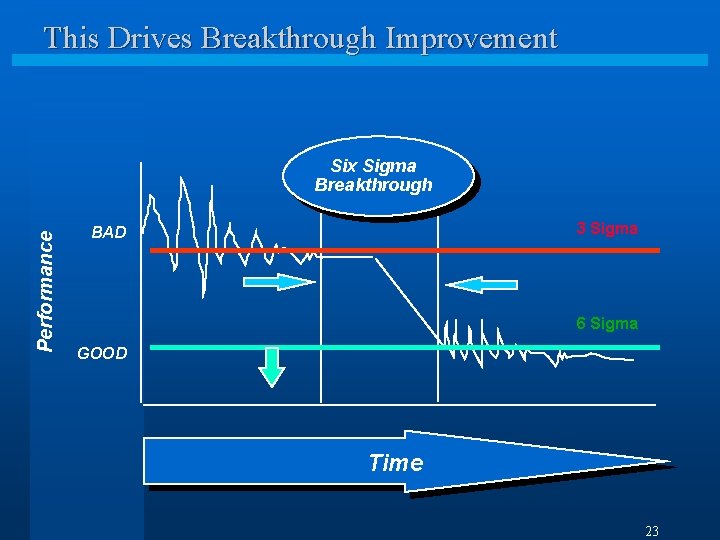
This Drives Breakthrough Improvement Performance Six Sigma Breakthrough 3 Sigma BAD 6 Sigma GOOD Time 23
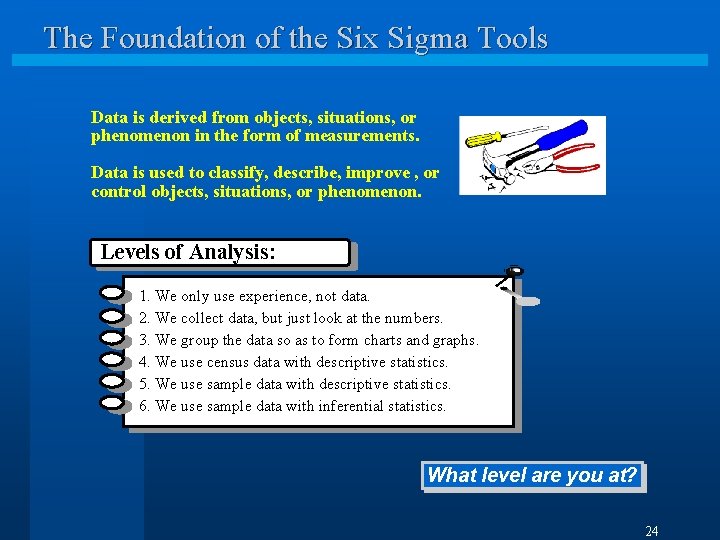
The Foundation of the Six Sigma Tools Data is derived from objects, situations, or phenomenon in the form of measurements. Data is used to classify, describe, improve , or control objects, situations, or phenomenon. Levels of Analysis: 1. We only use experience, not data. 2. We collect data, but just look at the numbers. 3. We group the data so as to form charts and graphs. 4. We use census data with descriptive statistics. 5. We use sample data with descriptive statistics. 6. We use sample data with inferential statistics. What level are you at? 24
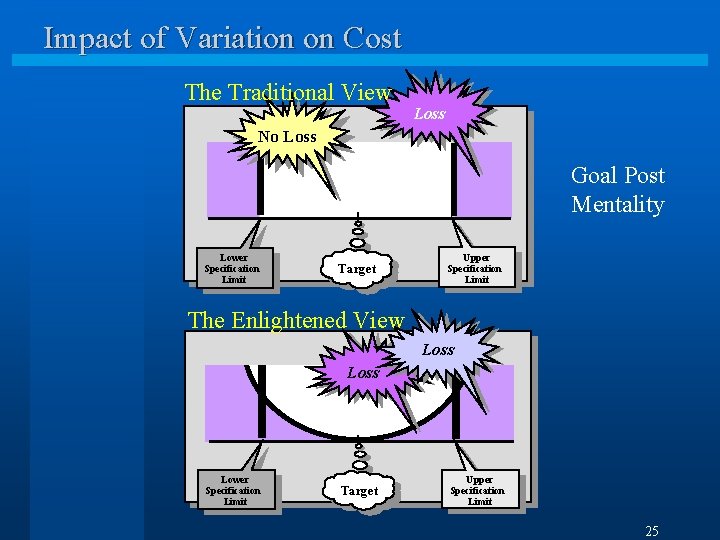
Impact of Variation on Cost The Traditional View Loss No Loss Goal Post Mentality Lower Specification Limit Target Upper Specification Limit The Enlightened View Loss Lower Specification Limit Target Upper Specification Limit 25
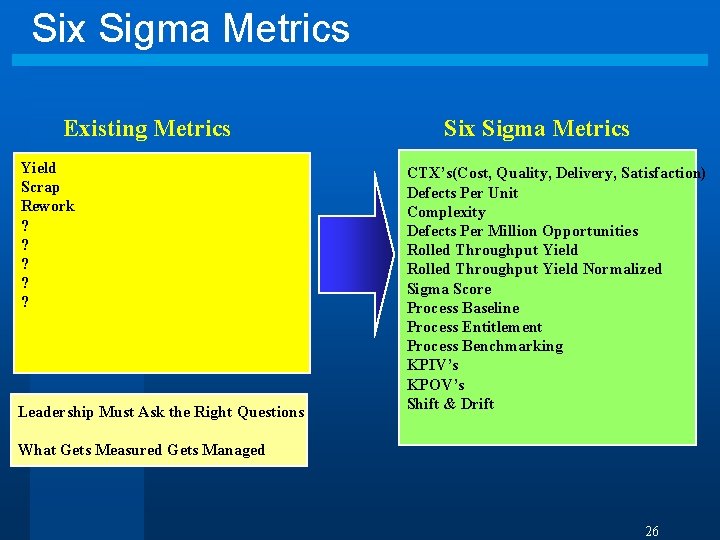
Six Sigma Metrics Existing Metrics Yield Scrap Rework ? ? ? Leadership Must Ask the Right Questions Six Sigma Metrics CTX’s(Cost, Quality, Delivery, Satisfaction) Defects Per Unit Complexity Defects Per Million Opportunities Rolled Throughput Yield Normalized Sigma Score Process Baseline Process Entitlement Process Benchmarking KPIV’s KPOV’s Shift & Drift What Gets Measured Gets Managed 26
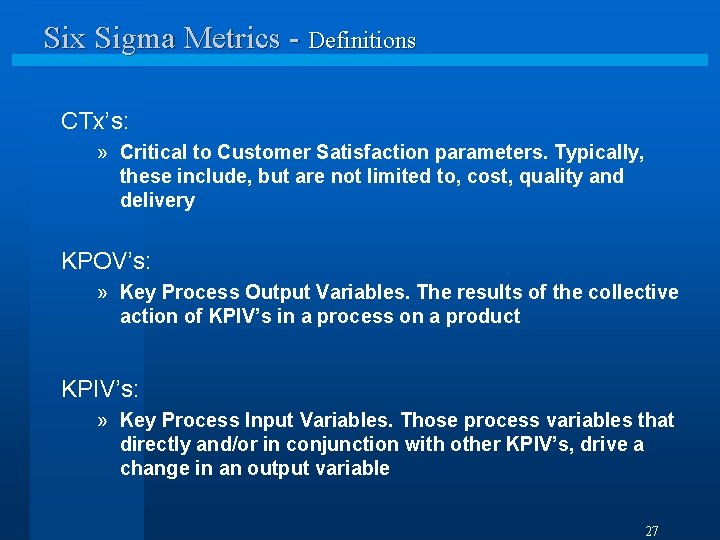
Six Sigma Metrics - Definitions CTx’s: » Critical to Customer Satisfaction parameters. Typically, these include, but are not limited to, cost, quality and delivery KPOV’s: » Key Process Output Variables. The results of the collective action of KPIV’s in a process on a product KPIV’s: » Key Process Input Variables. Those process variables that directly and/or in conjunction with other KPIV’s, drive a change in an output variable 27
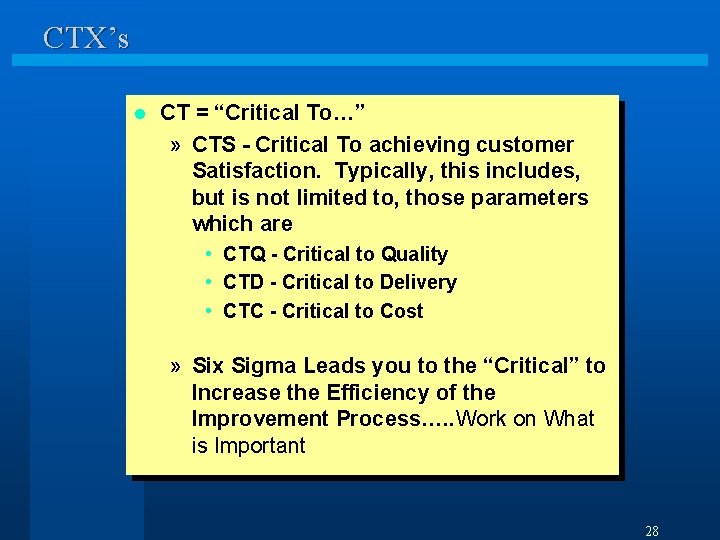
CTX’s l CT = “Critical To…” » CTS - Critical To achieving customer Satisfaction. Typically, this includes, but is not limited to, those parameters which are • CTQ - Critical to Quality • CTD - Critical to Delivery • CTC - Critical to Cost » Six Sigma Leads you to the “Critical” to Increase the Efficiency of the Improvement Process…. . Work on What is Important 28
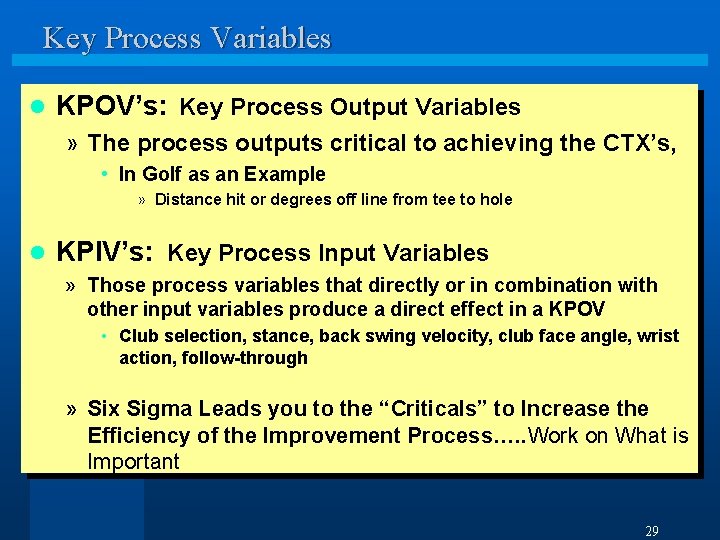
Key Process Variables l KPOV’s: Key Process Output Variables » The process outputs critical to achieving the CTX’s, • In Golf as an Example » Distance hit or degrees off line from tee to hole l KPIV’s: Key Process Input Variables » Those process variables that directly or in combination with other input variables produce a direct effect in a KPOV • Club selection, stance, back swing velocity, club face angle, wrist action, follow-through » Six Sigma Leads you to the “Criticals” to Increase the Efficiency of the Improvement Process…. . Work on What is Important 29
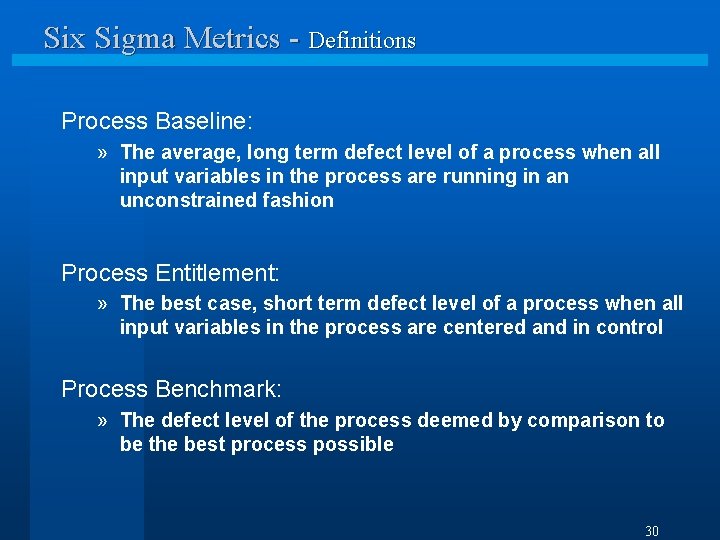
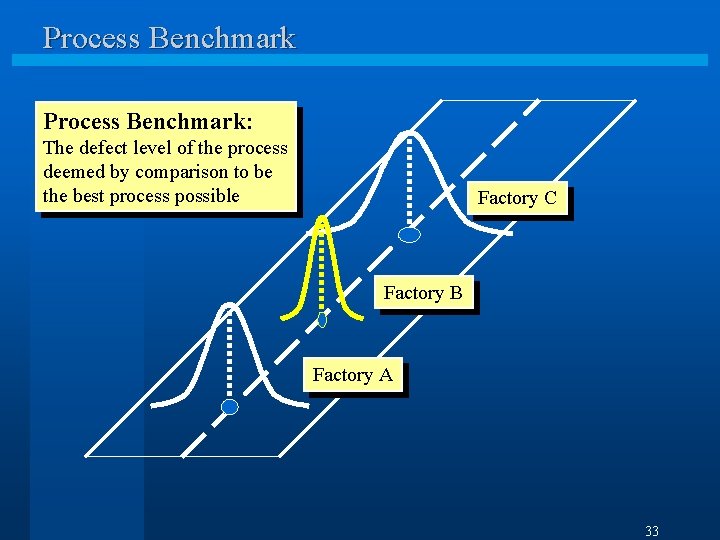
Six Sigma Metrics - Definitions Process Baseline: » The average, long term defect level of a process when all input variables in the process are running in an unconstrained fashion Process Entitlement: » The best case, short term defect level of a process when all input variables in the process are centered and in control Process Benchmark: » The defect level of the process deemed by comparison to be the best process possible 30
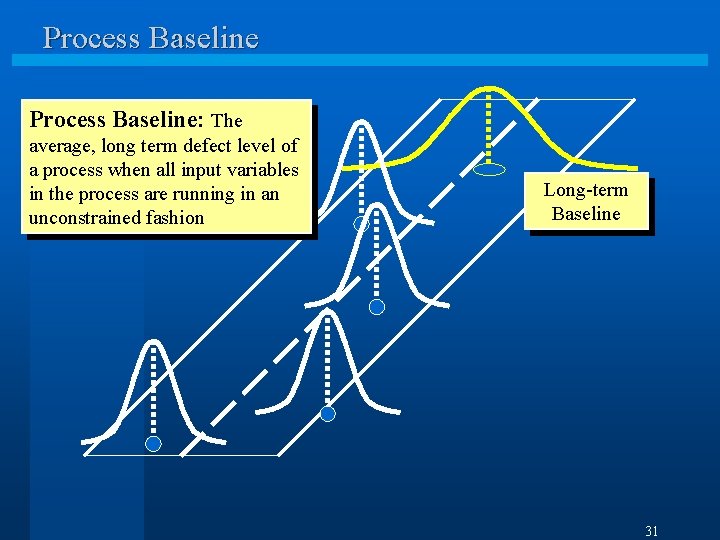
Process Baseline: The average, long term defect level of a process when all input variables in the process are running in an unconstrained fashion Long-term Baseline 31
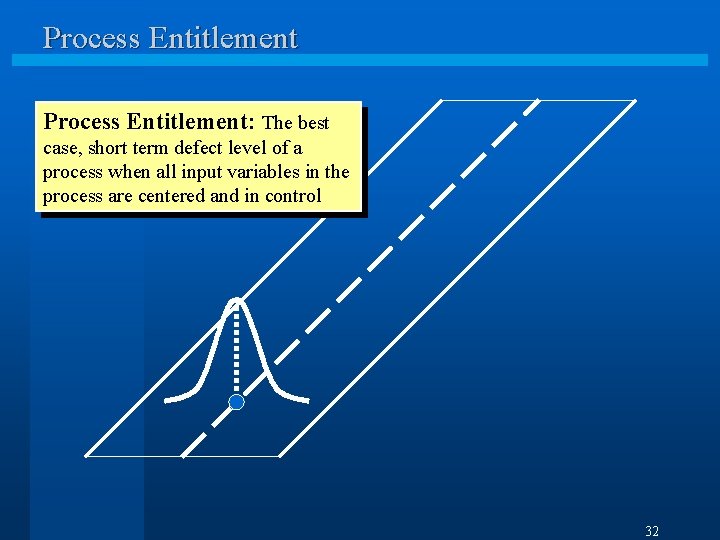
Process Entitlement: The best case, short term defect level of a process when all input variables in the process are centered and in control 32
Process Benchmark: The defect level of the process deemed by comparison to be the best process possible Factory C Factory B Factory A 33
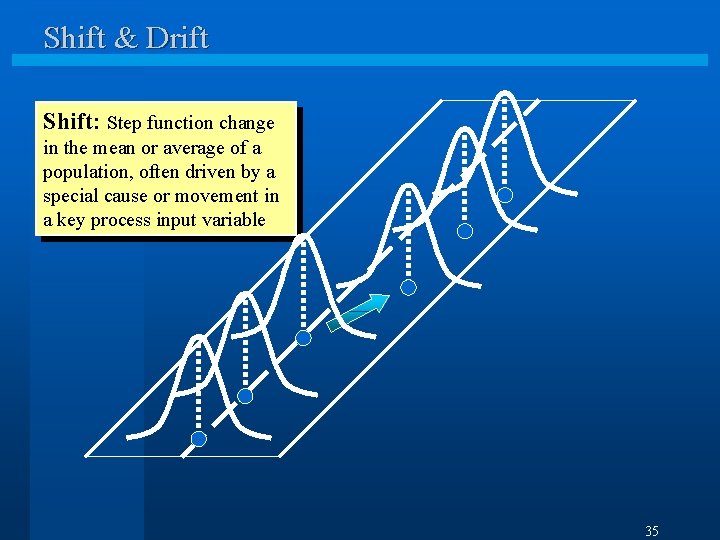
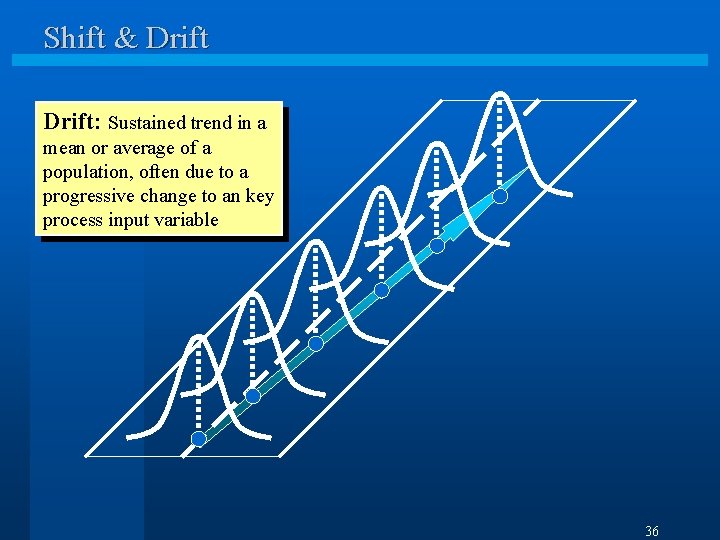
Six Sigma Metrics - Definitions Shift: » Step function change in the mean or average of a population, often driven by a special cause or movement in a key process input variable » Sudden Drift: » Sustained trend in a mean or average of a population, often due to a progressive change to an key process input variable » Gradual 34
Shift & Drift Shift: Step function change in the mean or average of a population, often driven by a special cause or movement in a key process input variable 35
Shift & Drift: Sustained trend in a mean or average of a population, often due to a progressive change to an key process input variable 36
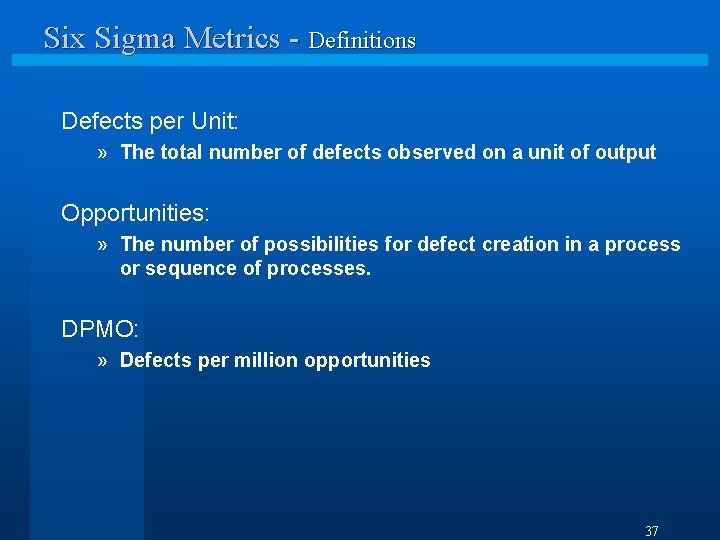
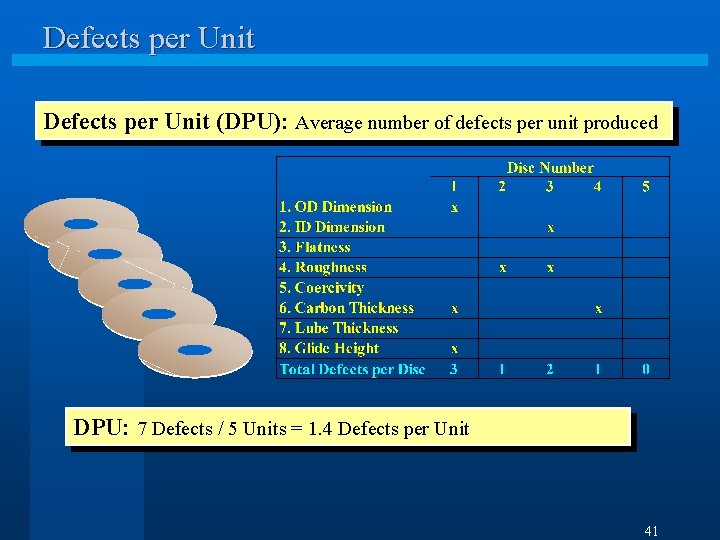
Six Sigma Metrics - Definitions Defects per Unit: » The total number of defects observed on a unit of output Opportunities: » The number of possibilities for defect creation in a process or sequence of processes. DPMO: » Defects per million opportunities 37
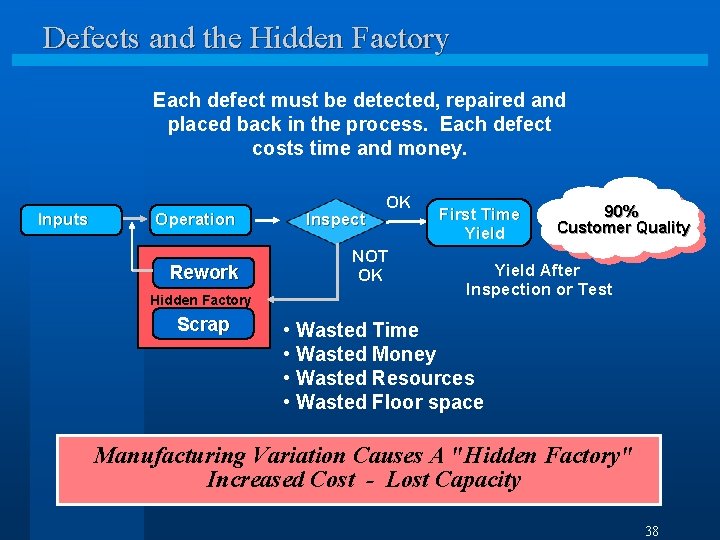
Defects and the Hidden Factory Each defect must be detected, repaired and placed back in the process. Each defect costs time and money. Inputs Operation Rework Hidden Factory Scrap Inspect OK NOT OK First Time Yield 90% Customer Quality Yield After Inspection or Test • Wasted Time • Wasted Money • Wasted Resources • Wasted Floor space Manufacturing Variation Causes A "Hidden Factory" Increased Cost - Lost Capacity 38
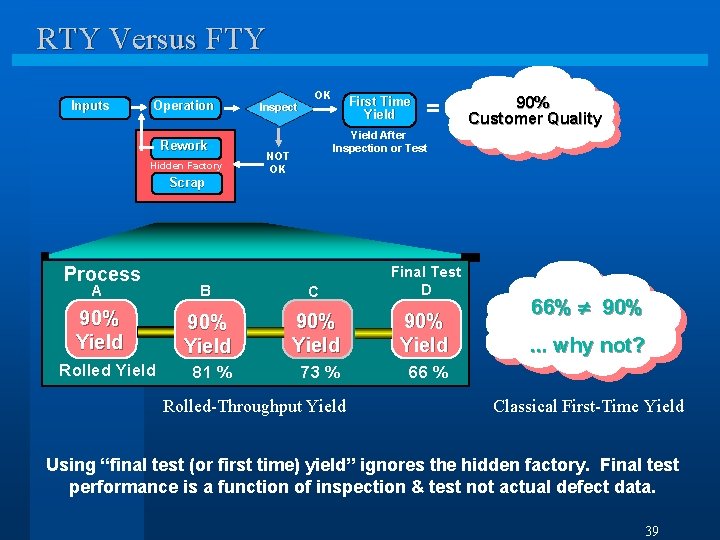
RTY Versus FTY Inputs Operation Rework Hidden Factory OK First Time Yield Inspect = 90% Customer Quality Yield After Inspection or Test NOT OK Scrap Process A 90% Yield Rolled Yield C Final Test D 90% Yield 81 % 73 % 66 % B Rolled-Throughput Yield 66% 90%. . . why not? Classical First-Time Yield Using “final test (or first time) yield” ignores the hidden factory. Final test performance is a function of inspection & test not actual defect data. 39
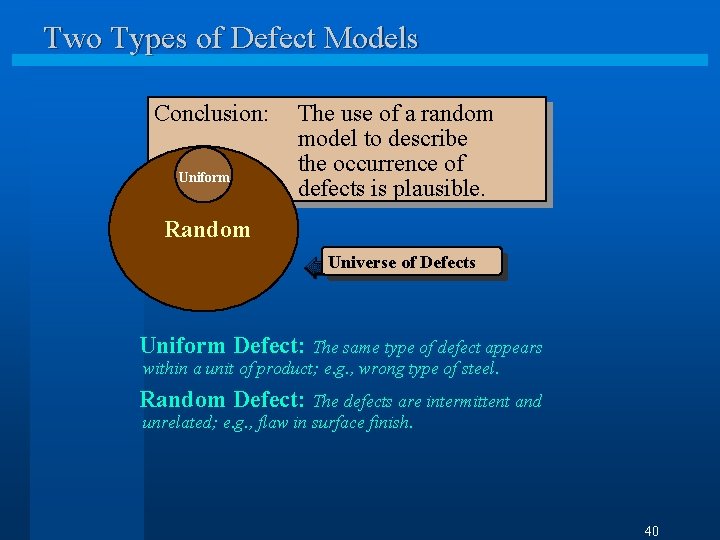
Two Types of Defect Models Conclusion: Theuse useof ofaarandom modelto todescribe the theoccurrenceof of Uniform defectsisisplausible. Random Universeofof. Defects Uniform Defect: The same type of defect appears within a unit of product; e. g. , wrong type of steel. Random Defect: The defects are intermittent and unrelated; e. g. , flaw in surface finish. 40
Defects per Unit (DPU): Average number of defects per unit produced DPU: 7 Defects / 5 Units = 1. 4 Defects per Unit 41
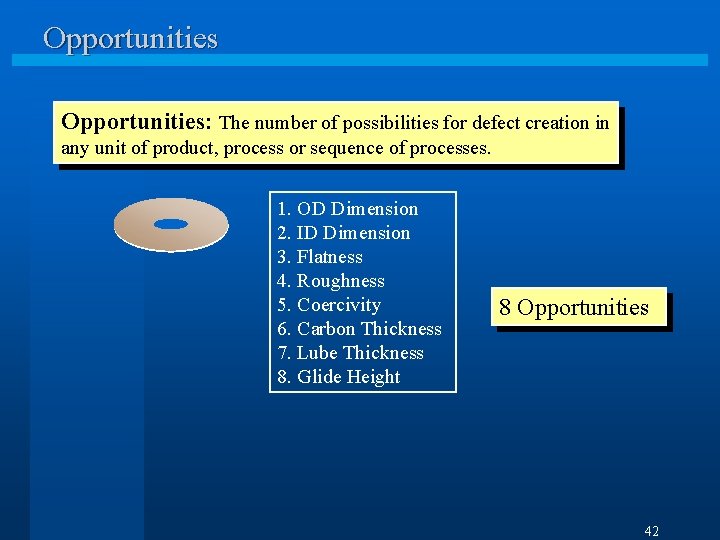
Opportunities: The number of possibilities for defect creation in any unit of product, process or sequence of processes. 1. OD Dimension 2. ID Dimension 3. Flatness 4. Roughness 5. Coercivity 6. Carbon Thickness 7. Lube Thickness 8. Glide Height 8 Opportunities 42
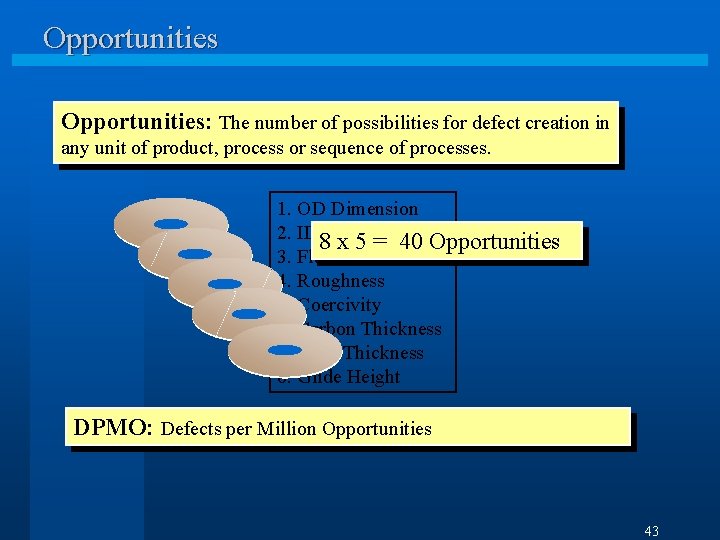
Opportunities: The number of possibilities for defect creation in any unit of product, process or sequence of processes. 1. OD Dimension 2. ID 8 Dimension x 5 = 40 Opportunities 3. Flatness 4. Roughness 5. Coercivity 6. Carbon Thickness 7. Lube Thickness 8. Glide Height DPMO: Defects per Million Opportunities 43
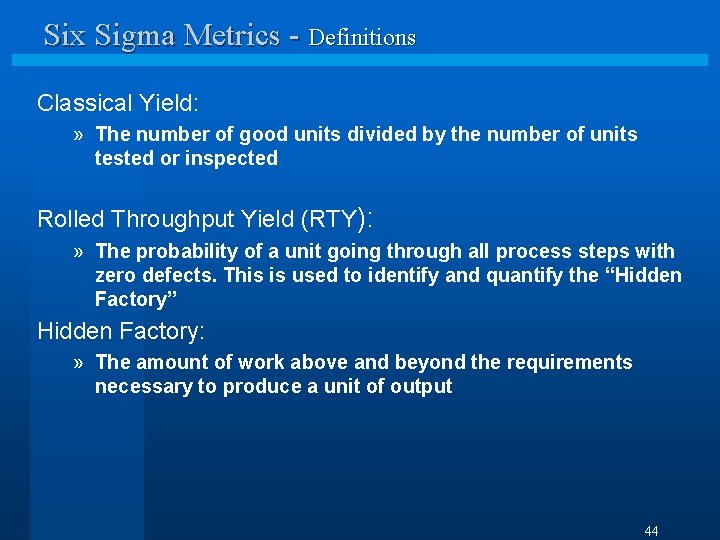
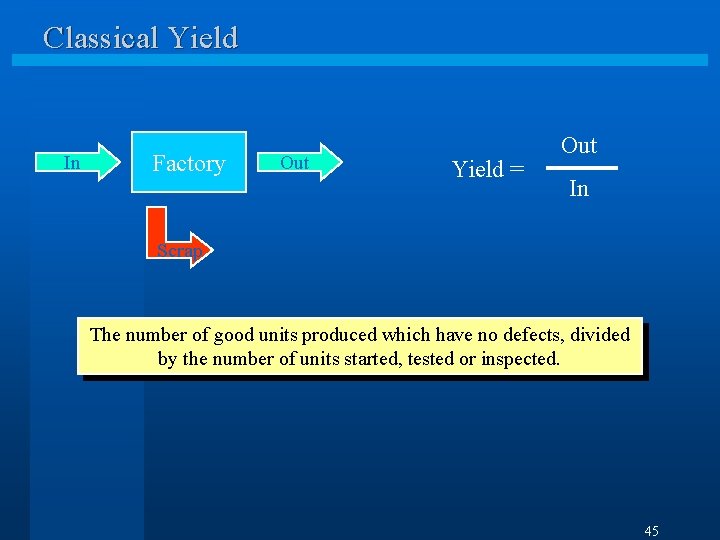
Six Sigma Metrics - Definitions Classical Yield: » The number of good units divided by the number of units tested or inspected Rolled Throughput Yield (RTY): » The probability of a unit going through all process steps with zero defects. This is used to identify and quantify the “Hidden Factory” Hidden Factory: » The amount of work above and beyond the requirements necessary to produce a unit of output 44
Classical Yield In Factory Out Yield = Out In Scrap The number of good units produced which have no defects, divided by the number of units started, tested or inspected. 45
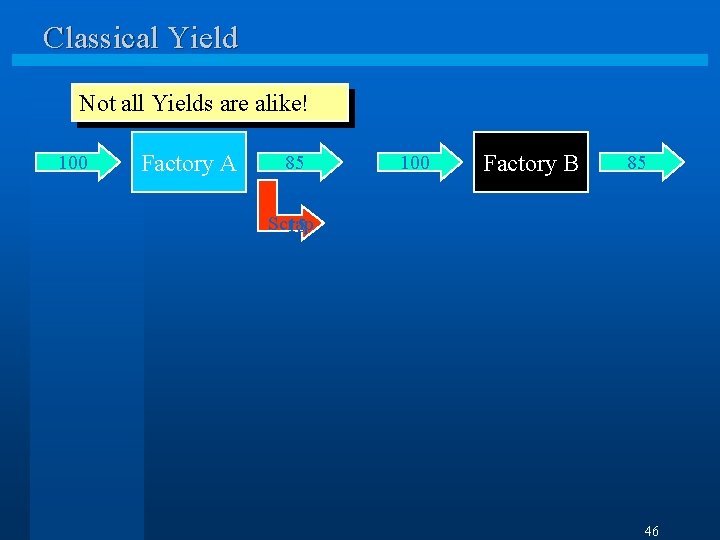
Classical Yield Not all Yields are alike! 100 Factory A 85 100 Factory B 85 Scrap 15 46
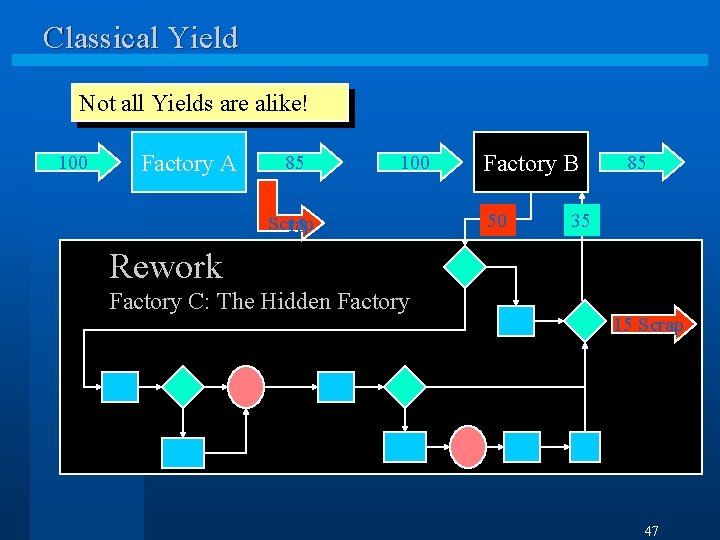
Classical Yield Not all Yields are alike! 100 Factory A 85 100 Scrap 15 Factory B 50 85 35 Rework Factory C: The Hidden Factory 15 Scrap 47
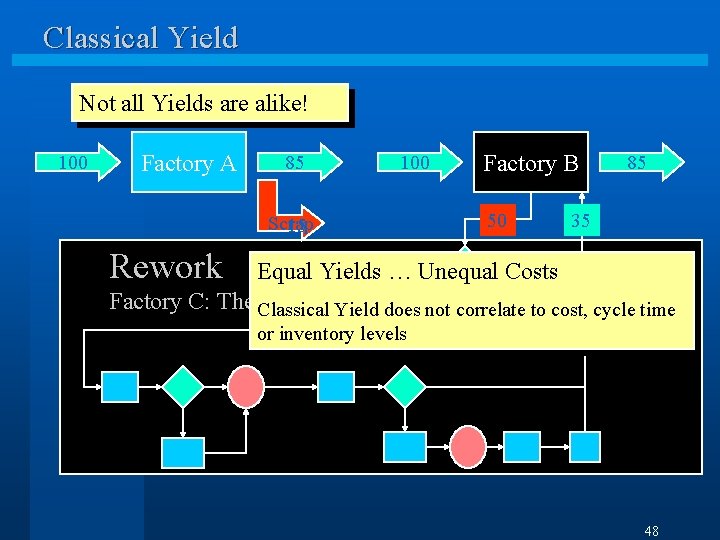
Classical Yield Not all Yields are alike! 100 Factory A 85 100 Scrap 15 Factory B 50 85 35 Rework Equal Yields … Unequal Costs Factory C: The Classical Hidden Yield Factory does not correlate to cost, cycle time or inventory levels 15 Scrap 48
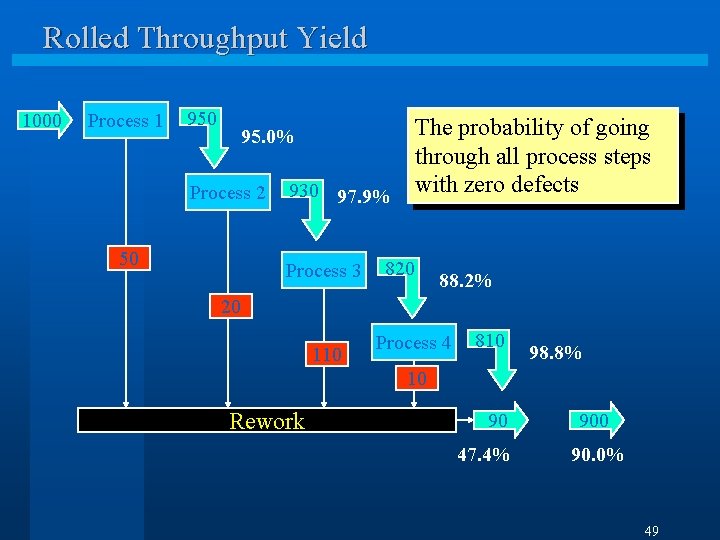
Rolled Throughput Yield 1000 Process 1 950 The probability of going through all process steps Process 2 930 97. 9% with zero defects 95. 0% 50 Process 3 820 88. 2% 20 110 Process 4 810 98. 8% 10 Rework 90 47. 4% 900 90. 0% 49
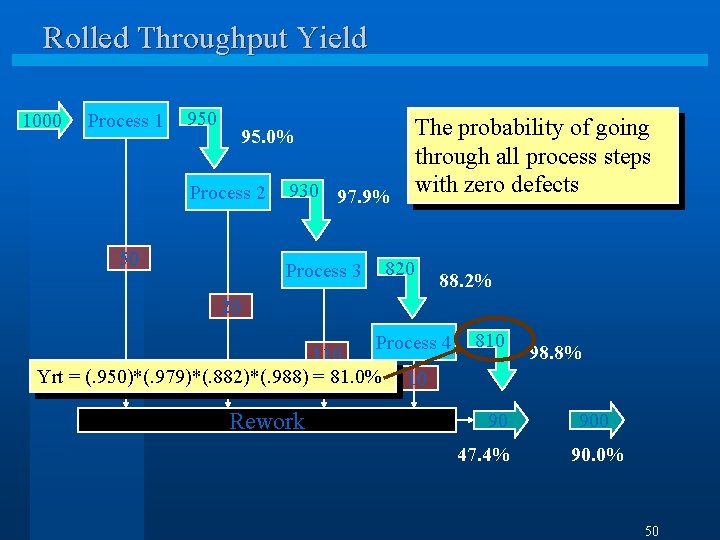
Rolled Throughput Yield 1000 Process 1 950 The probability of going through all process steps Process 2 930 97. 9% with zero defects 95. 0% 50 820 Process 3 88. 2% 20 Process 4 110 Yrt = (. 950)*(. 979)*(. 882)*(. 988) = 81. 0% Rework 810 98. 8% 10 90 47. 4% 900 90. 0% 50
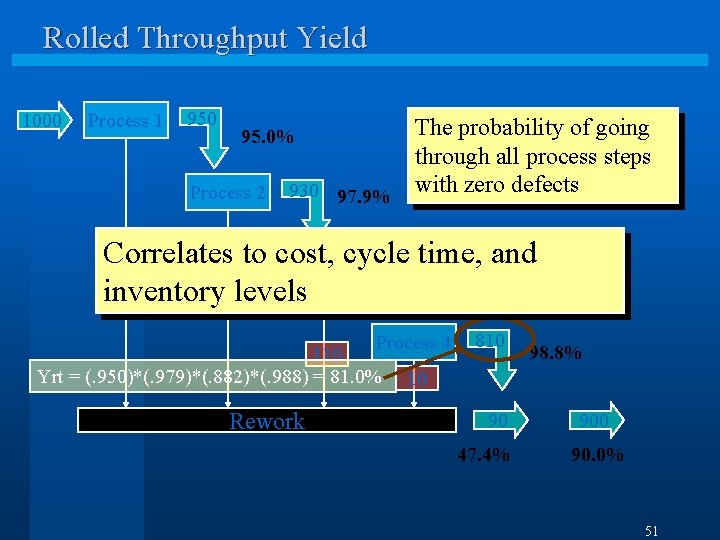
Rolled Throughput Yield 1000 Process 1 950 The probability of going through all process steps Process 2 930 97. 9% with zero defects 95. 0% Correlates to cost, cycle time, and 50 820 Process 3 88. 2% inventory 20 levels Process 4 110 Yrt = (. 950)*(. 979)*(. 882)*(. 988) = 81. 0% Rework 810 98. 8% 10 90 47. 4% 900 90. 0% 51
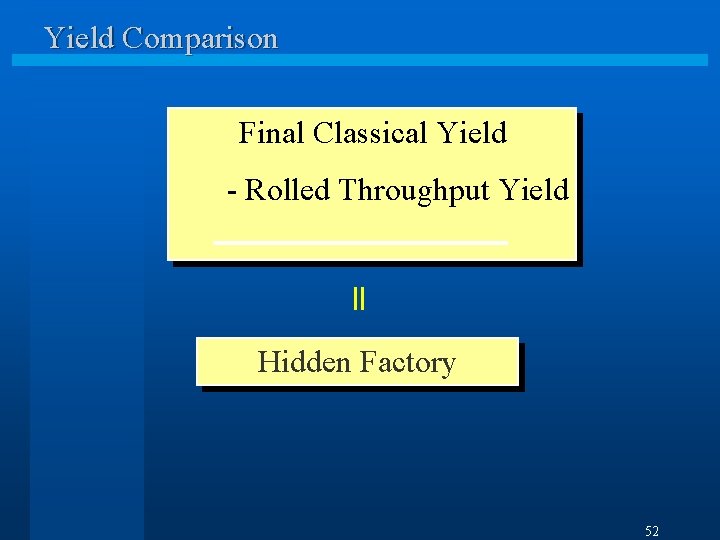
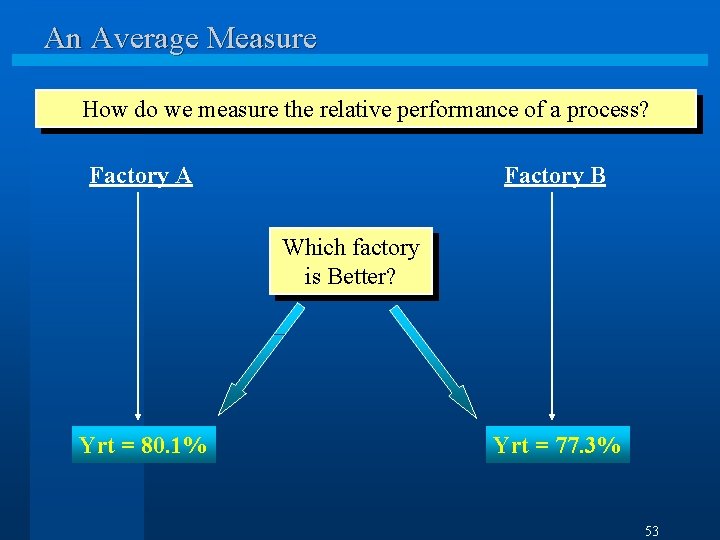
Yield Comparison Final Classical Yield - Rolled Throughput Yield = Hidden Factory 52
An Average Measure How do we measure the relative performance of a process? Factory A Factory B Which factory is Better? Yrt = 80. 1% Yrt = 77. 3% 53
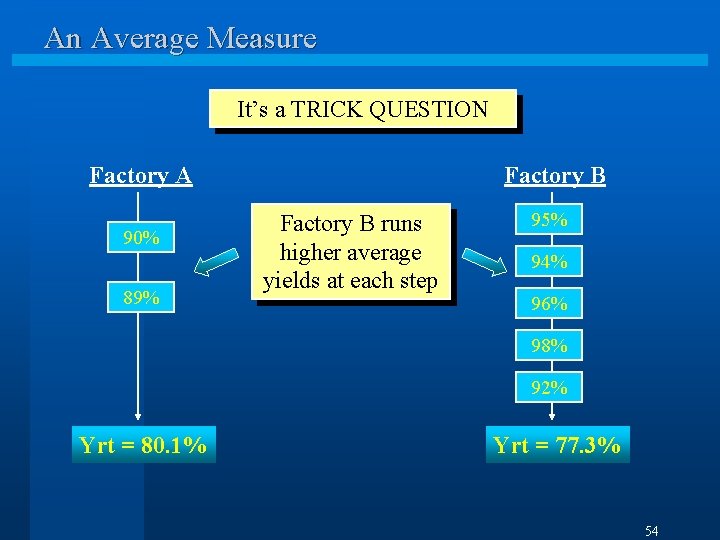
An Average Measure It’s a TRICK QUESTION Factory A 90% 89% Factory B runs higher average yields at each step 95% 94% 96% 98% 92% Yrt = 80. 1% Yrt = 77. 3% 54
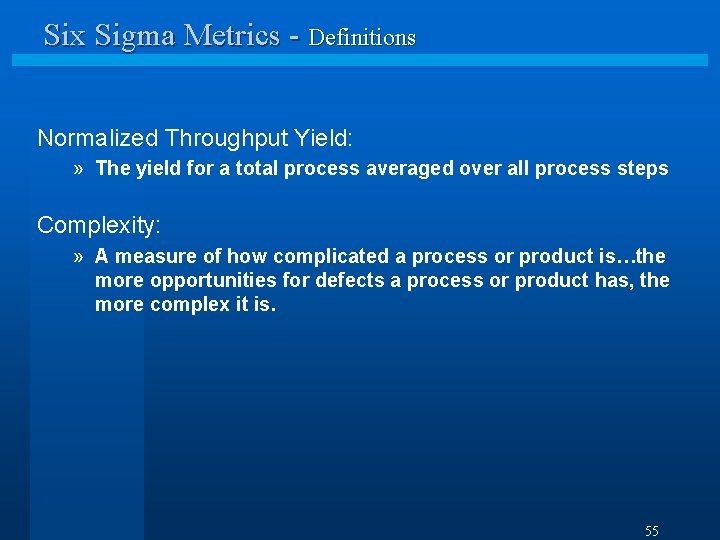
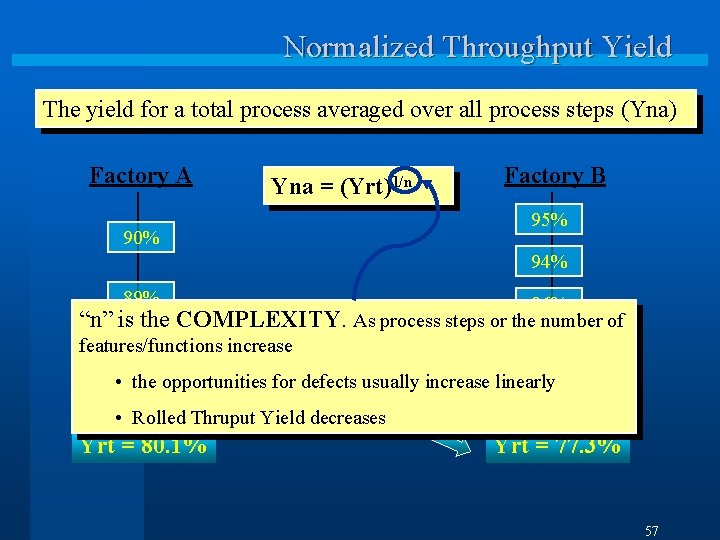
Six Sigma Metrics - Definitions Normalized Throughput Yield: » The yield for a total process averaged over all process steps Complexity: » A measure of how complicated a process or product is…the more opportunities for defects a process or product has, the more complex it is. 55
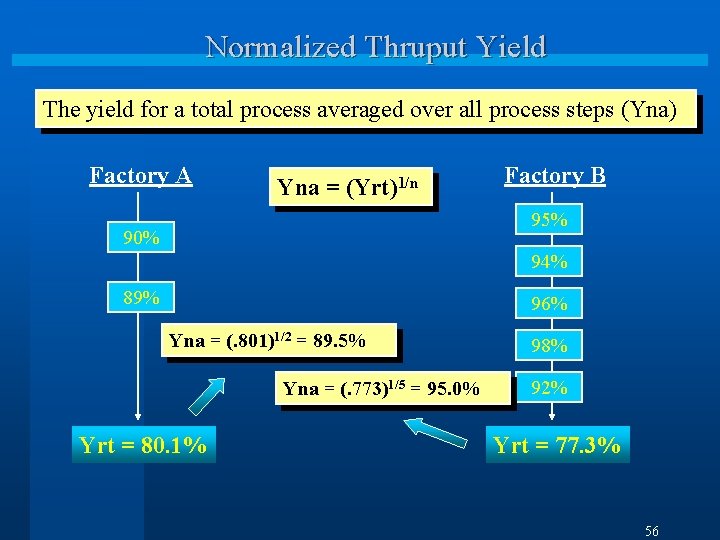
Normalized Thruput Yield The yield for a total process averaged over all process steps (Yna) Factory A Yna = (Yrt)1/n Factory B 95% 90% 94% 89% 96% Yna = (. 801)1/2 = 89. 5% Yna = (. 773)1/5 = 95. 0% Yrt = 80. 1% 98% 92% Yrt = 77. 3% 56
Normalized Throughput Yield The yield for a total process averaged over all process steps (Yna) Factory A 90% Yna = (Yrt)1/n Factory B 95% 94% 89% 96% “n” is the COMPLEXITY. As process steps or the number of 1/2 Yna = (. 801) features/functions increase = 89. 5% 98% • the opportunities for defects usually increase linearly 92% Yna = (. 773)1/5 = 95. 0% • Rolled Thruput Yield decreases Yrt = 80. 1% Yrt = 77. 3% 57
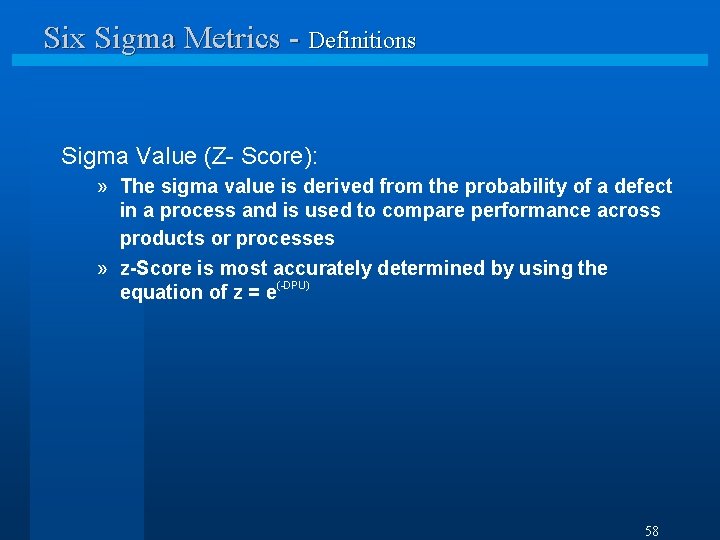
Six Sigma Metrics - Definitions Sigma Value (Z- Score): » The sigma value is derived from the probability of a defect in a process and is used to compare performance across products or processes » z-Score is most accurately determined by using the equation of z = e(-DPU) 58
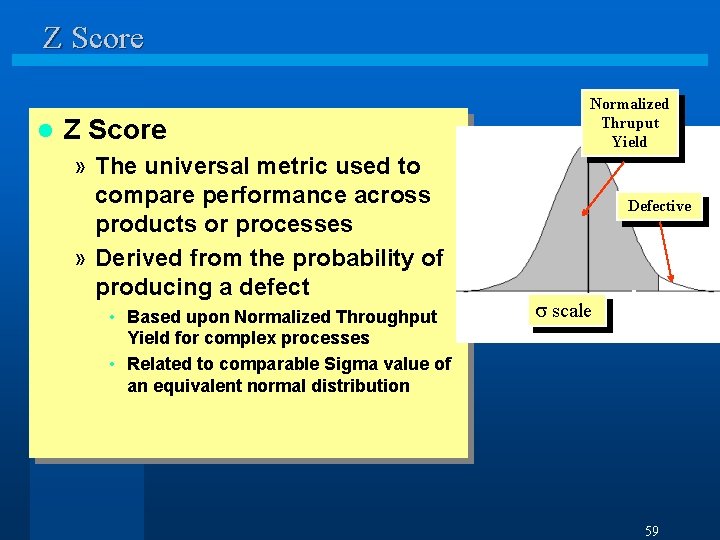
Z Score l Z Score » The universal metric used to compare performance across products or processes » Derived from the probability of producing a defect • Based upon Normalized Throughput Yield for complex processes • Related to comparable Sigma value of an equivalent normal distribution Normalized Thruput Yield Defective scale 3 Z 59
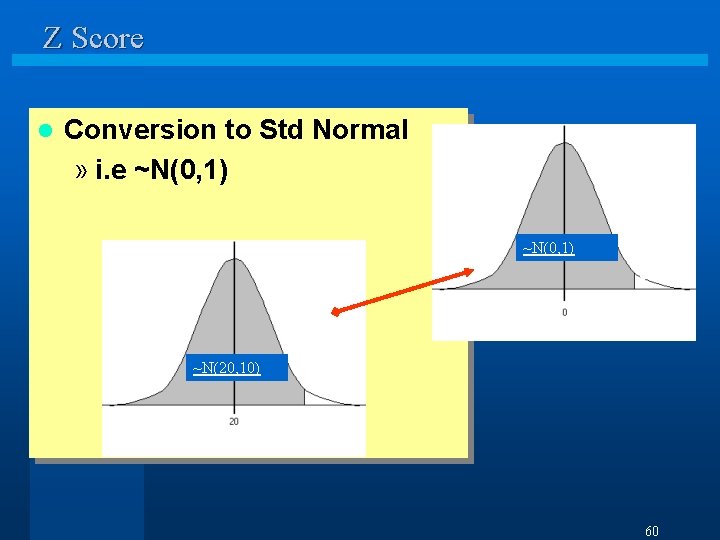
Z Score l Conversion to Std Normal » i. e ~N(0, 1) 3 Z ~N(20, 10) 60
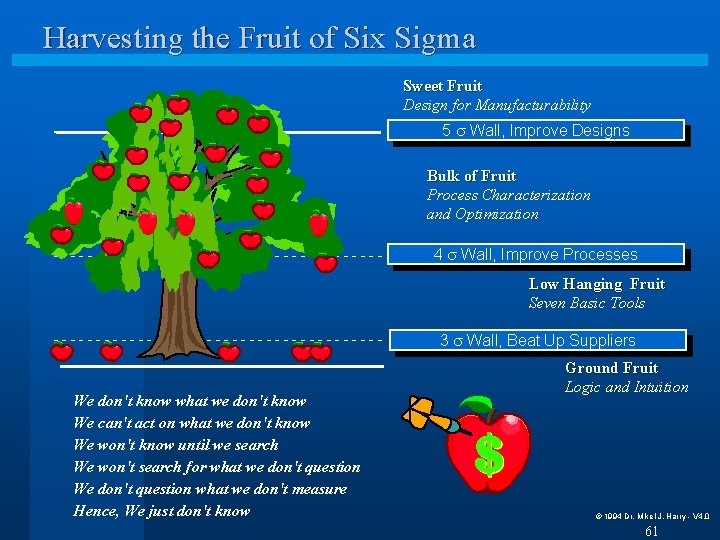
Harvesting the Fruit of Six Sigma Sweet Fruit Design for Manufacturability 5 Wall, Improve Designs Bulk of Fruit Process Characterization and Optimization -------------------- 4 Wall, Improve Processes Low Hanging Fruit Seven Basic Tools -------------------- We don't know what we don't know We can't act on what we don't know We won't know until we search We won't search for what we don't question We don't question what we don't measure Hence, We just don't know 3 Wall, Beat Up Suppliers Ground Fruit Logic and Intuition © 1994 Dr. Mikel J. Harry - V 4. 0 61
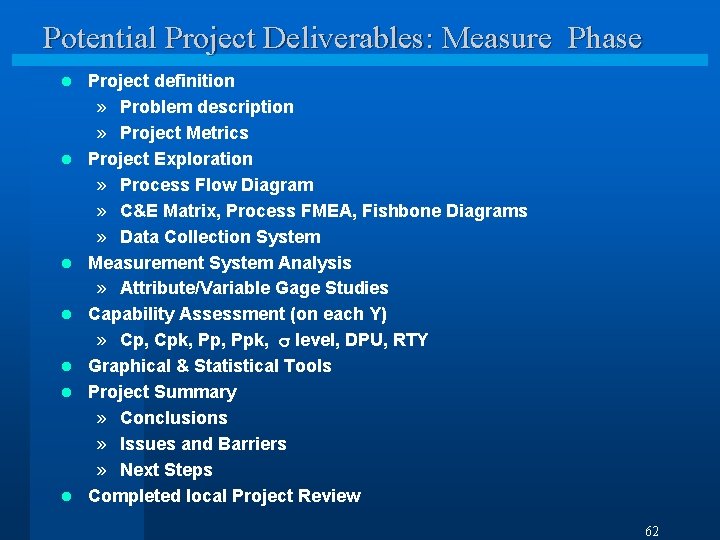
Potential Project Deliverables: Measure Phase l l l l Project definition » Problem description » Project Metrics Project Exploration » Process Flow Diagram » C&E Matrix, Process FMEA, Fishbone Diagrams » Data Collection System Measurement System Analysis » Attribute/Variable Gage Studies Capability Assessment (on each Y) » Cp, Cpk, Ppk, level, DPU, RTY Graphical & Statistical Tools Project Summary » Conclusions » Issues and Barriers » Next Steps Completed local Project Review 62
64