
The fluid dynamic paradigm of relativistic heavy ion

- Slides: 24
Πάντα ῥεῖ ? The fluid dynamic paradigm of relativistic heavy ion collisions Urs Achim Wiedemann CERN PH-TH International Conference on New Frontiers in Physics 29 August 2013, Kolymbari, Crete, Greece
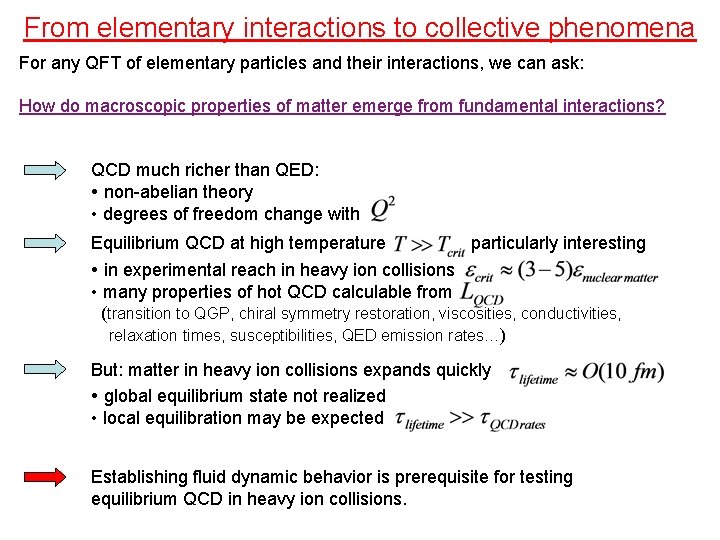
From elementary interactions to collective phenomena For any QFT of elementary particles and their interactions, we can ask: How do macroscopic properties of matter emerge from fundamental interactions? QCD much richer than QED: • non-abelian theory • degrees of freedom change with Equilibrium QCD at high temperature particularly interesting • in experimental reach in heavy ion collisions • many properties of hot QCD calculable from (transition to QGP, chiral symmetry restoration, viscosities, conductivities, relaxation times, susceptibilities, QED emission rates…) But: matter in heavy ion collisions expands quickly • global equilibrium state not realized • local equilibration may be expected Establishing fluid dynamic behavior is prerequisite for testing equilibrium QCD in heavy ion collisions.
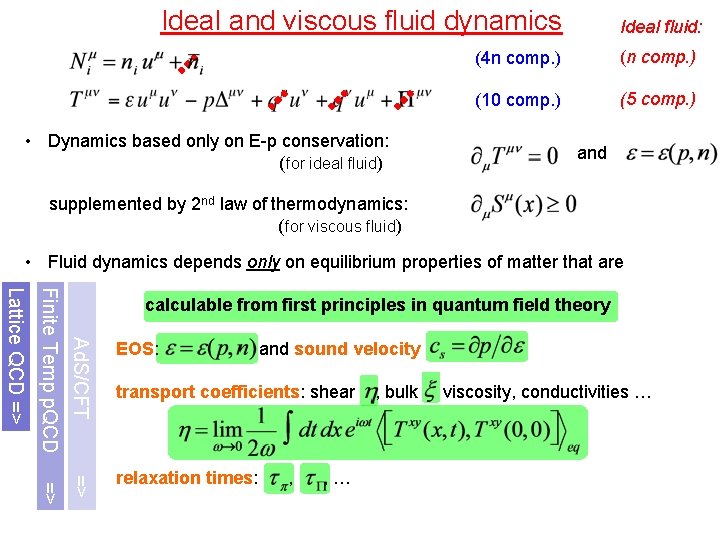
Ideal and viscous fluid dynamics Ideal fluid: (4 n comp. ) (10 comp. ) (5 comp. ) • Dynamics based only on E-p conservation: ( for ideal fluid) and supplemented by 2 nd law of thermodynamics: ( for viscous fluid) • Fluid dynamics depends only on equilibrium properties of matter that are Ad. S/CFT Finite Temp p. QCD Lattice QCD => calculable from first principles in quantum field theory EOS: - transport coefficients: shear - relaxation times: => => - and sound velocity , , … , bulk viscosity, conductivities …
1. Experimental signatures of fluid dynamics behavior in heavy ion collisions
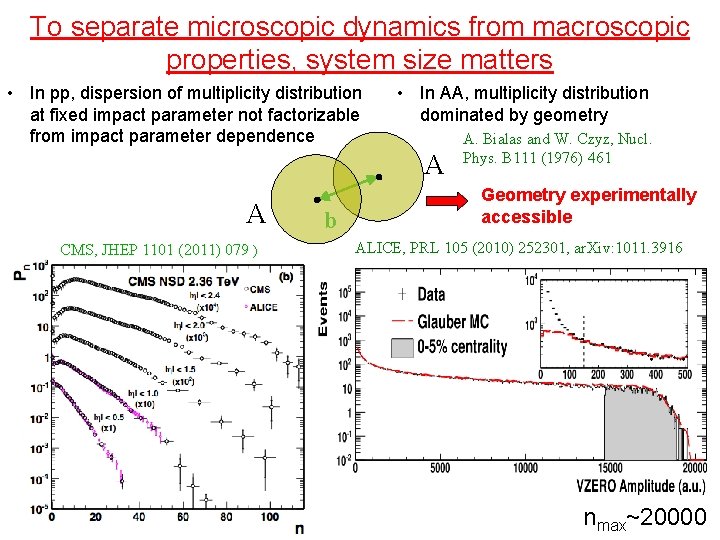
To separate microscopic dynamics from macroscopic properties, system size matters • In pp, dispersion of multiplicity distribution at fixed impact parameter not factorizable from impact parameter dependence • In AA, multiplicity distribution dominated by geometry A A CMS, JHEP 1101 (2011) 079 ) b A. Bialas and W. Czyz, Nucl. Phys. B 111 (1976) 461 Geometry experimentally accessible ALICE, PRL 105 (2010) 252301, ar. Xiv: 1011. 3916 nmax~20000
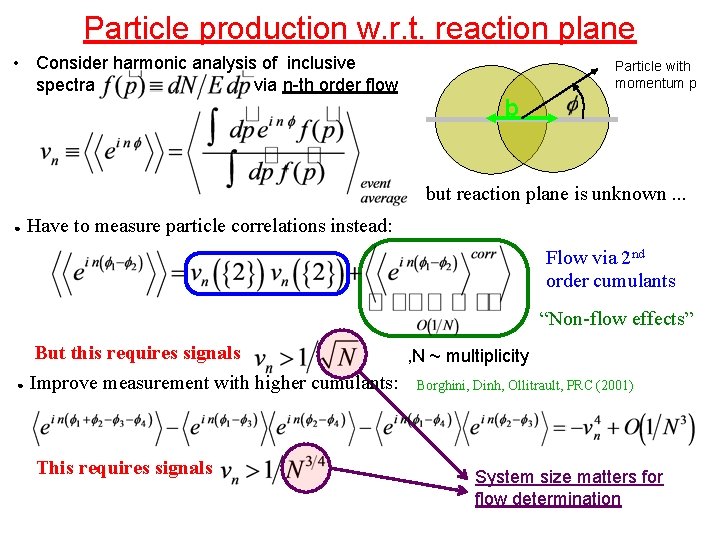
Particle production w. r. t. reaction plane • Consider harmonic analysis of inclusive spectra via n-th order flow Particle with momentum p b but reaction plane is unknown. . . ● Have to measure particle correlations instead: Flow via 2 nd order cumulants “Non-flow effects” But this requires signals ● Improve measurement with higher cumulants: This requires signals , N ~ multiplicity Borghini, Dinh, Ollitrault, PRC (2001) System size matters for flow determination
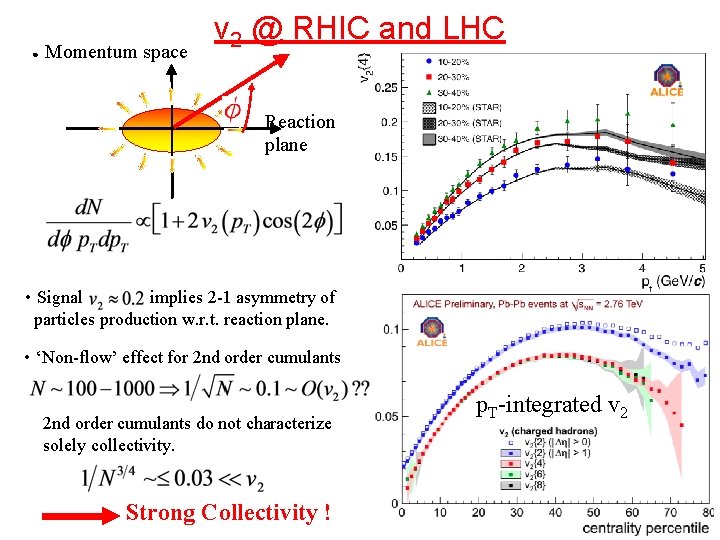
● Momentum space v 2 @ RHIC and LHC Reaction plane • Signal implies 2 -1 asymmetry of particles production w. r. t. reaction plane. • ‘Non-flow’ effect for 2 nd order cumulants do not characterize solely collectivity. Strong Collectivity ! p. T-integrated v 2
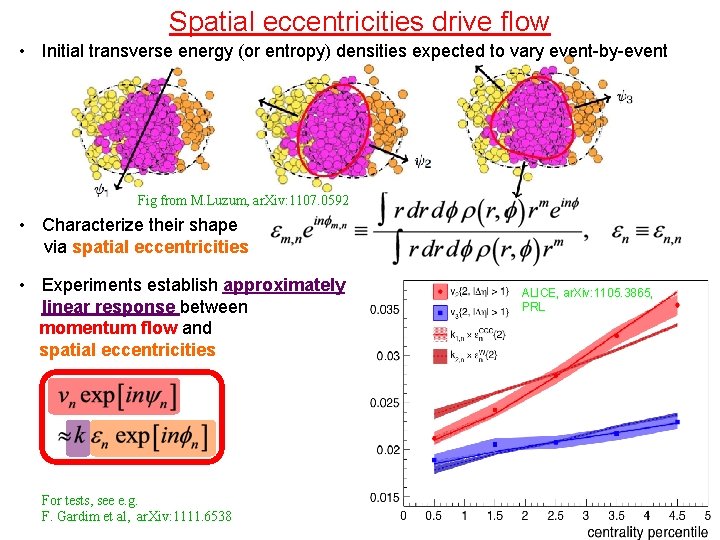
Spatial eccentricities drive flow • Initial transverse energy (or entropy) densities expected to vary event-by-event Fig from M. Luzum, ar. Xiv: 1107. 0592 • Characterize their shape via spatial eccentricities • Experiments establish approximately linear response between momentum flow and spatial eccentricities For tests, see e. g. F. Gardim et al, ar. Xiv: 1111. 6538 ALICE, ar. Xiv: 1105. 3865, PRL
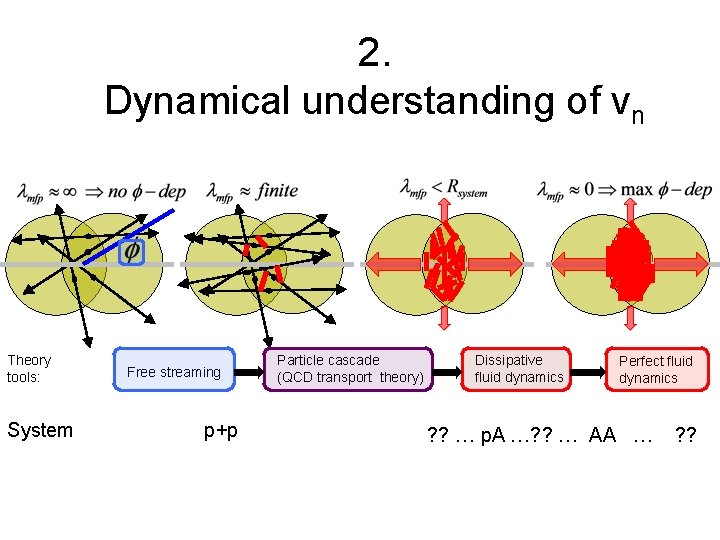
2. Dynamical understanding of vn Theory tools: System Free streaming p+p Particle cascade (QCD transport theory) Dissipative fluid dynamics Perfect fluid dynamics ? ? … p. A …? ? … AA … ? ?
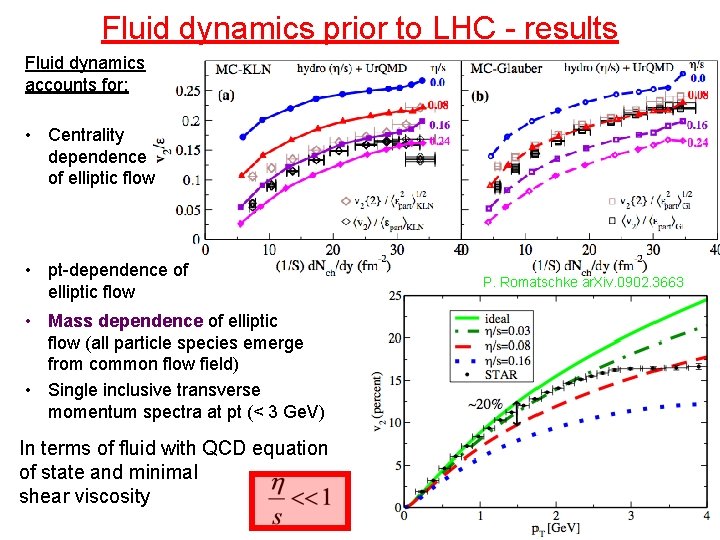
Fluid dynamics prior to LHC - results Fluid dynamics accounts for: • Centrality dependence of elliptic flow • pt-dependence of elliptic flow • Mass dependence of elliptic flow (all particle species emerge from common flow field) • Single inclusive transverse momentum spectra at pt (< 3 Ge. V) In terms of fluid with QCD equation of state and minimal shear viscosity P. Romatschke ar. Xiv. 0902. 3663
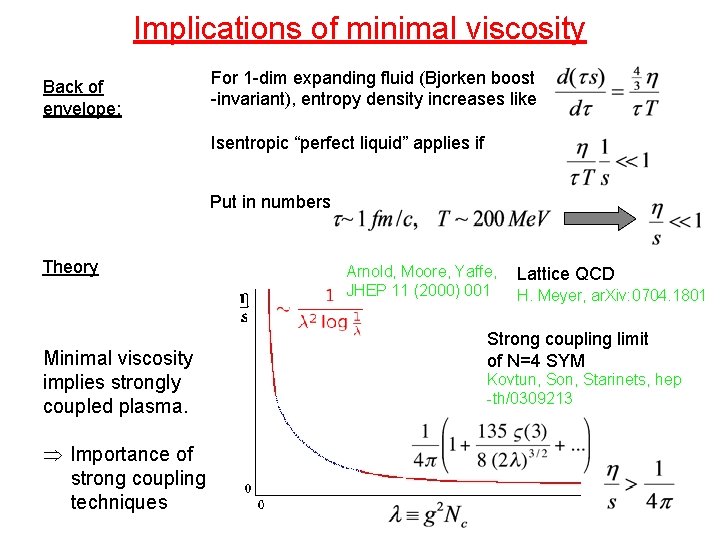
Implications of minimal viscosity Back of envelope: For 1 -dim expanding fluid (Bjorken boost -invariant), entropy density increases like Isentropic “perfect liquid” applies if Put in numbers Theory Minimal viscosity implies strongly coupled plasma. Importance of strong coupling techniques Arnold, Moore, Yaffe, JHEP 11 (2000) 001 Lattice QCD H. Meyer, ar. Xiv: 0704. 1801 Strong coupling limit of N=4 SYM Kovtun, Son, Starinets, hep -th/0309213
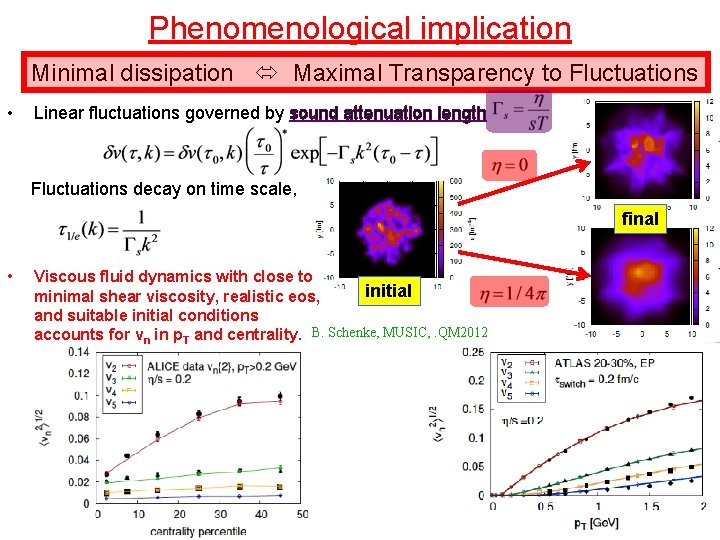
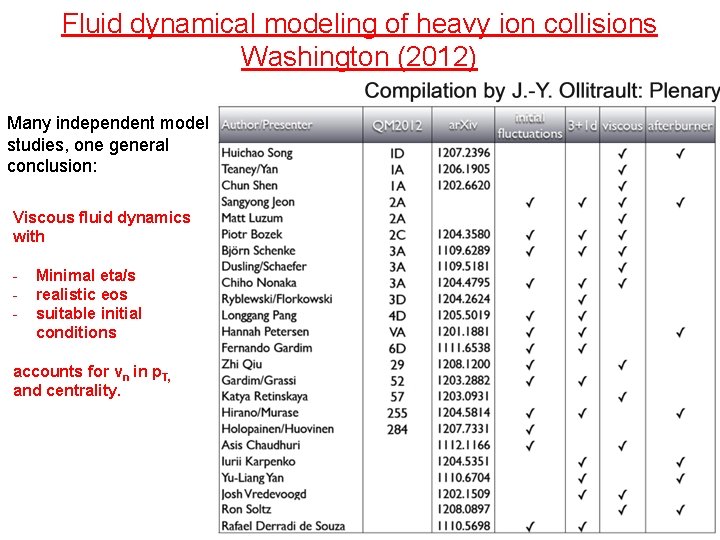
Phenomenological implication Minimal dissipation Maximal Transparency to Fluctuations • Linear fluctuations governed by sound attenuation length Fluctuations decay on time scale, final • Viscous fluid dynamics with close to initial minimal shear viscosity, realistic eos, and suitable initial conditions accounts for vn in p. T and centrality. B. Schenke, MUSIC, . QM 2012
Fluid dynamical modeling of heavy ion collisions Washington (2012) Many independent model studies, one general conclusion: Viscous fluid dynamics with - Minimal eta/s realistic eos suitable initial conditions accounts for vn in p. T, and centrality.
3. ‘Flow’ New Frontiers/new challenges
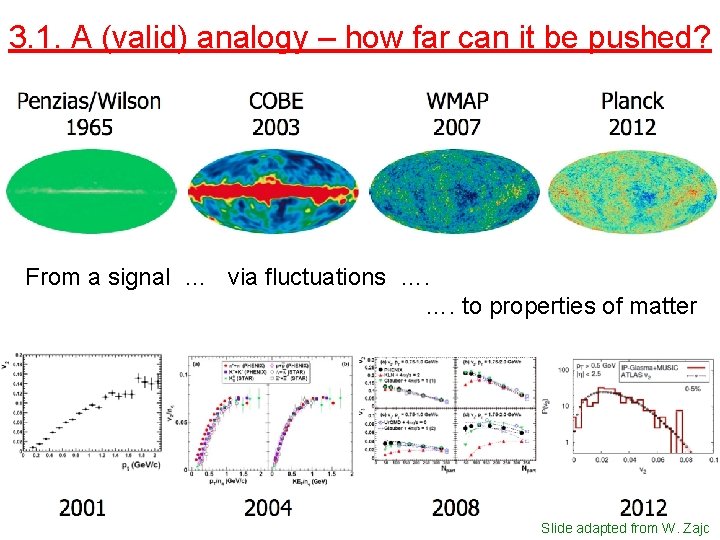
3. 1. A (valid) analogy – how far can it be pushed? From a signal … via fluctuations …. …. to properties of matter Slide adapted from W. Zajc
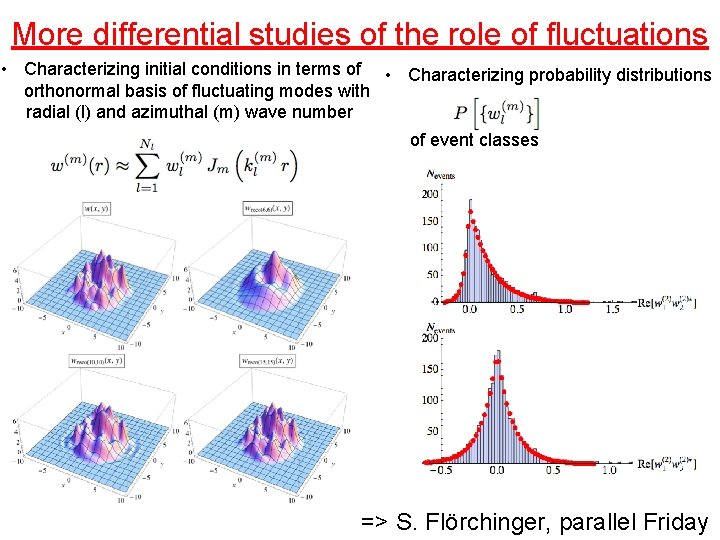
More differential studies of the role of fluctuations • Characterizing initial conditions in terms of • Characterizing probability distributions orthonormal basis of fluctuating modes with radial (l) and azimuthal (m) wave number of event classes => S. Flörchinger, parallel Friday
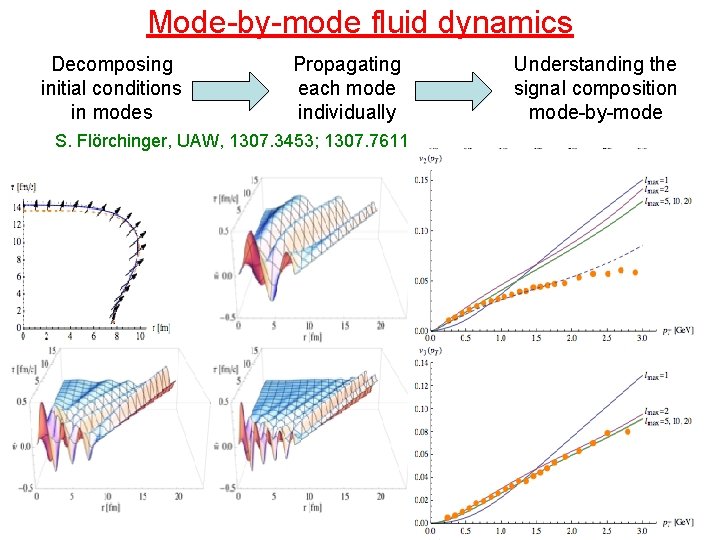
Mode-by-mode fluid dynamics Decomposing initial conditions in modes Propagating each mode individually S. Flörchinger, UAW, 1307. 3453; 1307. 7611 Understanding the signal composition mode-by-mode
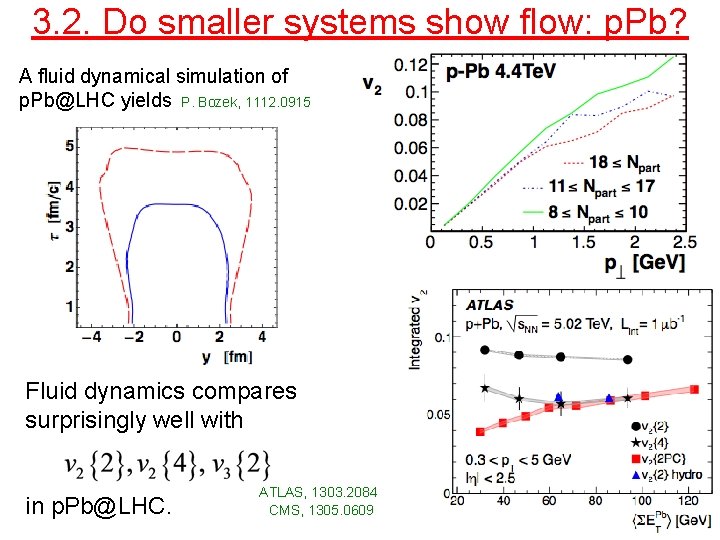
3. 2. Do smaller systems show flow: p. Pb? A fluid dynamical simulation of p. Pb@LHC yields P. Bozek, 1112. 0915 Fluid dynamics compares surprisingly well with in p. Pb@LHC. ATLAS, 1303. 2084 CMS, 1305. 0609
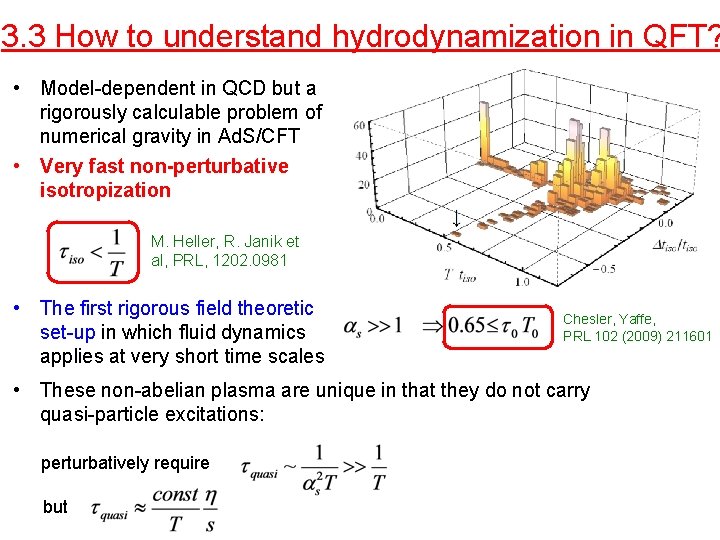
3. 3 How to understand hydrodynamization in QFT? • Model-dependent in QCD but a rigorously calculable problem of numerical gravity in Ad. S/CFT • Very fast non-perturbative isotropization M. Heller, R. Janik et al, PRL, 1202. 0981 • The first rigorous field theoretic set-up in which fluid dynamics applies at very short time scales Chesler, Yaffe, PRL 102 (2009) 211601 • These non-abelian plasma are unique in that they do not carry quasi-particle excitations: perturbatively require but
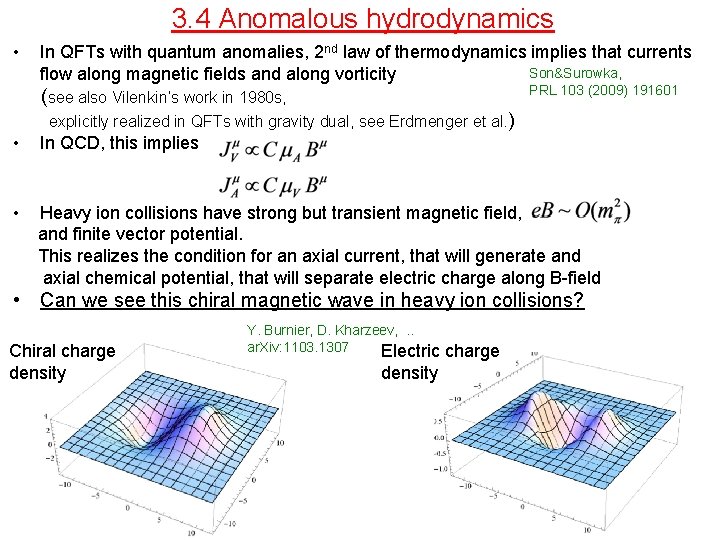
3. 4 Anomalous hydrodynamics • In QFTs with quantum anomalies, 2 nd law of thermodynamics implies that currents Son&Surowka, flow along magnetic fields and along vorticity PRL 103 (2009) 191601 (see also Vilenkin’s work in 1980 s, explicitly realized in QFTs with gravity dual, see Erdmenger et al. ) • In QCD, this implies • Heavy ion collisions have strong but transient magnetic field, and finite vector potential. This realizes the condition for an axial current, that will generate and axial chemical potential, that will separate electric charge along B-field • Can we see this chiral magnetic wave in heavy ion collisions? Chiral charge density Y. Burnier, D. Kharzeev, . . ar. Xiv: 1103. 1307 Electric density charge
Back-ups
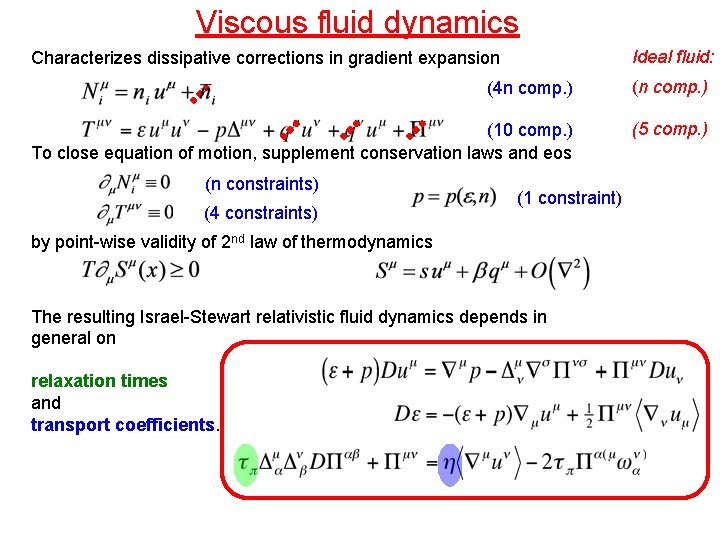
Viscous fluid dynamics Ideal fluid: Characterizes dissipative corrections in gradient expansion (4 n comp. ) (10 comp. ) To close equation of motion, supplement conservation laws and eos (5 comp. ) (n constraints) (4 constraints) (1 constraint) by point-wise validity of 2 nd law of thermodynamics The resulting Israel-Stewart relativistic fluid dynamics depends in general on relaxation times and transport coefficients.
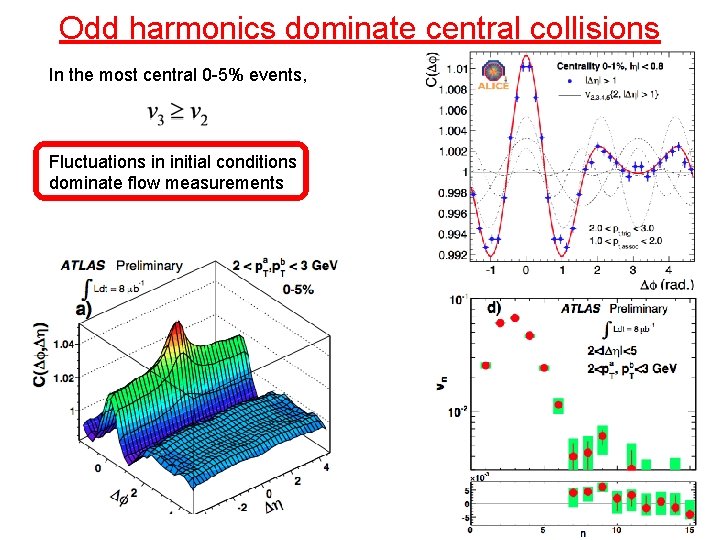
Odd harmonics dominate central collisions In the most central 0 -5% events, Fluctuations in initial conditions dominate flow measurements