
THE FLOW OF GENETIC INFORMATION FROM DNA TO
- Slides: 31
THE FLOW OF GENETIC INFORMATION FROM DNA TO RNA TO PROTEIN The DNA genotype is expressed as proteins, which provide the molecular basis for phenotypic traits • The information constituting an organism’s genotype is carried in its sequence of bases Copyright © 2003 Pearson Education, Inc. publishing as Benjamin Cummings
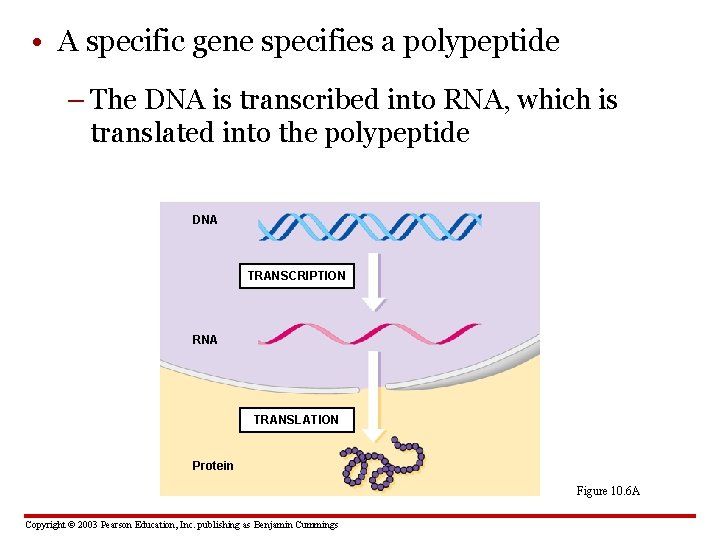
• A specific gene specifies a polypeptide – The DNA is transcribed into RNA, which is translated into the polypeptide DNA TRANSCRIPTION RNA TRANSLATION Protein Figure 10. 6 A Copyright © 2003 Pearson Education, Inc. publishing as Benjamin Cummings
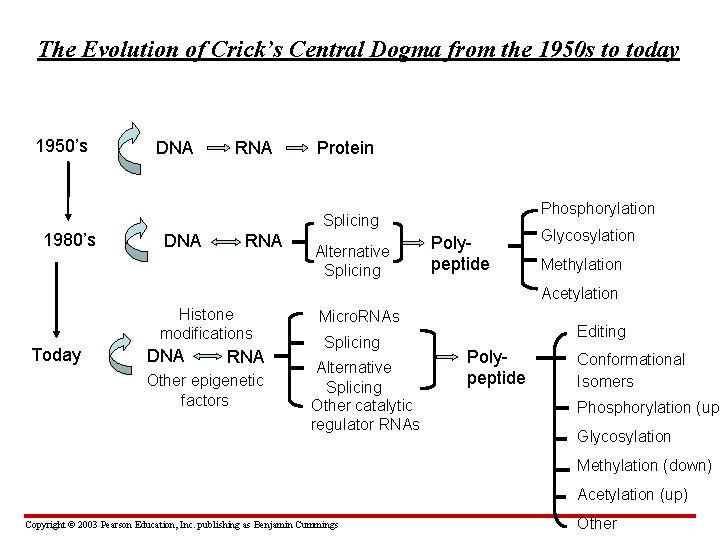
The Evolution of Crick’s Central Dogma from the 1950 s to today 1950’s DNA RNA Protein Phosphorylation Splicing 1980’s DNA RNA Alternative Splicing Polypeptide Glycosylation Methylation Acetylation Histone modifications Today DNA RNA Other epigenetic factors Micro. RNAs Splicing Alternative Splicing Other catalytic regulator RNAs Editing Polypeptide Conformational Isomers Phosphorylation (up) Glycosylation Methylation (down) Acetylation (up) Copyright © 2003 Pearson Education, Inc. publishing as Benjamin Cummings Other
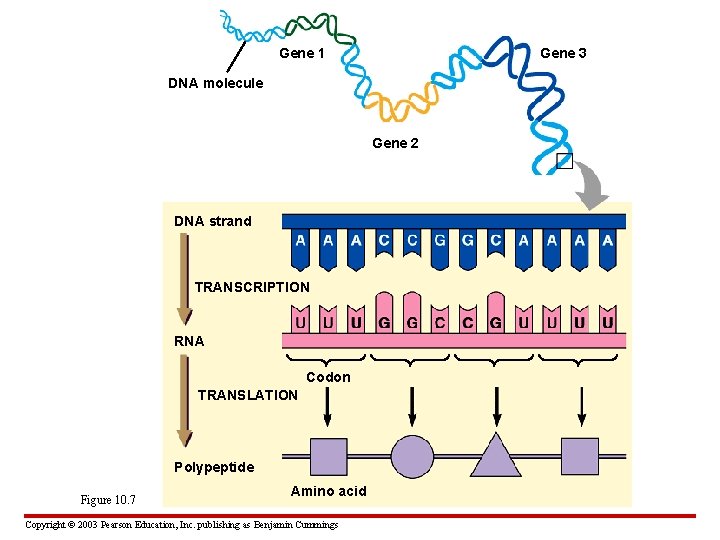
Genetic information written in codons is translated into amino acid sequences • The “words” of the DNA “language” are triplets of bases called codons – The codons in a gene specify the amino acid sequence of a polypeptide Copyright © 2003 Pearson Education, Inc. publishing as Benjamin Cummings
Gene 1 Gene 3 DNA molecule Gene 2 DNA strand TRANSCRIPTION RNA Codon TRANSLATION Polypeptide Figure 10. 7 Amino acid Copyright © 2003 Pearson Education, Inc. publishing as Benjamin Cummings
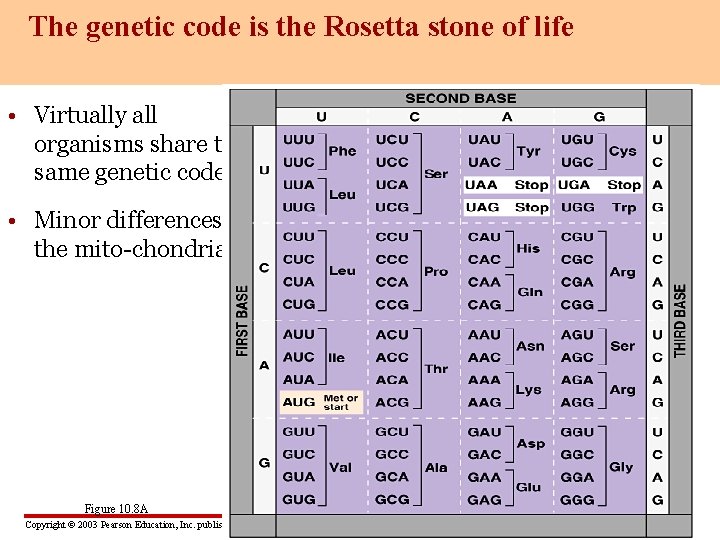
The genetic code is the Rosetta stone of life • Virtually all organisms share the same genetic code • Minor differences in the mito-chondria Figure 10. 8 A Copyright © 2003 Pearson Education, Inc. publishing as Benjamin Cummings
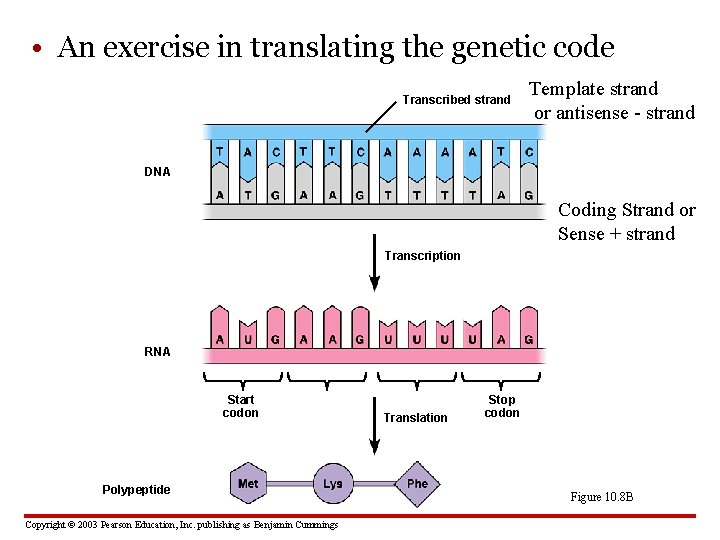
• An exercise in translating the genetic code Transcribed strand Template strand or antisense - strand DNA Coding Strand or Sense + strand Transcription RNA Start codon Polypeptide Copyright © 2003 Pearson Education, Inc. publishing as Benjamin Cummings Translation Stop codon Figure 10. 8 B
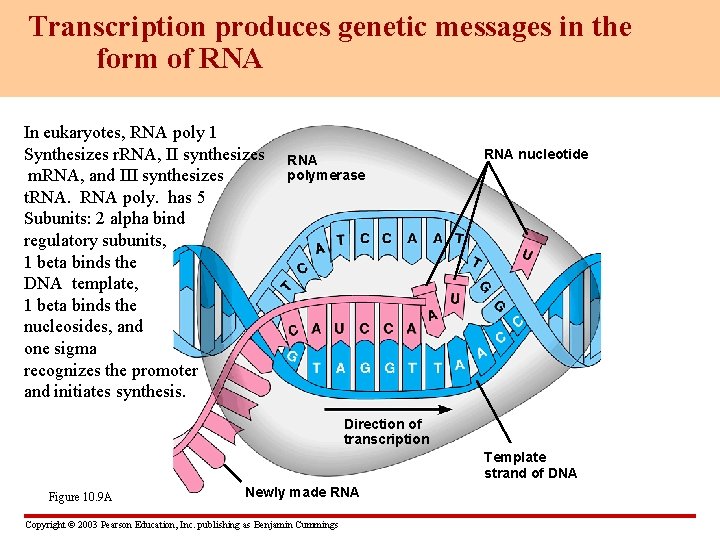
Transcription produces genetic messages in the form of RNA In eukaryotes, RNA poly 1 Synthesizes r. RNA, II synthesizes m. RNA, and III synthesizes t. RNA poly. has 5 Subunits: 2 alpha bind regulatory subunits, 1 beta binds the DNA template, 1 beta binds the nucleosides, and one sigma recognizes the promoter and initiates synthesis. RNA polymerase RNA nucleotide Direction of transcription Template strand of DNA Figure 10. 9 A Newly made RNA Copyright © 2003 Pearson Education, Inc. publishing as Benjamin Cummings
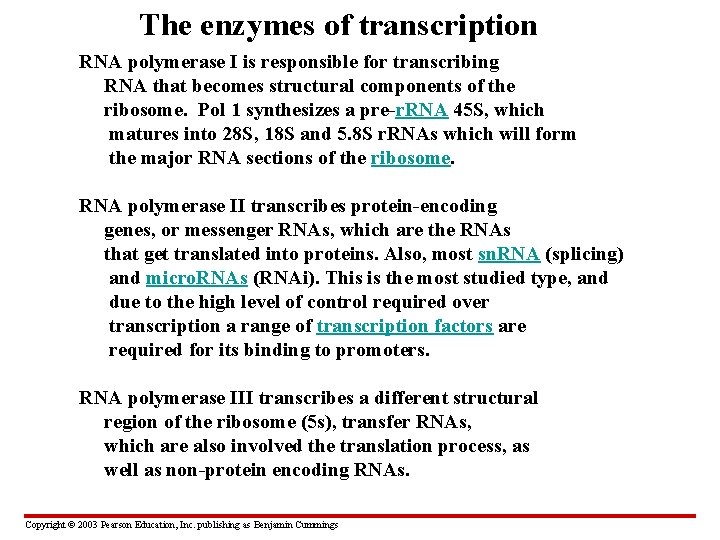
The enzymes of transcription RNA polymerase I is responsible for transcribing RNA that becomes structural components of the ribosome. Pol 1 synthesizes a pre-r. RNA 45 S, which matures into 28 S, 18 S and 5. 8 S r. RNAs which will form the major RNA sections of the ribosome. RNA polymerase II transcribes protein-encoding genes, or messenger RNAs, which are the RNAs that get translated into proteins. Also, most sn. RNA (splicing) and micro. RNAs (RNAi). This is the most studied type, and due to the high level of control required over transcription a range of transcription factors are required for its binding to promoters. RNA polymerase III transcribes a different structural region of the ribosome (5 s), transfer RNAs, which are also involved the translation process, as well as non-protein encoding RNAs. Copyright © 2003 Pearson Education, Inc. publishing as Benjamin Cummings
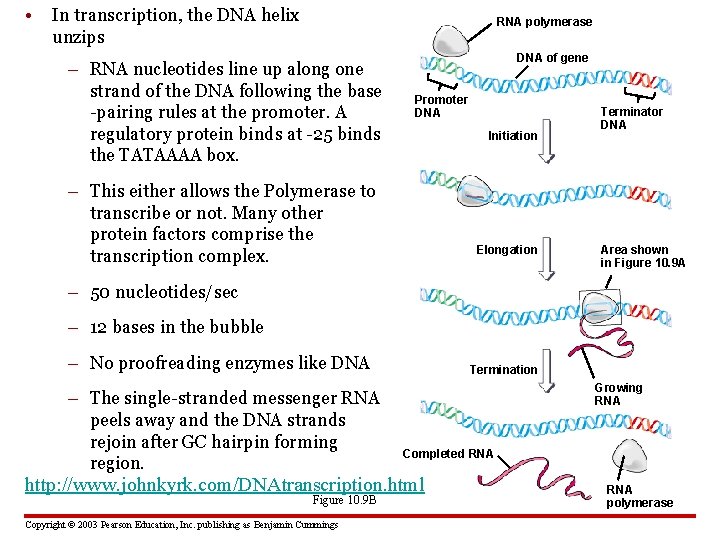
• In transcription, the DNA helix unzips RNA polymerase – RNA nucleotides line up along one strand of the DNA following the base -pairing rules at the promoter. A regulatory protein binds at -25 binds the TATAAAA box. DNA of gene Promoter DNA Initiation – This either allows the Polymerase to transcribe or not. Many other protein factors comprise the transcription complex. Elongation Terminator DNA Area shown in Figure 10. 9 A – 50 nucleotides/sec – 12 bases in the bubble – No proofreading enzymes like DNA – The single-stranded messenger RNA peels away and the DNA strands rejoin after GC hairpin forming region. Termination Growing RNA Completed RNA http: //www. johnkyrk. com/DNAtranscription. html Figure 10. 9 B Copyright © 2003 Pearson Education, Inc. publishing as Benjamin Cummings RNA polymerase
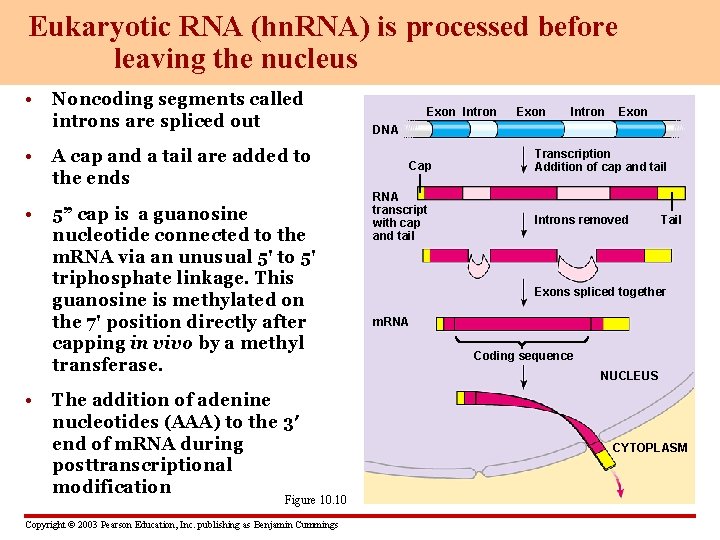
Eukaryotic RNA (hn. RNA) is processed before leaving the nucleus • • Noncoding segments called introns are spliced out A cap and a tail are added to the ends 5” cap is a guanosine nucleotide connected to the m. RNA via an unusual 5' to 5' triphosphate linkage. This guanosine is methylated on the 7' position directly after capping in vivo by a methyl transferase. The addition of adenine nucleotides (AAA) to the 3′ end of m. RNA during posttranscriptional modification Figure 10. 10 Copyright © 2003 Pearson Education, Inc. publishing as Benjamin Cummings Exon Intron Exon DNA Cap RNA transcript with cap and tail Transcription Addition of cap and tail Introns removed Tail Exons spliced together m. RNA Coding sequence NUCLEUS CYTOPLASM
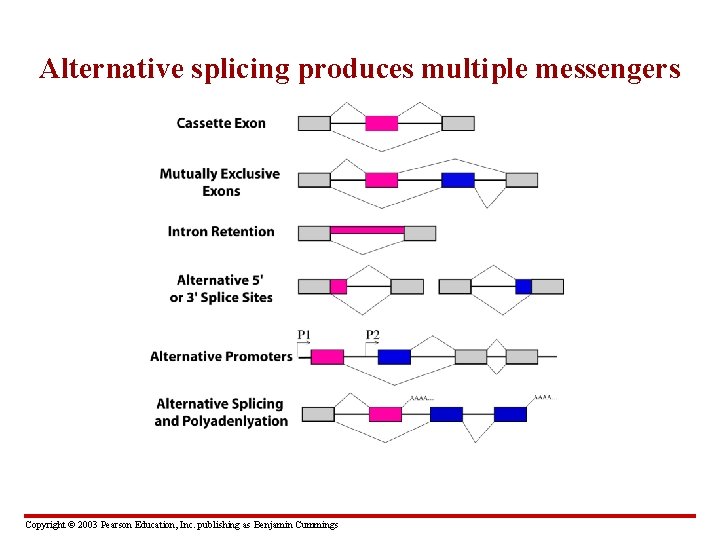
Alternative splicing produces multiple messengers Copyright © 2003 Pearson Education, Inc. publishing as Benjamin Cummings
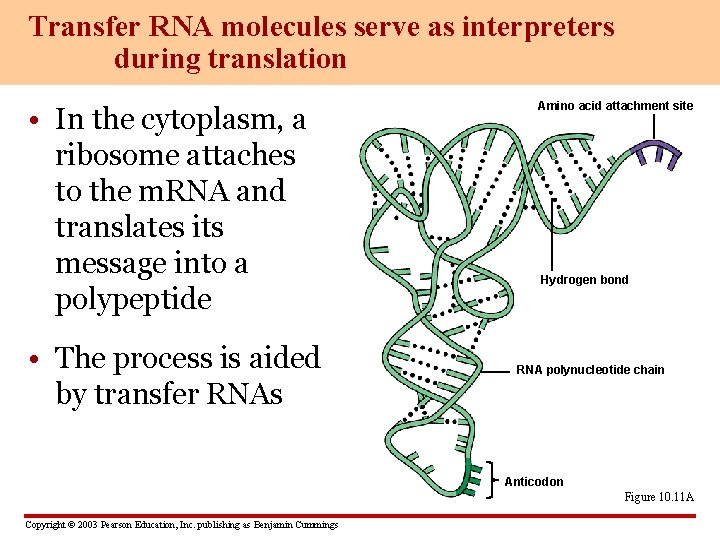
Transfer RNA molecules serve as interpreters during translation • In the cytoplasm, a ribosome attaches to the m. RNA and translates its message into a polypeptide • The process is aided by transfer RNAs Amino acid attachment site Hydrogen bond RNA polynucleotide chain Anticodon Figure 10. 11 A Copyright © 2003 Pearson Education, Inc. publishing as Benjamin Cummings
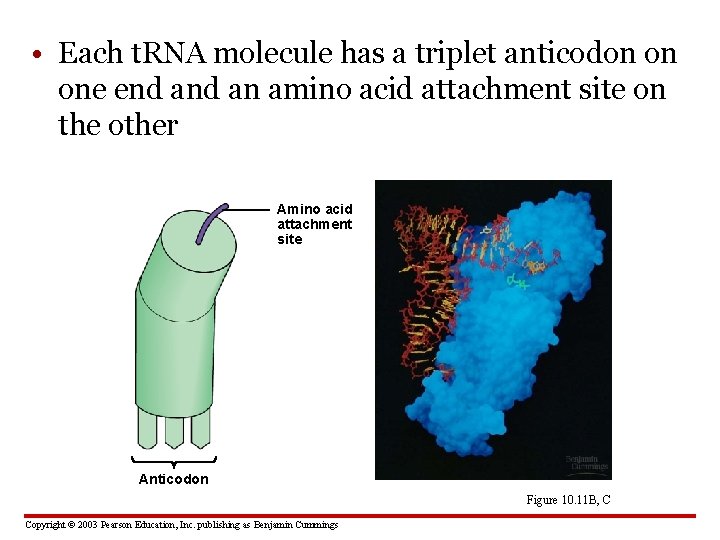
• Each t. RNA molecule has a triplet anticodon on one end an amino acid attachment site on the other Amino acid attachment site Anticodon Figure 10. 11 B, C Copyright © 2003 Pearson Education, Inc. publishing as Benjamin Cummings
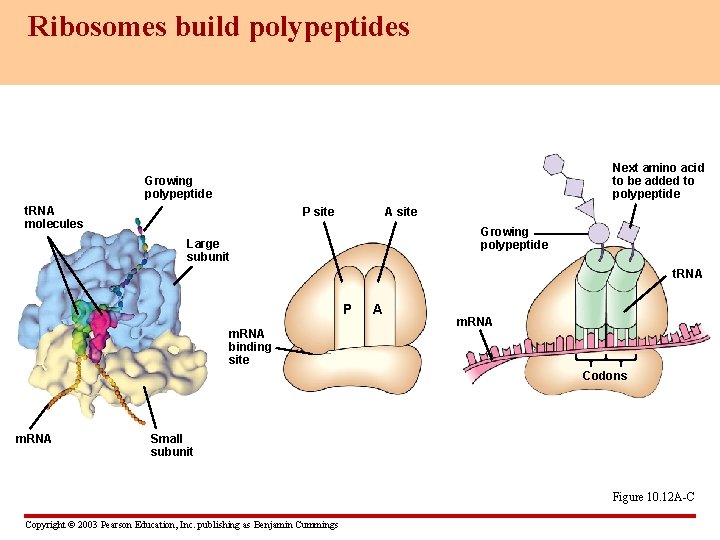
Ribosomes build polypeptides Next amino acid to be added to polypeptide Growing polypeptide t. RNA molecules P site A site Growing polypeptide Large subunit t. RNA P m. RNA binding site A m. RNA Codons m. RNA Small subunit Figure 10. 12 A-C Copyright © 2003 Pearson Education, Inc. publishing as Benjamin Cummings
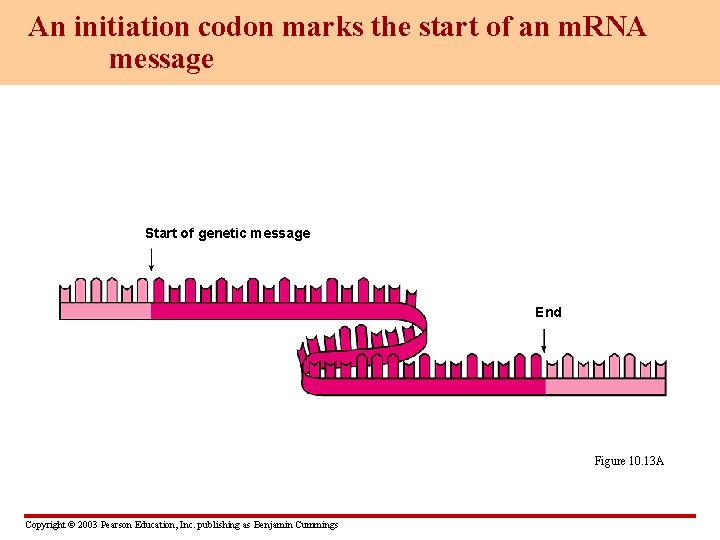
An initiation codon marks the start of an m. RNA message Start of genetic message End Figure 10. 13 A Copyright © 2003 Pearson Education, Inc. publishing as Benjamin Cummings
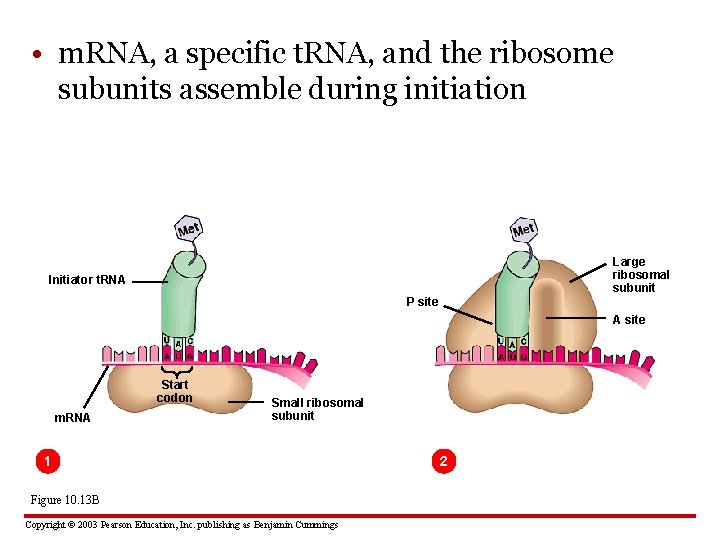
• m. RNA, a specific t. RNA, and the ribosome subunits assemble during initiation Large ribosomal subunit Initiator t. RNA P site A site Start codon m. RNA Small ribosomal subunit 1 Figure 10. 13 B Copyright © 2003 Pearson Education, Inc. publishing as Benjamin Cummings 2
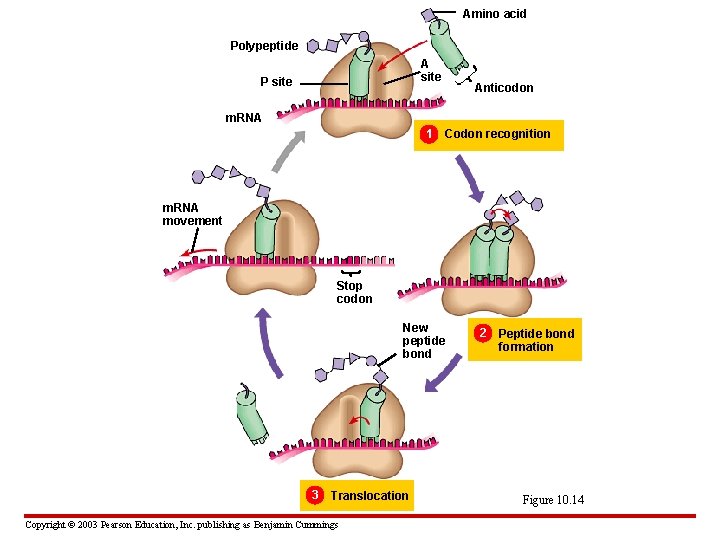
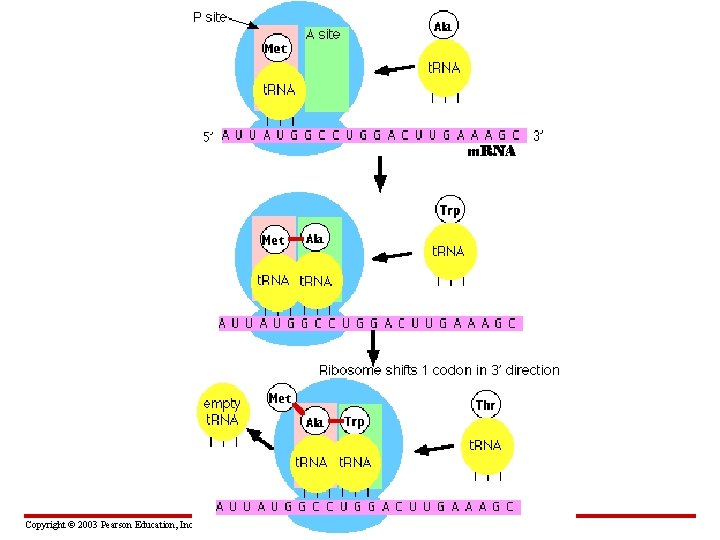
Elongation adds amino acids to the polypeptide chain until a stop codon terminates translation • The m. RNA moves a codon at a time relative to the ribosome – A t. RNA pairs with each codon, adding an amino acid to the growing polypeptide Copyright © 2003 Pearson Education, Inc. publishing as Benjamin Cummings
Amino acid Polypeptide A site P site Anticodon m. RNA 1 Codon recognition m. RNA movement Stop codon New peptide bond 3 Translocation Copyright © 2003 Pearson Education, Inc. publishing as Benjamin Cummings 2 Peptide bond formation Figure 10. 14
1. Initiation Copyright © 2003 Pearson Education, Inc. publishing as Benjamin Cummings
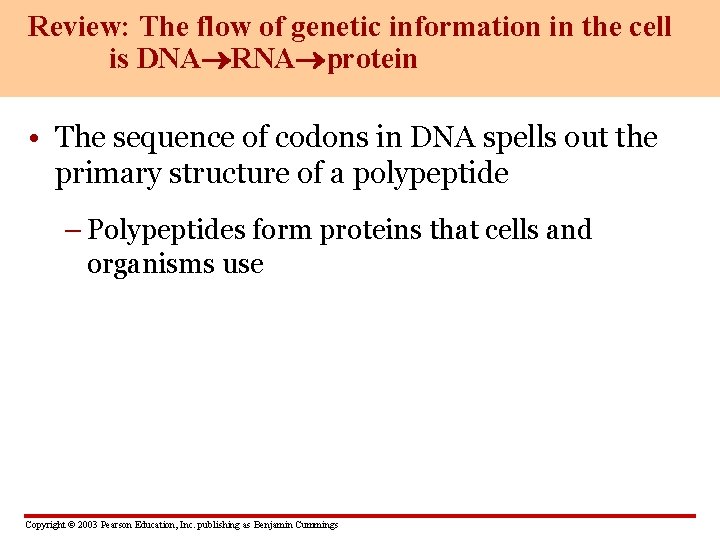
Review: The flow of genetic information in the cell is DNA RNA protein • The sequence of codons in DNA spells out the primary structure of a polypeptide – Polypeptides form proteins that cells and organisms use Copyright © 2003 Pearson Education, Inc. publishing as Benjamin Cummings
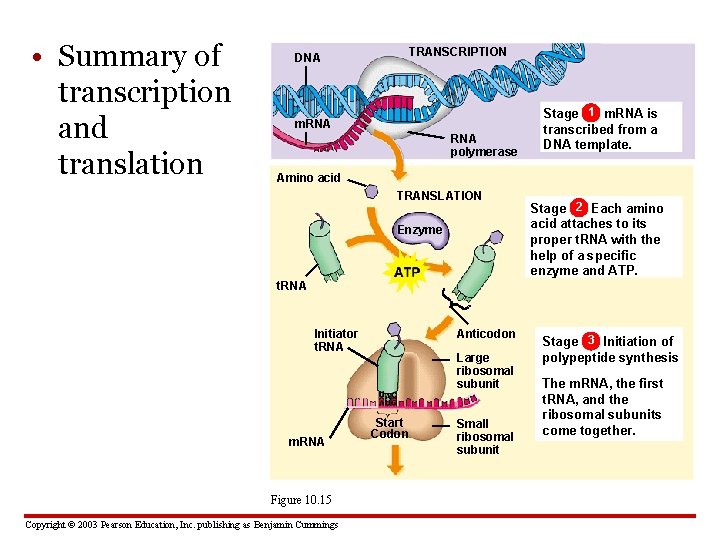
• Summary of transcription and translation TRANSCRIPTION DNA m. RNA polymerase Stage 1 m. RNA is transcribed from a DNA template. Amino acid TRANSLATION Enzyme Stage 2 Each amino acid attaches to its proper t. RNA with the help of a specific enzyme and ATP. t. RNA Initiator t. RNA m. RNA Figure 10. 15 Copyright © 2003 Pearson Education, Inc. publishing as Benjamin Cummings Anticodon Large ribosomal subunit Start Codon Small ribosomal subunit Stage 3 Initiation of polypeptide synthesis The m. RNA, the first t. RNA, and the ribosomal subunits come together.
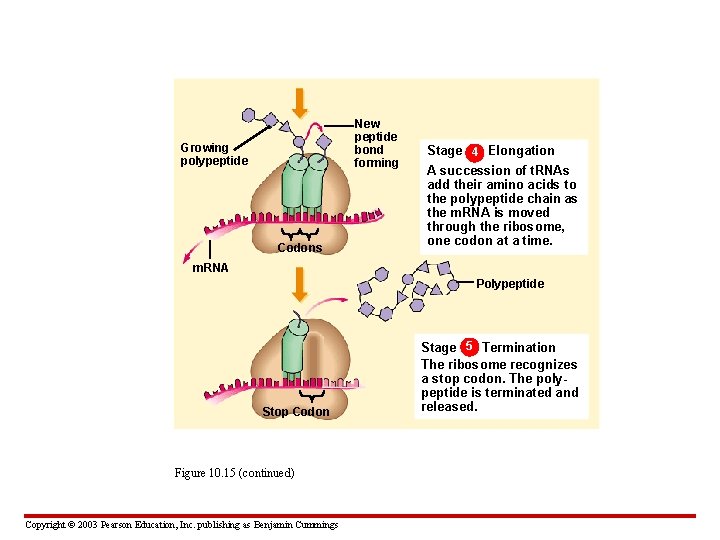
New peptide bond forming Growing polypeptide Codons Stage 4 Elongation A succession of t. RNAs add their amino acids to the polypeptide chain as the m. RNA is moved through the ribosome, one codon at a time. m. RNA Polypeptide Stop Codon Figure 10. 15 (continued) Copyright © 2003 Pearson Education, Inc. publishing as Benjamin Cummings Stage 5 Termination The ribosome recognizes a stop codon. The polypeptide is terminated and released.
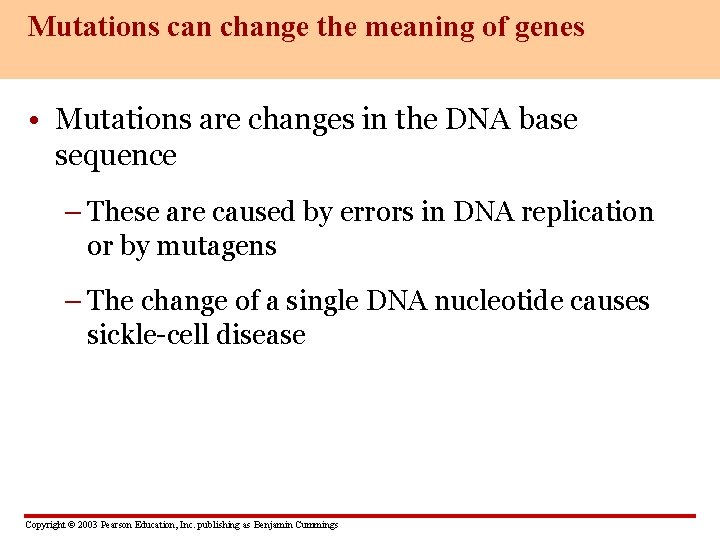
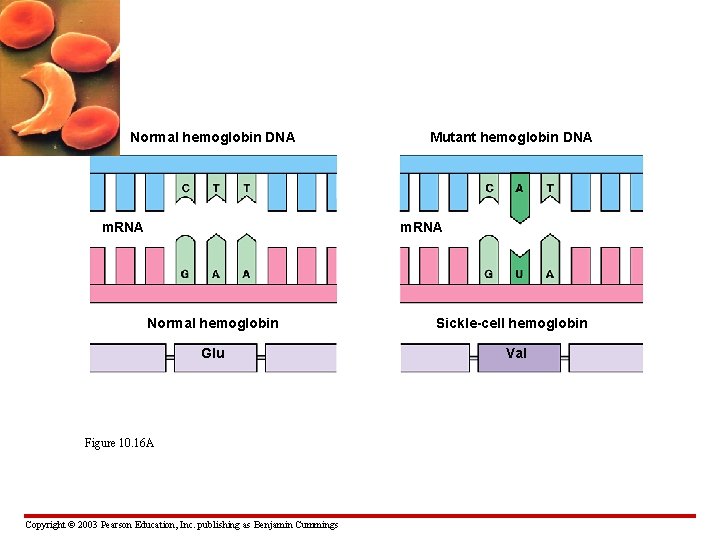
Mutations can change the meaning of genes • Mutations are changes in the DNA base sequence – These are caused by errors in DNA replication or by mutagens – The change of a single DNA nucleotide causes sickle-cell disease Copyright © 2003 Pearson Education, Inc. publishing as Benjamin Cummings
Normal hemoglobin DNA m. RNA Mutant hemoglobin DNA m. RNA Normal hemoglobin Glu Figure 10. 16 A Copyright © 2003 Pearson Education, Inc. publishing as Benjamin Cummings Sickle-cell hemoglobin Val
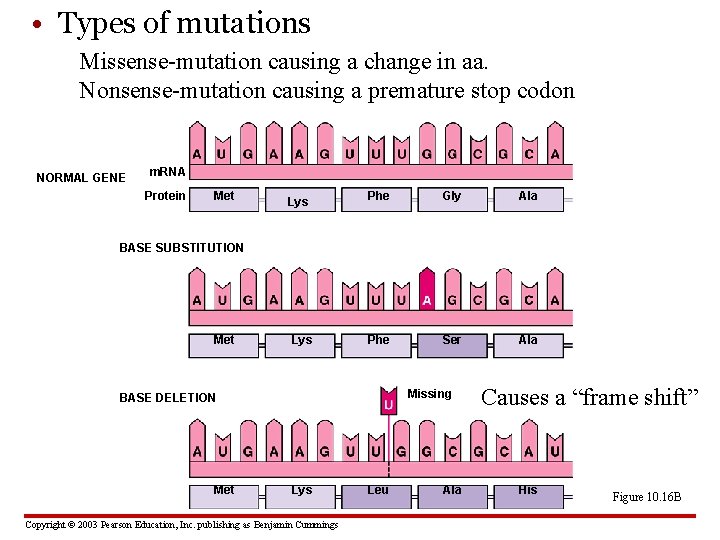
• Types of mutations Missense-mutation causing a change in aa. Nonsense-mutation causing a premature stop codon NORMAL GENE m. RNA Protein Met Lys Phe Gly Ala Phe Ser Ala BASE SUBSTITUTION Met Lys Missing BASE DELETION Met Lys Copyright © 2003 Pearson Education, Inc. publishing as Benjamin Cummings Leu Ala Causes a “frame shift” His Figure 10. 16 B
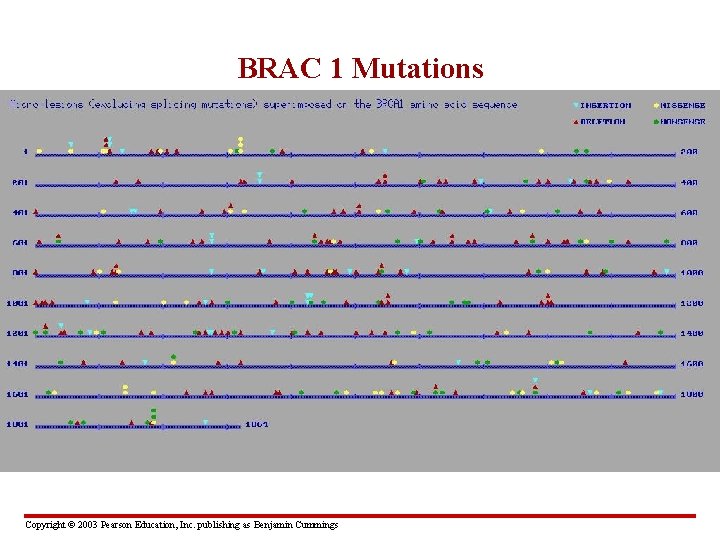
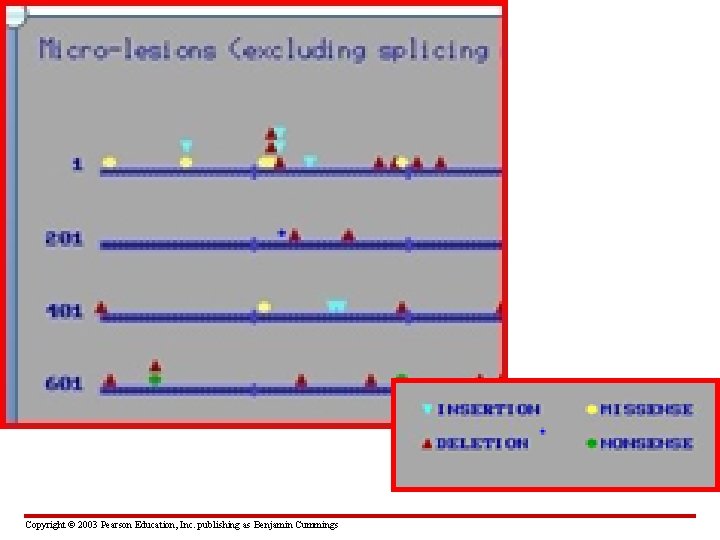
BRAC 1 Mutations Copyright © 2003 Pearson Education, Inc. publishing as Benjamin Cummings
Copyright © 2003 Pearson Education, Inc. publishing as Benjamin Cummings
Copyright © 2003 Pearson Education, Inc. publishing as Benjamin Cummings
Copyright © 2003 Pearson Education, Inc. publishing as Benjamin Cummings
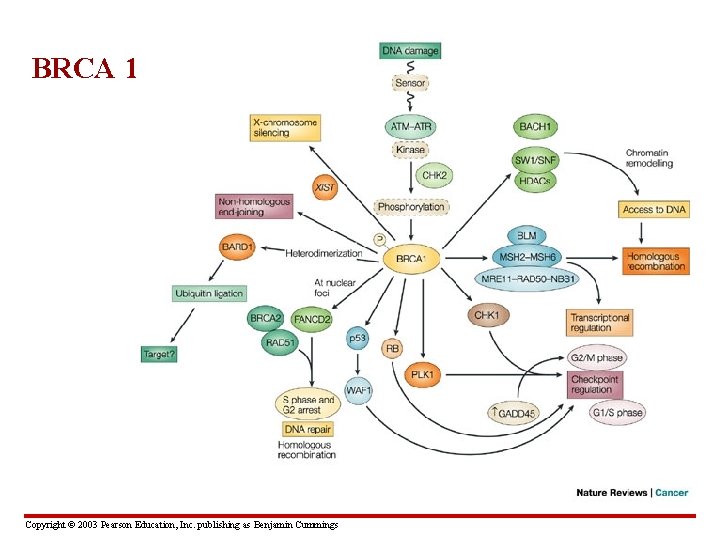
BRCA 1 Copyright © 2003 Pearson Education, Inc. publishing as Benjamin Cummings