
The flood myth is common to many cultures


- Slides: 26
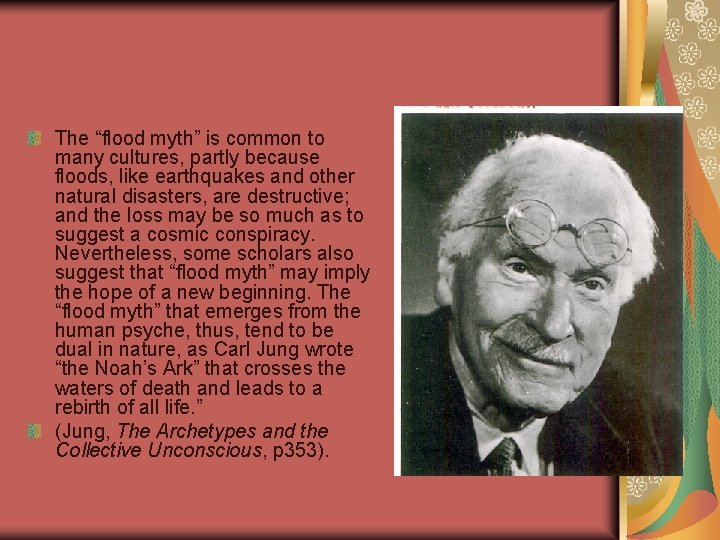
The “flood myth” is common to many cultures, partly because floods, like earthquakes and other natural disasters, are destructive; and the loss may be so much as to suggest a cosmic conspiracy. Nevertheless, some scholars also suggest that “flood myth” may imply the hope of a new beginning. The “flood myth” that emerges from the human psyche, thus, tend to be dual in nature, as Carl Jung wrote “the Noah’s Ark” that crosses the waters of death and leads to a rebirth of all life. ” (Jung, The Archetypes and the Collective Unconscious, p 353).
The “Flood” cleanses and gives birth to new forms even though it destroys the old. The “flood myth” reminds us that life depends on death, that without death there can be no cycle, no birth. That the new creation is preceded by a flood is understandable and appropriate, since the first life itself emerged from water. The Christian baptized sinners immersed in water —— “The flood……was an image which baptism come to fulfill. ” (J. Danielous, Sacramentum Futuri, p 65).
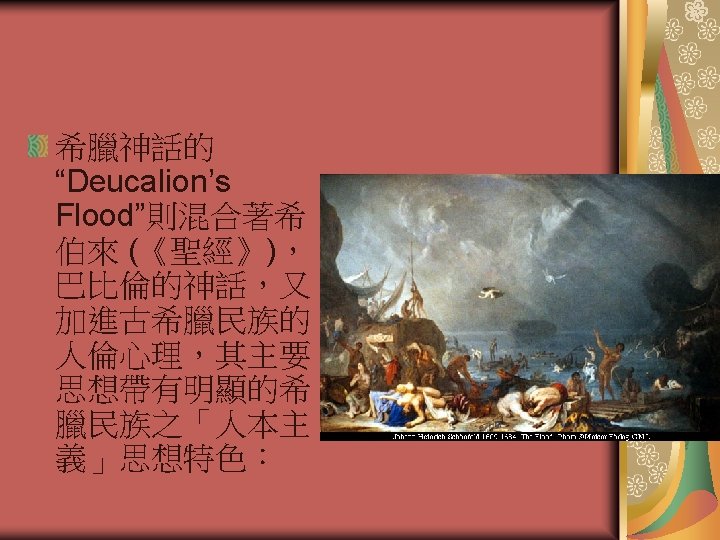
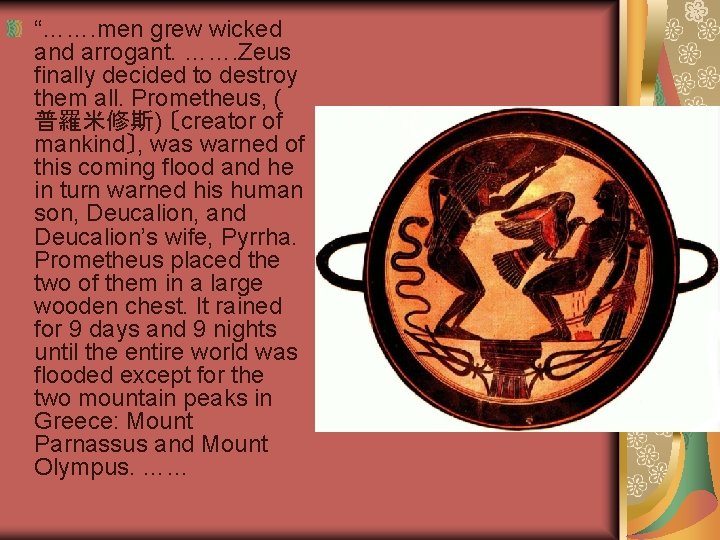
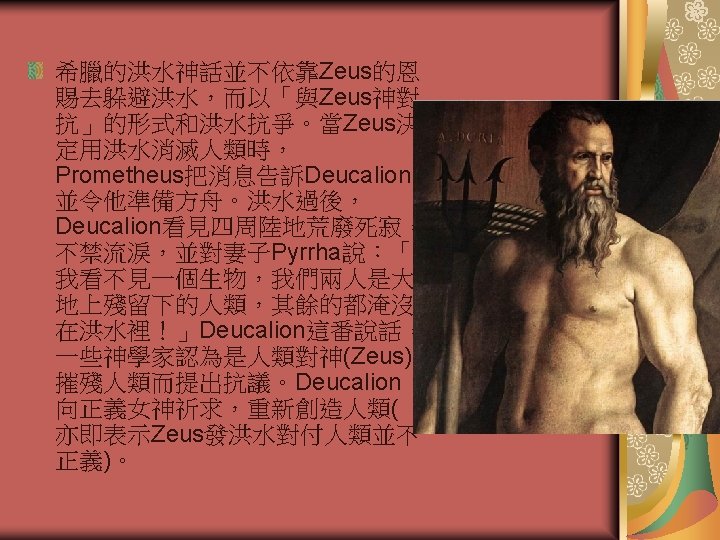
“……. men grew wicked and arrogant. ……. Zeus finally decided to destroy them all. Prometheus, ( 普羅米修斯) 〔creator of mankind〕, was warned of this coming flood and he in turn warned his human son, Deucalion, and Deucalion’s wife, Pyrrha. Prometheus placed the two of them in a large wooden chest. It rained for 9 days and 9 nights until the entire world was flooded except for the two mountain peaks in Greece: Mount Parnassus and Mount Olympus. ……
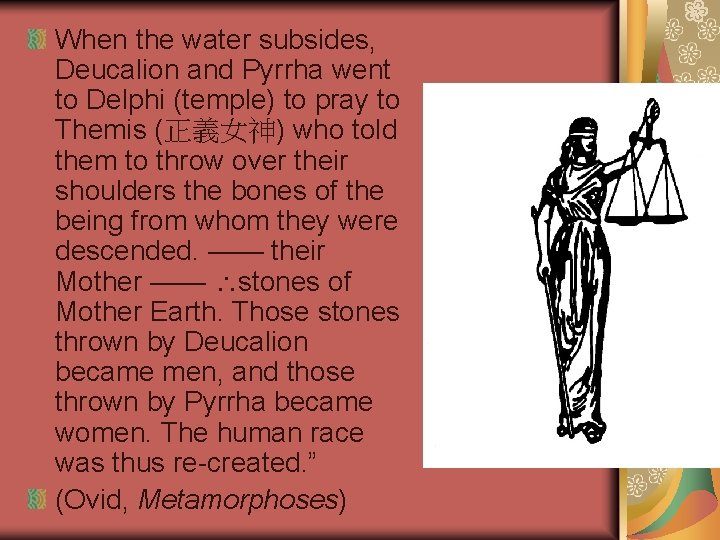
When the water subsides, Deucalion and Pyrrha went to Delphi (temple) to pray to Themis (正義女神) who told them to throw over their shoulders the bones of the being from whom they were descended. —— their Mother —— stones of Mother Earth. Those stones thrown by Deucalion became men, and those thrown by Pyrrha became women. The human race was thus re-created. ” (Ovid, Metamorphoses)
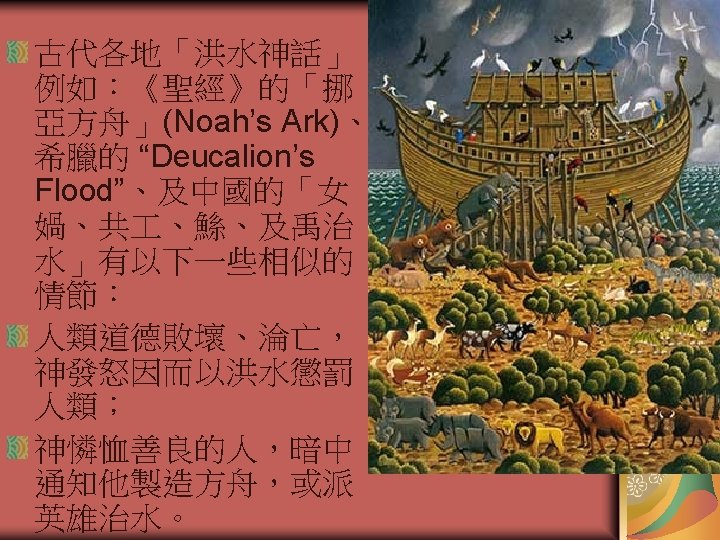
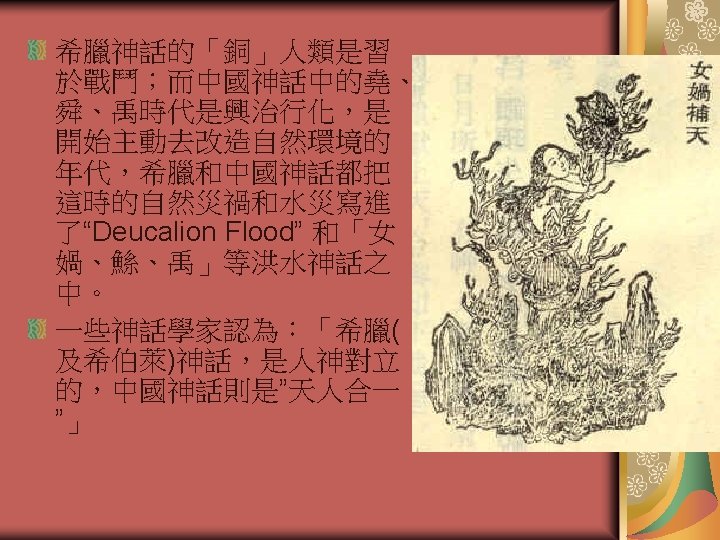
中國「洪水神話」 Birrell, Anne. “The Four Flood Myth Traditions of Classical China, “ T’oung Pao LXXXIII (1997), pp 213 -259. The Nu kua (女媧) Flood Myth; The Kung kung (共 ) Flood Myth; The Kun (鯀) Flood Myth; The Yu (禹) Flood Myth.
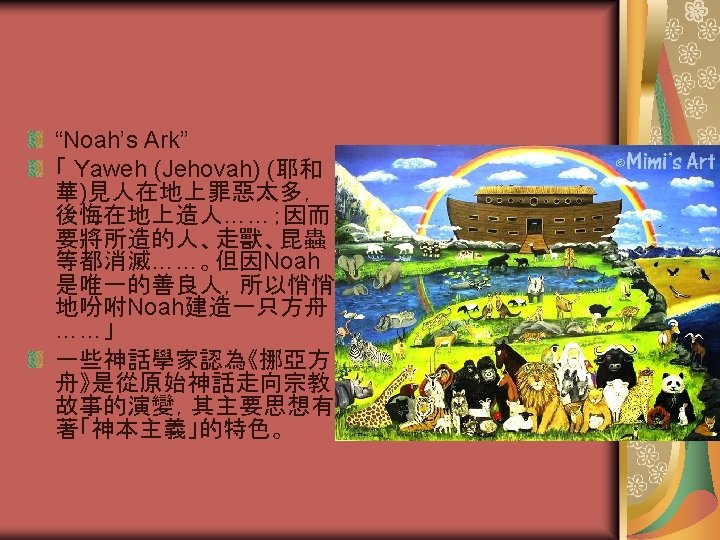
Myths on “Flood” (compiled by Fred Cheung) (Source: mainly from Powell, Classical Myth) In the biblical flood story, “the Lord [Yahweh] saw that the wickedness of man was great in the earth, and that every imagination of the thoughts of his heart was only evil continually. And the Lord was sorry that he had made man on the earth, and it grieved him to his heart. So the Lord said, ‘I will blot out man, whom I have created from the face of the ground, man and beast and creeping things and birds of the air, for I am sorry that I have made them. ’” Only Noah, because of his goodness, was saved from the flood that God sent. When the waters receded, Noah sent out a dove, which first returned because it found no place to rest. He released it again; this time it came back with an olive twig. He let it go a third time, but by now it had no need of the ark and disappeared for good (Genesis 6 -8). The waters receded, and Noah built an altar and sacrificed to God.
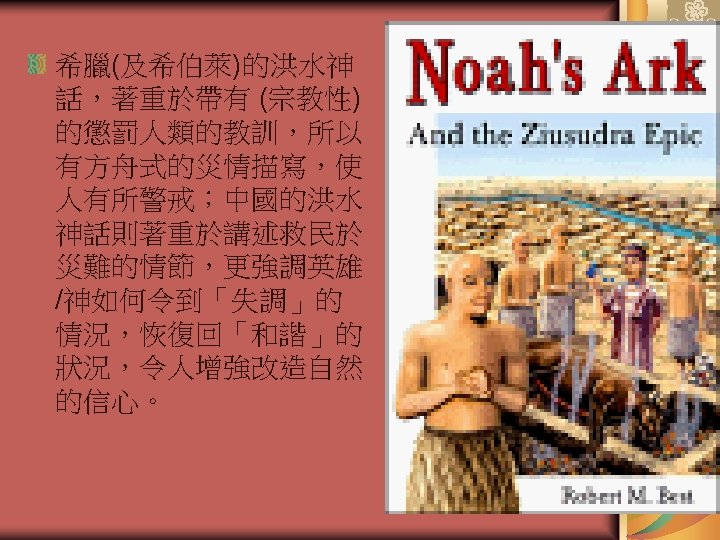
The Sumerian story begins with the creation of humans, the animals, and the foundation of five important cities. The next part of the tablet is broken; when it resumes, the gods have decreed the destruction of humankind by means of a universal flood. Some gods were opposed to their plan, and Enki intervened to save Ziusudra, “Long life, ” a pious man. Enki advised Ziusudra to build a large boat: “For seven days and nights, the deluge [flood] rampaged in the land. The huge boat was slung about on the vast waters. Then Utu [the Sun god] came forth, he who sheds light on heaven and earth. Ziusudra drew open a window of the huge boat, Ziusudra, the king, threw himself down on the ground before Utu. He killed an ox, slaughtered a sheep. ” Most of the tablet is lost. We learn only that Ziusudra was made to be like a god and transported to Dilmun, a mysterious land in the East where there is no pain or suffering, the Sumerian paradise.
Archaeological evidence proves that devastating floods sometimes took place in Mesopotamia when the rampaging Euphrates burst its banks and spilled across the flatland to the lower Tigris channel. The story may go back to an actual flood, …. Still, many variants of the story circulated in that region and spread to Palestine, Anatolia, and Greece. Although the basic themes are constant, details reflect different environments and national interests. The Mesopotamian story of Ziusudra/Atrahasis, in which divine powers send destruction to correct [human beings], reflects human insecurity before the capricious powers of gods…. .
The Hebrew account, on the other hand, presents Gods as destroying humans because of their wickedness, their moral failure. Omnipotent though He is, after the flood God voluntarily limits His power by striking a covenant with Noah, and Noah’s descendents: He will never again destroy the human race, but He demands that certain laws be observed. If one man kills another or an animal whose flesh he then eats with the blood, he must forfeit his own life (Genesis 9. 4. 1 -17). The biblical story also is etiological, explaining the origin of Hebrew customs concerning homicide and abstinence from blood. The story of Noah attempts to explain the origin of the special relationship between God and the Hebrews.
The myth of the flood must also be understood in the context of Mesopotamian cosmogonic myth. The universal flood is a return to the watery conditions before the creation, when Tiamat, the salt water, was mixed with Apsu, the sweet, reminiscent of the biblical description of when “darkness was upon the face of the deep, ” perhaps reflected in the biblical description of the flood: “All the fountains of the great deep burst forth, and the windows of the heavens were opened” (Genesis 7. 11). The Hebrew word tehom, translated “fluid chaos” in the first chapter of Genesis, probably is related etymologically to the Akkadian name Tiamat.
In the classical tradition the earliest direct accounts of the flood are from the Roman Period, in Ovid and Apollodorus, but certainly based on much earlier Greek examples. Hearing that all men were vicious and corrupt, Zeus descended among them disguised as an ordinary man. Human wickedness was exemplified by Lycaon, king of Arcadia, who practiced human sacrifice and cannibalism. …. Ovid goes on to describe the destruction of humanity. Only Prometheus’s son Decualion and his wife, Pyrrha, a daughter of Pandora and Epimetheus, survived.
Most important of the children of Deucalian and Pyrrha was their son Hellen, who gave his name to the whole Greek race, the Hellenes. Hellen had three sons, Dorus, Aeolus, and Xuthus. Dorus and Aeolus were the founders of the Dorians and the Aeolians, peoples who spoke two of the principal Greek dialects. Xuthus, the brother of Dorus and Aeolus, was father to Ion, from which descended the Ionians, the third principal group of Greeks, which included the Athenians. These figures are eponymous ancestors of the Greeks as a whole (i. e. , the Hellenes) and of the three principal ethnic divisions among the Greeks (i. e. , Dorians, Aeolians, and the Ionians). Eponymous means “giving one’s name to something, ” a place, people, city, or institution, and an eponym is the person whose name is so given. There are many eponyms in mythology, but most are really named after the fact.