
The Flipped Classroom Pedagogy in Chemistry Education Case
- Slides: 23
The Flipped Classroom Pedagogy in Chemistry Education – Case Chemical Equilibrium Course Ari Myllyviita MSc (Chem. Ed. ), BSc (Chem. ), BEd (soc. pedag. ) Lecturer (Chemistry and Mathematics), Project Coordinator Teacher Educator, e-Writer www. helsinki. fi/yliopisto
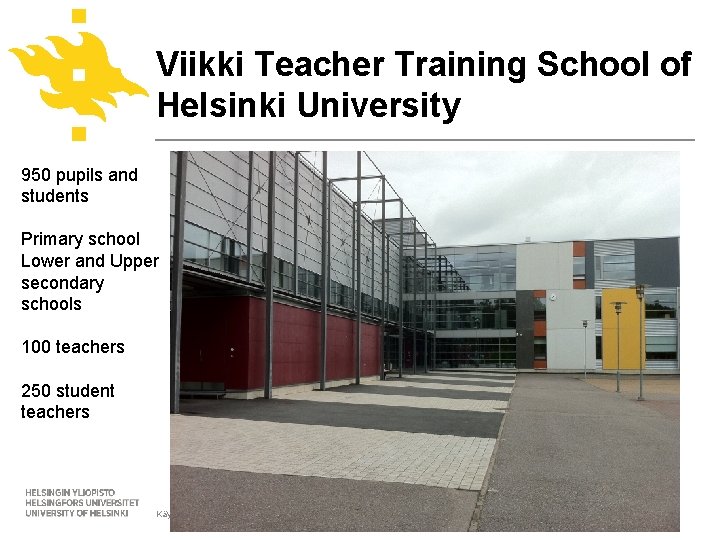
Viikki Teacher Training School of Helsinki University 950 pupils and students Primary school Lower and Upper secondary schools 100 teachers 250 student teachers Käyttäytymistieteellinen tiedekunta / Ari Myllyviita www. helsinki. fi/yliopisto
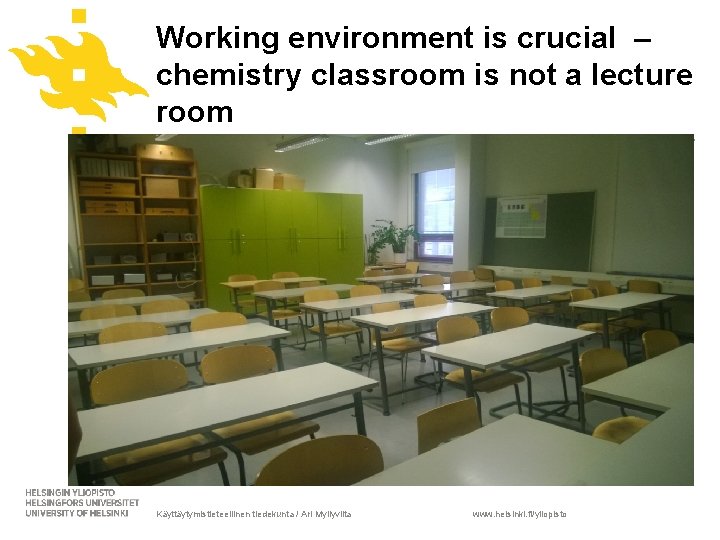
Working environment is crucial – chemistry classroom is not a lecture room Working in groups Laboratory context Käyttäytymistieteellinen tiedekunta / Ari Myllyviita www. helsinki. fi/yliopisto
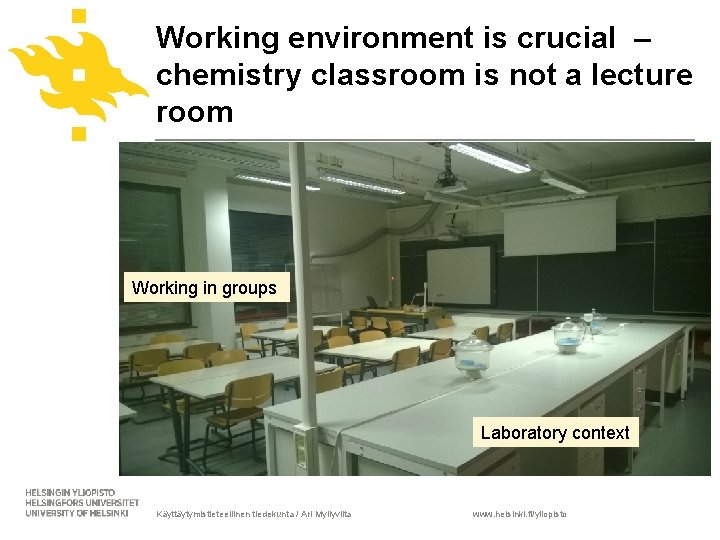
Working environment is crucial – chemistry classroom is not a lecture room Working in groups Laboratory context Käyttäytymistieteellinen tiedekunta / Ari Myllyviita www. helsinki. fi/yliopisto
Different pedagogical approaches • • Project based learning (teaching) Inquiry based learning Problem based learning Co-operative, collaborative learning – working in groups • Mastery learning (individual learning) • Flipped classroom approach Käyttäytymistieteellinen tiedekunta / Ari Myllyviita www. helsinki. fi/yliopisto
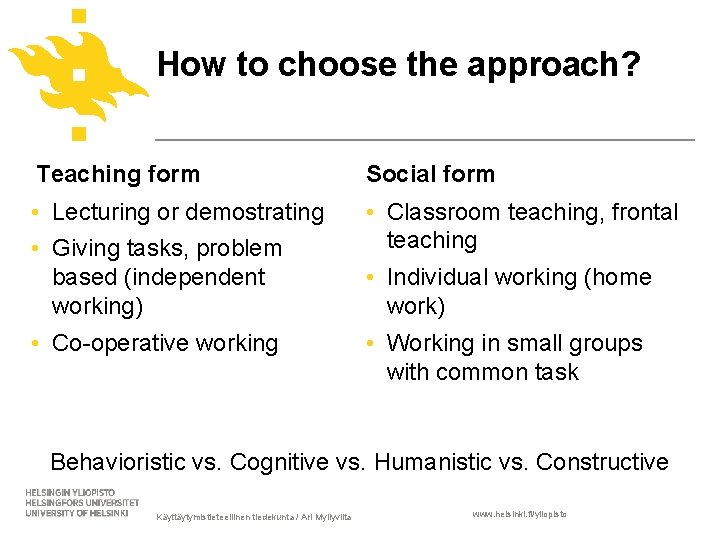
How to choose the approach? Teaching form Social form • Lecturing or demostrating • Classroom teaching, frontal teaching • Giving tasks, problem based (independent working) • Co-operative working • Individual working (home work) • Working in small groups with common task Behavioristic vs. Cognitive vs. Humanistic vs. Constructive Käyttäytymistieteellinen tiedekunta / Ari Myllyviita www. helsinki. fi/yliopisto
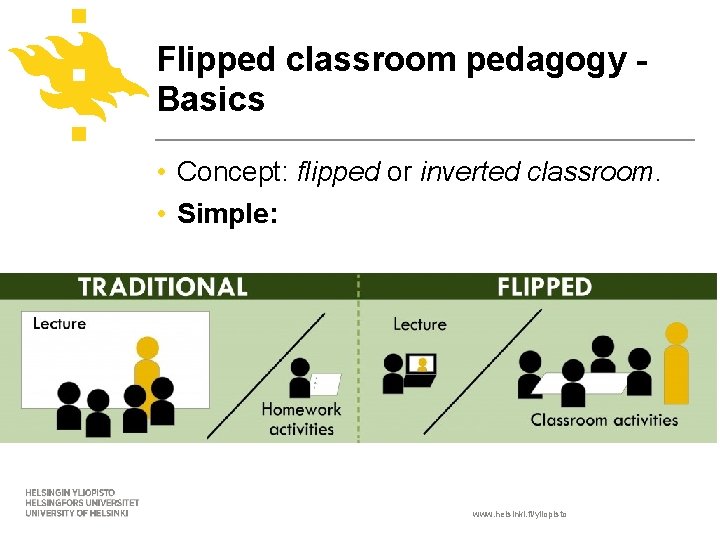
Flipped classroom pedagogy Basics • Concept: flipped or inverted classroom. • Simple: www. helsinki. fi/yliopisto
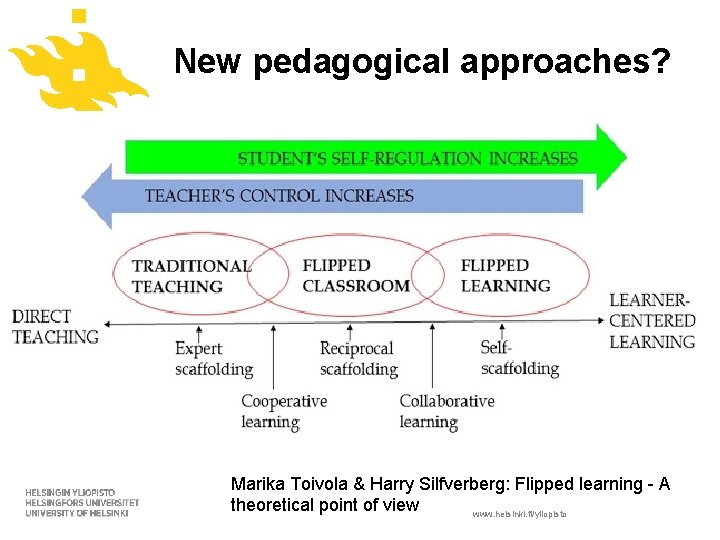
New pedagogical approaches? Marika Toivola & Harry Silfverberg: Flipped learning - A theoretical point of view www. helsinki. fi/yliopisto
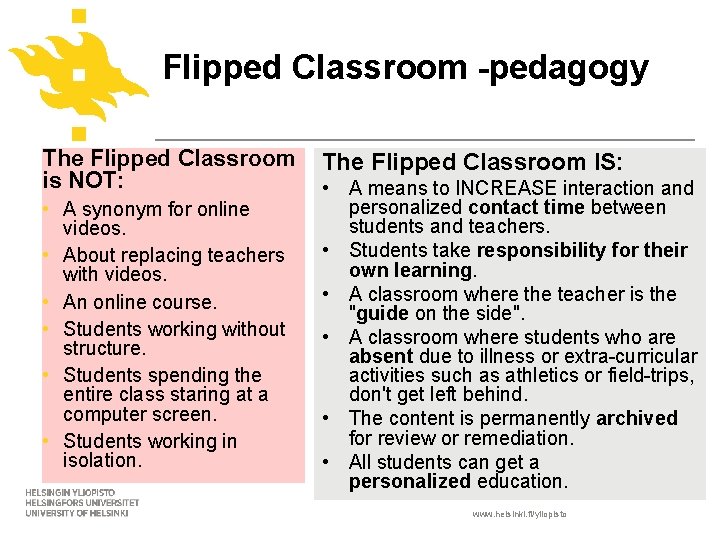
Flipped Classroom -pedagogy The Flipped Classroom is NOT: • A synonym for online videos. • About replacing teachers with videos. • An online course. • Students working without structure. • Students spending the entire class staring at a computer screen. • Students working in isolation. The Flipped Classroom IS: • A means to INCREASE interaction and personalized contact time between students and teachers. • Students take responsibility for their own learning. • A classroom where the teacher is the "guide on the side". • A classroom where students who are absent due to illness or extra-curricular activities such as athletics or field-trips, don't get left behind. • The content is permanently archived for review or remediation. • All students can get a personalized education. www. helsinki. fi/yliopisto
Flipped Classroom Pedagogy • The flipped classroom pedagogy gives an alternative way of teaching and learning if we compare it to the traditional teaching. In the flipped learning students are supposed to study new material outside of class, usually via reading or lecture videos. • During the face to face time, normal lesson, time is used more with higher-order tasks, like tasks as before called homework. • It is also possible to concentrate more difficult questions and to support individual learning. www. helsinki. fi/yliopisto
Chemistry education and Flipped Classroom Pedagogy • In chemistry education the flipped classroom pedagogy (FCP) is not yet commonly used, and very little reported. • The classroom activities used in chemistry are different if you compare to mathematics, where the FCP is practiced and reported much more. • The problem-solving, discussion, debates are the same, but when you have more time during lessons, you can do more experimental works and longer experiments and also analyzing and modeling the phenomena. www. helsinki. fi/yliopisto
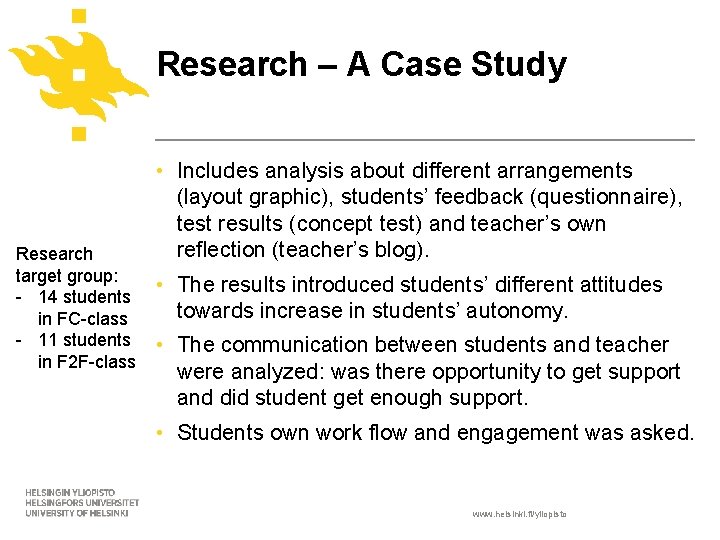
Research – A Case Study Research target group: - 14 students in FC-class - 11 students in F 2 F-class • Includes analysis about different arrangements (layout graphic), students’ feedback (questionnaire), test results (concept test) and teacher’s own reflection (teacher’s blog). • The results introduced students’ different attitudes towards increase in students’ autonomy. • The communication between students and teacher were analyzed: was there opportunity to get support and did student get enough support. • Students own work flow and engagement was asked. www. helsinki. fi/yliopisto
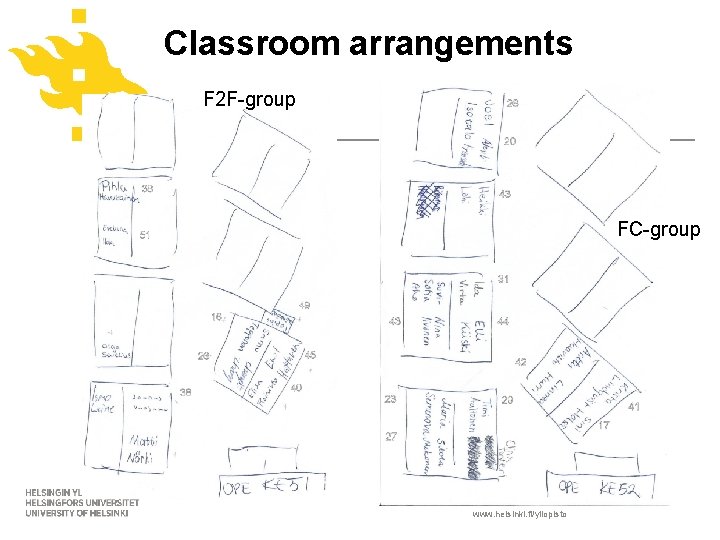
Classroom arrangements F 2 F-group FC-group www. helsinki. fi/yliopisto
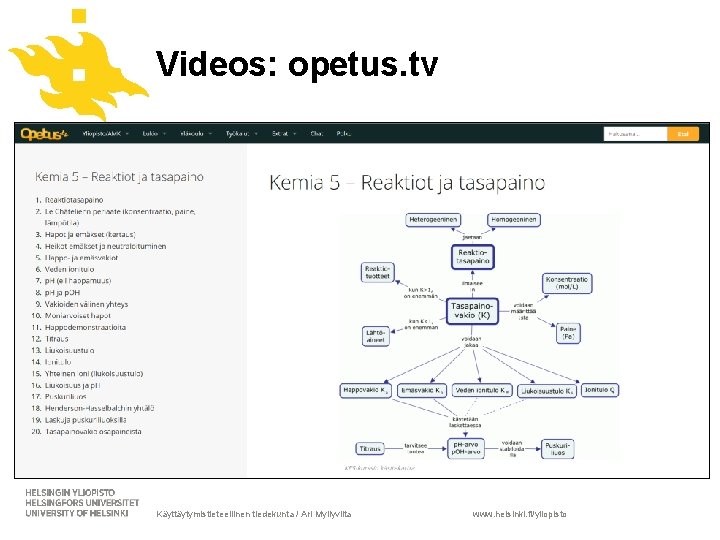
Some results • Students readiness to work with new approach was surprisingly positive • Videos – opetus. tv – were made by others teachers one problem was differences with order they handle themes and chemical concepts • Videos were static – so there were no questions and answers about theory during watching. • The classroom arrangements (next slide)! More possibilities for co-operation (part of the big idea) • Formative assessment - supporting studying and learning scaffolding, support when you need it www. helsinki. fi/yliopisto
Videos: opetus. tv Käyttäytymistieteellinen tiedekunta / Ari Myllyviita www. helsinki. fi/yliopisto
More results and discussion • Promote students’ autonomy out of classroom and collaborative learning during the lessons • The teacher leaves the direct control of the learning to the students and trusts students’ ability and desire to learn • they watch about 80% of the videos at home • Teachers role: situations, where individual students need more support and guidance • 10/12 said that they got enough support when it was needed, nobody said that it was not possible to get support. • Need of scaffolding and collaboration is also supported by different classroom arrangement; student were sitting in groups. • this was the case to 8/12, 2/12 said nothing, and 2/12 did not agree. • This classroom arrangement was one focus, when research arrangements were planned. www. helsinki. fi/yliopisto
Individual progress • The teacher can create differentiation in the group of different skill levels of the students • The support is based on students' own zone of proximal development (ZPD) at the moment. • Here the experience of the teacher or tearcher's PCK (pedagogical content knowledge) become more and more crucial. • This makes the FCP more difficult to put into practice and to get better learning results. www. helsinki. fi/yliopisto
Some lessons learned • Try this, if you want to develop your teaching; you have to study this approach before you start • Choose carefully the materials (videos, wwwmaterials, text book) • Plan your classroom to support group work • Create motivation (with formative assessment) • ICT support Käyttäytymistieteellinen tiedekunta / Ari Myllyviita www. helsinki. fi/yliopisto
Fits for all? • Is this FCP method suitable to chemistry education in every cases? When asked students, do you think this would have been worked earlier courses, only 3/12 agreed. • In the traditional teaching teachers choose the level of teaching based on conceptions of the average skill level of the group. • How it fits to most of the students? www. helsinki. fi/yliopisto
Thanks for your attention www. helsinki. fi/yliopisto
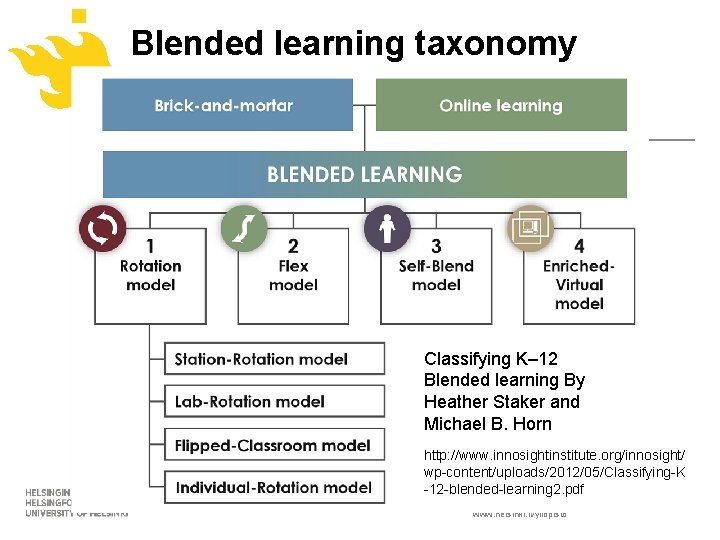
Blended learning taxonomy Classifying K– 12 Blended learning By Heather Staker and Michael B. Horn http: //www. innosightinstitute. org/innosight/ wp-content/uploads/2012/05/Classifying-K -12 -blended-learning 2. pdf www. helsinki. fi/yliopisto
Flipped classroom as a blended learning model • Students have the opportunity to learn new content by online delivery and instruction from a remote location and in the classroom students do their homework or assignments instead of listening to lectures • There is more scaffolding, student-teacher interaction, and opportunities for student collaboration in the face-to-face class meetings • Literature on flipped classrooms document four blended learning models (Staker & Horn, 2012); • (1) rotation model, • (2) flex model, • (3) self-blended model, and • (4) enriched-virtual model. including www. helsinki. fi/yliopisto
Flipped classroom pedagogy references • Lage, M. J. , Platt, G. J. , & Treglia, M. (2000). Inverting the classroom: A gateway to creating an inclusive learning environment. Journal of Economic Education, 31, 30 -43. www. helsinki. fi/yliopisto