
The Flight Template A tool for Optimization of

- Slides: 37
The “Flight Template” A tool for Optimization of sailplane aerodynamics at preliminary design stage for cross country flight Prepared and presented by Matthieu Scherrer
Contents o Introduction n o Flight template Theory n o Flight template concept & determination Using Flight Templates n n n o Aerodynamic in sailplane optimization For airfoil selection For AR selection For airfoil optimization Conclusion
Introduction
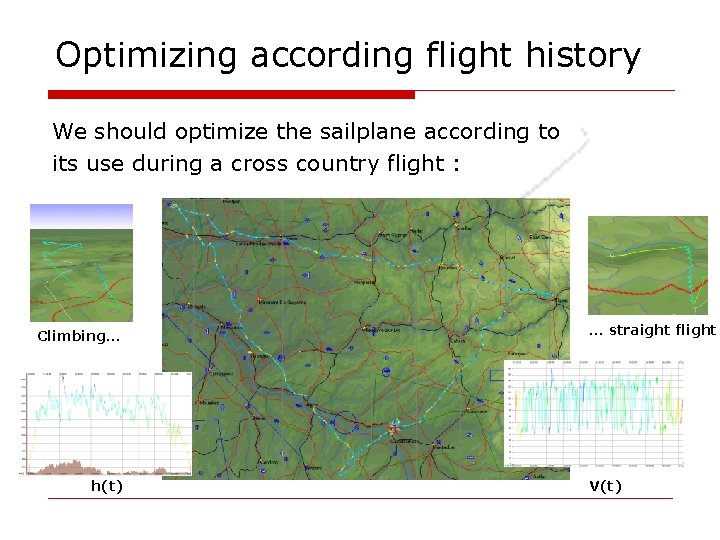
Optimizing according flight history We should optimize the sailplane according to its use during a cross country flight : Climbing… h(t) … straight flight V(t)
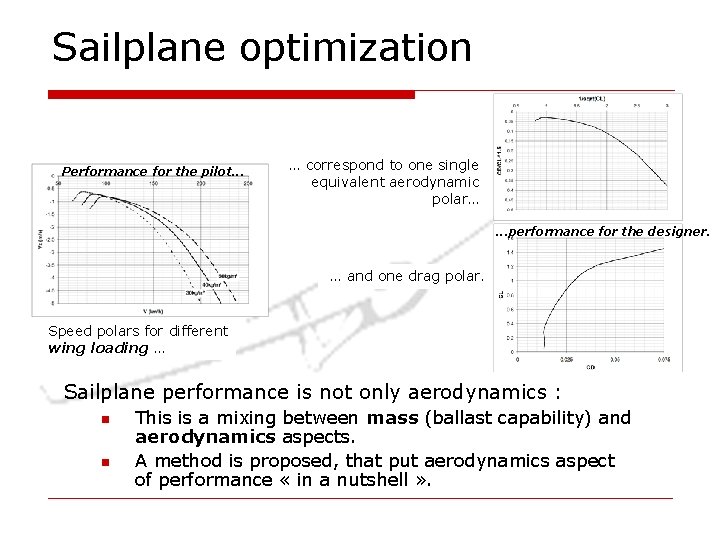
Sailplane optimization Performance for the pilot. . . … correspond to one single equivalent aerodynamic polar…. . . performance for the designer. … and one drag polar. Speed polars for different wing loading … Sailplane performance is not only aerodynamics : n n This is a mixing between mass (ballast capability) and aerodynamics aspects. A method is proposed, that put aerodynamics aspect of performance « in a nutshell » .
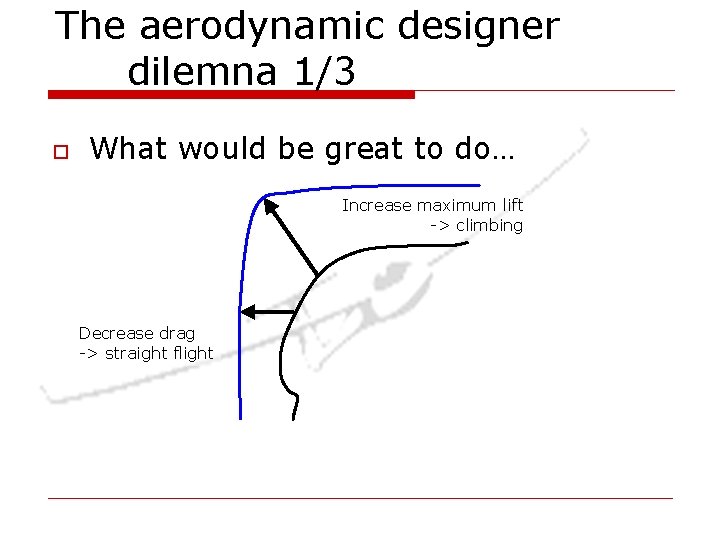
The aerodynamic designer dilemna 1/3 o What would be great to do… Increase maximum lift -> climbing Decrease drag -> straight flight
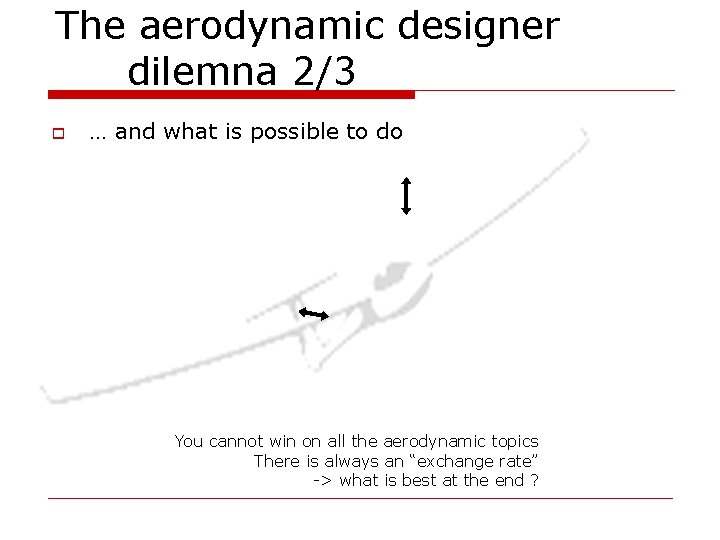
The aerodynamic designer dilemna 2/3 o … and what is possible to do You cannot win on all the aerodynamic topics There is always an “exchange rate” -> what is best at the end ?
The aerodynamic designer dilemna 3/3 Given what is possible to do, what is the best between : o An aerodynamic behavior that favors climbing ? o An aerodynamic behavior that favors straight flight ? This is a compromise : we have to quantify how many of each aerodynamic component we should have (like a recipe) There is a need for a «cost function» , that gives a figure representative for the global performance.
Flight Template theory
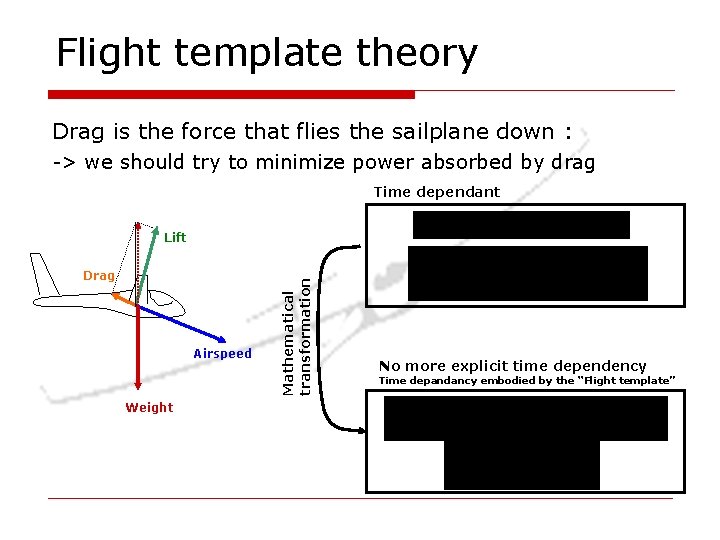
Flight template theory Drag is the force that flies the sailplane down : -> we should try to minimize power absorbed by drag Time dependant Drag Airspeed Weight Mathematical transformation Lift No more explicit time dependency Time depandancy embodied by the “Flight template”
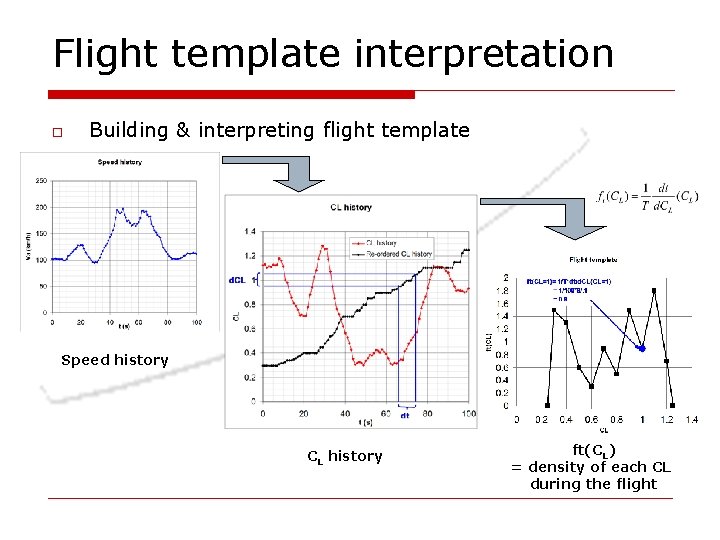
Flight template interpretation o Building & interpreting flight template Speed history CL history ft(CL) = density of each CL during the flight
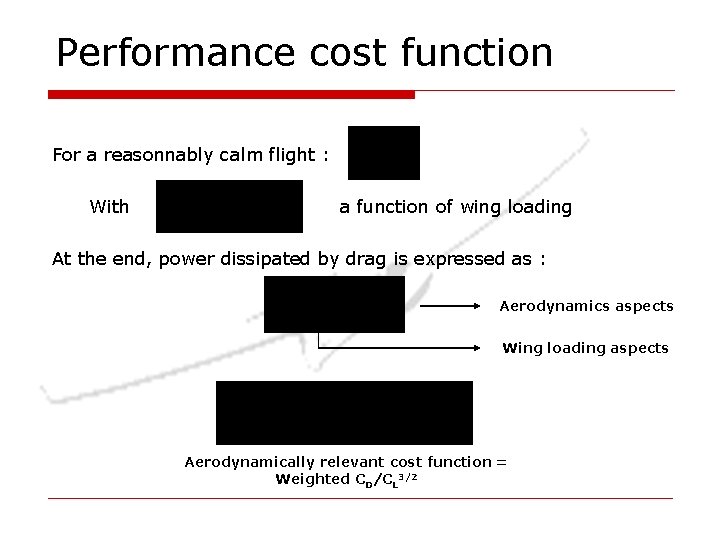
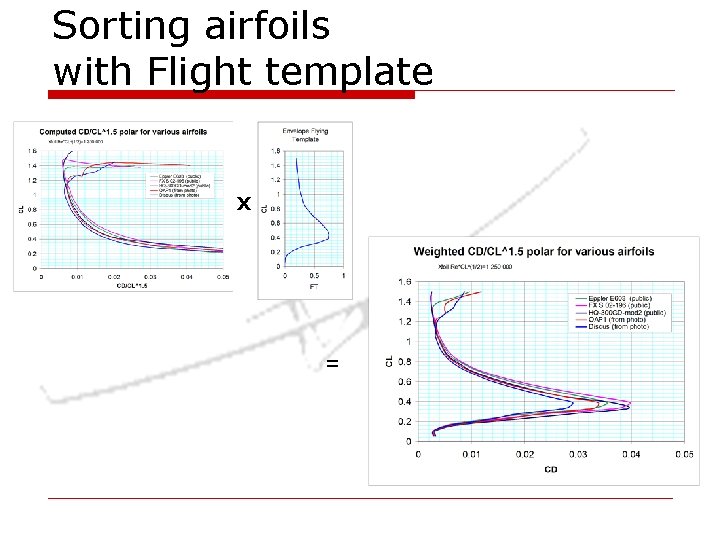
Performance cost function For a reasonnably calm flight : With a function of wing loading At the end, power dissipated by drag is expressed as : Aerodynamics aspects Wing loading aspects Aerodynamically relevant cost function = Weighted CD/CL 3/2
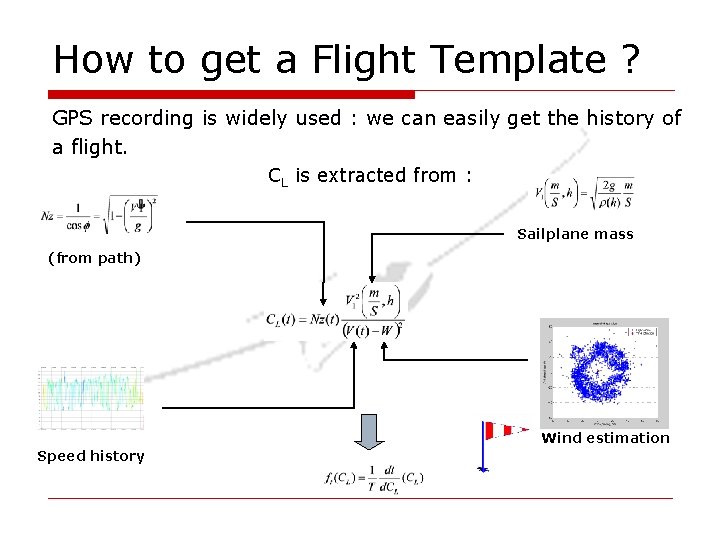
How to get a Flight Template ? GPS recording is widely used : we can easily get the history of a flight. CL is extracted from : Sailplane mass (from path) Wind estimation Speed history
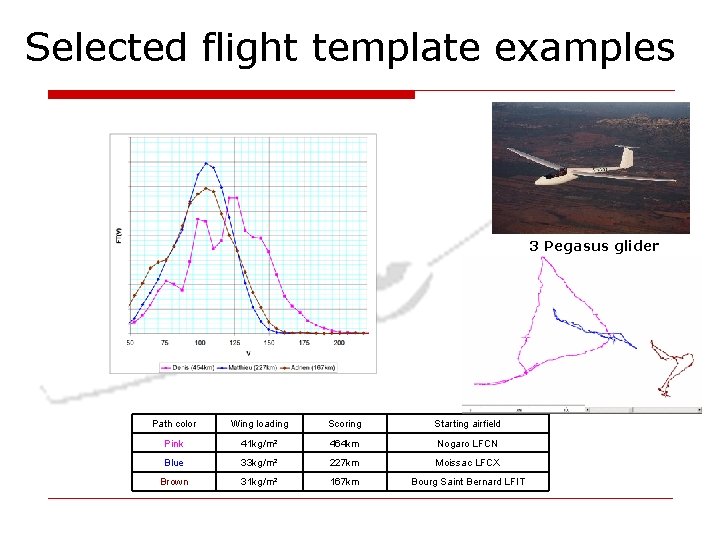
Selected flight template examples 3 Pegasus glider Path color Wing loading Scoring Starting airfield Pink 41 kg/m² 464 km Nogaro LFCN Blue 33 kg/m² 227 km Moissac LFCX Brown 31 kg/m² 167 km Bourg Saint Bernard LFIT
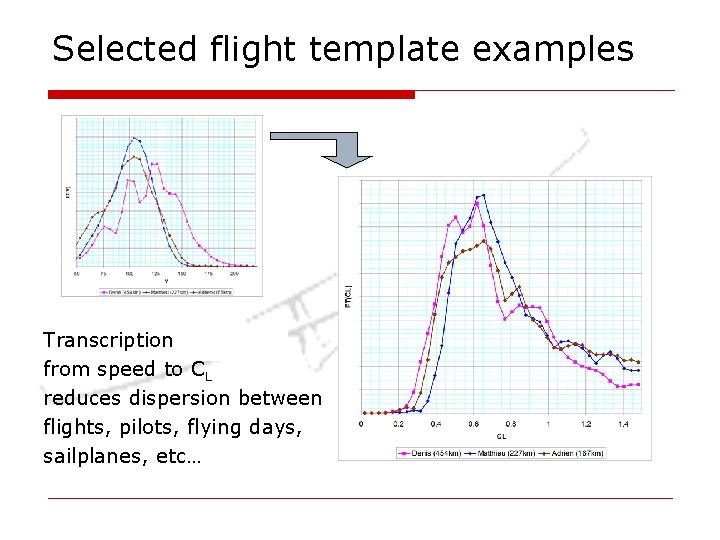
Selected flight template examples Transcription from speed to CL reduces dispersion between flights, pilots, flying days, sailplanes, etc…
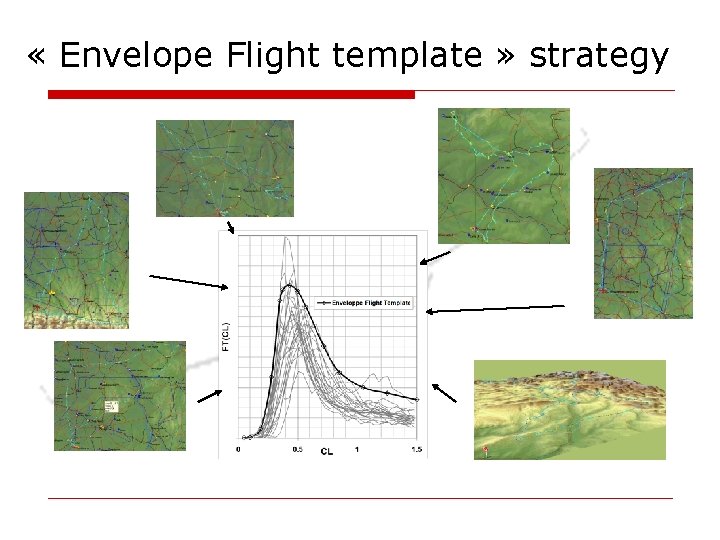
« Envelope Flight template » strategy
Using Flight Templates For airfoil selection For AR selection For airfoil optimization
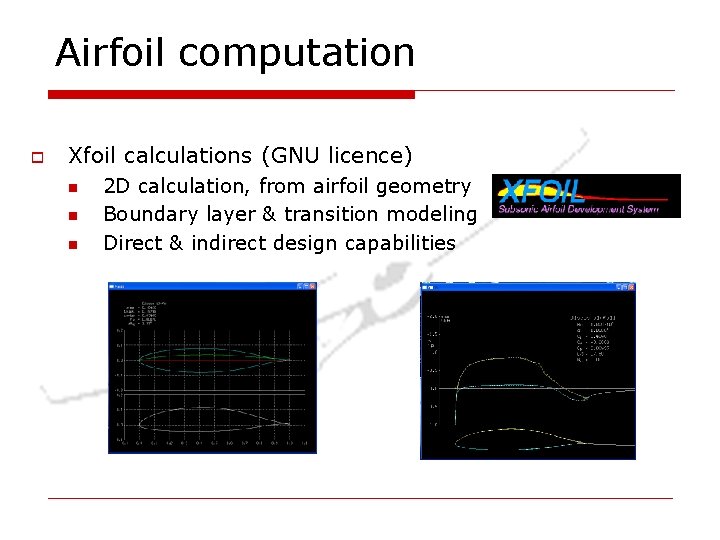
Airfoil computation o Xfoil calculations (GNU licence) n n n 2 D calculation, from airfoil geometry Boundary layer & transition modeling Direct & indirect design capabilities
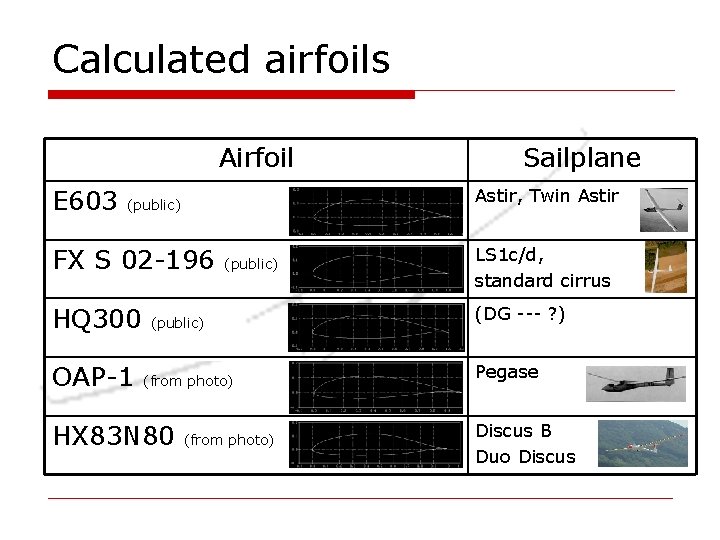
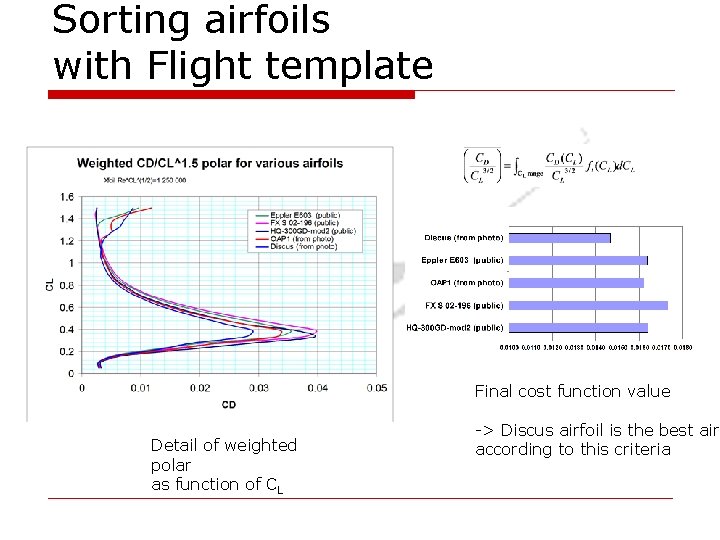
Calculated airfoils Airfoil Sailplane E 603 (public) Astir, Twin Astir FX S 02 -196 (public) LS 1 c/d, standard cirrus HQ 300 (public) (DG --- ? ) OAP-1 (from photo) Pegase HX 83 N 80 (from photo) Discus B Duo Discus
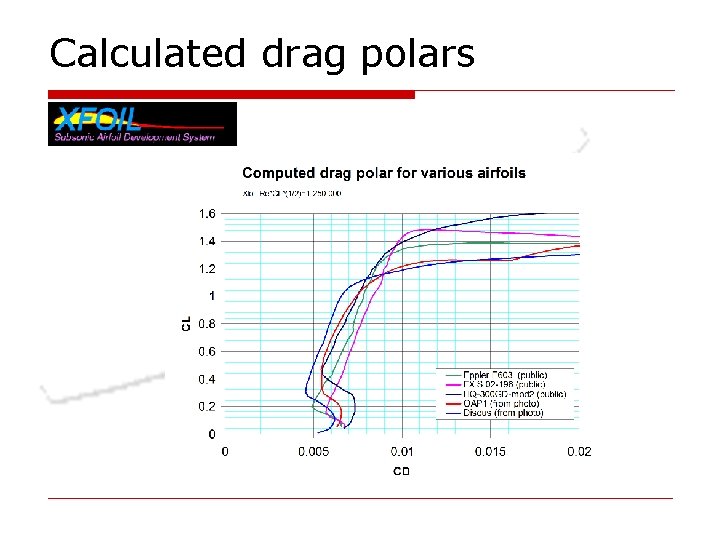
Calculated drag polars
Sorting airfoils with Flight template X =
Sorting airfoils with Flight template Final cost function value Detail of weighted polar as function of CL -> Discus airfoil is the best airf according to this criteria
Using Flight Templates For airfoil selection For AR selection For airfoil optimization
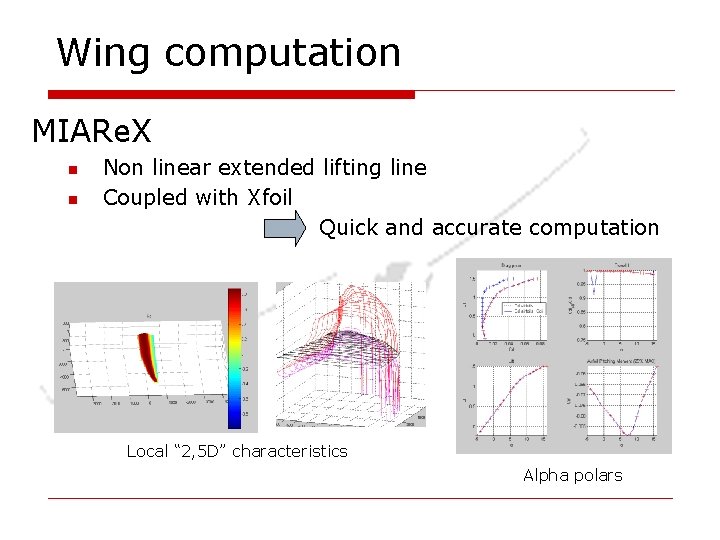
Wing computation MIARe. X n n Non linear extended lifting line Coupled with Xfoil Quick and accurate computation Local “ 2, 5 D” characteristics Alpha polars
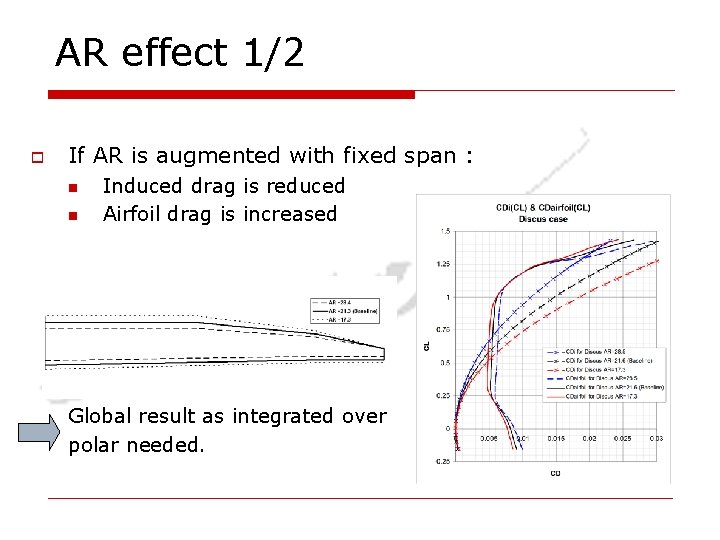
AR effect 1/2 o If AR is augmented with fixed span : n n Induced drag is reduced Airfoil drag is increased Global result as integrated over polar needed.
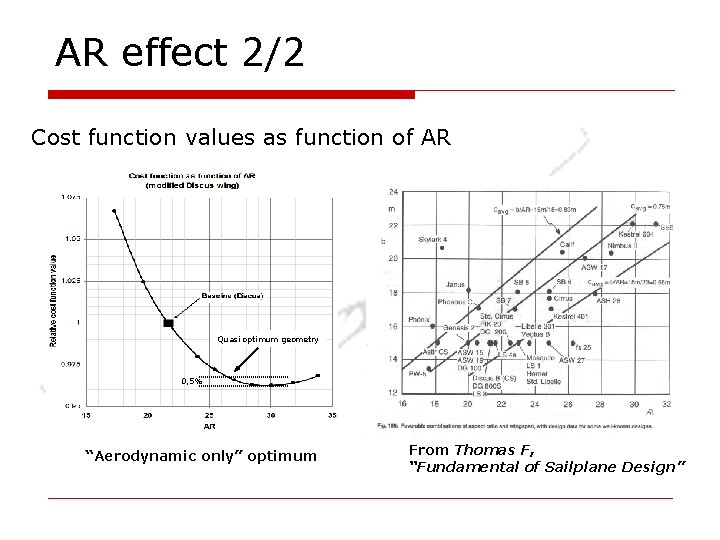
AR effect 2/2 Cost function values as function of AR Quasi optimum geometry 0, 5% “Aerodynamic only” optimum From Thomas F, “Fundamental of Sailplane Design”
Using Flight Templates For airfoil selection For AR selection For airfoil optimization
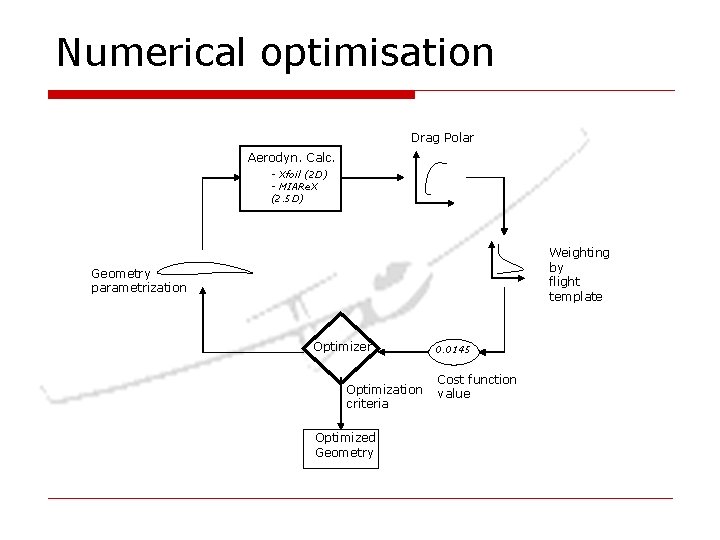
Numerical optimisation Drag Polar Aerodyn. Calc. - Xfoil (2 D) - MIARe. X (2. 5 D) Weighting by flight template Geometry parametrization Optimizer 0. 0145 Cost function Optimization value criteria Optimized Geometry
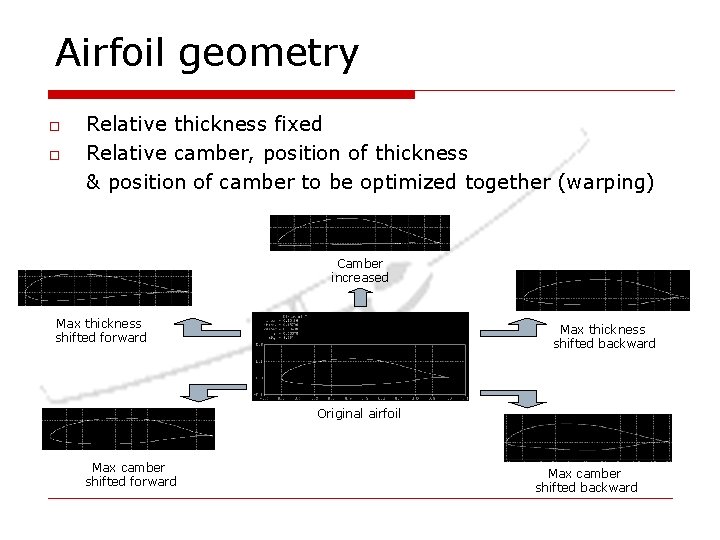
Airfoil geometry o o Relative thickness fixed Relative camber, position of thickness & position of camber to be optimized together (warping) Camber increased Max thickness shifted forward Max thickness shifted backward Original airfoil Max camber shifted forward Max camber shifted backward
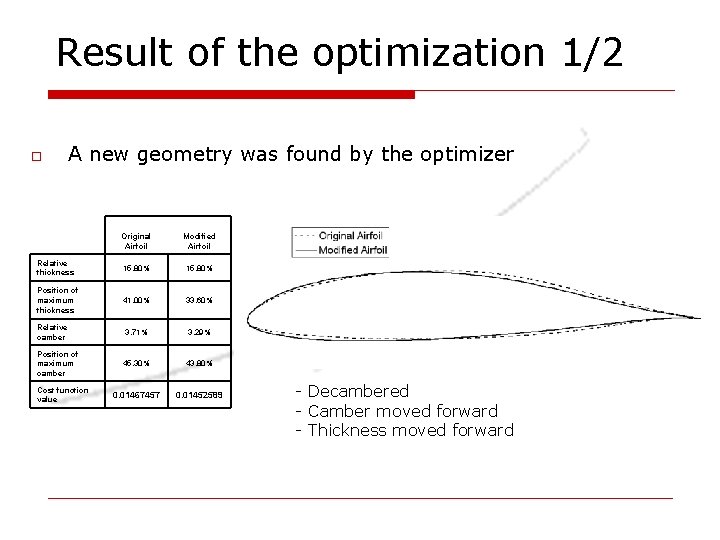
Result of the optimization 1/2 o A new geometry was found by the optimizer Original Airfoil Modified Airfoil Relative thickness 15. 80% Position of maximum thickness 41. 00% 33. 60% Relative camber 3. 71% 3. 29% Position of maximum camber 45. 30% 43. 80% 0. 01467457 0. 01452589 Cost function value - Decambered - Camber moved forward - Thickness moved forward
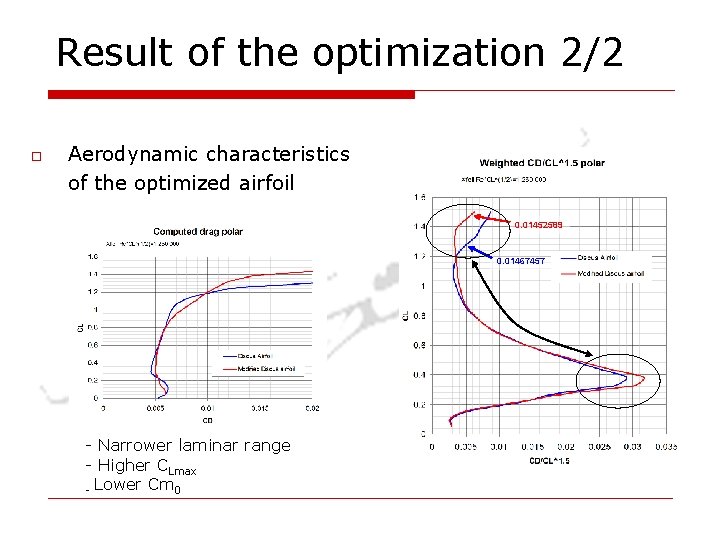
Result of the optimization 2/2 o Aerodynamic characteristics of the optimized airfoil 0. 01452589 0. 01467457 - Narrower laminar range - Higher CLmax - Lower Cm 0
Conclusion
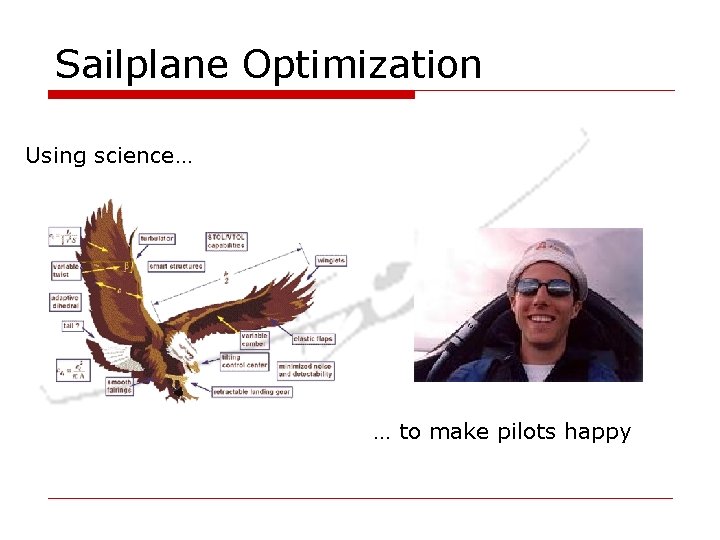
Sailplane Optimization Using science… … to make pilots happy
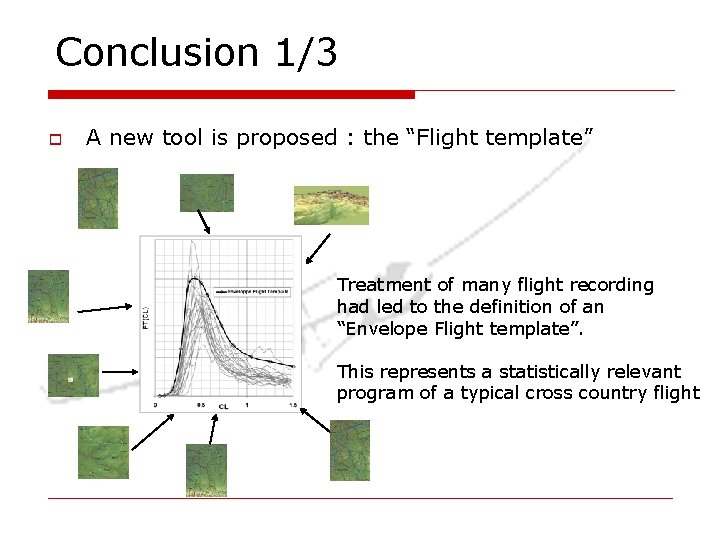
Conclusion 1/3 o A new tool is proposed : the “Flight template” Treatment of many flight recording had led to the definition of an “Envelope Flight template”. This represents a statistically relevant program of a typical cross country flight
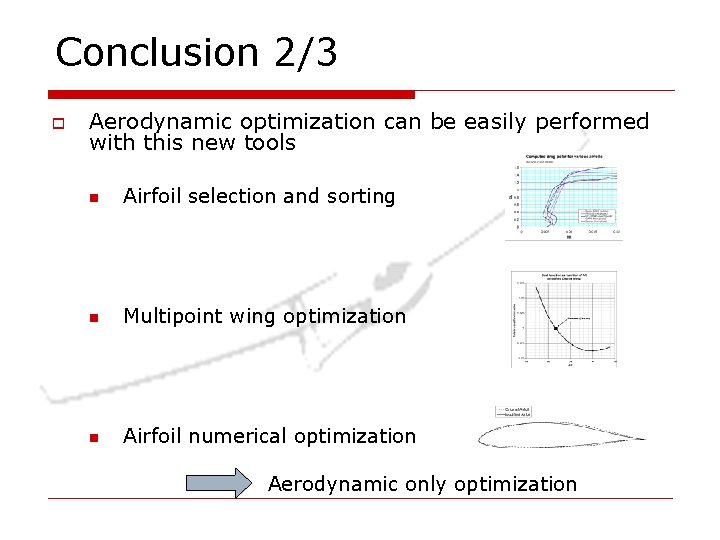
Conclusion 2/3 o Aerodynamic optimization can be easily performed with this new tools n Airfoil selection and sorting n Multipoint wing optimization n Airfoil numerical optimization Aerodynamic only optimization
Conclusion 3/3 o Way forward : Using the Flight template for computing aerodynamic performance, coupled with other disciplines for a multidisciplinary optimization process. Objective : optimizing the sailplane as a whole thing, and not only its aerodynamic.
Questions ? o Have nice flights ! Matthieu. scherrer@free. fr