
The Flat Dilatometer Test DMT Design Applications and

- Slides: 28
The Flat Dilatometer Test (DMT): Design Applications and Recent Developments P. Monaco, S. Marchetti & G. Totani University of L'Aquila, Italy
KEY DMT REFERENCES ORIGINAL PAPER MARCHETTI S. (1980). In Situ Tests by Flat Dilatometer. J. Geotech. Engrg. Div. ASCE, 106(GT 3), 299 -321 STANDARDS ASTM D 6635 -01 (2001). Standard Test Method for Performing the Flat Plate Dilatometer. EUROCODE 7 – Geotechnical Design – Part 2: Ground Investigation and Testing. EN 1997 -2: 2007 SOA REPORT TC 16 (2001). The Flat Dilatometer Test (DMT) in Soil Investigations. May 2001, 41 pp. Reprint in Proc. 2 nd Int. Conf. on Flat Dilatometer, Washington D. C. , 7 -48 INTERNET www. marchetti-dmt. it biblio site (download papers)
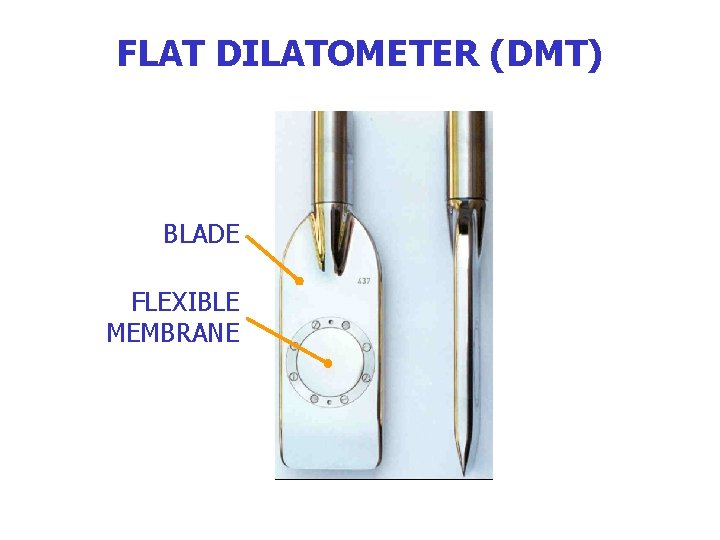
FLAT DILATOMETER (DMT) BLADE FLEXIBLE MEMBRANE
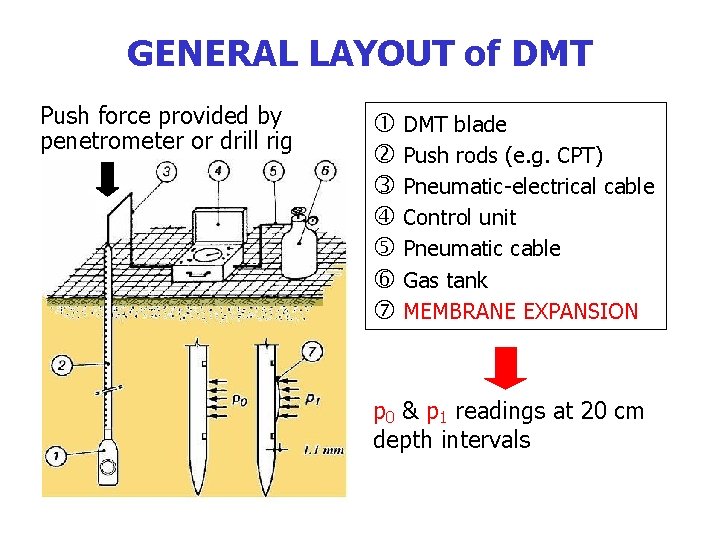
GENERAL LAYOUT of DMT Push force provided by penetrometer or drill rig DMT blade Push rods (e. g. CPT) Pneumatic-electrical cable Control unit Pneumatic cable Gas tank MEMBRANE EXPANSION p 0 & p 1 readings at 20 cm depth intervals
SOILS that can be TESTED by DMT n CLAY, SILT, SAND – But can cross through GRAVEL layers 0. 5 m n Soils from VERY SOFT to VERY STIFF (upper limit is push capacity of rig) Clays: Cu = 2 -4 to 1000 k. Pa (marls) Moduli: up to 400 MPa
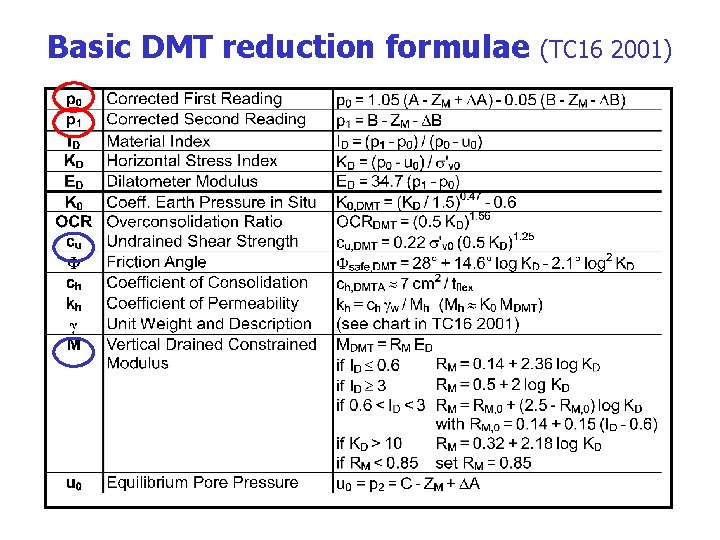
Basic DMT reduction formulae (TC 16 2001)
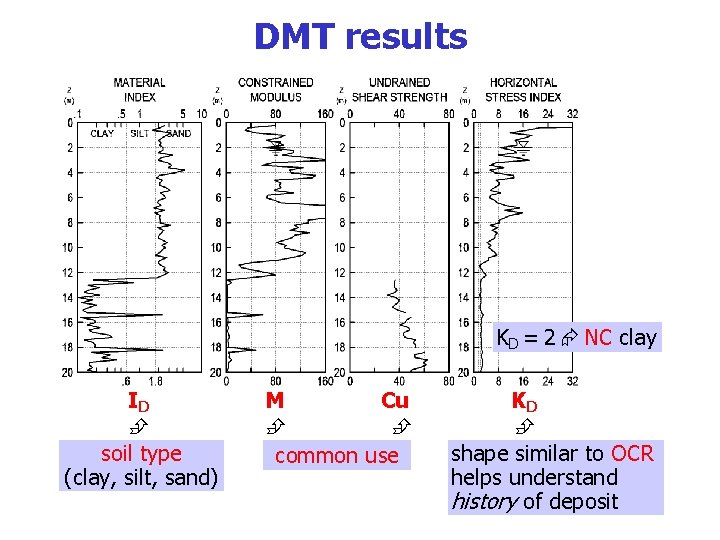
DMT results KD = 2 NC clay ID soil type (clay, silt, sand) M Cu common use KD shape similar to OCR helps understand history of deposit
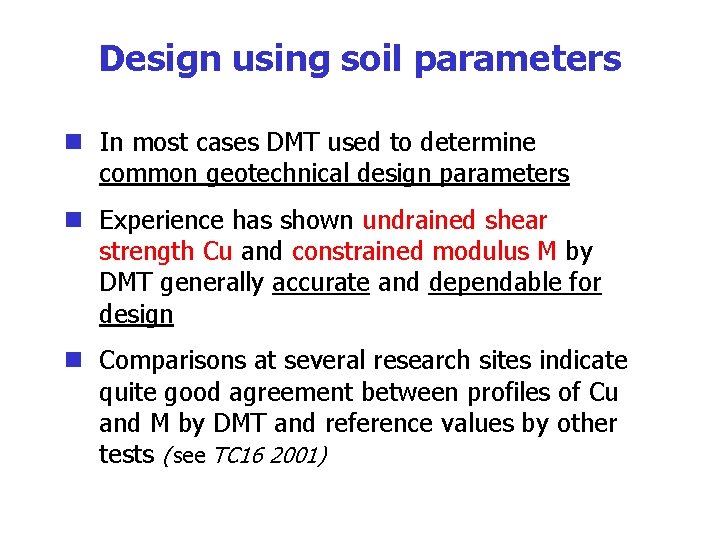
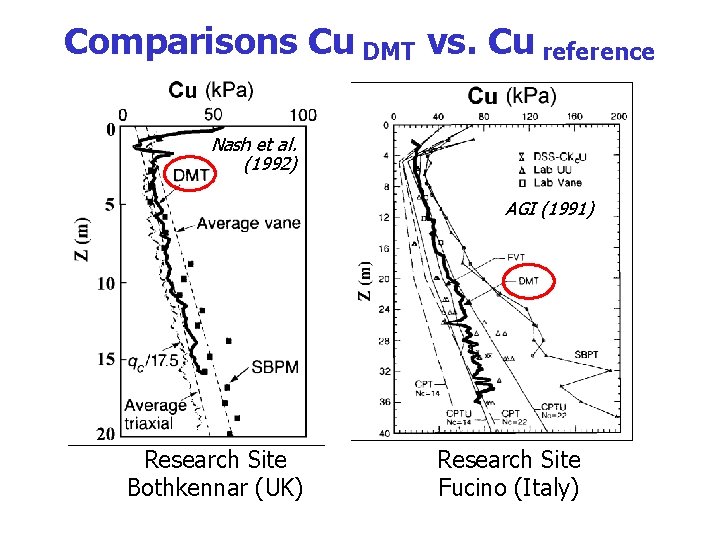
Design using soil parameters n In most cases DMT used to determine common geotechnical design parameters n Experience has shown undrained shear strength Cu and constrained modulus M by DMT generally accurate and dependable for design n Comparisons at several research sites indicate quite good agreement between profiles of Cu and M by DMT and reference values by other tests ( see TC 16 2001)
Comparisons Cu DMT vs. Cu reference Nash et al. (1992) AGI (1991) Research Site Bothkennar (UK) Research Site Fucino (Italy)
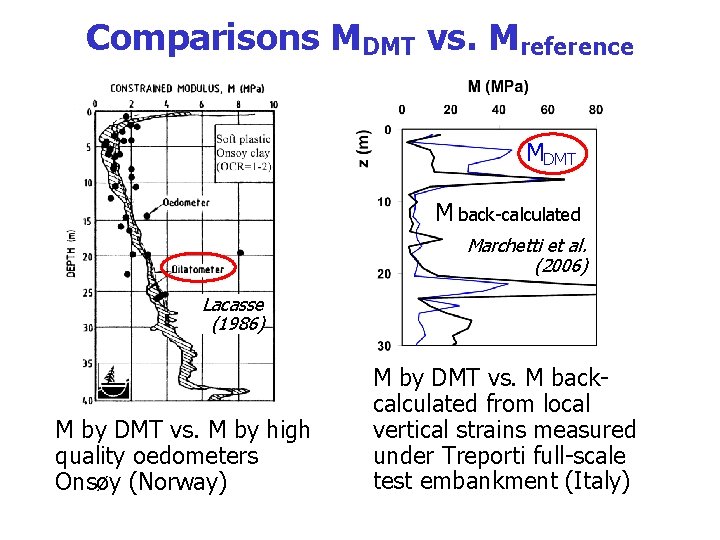
Comparisons MDMT vs. Mreference MDMT M back-calculated Marchetti et al. (2006) Lacasse (1986) M by DMT vs. M by high quality oedometers Onsøy (Norway) M by DMT vs. M backcalculated from local vertical strains measured under Treporti full-scale test embankment (Italy)
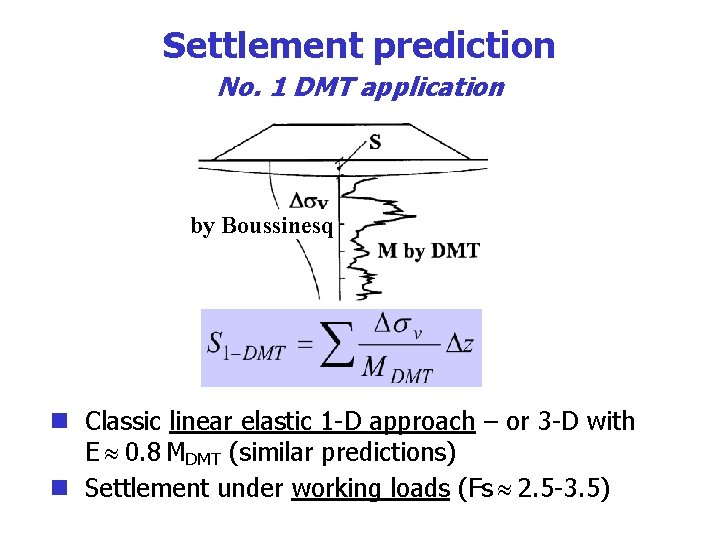
Settlement prediction No. 1 DMT application by Boussinesq n Classic linear elastic 1 -D approach – or 3 -D with E 0. 8 MDMT (similar predictions) n Settlement under working loads (Fs 2. 5 -3. 5)
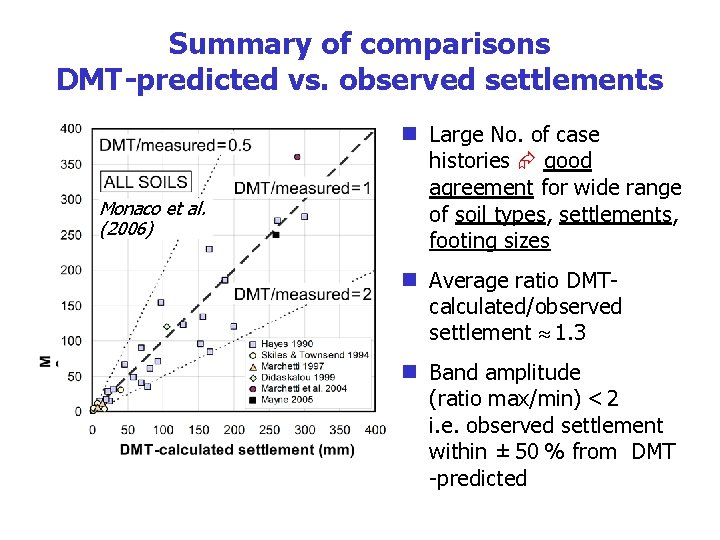
Summary of comparisons DMT-predicted vs. observed settlements Monaco et al. (2006) n Large No. of case histories good agreement for wide range of soil types, settlements, footing sizes n Average ratio DMTcalculated/observed settlement 1. 3 n Band amplitude (ratio max/min) < 2 i. e. observed settlement within ± 50 % from DMT -predicted
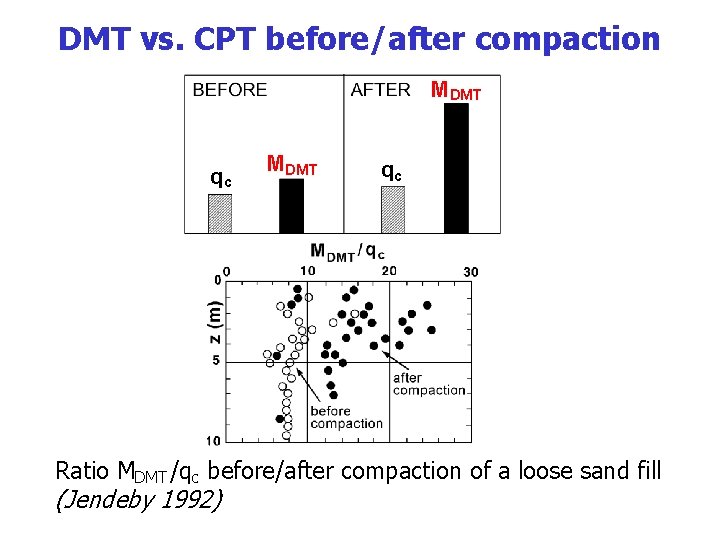
Compaction control n Experience suggests DMT well suited to detect BENEFITS of SOIL IMPROVEMENT due to its high sensitivity to changes of stresses/density in soil n Several comparisons of CPT and DMT before/after compaction Schmertmann et al. (1986), Jendeby (1992) increase in MDMT after compaction of sand 2 increase in qc (CPT) Pasqualini & Rosi (1993). . .
DMT vs. CPT before/after compaction MDMT qc Ratio MDMT /qc before/after compaction of a loose sand fill (Jendeby 1992)
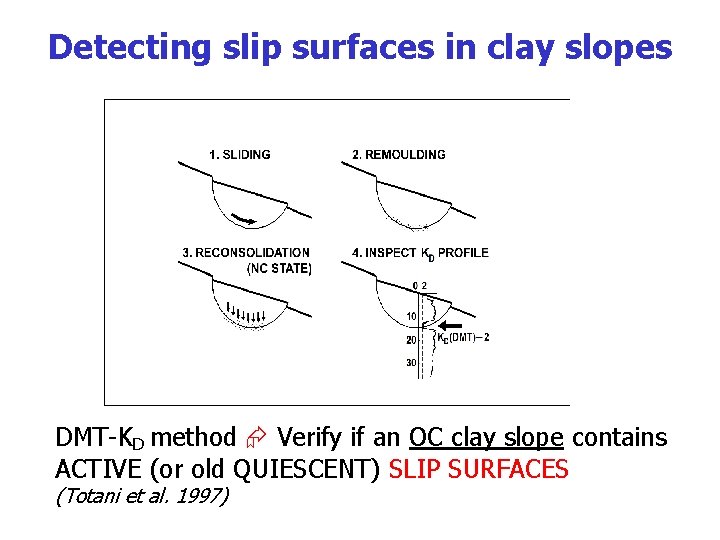
Detecting slip surfaces in clay slopes DMT-KD method Verify if an OC clay slope contains ACTIVE (or old QUIESCENT) SLIP SURFACES (Totani et al. 1997)
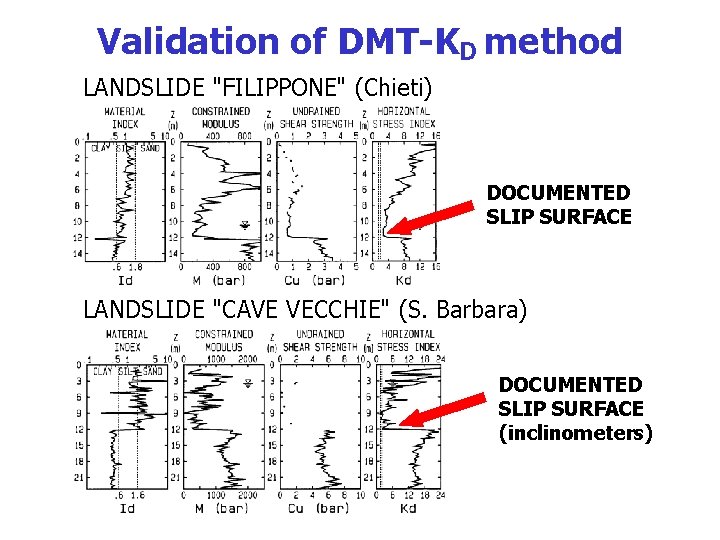
Validation of DMT-KD method LANDSLIDE "FILIPPONE" (Chieti) DOCUMENTED SLIP SURFACE LANDSLIDE "CAVE VECCHIE" (S. Barbara) DOCUMENTED SLIP SURFACE (inclinometers)
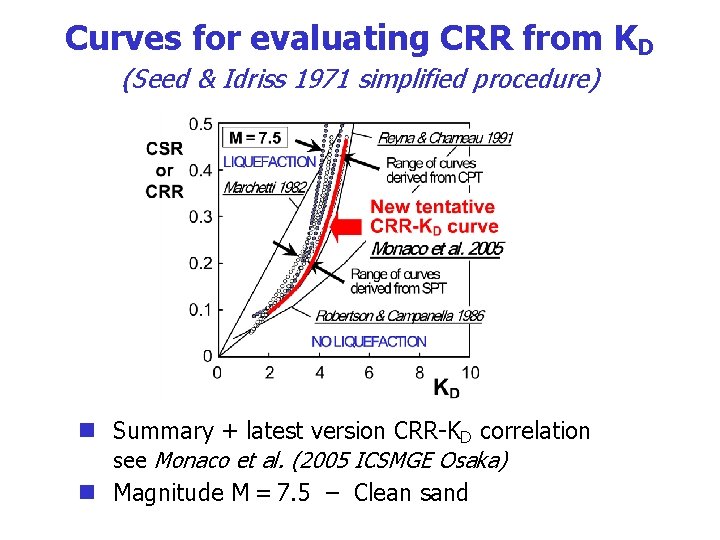
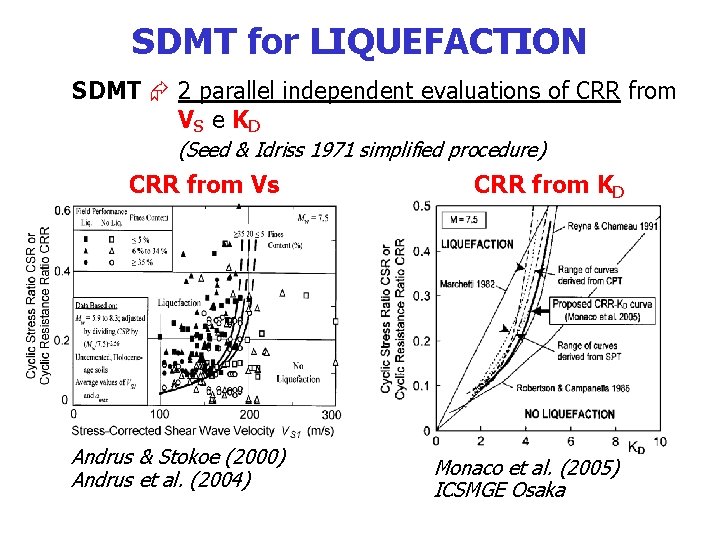
DMT for LIQUEFACTION n Correlations for evaluating Cyclic Resistance Ratio CRR from KD developed in past 2 decades, stimulated by: – Sensitivity of KD to factors known to increase liquefaction resistance: Stress History, prestraining/aging, cementation, structure … – Correlation KD – Relative Density – Correlation KD – In situ State Parameter n Key element supporting well-based CRR-KD correlation: ability of KD to reflect aging in sands (1 st order of magnitude influence on liquefaction) + sensitivity of KD to non-textbook OCR crusts in sands
Curves for evaluating CRR from KD (Seed & Idriss 1971 simplified procedure) n Summary + latest version CRR-KD correlation see Monaco et al. (2005 ICSMGE Osaka) n Magnitude M = 7. 5 – Clean sand
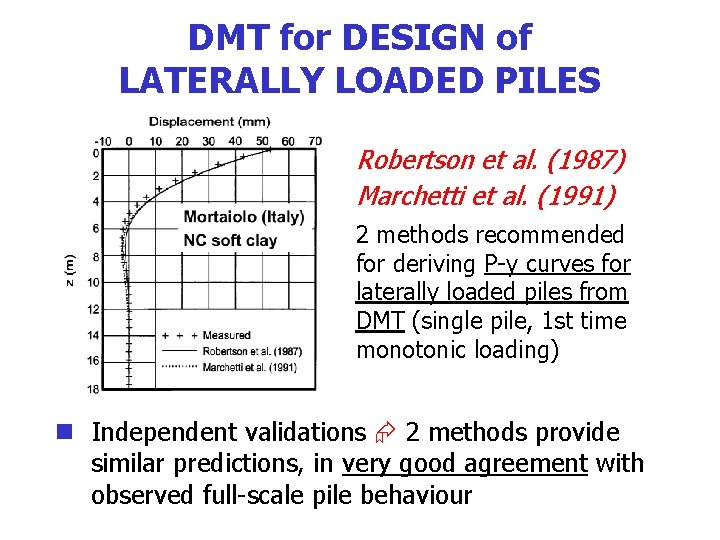
DMT for DESIGN of LATERALLY LOADED PILES Robertson et al. (1987) Marchetti et al. (1991) 2 methods recommended for deriving P-y curves for laterally loaded piles from DMT (single pile, 1 st time monotonic loading) n Independent validations 2 methods provide similar predictions, in very good agreement with observed full-scale pile behaviour
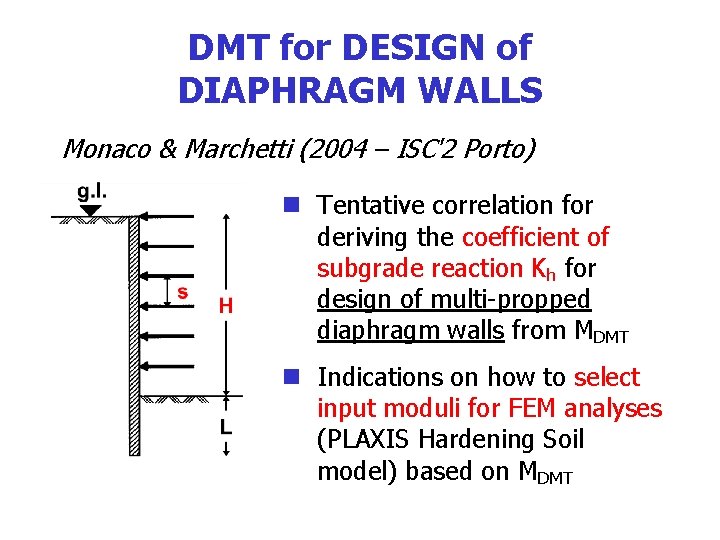
DMT for DESIGN of DIAPHRAGM WALLS Monaco & Marchetti (2004 – ISC'2 Porto) n Tentative correlation for deriving the coefficient of subgrade reaction Kh for design of multi-propped diaphragm walls from MDMT n Indications on how to select input moduli for FEM analyses (PLAXIS Hardening Soil model) based on MDMT
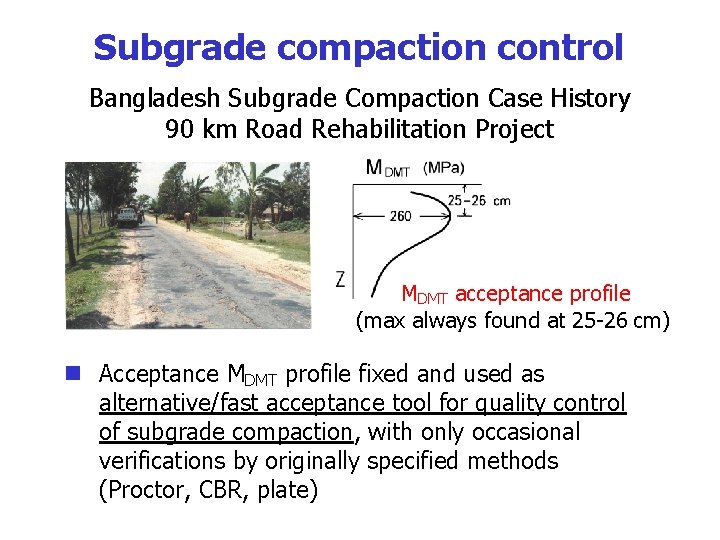
Subgrade compaction control Bangladesh Subgrade Compaction Case History 90 km Road Rehabilitation Project MDMT acceptance profile (max always found at 25 -26 cm) n Acceptance MDMT profile fixed and used as alternative/fast acceptance tool for quality control of subgrade compaction, with only occasional verifications by originally specified methods (Proctor, CBR, plate)
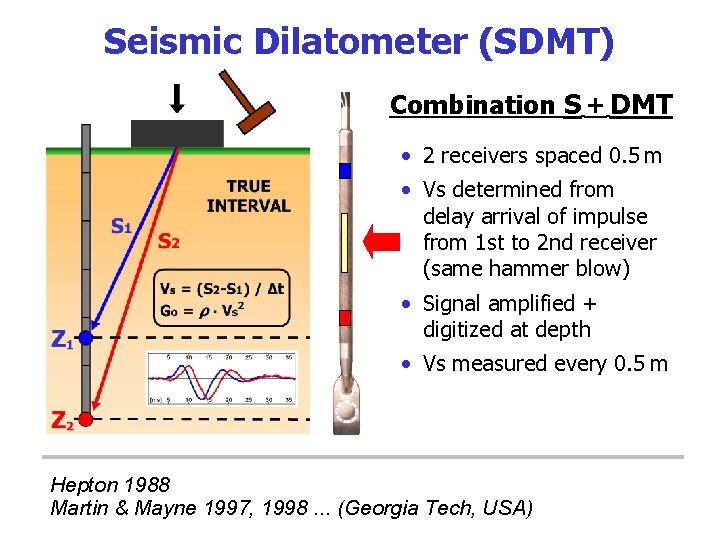
Seismic Dilatometer (SDMT) Combination S + DMT • 2 receivers spaced 0. 5 m • Vs determined from delay arrival of impulse from 1 st to 2 nd receiver (same hammer blow) • Signal amplified + digitized at depth • Vs measured every 0. 5 m Hepton 1988 Martin & Mayne 1997, 1998. . . (Georgia Tech, USA)
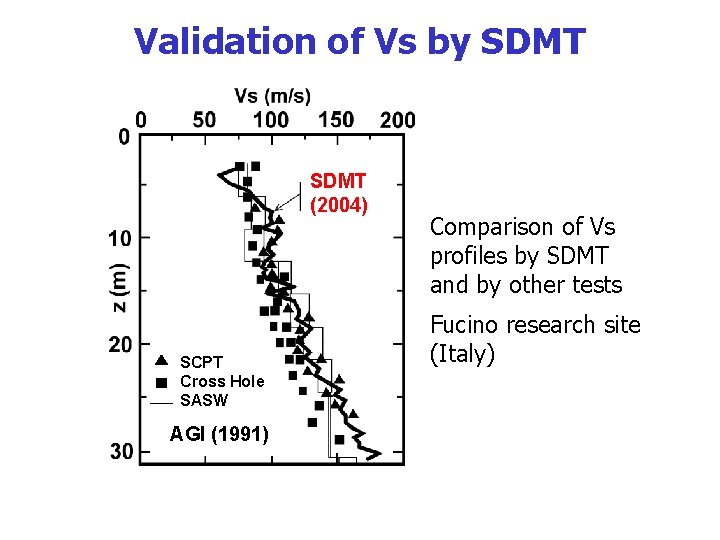
Validation of Vs by SDMT (2004) SCPT Cross Hole SASW AGI (1991) Comparison of Vs profiles by SDMT and by other tests Fucino research site (Italy)
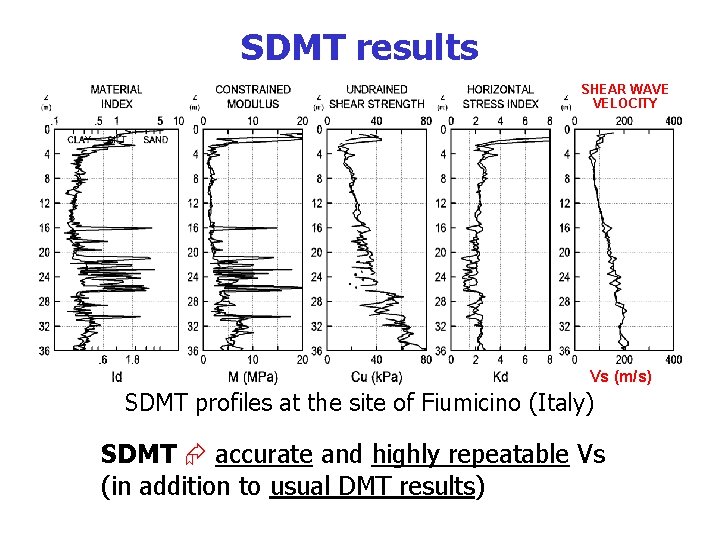
SDMT results SHEAR WAVE VELOCITY Vs (m/s) SDMT profiles at the site of Fiumicino (Italy) SDMT accurate and highly repeatable Vs (in addition to usual DMT results)
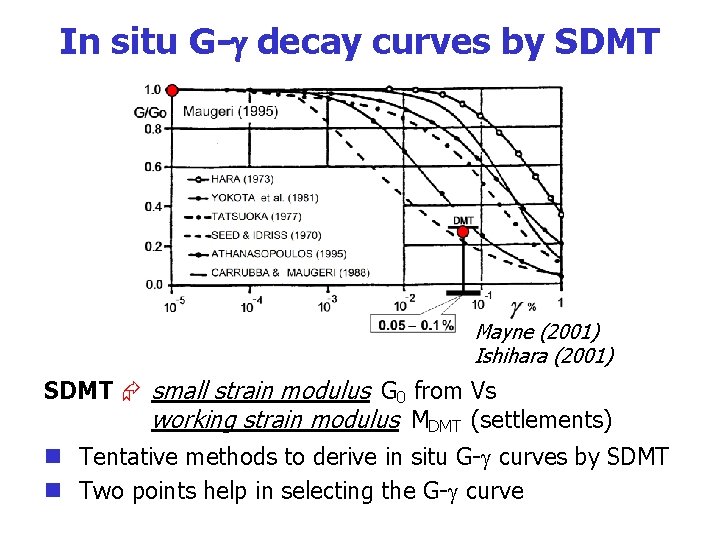
In situ G- decay curves by SDMT Mayne (2001) Ishihara (2001) SDMT small strain modulus G 0 from Vs working strain modulus MDMT (settlements) n Tentative methods to derive in situ G- curves by SDMT n Two points help in selecting the G- curve
SDMT for LIQUEFACTION SDMT 2 parallel independent evaluations of CRR from V S e KD (Seed & Idriss 1971 simplified procedure) CRR from Vs Andrus & Stokoe (2000) Andrus et al. (2004) CRR from KD Monaco et al. (2005) ICSMGE Osaka
FINAL REMARKS n DMT quick, simple, economical, highly reproducible in situ test n Executable with a variety of field equipment n Dependable estimates of various design parameters/information – – – soil type stress state/history constrained modulus M undrained shear strength Cu in clay consolidation/flow parameters. . .
FINAL REMARKS n Variety of design applications n Most effective vs. common penetration tests when settlements/deformations important for design (e. g. strict specs or need to decide: piles or shallow ? ) n SDMT accurate measurements of Vs (and G 0) + usual DMT results – greatly enhances DMT capability Special thanks to Allan Mc. Connell (IGS)