
THE FIVEPARAGRAPH ESSAY STRUCTURE A TEMPLATE FOR COLLEGE



- Slides: 12
THE FIVE-PARAGRAPH ESSAY STRUCTURE: A TEMPLATE FOR COLLEGE WRITING Professor Minnis
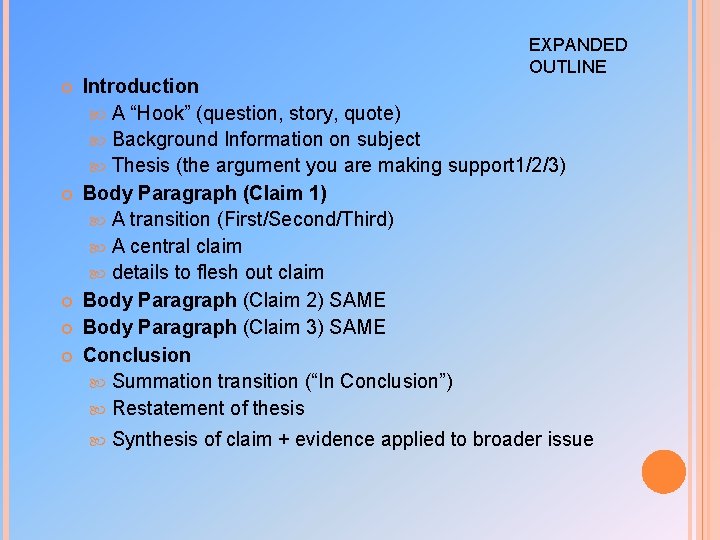
EXPANDED OUTLINE Introduction A “Hook” (question, story, quote) Background Information on subject Thesis (the argument you are making support 1/2/3) Body Paragraph (Claim 1) A transition (First/Second/Third) A central claim details to flesh out claim Body Paragraph (Claim 2) SAME Body Paragraph (Claim 3) SAME Conclusion Summation transition (“In Conclusion”) Restatement of thesis Synthesis of claim + evidence applied to broader issue
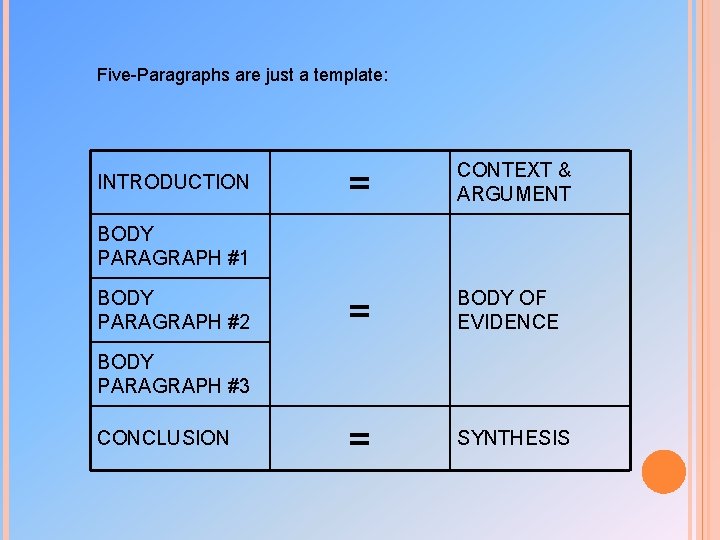
Five-Paragraphs are just a template: INTRODUCTION = CONTEXT & ARGUMENT = BODY OF EVIDENCE = SYNTHESIS BODY PARAGRAPH #1 BODY PARAGRAPH #2 BODY PARAGRAPH #3 CONCLUSION
DESCRIPTIVE WRITING
DESCRIPTIVE WRITING A descriptive essay tells what something looks like or what it feels like, sounds like, smells like or tastes like. You can use language to create a vivid impression for your readers. Your descriptions help to create a dominant impression - mood or quality – for your writing. Your descriptions may be objective or subjective.
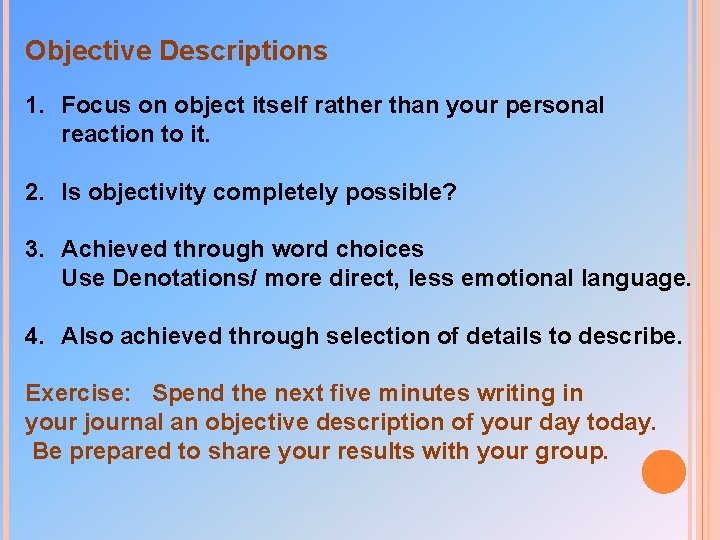
Objective Descriptions 1. Focus on object itself rather than your personal reaction to it. 2. Is objectivity completely possible? 3. Achieved through word choices Use Denotations/ more direct, less emotional language. 4. Also achieved through selection of details to describe. Exercise: Spend the next five minutes writing in your journal an objective description of your day today. Be prepared to share your results with your group.
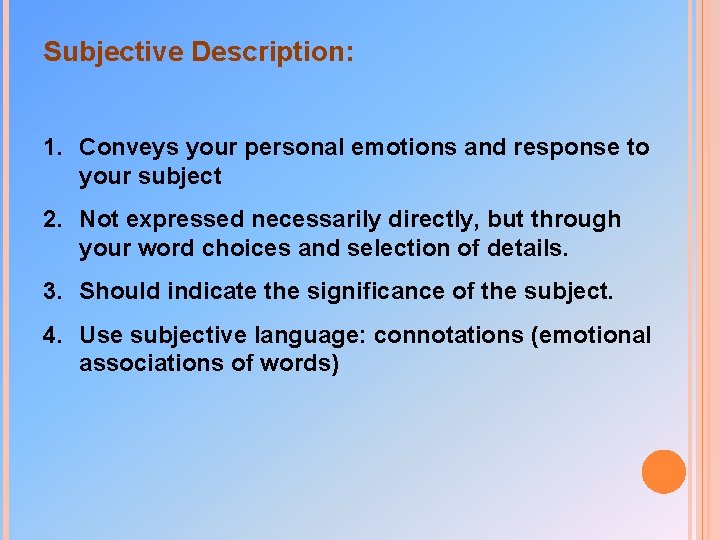
Subjective Description: 1. Conveys your personal emotions and response to your subject 2. Not expressed necessarily directly, but through your word choices and selection of details. 3. Should indicate the significance of the subject. 4. Use subjective language: connotations (emotional associations of words)
SUBJECTIVE CONTINUED… 5. Use figures of speech to compare dissimilar things: • Simile (something is like something else) • Metaphor (something is something else). • Personification: giving human characteristics to objects or animals. 6. Allusion: reference to a person, place, event or quotation that you assume the reader understands. Exercise: For the next five minutes, write a subjective version of your previous essay on your day today.
Selecting Details: In both objective and subjective writing, select specific details to describe. Example: You might say, “He looked angry. ” Or, you might say, “His face flushed, and one corner of his mouth twitched as he tried to control his anger. ” Imagery: describe using details that appeal to the five senses. Taste, touch, smell, feel and hear **************************************** Exercise: Look about the room: in your journal write for five minutes and describe this room. Give as many specific details as you can, and use imagery. You may decide whether to write objectively or subjectively. Be prepared to share your work with your group.
ORGANIZING A DESCRIPTIVE ESSAY Options: 1. Spatial order: describe an object or space as you move around or through it, from each perspective. 2. Order of impression: what do you notice first, second, etc. 3. Order of importance: what is the least important detail, what is the most? Whatever scheme you choose, remember that it must serve to support your thesis.
5 PARAGRAPH ORDER The essay uses the 5 paragraph order we have discussed today. Example: Main Topic-A restaurant Subtopics-food, décor, and service Conclusion-restate the events, final thought You will do a subjective description essay Due 3/21/13 800 -1000 words (1 -1 ½ pgs), typed-NR/Arial, double spaced, 12 font.
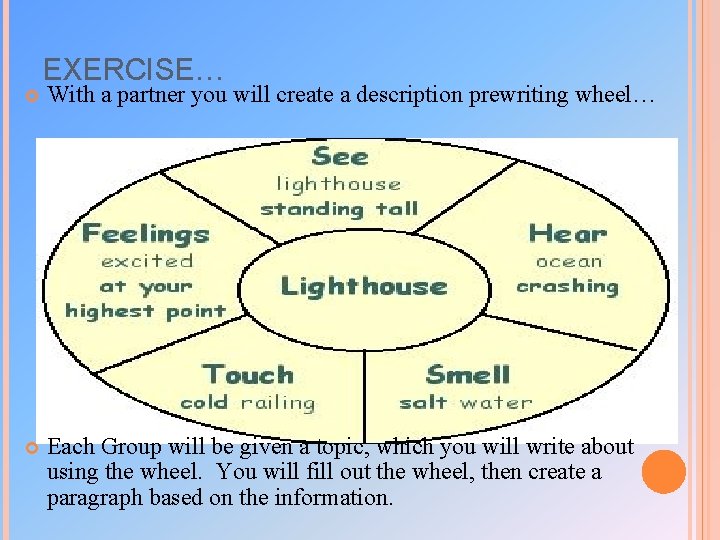
EXERCISE… With a partner you will create a description prewriting wheel… Each Group will be given a topic, which you will write about using the wheel. You will fill out the wheel, then create a paragraph based on the information.