
The FiveNumber Summary Lecture 18 Sec 5 3
The Five-Number Summary Lecture 18 Sec. 5. 3. 1 – 5. 3. 3 Tue, Sep 25, 2007
The Five-Number Summary n n A five-number summary of a sample or population consists of five numbers that divide the sample or population into four equal parts. These numbers are called the quartiles. ¨ 0 th Quartile = minimum. ¨ 1 st Quartile = Q 1. ¨ 2 nd Quartile = median. ¨ 3 rd Quartile = Q 3. ¨ 4 th Quartile = maximum.
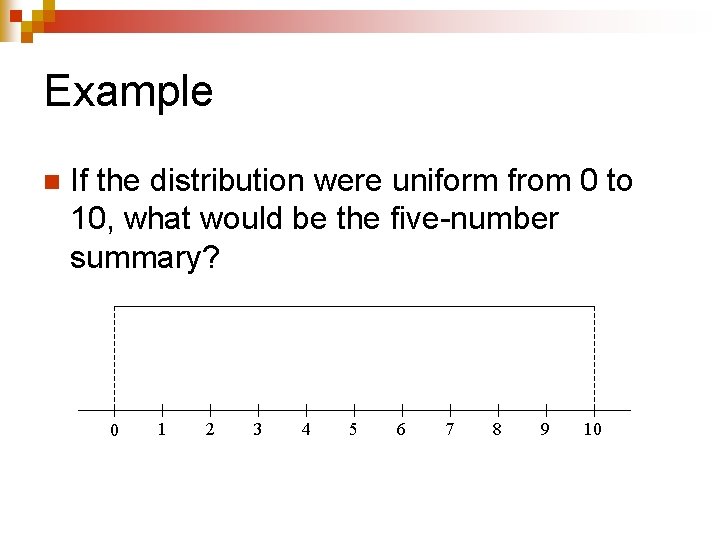
Example n If the distribution were uniform from 0 to 10, what would be the five-number summary? 0 1 2 3 4 5 6 7 8 9 10
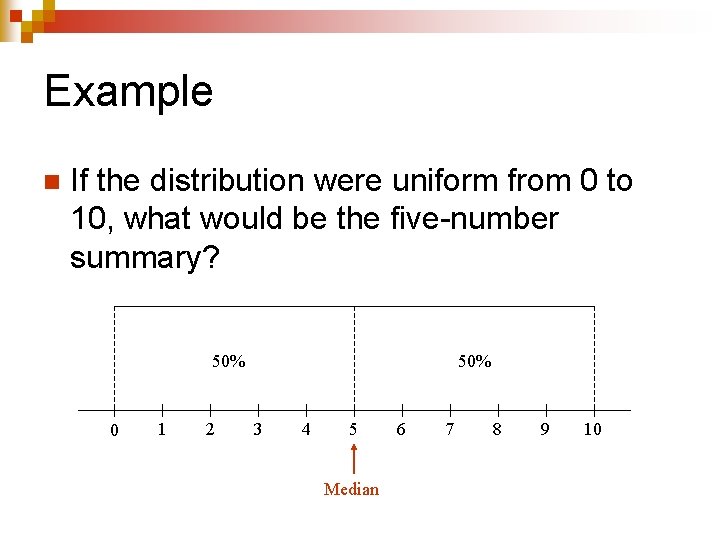
Example n If the distribution were uniform from 0 to 10, what would be the five-number summary? 50% 0 1 2 50% 3 4 5 Median 6 7 8 9 10
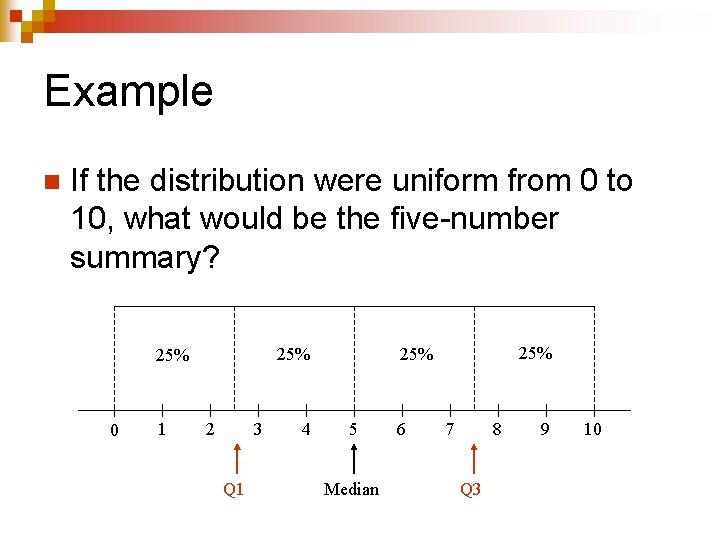
Example n If the distribution were uniform from 0 to 10, what would be the five-number summary? 0 1 2 3 Q 1 4 25% 25% 5 Median 6 7 8 Q 3 9 10

Example n Where would the median and quartiles be in this non-uniform distribution? 1 2 3 4 5 6 7
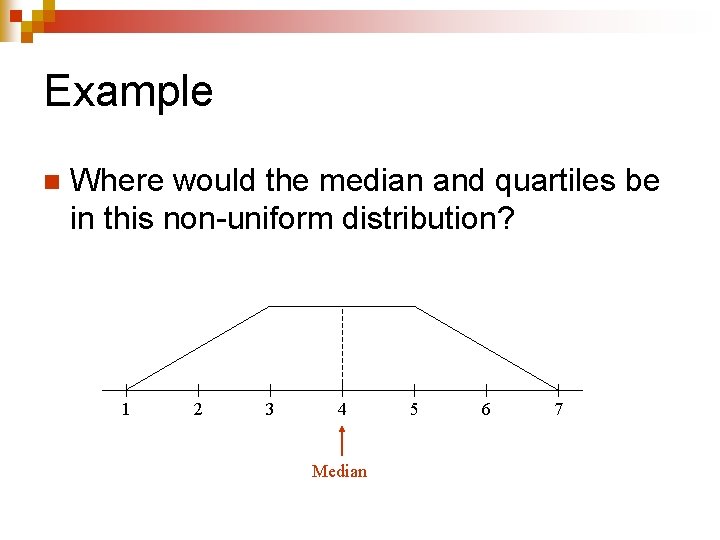
Example n Where would the median and quartiles be in this non-uniform distribution? 1 2 3 4 Median 5 6 7
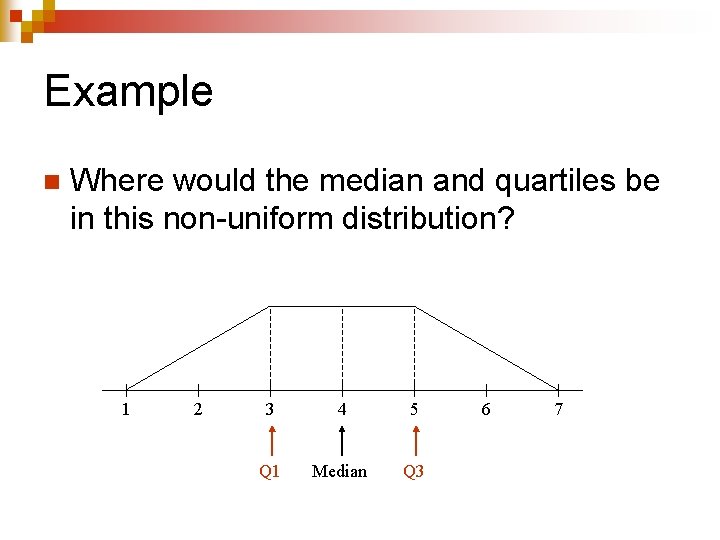
Example n Where would the median and quartiles be in this non-uniform distribution? 1 2 3 4 5 Q 1 Median Q 3 6 7
Percentiles – Textbook’s Method n The pth percentile – A value that separates the lower p% of a sample or population from the upper (100 – p)%. ¨ p% or more of the values fall at or below the pth percentile, and ¨ (100 – p)% or more of the values fall at or above the pth percentile.
Percentiles – Textbook’s Method n Find the quartiles of the following sample: 5, 8, 10, 15, 17, 19, 20, 24, 25, 30, 32.
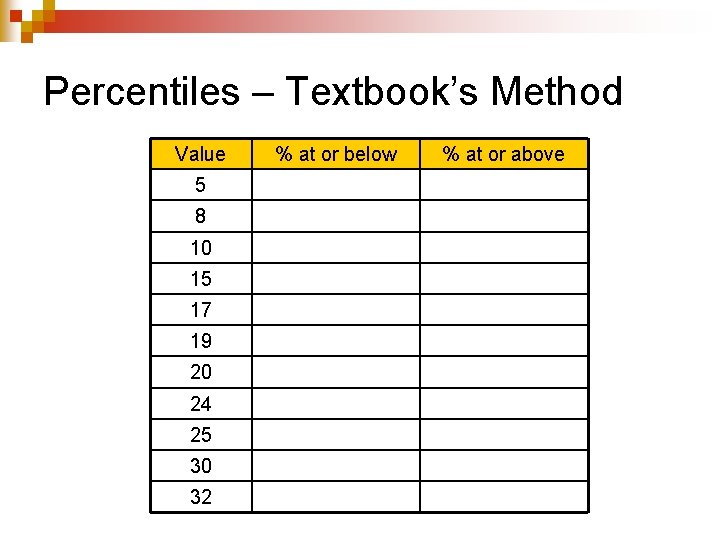
Percentiles – Textbook’s Method Value 5 8 10 15 17 19 20 24 25 30 32 % at or below % at or above
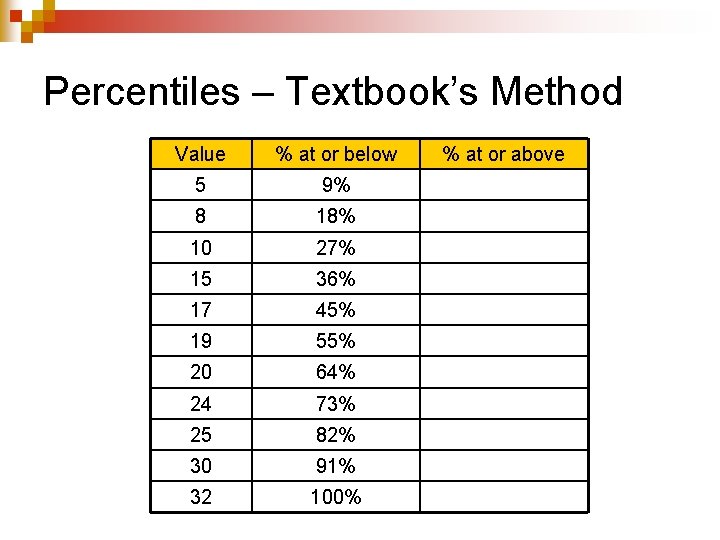
Percentiles – Textbook’s Method Value % at or below 5 9% 8 18% 10 27% 15 36% 17 45% 19 55% 20 64% 24 73% 25 82% 30 91% 32 100% % at or above
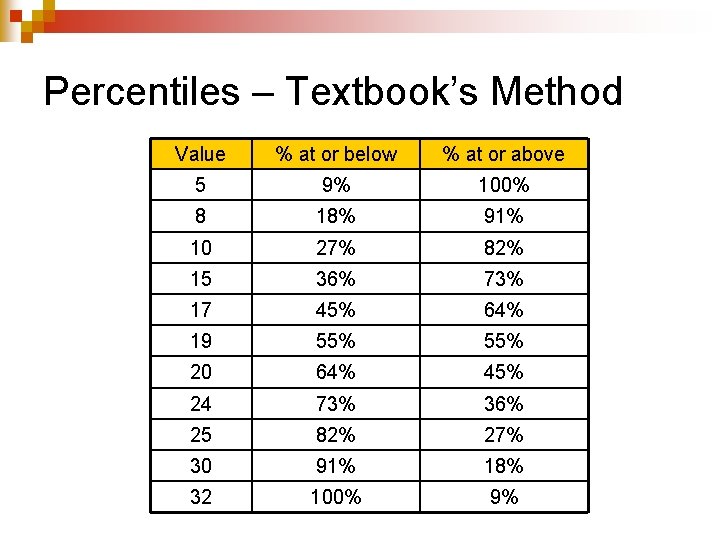
Percentiles – Textbook’s Method Value % at or below % at or above 5 9% 100% 8 18% 91% 10 27% 82% 15 36% 73% 17 45% 64% 19 55% 20 64% 45% 24 73% 36% 25 82% 27% 30 91% 18% 32 100% 9%
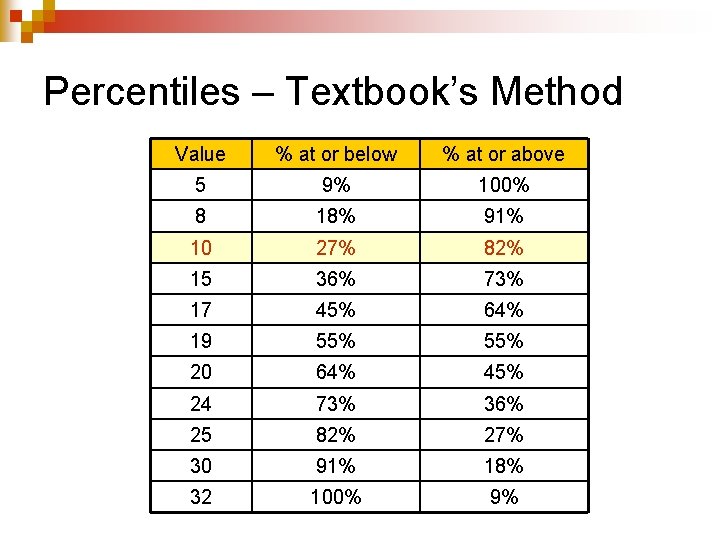
Percentiles – Textbook’s Method Value % at or below % at or above 5 9% 100% 8 18% 91% 10 27% 82% 15 36% 73% 17 45% 64% 19 55% 20 64% 45% 24 73% 36% 25 82% 27% 30 91% 18% 32 100% 9%
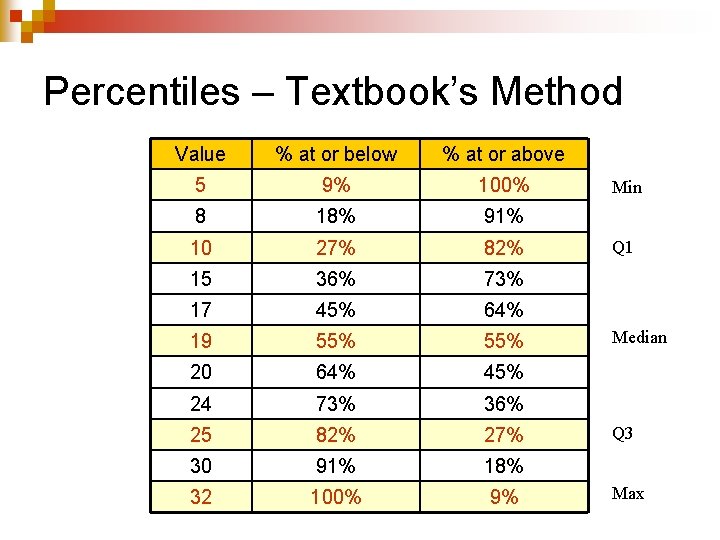
Percentiles – Textbook’s Method Value % at or below % at or above 5 9% 100% 8 18% 91% 10 27% 82% 15 36% 73% 17 45% 64% 19 55% 20 64% 45% 24 73% 36% 25 82% 27% 30 91% 18% 32 100% 9% Min Q 1 Median Q 3 Max
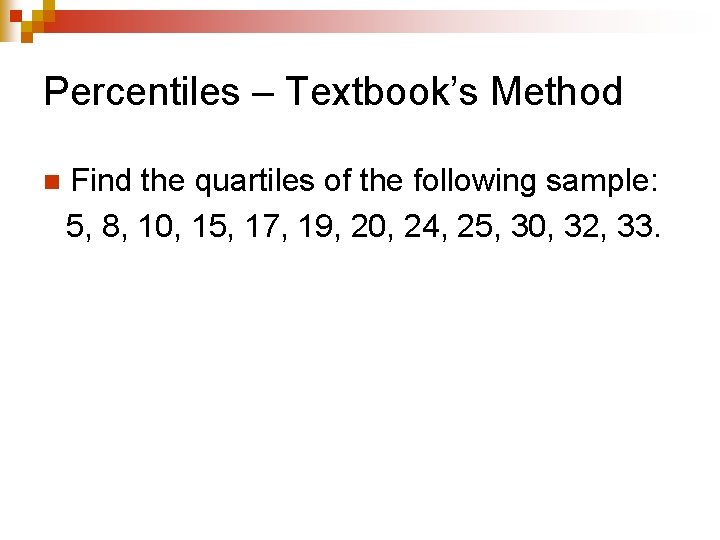
Percentiles – Textbook’s Method n Find the quartiles of the following sample: 5, 8, 10, 15, 17, 19, 20, 24, 25, 30, 32, 33.
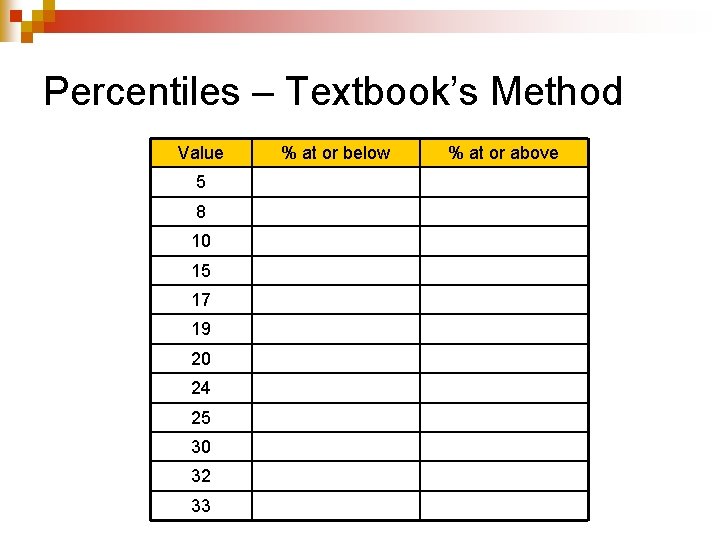
Percentiles – Textbook’s Method Value 5 8 10 15 17 19 20 24 25 30 32 33 % at or below % at or above
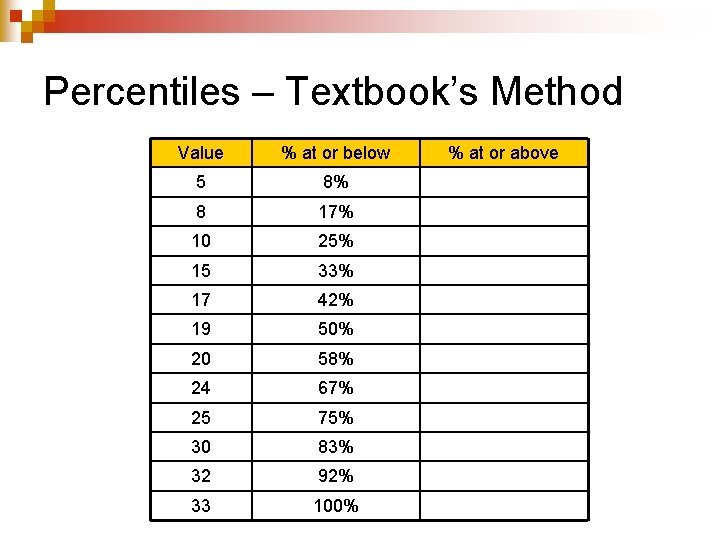
Percentiles – Textbook’s Method Value % at or below 5 8% 8 17% 10 25% 15 33% 17 42% 19 50% 20 58% 24 67% 25 75% 30 83% 32 92% 33 100% % at or above
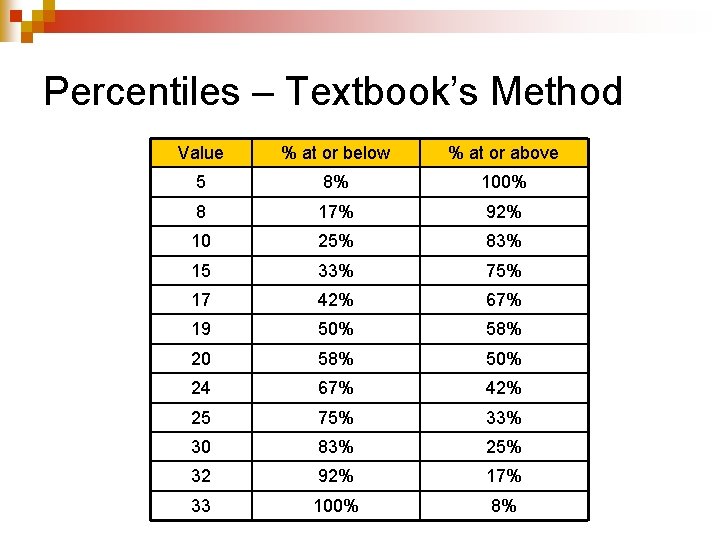
Percentiles – Textbook’s Method Value % at or below % at or above 5 8% 100% 8 17% 92% 10 25% 83% 15 33% 75% 17 42% 67% 19 50% 58% 20 58% 50% 24 67% 42% 25 75% 33% 30 83% 25% 32 92% 17% 33 100% 8%
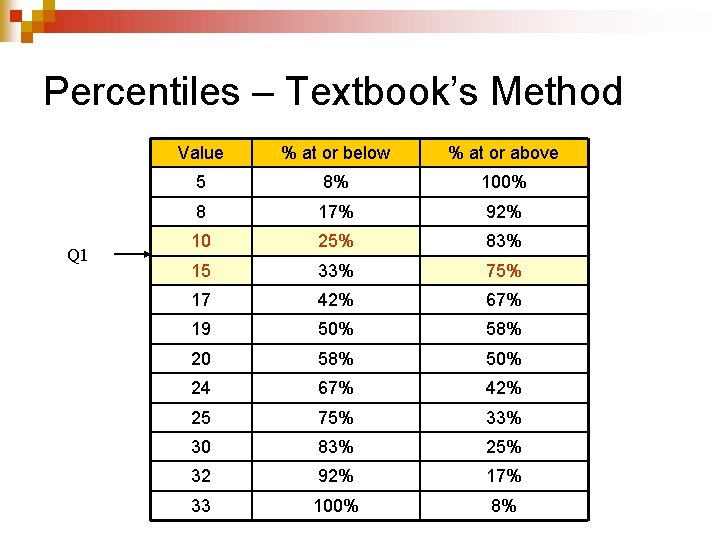
Percentiles – Textbook’s Method Q 1 Value % at or below % at or above 5 8% 100% 8 17% 92% 10 25% 83% 15 33% 75% 17 42% 67% 19 50% 58% 20 58% 50% 24 67% 42% 25 75% 33% 30 83% 25% 32 92% 17% 33 100% 8%
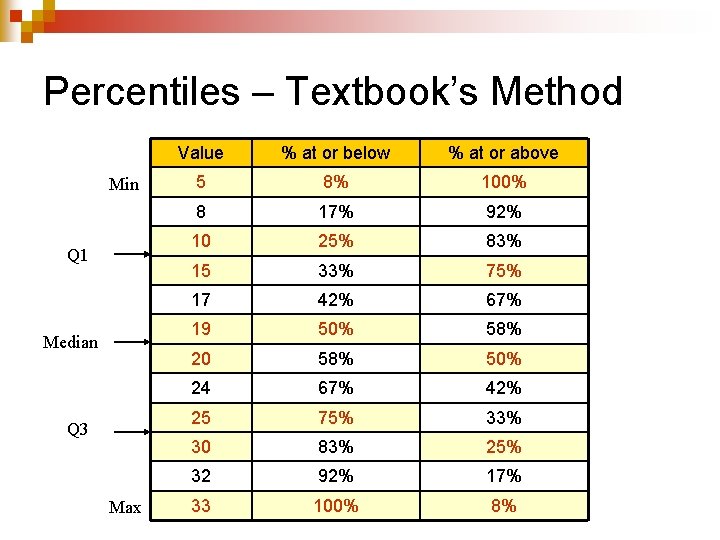
Percentiles – Textbook’s Method Min Q 1 Median Q 3 Max Value % at or below % at or above 5 8% 100% 8 17% 92% 10 25% 83% 15 33% 75% 17 42% 67% 19 50% 58% 20 58% 50% 24 67% 42% 25 75% 33% 30 83% 25% 32 92% 17% 33 100% 8%
TI-83 Quartiles To find the quartiles, first find the median (2 nd quartile). n Then the 1 st quartile is the “median” of all the numbers that are listed before the median. n The 3 rd quartile is the “median” of all the numbers that are listed after the median. n
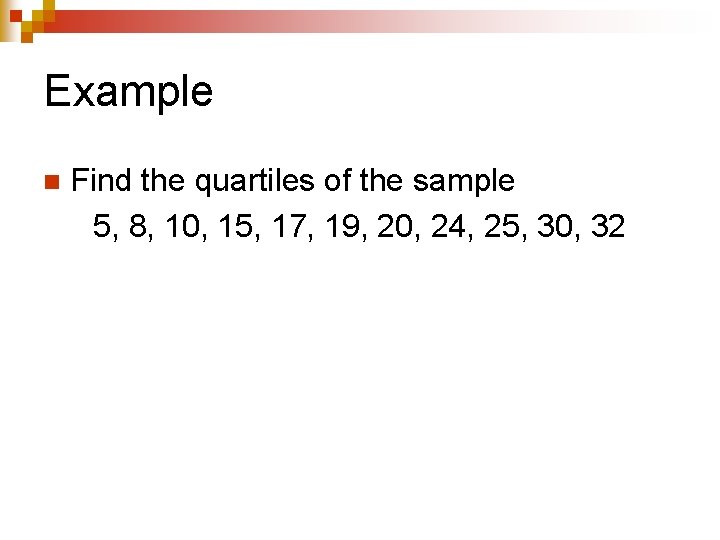
Example n Find the quartiles of the sample 5, 8, 10, 15, 17, 19, 20, 24, 25, 30, 32
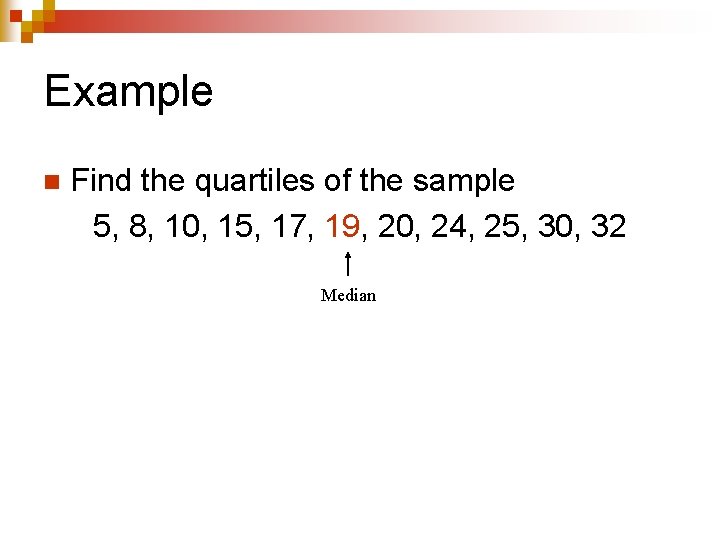
Example n Find the quartiles of the sample 5, 8, 10, 15, 17, 19, 20, 24, 25, 30, 32 Median
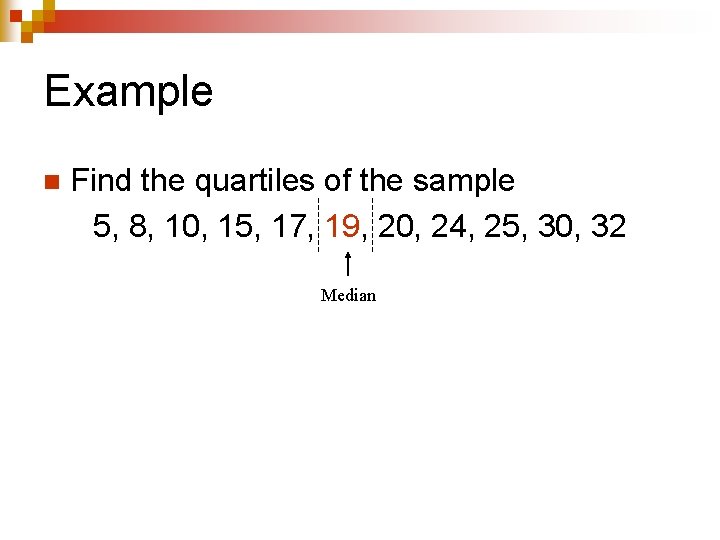
Example n Find the quartiles of the sample 5, 8, 10, 15, 17, 19, 20, 24, 25, 30, 32 Median
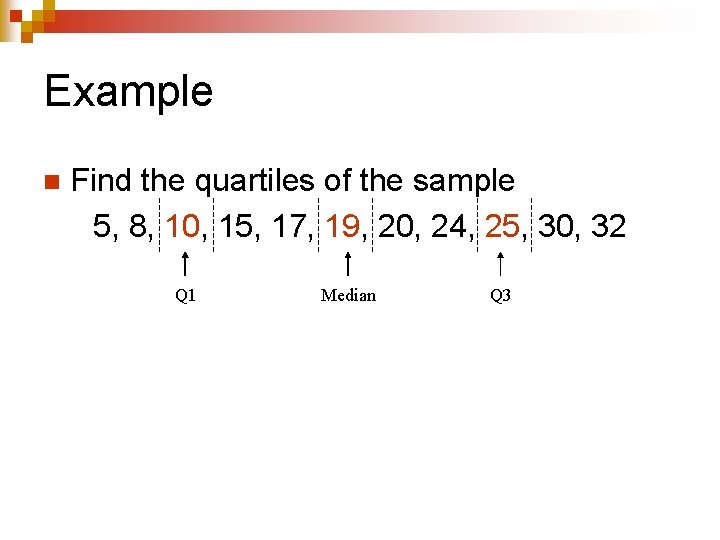
Example n Find the quartiles of the sample 5, 8, 10, 15, 17, 19, 20, 24, 25, 30, 32 Q 1 Median Q 3
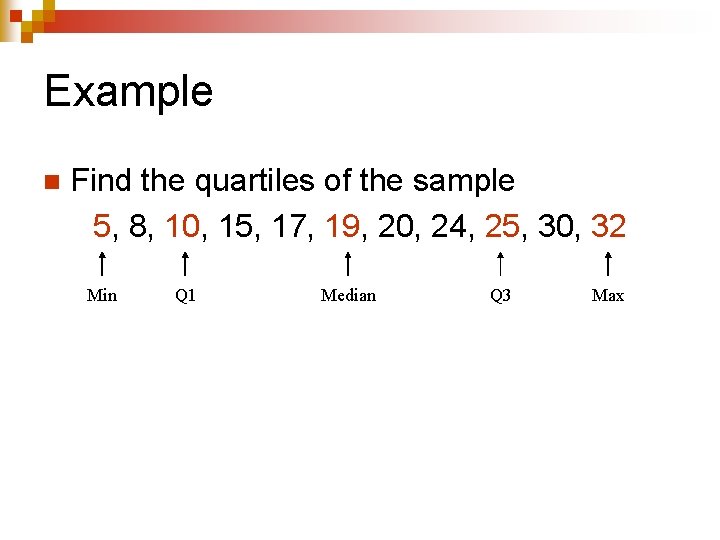
Example n Find the quartiles of the sample 5, 8, 10, 15, 17, 19, 20, 24, 25, 30, 32 Min Q 1 Median Q 3 Max
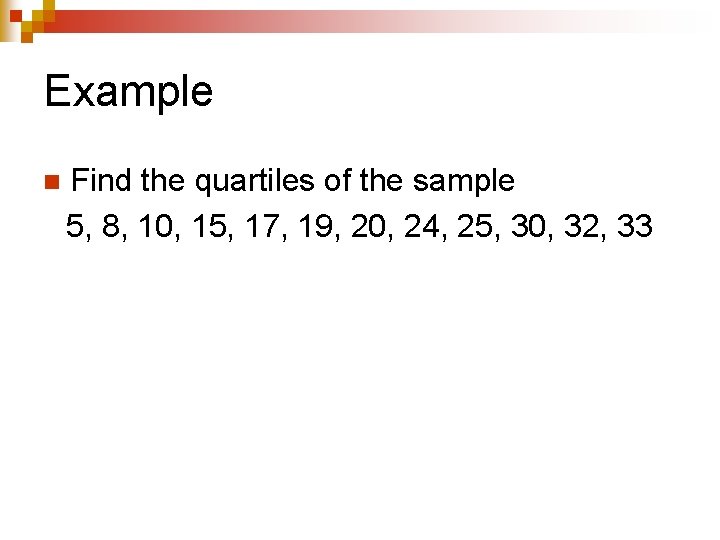
Example n Find the quartiles of the sample 5, 8, 10, 15, 17, 19, 20, 24, 25, 30, 32, 33
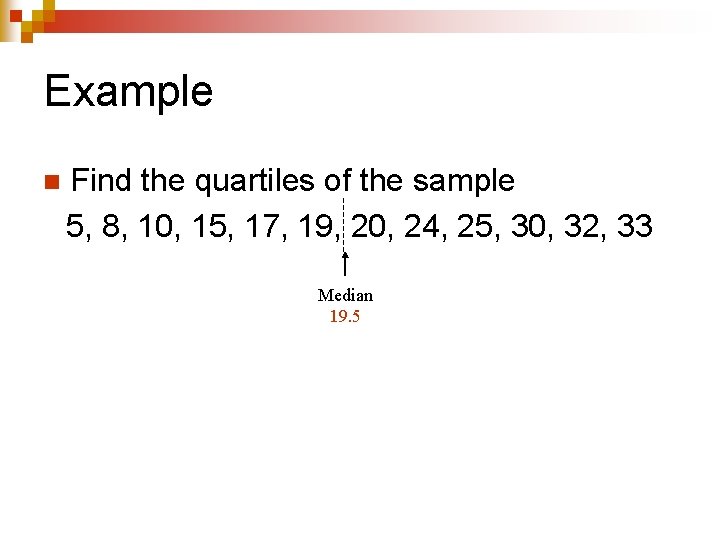
Example n Find the quartiles of the sample 5, 8, 10, 15, 17, 19, 20, 24, 25, 30, 32, 33 Median 19. 5
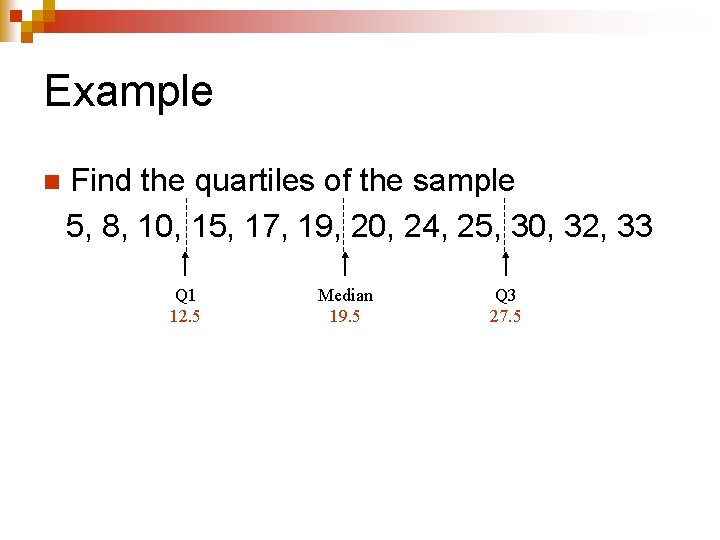
Example n Find the quartiles of the sample 5, 8, 10, 15, 17, 19, 20, 24, 25, 30, 32, 33 Q 1 12. 5 Median 19. 5 Q 3 27. 5
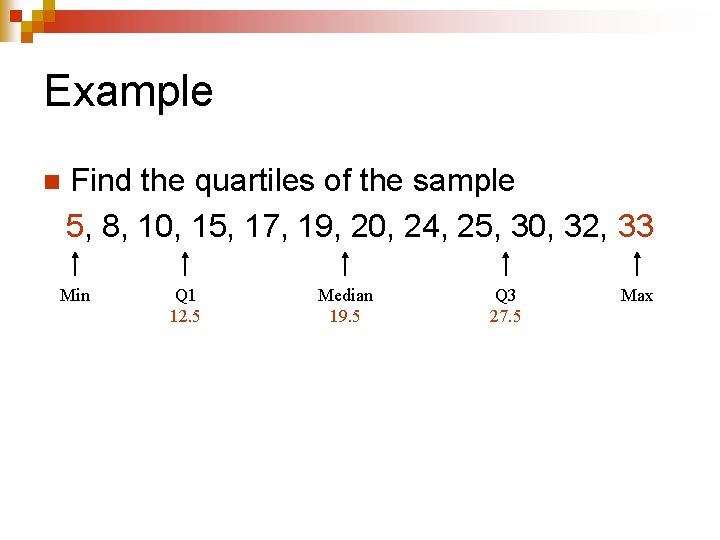
Example n Find the quartiles of the sample 5, 8, 10, 15, 17, 19, 20, 24, 25, 30, 32, 33 Min Q 1 12. 5 Median 19. 5 Q 3 27. 5 Max
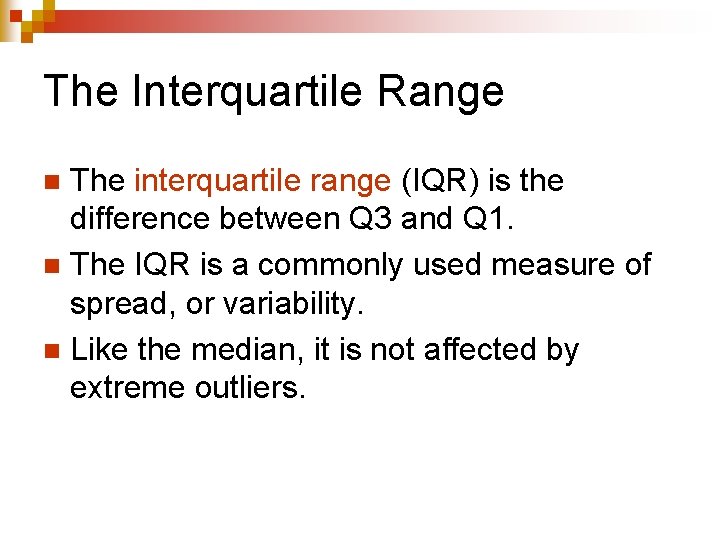
The Interquartile Range The interquartile range (IQR) is the difference between Q 3 and Q 1. n The IQR is a commonly used measure of spread, or variability. n Like the median, it is not affected by extreme outliers. n
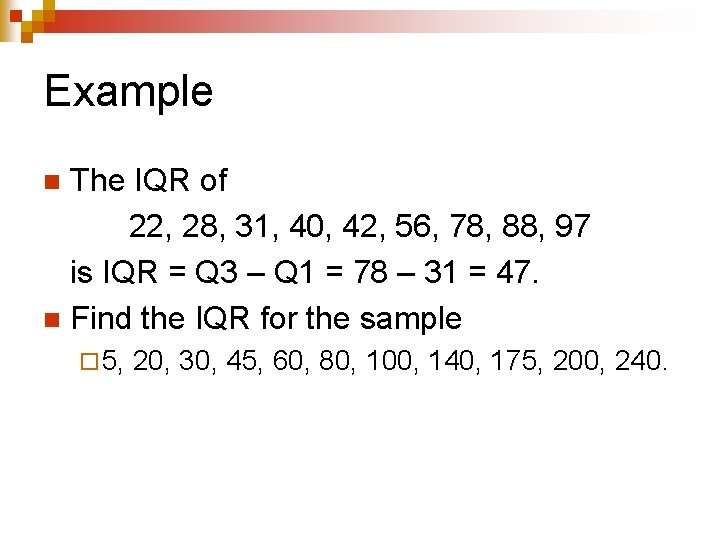
Example The IQR of 22, 28, 31, 40, 42, 56, 78, 88, 97 is IQR = Q 3 – Q 1 = 78 – 31 = 47. n Find the IQR for the sample n ¨ 5, 20, 30, 45, 60, 80, 100, 140, 175, 200, 240.
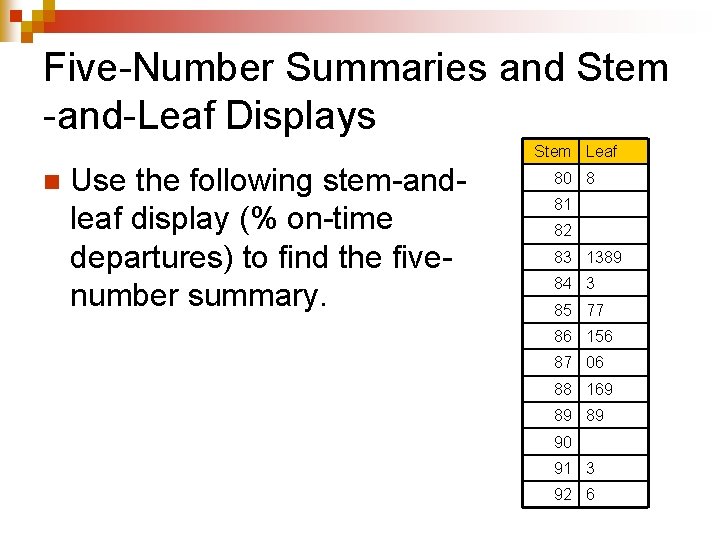
Five-Number Summaries and Stem -and-Leaf Displays Stem Leaf n Use the following stem-andleaf display (% on-time departures) to find the fivenumber summary. 80 8 81 82 83 1389 84 3 85 77 86 156 87 06 88 169 89 89 90 91 3 92 6
- Slides: 34