
The Five Traditional Canons of Rhetoric Purpose Foundation
- Slides: 14
The Five Traditional Canons of Rhetoric
Purpose Foundation for both textual analysis (reading) and composition (writing). A lens through which you can view and create content. Recognize (and, in turn, use), strategies from all five canons Appreciate how textual strategies and features function in a variety of text types. ● Less important that you memorize the terms, more important to analyze their function and use correctly ● ●
1. Invention (“Inventio”) ● The word comes from Latin “invenire, ” meaning “to find. ” ● Skill of finding and developing ideas and materials to support arguments. ● Approaches can be systematic or formal (journalists’ questions: who, what, where, when, why? ; the modes of development: narration/description, definition, cause & effect, process analysis, division/classification, etc. ), or intuitive (free writing, journals, brainstorming, talking). ○ Modes project! The difference between having to say something and having something to say ● Read, write, think, and talk, talk – all of these support invention!
1. Invention: How to use it in your writing ● Strong invention will help you perform well on the AP English Language exam! ○ “. . . your goal in invention is to discover ideas and to take inventory of everything you might say to make your position clear and compelling” (p. 51). Narration — provides background information or sets a context Partition — outlines and defines the scope of the argument Confirmation — provides evidence and the “body” of the argument Refutation — considers the opposing points of view or objections and counters them or makes a concession ● Peroration — concludes the argument, calls on the audience or reader to think or act in a certain way ● ●
2. Arrangement (“Dispositio”) ● Commonly referred to as “organization” or “structure. ” ● In a rhetorical sense, it refers to “the shape of a text, ” how an author arranges the elements of a text to achieve her purpose. ● Identifying a text’s beginning, middle, and end is a good way to start considering the concept of arrangement.
2. Arrangement: How to use it in your writing ● Working with arrangement helps students as both readers and writers. ○ “Your goal in arrangement is to select the best and most appropriate ideas, examples, and propositions. . . and to decide how to order [them] most effectively. . . [to] achieve your purpose” (p. 51). ● Well known, established arrangements include: ○ The Five-paragraph Essay ■ Introduction ■ Body paragraphs 1, 2, 3 ■ Conclusion
2. Arrangement: How to use it in your writing ● Well known, established arrangements include: ○ ○ Argument, basic four-part structure ■ Assertion (I think…) ■ Dealing with the opposing point of view (Others may disagree…) ■ Evidence/rebuttal (Here’s why I’m right. . . ) ■ Conclusion (Therefore. . . agree with me, think like I do, do what I’m suggesting) From Ancient Rome, the six-part argument: ■ Exordium (the web) - introduction ■ Narration (provides background information or sets a context) ■ Partition (outlines and defines the scope of the argument ■ Confirmation (provides evidence and the “body” of the argument ■ Refutation (considers the opposing points of view or objections and counters them or makes a concession) ■ Peroration (concludes the argument, clals on the audience or reader to think or act in a certain way)
3. Style (“Elocutio”) ● Every piece of writing has style. ● Style describes the totality of choices a writer has made, including such elements as figurative language, diction, language resources (punctuation), levels of formality, syntax, etc. ● Students tend to know more about this canons than the others, and often English teachers do too!
3. Style: How to use it in your writing ● On the AP English Language exam, style counts! ○ Essays scoring a nine may “demonstrate particularly impressive control of language. ” ● Make purposeful choices as a writer ○ ○ Diction Figurative language Language resources (punctuation) Syntax ● Consider your audience ○ Level of formality
4. Memory (“Memory”) ● In Aristotle’s time (an oral culture, pre-printing press), memory was meant literally. Works of considerable length were literally memorized. ● In our time, culture places more emphasis on the written word. An idea may not be considered legitimate until you have “gotten it in writing, ” “signed on, ” or until “the ink is dry. ” ● Contemporary “memory” refers to what you know, can access, and use in support of your own ideas. ● Cultural literacy is an important element of memory and works hand-in-hand with invention.
4. Memory: How to use it in your writing ● Memory is necessary for a “mature academic perspective” and is an invitation into the discourse. ● Good memory is a common characteristic of upper-half papers on the AP English Language exam. ○ ○ Following a columnist project IG: “Article of the Week” and “What I Just Read” ● “You have to know things. The more you know, the more you will remember” --Aristotle (maybe) ● “The more you know, the funnier life is” --Quinn Mc. Cutchan
5. Delivery (“Pronuntiatio”) ● In Aristotle’s time, delivery referred to the art of public speaking, enunciation, gestures, eye-contact, cadence, pacing, etc. ● In our time, it refers to how a text looks on the page or screen. ● The tools of delivery include font size and style, the use of white space (margins, columns), insertion of visuals, layout (columns, bullets, boxes, etc. ), hypertext links, emphasis techniques like italics, bold, dashes, etc. , and a great new delivery tool, emoji!
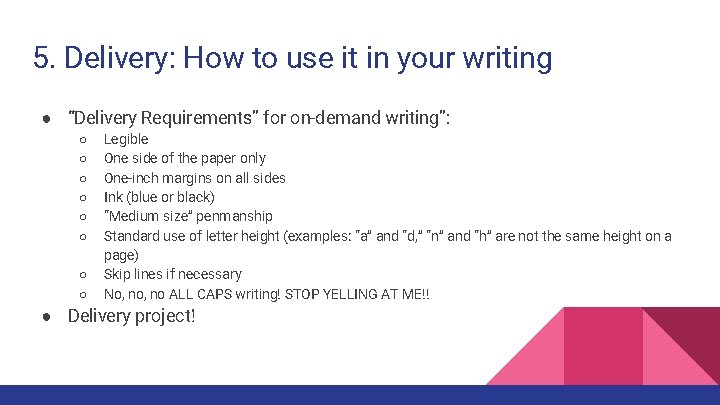
5. Delivery: How to use it in your writing ● “Delivery Requirements” for on-demand writing”: ○ ○ ○ ○ Legible One side of the paper only One-inch margins on all sides Ink (blue or black) “Medium size” penmanship Standard use of letter height (examples: “a” and “d, ” “n” and “h” are not the same height on a page) Skip lines if necessary No, no ALL CAPS writing! STOP YELLING AT ME!! ● Delivery project!
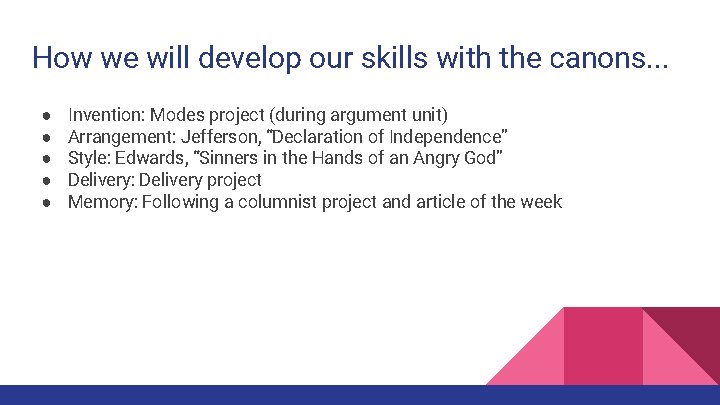
How we will develop our skills with the canons. . . ● ● ● Invention: Modes project (during argument unit) Arrangement: Jefferson, “Declaration of Independence” Style: Edwards, “Sinners in the Hands of an Angry God” Delivery: Delivery project Memory: Following a columnist project and article of the week