
The Five Themes of Geography Presented by Mrs
The Five Themes of Geography Presented by Mrs. Wilson
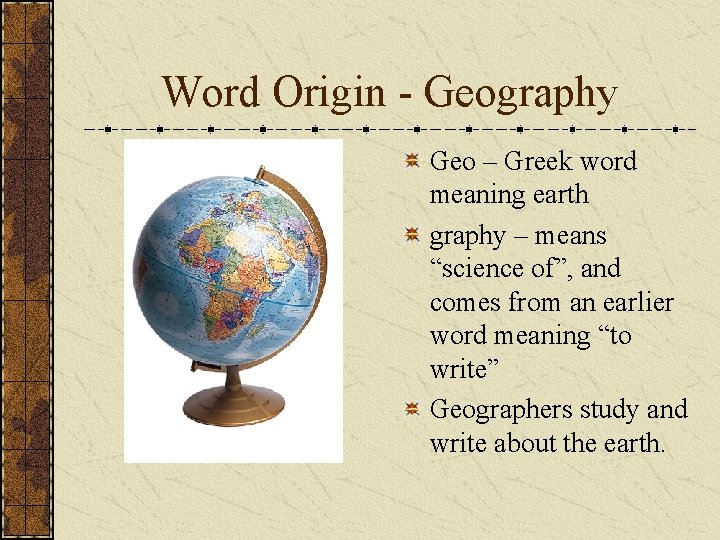
Word Origin - Geography Geo – Greek word meaning earth graphy – means “science of”, and comes from an earlier word meaning “to write” Geographers study and write about the earth.
Two Guiding Questions In their study of the earth and its inhabitants, geographers ask themselves two main questions. Where are things? Why are they there?
The Five Themes Location Place Human-Environment Interaction Movement Regions
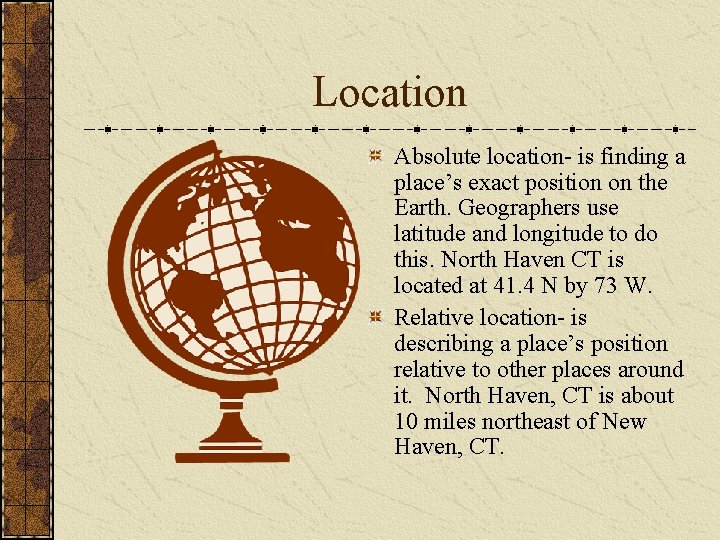
Location Absolute location- is finding a place’s exact position on the Earth. Geographers use latitude and longitude to do this. North Haven CT is located at 41. 4 N by 73 W. Relative location- is describing a place’s position relative to other places around it. North Haven, CT is about 10 miles northeast of New Haven, CT.
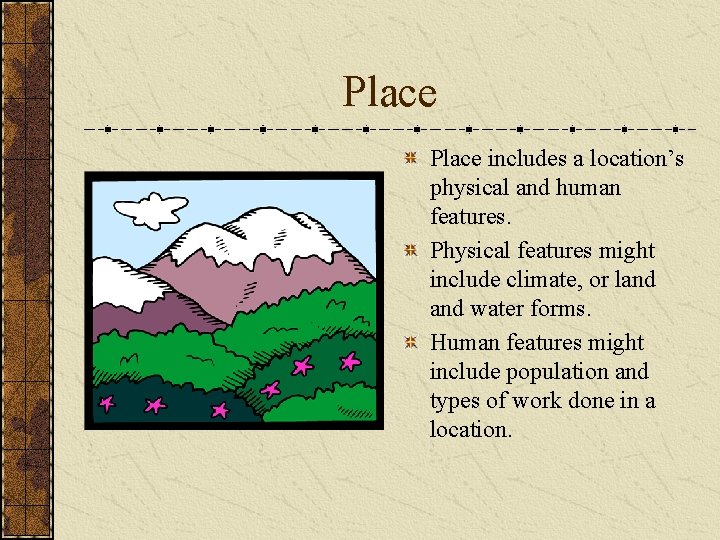
Place includes a location’s physical and human features. Physical features might include climate, or land water forms. Human features might include population and types of work done in a location.
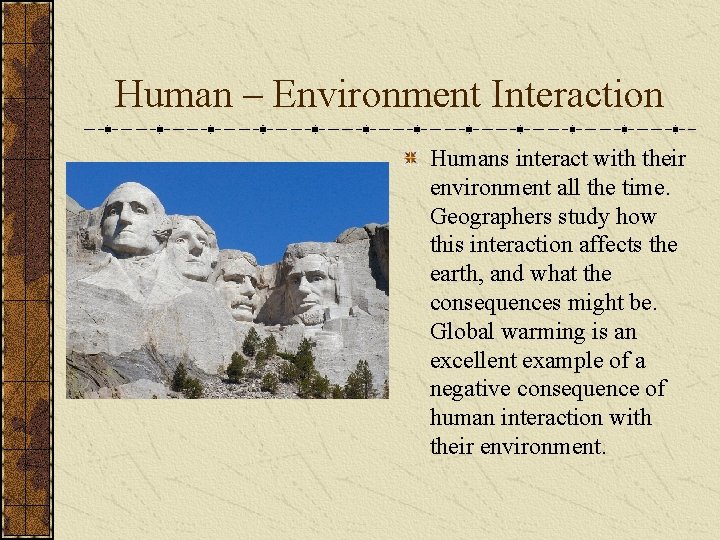
Human – Environment Interaction Humans interact with their environment all the time. Geographers study how this interaction affects the earth, and what the consequences might be. Global warming is an excellent example of a negative consequence of human interaction with their environment.
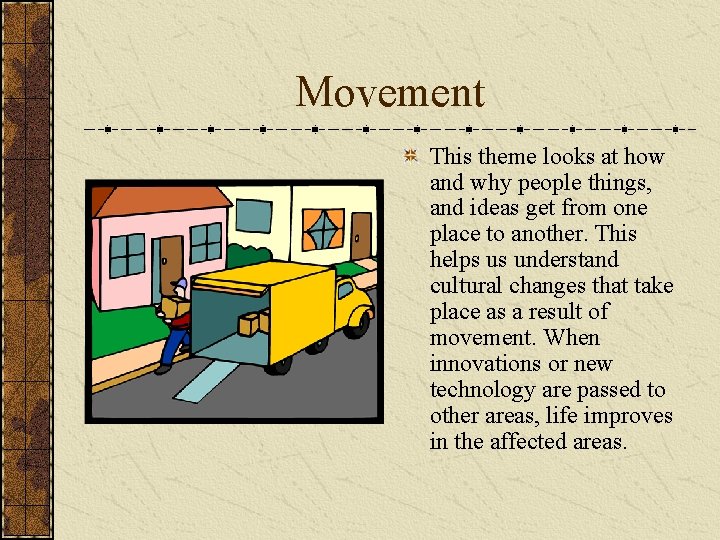
Movement This theme looks at how and why people things, and ideas get from one place to another. This helps us understand cultural changes that take place as a result of movement. When innovations or new technology are passed to other areas, life improves in the affected areas.
Regions Geographers classify areas with a unifying characteristic into regions. Regions can be based on many things, such as political boundaries, land types, climate, population, or history. The “corn belt” of the U. S. is an example of an agricultural region, while the “great plains” is a region based on land type.
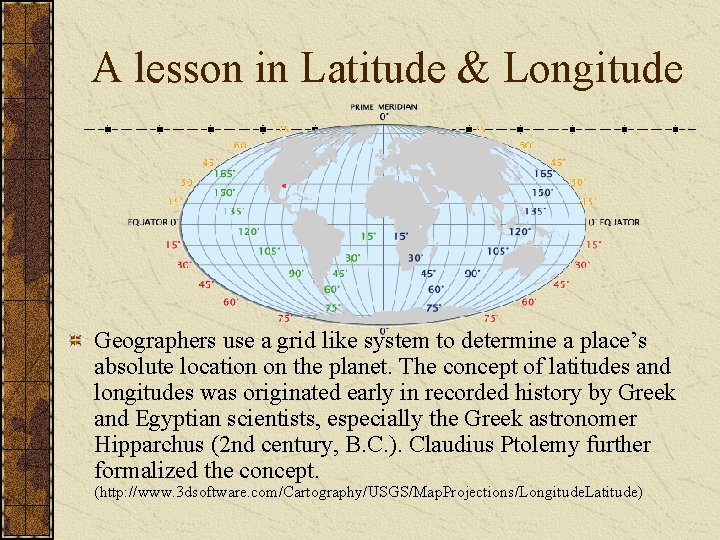
A lesson in Latitude & Longitude Geographers use a grid like system to determine a place’s absolute location on the planet. The concept of latitudes and longitudes was originated early in recorded history by Greek and Egyptian scientists, especially the Greek astronomer Hipparchus (2 nd century, B. C. ). Claudius Ptolemy further formalized the concept. (http: //www. 3 dsoftware. com/Cartography/USGS/Map. Projections/Longitude. Latitude)
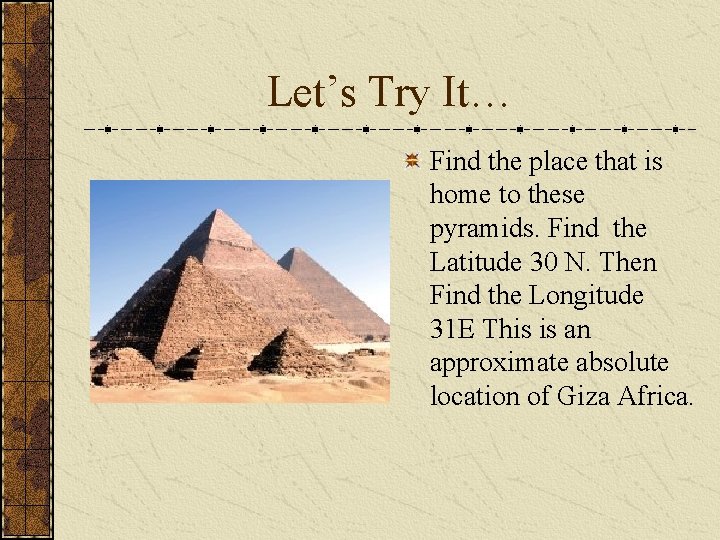
Let’s Try It… Find the place that is home to these pyramids. Find the Latitude 30 N. Then Find the Longitude 31 E This is an approximate absolute location of Giza Africa.
Ready for more? Use the atlas to find the places at these locations. They will be continents, bodies of water and land forms. 20 N 160 W 20 N 40 E 20 S 68 W 30 N 90 E 10 S 80 E 40 N 110 W-
- Slides: 12