
The Five Factor Model of Personality Timothy C
- Slides: 43
The Five Factor Model of Personality Timothy C. Thomason Northern Arizona University
The Lexical Hypothesis • How do we talk about personality and individual differences? • We need a taxonomy of descriptors (traits). • The lexical hypothesis says that most of the important personality characteristics have been encoded in the natural language. • So the dictionary can be used as a starting point to identify how we talk about traits.
A Limitation of the Lexical Hypothesis • Not all personality traits are encoded in language as adjectives. • For example, the English language contains no single trait adjective for the traits “need for variety” or “tolerance of ambiguity. ” • So lexical studies confound differences in personality structure with differences with personality language.
The Search for Personality Factors • In 1936 Allport conducted a lexical study of terms related to personality in an unabridged dictionary. He identified 18, 000 terms. • In 1943 Cattell selected 4, 500 terms from Allport’s list and used statistical methods to reduce them to 35 variables. Factor analysis identified 12 factors. • The 12 factors became part of Cattell’s 16 Personality Factors questionnaire (16 PF).
The Discovery of the Big Five • Researchers studied Cattell’s data and found five strong and recurrent factors. • This five factor structure has been replicated many times. • These factors became known as the Big Five. • They are big in the sense that they are broad factors at a high level of abstraction.
The NEO Personality Inventory • In the 1980 s Costa and Mc. Crae developed the NEO Personality Inventory (NEO-PI) to measure Neuroticism, Extraversion, and Openness to Experience. • They added scales to measure Agreeableness and Conscientiousness and published the NEO Personality Inventory – Revised (NEO-PI-R) which had 240 items. Each of the five factors had six specific facets (subscales).
The Five Factors • • • Openness to experience Conscientiousness Extraversion Agreeableness Neuroticism
Original Names for the Factors • Openness to experience or Intellect, Imagination, or Culture • Consciousness or Will to Achieve • Extraversion or Surgency • Agreeableness vs. Antagonism • Neuroticism vs. Emotional Stability
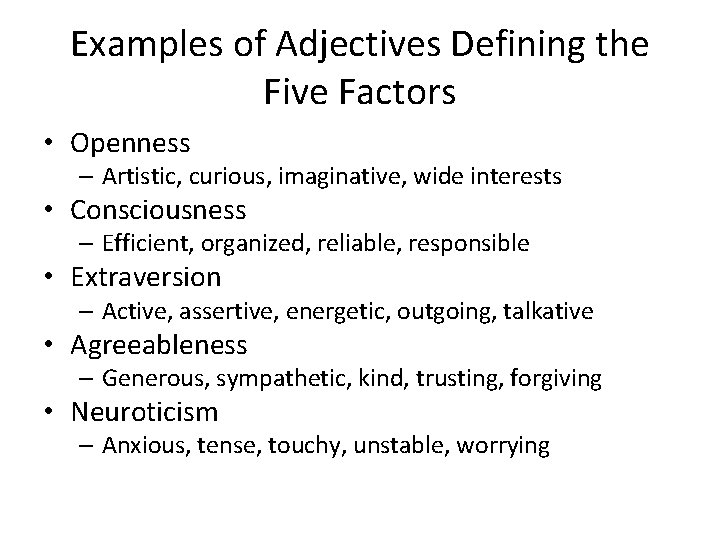
Examples of Adjectives Defining the Five Factors • Openness – Artistic, curious, imaginative, wide interests • Consciousness – Efficient, organized, reliable, responsible • Extraversion – Active, assertive, energetic, outgoing, talkative • Agreeableness – Generous, sympathetic, kind, trusting, forgiving • Neuroticism – Anxious, tense, touchy, unstable, worrying
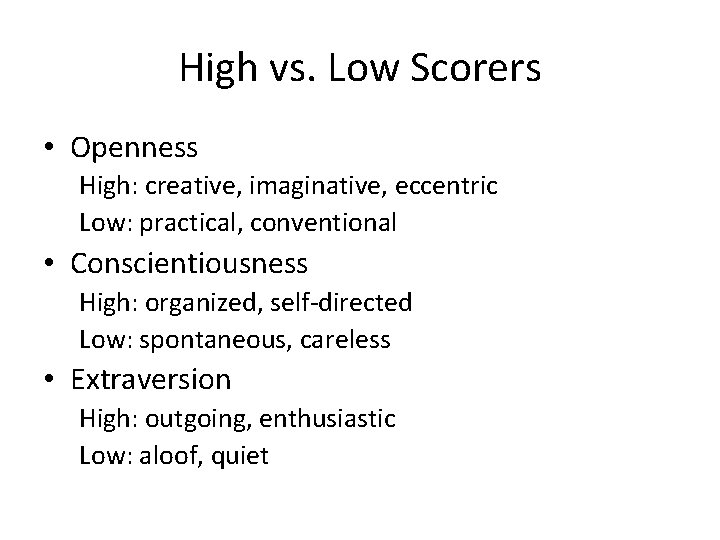
High vs. Low Scorers • Openness High: creative, imaginative, eccentric Low: practical, conventional • Conscientiousness High: organized, self-directed Low: spontaneous, careless • Extraversion High: outgoing, enthusiastic Low: aloof, quiet
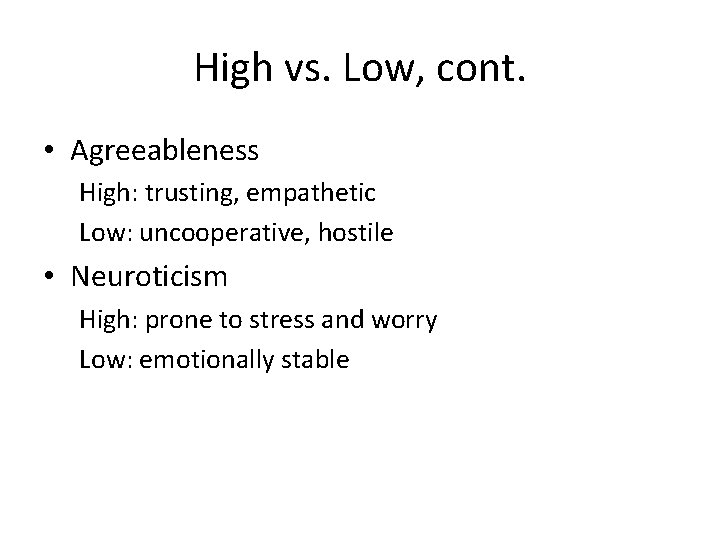
High vs. Low, cont. • Agreeableness High: trusting, empathetic Low: uncooperative, hostile • Neuroticism High: prone to stress and worry Low: emotionally stable
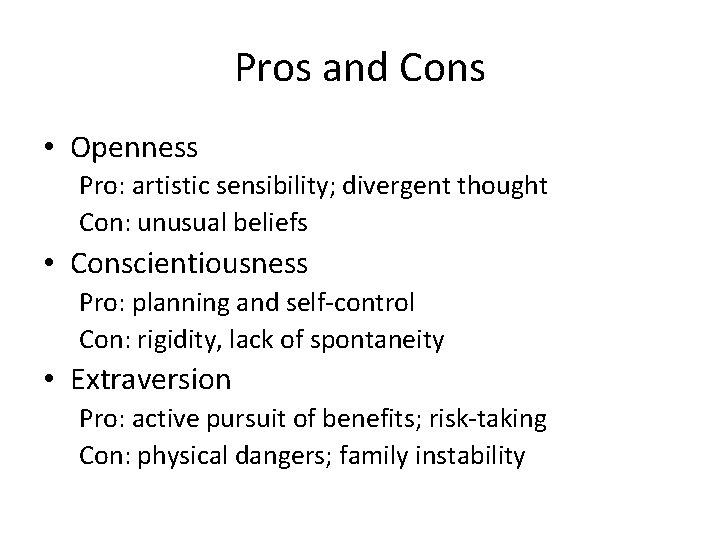
Pros and Cons • Openness Pro: artistic sensibility; divergent thought Con: unusual beliefs • Conscientiousness Pro: planning and self-control Con: rigidity, lack of spontaneity • Extraversion Pro: active pursuit of benefits; risk-taking Con: physical dangers; family instability
Pros and Cons, cont. • Agreeableness Pro: harmonious social relationships Con: not putting self first; lost status • Neuroticism Pro: vigilance; striving Con: anxiety, depression
Assessment of the FFM The NEO Personality Inventory – Revised (NEO-PI-R) has 240 items and is the standard instrument for assessing the five factors.
Briefer Tests to Measure the Big Five • A briefer version of the NEO-PI-R called the NEO-Five Factor Inventory (the NEO-FFI) was developed for research purposes. • The NEO-FFI has 60 items and has good reliability (. 78) and good correlations with the NEO-PI-R, but provides less data on the facets. • Another brief inventory was developed called the Big Five Inventory (BFI) with 44 items.
The SIMP • The Single-Item Measures of Personality (SIMP) is the shortest instrument to measure the five factors that has acceptable reliability and validity. • It has five items, one for each of the 5 factors.
Why Five? • “There is nothing magic about the number 5; it is simply what the data seem to show. ” • “We believe it is an empirical fact, like the fact that there are seven continents. ” • The speed of light is 300, 000 kilometers per second, but we have no clue why. We don’t know why there are five factors instead of 3 or 6 or 7. • Mc. Crae & Costa
Are the Five Factors Too Broad? • A common objection is that five dimensions cannot possibly capture all of the variation in human personality. • But personality can be conceptualized at different levels of abstraction or breadth. Similar to how creatures can be categorized at different levels of abstraction: Eg. Vertebrate -- fish -- guppy • The five factors are useful for some initial rough distinctions but of less value for predicting the behavior of a specific person.
Is the FFM “True”? • The Five Factor Model is the most widely accepted model currently, but it is not the last word in the description of personality. • It is well supported, but as more research is done the model may need to change. • In the future it may turn out that evidence will be found to show that there are fewer factors than five or more factors than five.
Are the Factors Universal? • Cross-cultural studies using translations of the NEO-PI-R have found that the factors exist in all of the cultures studied. This covers most of the earths inhabitants. • Studies have not been done in preliterate societies, and Native Americans have not been studied. • The existing evidence suggests that there is a common human structure of personality.
Are the Factors Universal? , cont. • If the five factors are universal, it may be due to a common genetic basis for personality. • Parent-child relations have little lasting effect on personality traits. • Traits are generally stable across the adult lifespan. • Personality traits are endogenous basic tendencies but interact with the environment.
Evolution and the Five Factor Model • Personality traits relate to social adaptation. – Eg. , To retain their mates, extraverts show off; agreeable men express affection; men low in conscientiousness try to make their mates jealous. • The five factors relate to the tasks people have evolved to solve. – People notice individual differences in personality and base their choices of friends and mates partly on inferred personality characteristics.
Hypotheses Re. the Evolution of Traits • Some traits may be adaptively neutral. – Eg. Openness may have dubious adaptive value. • Traits may be the result of stabilizing selection; extreme values were selected out. – Eg. People who were too introverted to find a mate did not reproduce. • Traits may have evolved to solve problems.
H: The Five Factors are Evolved Mechanisms to Solve Problems • Extraversion motivates people to approach sources of reward. • Introversion is an advantage when tasks require being alone. • Agreeableness makes it easier to get friends. • Openness and exploration leads to finding new resources. • Low conscientiousness is good if risk-taking leads to new resources.
Evolution and the FFM, cont. • Evolutionary theories about the FFM refer to “adaptive problems confronted by ancestral human populations” but the FFM has also been found in chimpanzees to some extent. • So precursors of the five factors may have evolved in ancestors common to all primates. Eg. Maybe Extraversion evolved when fish first formed schools!
Trait Terms are Evaluative • 97% of trait terms are evaluative; 3% neutral • Trait terms reflect evaluations of others as potential contributors to, or exploiters of, the group’s resources. – Consciousness: who can you trust with tasks? – Agreeableness: who will suspend their own needs to contribute to the group?
The Five Factors Have 30 Facets • Costa and Mc. Crae’s 30 facets represent the most widely used and empirically validated model of a trait taxonomy. • Example: Facets within Extraversion: – Gregariousness – Assertiveness – Activity – Excitement seeking – Positive emotions – Warmth
Do Traits Predict Life Outcomes? • The assumption is that personal factors (such as the individual’s traits) and environmental factors (such as aspects of a job or a relationship partner) interact to jointly produce behavioral outcomes. • Personality traits are important because they influence the way individuals interact with particular environments.
Health and Longevity • Conscientiousness predicts good health habits, health outcomes, and longevity. • Low Conscientiousness predicts the likelihood of engaging in risky behaviors. Eg. smoking, substance abuse, poor diet. • When diagnosed with an illness, highly Conscientious people are more likely to adhere to treatment and live longer.
Health, cont. • Low Agreeableness predicts heart disease. • High Neuroticism predicts less successful coping with illness. • People high in Extraversion have more social support available to help them cope with illness.
FFM and Adjustment Problems • Low Agreeableness and low Conscientousness in adolescents predicts delinquency. • High neuroticism and low Conscientousness predicts depression and anxiety. • Low Conscientousness predicts ADHD in adults.
FFM and Coping Strategies • Extraversion – Positive thinking; direct action; substitution • Neuroticism – Escapist fantasy; hostility; passivity; withdrawal • Openness – High openness: humor (see the humor in it) – Low openness: faith (put your faith in God)
FFM & Academic & Work Outcomes • Conscientiousness predicts higher GPAs. • Conscientiousness predicts good job performance across a wide range of jobs. • Highly Neurotic people are more likely to experience burnout and to change jobs.
FFM and Work Outcomes • Extraversion predicts success in sales and management jobs. • Openness predicts success in artistic jobs. • Conscientiousness predicts success in conventional jobs. • Agreeableness and low Neuroticism predicts success in jobs where people work in groups.
FFM and Well-Being • Personality is the strongest predictor of high subjective well-being. • Personality relates to life satisfaction more than economic factors. • Personality is responsible for 35% of life satisfaction differences; 4% is due to employment status; 4% is due to income; and 1% to 4% is due to marital status.
FFM and Well-Being • Extraversion has a direct, positive effect on well-being. • Neuroticism has a negative effect on wellbeing.
FFM and Infidelity Who is most likely to be unfaithful to their relationship partner? Someone who has • High Extraversion • High Neuroticism • High Openness • Low Agreeableness • Low Conscientiousness
Traits are Not the Whole Story • People have the ability to change their patterns of behavior, thoughts, and feelings (eg. , as a result of psychotherapy). • Links between the Big Five and life outcomes are neither fixed nor inevitable for the individual. • The Big Five may point to areas people can focus on for change (eg. conscientiousness).
Personality is Stable for Most People • Personality traits have long-term stability. • Four-fifths of the variance is stable across the adult lifespan. • There are some changes after age 30 in all five factors, but they are very gradual. • The 30 year old extravert is still likely to be an extravert at age 70, though not quite as active or keen on excitement.
Changes in Traits in Adulthood • The traits described by the five factors change more during young adulthood than any other period of life. • Openness typically increases in the 20 s and goes into a gradual decline after that. • People tend to become more reliable and agreeable with age. • These patterns seem to hold across cultures.
Summary: The Five Factor Model • Currently, the Five Factor Model, with the 30 facets, represents the most widely used and empirically validated model of personality structure.
Limitations of the FFM • The FFM is not (and was never intended to be) a comprehensive theory of personality. • It was developed to account for the structural relations among personality traits. • It is more descriptive than explanatory.
Resources • Handbook of Personality, 2008, by John, Robins, & Pervin, NY: Guilford Press. • Articles by R. Mc. Crae & P. Costa • Buss, D. M. (1995). Evolutionary psychology. Psychological Inquiry, 6(1), 1 -30.