
The first year of operating the LHC accelerator
![LHC Systems – Operational Efficiency All faults downtime distribution Equipment type Faults Qty. Availability[1]](https://slidetodoc.com/presentation_image_h2/9728dd9fb841619de6539a5efed11c19/image-34.jpg "LHC Systems – Operational Efficiency All faults downtime distribution Equipment type Faults Qty. Availability[1]")
- Slides: 51
The first year of operating the LHC accelerator Andrzej SIEMKO CERN, European Organization for Nuclear Research Geneva, Switzerland On behalf of the LHC commissioning team Andrzej Siemko, CERN, Geneva Cracow Epiphany Conference 10 – 12 January 2011
OUTLINE • Early beam operations and main parameters for the first LHC proton run • Strategy and progress during 2010 • Observations, encountered limitations • First heavy ion run • Prospects for 2011 • Summary and conclusions Andrzej Siemko, CERN, Geneva Cracow Epiphany Conference 10 – 12 January 2011
OUTLINE • Early beam operations and main parameters for the first LHC proton run • Reduced energy • Instantaneous luminosity • Strategy and progress during 2010 • Observations, encountered limitations • First heavy ion run • Prospects for 2011 • Summary and conclusions Andrzej Siemko, CERN, Geneva Cracow Epiphany Conference 10 – 12 January 2011
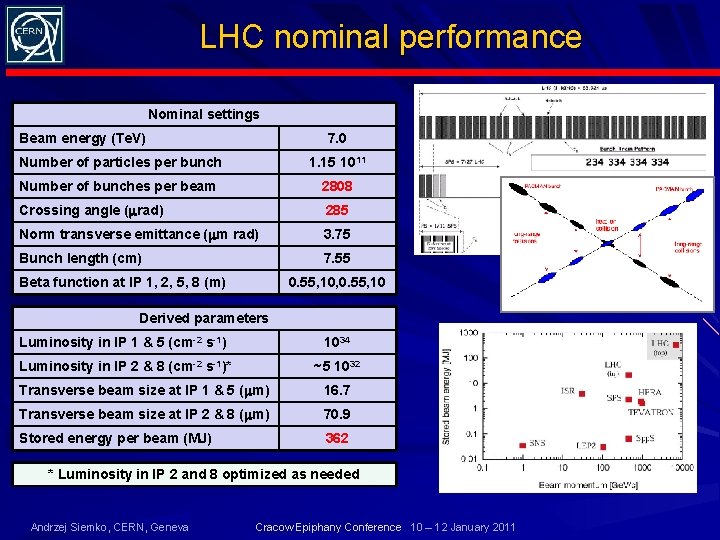
LHC nominal performance Nominal settings Beam energy (Te. V) 7. 0 Number of particles per bunch 1. 15 1011 Number of bunches per beam 2808 Crossing angle ( rad) 285 Norm transverse emittance ( m rad) 3. 75 Bunch length (cm) 7. 55 Beta function at IP 1, 2, 5, 8 (m) 0. 55, 10, 0. 55, 10 Derived parameters Luminosity in IP 1 & 5 (cm-2 s-1) 1034 Luminosity in IP 2 & 8 (cm-2 s-1)* ~5 1032 Transverse beam size at IP 1 & 5 ( m) 16. 7 Transverse beam size at IP 2 & 8 ( m) 70. 9 Stored energy per beam (MJ) 362 * Luminosity in IP 2 and 8 optimized as needed Andrzej Siemko, CERN, Geneva Cracow Epiphany Conference 10 – 12 January 2011
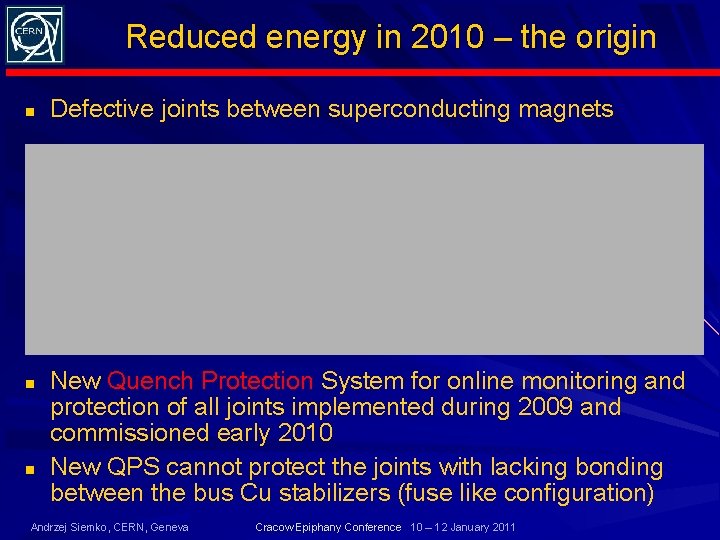
Reduced energy in 2010 – the origin n Defective joints between superconducting magnets New Quench Protection System for online monitoring and protection of all joints implemented during 2009 and commissioned early 2010 New QPS cannot protect the joints with lacking bonding between the bus Cu stabilizers (fuse like configuration) Andrzej Siemko, CERN, Geneva Cracow Epiphany Conference 10 – 12 January 2011
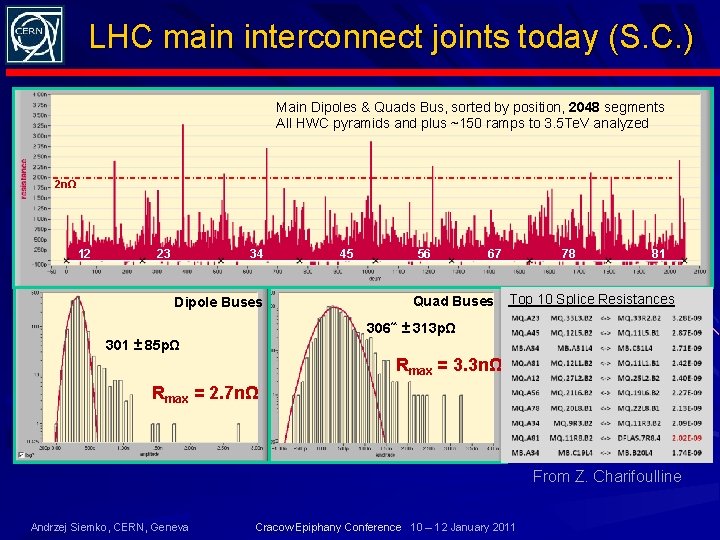
LHC main interconnect joints today (S. C. ) Main Dipoles & Quads Bus, sorted by position, 2048 segments All HWC pyramids and plus ~150 ramps to 3. 5 Te. V analyzed 2 nΩ 12 23 34 Dipole Buses 45 56 67 Quad Buses 78 81 Top 10 Splice Resistances 306** ± 313 pΩ 301 ± 85 pΩ Rmax = 3. 3 nΩ Rmax = 2. 7 nΩ From Z. Charifoulline Andrzej Siemko, CERN, Geneva Cracow Epiphany Conference 10 – 12 January 2011
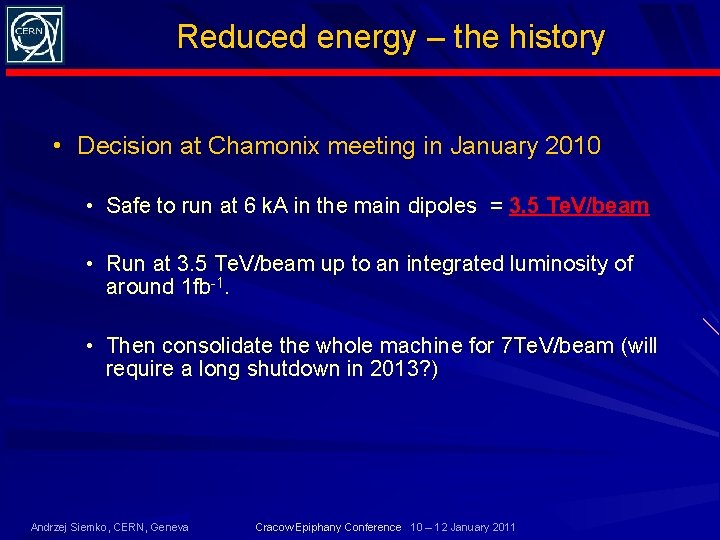
Reduced energy – the history • Decision at Chamonix meeting in January 2010 • Safe to run at 6 k. A in the main dipoles = 3. 5 Te. V/beam • Run at 3. 5 Te. V/beam up to an integrated luminosity of around 1 fb-1. • Then consolidate the whole machine for 7 Te. V/beam (will require a long shutdown in 2013? ) Andrzej Siemko, CERN, Geneva Cracow Epiphany Conference 10 – 12 January 2011
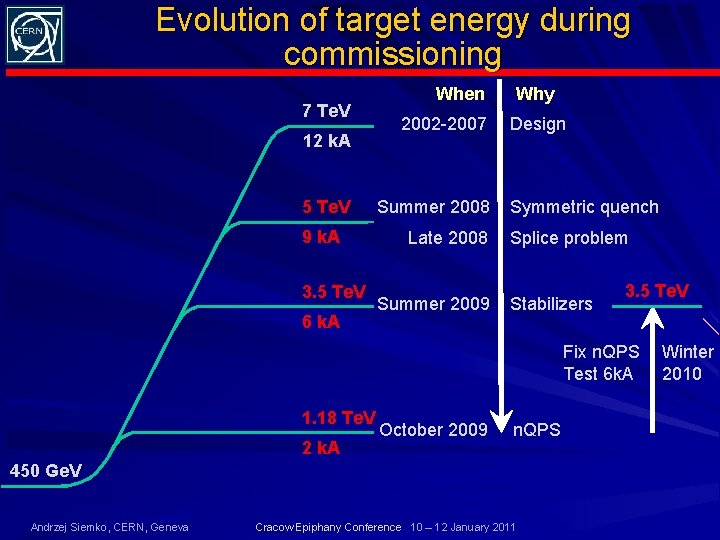
Evolution of target energy during commissioning 7 Te. V 12 k. A 5 Te. V 9 k. A 3. 5 Te. V 6 k. A When 2002 -2007 Summer 2008 Late 2008 Summer 2009 Why Design Symmetric quench Splice problem Stabilizers 3. 5 Te. V Fix n. QPS Test 6 k. A 1. 18 Te. V 2 k. A October 2009 n. QPS 450 Ge. V Andrzej Siemko, CERN, Geneva Cracow Epiphany Conference 10 – 12 January 2011 Winter 2010
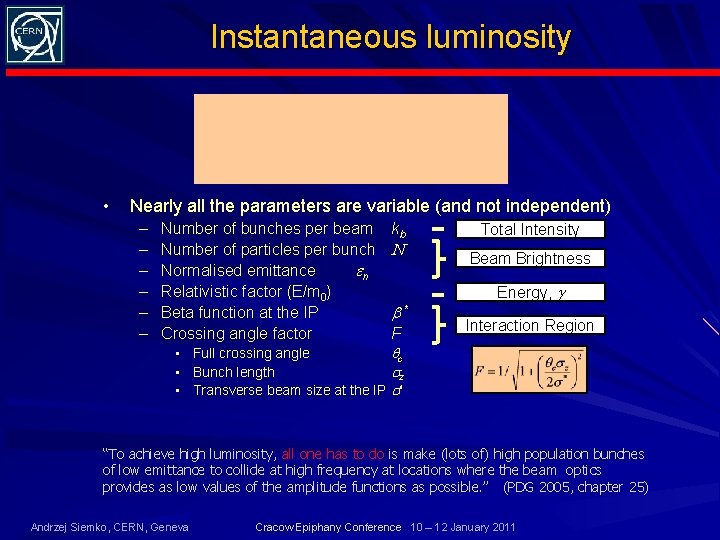
Instantaneous luminosity • Nearly all the parameters are variable (and not independent) – – – Number of bunches per beam Number of particles per bunch Normalised emittance n Relativistic factor (E/m 0) Beta function at the IP Crossing angle factor kb * F Total Intensity Beam Brightness Energy, Interaction Region • Full crossing angle c • Bunch length z • Transverse beam size at the IP * “To achieve high luminosity, all one has to do is make (lots of) high population bunches of low emittance to collide at high frequency at locations where the beam optics provides as low values of the amplitude functions as possible. ” (PDG 2005, chapter 25) Andrzej Siemko, CERN, Geneva Cracow Epiphany Conference 10 – 12 January 2011
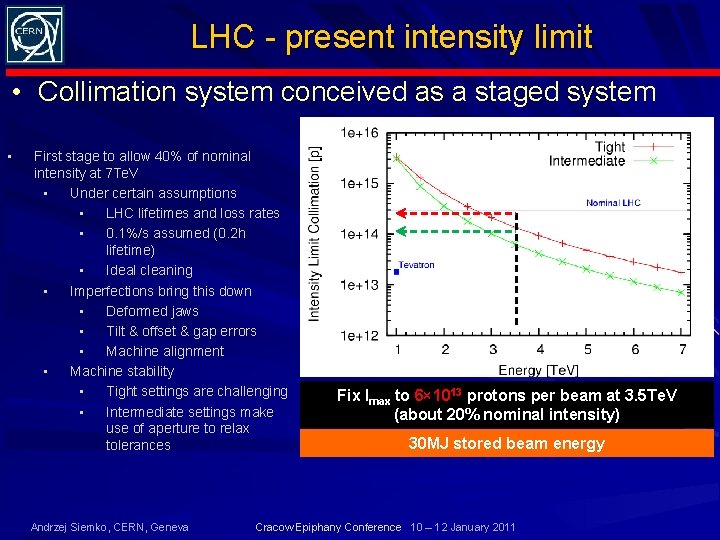
LHC - present intensity limit • Collimation system conceived as a staged system • First stage to allow 40% of nominal intensity at 7 Te. V • Under certain assumptions • LHC lifetimes and loss rates • 0. 1%/s assumed (0. 2 h lifetime) • Ideal cleaning • Imperfections bring this down • Deformed jaws • Tilt & offset & gap errors • Machine alignment • Machine stability • Tight settings are challenging • Intermediate settings make use of aperture to relax tolerances Andrzej Siemko, CERN, Geneva Fix Imax to 6× 10¹³ protons per beam at 3. 5 Te. V (about 20% nominal intensity) 30 MJ stored beam energy Cracow Epiphany Conference 10 – 12 January 2011
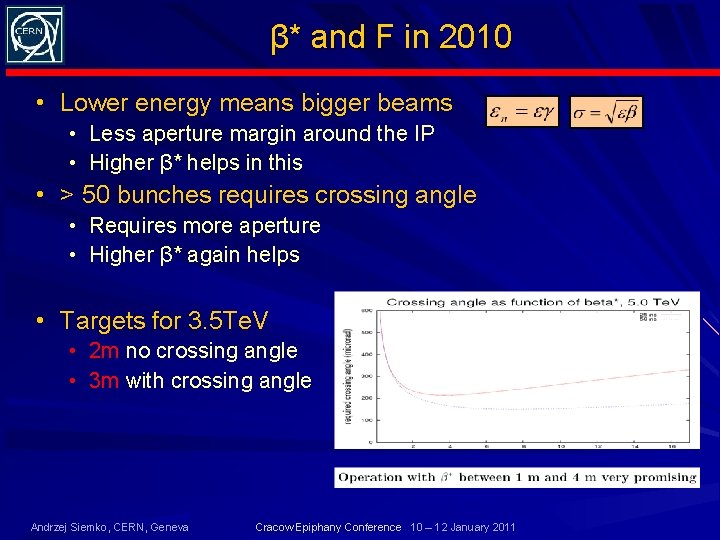
β* and F in 2010 • Lower energy means bigger beams • Less aperture margin around the IP • Higher β* helps in this • > 50 bunches requires crossing angle • Requires more aperture • Higher β* again helps • Targets for 3. 5 Te. V • 2 m no crossing angle • 3 m with crossing angle Andrzej Siemko, CERN, Geneva Cracow Epiphany Conference 10 – 12 January 2011
OUTLINE • Early beam operations and main parameters for the first LHC proton run • Strategy and progress during 2010 • Observations, encountered limitations • First heavy ion run • Prospects for 2011 • Summary and conclusions Andrzej Siemko, CERN, Geneva Cracow Epiphany Conference 10 – 12 January 2011
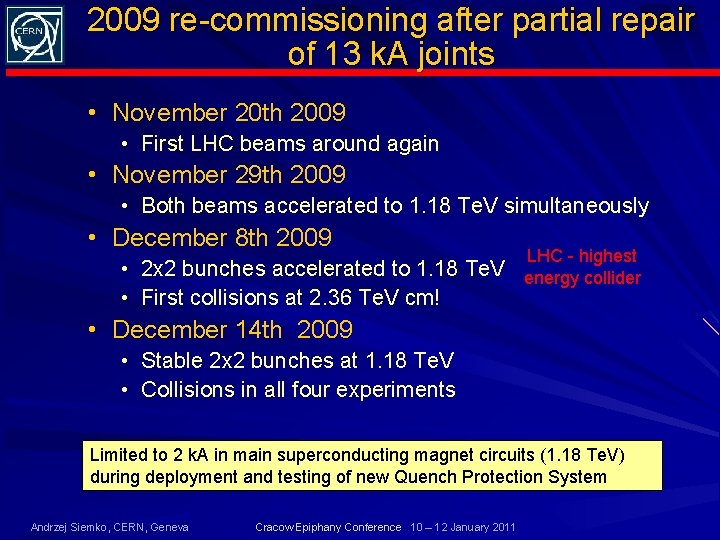
2009 re-commissioning after partial repair of 13 k. A joints • November 20 th 2009 • First LHC beams around again • November 29 th 2009 • Both beams accelerated to 1. 18 Te. V simultaneously • December 8 th 2009 • 2 x 2 bunches accelerated to 1. 18 Te. V • First collisions at 2. 36 Te. V cm! LHC - highest energy collider • December 14 th 2009 • Stable 2 x 2 bunches at 1. 18 Te. V • Collisions in all four experiments Limited to 2 k. A in main superconducting magnet circuits (1. 18 Te. V) during deployment and testing of new Quench Protection System Andrzej Siemko, CERN, Geneva Cracow Epiphany Conference 10 – 12 January 2011
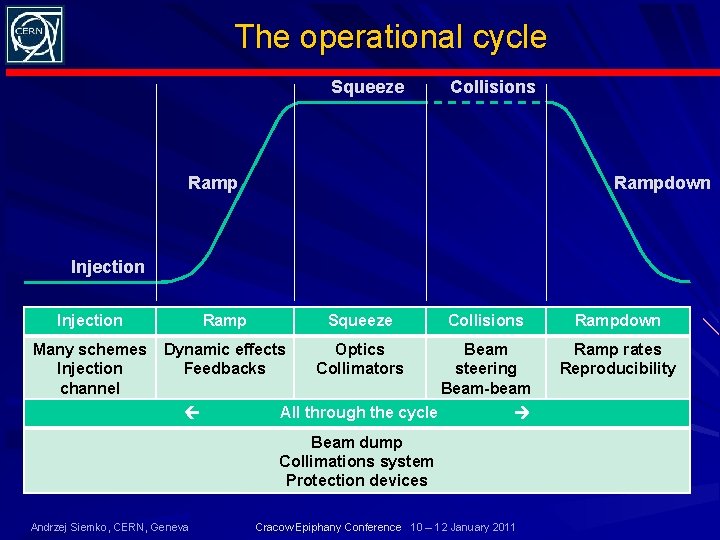
The operational cycle Squeeze Collisions Rampdown Injection Ramp Squeeze Collisions Rampdown Many schemes Injection channel Dynamic effects Feedbacks Optics Collimators Beam steering Beam-beam Ramp rates Reproducibility All through the cycle Beam dump Collimations system Protection devices Andrzej Siemko, CERN, Geneva Cracow Epiphany Conference 10 – 12 January 2011
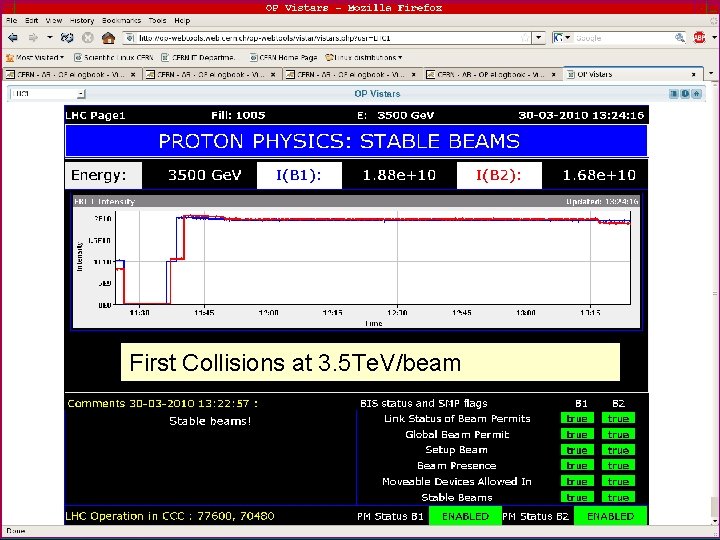
First Collisions at 3. 5 Te. V/beam Andrzej Siemko, CERN, Geneva Cracow Epiphany Conference 10 – 12 January 2011
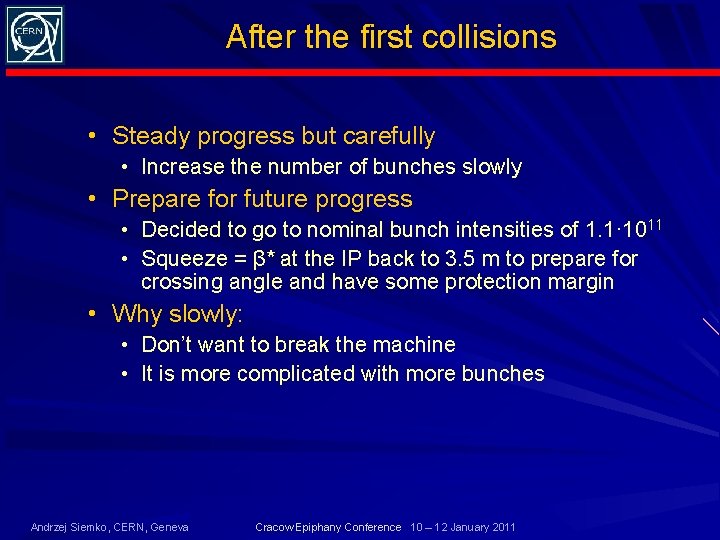
After the first collisions • Steady progress but carefully • Increase the number of bunches slowly • Prepare for future progress • Decided to go to nominal bunch intensities of 1. 1· 1011 • Squeeze = β* at the IP back to 3. 5 m to prepare for crossing angle and have some protection margin • Why slowly: • Don’t want to break the machine • It is more complicated with more bunches Andrzej Siemko, CERN, Geneva Cracow Epiphany Conference 10 – 12 January 2011
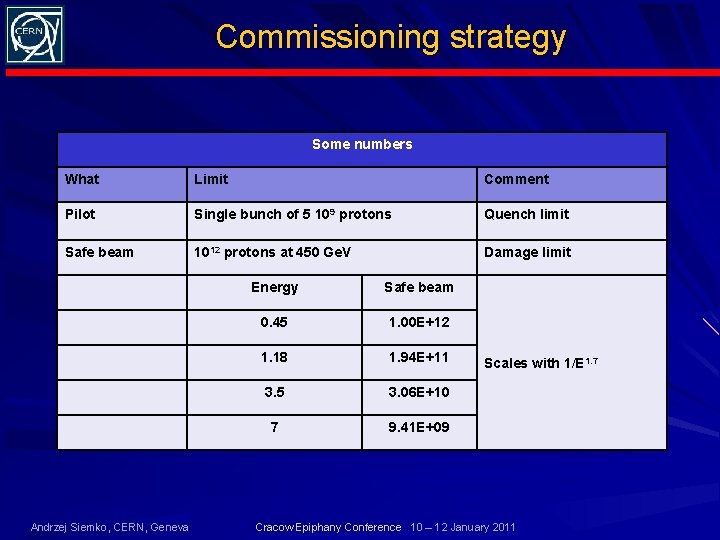
Commissioning strategy Some numbers What Limit Comment Pilot Single bunch of 5 109 protons Quench limit Safe beam 1012 protons at 450 Ge. V Damage limit Andrzej Siemko, CERN, Geneva Energy Safe beam 0. 45 1. 00 E+12 1. 18 1. 94 E+11 3. 5 3. 06 E+10 7 9. 41 E+09 Scales with 1/E 1. 7 Cracow Epiphany Conference 10 – 12 January 2011
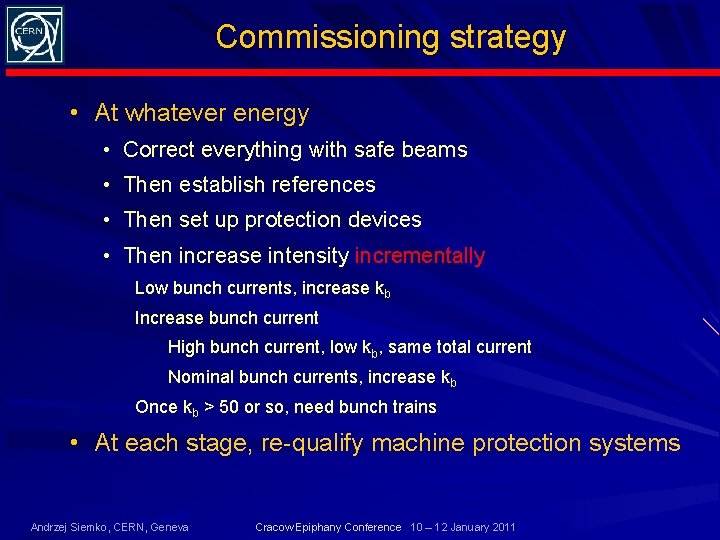
Commissioning strategy • At whatever energy • Correct everything with safe beams • Then establish references • Then set up protection devices • Then increase intensity incrementally Low bunch currents, increase kb Increase bunch current High bunch current, low kb, same total current Nominal bunch currents, increase kb Once kb > 50 or so, need bunch trains • At each stage, re-qualify machine protection systems Andrzej Siemko, CERN, Geneva Cracow Epiphany Conference 10 – 12 January 2011
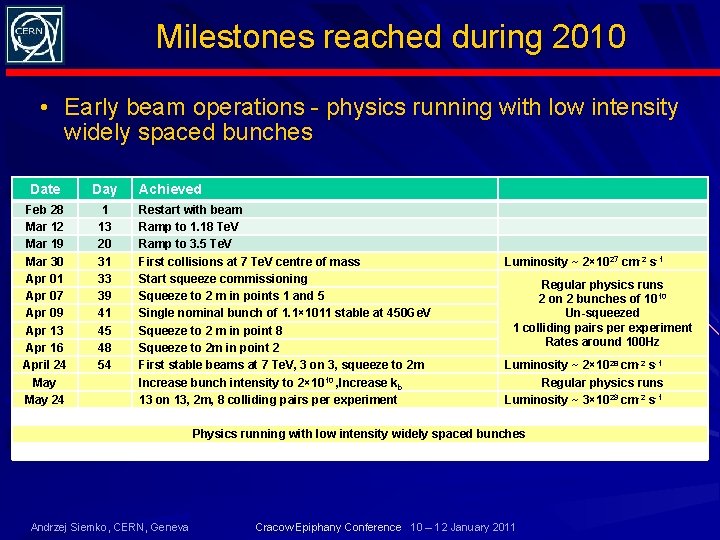
Milestones reached during 2010 • Early beam operations - physics running with low intensity widely spaced bunches Date Day Feb 28 Mar 12 Mar 19 Mar 30 Apr 01 Apr 07 Apr 09 Apr 13 Apr 16 April 24 May 24 1 13 20 31 33 39 41 45 48 54 Achieved Restart with beam Ramp to 1. 18 Te. V Ramp to 3. 5 Te. V First collisions at 7 Te. V centre of mass Start squeeze commissioning Squeeze to 2 m in points 1 and 5 Single nominal bunch of 1. 1× 10¹¹ stable at 450 Ge. V Squeeze to 2 m in point 8 Squeeze to 2 m in point 2 First stable beams at 7 Te. V, 3 on 3, squeeze to 2 m Increase bunch intensity to 2× 10¹⁰ , Increase kb 13 on 13, 2 m, 8 colliding pairs per experiment Luminosity ~ 2× 1027 cm-2 s-1 Regular physics runs 2 on 2 bunches of 1010 Un-squeezed 1 colliding pairs per experiment Rates around 100 Hz Luminosity ~ 2× 1028 cm-2 s-1 Regular physics runs Luminosity ~ 3× 1029 cm-2 s-1 Physics running with low intensity widely spaced bunches Andrzej Siemko, CERN, Geneva Cracow Epiphany Conference 10 – 12 January 2011
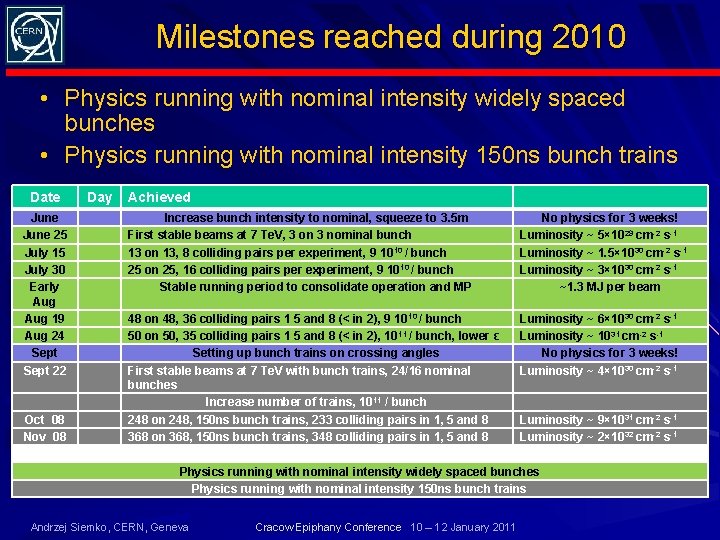
Milestones reached during 2010 • Physics running with nominal intensity widely spaced bunches • Physics running with nominal intensity 150 ns bunch trains Date June 25 July 15 July 30 Early Aug 19 Aug 24 Sept 22 Oct 08 Nov 08 Day Achieved Increase bunch intensity to nominal, squeeze to 3. 5 m First stable beams at 7 Te. V, 3 on 3 nominal bunch 13 on 13, 8 colliding pairs per experiment, 9 10 10 / bunch 25 on 25, 16 colliding pairs per experiment, 9 10 10 / bunch Stable running period to consolidate operation and MP No physics for 3 weeks! Luminosity ~ 5× 1029 cm-2 s-1 Luminosity ~ 1. 5× 1030 cm-2 s-1 Luminosity ~ 3× 1030 cm-2 s-1 ~1. 3 MJ per beam 48 on 48, 36 colliding pairs 1 5 and 8 (< in 2), 9 10 10 / bunch 50 on 50, 35 colliding pairs 1 5 and 8 (< in 2), 10 11 / bunch, lower ε Setting up bunch trains on crossing angles First stable beams at 7 Te. V with bunch trains, 24/16 nominal bunches Increase number of trains, 1011 / bunch 248 on 248, 150 ns bunch trains, 233 colliding pairs in 1, 5 and 8 368 on 368, 150 ns bunch trains, 348 colliding pairs in 1, 5 and 8 Luminosity ~ 6× 1030 cm-2 s-1 Luminosity ~ 1031 cm-2 s-1 No physics for 3 weeks! Luminosity ~ 4× 1030 cm-2 s-1 Luminosity ~ 9× 1031 cm-2 s-1 Luminosity ~ 2× 1032 cm-2 s-1 Physics running with nominal intensity widely spaced bunches Physics running with nominal intensity 150 ns bunch trains Andrzej Siemko, CERN, Geneva Cracow Epiphany Conference 10 – 12 January 2011
2010 Proton Run - Performance Highlights Andrzej Siemko, CERN, Geneva Cracow Epiphany Conference 10 – 12 January 2011
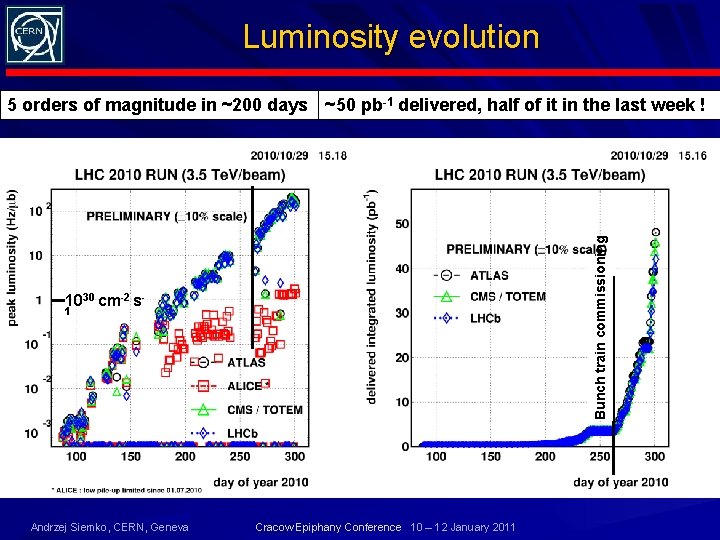
Luminosity evolution Bunch train commissioning 5 orders of magnitude in ~200 days ~50 pb-1 delivered, half of it in the last week ! 1030 cm-2 s 1 Andrzej Siemko, CERN, Geneva Cracow Epiphany Conference 10 – 12 January 2011
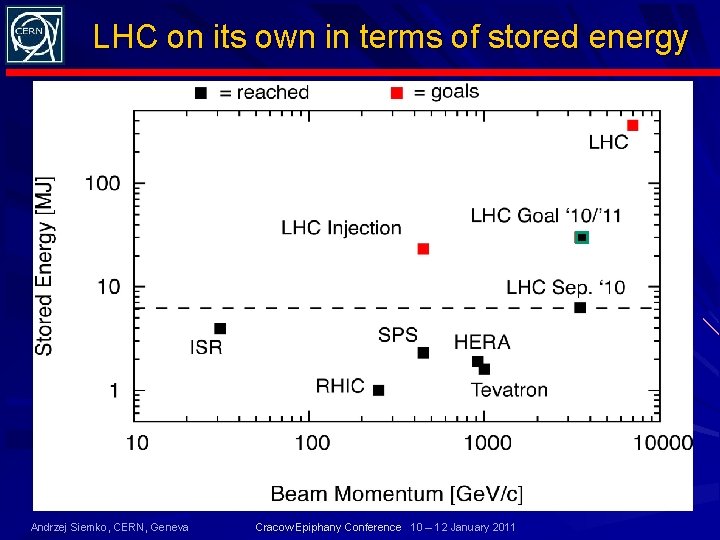
LHC on its own in terms of stored energy Andrzej Siemko, CERN, Geneva Cracow Epiphany Conference 10 – 12 January 2011
OUTLINE • Early beam operations and main parameters for the first LHC proton run • Strategy and progress during 2010 • Observations, encountered limitations • First heavy ion run • Prospects for 2011 • Summary and conclusions Andrzej Siemko, CERN, Geneva Cracow Epiphany Conference 10 – 12 January 2011
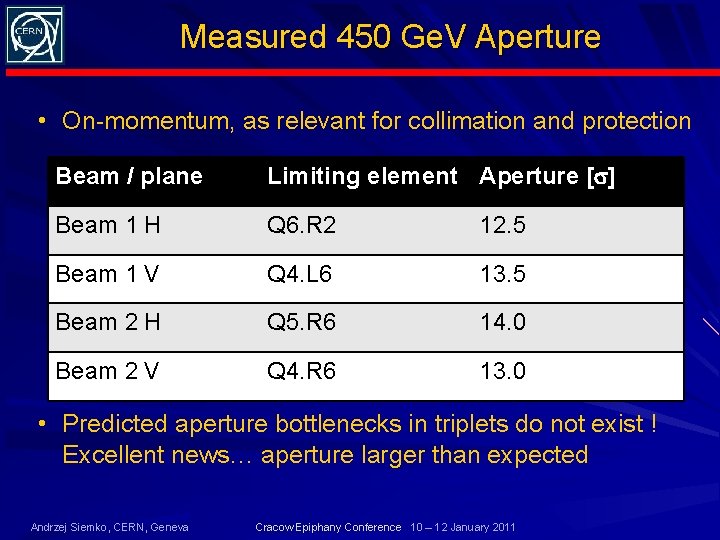
Measured 450 Ge. V Aperture • On-momentum, as relevant for collimation and protection Beam / plane Limiting element Aperture [s] Beam 1 H Q 6. R 2 12. 5 Beam 1 V Q 4. L 6 13. 5 Beam 2 H Q 5. R 6 14. 0 Beam 2 V Q 4. R 6 13. 0 • Predicted aperture bottlenecks in triplets do not exist ! Excellent news… aperture larger than expected Andrzej Siemko, CERN, Geneva Cracow Epiphany Conference 10 – 12 January 2011
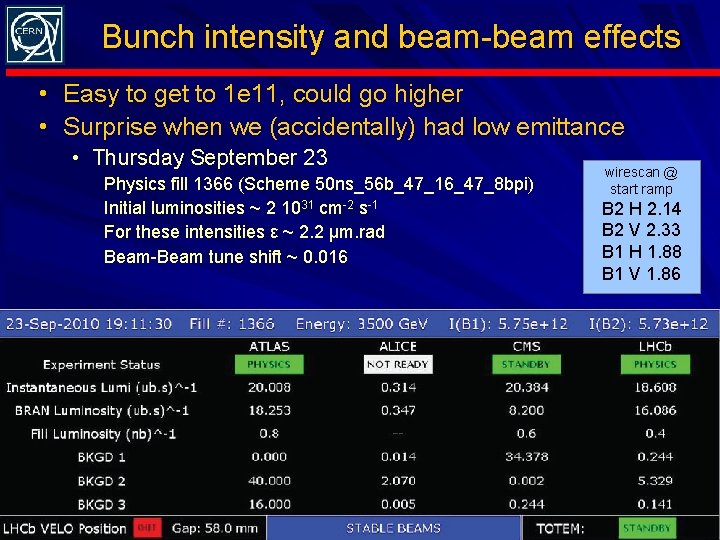
Bunch intensity and beam-beam effects • Easy to get to 1 e 11, could go higher • Surprise when we (accidentally) had low emittance • Thursday September 23 Physics fill 1366 (Scheme 50 ns_56 b_47_16_47_8 bpi) Initial luminosities ~ 2 1031 cm-2 s-1 For these intensities ε ~ 2. 2 µm. rad Beam-Beam tune shift ~ 0. 016 Andrzej Siemko, CERN, Geneva Cracow Epiphany Conference 10 – 12 January 2011 wirescan @ start ramp B 2 H 2. 14 B 2 V 2. 33 B 1 H 1. 88 B 1 V 1. 86
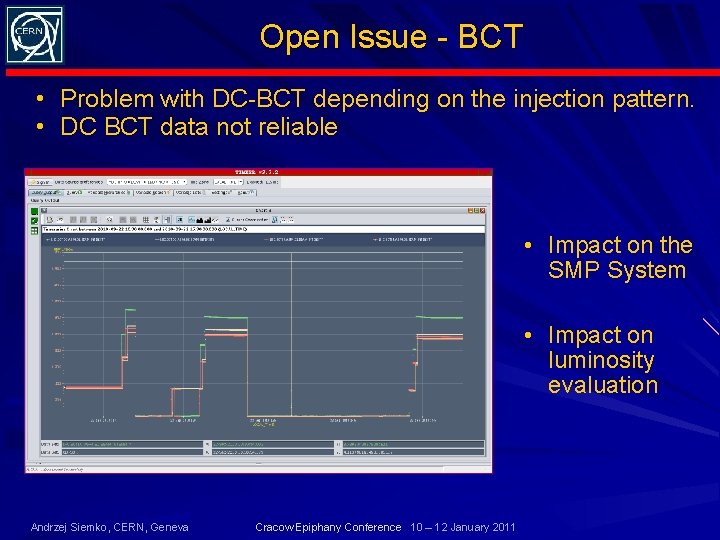
Open Issue - BCT • Problem with DC-BCT depending on the injection pattern. • DC BCT data not reliable • Impact on the SMP System • Impact on luminosity evaluation Andrzej Siemko, CERN, Geneva Cracow Epiphany Conference 10 – 12 January 2011
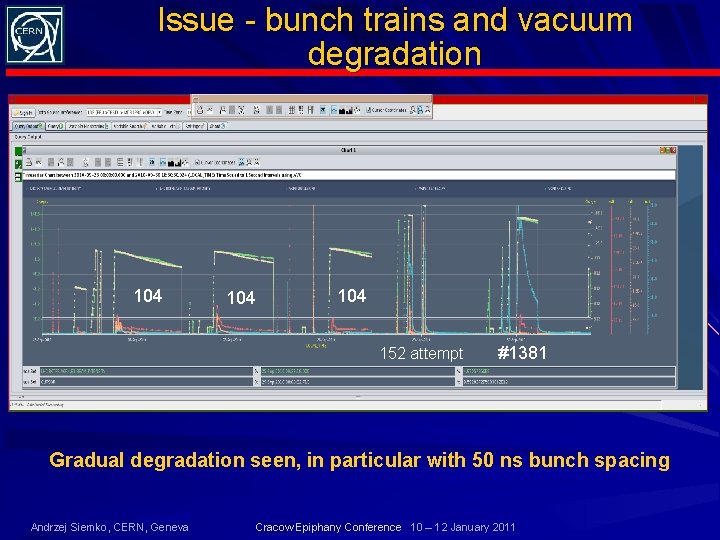
Issue - bunch trains and vacuum degradation 104 104 152 attempt #1381 Gradual degradation seen, in particular with 50 ns bunch spacing Andrzej Siemko, CERN, Geneva Cracow Epiphany Conference 10 – 12 January 2011
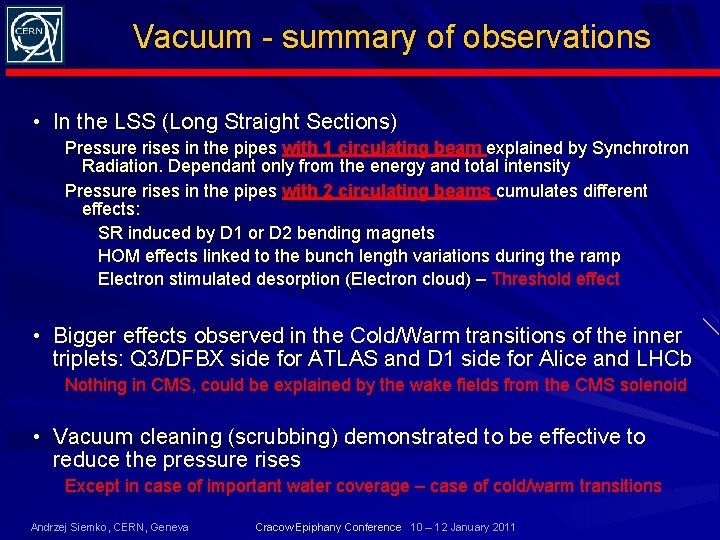
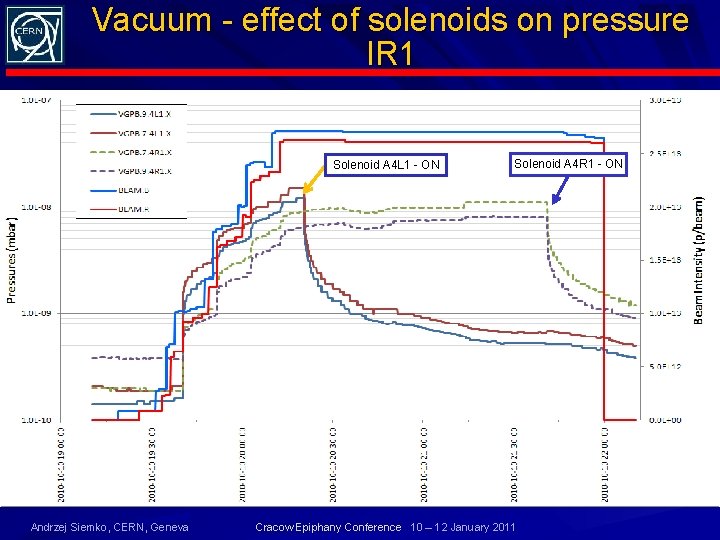
Vacuum - summary of observations • In the LSS (Long Straight Sections) Pressure rises in the pipes with 1 circulating beam explained by Synchrotron Radiation. Dependant only from the energy and total intensity Pressure rises in the pipes with 2 circulating beams cumulates different effects: SR induced by D 1 or D 2 bending magnets HOM effects linked to the bunch length variations during the ramp Electron stimulated desorption (Electron cloud) – Threshold effect • Bigger effects observed in the Cold/Warm transitions of the inner triplets: Q 3/DFBX side for ATLAS and D 1 side for Alice and LHCb Nothing in CMS, could be explained by the wake fields from the CMS solenoid • Vacuum cleaning (scrubbing) demonstrated to be effective to reduce the pressure rises Except in case of important water coverage – case of cold/warm transitions Andrzej Siemko, CERN, Geneva Cracow Epiphany Conference 10 – 12 January 2011
Vacuum - effect of solenoids on pressure IR 1 Solenoid A 4 L 1 - ON Andrzej Siemko, CERN, Geneva Solenoid A 4 R 1 - ON Cracow Epiphany Conference 10 – 12 January 2011
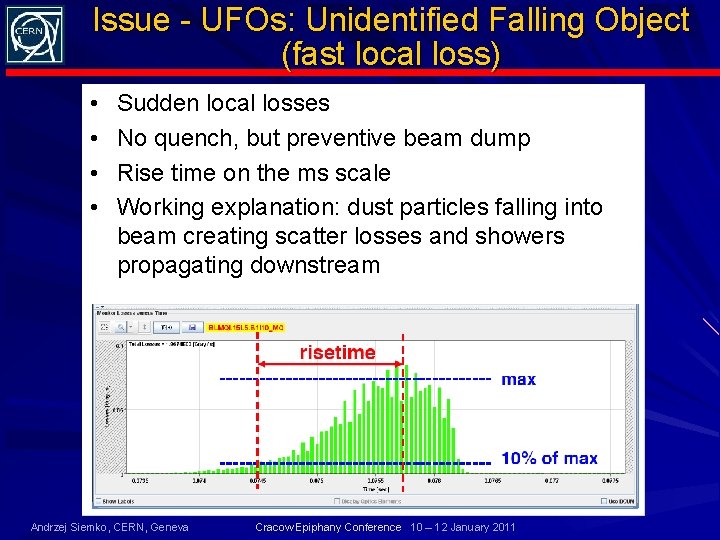
Issue - UFOs: Unidentified Falling Object (fast local loss) • • Sudden local losses No quench, but preventive beam dump Rise time on the ms scale Working explanation: dust particles falling into beam creating scatter losses and showers propagating downstream Andrzej Siemko, CERN, Geneva Cracow Epiphany Conference 10 – 12 January 2011
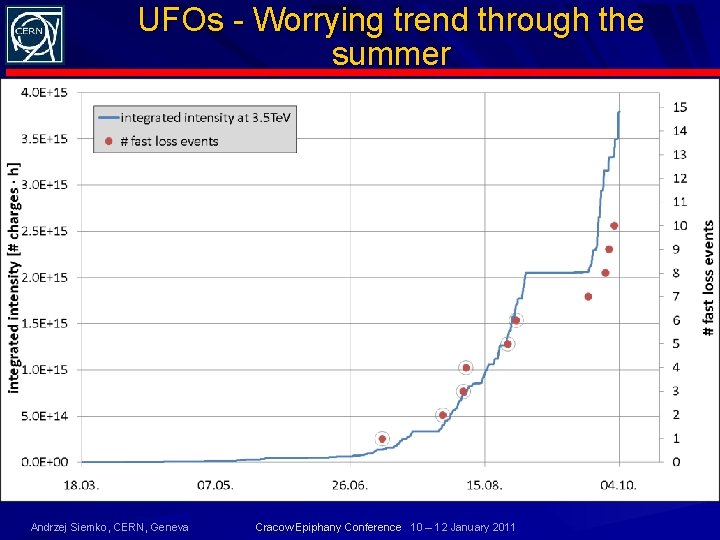
UFOs - Worrying trend through the summer Andrzej Siemko, CERN, Geneva Cracow Epiphany Conference 10 – 12 January 2011
Mitigated by change of BLM threshold • UFO dump rate has gone down significantly since we increased the thresholds at SC elements (except triplets) by a factor 3. • 12 UFOs before change of threshold. • But there are still coming at a steady rate. • No quench with UFOs. • 2 UFOs since threshold change: • UFO near LHCb leading to dump by LHCb – not the LHC BLMs. • Ultra-fast and somehow non-standard UFO at BSRT. • Even though the UFO rate seems to be under control now, UFOs will become a problem if we ever increase the energy since the quench and BLM thresholds will come down again (factor 2 -3 !). • To be looked at and understood • UFO mechanism • Possible cleaning by beam • Actions for 2012 stop Andrzej Siemko, CERN, Geneva Cracow Epiphany Conference 10 – 12 January 2011
LHC Systems – Operational Efficiency All faults downtime distribution Equipment type Faults Qty. Availability[1] [%] MTBF [hours] Quench heater power supplies 26 6076 99. 998 1145760 Quench detection systems 19 10438 99. 999 3362135 DAQ caused by radiation (SEU) 12 1624 99. 997 828240 DAQ other causes than radiation 8 2532 99. 999 1936980 DAQ all faults combined 20 2532 99. 997 774792 EE 600 6 202 99. 988 206040 EE 13 k. A 5 32 99. 939 39168 R. Denz QPS wins in 2010 by a neck… Andrzej Siemko, CERN, Geneva Cracow Epiphany Conference 10 – 12 January 2011
OUTLINE • Early beam operations and main parameters for the first LHC proton run • Strategy and progress during 2010 • Observations, encountered limitations • First heavy ion run • Prospects for 2011 • Summary and conclusions Andrzej Siemko, CERN, Geneva Cracow Epiphany Conference 10 – 12 January 2011
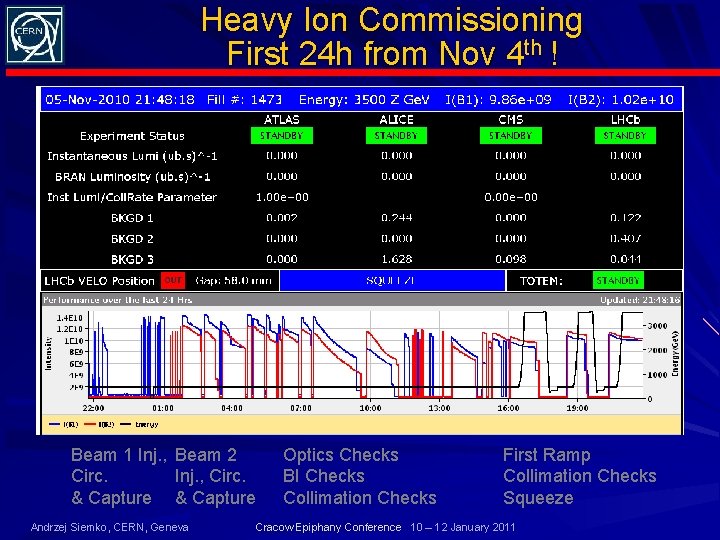
Heavy Ion Commissioning First 24 h from Nov 4 th ! Beam 1 Inj. , Beam 2 Circ. Inj. , Circ. & Capture Andrzej Siemko, CERN, Geneva Optics Checks BI Checks Collimation Checks First Ramp Collimation Checks Squeeze Cracow Epiphany Conference 10 – 12 January 2011
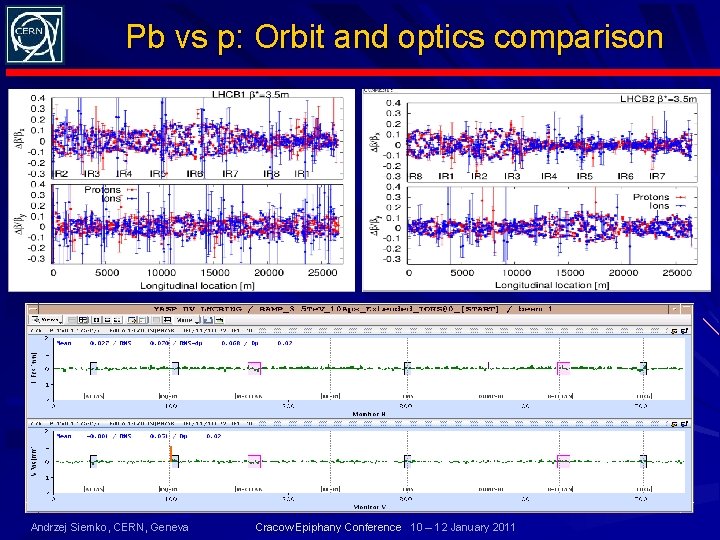
Pb vs p: Orbit and optics comparison Andrzej Siemko, CERN, Geneva Cracow Epiphany Conference 10 – 12 January 2011
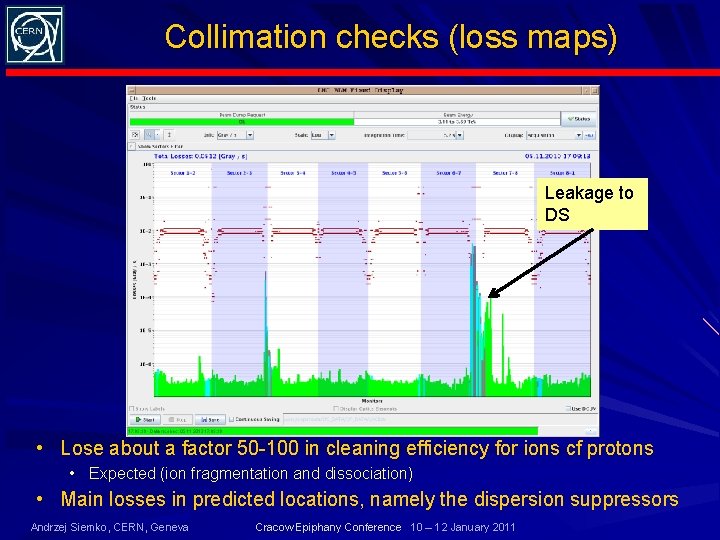
Collimation checks (loss maps) Leakage to DS • Lose about a factor 50 -100 in cleaning efficiency for ions cf protons • Expected (ion fragmentation and dissociation) • Main losses in predicted locations, namely the dispersion suppressors Andrzej Siemko, CERN, Geneva Cracow Epiphany Conference 10 – 12 January 2011
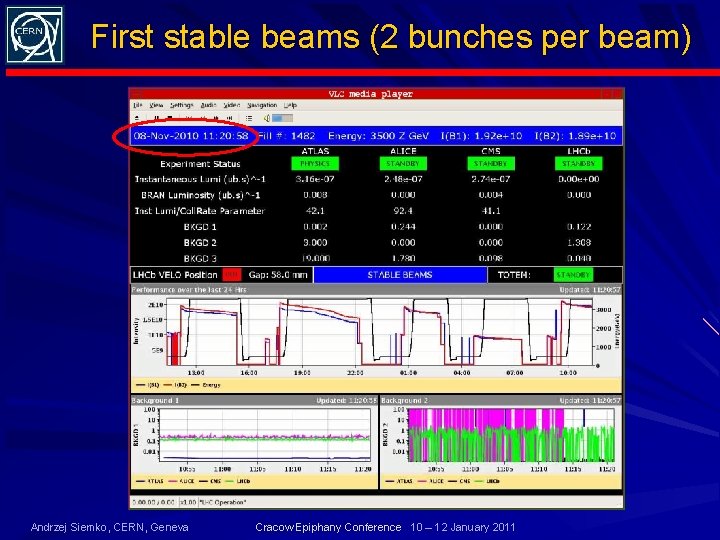
First stable beams (2 bunches per beam) Andrzej Siemko, CERN, Geneva Cracow Epiphany Conference 10 – 12 January 2011
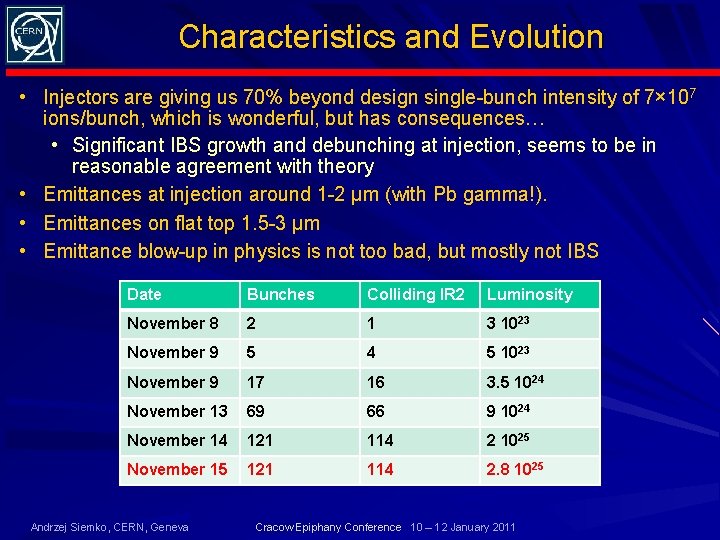
Characteristics and Evolution • Injectors are giving us 70% beyond design single-bunch intensity of 7× 10⁷ ions/bunch, which is wonderful, but has consequences… • Significant IBS growth and debunching at injection, seems to be in reasonable agreement with theory • Emittances at injection around 1 -2 μm (with Pb gamma!). • Emittances on flat top 1. 5 -3 μm • Emittance blow-up in physics is not too bad, but mostly not IBS Date Bunches Colliding IR 2 Luminosity November 8 2 1 3 1023 November 9 5 4 5 1023 November 9 17 16 3. 5 1024 November 13 69 66 9 1024 November 14 121 114 2 1025 November 15 121 114 2. 8 1025 Andrzej Siemko, CERN, Geneva Cracow Epiphany Conference 10 – 12 January 2011
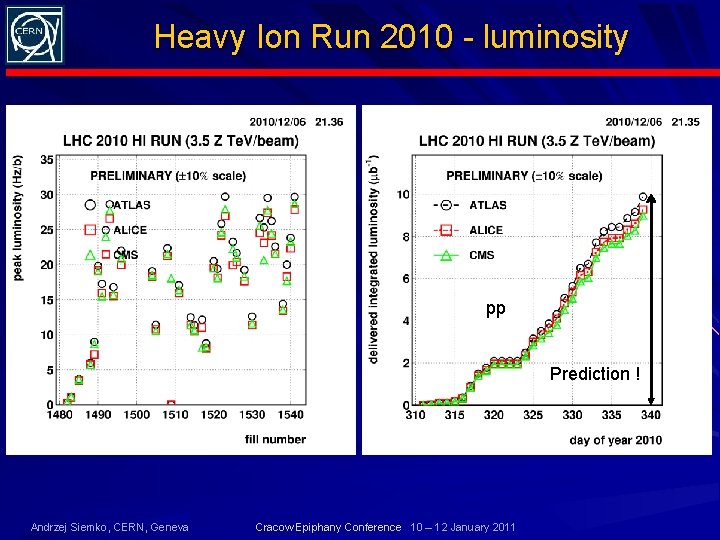
Heavy Ion Run 2010 - luminosity pp Prediction ! Andrzej Siemko, CERN, Geneva Cracow Epiphany Conference 10 – 12 January 2011
Heavy Ion Issues - Single Event Upset • Primary ion beam losses are intercepted at the collimators • Several features contribute to more severe ion loss • Ion dissociation and fragmentation reduce cleaning efficiency by factor ~100 when compared to protons. Collimation upgrade (DS collimators) will solve this. • Ion beam lifetimes factor ~3 -6 lower than for proton beams Not yet understood • Effects are clearly seen in Radmon monitors • And in the equipment! • QPS and PC Andrzej Siemko, CERN, Geneva Cracow Epiphany Conference 10 – 12 January 2011
OUTLINE • Early beam operations and main parameters for the first LHC proton run • Strategy and progress during 2010 • Observations, encountered limitations • First heavy ion run • Prospects for 2011 • Summary and conclusions Andrzej Siemko, CERN, Geneva Cracow Epiphany Conference 10 – 12 January 2011
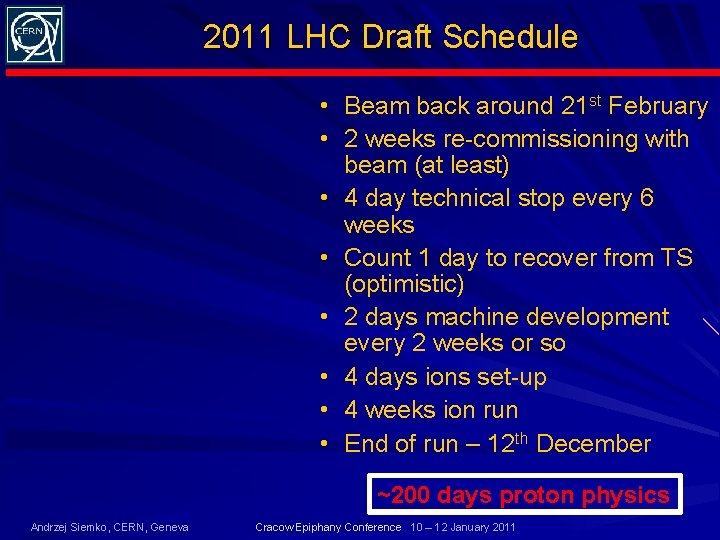
2011 LHC Draft Schedule • Beam back around 21 st February • 2 weeks re-commissioning with beam (at least) • 4 day technical stop every 6 weeks • Count 1 day to recover from TS (optimistic) • 2 days machine development every 2 weeks or so • 4 days ions set-up • 4 weeks ion run • End of run – 12 th December ~200 days proton physics Andrzej Siemko, CERN, Geneva Cracow Epiphany Conference 10 – 12 January 2011
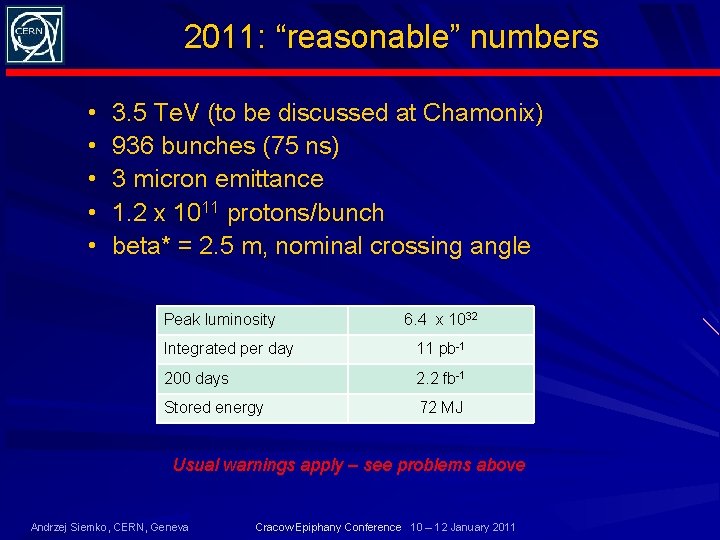
2011: “reasonable” numbers • • • 3. 5 Te. V (to be discussed at Chamonix) 936 bunches (75 ns) 3 micron emittance 1. 2 x 10¹¹ protons/bunch beta* = 2. 5 m, nominal crossing angle Peak luminosity 6. 4 x 1032 Integrated per day 11 pb-1 200 days 2. 2 fb-1 Stored energy 72 MJ Usual warnings apply – see problems above Andrzej Siemko, CERN, Geneva Cracow Epiphany Conference 10 – 12 January 2011
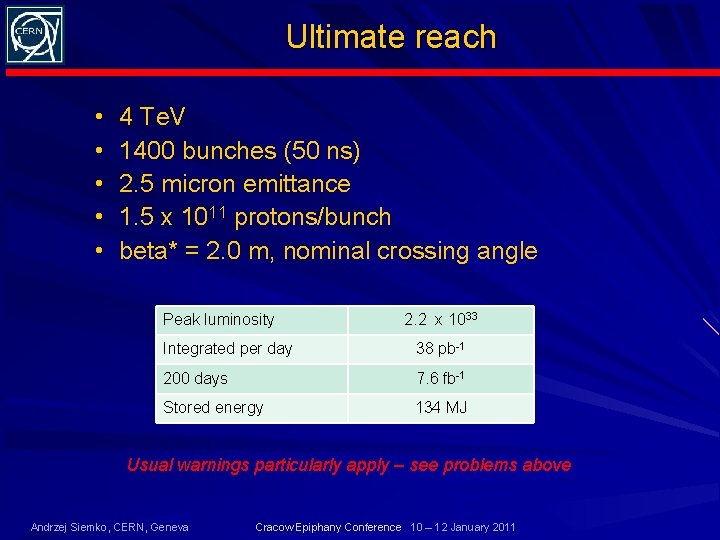
Ultimate reach • • • 4 Te. V 1400 bunches (50 ns) 2. 5 micron emittance 1. 5 x 10¹¹ protons/bunch beta* = 2. 0 m, nominal crossing angle Peak luminosity 2. 2 x 1033 Integrated per day 38 pb-1 200 days 7. 6 fb-1 Stored energy 134 MJ Usual warnings particularly apply – see problems above Andrzej Siemko, CERN, Geneva Cracow Epiphany Conference 10 – 12 January 2011
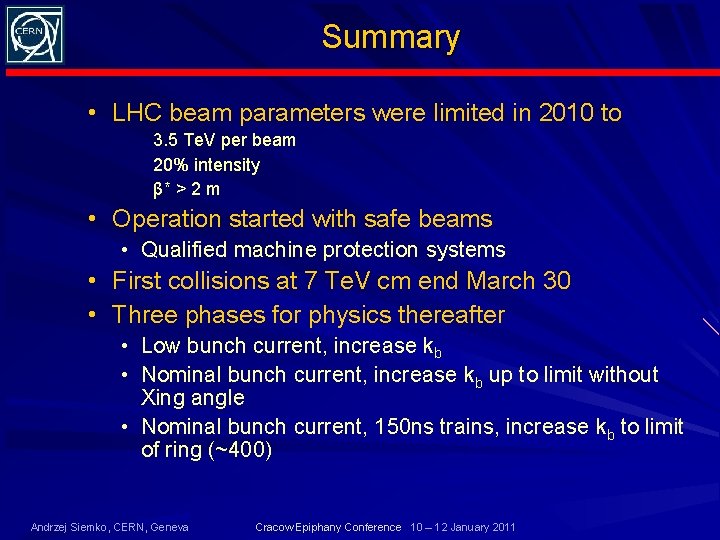
Summary • LHC beam parameters were limited in 2010 to 3. 5 Te. V per beam 20% intensity β* > 2 m • Operation started with safe beams • Qualified machine protection systems • First collisions at 7 Te. V cm end March 30 • Three phases for physics thereafter • Low bunch current, increase kb • Nominal bunch current, increase kb up to limit without Xing angle • Nominal bunch current, 150 ns trains, increase kb to limit of ring (~400) Andrzej Siemko, CERN, Geneva Cracow Epiphany Conference 10 – 12 January 2011
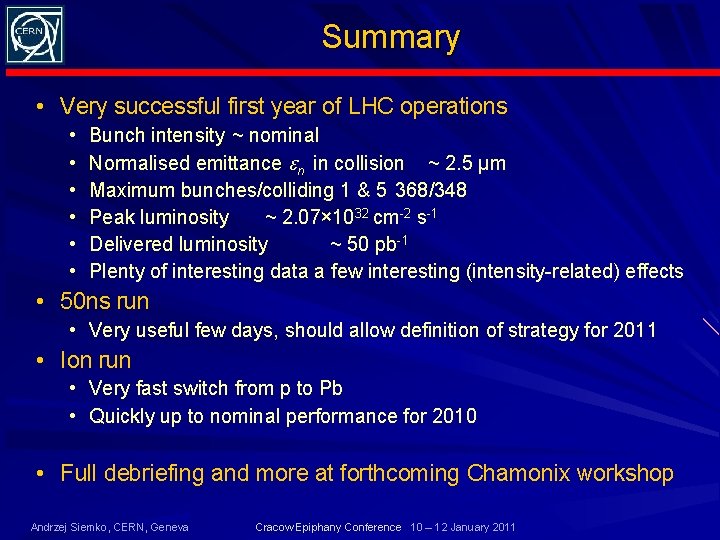
Summary • Very successful first year of LHC operations • • • Bunch intensity ~ nominal Normalised emittance n in collision ~ 2. 5 µm Maximum bunches/colliding 1 & 5 368/348 Peak luminosity ~ 2. 07× 1032 cm-2 s-1 Delivered luminosity ~ 50 pb-1 Plenty of interesting data a few interesting (intensity-related) effects • 50 ns run • Very useful few days, should allow definition of strategy for 2011 • Ion run • Very fast switch from p to Pb • Quickly up to nominal performance for 2010 • Full debriefing and more at forthcoming Chamonix workshop Andrzej Siemko, CERN, Geneva Cracow Epiphany Conference 10 – 12 January 2011
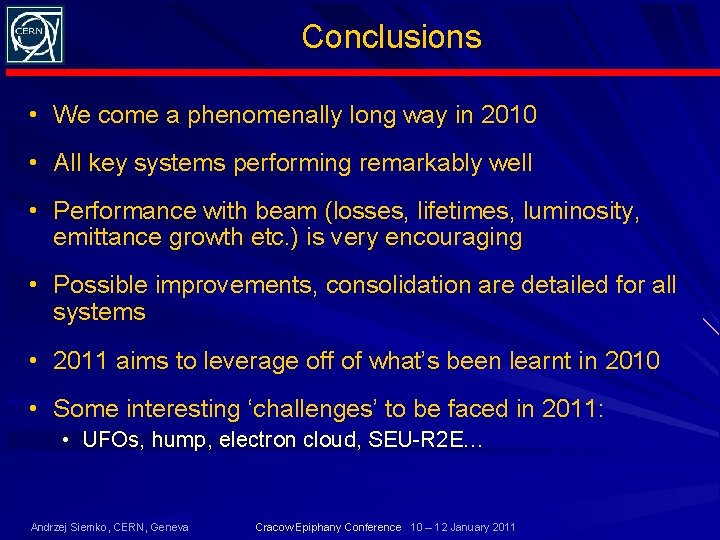
Conclusions • We come a phenomenally long way in 2010 • All key systems performing remarkably well • Performance with beam (losses, lifetimes, luminosity, emittance growth etc. ) is very encouraging • Possible improvements, consolidation are detailed for all systems • 2011 aims to leverage off of what’s been learnt in 2010 • Some interesting ‘challenges’ to be faced in 2011: • UFOs, hump, electron cloud, SEU-R 2 E… Andrzej Siemko, CERN, Geneva Cracow Epiphany Conference 10 – 12 January 2011
Acknowledgements • This talk sketched some aspects of the work of many people, over many years. • Particular thanks for material to: • R. Bailey, R. Schmidt, F. Bertinelli, J. Wenninger, J. Jowett, M. Lamont, A. Verweij and J. Uythoven. Andrzej Siemko, CERN, Geneva Cracow Epiphany Conference 10 – 12 January 2011
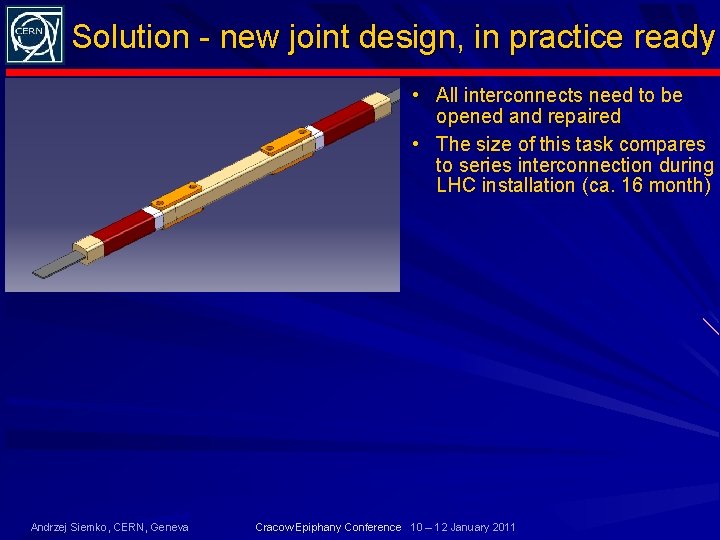
Solution - new joint design, in practice ready • All interconnects need to be opened and repaired • The size of this task compares to series interconnection during LHC installation (ca. 16 month) Andrzej Siemko, CERN, Geneva Cracow Epiphany Conference 10 – 12 January 2011