
The First Industrial Revolution The Industrial Revolution was
- Slides: 30
The First Industrial Revolution
• The Industrial Revolution was a _fundamental________ change in the way goods were produced, from human labor to machines • The more _efficient_ means of production and subsequent higher levels of __production_______ triggered farreaching changes to industrialized societies What was the Industrial Revolution?
� __machines____ were invented which replaced human labor � New __energy_____ sources were developed to power the new machinery – water, steam, electricity, oil (gas, kerosene) �Some historians place advances in __wind__, __atomic_______, and __solar_____ energy at the later stages of the Industrial Revolution � Increased use of metals and minerals �Aluminum, coal, copper, iron, etc. The Industrial Revolution
� __Transportation_______ improved �Ships ○ Wooden ships → __iron_______ ships → Steel ships ○ Wind-powered sails → __steam____- powered boilers �Trains �Automobiles � __Communications_______ improved �Telegraph �Telephone �Radio �Cellular/wireless The Industrial Revolution
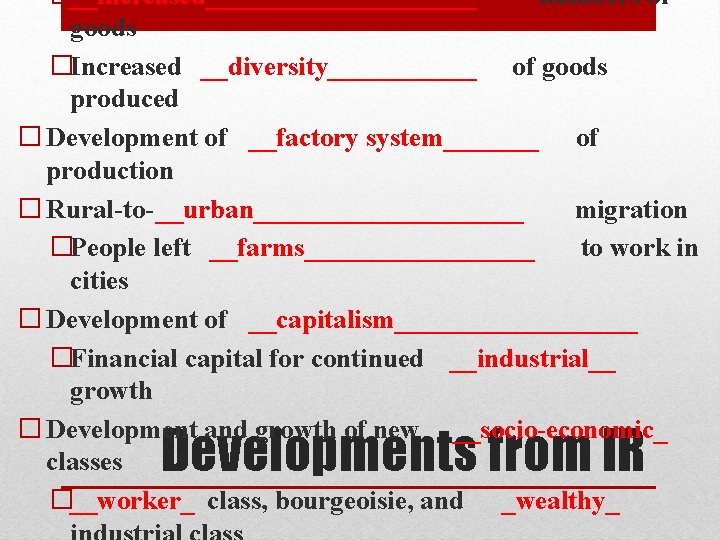
�__increased__________ numbers of goods �Increased __diversity______ of goods produced � Development of __factory system_______ of production � Rural-to-__urban__________ migration �People left __farms_________ to work in cities � Development of __capitalism_________ �Financial capital for continued __industrial__ growth � Development and growth of new __socio-economic_ classes �__worker_ class, bourgeoisie, and _wealthy_ Developments from IR
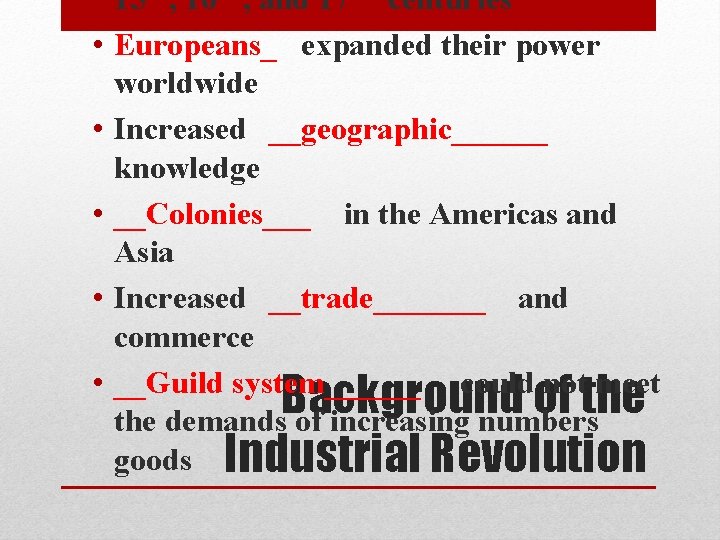
• 15 , 16 , and 17 centuries • Europeans_ expanded their power worldwide • Increased __geographic______ knowledge • __Colonies___ in the Americas and Asia • Increased __trade_______ and commerce • __Guild system______ could not meet Background of the demands of increasing numbers goods Industrial Revolution
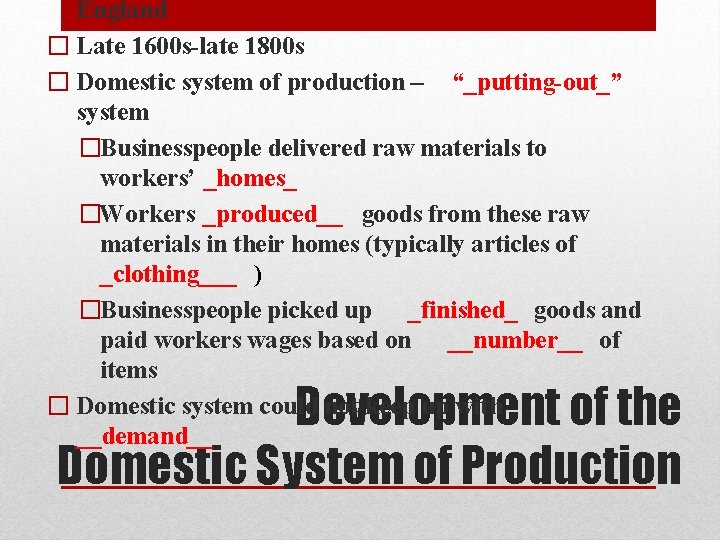
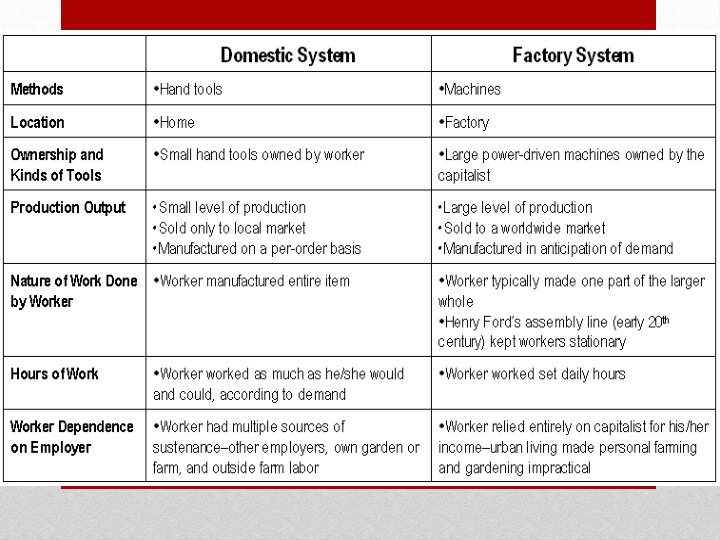
England � Late 1600 s-late 1800 s � Domestic system of production – “_putting-out_” system �Businesspeople delivered raw materials to workers’ _homes_ �Workers _produced__ goods from these raw materials in their homes (typically articles of _clothing___ ) �Businesspeople picked up _finished_ goods and paid workers wages based on __number__ of items � Domestic system could not keep up with __demand__ Development of the Domestic System of Production
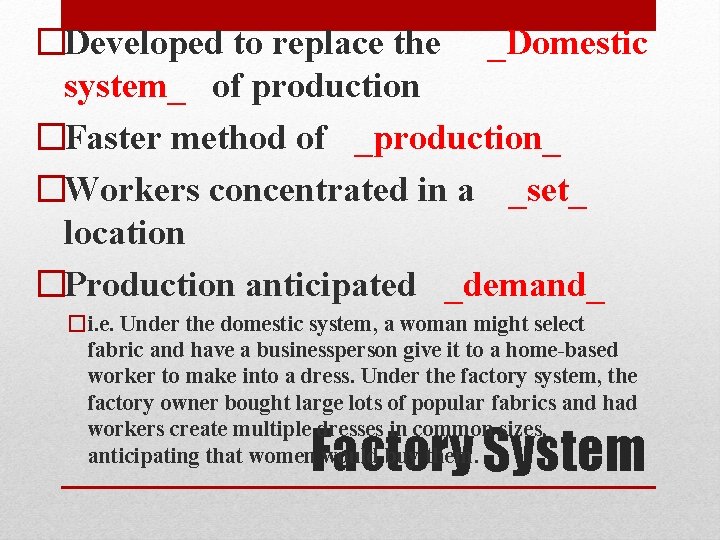
�Developed to replace the _Domestic system_ of production �Faster method of _production_ �Workers concentrated in a _set_ location �Production anticipated _demand_ �i. e. Under the domestic system, a woman might select fabric and have a businessperson give it to a home-based worker to make into a dress. Under the factory system, the factory owner bought large lots of popular fabrics and had workers create multiple dresses in common sizes, anticipating that women would buy them. Factory System
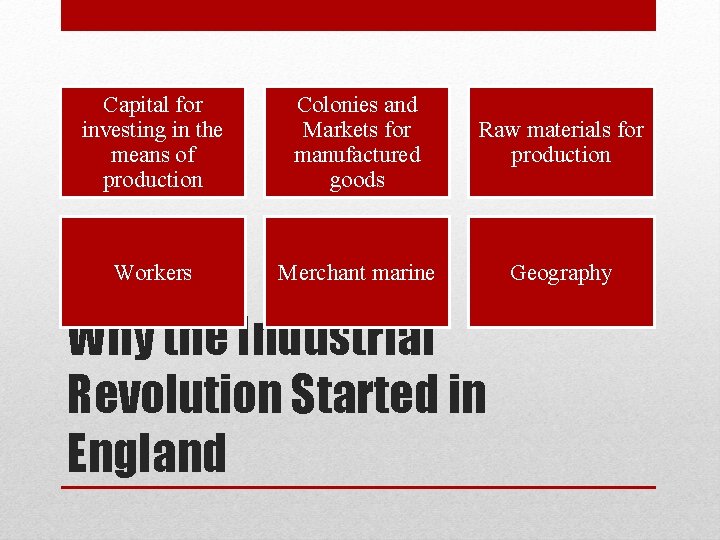
Capital for investing in the means of production Colonies and Markets for manufactured goods Raw materials for production Workers Merchant marine Geography Why the Industrial Revolution Started in England
• The Commercial Revolution made many English merchants very wealthy • These merchants had the capital to invest in the factory system – money to buy buildings, machinery, and raw materials England’s Resources: Capital
� Wealth from the Commercial Revolution spread beyond the merchant class � England had more colonies than any other nation � Its colonies gave England access to enormous markets and vast amounts of raw materials England’s Resources: �Many of the natural cloths popular today, such as calico and gingham, were originally created in India Colonies and Markets �China had a silk industry � Colonies had rich textile industries for centuries
� England itself possessed the necessary raw materials to create the means of production � Coal – vast coal reserves powered steam engines � Iron – basic building block of large machines, railroad tracks, trains, and ships England’s Resources: Raw Materials
� Serfdom and guilds ended earlier in England than other countries � English people could freely travel from the countryside to the cities England’s Resources: Workers � Enclosure Acts – caused many small farmers to lose their lands, and these former farmers increased the labor supply
• World’s largest merchant fleet • Merchant marine built up from the Commercial Revolution • Vast numbers of ships could bring raw materials and finished goods to and from England’s colonies and possessions, as well as to and from other countries England’s Resources: Merchant Marine
� England is the political center of Great Britain, an island � Great Britain (as the entire island was called beginning in 1707) did not suffer fighting on its land during the wars of the 18 th century � Island has excellent harbors and ports � Damp climate benefited the textile industry (thread did not dry out) � Government stable � No internal trade barriers England’s Resources: Geography
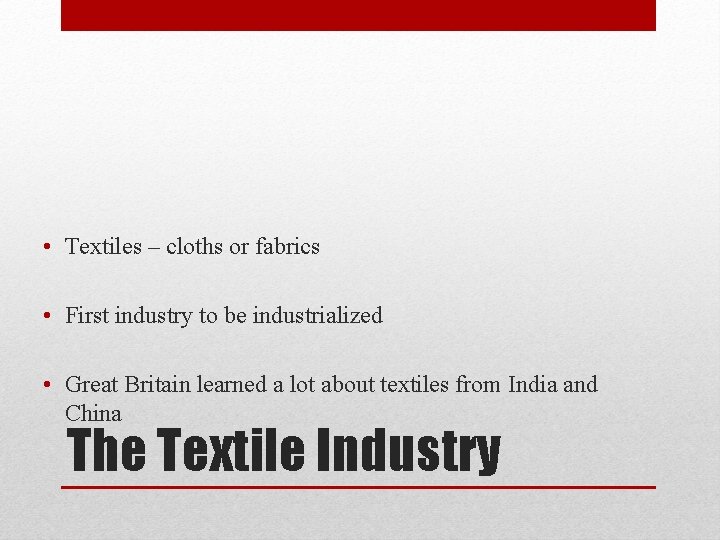
• Textiles – cloths or fabrics • First industry to be industrialized • Great Britain learned a lot about textiles from India and China The Textile Industry
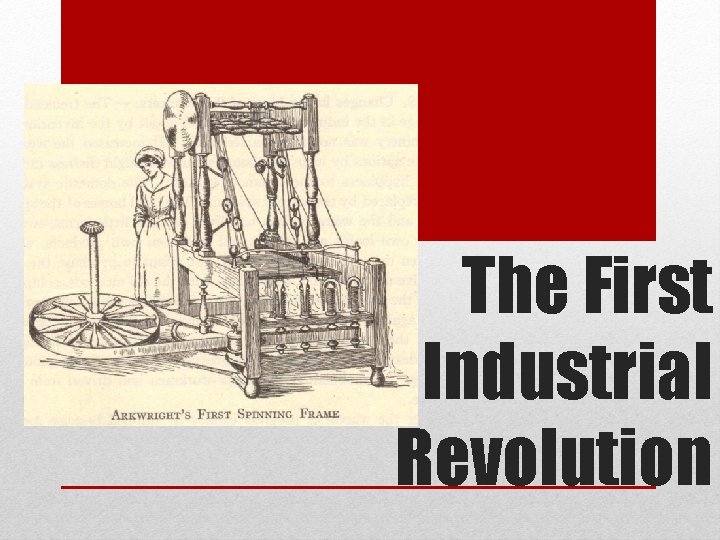
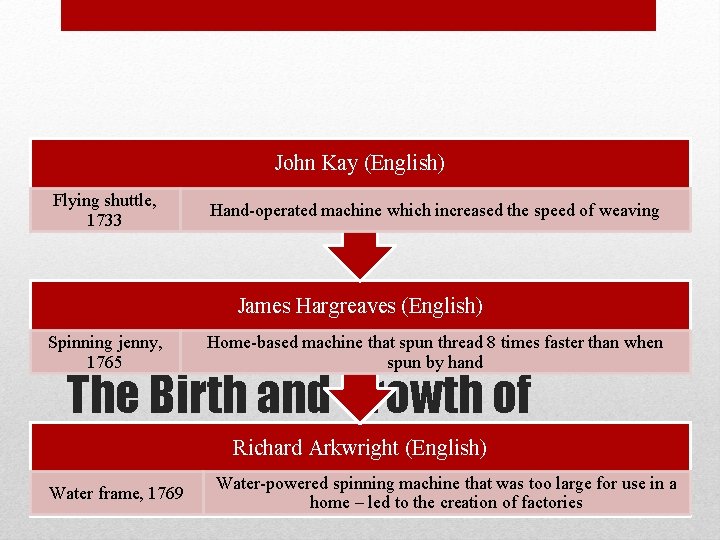
John Kay (English) Flying shuttle, 1733 Hand-operated machine which increased the speed of weaving James Hargreaves (English) Spinning jenny, 1765 Home-based machine that spun thread 8 times faster than when spun by hand The Birth and Growth of Richard Arkwright (English) the Textile Industry Water frame, 1769 Water-powered spinning machine that was too large for use in a home – led to the creation of factories
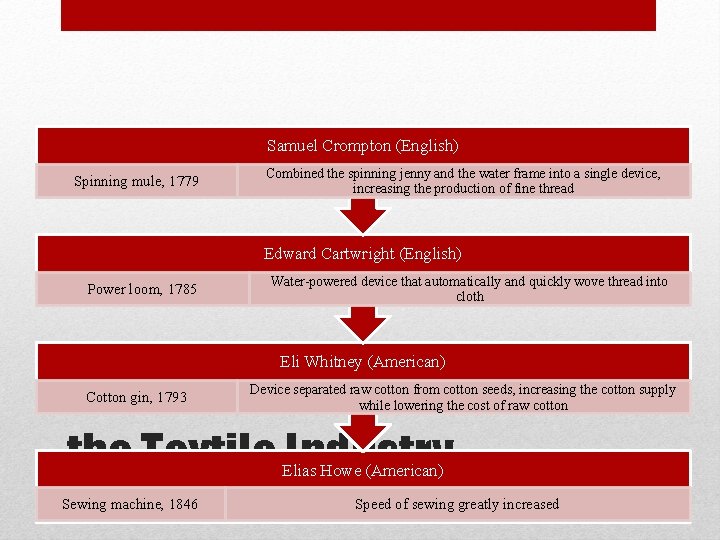
Samuel Crompton (English) Spinning mule, 1779 Combined the spinning jenny and the water frame into a single device, increasing the production of fine thread Edward Cartwright (English) Power loom, 1785 Water-powered device that automatically and quickly wove thread into cloth Eli Whitney (American) The Birth and Growth of the Textile Industry Cotton gin, 1793 Device separated raw cotton from cotton seeds, increasing the cotton supply while lowering the cost of raw cotton Elias Howe (American) Sewing machine, 1846 Speed of sewing greatly increased
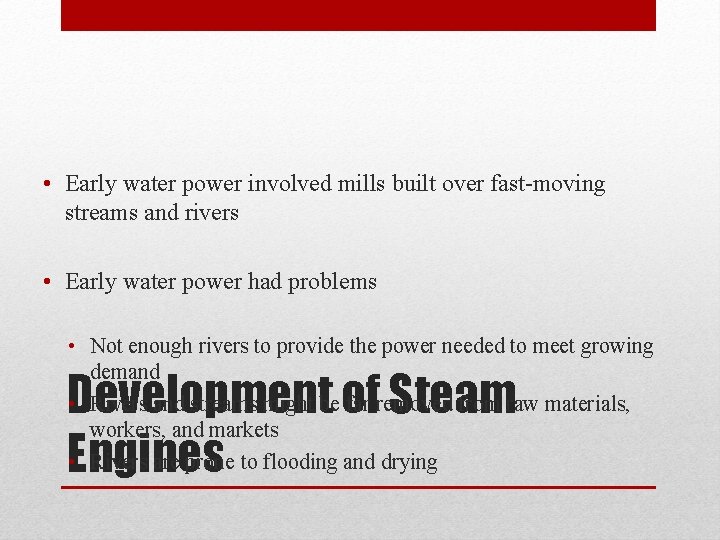
• Early water power involved mills built over fast-moving streams and rivers • Early water power had problems • Not enough rivers to provide the power needed to meet growing demand • Rivers and streams might be far removed from raw materials, workers, and markets • Rivers are prone to flooding and drying Development of Steam Engines
� Humans tried harnessing steam power for millennia �Hero of Alexandria, Egypt – created a steam-driven device in the 1 st century B. C. E. � Thomas Newcomen, England (1704) �Created a steam engine to pump water from mines � James Watt, Scotland (1769) �Improved Newcomen’s engine to power machinery Steam Power
� Prior to the Industrial Revolution, steel was difficult to produce and expensive � Henry Bessemer, 1856 �Developed the Bessemer process �Brought on the “Age of Steel” �Steel is the most important metal used over the past 150+ years � Other improvements in steel production �Open-hearth furnace. Process and Bessemer �Electric furnace �Use of other metals to produce various types of steel Steel
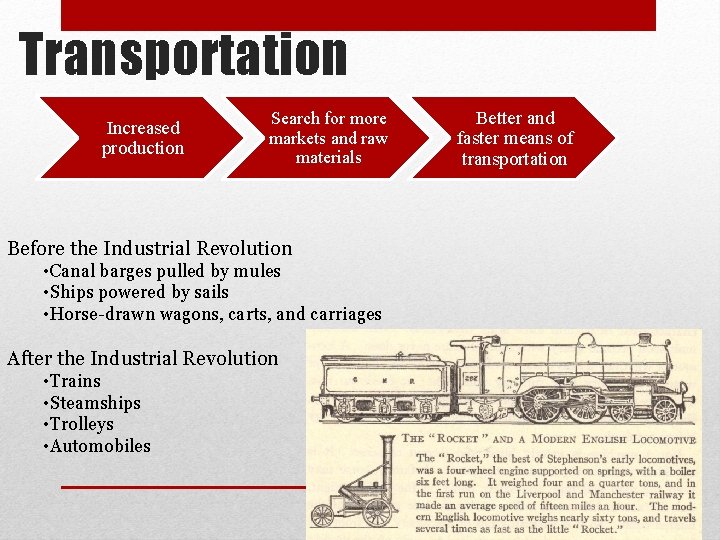
Transportation Increased production Search for more markets and raw materials Before the Industrial Revolution • Canal barges pulled by mules • Ships powered by sails • Horse-drawn wagons, carts, and carriages After the Industrial Revolution • Trains • Steamships • Trolleys • Automobiles Better and faster means of transportation
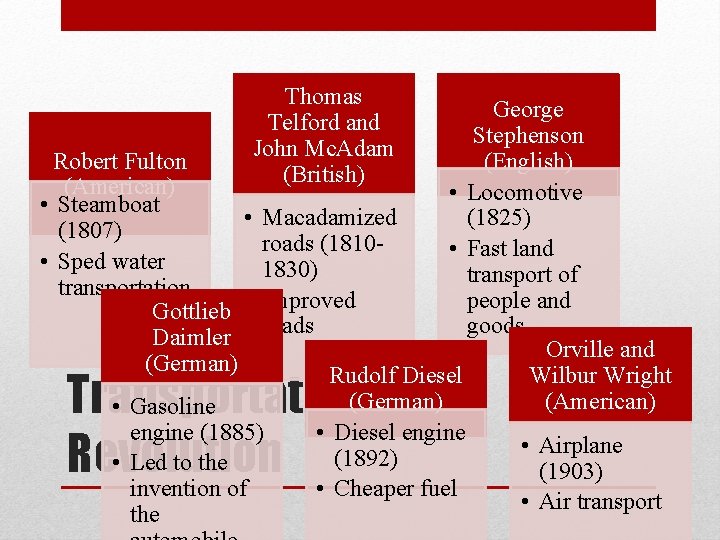
Thomas Telford and John Mc. Adam (British) George Stephenson (English) Robert Fulton (American) • Locomotive • Steamboat (1825) • Macadamized (1807) roads (1810 • Fast land • Sped water 1830) transport of transportation people and Gottlieb • Improved goods Daimler roads Orville and (German) Rudolf Diesel Wilbur Wright (German) (American) • Gasoline • Diesel engine (1885) • Airplane (1892) • Led to the (1903) • Cheaper fuel invention of • Air transport the Transportation Revolution
� Robert Fulton invented the steamboat in 1807 � The Clermont operated the first regular steamboat route, running between Albany and New York City � 1819 – the Savannah used a steam engine as auxiliary power for the first time when it sailed across the Atlantic Ocean � 1836 – John Ericsson invented a screw propeller to replace paddle wheels � 1838 – the Great Western first ship to sail across the Atlantic on steam power alone, completing the trip in 15 days Steamboats
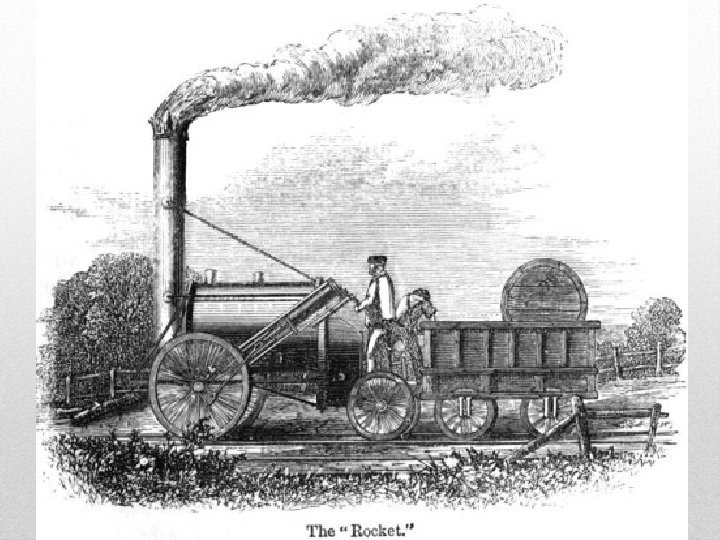
� 1830 – Stephenson’s “Rocket” train traveled the 40 miles between Liverpool and Manchester in 1 ½ hours � 1830 -1870 – railroad tracks went from 49 miles to over 15, 000 miles � Steel rails replaced iron rails � 1869 – Westinghouse’s air brake made train travel safer � Greater train traveling comfort – heavier train cars, improved road beds, and sleeping cars Railroads
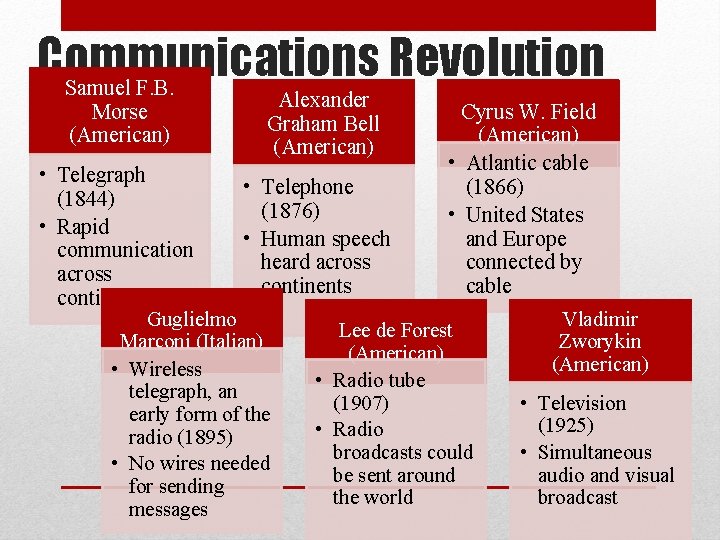
Communications Revolution Samuel F. B. Morse (American) Alexander Graham Bell (American) Cyrus W. Field (American) • Atlantic cable • Telegraph • Telephone (1866) (1844) (1876) • United States • Rapid • Human speech and Europe communication heard across connected by across continents cable continents Vladimir Guglielmo Lee de Forest Zworykin Marconi (Italian) (American) • Wireless • Radio tube telegraph, an • Television (1907) early form of the (1925) • Radio radio (1895) • Simultaneous broadcasts could • No wires needed audio and visual be sent around for sending the world broadcast messages
1. What was the Industrial Revolution? 2. Describe at least three developments of the Industrial Revolution. 3. Compare and contrast the domestic and factory methods of production. 4. Why did the Industrial Revolution begin in England? Review Questions 5. Explain why one invention or development leads to another.
6. Explain how developments in the textile industry sparked the Industrial Revolution. 7. Describe at least three developments in the area of transportation. 8. Describe at least three developments in the field of communications. 9. Considering the conditions necessary for industrialization to occur, how well equipped is the undeveloped world for becoming industrialized? Are modern undeveloped nations in a better or worse position than 18 th- and 19 th-century England? Review Questions