
The First Humans Human lifestyle was nomadic in

- Slides: 28
The First Humans • Human lifestyle was nomadic in order to get food. • Nomadic: wandering from place to place. • Shelter was natural and temporary, with caves being the best. • Only fishing communities somewhat more permanent. © 2010, TESCC • Men and women divided their responsibilities according survival priorities and abilities. • Men hunted (some gathering): women gathered (some hunting). • This was a matter of necessity for survival. If affects the thinking of humans today.
The First Humans • Human lifestyle was nomadic in order to get food. • Nomadic: wandering from place to place. • Shelter was natural and temporary, with caves being the best. • Only fishing communities somewhat more permanent. © 2010, TESCC • Men and women divided their responsibilities according survival priorities and abilities. • Men hunted (some gathering): women gathered (some hunting). • This was a matter of necessity for survival. If affects the thinking of humans today.
Migrations of Homo sapiens Europe 40, 000 years ago Siberia 40, 000 years ago North America 12, 000 -30, 000 years ago Oceania 1600 B. C. E. -500 C. E. Southwest Asia 100, 000 years ago Human Origins 200, 000 -250, 000 years ago Australia as many as 60, 000 years ago Chile 12, 000 -13 , 000 years ago Possible coastal routes of human migration Possible landward routes of human migration © 2010, TESCC Migrations in Oceania 3
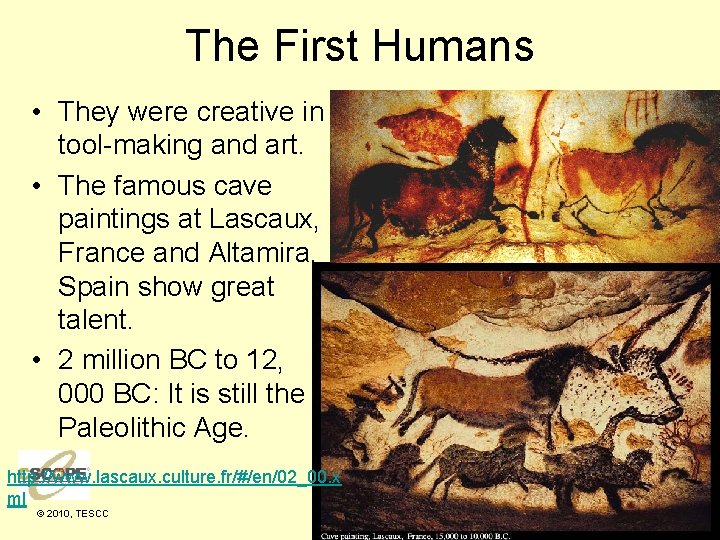
The First Humans • They were creative in tool-making and art. • The famous cave paintings at Lascaux, France and Altamira, Spain show great talent. • 2 million BC to 12, 000 BC: It is still the Paleolithic Age. http: //www. lascaux. culture. fr/#/en/02_00. x ml © 2010, TESCC
Neolithic Revolution (Agricultural Revolution) © 2010, TESCC
Key Understanding Geographic factors that allow advances in agriculture create a stable food supply which permits the development of a society. © 2010, TESCC
On your paper create a chart to compare what life is like before the development of farming with what it is like after the development of farming. Example on next slide © 2010, TESCC
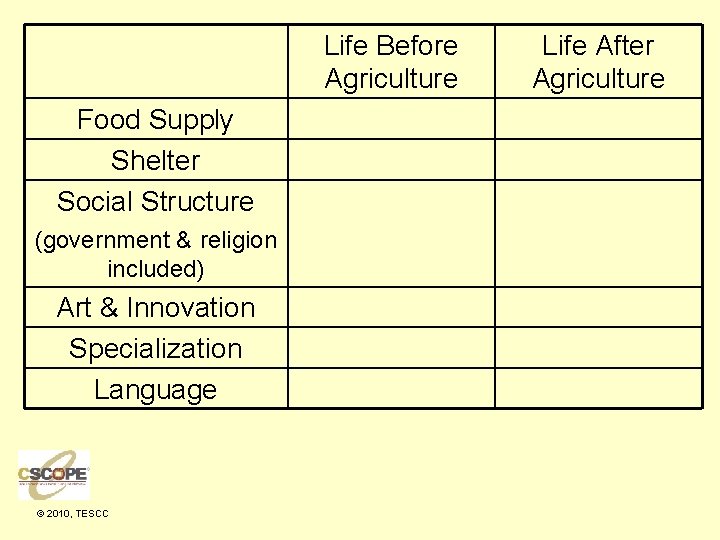
Life Before Agriculture Food Supply Shelter Social Structure (government & religion included) Art & Innovation Specialization Language © 2010, TESCC Life After Agriculture
Life Before the Agriculture Food Supply • Food gatherers as opposed to food producers • Nomadic – roaming existence – As the food in an area was consumed, man moved on, looking for another food supply – Followed the migration patterns of the herds. © 2010, TESCC
Life Before the Agriculture Shelter • Nomadic people live on what the environment can provide, such as caves. • Temporary shelters made of wood and hides. © 2010, TESCC
Life Before the Agriculture Social Structure • Social Structure was based on the family. • A group of families is called a clan. © 2010, TESCC
Life Before the Agriculture Art & Innovation • Some drawings and art work have been found. – Lascaux Cave Painting in France • Primitive weapons and tools – Sewing needles – Use of fire © 2010, TESCC
Life Before the Agriculture Specialization • Subsistence lifestyle dictated that the number one priority for all family members was to find food. © 2010, TESCC
Life Before the Agriculture Language • Only verbal communication was used. Symbols were used to mark places of importance. © 2010, TESCC
Development of Agriculture As man learns to farm, he is able to settle in one place and able to acquire more things. Although known as a revolution, these changes occurred independently throughout the world over the course of several thousand years. © 2010, TESCC
Life After the Agriculture Food Supply • Food Producing: planted, tended, harvested, and stored crops. • Domesticated animals are used for food and as beasts of burden. • Hunting supplemented the food supply. © 2010, TESCC
Life After the Agriculture Shelter • Use of mud bricks as building material • Eventually stones were used, leading to rock being quarried and cut for building. • Villages located near fields and other reliable food sources. (rivers/sea) © 2010, TESCC
Life After the Agriculture Social Structure • Complex social structures developed which involved when many clans began living in close proximity. • Gender separation: – Men farmed, herded, and hunted – Women did jobs near the home: childrearing, food preparation, etc. © 2010, TESCC
Social Structure continued. . • Religion is believed to have been developed to explain the forces of nature • Governments developed to organize activities. © 2010, TESCC
Life After the Agriculture Art & Innovation • Carving and statuary, complex tools such as advances in weapons, plows pulled by animals, building techniques, cloth making and weaving • Architecture and building for religious or common use © 2010, TESCC
Life After the Agriculture Specialization • People begin to specialize in various tasks: (tool maker), stone cutter, potter, basket weaving, early metallurgy. • Regional resources are gathered and traded. © 2010, TESCC
Life After the Agriculture Language • Development of pictographic languages (Egyptian Hieroglyphic) or written language. • Developed to keep records concerning food storage & trade. © 2010, TESCC
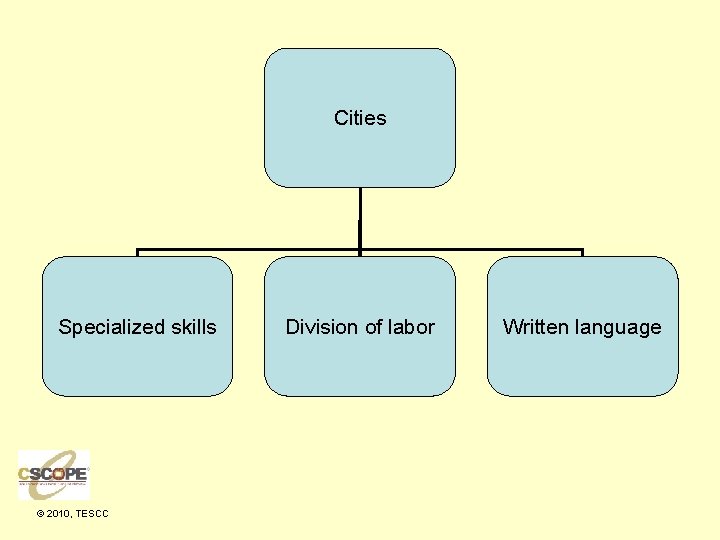
Cities Specialized skills © 2010, TESCC Division of labor Written language
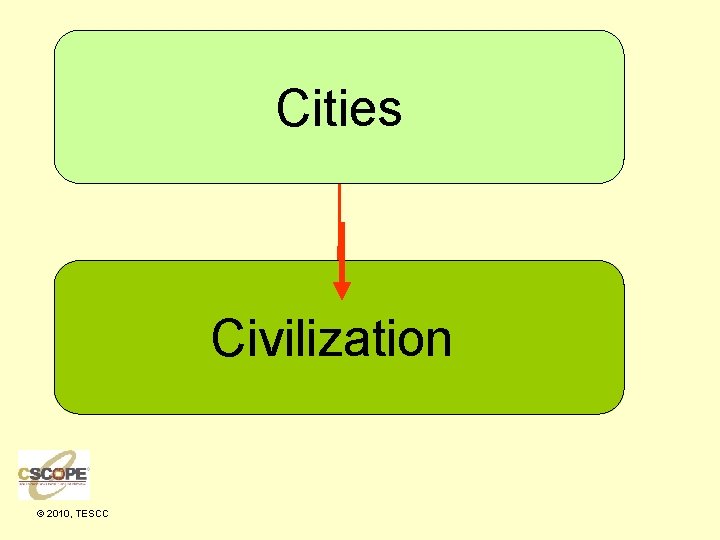
Cities Civilization © 2010, TESCC
What is a Civilization? • Civilization - An advanced state of intellectual, cultural, and material development in human society, marked by progress in the arts and sciences, the extensive use of record -keeping, including writing, and the appearance of complex political and social institutions. © 2010, TESCC
Features of a Civilization • Some forms of government – can range from being very basic to very complex ( a student council is considered a form of governing body – just someone or a group of some ones – who serve as a central authority or makes decisions for a group). • Some form of written language – record keeping became necessary. Why? © 2010, TESCC
Features of a Civilization • Division of labor or specialization in jobs – the breakdown of work into its tasks or parts and assigned to various people or groups for the purposes of efficiency • Social classes or social hierarchy – in different civilizations, this can be determined on different things, including: wealth, power, different ethnicity, etc. © 2010, TESCC
Features of a Civilization • Advanced technical skills. Sometimes this means inventions, sometimes it means things like art and/or architecture – an appreciation or development of something that is more than just basic. • Religion or belief system – a civilization usually is comprised of people who share similar beliefs. It may vary somewhat among the people but usually there is a core belief that often is reflected in their religious beliefs as well. © 2010, TESCC