
The First Door is the Right Door The
- Slides: 1
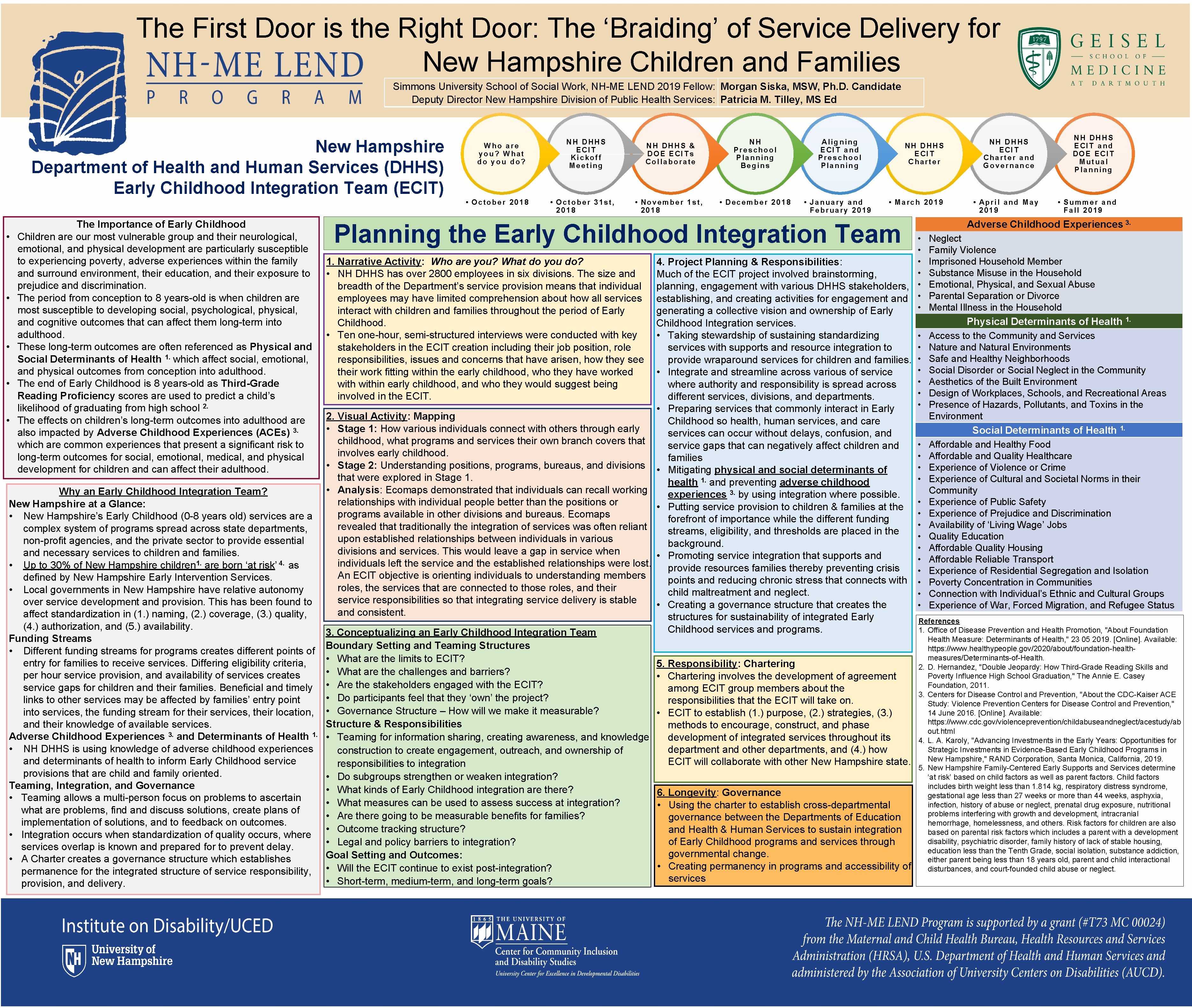
The First Door is the Right Door: The ‘Braiding’ of Service Delivery for New Hampshire Children and Families Simmons University School of Social Work, NH-ME LEND 2019 Fellow: Morgan Siska, MSW, Ph. D. Candidate Deputy Director New Hampshire Division of Public Health Services: Patricia M. Tilley, MS Ed New Hampshire Department of Health and Human Services (DHHS) Early Childhood Integration Team (ECIT) Who are you? What do you do? • October 2018 • • • The Importance of Early Childhood Children are our most vulnerable group and their neurological, emotional, and physical development are particularly susceptible to experiencing poverty, adverse experiences within the family and surround environment, their education, and their exposure to prejudice and discrimination. The period from conception to 8 years-old is when children are most susceptible to developing social, psychological, physical, and cognitive outcomes that can affect them long-term into adulthood. These long-term outcomes are often referenced as Physical and Social Determinants of Health 1. which affect social, emotional, and physical outcomes from conception into adulthood. The end of Early Childhood is 8 years-old as Third-Grade Reading Proficiency scores are used to predict a child’s likelihood of graduating from high school 2. The effects on children’s long-term outcomes into adulthood are also impacted by Adverse Childhood Experiences (ACEs) 3. which are common experiences that present a significant risk to long-term outcomes for social, emotional, medical, and physical development for children and can affect their adulthood. Why an Early Childhood Integration Team? New Hampshire at a Glance: • New Hampshire’s Early Childhood (0 -8 years old) services are a complex system of programs spread across state departments, non-profit agencies, and the private sector to provide essential and necessary services to children and families. • Up to 30% of New Hampshire children 1. are born ‘at risk’ 4. as defined by New Hampshire Early Intervention Services. • Local governments in New Hampshire have relative autonomy over service development and provision. This has been found to affect standardization in (1. ) naming, (2. ) coverage, (3. ) quality, (4. ) authorization, and (5. ) availability. Funding Streams • Different funding streams for programs creates different points of entry for families to receive services. Differing eligibility criteria, per hour service provision, and availability of services creates service gaps for children and their families. Beneficial and timely links to other services may be affected by families’ entry point into services, the funding stream for their services, their location, and their knowledge of available services. Adverse Childhood Experiences 3. and Determinants of Health 1. • NH DHHS is using knowledge of adverse childhood experiences and determinants of health to inform Early Childhood service provisions that are child and family oriented. Teaming, Integration, and Governance • Teaming allows a multi-person focus on problems to ascertain what are problems, find and discuss solutions, create plans of implementation of solutions, and to feedback on outcomes. • Integration occurs when standardization of quality occurs, where services overlap is known and prepared for to prevent delay. • A Charter creates a governance structure which establishes permanence for the integrated structure of service responsibility, provision, and delivery. NH DHHS ECIT Kickoff Meeting • October 31 st, 2018 NH DHHS & DOE ECITs Collaborate • November 1 st, 2018 NH Preschool Planning Begins Aligning ECIT and Preschool Planning • December 2018 • January and February 2019 NH DHHS ECIT Charter • March 2019 Planning the Early Childhood Integration Team NH DHHS ECIT Charter and Governance • April and May 2019 NH DHHS ECIT and DOE ECIT Mutual Planning • Summer and Fall 2019 Adverse Childhood Experiences 3. • Neglect • Family Violence • Imprisoned Household Member 1. Narrative Activity: Who are you? What do you do? 4. Project Planning & Responsibilities: • Substance Misuse in the Household • NH DHHS has over 2800 employees in six divisions. The size and Much of the ECIT project involved brainstorming, breadth of the Department’s service provision means that individual planning, engagement with various DHHS stakeholders, • Emotional, Physical, and Sexual Abuse employees may have limited comprehension about how all services establishing, and creating activities for engagement and • Parental Separation or Divorce • Mental Illness in the Household interact with children and families throughout the period of Early generating a collective vision and ownership of Early Physical Determinants of Health 1. Childhood Integration services. • Ten one-hour, semi-structured interviews were conducted with key • Taking stewardship of sustaining standardizing • Access to the Community and Services • Nature and Natural Environments stakeholders in the ECIT creation including their job position, role services with supports and resource integration to responsibilities, issues and concerns that have arisen, how they see provide wraparound services for children and families. • Safe and Healthy Neighborhoods • Social Disorder or Social Neglect in the Community their work fitting within the early childhood, who they have worked • Integrate and streamline across various of service • Aesthetics of the Built Environment within early childhood, and who they would suggest being where authority and responsibility is spread across • Design of Workplaces, Schools, and Recreational Areas involved in the ECIT. different services, divisions, and departments. • Presence of Hazards, Pollutants, and Toxins in the • Preparing services that commonly interact in Early Environment 2. Visual Activity: Mapping Childhood so health, human services, and care 1. • Stage 1: How various individuals connect with others through early Social Determinants of Health services can occur without delays, confusion, and childhood, what programs and services their own branch covers that • Affordable and Healthy Food service gaps that can negatively affect children and involves early childhood. • Affordable and Quality Healthcare families • Stage 2: Understanding positions, programs, bureaus, and divisions • Mitigating physical and social determinants of • Experience of Violence or Crime that were explored in Stage 1. • Experience of Cultural and Societal Norms in their health 1. and preventing adverse childhood • Analysis: Ecomaps demonstrated that individuals can recall working Community 3. experiences by using integration where possible. • Experience of Public Safety relationships with individual people better than the positions or • Putting service provision to children & families at the • Experience of Prejudice and Discrimination programs available in other divisions and bureaus. Ecomaps forefront of importance while the different funding • Availability of ‘Living Wage’ Jobs revealed that traditionally the integration of services was often reliant streams, eligibility, and thresholds are placed in the • Quality Education upon established relationships between individuals in various background. • Affordable Quality Housing divisions and services. This would leave a gap in service when • Promoting service integration that supports and • Affordable Reliable Transport individuals left the service and the established relationships were lost. provide resources families thereby preventing crisis • Experience of Residential Segregation and Isolation An ECIT objective is orienting individuals to understanding members points and reducing chronic stress that connects with • Poverty Concentration in Communities roles, the services that are connected to those roles, and their child maltreatment and neglect. • Connection with Individual’s Ethnic and Cultural Groups service responsibilities so that integrating service delivery is stable • Creating a governance structure that creates the • Experience of War, Forced Migration, and Refugee Status and consistent. structures for sustainability of integrated Early References Childhood services and programs. 1. Office of Disease Prevention and Health Promotion, "About Foundation 3. Conceptualizing an Early Childhood Integration Team Health Measure: Determinants of Health, " 23 05 2019. [Online]. Available: Boundary Setting and Teaming Structures https: //www. healthypeople. gov/2020/about/foundation-healthmeasures/Determinants-of-Health. • What are the limits to ECIT? 5. Responsibility: Chartering 2. D. Hernandez, "Double Jeopardy: How Third-Grade Reading Skills and • What are the challenges and barriers? Poverty Influence High School Graduation, " The Annie E. Casey • Chartering involves the development of agreement Foundation, 2011. • Are the stakeholders engaged with the ECIT? among ECIT group members about the 3. Centers for Disease Control and Prevention, "About the CDC-Kaiser ACE • Do participants feel that they ‘own’ the project? responsibilities that the ECIT will take on. Study: Violence Prevention Centers for Disease Control and Prevention, " • Governance Structure – How will we make it measurable? 14 June 2016. [Online]. Available: • ECIT to establish (1. ) purpose, (2. ) strategies, (3. ) https: //www. cdc. gov/violenceprevention/childabuseandneglect/acestudy/ab Structure & Responsibilities methods to encourage, construct, and phase out. html • Teaming for information sharing, creating awareness, and knowledge development of integrated services throughout its 4. L. A. Karoly, "Advancing Investments in the Early Years: Opportunities for Strategic Investments in Evidence-Based Early Childhood Programs in department and other departments, and (4. ) how construction to create engagement, outreach, and ownership of New Hampshire, " RAND Corporation, Santa Monica, California, 2019. ECIT will collaborate with other New Hampshire state. responsibilities to integration 5. New Hampshire Family-Centered Early Supports and Services determine ‘at risk’ based on child factors as well as parent factors. Child factors • Do subgroups strengthen or weaken integration? includes birth weight less than 1. 814 kg, respiratory distress syndrome, • What kinds of Early Childhood integration are there? 6. Longevity: Governance gestational age less than 27 weeks or more than 44 weeks, asphyxia, • What measures can be used to assess success at integration? infection, history of abuse or neglect, prenatal drug exposure, nutritional • Using the charter to establish cross-departmental problems interfering with growth and development, intracranial • Are there going to be measurable benefits for families? governance between the Departments of Education hemorrhage, homelessness, and others. Risk factors for children are also • Outcome tracking structure? and Health & Human Services to sustain integration based on parental risk factors which includes a parent with a development disability, psychiatric disorder, family history of lack of stable housing, of Early Childhood programs and services through • Legal and policy barriers to integration? education less than the Tenth Grade, social isolation, substance addiction, governmental change. Goal Setting and Outcomes: either parent being less than 18 years old, parent and child interactional • Creating permanency in programs and accessibility of disturbances, and court-founded child abuse or neglect. • Will the ECIT continue to exist post-integration? services • Short-term, medium-term, and long-term goals?