
THE FIRST ANNUAL ECC STUDENT LEARNING OUTCOMES ASSESSMENT
- Slides: 36
THE FIRST ANNUAL ECC STUDENT LEARNING OUTCOMES ASSESSMENT SYMPOSIUM featuring the SLO assessment experiences and the course-specific findings of the Fall 2010 Student Learning Outcomes Assessment Team (SLOAT) facilitated by Dr. Susan Gaulden, Coordinator of Planning for Institutional, Program, and Student Learning Outcomes Assessment & Mathematics Professor February 24, 2011
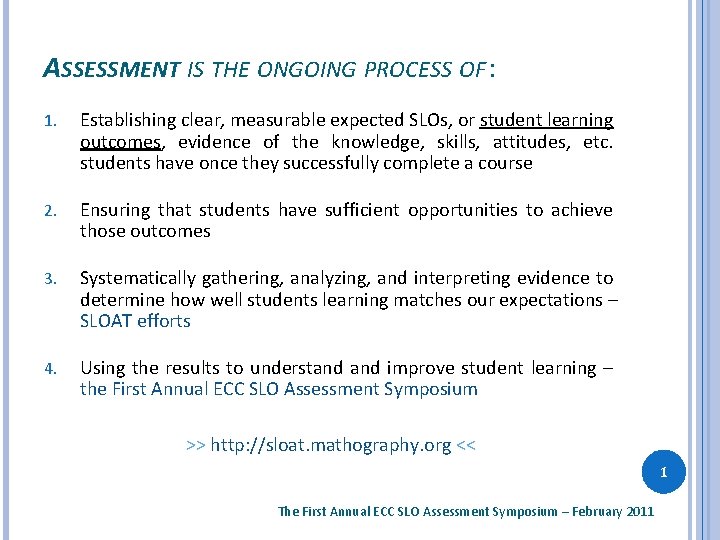
ASSESSMENT IS THE ONGOING PROCESS OF : 1. Establishing clear, measurable expected SLOs, or student learning outcomes, evidence of the knowledge, skills, attitudes, etc. students have once they successfully complete a course 2. Ensuring that students have sufficient opportunities to achieve those outcomes 3. Systematically gathering, analyzing, and interpreting evidence to determine how well students learning matches our expectations – SLOAT efforts 4. Using the results to understand improve student learning – the First Annual ECC SLO Assessment Symposium >> http: //sloat. mathography. org << 1 The First Annual ECC SLO Assessment Symposium – February 2011
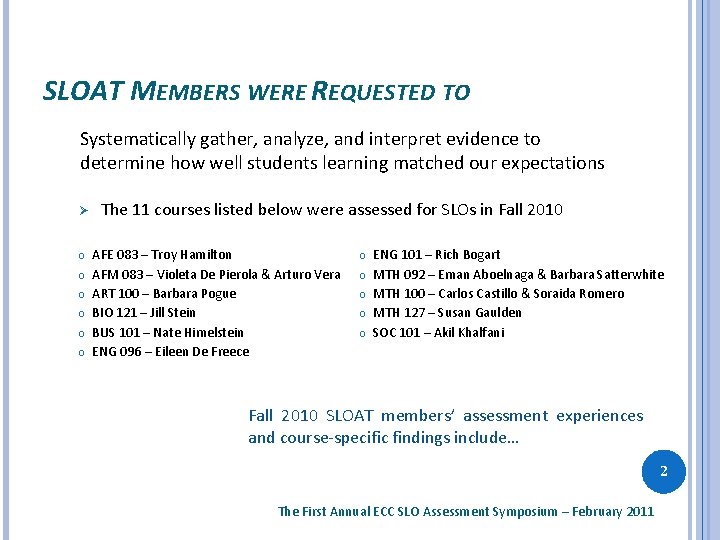
SLOAT MEMBERS WERE REQUESTED TO Systematically gather, analyze, and interpret evidence to determine how well students learning matched our expectations Ø The 11 courses listed below were assessed for SLOs in Fall 2010 o AFE 083 – Troy Hamilton o ENG 101 – Rich Bogart o AFM 083 – Violeta De Pierola & Arturo Vera o MTH 092 – Eman Aboelnaga & Barbara Satterwhite o ART 100 – Barbara Pogue o MTH 100 – Carlos Castillo & Soraida Romero o BIO 121 – Jill Stein o MTH 127 – Susan Gaulden o BUS 101 – Nate Himelstein o SOC 101 – Akil Khalfani o ENG 096 – Eileen De Freece Fall 2010 SLOAT members’ assessment experiences and course-specific findings include… 2 The First Annual ECC SLO Assessment Symposium – February 2011
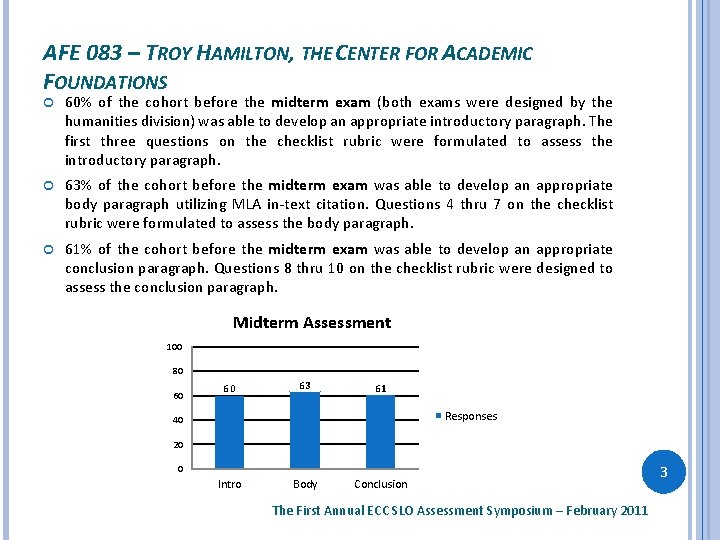
AFE 083 – TROY HAMILTON, THE CENTER FOR ACADEMIC FOUNDATIONS 60% of the cohort before the midterm exam (both exams were designed by the humanities division) was able to develop an appropriate introductory paragraph. The first three questions on the checklist rubric were formulated to assess the introductory paragraph. 63% of the cohort before the midterm exam was able to develop an appropriate body paragraph utilizing MLA in-text citation. Questions 4 thru 7 on the checklist rubric were formulated to assess the body paragraph. 61% of the cohort before the midterm exam was able to develop an appropriate conclusion paragraph. Questions 8 thru 10 on the checklist rubric were designed to assess the conclusion paragraph. Midterm Assessment 100 80 60 60 63 61 Responses 40 20 0 Intro Body Conclusion The First Annual ECC SLO Assessment Symposium – February 2011 3
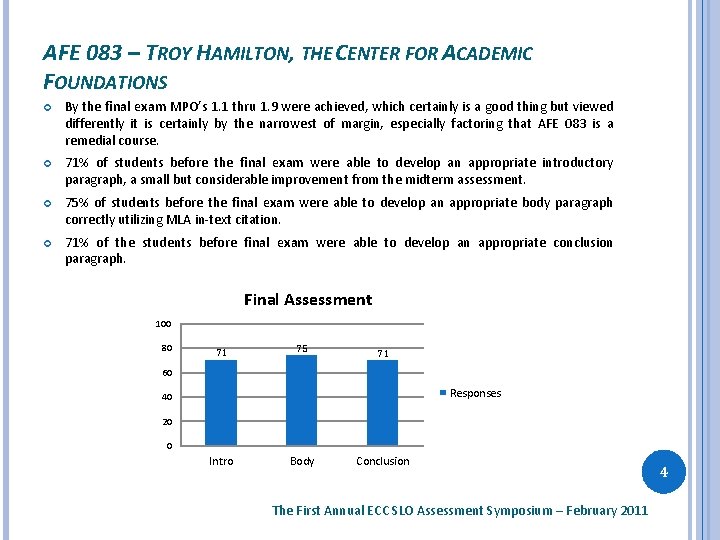
AFE 083 – TROY HAMILTON, THE CENTER FOR ACADEMIC FOUNDATIONS By the final exam MPO’s 1. 1 thru 1. 9 were achieved, which certainly is a good thing but viewed differently it is certainly by the narrowest of margin, especially factoring that AFE 083 is a remedial course. 71% of students before the final exam were able to develop an appropriate introductory paragraph, a small but considerable improvement from the midterm assessment. 75% of students before the final exam were able to develop an appropriate body paragraph correctly utilizing MLA in-text citation. 71% of the students before final exam were able to develop an appropriate conclusion paragraph. Final Assessment 100 80 71 75 71 60 Responses 40 20 0 Intro Body Conclusion The First Annual ECC SLO Assessment Symposium – February 2011 4
AFM 083 – VIOLETA DE PIEROLA AND ARTURO VERA, THE CENTER FOR ACADEMIC FOUNDATIONS Academic Foundations Math (AFM 083) is a beginning mathematics course designed to take students from concrete arithmetic ideas to the more abstract algebraic forms of these ideas. Some of the instructional components of AFM 083 are two mandatory sessions (one hour each) of tutoring per week and the required completion of ALEKS (computer software) assignments. The AFM 083 course outline lists the following goals: 1. Demonstrate knowledge of the fundamental concepts and theories from arithmetic, algebra and geometry. 2. Utilize various problem-solving and critical-thinking techniques to set up and solve real-world applications. 3. Communicate accurate mathematical terminology and notation in written and/or oral form in order to explain strategies to solve problems as well as to interpret found solutions. The First Annual ECC SLO Assessment Symposium – February 2011 5
AFM 083 – VIOLETA DE PIEROLA AND ARTURO VERA, THE CENTER FOR ACADEMIC FOUNDATIONS The task assigned to the AFM 083 SLOAT members was to determine if the students enrolled in the course are learning the goals set forth in the course outline. SLOAT participation was also meant to help instructors understand how the students enrolled in the Center for Academic Foundations learn and what different teaching techniques should be used. This assessment was conducted by Violeta De Pierola and Arturo Vera and data was collected on 32 students. 6 The First Annual ECC SLO Assessment Symposium – February 2011
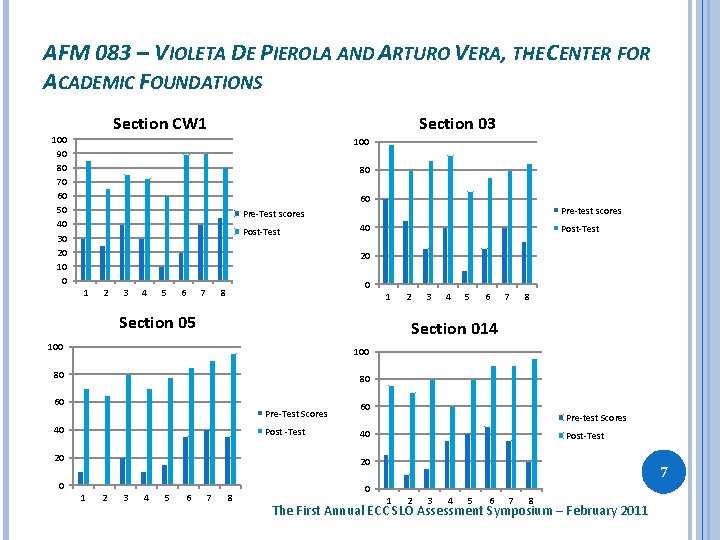
AFM 083 – VIOLETA DE PIEROLA AND ARTURO VERA, THE CENTER FOR ACADEMIC FOUNDATIONS Section 03 Section CW 1 100 90 80 70 60 50 40 30 20 100 80 60 Pre-test scores Pre-Test scores Post-Test 40 Post-Test 20 1 2 3 4 5 6 7 0 8 1 Section 05 100 80 80 60 Pre-Test Scores 40 Post -Test 0 0 4 5 6 7 8 Pre-test Scores 40 20 3 4 60 20 2 3 Section 014 100 1 2 Post-Test 7 1 2 3 4 5 6 7 8 The First Annual ECC SLO Assessment Symposium – February 2011
AFM 083 – VIOLETA DE PIEROLA AND ARTURO VERA, THE CENTER FOR ACADEMIC FOUNDATIONS After reviewing the data collected from the assessment, we realize that the instructors need to spend more time reviewing fractions (adding, subtracting, multiplying and dividing), relating word problems into real life, and simplifying basic algebraic operations. Some suggestions to help students learning more effectively are as follows: • Instructors can have SIs work with students struggling with these math concepts. • The students should work on ALEKS at least one day per week during tutoring time. • The students should work together while working on these math topics. 8 The First Annual ECC SLO Assessment Symposium – February 2011
ART 100 – BARBARA POGUE, HUMANITIES DIVISION Focus on the Principles of Design booklet—relates to course goal #4: “Prepare and present information using the computer by doing the Principles of Design booklet. ” MPOs related to CG #4: “Use magazines to gather examples of each principle; use computers to type up explanations of why each illustration fits the criteria for the principles of design; assemble images, titles and explanations, along with a cover sheet, into a booklet. ” I prepared a handout of instructions and another to evaluate the booklets. I devoted one class period to work on the booklets and then left the students on their own for two months to finish the project. The First Annual ECC SLO Assessment Symposium – February 2011 9
ART 100 – BARBARA POGUE, HUMANITIES DIVISION I discovered that all the students did the assignment, but that the grades ran the gamut from A to D. I discovered that my assessment sheet was inadequate, as it didn’t take into consideration the almost intangible differences between fair, good and excellent design choices for the booklets. I decided that this semester, I needed to spend more than just one class period on doing the booklets. The students need more handson, direct instruction and comments from me, so this semester I will spend three class periods on working on the booklet. 10 The First Annual ECC SLO Assessment Symposium – February 2011
BIO 121 – JILL STEIN, BIOLOGY &CHEMISTRY DIVISION Data was collected on the level of student mastery of 15 MPOs Partial achievement was attained for all MPOs Student Survey Results: Self-reported barriers of biology success 33% of students indicated that they have test anxiety 41% of students do not study enough because of overcommitted schedules 18% felt that their biology background was insufficient 11 The First Annual ECC SLO Assessment Symposium – February 2011
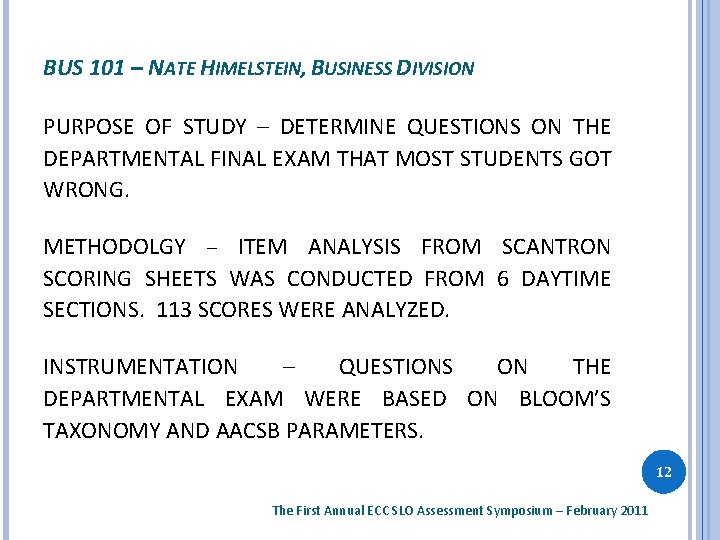
BUS 101 – NATE HIMELSTEIN, BUSINESS DIVISION PURPOSE OF STUDY – DETERMINE QUESTIONS ON THE DEPARTMENTAL FINAL EXAM THAT MOST STUDENTS GOT WRONG. METHODOLGY – ITEM ANALYSIS FROM SCANTRON SCORING SHEETS WAS CONDUCTED FROM 6 DAYTIME SECTIONS. 113 SCORES WERE ANALYZED. INSTRUMENTATION – QUESTIONS ON THE DEPARTMENTAL EXAM WERE BASED ON BLOOM’S TAXONOMY AND AACSB PARAMETERS. 12 The First Annual ECC SLO Assessment Symposium – February 2011
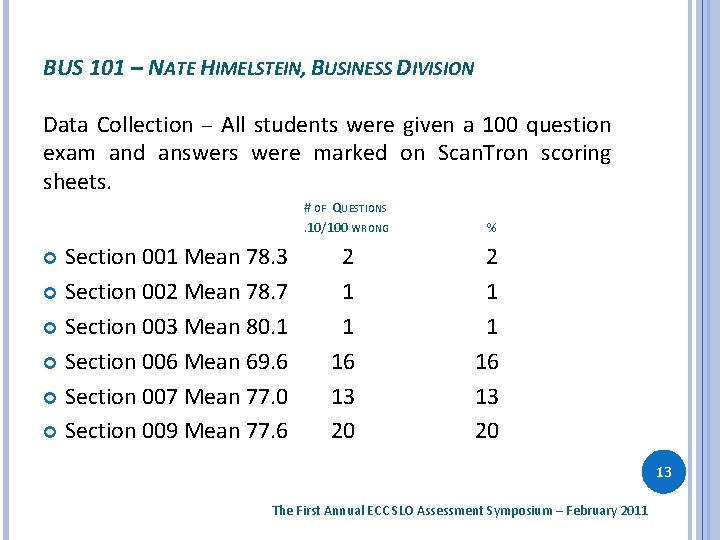
BUS 101 – NATE HIMELSTEIN, BUSINESS DIVISION Data Collection – All students were given a 100 question exam and answers were marked on Scan. Tron scoring sheets. # OF QUESTIONS. 10/100 WRONG Section 001 Mean 78. 3 Section 002 Mean 78. 7 Section 003 Mean 80. 1 Section 006 Mean 69. 6 Section 007 Mean 77. 0 Section 009 Mean 77. 6 2 1 1 16 13 20 % 2 1 1 16 13 20 13 The First Annual ECC SLO Assessment Symposium – February 2011
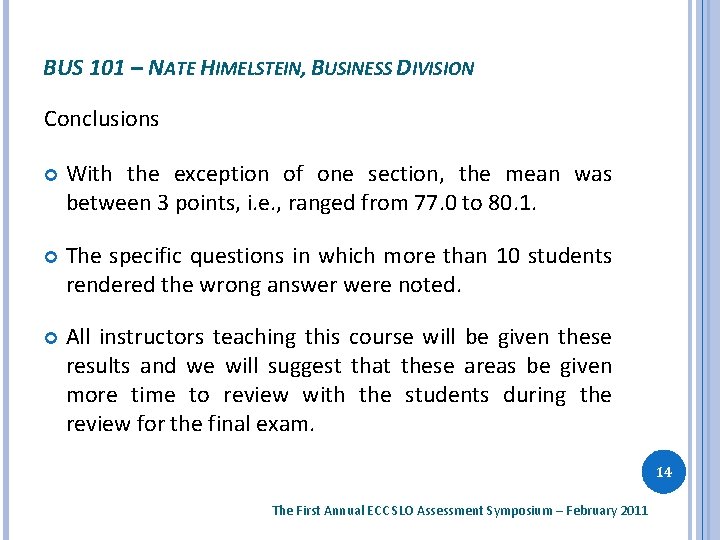
BUS 101 – NATE HIMELSTEIN, BUSINESS DIVISION Conclusions With the exception of one section, the mean was between 3 points, i. e. , ranged from 77. 0 to 80. 1. The specific questions in which more than 10 students rendered the wrong answer were noted. All instructors teaching this course will be given these results and we will suggest that these areas be given more time to review with the students during the review for the final exam. 14 The First Annual ECC SLO Assessment Symposium – February 2011
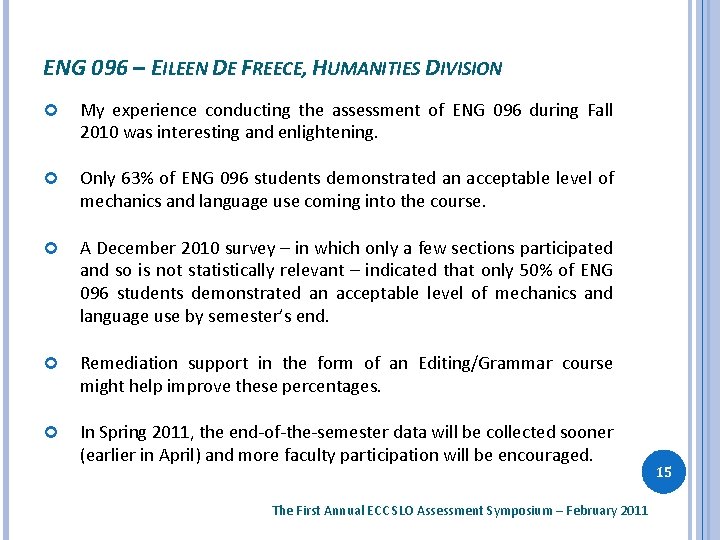
ENG 096 – EILEEN DE FREECE, HUMANITIES DIVISION My experience conducting the assessment of ENG 096 during Fall 2010 was interesting and enlightening. Only 63% of ENG 096 students demonstrated an acceptable level of mechanics and language use coming into the course. A December 2010 survey – in which only a few sections participated and so is not statistically relevant – indicated that only 50% of ENG 096 students demonstrated an acceptable level of mechanics and language use by semester’s end. Remediation support in the form of an Editing/Grammar course might help improve these percentages. In Spring 2011, the end-of-the-semester data will be collected sooner (earlier in April) and more faculty participation will be encouraged. The First Annual ECC SLO Assessment Symposium – February 2011 15
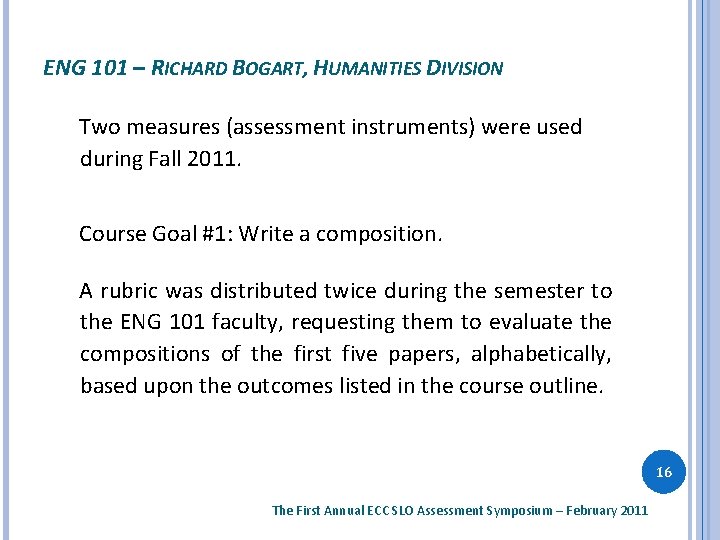
ENG 101 – RICHARD BOGART, HUMANITIES DIVISION Two measures (assessment instruments) were used during Fall 2011. Course Goal #1: Write a composition. A rubric was distributed twice during the semester to the ENG 101 faculty, requesting them to evaluate the compositions of the first five papers, alphabetically, based upon the outcomes listed in the course outline. 16 The First Annual ECC SLO Assessment Symposium – February 2011
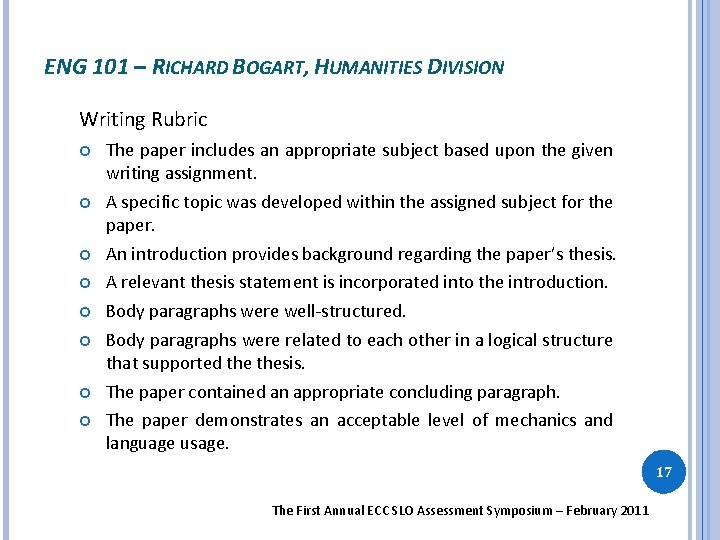
ENG 101 – RICHARD BOGART, HUMANITIES DIVISION Writing Rubric The paper includes an appropriate subject based upon the given writing assignment. A specific topic was developed within the assigned subject for the paper. An introduction provides background regarding the paper’s thesis. A relevant thesis statement is incorporated into the introduction. Body paragraphs were well-structured. Body paragraphs were related to each other in a logical structure that supported thesis. The paper contained an appropriate concluding paragraph. The paper demonstrates an acceptable level of mechanics and language usage. 17 The First Annual ECC SLO Assessment Symposium – February 2011
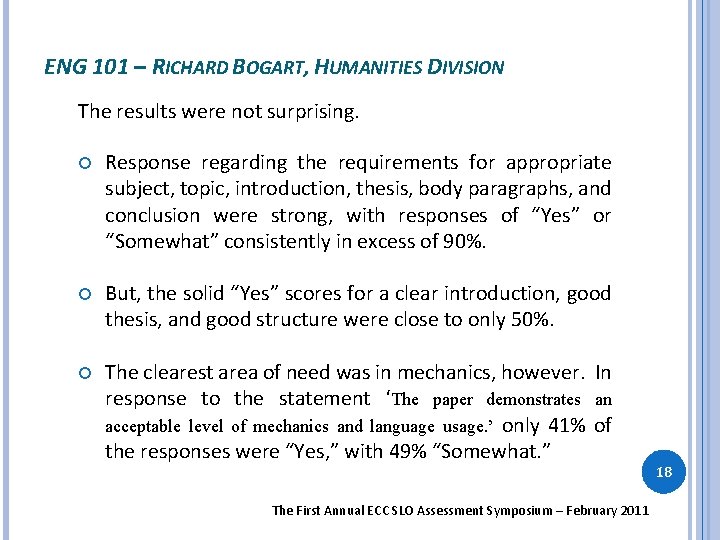
ENG 101 – RICHARD BOGART, HUMANITIES DIVISION The results were not surprising. Response regarding the requirements for appropriate subject, topic, introduction, thesis, body paragraphs, and conclusion were strong, with responses of “Yes” or “Somewhat” consistently in excess of 90%. But, the solid “Yes” scores for a clear introduction, good thesis, and good structure were close to only 50%. The clearest area of need was in mechanics, however. In response to the statement ‘The paper demonstrates an acceptable level of mechanics and language usage. ’ only 41% of the responses were “Yes, ” with 49% “Somewhat. ” The First Annual ECC SLO Assessment Symposium – February 2011 18
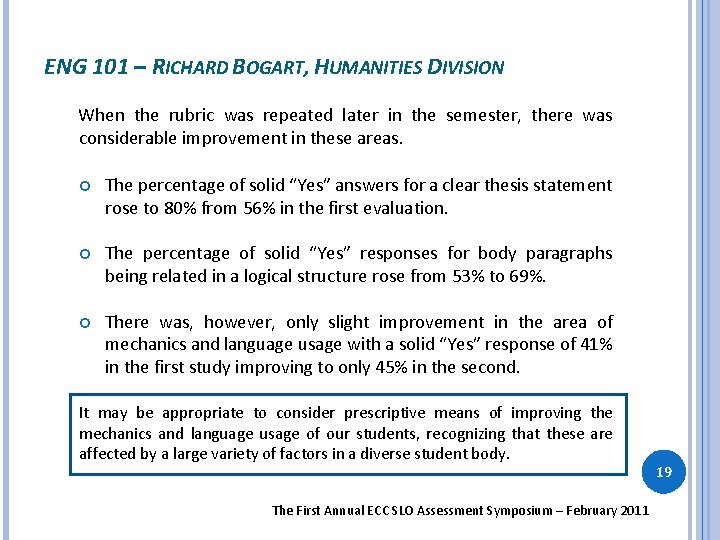
ENG 101 – RICHARD BOGART, HUMANITIES DIVISION When the rubric was repeated later in the semester, there was considerable improvement in these areas. The percentage of solid “Yes” answers for a clear thesis statement rose to 80% from 56% in the first evaluation. The percentage of solid “Yes” responses for body paragraphs being related in a logical structure rose from 53% to 69%. There was, however, only slight improvement in the area of mechanics and language usage with a solid “Yes” response of 41% in the first study improving to only 45% in the second. It may be appropriate to consider prescriptive means of improving the mechanics and language usage of our students, recognizing that these are affected by a large variety of factors in a diverse student body. 19 The First Annual ECC SLO Assessment Symposium – February 2011
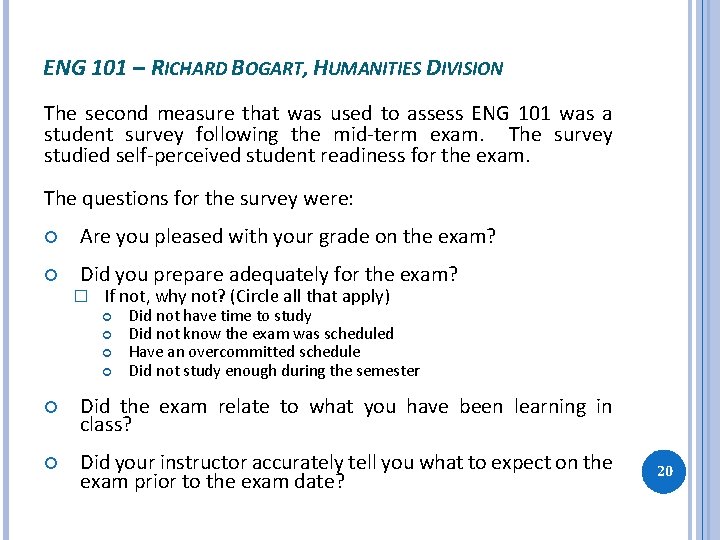
ENG 101 – RICHARD BOGART, HUMANITIES DIVISION The second measure that was used to assess ENG 101 was a student survey following the mid-term exam. The survey studied self-perceived student readiness for the exam. The questions for the survey were: Are you pleased with your grade on the exam? Did you prepare adequately for the exam? � If not, why not? (Circle all that apply) Did not have time to study Did not know the exam was scheduled Have an overcommitted schedule Did not study enough during the semester Did the exam relate to what you have been learning in class? Did your instructor accurately tell you what to expect on the exam prior to the exam date? 20
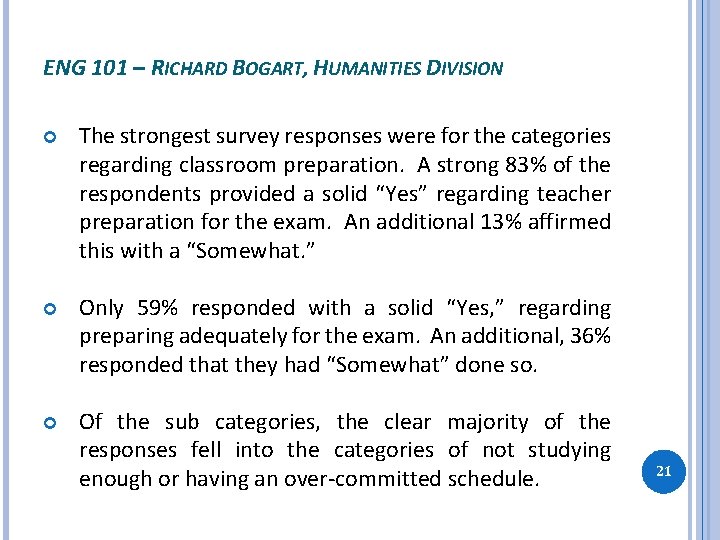
ENG 101 – RICHARD BOGART, HUMANITIES DIVISION The strongest survey responses were for the categories regarding classroom preparation. A strong 83% of the respondents provided a solid “Yes” regarding teacher preparation for the exam. An additional 13% affirmed this with a “Somewhat. ” Only 59% responded with a solid “Yes, ” regarding preparing adequately for the exam. An additional, 36% responded that they had “Somewhat” done so. Of the sub categories, the clear majority of the responses fell into the categories of not studying enough or having an over-committed schedule. 21
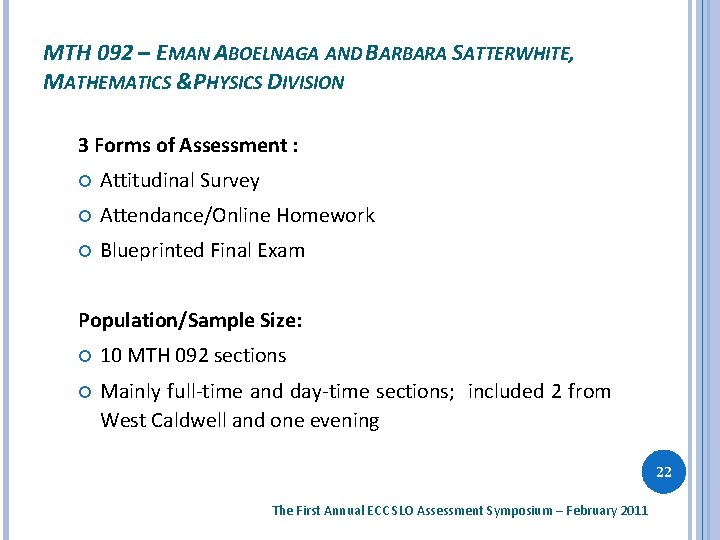
MTH 092 – EMAN ABOELNAGA AND BARBARA SATTERWHITE, MATHEMATICS &PHYSICS DIVISION 3 Forms of Assessment : Attitudinal Survey Attendance/Online Homework Blueprinted Final Exam Population/Sample Size: 10 MTH 092 sections Mainly full-time and day-time sections; included 2 from West Caldwell and one evening 22 The First Annual ECC SLO Assessment Symposium – February 2011
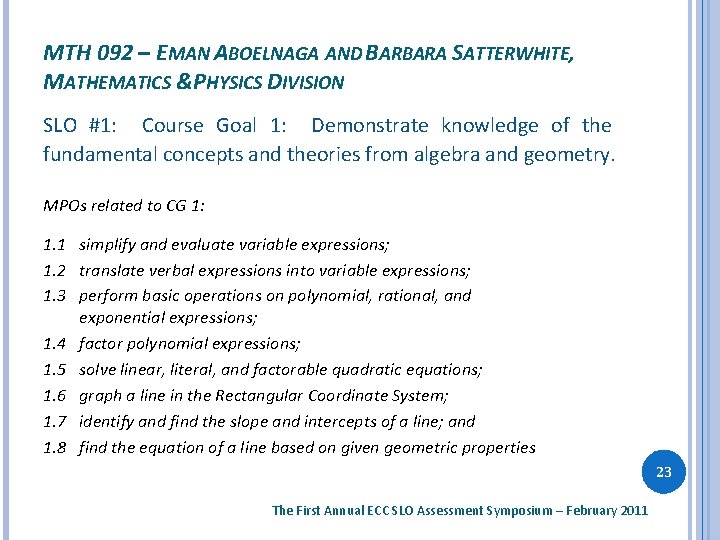
MTH 092 – EMAN ABOELNAGA AND BARBARA SATTERWHITE, MATHEMATICS &PHYSICS DIVISION SLO #1: Course Goal 1: Demonstrate knowledge of the fundamental concepts and theories from algebra and geometry. MPOs related to CG 1: 1. 1 simplify and evaluate variable expressions; 1. 2 translate verbal expressions into variable expressions; 1. 3 perform basic operations on polynomial, rational, and exponential expressions; 1. 4 factor polynomial expressions; 1. 5 solve linear, literal, and factorable quadratic equations; 1. 6 graph a line in the Rectangular Coordinate System; 1. 7 identify and find the slope and intercepts of a line; and 1. 8 find the equation of a line based on given geometric properties 23 The First Annual ECC SLO Assessment Symposium – February 2011
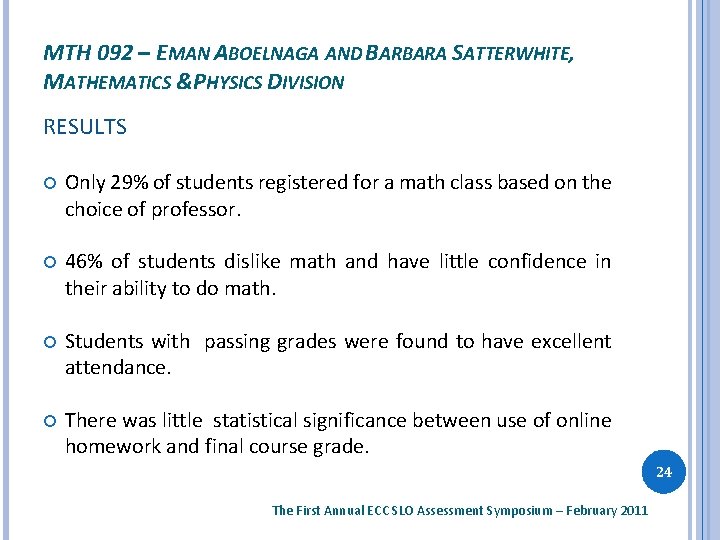
MTH 092 – EMAN ABOELNAGA AND BARBARA SATTERWHITE, MATHEMATICS &PHYSICS DIVISION RESULTS Only 29% of students registered for a math class based on the choice of professor. 46% of students dislike math and have little confidence in their ability to do math. Students with passing grades were found to have excellent attendance. There was little statistical significance between use of online homework and final course grade. 24 The First Annual ECC SLO Assessment Symposium – February 2011
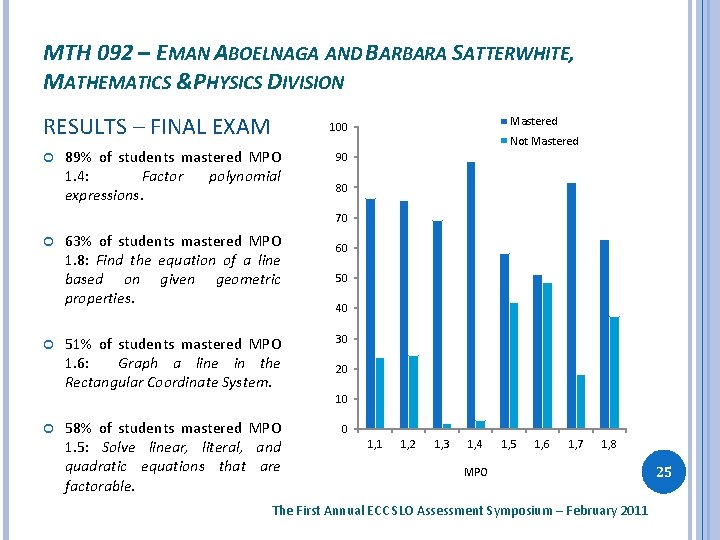
MTH 092 – EMAN ABOELNAGA AND BARBARA SATTERWHITE, MATHEMATICS &PHYSICS DIVISION RESULTS – FINAL EXAM Mastered 100 89% of students mastered MPO 1. 4: Factor polynomial expressions. Not Mastered 90 80 70 63% of students mastered MPO 1. 8: Find the equation of a line based on given geometric properties. 60 50 40 51% of students mastered MPO 1. 6: Graph a line in the Rectangular Coordinate System. 30 58% of students mastered MPO 1. 5: Solve linear, literal, and quadratic equations that are factorable. 0 20 10 1, 1 1, 2 1, 3 1, 4 1, 5 1, 6 1, 7 1, 8 MPO The First Annual ECC SLO Assessment Symposium – February 2011 25
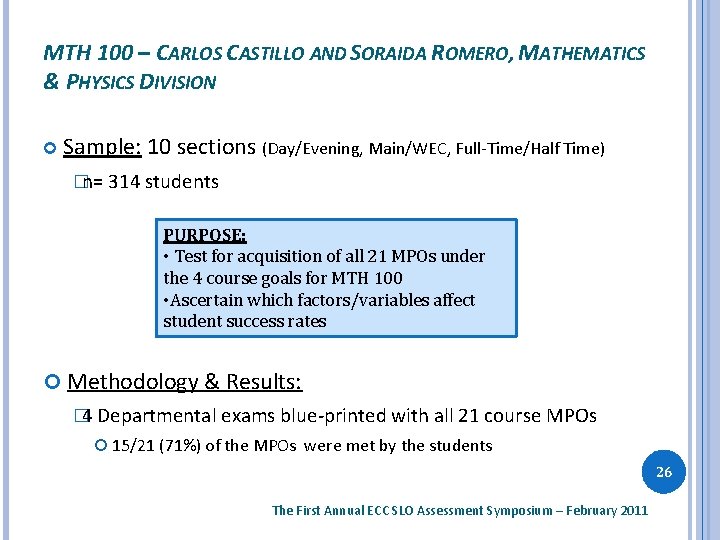
MTH 100 – CARLOS CASTILLO AND SORAIDA ROMERO, MATHEMATICS & PHYSICS DIVISION Sample: 10 sections (Day/Evening, Main/WEC, Full-Time/Half Time) �n= 314 students PURPOSE: • Test for acquisition of all 21 MPOs under the 4 course goals for MTH 100 • Ascertain which factors/variables affect student success rates Methodology & Results: � 4 Departmental exams blue-printed with all 21 course MPOs 15/21 (71%) of the MPOs were met by the students 26 The First Annual ECC SLO Assessment Symposium – February 2011
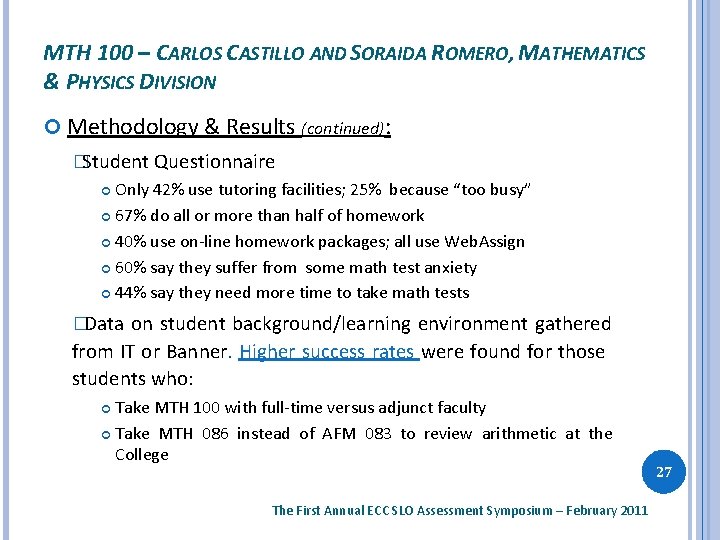
MTH 100 – CARLOS CASTILLO AND SORAIDA ROMERO, MATHEMATICS & PHYSICS DIVISION Methodology & Results (continued): �Student Questionnaire Only 42% use tutoring facilities; 25% because “too busy” 67% do all or more than half of homework 40% use on-line homework packages; all use Web. Assign 60% say they suffer from some math test anxiety 44% say they need more time to take math tests �Data on student background/learning environment gathered from IT or Banner. Higher success rates were found for those students who: Take MTH 100 with full-time versus adjunct faculty Take MTH 086 instead of AFM 083 to review arithmetic at the College The First Annual ECC SLO Assessment Symposium – February 2011 27
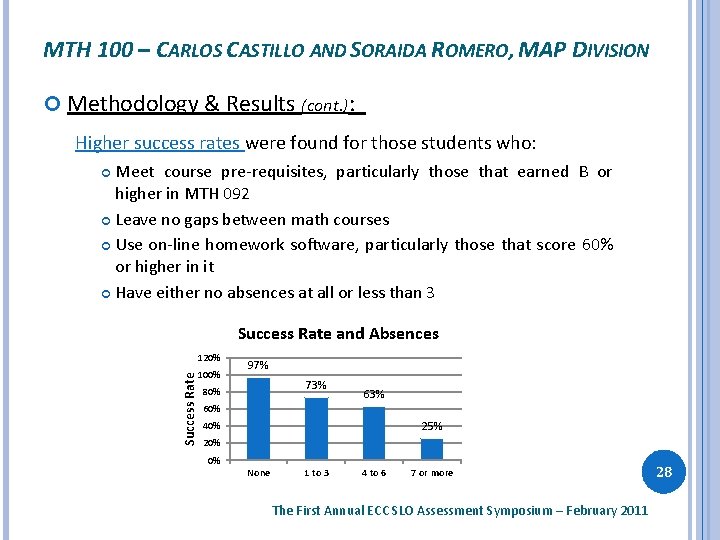
MTH 100 – CARLOS CASTILLO AND SORAIDA ROMERO, MAP DIVISION Methodology & Results (cont. ): Higher success rates were found for those students who: Meet course pre-requisites, particularly those that earned B or higher in MTH 092 Leave no gaps between math courses Use on-line homework software, particularly those that score 60% or higher in it Have either no absences at all or less than 3 Success Rate and Absences Success Rate 120% 100% 97% 73% 80% 63% 60% 25% 40% 20% 0% None 1 to 3 4 to 6 7 or more The First Annual ECC SLO Assessment Symposium – February 2011 28
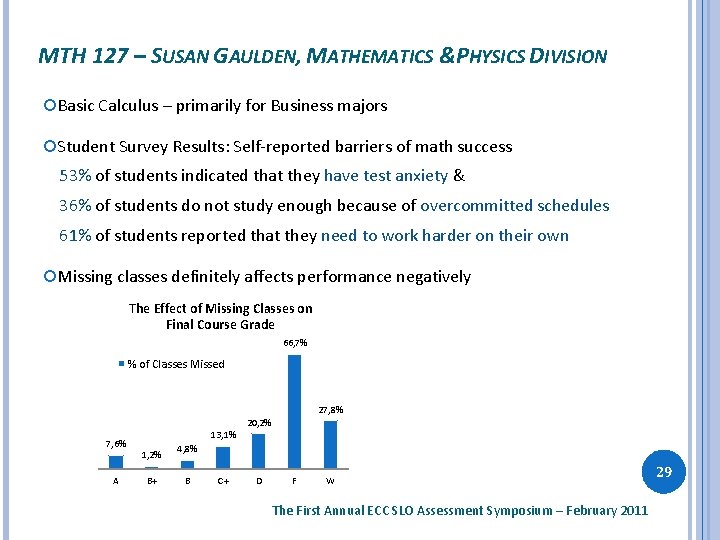
MTH 127 – SUSAN GAULDEN, MATHEMATICS &PHYSICS DIVISION Basic Calculus – primarily for Business majors Student Survey Results: Self-reported barriers of math success 53% of students indicated that they have test anxiety & 36% of students do not study enough because of overcommitted schedules 61% of students reported that they need to work harder on their own Missing classes definitely affects performance negatively The Effect of Missing Classes on Final Course Grade 66, 7% % of Classes Missed 27, 8% 7, 6% A 13, 1% 1, 2% B+ 20, 2% 4, 8% B C+ D F W The First Annual ECC SLO Assessment Symposium – February 2011 29
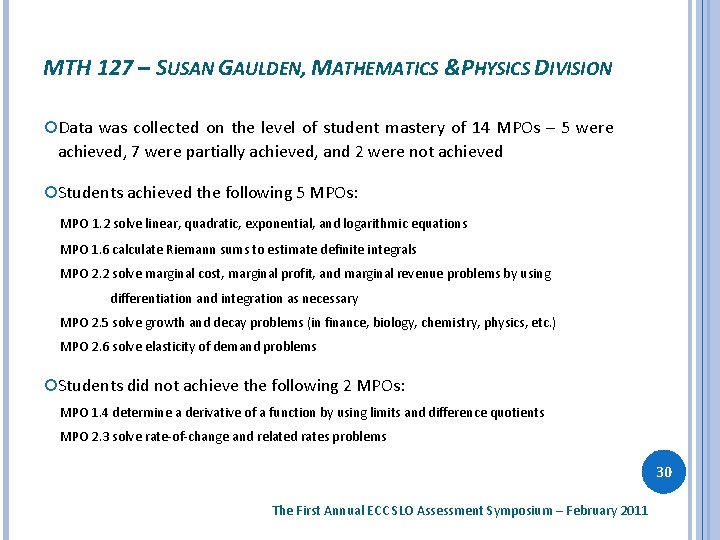
MTH 127 – SUSAN GAULDEN, MATHEMATICS &PHYSICS DIVISION Data was collected on the level of student mastery of 14 MPOs – 5 were achieved, 7 were partially achieved, and 2 were not achieved Students achieved the following 5 MPOs: MPO 1. 2 solve linear, quadratic, exponential, and logarithmic equations MPO 1. 6 calculate Riemann sums to estimate definite integrals MPO 2. 2 solve marginal cost, marginal profit, and marginal revenue problems by using differentiation and integration as necessary MPO 2. 5 solve growth and decay problems (in finance, biology, chemistry, physics, etc. ) MPO 2. 6 solve elasticity of demand problems Students did not achieve the following 2 MPOs: MPO 1. 4 determine a derivative of a function by using limits and difference quotients MPO 2. 3 solve rate-of-change and related rates problems 30 The First Annual ECC SLO Assessment Symposium – February 2011
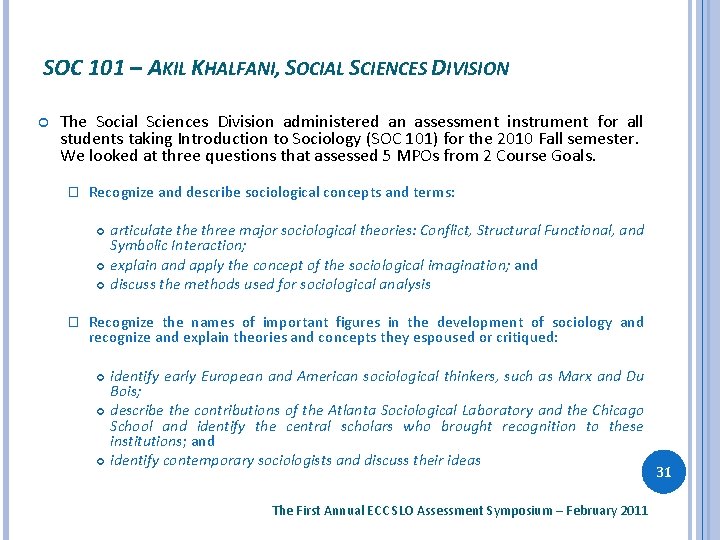
SOC 101 – AKIL KHALFANI, SOCIAL SCIENCES DIVISION The Social Sciences Division administered an assessment instrument for all students taking Introduction to Sociology (SOC 101) for the 2010 Fall semester. We looked at three questions that assessed 5 MPOs from 2 Course Goals. � Recognize and describe sociological concepts and terms: � articulate three major sociological theories: Conflict, Structural Functional, and Symbolic Interaction; explain and apply the concept of the sociological imagination; and discuss the methods used for sociological analysis Recognize the names of important figures in the development of sociology and recognize and explain theories and concepts they espoused or critiqued: identify early European and American sociological thinkers, such as Marx and Du Bois; describe the contributions of the Atlanta Sociological Laboratory and the Chicago School and identify the central scholars who brought recognition to these institutions; and identify contemporary sociologists and discuss their ideas The First Annual ECC SLO Assessment Symposium – February 2011 31
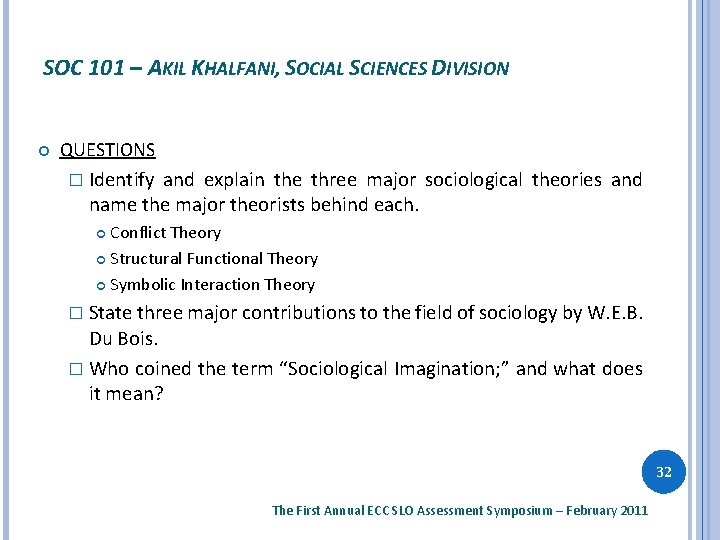
SOC 101 – AKIL KHALFANI, SOCIAL SCIENCES DIVISION QUESTIONS � Identify and explain the three major sociological theories and name the major theorists behind each. Conflict Theory Structural Functional Theory Symbolic Interaction Theory � State three major contributions to the field of sociology by W. E. B. Du Bois. � Who coined the term “Sociological Imagination; ” and what does it mean? 32 The First Annual ECC SLO Assessment Symposium – February 2011
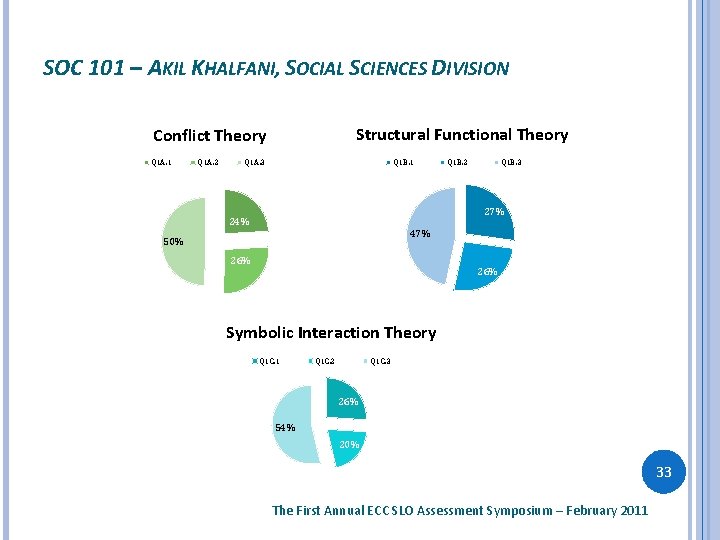
SOC 101 – AKIL KHALFANI, SOCIAL SCIENCES DIVISION Structural Functional Theory Conflict Theory Q 1 A. 1 Q 1 A. 2 Q 1 B. 1 Q 1 A. 3 Q 1 B. 2 Q 1 B. 3 27% 24% 47% 50% 26% Symbolic Interaction Theory Q 1 C. 1 Q 1 C. 2 Q 1 C. 3 26% 54% 20% 33 The First Annual ECC SLO Assessment Symposium – February 2011
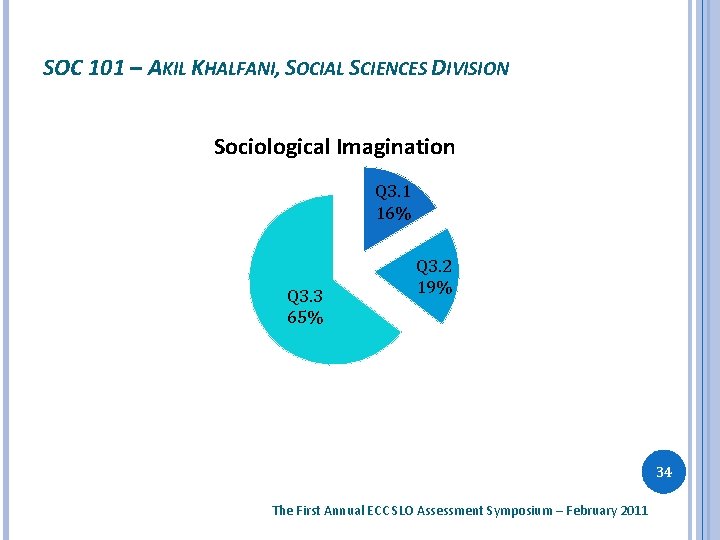
SOC 101 – AKIL KHALFANI, SOCIAL SCIENCES DIVISION Sociological Imagination Q 3. 1 16% Q 3. 3 65% Q 3. 2 19% 34 The First Annual ECC SLO Assessment Symposium – February 2011
Thank you for attending the First Annual ECC SLO Assessment Symposium 35 The First Annual ECC SLO Assessment Symposium – February 2011