
The Finger Movement and Finger Pressure in Baseball

The Finger Movement and Finger Pressure in Baseball Pitching : A Case Report Shu-Wei Chen 1, Wang-Jing Liu 1, Ya-Han Guo 1, Tsung-Ying Hung 1, Jung-Tang Kung 2, and Wen-Tzu Tang 1 1 Graduate Institute of Athletics and Coaching Science, Nation Taiwan Sport University, Taiwan 2 Department of Sports Training Science-Balls, National Taiwan Sport University, Taiwan
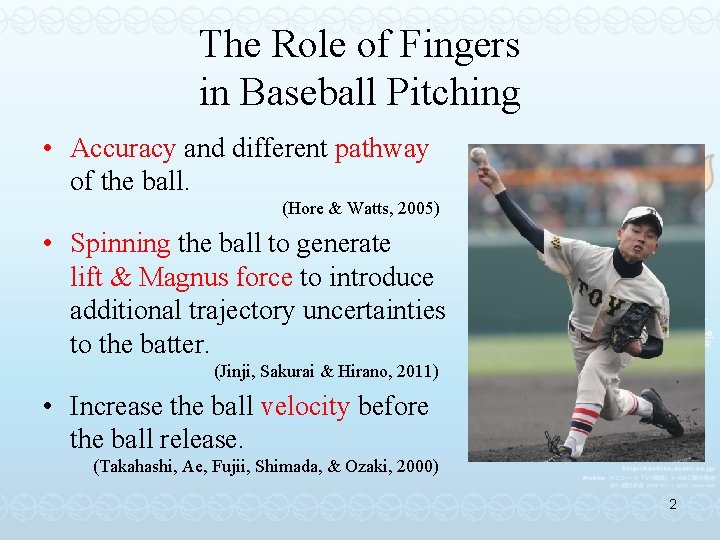
The Role of Fingers in Baseball Pitching • Accuracy and different pathway of the ball. (Hore & Watts, 2005) • Spinning the ball to generate lift & Magnus force to introduce additional trajectory uncertainties to the batter. (Jinji, Sakurai & Hirano, 2011) • Increase the ball velocity before the ball release. (Takahashi, Ae, Fujii, Shimada, & Ozaki, 2000) 2
Motivation • The flexed finger joints can exert large force to accelerate the ball and to control the direction of ball trajectory. (Takahashi, Ae, Fujii, Shimada, & Ozaki, 2000) • There was a few study to investigate the index finger & middle finger movement and finger pressure together on different pitch types. 3
Purpose To measure: • The linear velocity of Metacarpophalangeal (MCP) & finger tip of index finger (F 2) and middle finger (F 3); • The joint angle of MCP, proximal interphalangeal (PIP) and distal interphalangeal (DIP) of F 2 & F 3; • The tip & pulp pressure of F 2 & F 3; when pitching 4 different pitch types (4 -seam fastball, curveball, slider, & change-up). 4
Participant • One elite college right-handed pitcher who volunteered to join this study. • Age: 21 years, Training career: 13 years, Pitcher career: 8 years, Body height: 1. 84 m, Body weight: 85 kg, Maximum ball velocity: 40 m/s (144 km/h). • Agreement of IRB, NTSU. 5
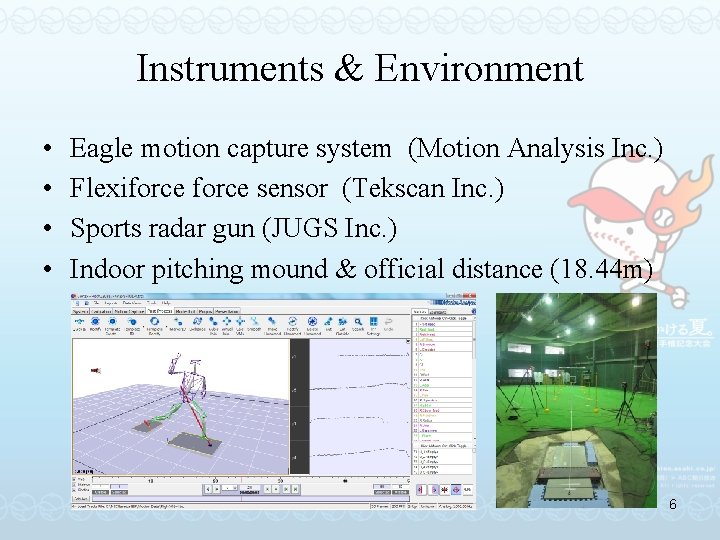
Instruments & Environment • • Eagle motion capture system (Motion Analysis Inc. ) Flexiforce sensor (Tekscan Inc. ) Sports radar gun (JUGS Inc. ) Indoor pitching mound & official distance (18. 44 m) 6
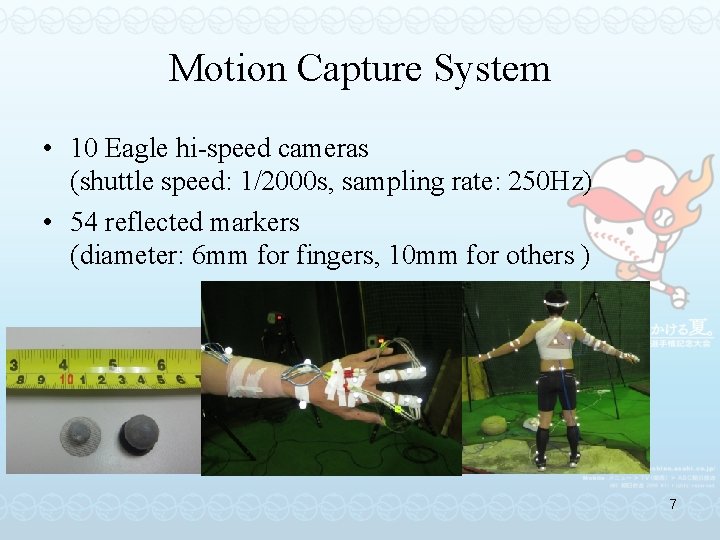
Motion Capture System • 10 Eagle hi-speed cameras (shuttle speed: 1/2000 s, sampling rate: 250 Hz) • 54 reflected markers (diameter: 6 mm for fingers, 10 mm for others ) 7
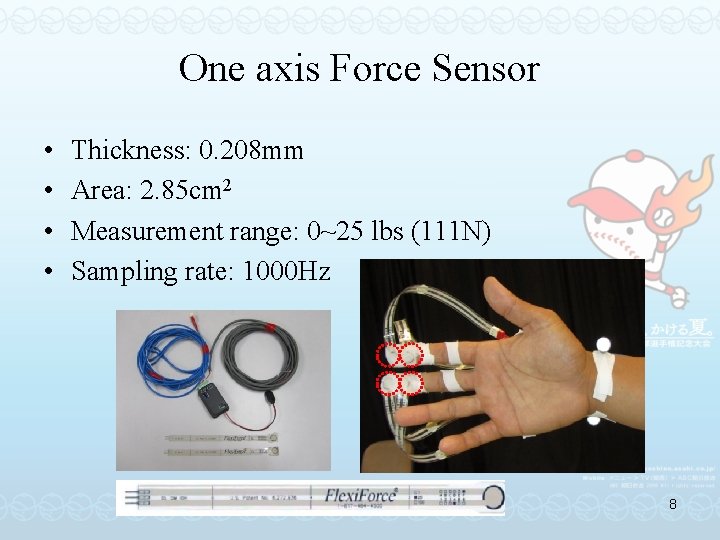
One axis Force Sensor • • Thickness: 0. 208 mm Area: 2. 85 cm 2 Measurement range: 0~25 lbs (111 N) Sampling rate: 1000 Hz 8
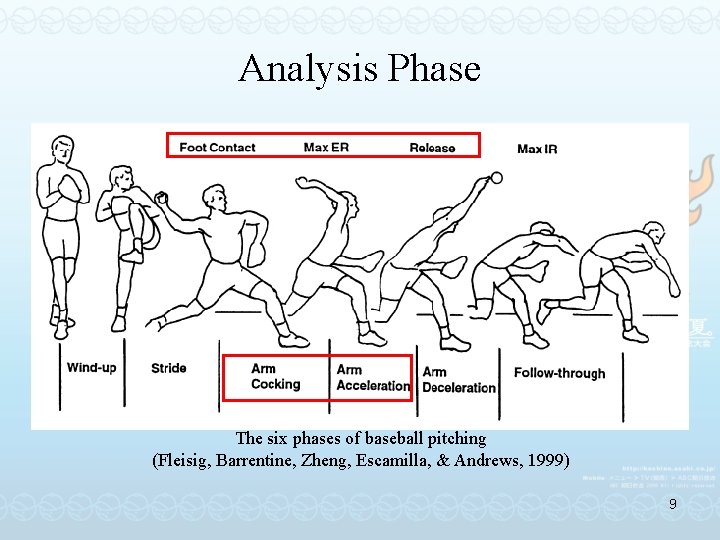
Analysis Phase The six phases of baseball pitching (Fleisig, Barrentine, Zheng, Escamilla, & Andrews, 1999) 9
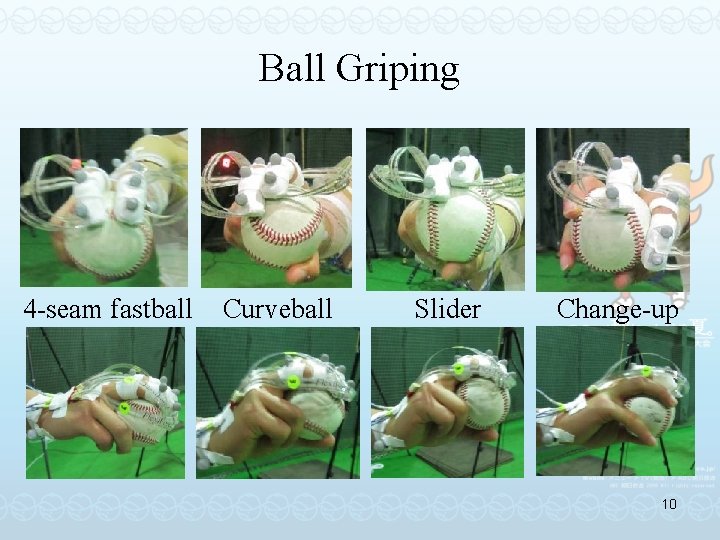
Ball Griping 4 -seam fastball Curveball Slider Change-up 10
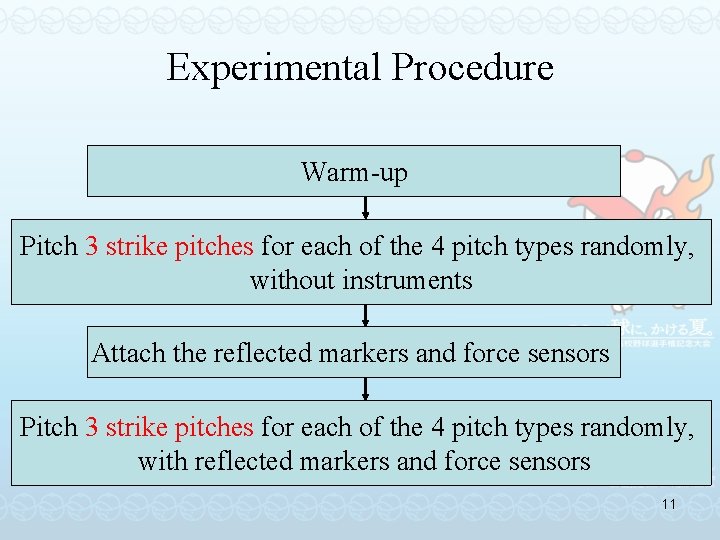
Experimental Procedure Warm-up Pitch 3 strike pitches for each of the 4 pitch types randomly, without instruments Attach the reflected markers and force sensors Pitch 3 strike pitches for each of the 4 pitch types randomly, with reflected markers and force sensors 11

Calibration of Finger Pressure • Calibrate by weights • Linear regression formula • Voltage → force • Force →pressure 12
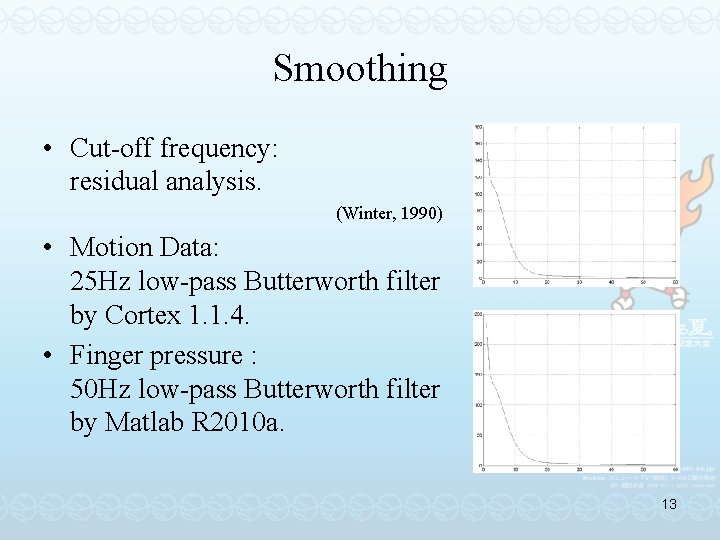
Smoothing • Cut-off frequency: residual analysis. (Winter, 1990) • Motion Data: 25 Hz low-pass Butterworth filter by Cortex 1. 1. 4. • Finger pressure : 50 Hz low-pass Butterworth filter by Matlab R 2010 a. 13
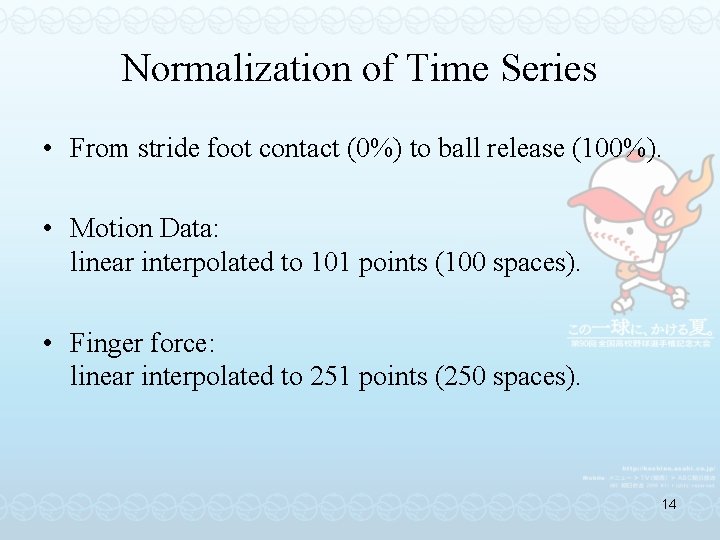
Normalization of Time Series • From stride foot contact (0%) to ball release (100%). • Motion Data: linear interpolated to 101 points (100 spaces). • Finger force: linear interpolated to 251 points (250 spaces). 14
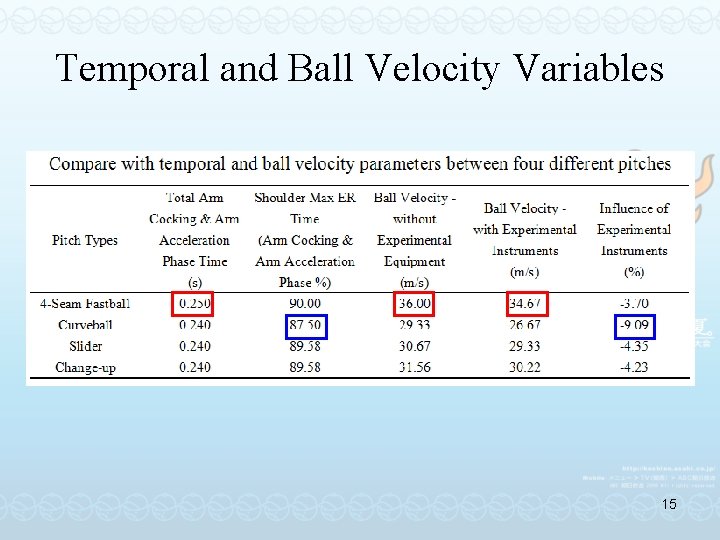
Temporal and Ball Velocity Variables 15
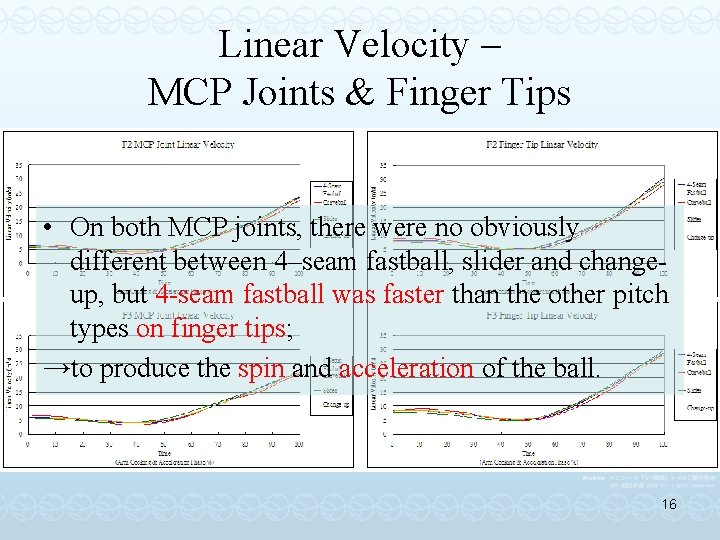
Linear Velocity – MCP Joints & Finger Tips • On both MCP joints, there were no obviously different between 4–seam fastball, slider and changeup, but 4 -seam fastball was faster than the other pitch types on finger tips; →to produce the spin and acceleration of the ball. 16
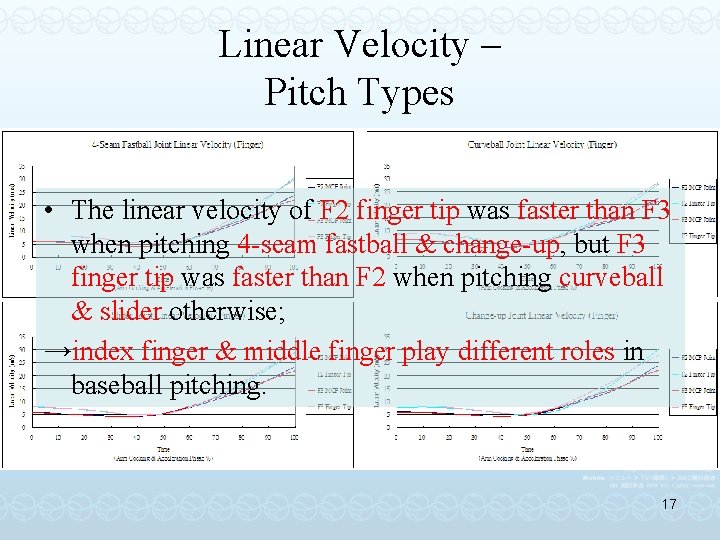
Linear Velocity – Pitch Types • The linear velocity of F 2 finger tip was faster than F 3 when pitching 4 -seam fastball & change-up, but F 3 finger tip was faster than F 2 when pitching curveball & slider otherwise; →index finger & middle finger play different roles in baseball pitching. 17

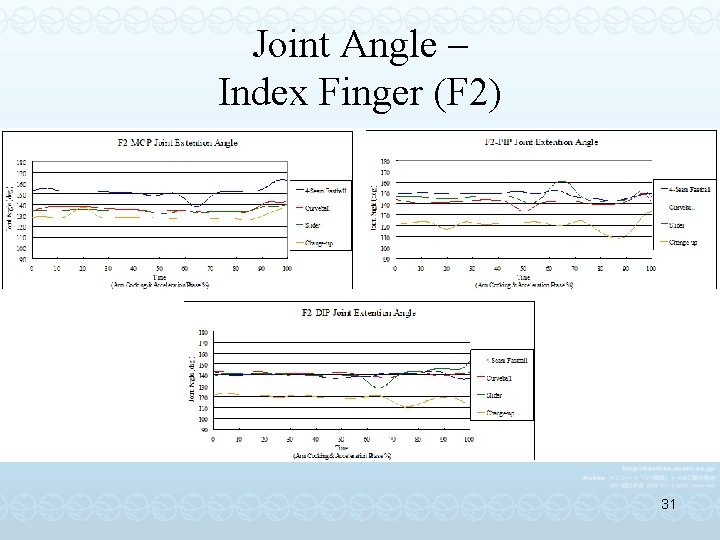
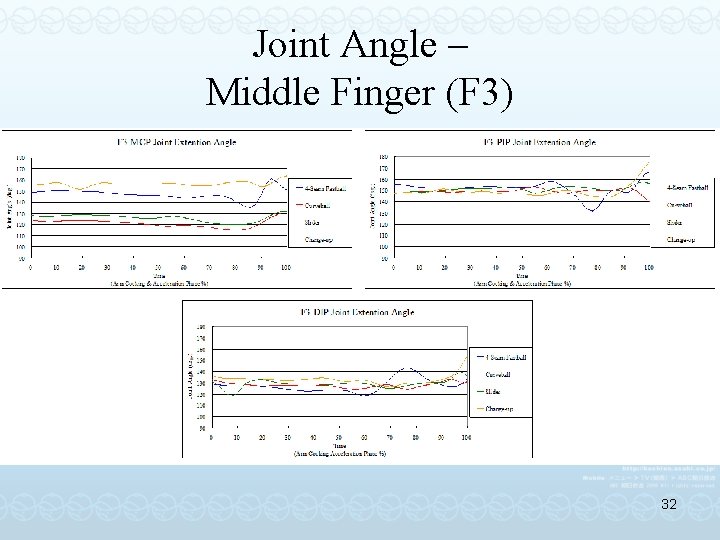
Joint Angle – Max ER ~ Ball Release • The MCP and PIP joints were extended by the reaction force of the ball while the DIP joints were flexed in the beginning of arm acceleration phase, and the MCP and PIP joint were flexed while the DIP joints were extended in the end of arm acceleration phase, especially when pitching 4 -seam fastball and slider; →because of the ball rolling to the finger tips, and in order to push the ball forward. 18
Simultaneous Movement • The flexor digitorum profundus (FDP) generated flexion movement at the MCP, PIP and DIP joints together. • The FDP generated simultaneous movement between the PIP and DIP joints. (Nimbarte, Kaz, & Li, 2008) →the reaction force of the ball generated the reverse movement on PIP & DIP. 19
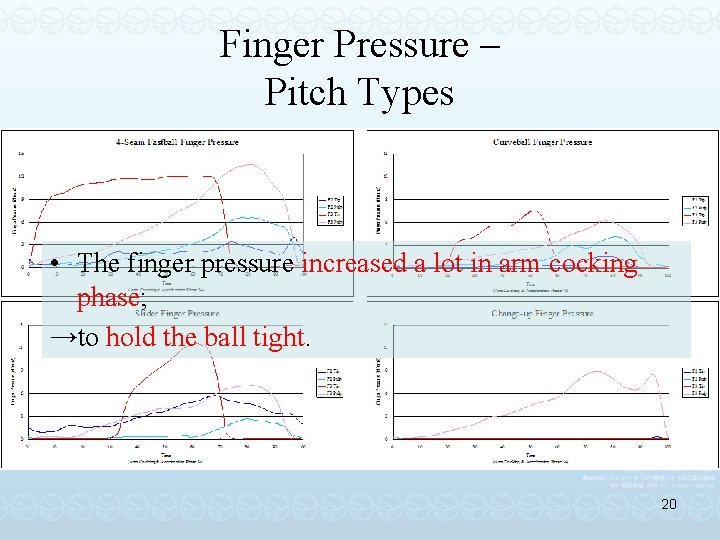
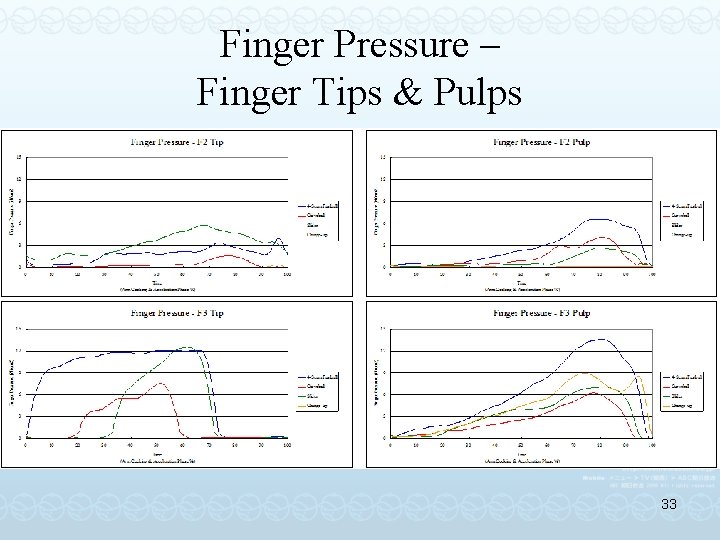
Finger Pressure – Pitch Types • The finger pressure increased a lot in arm cocking phase; →to hold the ball tight. 20
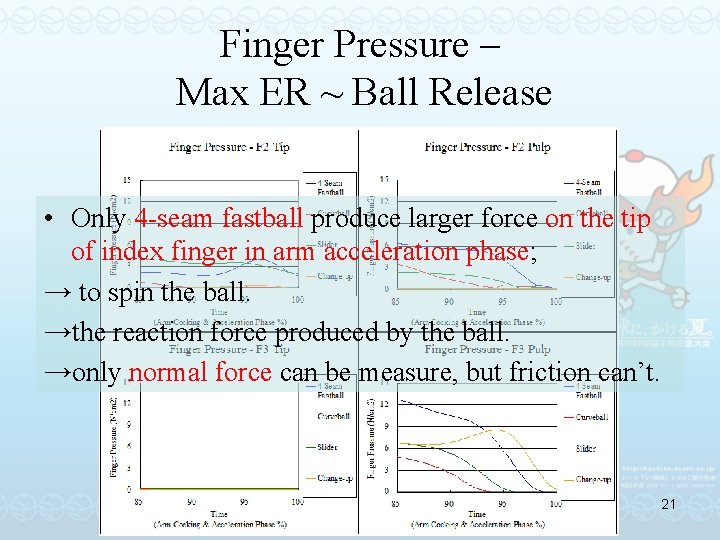
Finger Pressure – Max ER ~ Ball Release • Only 4 -seam fastball produce larger force on the tip of index finger in arm acceleration phase; → to spin the ball. →the reaction force produced by the ball. →only normal force can be measure, but friction can’t. 21

Conclusion • 4 -seam fastball was faster than the other pitch types on finger tips. • The reaction force of the ball generated the reverse movement on PIP & DIP joints in arm acceleration phase. • Only 4 -seam fastball produce larger force on the tip of index finger in arm acceleration phase. • Index finger & middle finger play different roles in baseball pitching. 22

Acknowledgement • This study was supported by National Science Council, Taiwan (NSC 99 -2410 -H-179 -004 -MY 2). 23
Reference • • • Fleisig, G. S. , Barrentine, S. W. , Zheng, N. , Escamilla, R. F. , & Andrews, J. R. (1999). Kinematic and kinetic comparison of baseball pitching among various levels of development. Journal of biomechanics, 32(12), 1371 -1375. Hore, J. , & Watts, S. (2005). Timing Finger Opening in Overarm Throwing Based on a Spatial Representation of Hand Path. Journal of Neurophysiology, 93(6), 31893199. Jinji, T. , Sakurai, S. , & Hirano, Y. (2011). Factors determining the spin axis of a pitched fastball in baseball. Journal of Sports Sciences, 29(7), 761 -767. Nimbarte, A. D. , Kaz, R. , & Li, Z. -M. (2008). Finger joint motion generated by individual extrinsic muscles: A cadaveric study. Journal of Orthopaedic Surgery and Research, 3, 27 -33. Takahashi, K. , Ae, M. , Fujii, N. , Shimada, K. , & Ozaki, T. (2000). Increase in the ball velocity and the forces exerted on the ball by the fingers of the hand. Japanese journal of biomechanics in sports & exercise, 4(2), 116 -124. Winter, D. A. (1990). Biomechanics and motor control of human movement. New York: Wiley. 24
Thanks for your listening 25
Finger tips spin and accelerate the ball • On both MCP joints, there were no obviously different between 4–seam fastball, slider and changeup, but 4 -seam fastball was faster than the other pitches on finger tips; →to produce the spin and acceleration of the ball. 26
Different roles of F 2 & F 3 • The linear velocity of F 2 finger tip was faster than F 3 when pitching 4 -seam fastball & change-up, but F 3 finger tip was faster than F 2 when pitching curveball & slider otherwise; →index finger & middle finger play different roles in baseball pitching. 27
The rolling of the ball • The MCP and PIP joints were extended by the reaction force of the ball while the DIP joints were flexed in the beginning of arm acceleration phase, and the MCP and PIP joint were flexed while the DIP joints were extended in the end of arm acceleration phase, especially when pitching 4 -seam fastball and slider; →because of the ball rolling to the finger tips, and in order to push the ball forward. 28
Holding the ball • The finger pressure increased a lot in arm cocking phase; →to hold the ball tight. 29
Large force on the tip of F 2 • Only 4 -seam fastball produce larger force on the tip of index finger in arm acceleration phase; → to spin the ball. →the reaction force produced by the ball. →only normal force can be measure, but friction can’t. 30
Joint Angle – Index Finger (F 2) 31
Joint Angle – Middle Finger (F 3) 32
Finger Pressure – Finger Tips & Pulps 33
Limitation of Current Research • • Choosing of cut-off frequency. Only one axis of force sensor. Only one participant. Personal characteristics of pitching form and grip way of pitch types. 34
Direction for Future Research • • • More participant. New skin-like & 3 axis force sensor. Better cut-off frequency. Investigating the spin and trajectory of the ball. Statistical analysis between different pitch types. Correlation analysis between finger movement and finger force. 35
- Slides: 35