
The Financial Industry Business Ontology Explanatory Material Mike

The Financial Industry Business Ontology Explanatory Material Mike Bennett, EDM Council August 20 2012 Confidential 1

Overview • Definition of an ontology • Overview of classification theory • Transformation from a taxonomy to an ontology. • The Financial Industry Business Ontology (FIBO) • From business semantics to an operational ontology Confidential
Data Governance • A Bank is in essence an IT Company – Software manufacturing – Data production, consumption, – Information supply chain • So how do we manage the business view of data? – Language interface business to IT – Conceptual model Confidential Copyright © 2010 EDM Council Inc. 3
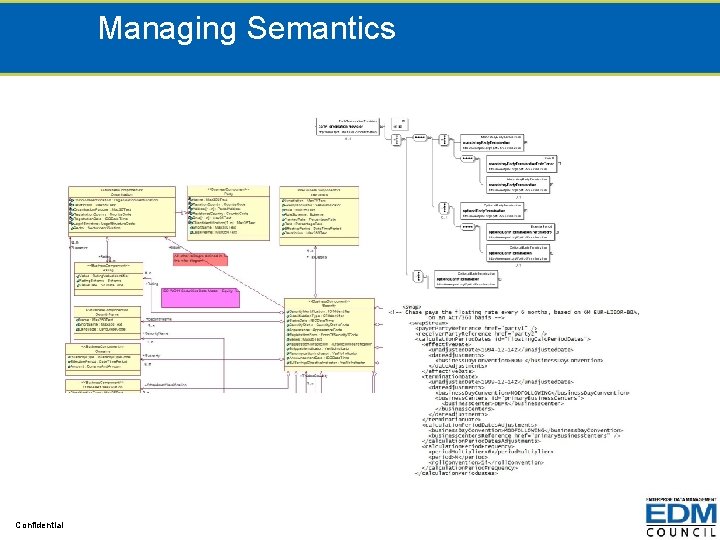
Managing Semantics Confidential
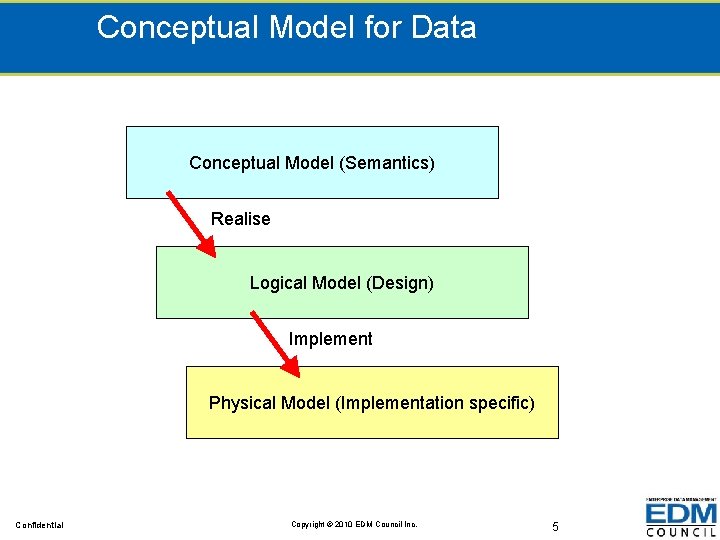
Conceptual Model for Data Conceptual Model (Semantics) Realise Logical Model (Design) Implement Physical Model (Implementation specific) Confidential Copyright © 2010 EDM Council Inc. 5
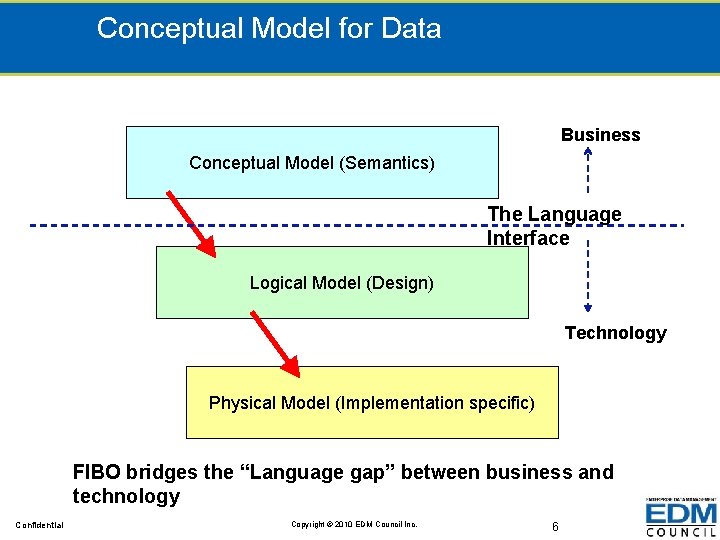
Conceptual Model for Data Business Conceptual Model (Semantics) The Language Interface Logical Model (Design) Technology Physical Model (Implementation specific) FIBO bridges the “Language gap” between business and technology Confidential Copyright © 2010 EDM Council Inc. 6
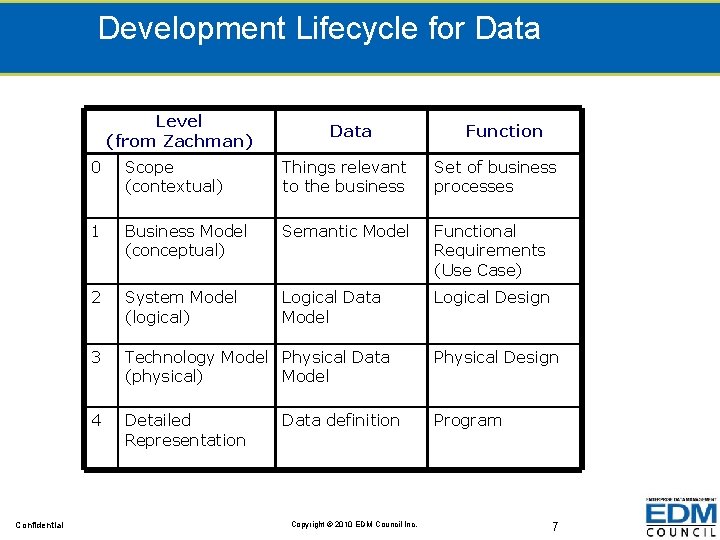
Development Lifecycle for Data Level (from Zachman) Confidential Data Function 0 Scope (contextual) Things relevant to the business Set of business processes 1 Business Model (conceptual) Semantic Model Functional Requirements (Use Case) 2 System Model (logical) Logical Data Model Logical Design 3 Technology Model Physical Data (physical) Model Physical Design 4 Detailed Representation Program Data definition Copyright © 2010 EDM Council Inc. 7
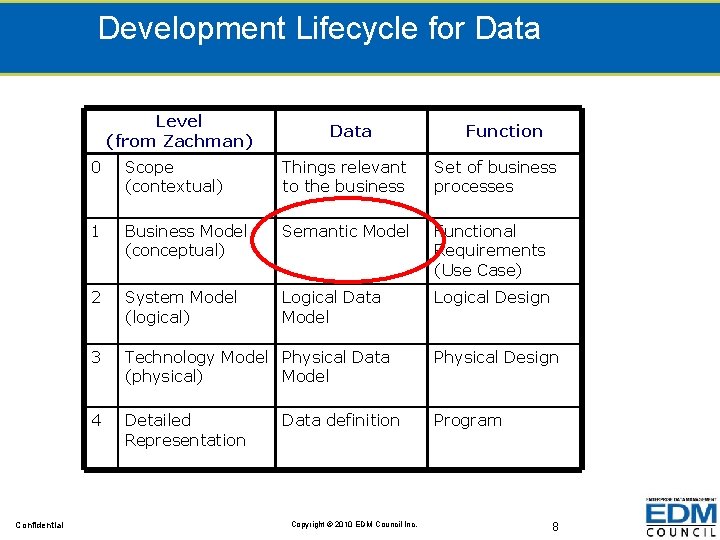
Development Lifecycle for Data Level (from Zachman) Confidential Data Function 0 Scope (contextual) Things relevant to the business Set of business processes 1 Business Model (conceptual) Semantic Model Functional Requirements (Use Case) 2 System Model (logical) Logical Data Model Logical Design 3 Technology Model Physical Data (physical) Model Physical Design 4 Detailed Representation Program Data definition Copyright © 2010 EDM Council Inc. 8
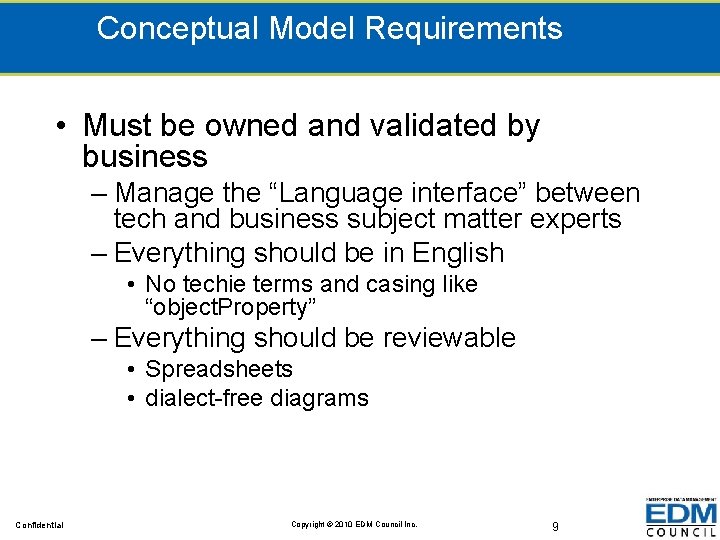
Conceptual Model Requirements • Must be owned and validated by business – Manage the “Language interface” between tech and business subject matter experts – Everything should be in English • No techie terms and casing like “object. Property” – Everything should be reviewable • Spreadsheets • dialect-free diagrams Confidential Copyright © 2010 EDM Council Inc. 9
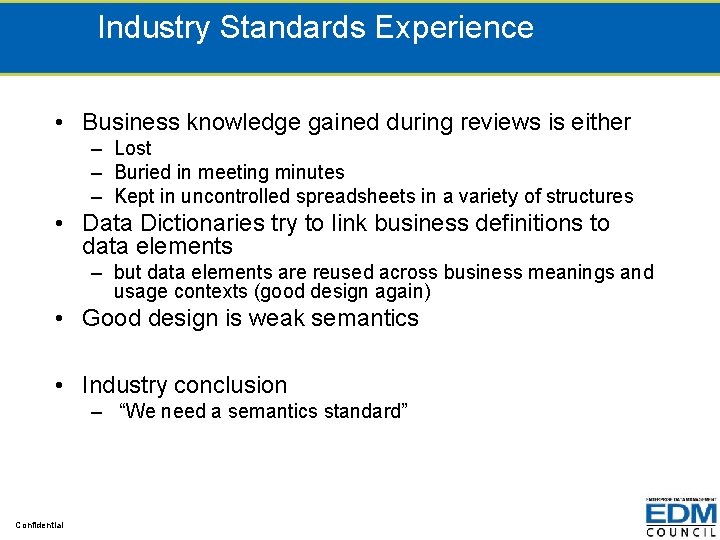
Industry Standards Experience • Business knowledge gained during reviews is either – Lost – Buried in meeting minutes – Kept in uncontrolled spreadsheets in a variety of structures • Data Dictionaries try to link business definitions to data elements – but data elements are reused across business meanings and usage contexts (good design again) • Good design is weak semantics • Industry conclusion – “We need a semantics standard” Confidential
Ontology • “A formal specification of a conceptualization” • But – What formalization? – What conceptualization? – That defines what sort of ontology Confidential Copyright © 2010 EDM Council Inc. 11
Some Terms • Taxonomy – A structured classification scheme • Linnaeus Taxonomy of Species • Taxonomy of Financial Instruments • Ontology – Adds formal properties to a taxonomy – Describes real world things • Vocabulary or Lexicon – Deals with the words for things Confidential Copyright © 2010 EDM Council Inc. 12
Taxonomy • Taxonomy: – system that can be used to group, arrange, and describe items according to meaningful principles, and which provides users with an overview of the domain being organized • Lambe (2009) • A taxonomy uses a classification scheme to arrange the items in the domain of discourse • A Taxonomy forms the basis for any ontology Confidential Copyright © 2010 EDM Council Inc. 13
From Taxonomy to Ontology • Ontology: the study of what is • Ontologies (plural): the real world universe as it is referred to in a computer application – Informal: every application has an ontology, whether it’s documented or not – Formal: uses formal logic in some notation • Semantic Web – Uses a formalism which can be reasoned over Confidential Copyright © 2010 EDM Council Inc. 14
Model Theory and Semiotics • For any model we may ask: – What is that to which the model elements correspond? – What is the formal grounding of the symbols in the model • For an ontology: – The things to which the model elements refer are real things in the domain of discourse – The grounding is formal logic Confidential Copyright © 2010 EDM Council Inc. 15
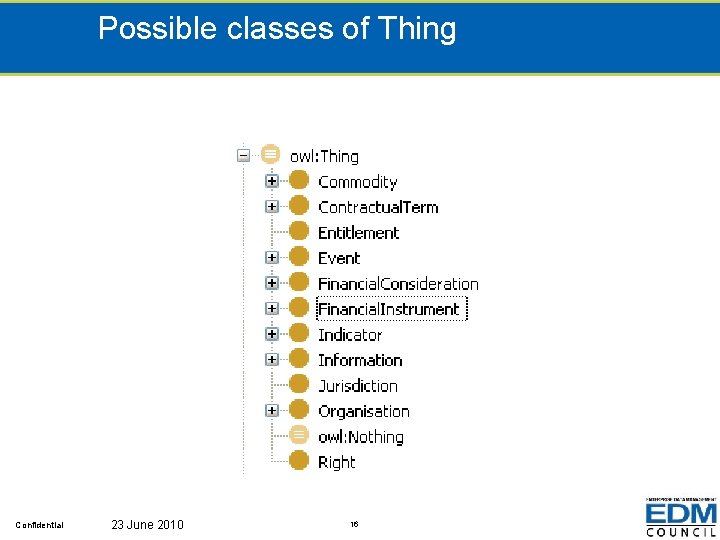
Possible classes of Thing Confidential 23 June 2010 16
Example “Thing”: Equity • Real world definition of Equity: "An equity is a financial instrument setting out a number of terms which define rights and benefits to the holder in relation to their holding a portion of the equity within the issuing company". Confidential 23 June 2010 17
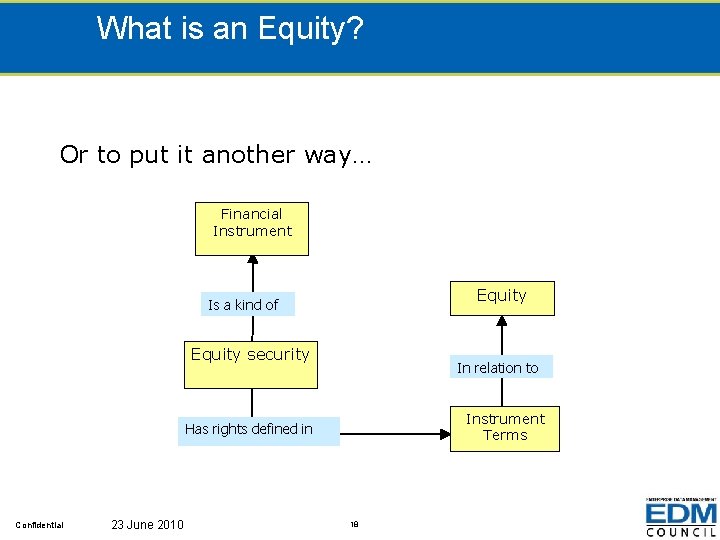
What is an Equity? Or to put it another way… Financial Instrument Equity Is a kind of Equity security In relation to Instrument Terms Has rights defined in Confidential 23 June 2010 18
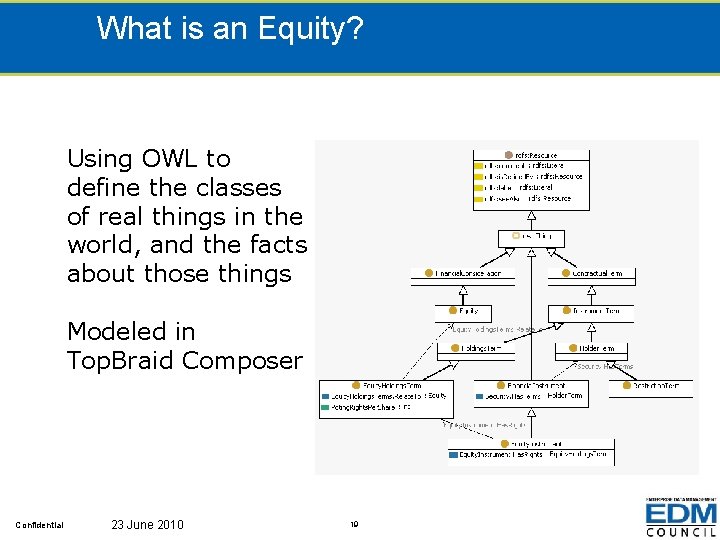
What is an Equity? Using OWL to define the classes of real things in the world, and the facts about those things Modeled in Top. Braid Composer Confidential 23 June 2010 19
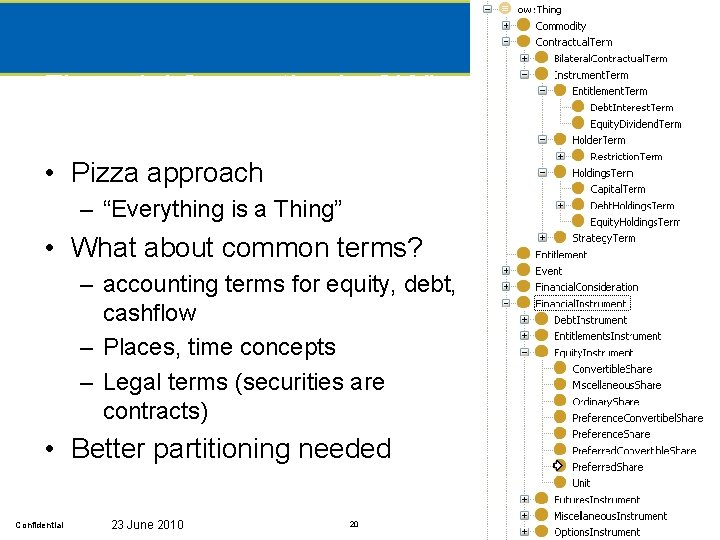
Financial Semantics in OWL • Pizza approach – “Everything is a Thing” • What about common terms? – accounting terms for equity, debt, cashflow – Places, time concepts – Legal terms (securities are contracts) • Better partitioning needed Confidential 23 June 2010 20
The Semantic Web • Web Ontology Language – Based on Subject-Verb-Object “Triples” – Widely used • Protégé tool • Experiment: Ingest a logical data model into OWL – Result: a logical data model in OWL • Syntax is not semantics! Confidential
Making it Meaningful • Putting something into RDF/OWL does not make it meaningful – Only you can do that • So, what is a meaningful model – 1. Formal relationship between model and subject matter: • “Everything is a Thing” – 2. Formal notation grounded in common logic – 3. Abstraction of kinds of thing into their simplest possible building blocks • Contracts, Parties, Legal Entities etc. Confidential
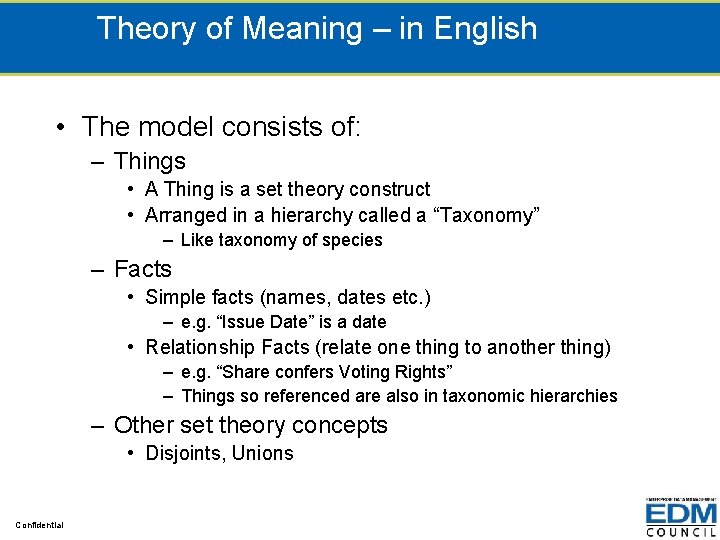
Theory of Meaning – in English • The model consists of: – Things • A Thing is a set theory construct • Arranged in a hierarchy called a “Taxonomy” – Like taxonomy of species – Facts • Simple facts (names, dates etc. ) – e. g. “Issue Date” is a date • Relationship Facts (relate one thing to another thing) – e. g. “Share confers Voting Rights” – Things so referenced are also in taxonomic hierarchies – Other set theory concepts • Disjoints, Unions Confidential
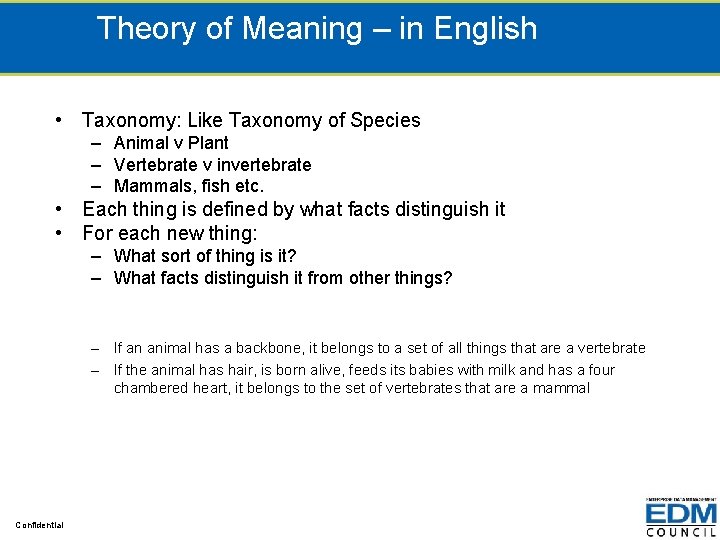
Theory of Meaning – in English • Taxonomy: Like Taxonomy of Species – Animal v Plant – Vertebrate v invertebrate – Mammals, fish etc. • Each thing is defined by what facts distinguish it • For each new thing: – What sort of thing is it? – What facts distinguish it from other things? – If an animal has a backbone, it belongs to a set of all things that are a vertebrate – If the animal has hair, is born alive, feeds its babies with milk and has a four chambered heart, it belongs to the set of vertebrates that are a mammal Confidential
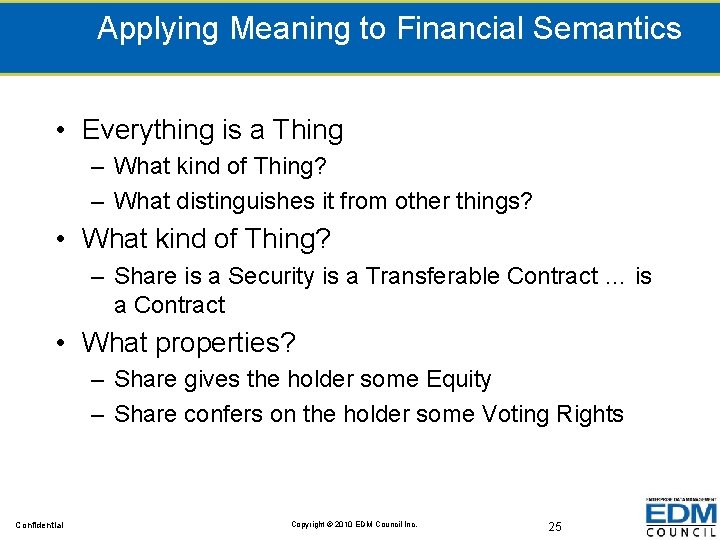
Applying Meaning to Financial Semantics • Everything is a Thing – What kind of Thing? – What distinguishes it from other things? • What kind of Thing? – Share is a Security is a Transferable Contract … is a Contract • What properties? – Share gives the holder some Equity – Share confers on the holder some Voting Rights Confidential Copyright © 2010 EDM Council Inc. 25
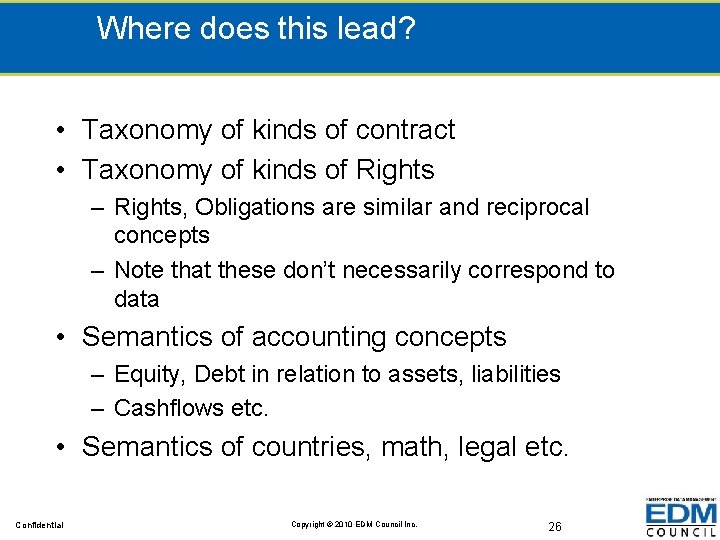
Where does this lead? • Taxonomy of kinds of contract • Taxonomy of kinds of Rights – Rights, Obligations are similar and reciprocal concepts – Note that these don’t necessarily correspond to data • Semantics of accounting concepts – Equity, Debt in relation to assets, liabilities – Cashflows etc. • Semantics of countries, math, legal etc. Confidential Copyright © 2010 EDM Council Inc. 26
Global Terms • Rationale: – Everything is a specialization of some more general term • Legal, accounting, events, transaction semantics – Facts about instruments are stated in terms of other things • Countries, formulae etc. • Want to derive from and align with the best ontologies for these area • Disposed under a common framework • FIBO models are extensively partitioned • Shared Semantics: – Align with standard ontologies where these exist – Leverage OMG standards e. g. Date Time Vocabulary • Work with academia and standards (ongoing) – Transaction Semantics: REA, XBRL-GL Confidential

Financial Industry Business Ontology User Commitments Original BIAN XBRL Content Boxes & Lines SME Reviews Industry Standards ISO 20022 Fp. ML MDDL XLS FIBO Archetypes Theory of meaning UML Tools Sub-set for readability Sem. Web OWL constructs ODM v 1. 1 Confidential RDF/OWL
What we wanted • Business meanings • In business language • For business people Confidential
What we wanted • Business meanings – Not data dictionary • In business language – Not a design • For business people – No funny symbols and things – No language to learn – Just the facts – Boxes and lines – something like this… Confidential
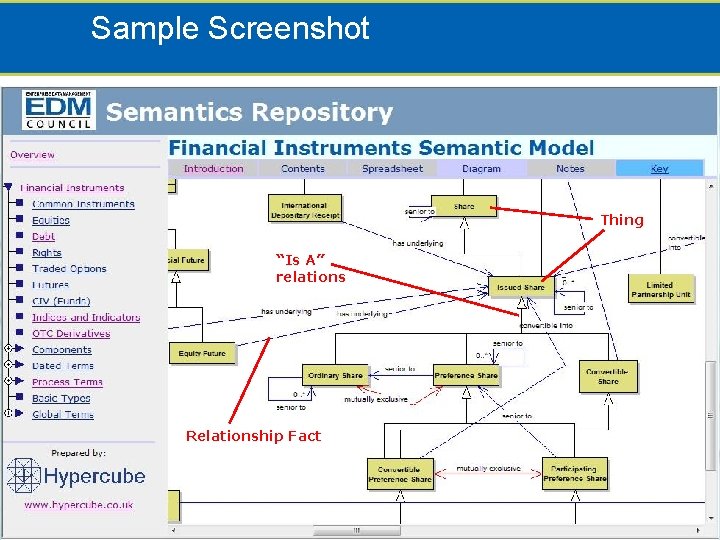
Sample Screenshot Thing “Is A” relations Relationship Fact Confidential Copyright © 2010 EDM Council Inc. 31
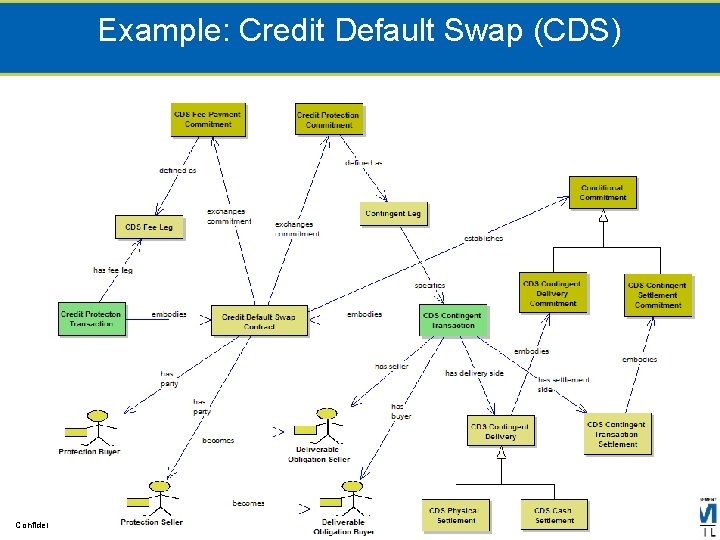
Example: Credit Default Swap (CDS) Confidential Copyright © 2010 EDM Council Inc. 32
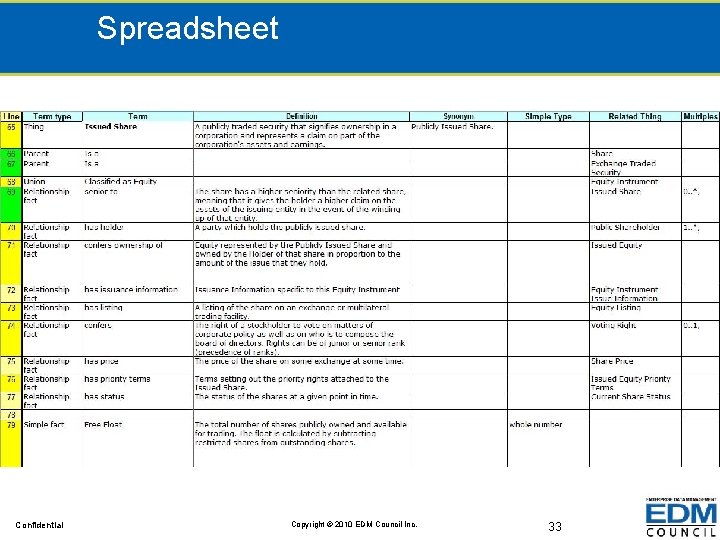
Spreadsheet Confidential Copyright © 2010 EDM Council Inc. 33
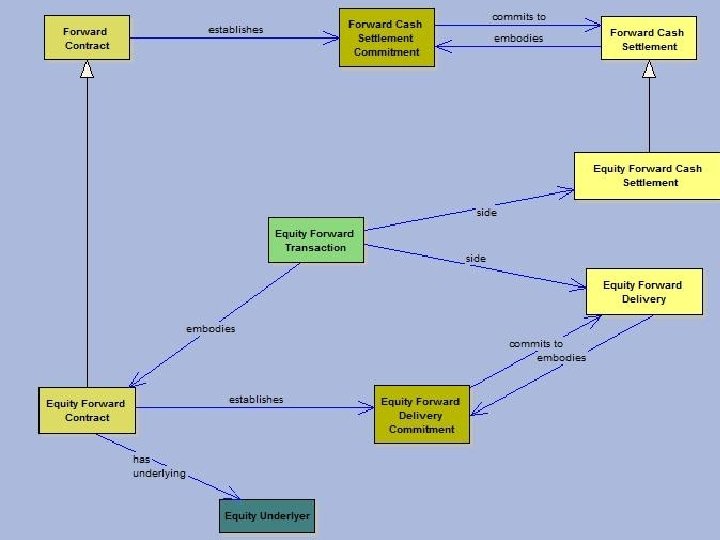
Sample screenshot 2: Different types of Thing Confidential The EDM Council
So what is FIBO • FIBO has these distinct aspects: – The Business Ontology – Presentation for Business Readability • Released in discrete ontologies by subject area – FIBO for Business Entities is currently under submission – Securities, Loans, Derivatives to follow – Corporate Actions, Transactions later • Leverage other OMG standards and shared semantics Confidential
From Business to Operational Ontology • Uses for FIBO • Semantic Technology applications • Conceptual versus Operational Ontologies • Transforming from one to the other • Use of metadata Confidential Copyright © 2010 EDM Council Inc. 36
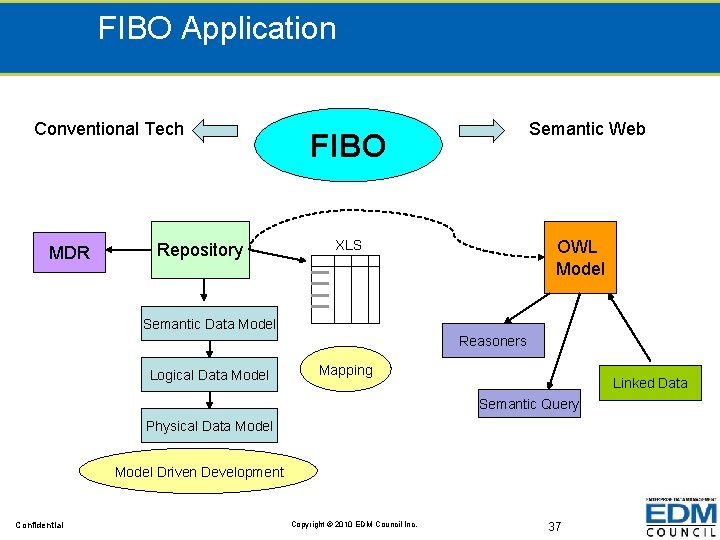
FIBO Application Conventional Tech MDR Repository Semantic Web FIBO OWL Model XLS Semantic Data Model Reasoners Logical Data Model Mapping Linked Data Semantic Query Physical Data Model Driven Development Confidential Copyright © 2010 EDM Council Inc. 37
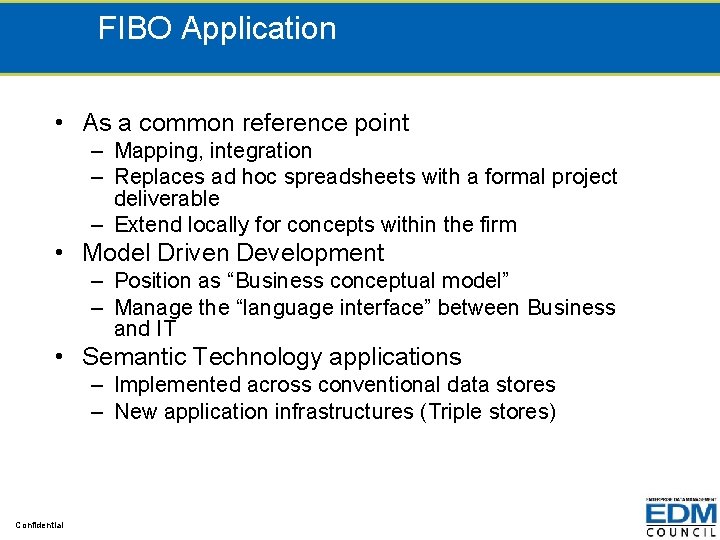
FIBO Application • As a common reference point – Mapping, integration – Replaces ad hoc spreadsheets with a formal project deliverable – Extend locally for concepts within the firm • Model Driven Development – Position as “Business conceptual model” – Manage the “language interface” between Business and IT • Semantic Technology applications – Implemented across conventional data stores – New application infrastructures (Triple stores) Confidential
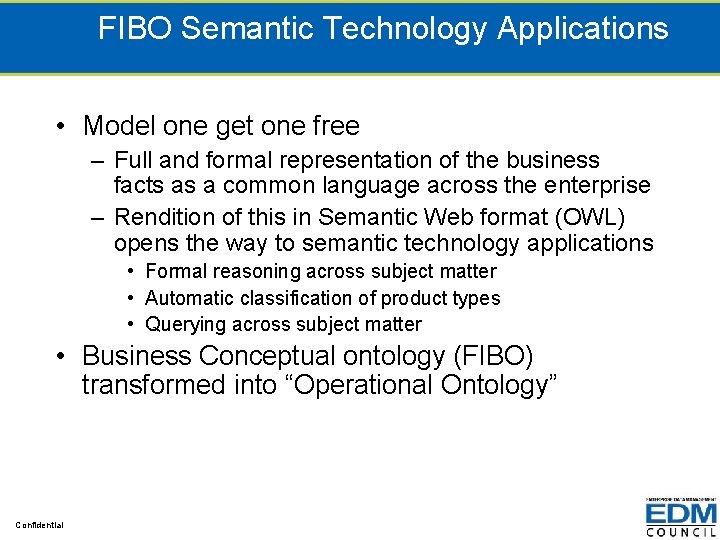
FIBO Semantic Technology Applications • Model one get one free – Full and formal representation of the business facts as a common language across the enterprise – Rendition of this in Semantic Web format (OWL) opens the way to semantic technology applications • Formal reasoning across subject matter • Automatic classification of product types • Querying across subject matter • Business Conceptual ontology (FIBO) transformed into “Operational Ontology” Confidential
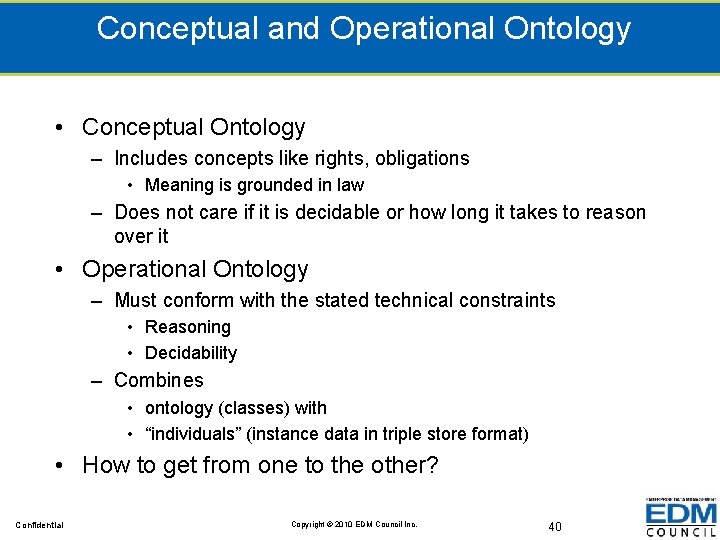
Conceptual and Operational Ontology • Conceptual Ontology – Includes concepts like rights, obligations • Meaning is grounded in law – Does not care if it is decidable or how long it takes to reason over it • Operational Ontology – Must conform with the stated technical constraints • Reasoning • Decidability – Combines • ontology (classes) with • “individuals” (instance data in triple store format) • How to get from one to the other? Confidential Copyright © 2010 EDM Council Inc. 40
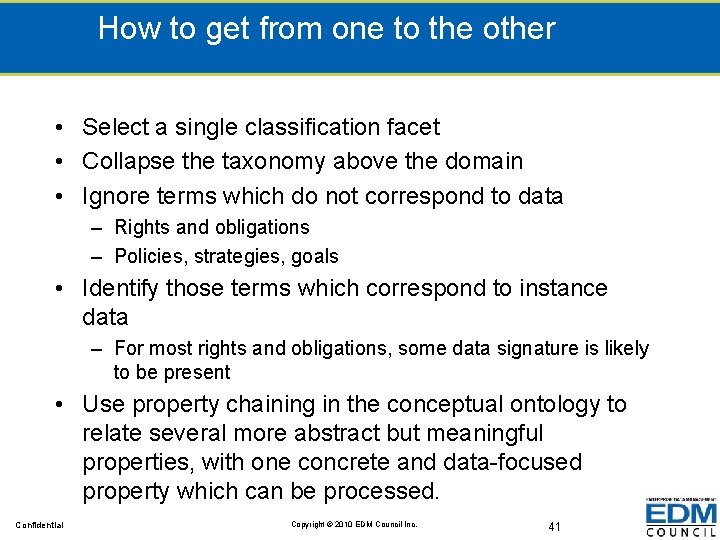
How to get from one to the other • Select a single classification facet • Collapse the taxonomy above the domain • Ignore terms which do not correspond to data – Rights and obligations – Policies, strategies, goals • Identify those terms which correspond to instance data – For most rights and obligations, some data signature is likely to be present • Use property chaining in the conceptual ontology to relate several more abstract but meaningful properties, with one concrete and data-focused property which can be processed. Confidential Copyright © 2010 EDM Council Inc. 41
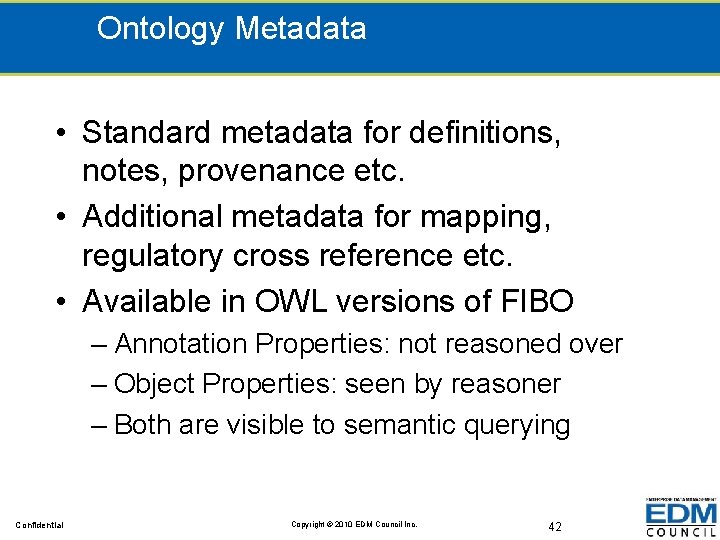
Ontology Metadata • Standard metadata for definitions, notes, provenance etc. • Additional metadata for mapping, regulatory cross reference etc. • Available in OWL versions of FIBO – Annotation Properties: not reasoned over – Object Properties: seen by reasoner – Both are visible to semantic querying Confidential Copyright © 2010 EDM Council Inc. 42
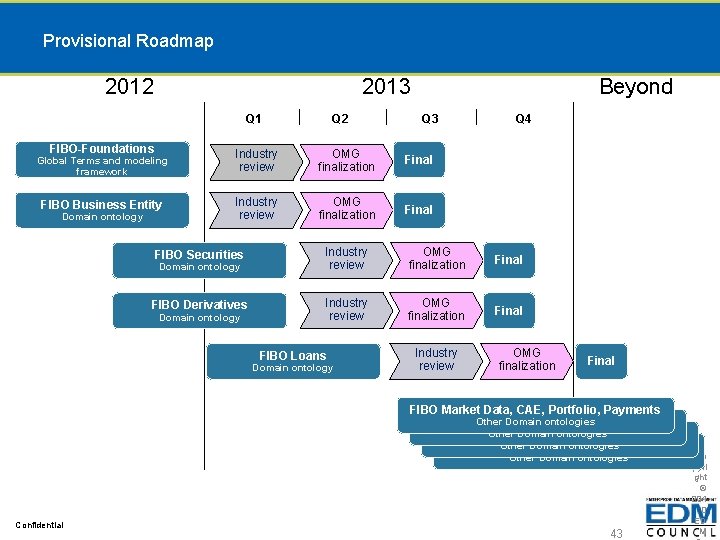
Provisional Roadmap 2012 2013 Q 1 Q 2 Beyond Q 3 FIBO-Foundations Industry review OMG finalization Final FIBO Business Entity Industry review OMG finalization Final Global Terms and modeling framework Domain ontology Q 4 FIBO Securities Industry review OMG finalization Final FIBO Derivatives Industry review OMG finalization Final Domain ontology FIBO Loans Domain ontology Industry review OMG finalization Final FIBO Market Data, CAE, Portfolio, Payments Other Domain ontologies FIBO Market Data, CAE, Risk/Reporting Other Domain ontologies Confidential 43 Co pyri ght © 201 0 ED M
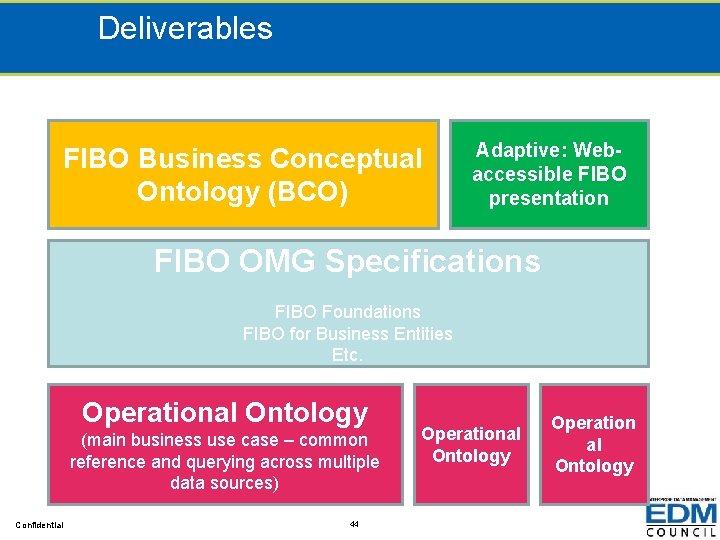
Deliverables FIBO Business Conceptual Ontology (BCO) Adaptive: Webaccessible FIBO presentation FIBO OMG Specifications FIBO Foundations FIBO for Business Entities Etc. Operational Ontology (main business use case – common reference and querying across multiple data sources) Confidential 44 Operational Ontology Operation al Ontology
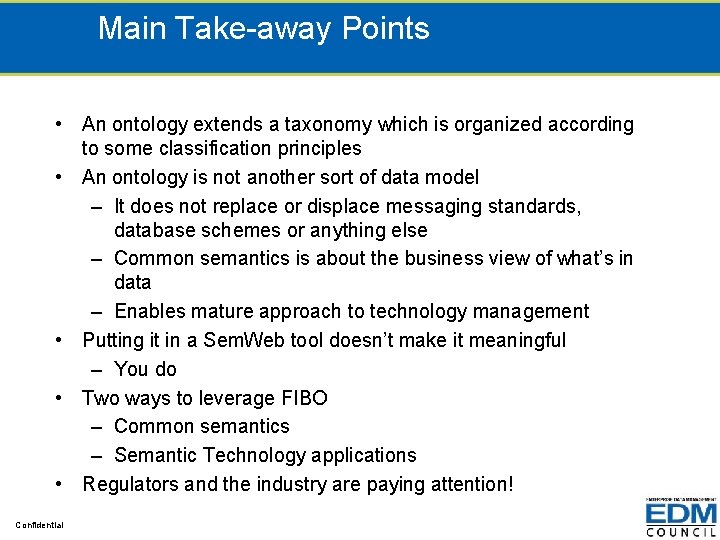
Main Take-away Points • An ontology extends a taxonomy which is organized according to some classification principles • An ontology is not another sort of data model – It does not replace or displace messaging standards, database schemes or anything else – Common semantics is about the business view of what’s in data – Enables mature approach to technology management • Putting it in a Sem. Web tool doesn’t make it meaningful – You do • Two ways to leverage FIBO – Common semantics – Semantic Technology applications • Regulators and the industry are paying attention! Confidential
Contact • Mike Bennett – mbennett@edmcouncil. org Confidential Copyright © 2010 EDM Council Inc. 46
- Slides: 46