
The Financial Aid Process Making college accessible and
The Financial Aid Process
“Making college accessible and affordable for Illinois students. ” – ISAC Mission Statement • The Illinois Student Assistance Commission (ISAC) is the college access and financial aid agency in the state of Illinois that administers scholarship, grant, prepaid tuition, and student loan repayment/forgiveness programs.
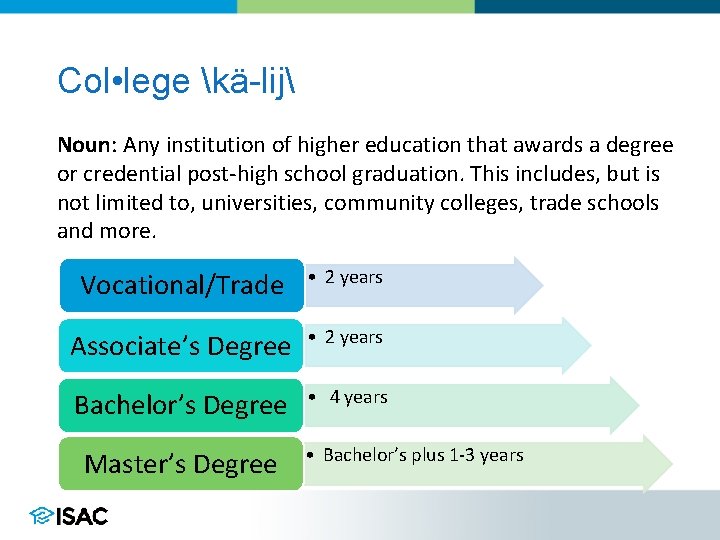
Col • lege kä-lij Noun: Any institution of higher education that awards a degree or credential post-high school graduation. This includes, but is not limited to, universities, community colleges, trade schools and more. Vocational/Trade • 2 years Associate’s Degree • 2 years Bachelor’s Degree • 4 years Master’s Degree • Bachelor’s plus 1 -3 years
Slide Content Title Content
Planning for College There are lots of things to think about and many questions you need to ask. • • • Can I afford college? How much will it cost? What is financial aid? What is a FAFSA? When and how do I apply? Where can I get help? Ask questions…
What is Financial Aid? • It is borrowed, given, or earned money that can be obtained from various sources to help pay for college • Financial aid makes college affordable for you • It is intended to make up the difference between what your family can afford to pay and what college costs. If you think you can’t afford college, think again. There’s lots of aid out there.
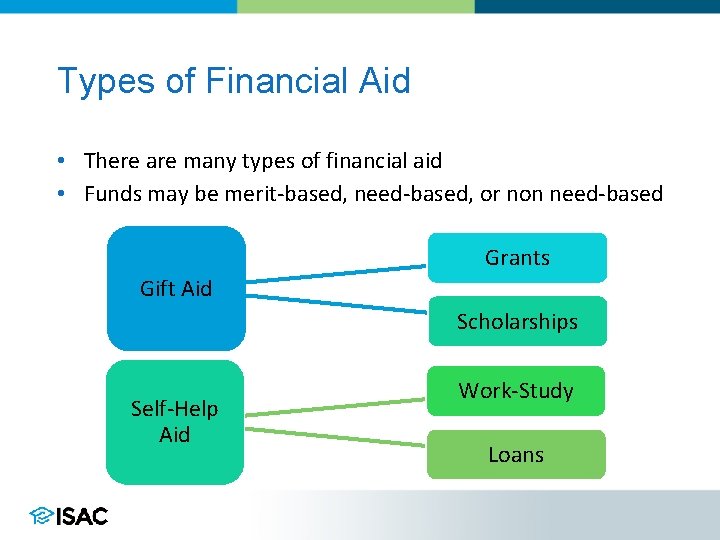
Types of Financial Aid • There are many types of financial aid • Funds may be merit-based, need-based, or non need-based Grants Gift Aid Scholarships Self-Help Aid Work-Study Loans
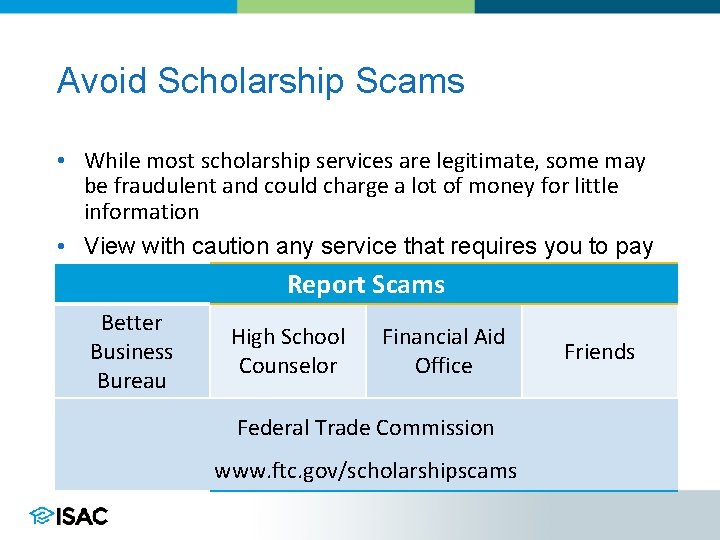
Avoid Scholarship Scams • While most scholarship services are legitimate, some may be fraudulent and could charge a lot of money for little information • View with caution any service that requires you to pay Report Scams Better Business Bureau High School Counselor Financial Aid Office Federal Trade Commission www. ftc. gov/scholarshipscams Friends
Sources of Financial Aid • The “Must-Get-to-Know” financial aid sources Illinois Student Assistance Commission U. S. Department of Education’s Office of Federal Student Aid www. ISAC. org Agency in the state of Illinois that administers scholarship, grant, prepaid tuition, and student loan repayment/forgiveness programs. . www. Student. Aid. gov Federal agency that provides college funding in the form of grant, scholarship, work-study, and educational loan programs.
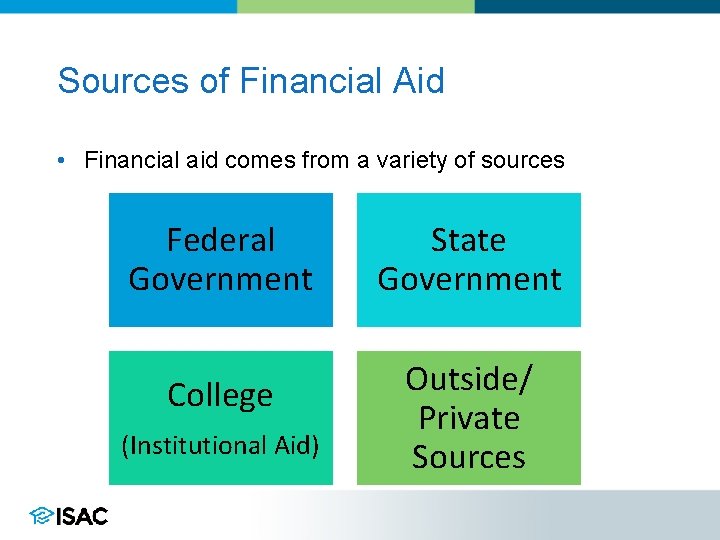
Sources of Financial Aid • Financial aid comes from a variety of sources Federal Government State Government College Outside/ Private Sources (Institutional Aid)
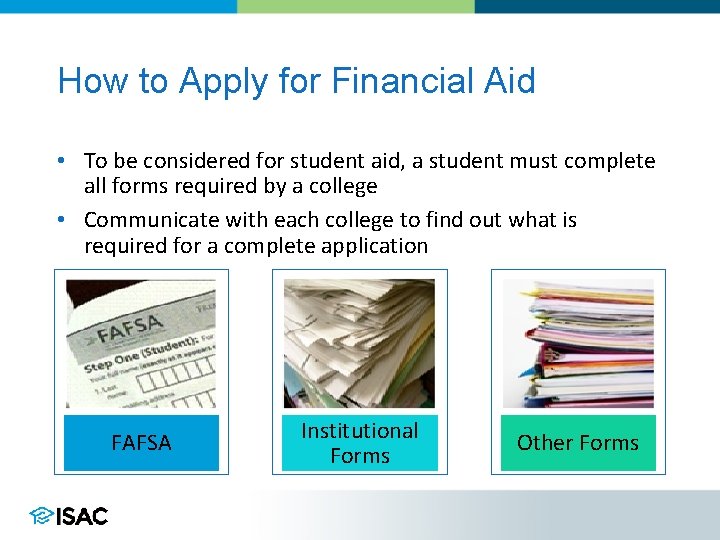
How to Apply for Financial Aid • To be considered for student aid, a student must complete all forms required by a college • Communicate with each college to find out what is required for a complete application FAFSA Institutional Forms Other Forms
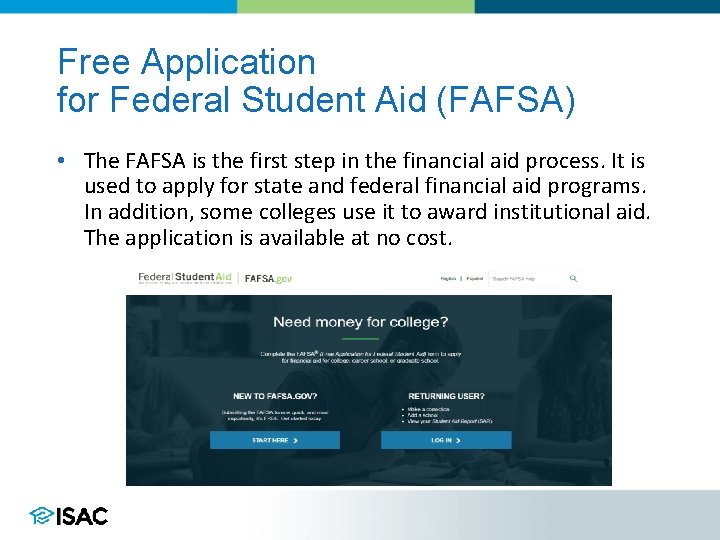
Free Application for Federal Student Aid (FAFSA) • The FAFSA is the first step in the financial aid process. It is used to apply for state and federal financial aid programs. In addition, some colleges use it to award institutional aid. The application is available at no cost.
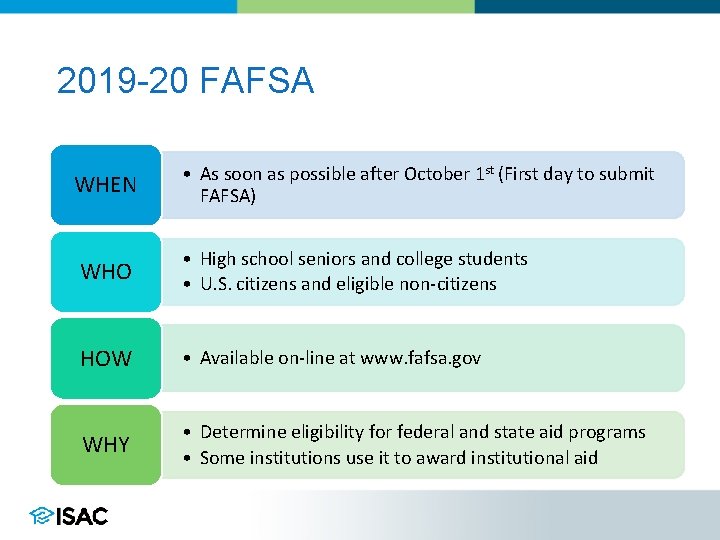
2019 -20 FAFSA WHEN • As soon as possible after October 1 st (First day to submit FAFSA) WHO • High school seniors and college students • U. S. citizens and eligible non-citizens HOW • Available on-line at www. fafsa. gov WHY • Determine eligibility for federal and state aid programs • Some institutions use it to award institutional aid
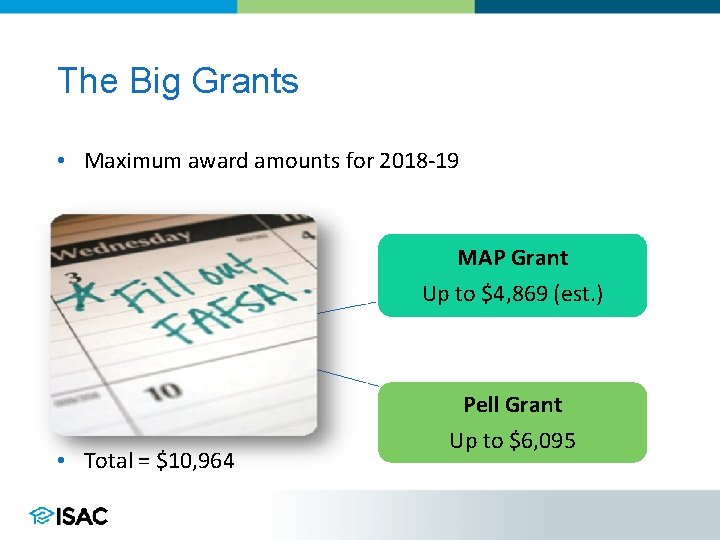
The Big Grants • Maximum award amounts for 2018 -19 MAP Grant Up to $4, 869 (est. ) • Total = $10, 964 Pell Grant Up to $6, 095
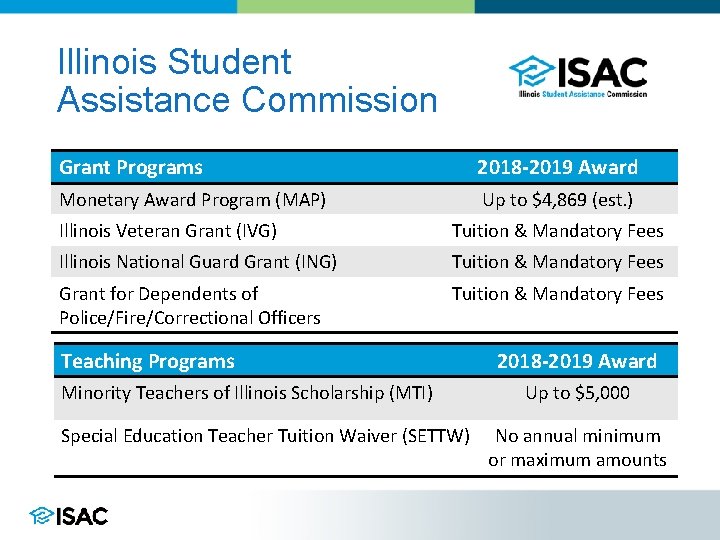
Illinois Student Assistance Commission Grant Programs 2018 -2019 Award Monetary Award Program (MAP) Up to $4, 869 (est. ) Illinois Veteran Grant (IVG) Tuition & Mandatory Fees Illinois National Guard Grant (ING) Tuition & Mandatory Fees Grant for Dependents of Police/Fire/Correctional Officers Tuition & Mandatory Fees Teaching Programs Minority Teachers of Illinois Scholarship (MTI) Special Education Teacher Tuition Waiver (SETTW) 2018 -2019 Award Up to $5, 000 No annual minimum or maximum amounts
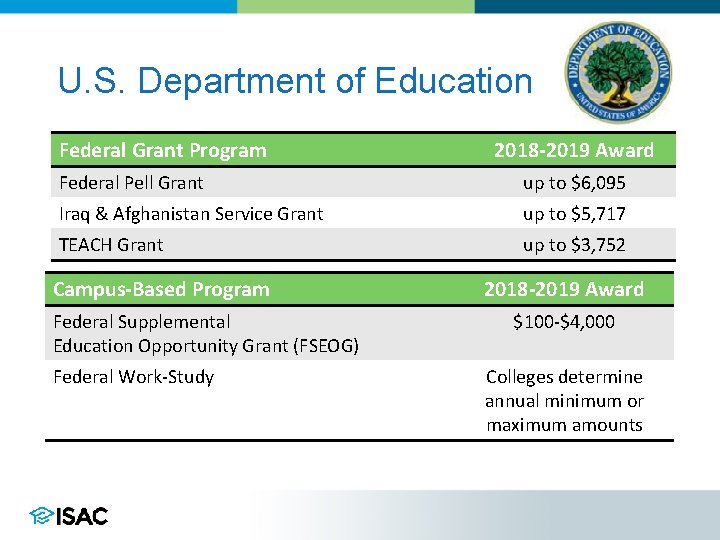
U. S. Department of Education Federal Grant Program 2018 -2019 Award Federal Pell Grant up to $6, 095 Iraq & Afghanistan Service Grant up to $5, 717 TEACH Grant up to $3, 752 Campus-Based Program Federal Supplemental Education Opportunity Grant (FSEOG) Federal Work-Study 2018 -2019 Award $100 -$4, 000 Colleges determine annual minimum or maximum amounts
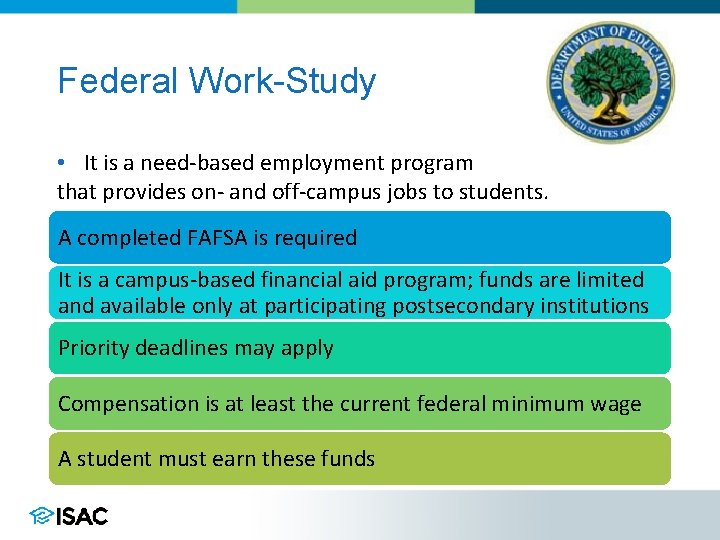
Federal Work-Study • It is a need-based employment program that provides on- and off-campus jobs to students. A completed FAFSA is required It is a campus-based financial aid program; funds are limited and available only at participating postsecondary institutions Priority deadlines may apply Compensation is at least the current federal minimum wage A student must earn these funds
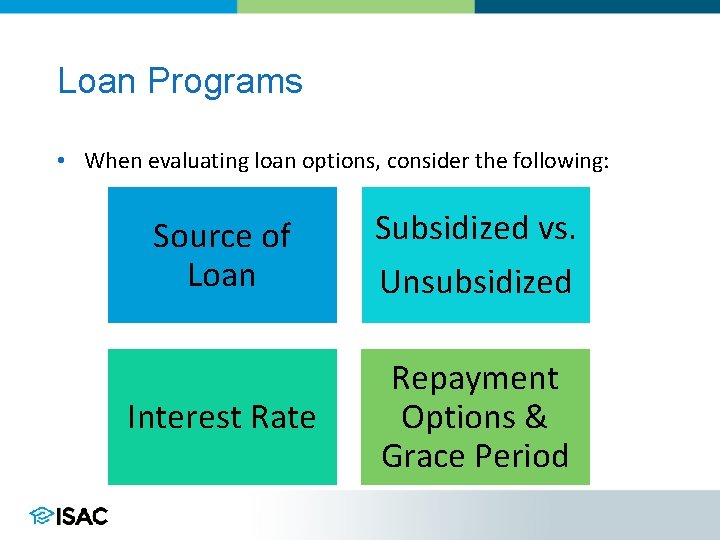
Loan Programs • When evaluating loan options, consider the following: Source of Loan Subsidized vs. Unsubsidized Interest Rate Repayment Options & Grace Period
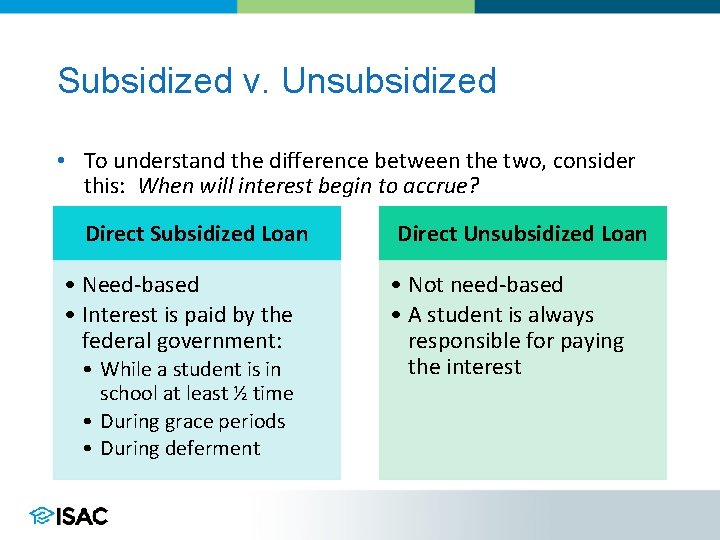
Subsidized v. Unsubsidized • To understand the difference between the two, consider this: When will interest begin to accrue? Direct Subsidized Loan • Need-based • Interest is paid by the federal government: • While a student is in school at least ½ time • During grace periods • During deferment Direct Unsubsidized Loan • Not need-based • A student is always responsible for paying the interest
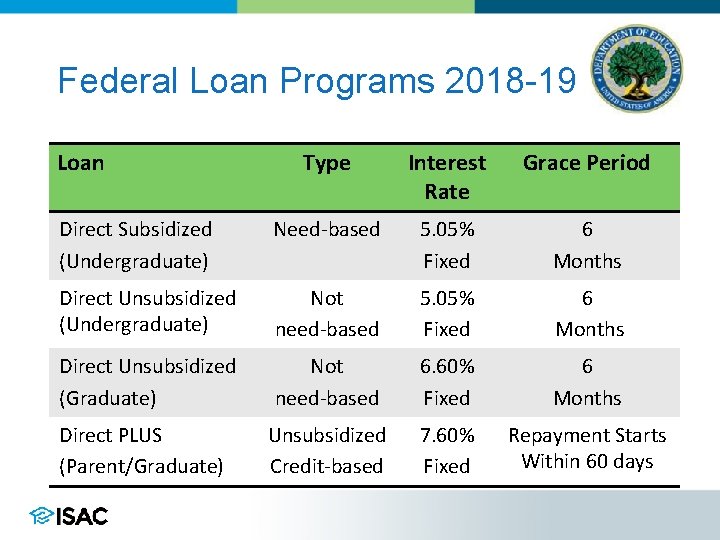
Federal Loan Programs 2018 -19 Loan Type Interest Rate Grace Period Direct Subsidized (Undergraduate) Need-based 5. 05% Fixed 6 Months Direct Unsubsidized (Undergraduate) Not need-based 5. 05% Fixed 6 Months Direct Unsubsidized (Graduate) Not need-based 6. 60% Fixed 6 Months Direct PLUS (Parent/Graduate) Unsubsidized Credit-based 7. 60% Fixed Repayment Starts Within 60 days
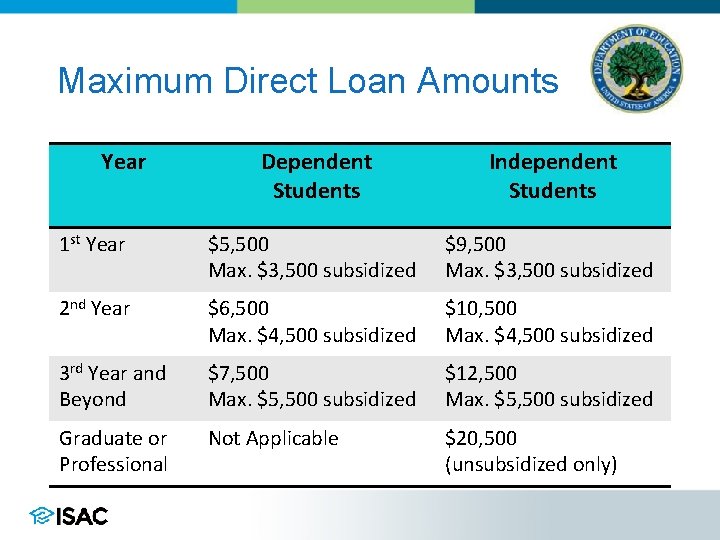
Maximum Direct Loan Amounts Year Dependent Students Independent Students 1 st Year $5, 500 Max. $3, 500 subsidized $9, 500 Max. $3, 500 subsidized 2 nd Year $6, 500 Max. $4, 500 subsidized $10, 500 Max. $4, 500 subsidized 3 rd Year and Beyond $7, 500 Max. $5, 500 subsidized $12, 500 Max. $5, 500 subsidized Graduate or Professional Not Applicable $20, 500 (unsubsidized only)
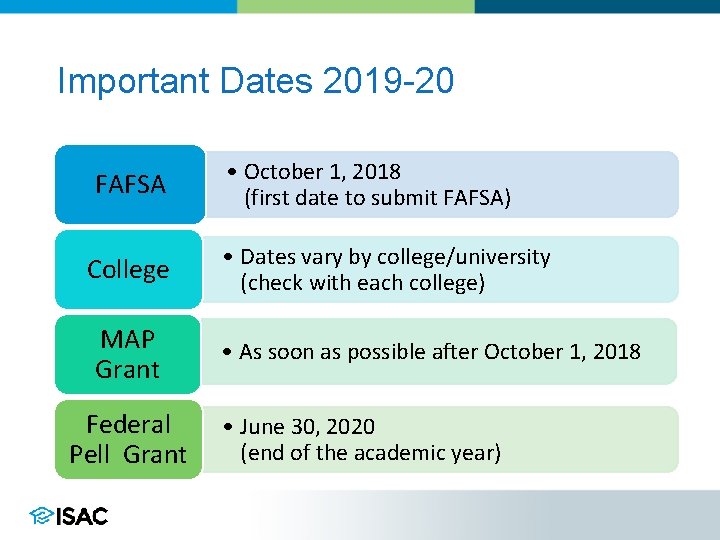
Important Dates 2019 -20 FAFSA College MAP Grant Federal Pell Grant • October 1, 2018 (first date to submit FAFSA) • Dates vary by college/university (check with each college) • As soon as possible after October 1, 2018 • June 30, 2020 (end of the academic year)
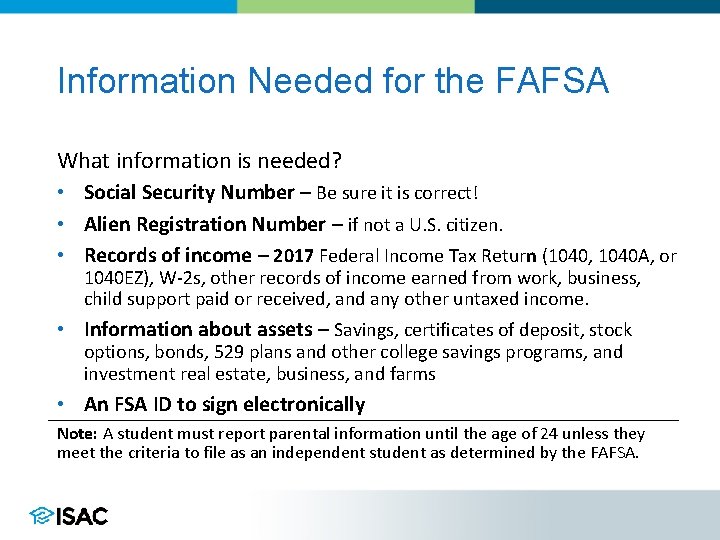
Information Needed for the FAFSA What information is needed? • Social Security Number – Be sure it is correct! • Alien Registration Number – if not a U. S. citizen. • Records of income – 2017 Federal Income Tax Return (1040, 1040 A, or 1040 EZ), W-2 s, other records of income earned from work, business, child support paid or received, and any other untaxed income. • Information about assets – Savings, certificates of deposit, stock options, bonds, 529 plans and other college savings programs, and investment real estate, business, and farms • An FSA ID to sign electronically Note: A student must report parental information until the age of 24 unless they meet the criteria to file as an independent student as determined by the FAFSA.
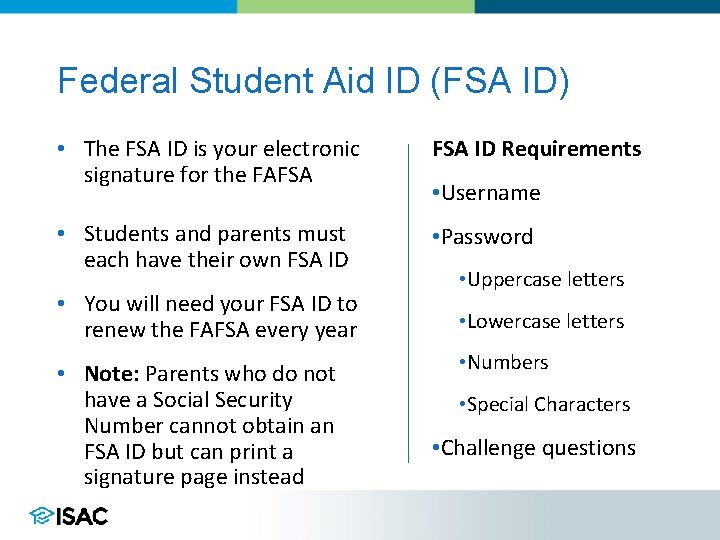
Federal Student Aid ID (FSA ID) • The FSA ID is your electronic signature for the FAFSA ID Requirements • Students and parents must each have their own FSA ID • Password • You will need your FSA ID to renew the FAFSA every year • Note: Parents who do not have a Social Security Number cannot obtain an FSA ID but can print a signature page instead • Username • Uppercase letters • Lowercase letters • Numbers • Special Characters • Challenge questions
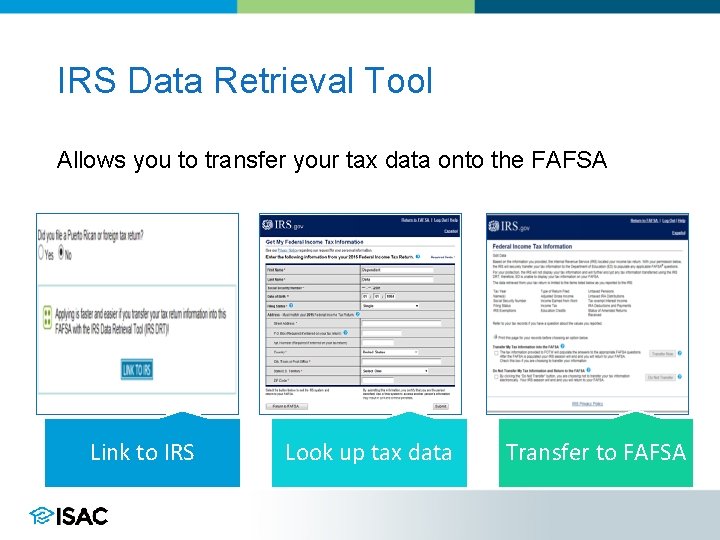
IRS Data Retrieval Tool Allows you to transfer your tax data onto the FAFSA Link to IRS Look up tax data Transfer to FAFSA
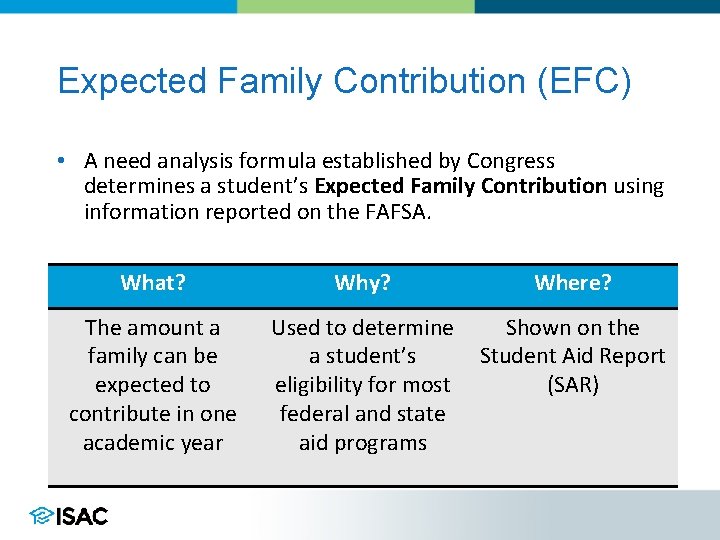
Expected Family Contribution (EFC) • A need analysis formula established by Congress determines a student’s Expected Family Contribution using information reported on the FAFSA. What? Why? Where? The amount a family can be expected to contribute in one academic year Used to determine a student’s eligibility for most federal and state aid programs Shown on the Student Aid Report (SAR)
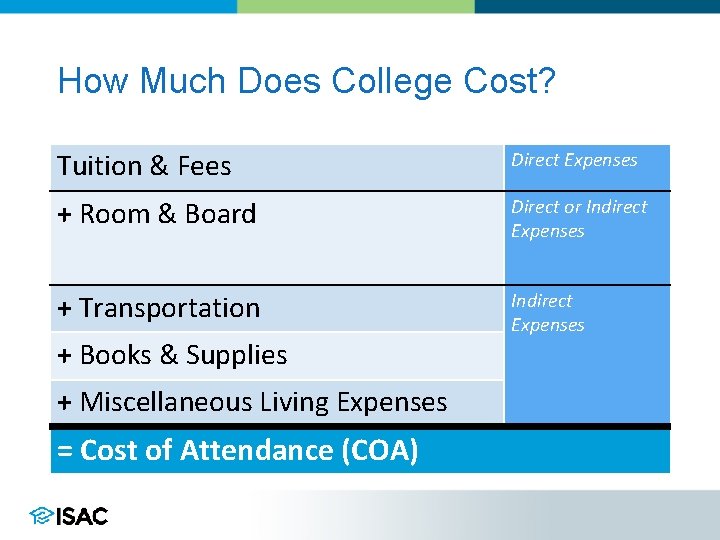
How Much Does College Cost? Tuition & Fees Direct Expenses + Room & Board Direct or Indirect Expenses + Transportation Indirect Expenses + Books & Supplies + Miscellaneous Living Expenses = Cost of Attendance (COA)
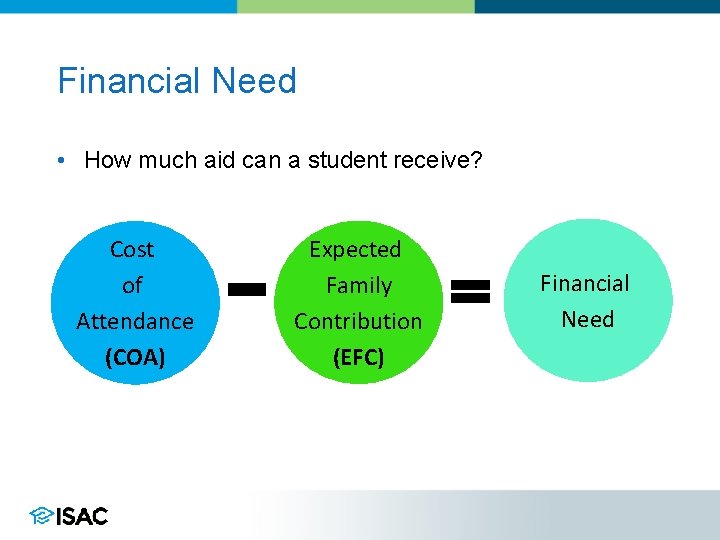
Financial Need • How much aid can a student receive? Cost of Attendance (COA) Expected Family Contribution (EFC) Financial Need
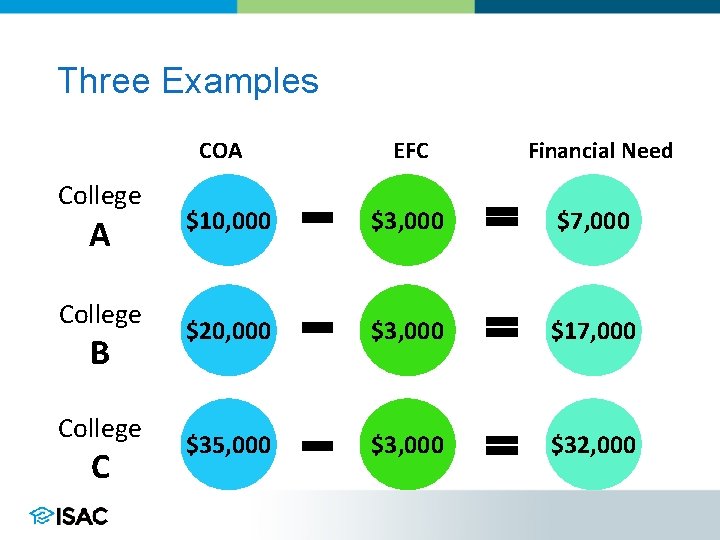
Three Examples COA College B College C EFC Financial Need $10, 000 $3, 000 $7, 000 $20, 000 $3, 000 $17, 000 $35, 000 $32, 000
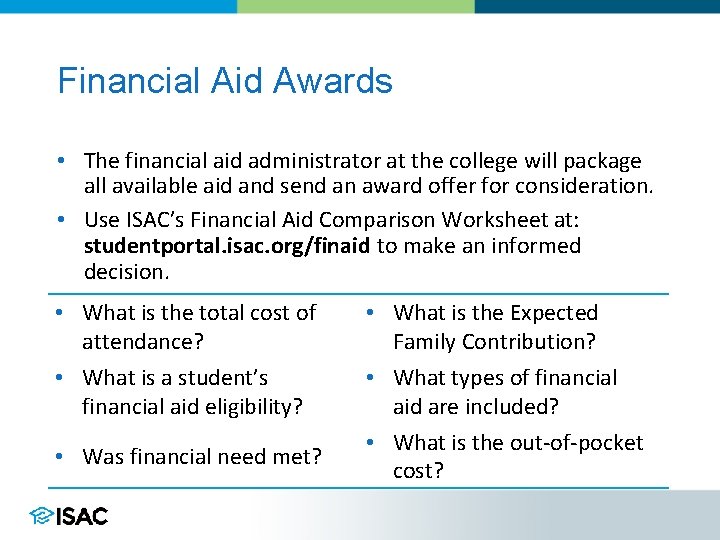
Financial Aid Awards • The financial aid administrator at the college will package all available aid and send an award offer for consideration. • Use ISAC’s Financial Aid Comparison Worksheet at: studentportal. isac. org/finaid to make an informed decision. • What is the total cost of attendance? • What is a student’s financial aid eligibility? • Was financial need met? • What is the Expected Family Contribution? • What types of financial aid are included? • What is the out-of-pocket cost?
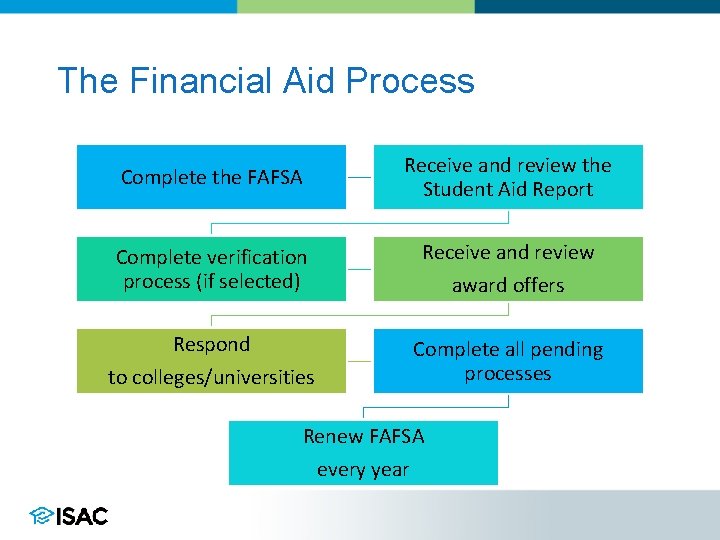
The Financial Aid Process Complete the FAFSA Receive and review the Student Aid Report Complete verification process (if selected) Receive and review Respond Complete all pending processes award offers to colleges/universities Renew FAFSA every year
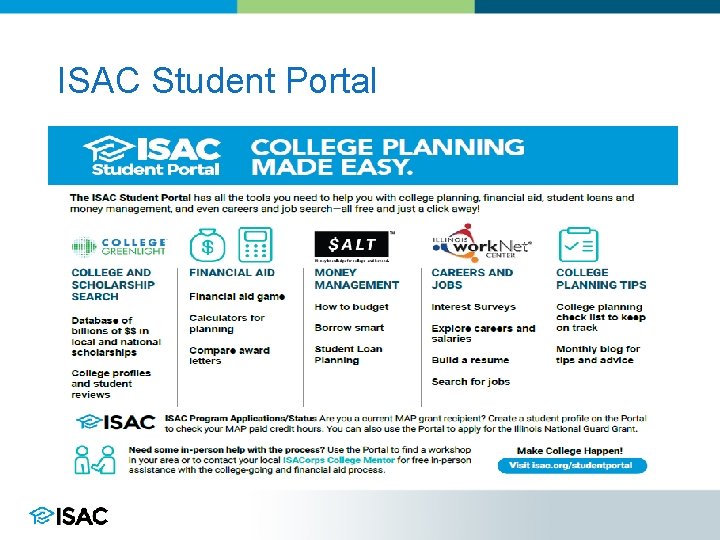
ISAC Student Portal
Trusted Websites • Learn what you need to know and stay up-to-date with accurate and trusted sources of information Studentportal. isac. org Student. Aid. gov FAFSA. gov
ISAC College Q & A • Questions about financial aid? • Questions about getting to college? • Text with our experts! (847) 243 -6470
Questions? Thank you! Jhoanna Vega-Rocha Jhoanna. Vega-Rocha@Illinois. gov (847) 732 -3009 This presentation is available under the Creative Commons Attribution-Non. Commercial. No. Derivatives License. Copyright 2016 Illinois Student Assistance Commission. ISAC_FAP_English 06 -07 -18
- Slides: 35