
The Field Area Network FAN Smart Grid second
- Slides: 43
The Field Area Network (FAN) “Smart Grid” second wave brings critical infrastructure for utility communications Craig Rodine Technical Executive Stanford University EE 392 n April 18, 2011
Topics • Introduction: EPRI, utilities, communications • Background: legacy and “first wave” applications • “Second wave”: focus on critical comms infrastructure • Towards robust unlicensed / lightly licensed systems • Towards resilient 4 G-based systems • Modeling cost and other practical aspects • Q&A and discussion © 2011 Electric Power Research Institute, Inc. All rights reserved. 2
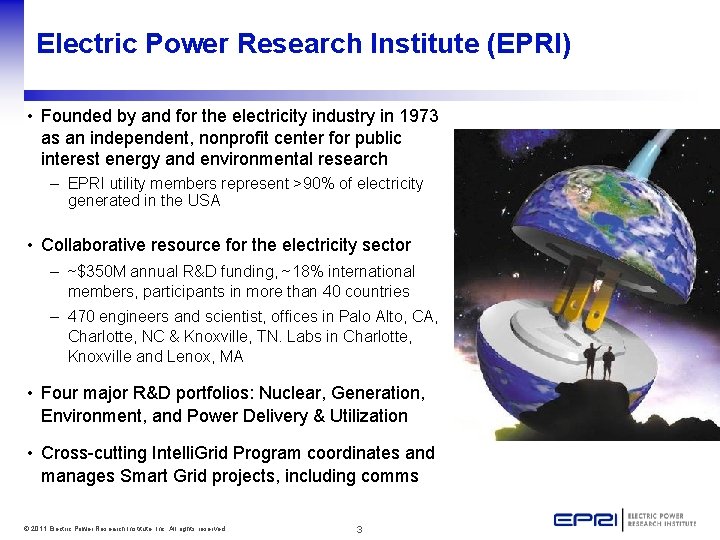
Electric Power Research Institute (EPRI) • Founded by and for the electricity industry in 1973 as an independent, nonprofit center for public interest energy and environmental research – EPRI utility members represent >90% of electricity generated in the USA • Collaborative resource for the electricity sector – ~$350 M annual R&D funding, ~18% international members, participants in more than 40 countries – 470 engineers and scientist, offices in Palo Alto, CA, Charlotte, NC & Knoxville, TN. Labs in Charlotte, Knoxville and Lenox, MA • Four major R&D portfolios: Nuclear, Generation, Environment, and Power Delivery & Utilization • Cross-cutting Intelli. Grid Program coordinates and manages Smart Grid projects, including comms © 2011 Electric Power Research Institute, Inc. All rights reserved. 3
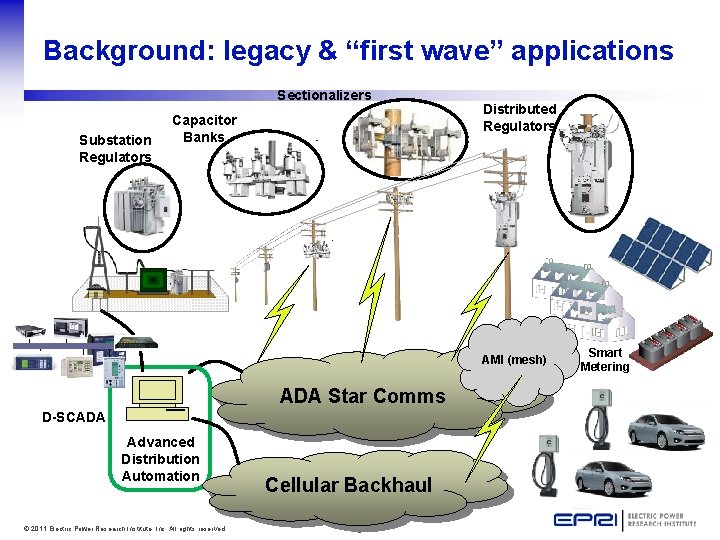
Field Area Network Overview • Field Area Network - FAN – Ubiquitous, broadband wireless resource – Meets stringent utility requirements for reliability, resilience – Designed to support all current and anticipated applications • Integration of legacy and “First Wave” Smart Grid applications. . – Distribution Management Systems – DMS (SCADA) – Advanced Metering Infrastructure, Demand Response, Distributed Energy Resources (incl. PHEV charging) • . . with “Second Wave” Smart Grid applications – Advanced Distribution Automation: Fast fault location, recovery, and automated sectionalization; Conservation Voltage Regulation; Volt/Var control; Power Quality controls; etc. – Fine grained load profiling and control of Distributed Energy Resources, including roaming DERs (EV charging) – Integrated field operations and support, mobile data, voice (Vo. IP) © 2011 Electric Power Research Institute, Inc. All rights reserved. 4
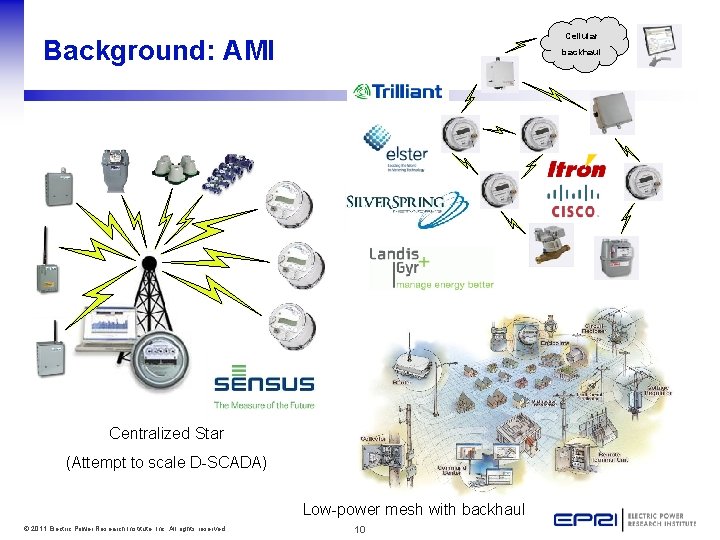
Background: legacy & “first wave” applications Sectionalizers Substation Regulators Capacitor Banks Distributed Regulators AMI (mesh) ADA Star Comms D-SCADA Advanced Distribution Automation © 2011 Electric Power Research Institute, Inc. All rights reserved. Cellular Backhaul 5 Smart Metering
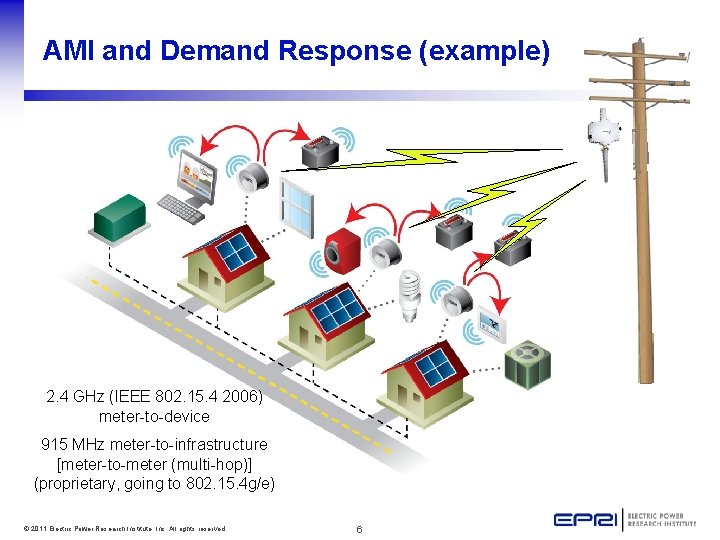
AMI and Demand Response (example) 2. 4 GHz (IEEE 802. 15. 4 2006) meter-to-device 915 MHz meter-to-infrastructure [meter-to-meter (multi-hop)] (proprietary, going to 802. 15. 4 g/e) © 2011 Electric Power Research Institute, Inc. All rights reserved. 6
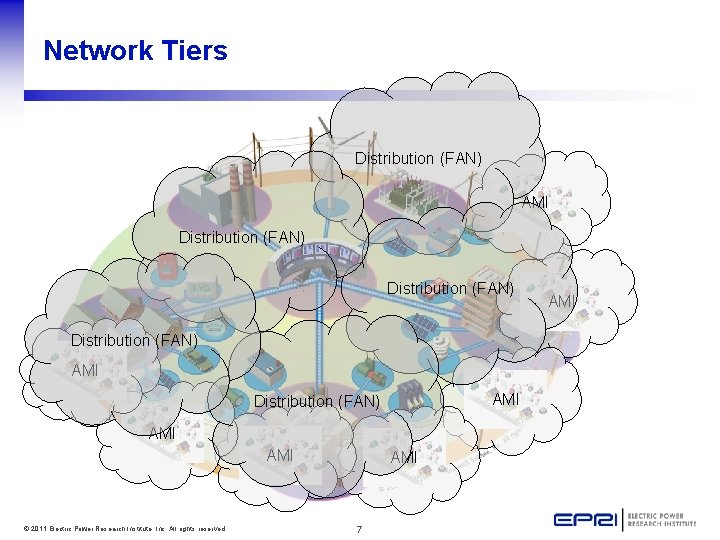
Network Tiers Distribution (FAN) AMI AMI Distribution (FAN) AMI © 2011 Electric Power Research Institute, Inc. All rights reserved. AMI 7 AMI
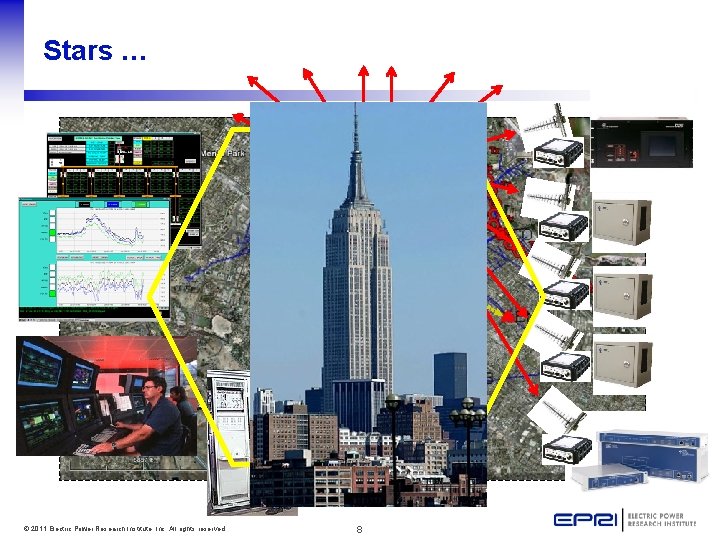
Stars … Master Radio (MAS) Modem Rack (D/A) Master SCADA Controller (Proprietary) © 2011 Electric Power Research Institute, Inc. All rights reserved. 8
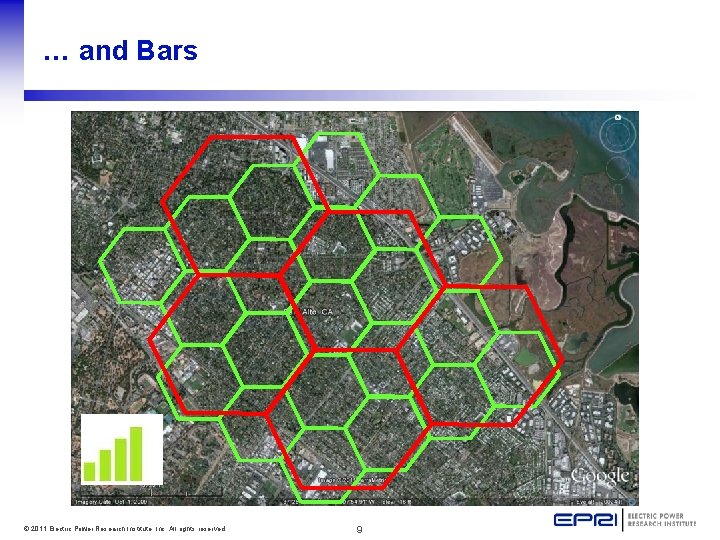
… and Bars © 2011 Electric Power Research Institute, Inc. All rights reserved. 9
Cellular Background: AMI backhaul Centralized Star (Attempt to scale D-SCADA) Low-power mesh with backhaul © 2011 Electric Power Research Institute, Inc. All rights reserved. 10
AMI, DR, and the “first wave” • Strengths – Supports communication (direct or indirect) with the customer (energy consumption, messages, “soft” or “hard” Demand Response) – Addressed what was thought (ca. 2007) to be the most pressing utility requirements: peak shaving through price signals, movein/move-out, etc. – Lowest barrier to entry (no license needed) • Challenges – Not as scalable as expected, desired (waiting for OFDM) – Limited resources (bandwidth, throughput, compute power), a challenge for security, firmware upgrade, etc. – Not obviously extensible to other applications (Distribution Automation, volume integration of DERs, etc. ) – Potentially challenged by other services deployed in the 915 MHz ISM band (modeling would help) © 2011 Electric Power Research Institute, Inc. All rights reserved. 11
Towards robust unlicensed / lightly licensed systems • Key concepts – Use multiple unlicensed bands to mitigate interference • 802. 11 n using 915 MHz, 2. 450 GHz, 5. 800 GHz (ISM) – Use frequency agility (3. 65 GHz, TV Whitepsace, …) – Benefit from & drive innovations in wireless standards (IEEE 802, Dy. SPAN) and technology (CR, SDR) • Major challenges for utilities and vendors – Standards and technology timing, availability, commitment • Example, standards: 802. 11 y? 802. 16 h? 802. 22? 802. 11 af? – Managing risk over space and time • Interference almost always increases almost everywhere! – Very large number of mesh nodes • Requires sophistiocated network and element management © 2011 Electric Power Research Institute, Inc. All rights reserved. 12
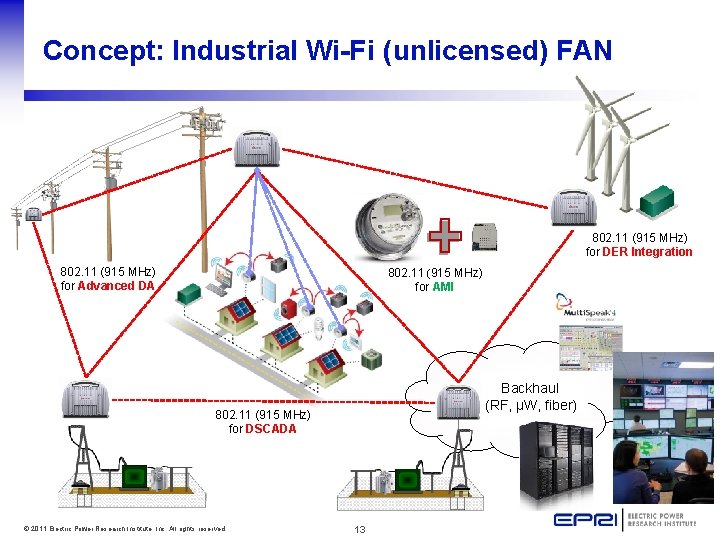
Concept: Industrial Wi-Fi (unlicensed) FAN 802. 11 (915 MHz) for DER Integration 802. 11 (915 MHz) for Advanced DA 802. 11 (915 MHz) for AMI Backhaul (RF, µW, fiber) 802. 11 (915 MHz) for DSCADA © 2011 Electric Power Research Institute, Inc. All rights reserved. 13
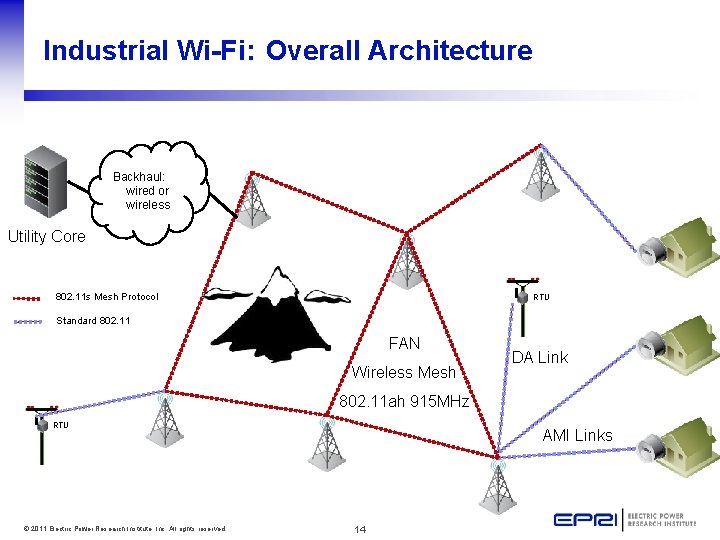
Industrial Wi-Fi: Overall Architecture Backhaul: wired or wireless Utility Core 802. 11 s Mesh Protocol RTU Standard 802. 11 FAN Wireless Mesh DA Link 802. 11 ah 915 MHz RTU © 2011 Electric Power Research Institute, Inc. All rights reserved. AMI Links 14
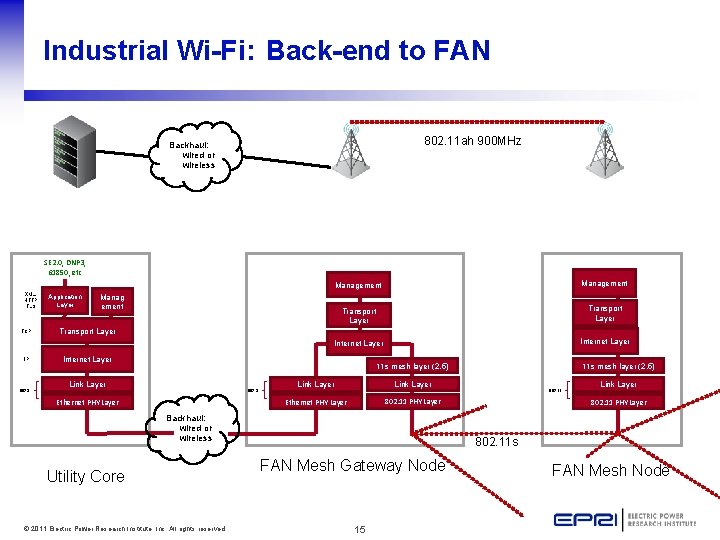
Industrial Wi-Fi: Back-end to FAN 802. 11 ah 900 MHz Backhaul: wired or wireless SE 2. 0, DNP 3, 61850, etc XML, HTTP TLS TCP IP 802. 3 Application Layer Management Transport Layer Internet Layer Manag ement Transport Layer Internet Layer 11 s mesh layer (2. 5) Link Layer 802. 3 Ethernet PHY Layer Link Layer Ethernet PHY Layer 802. 11 PHY Layer Backhaul: wired or wireless Utility Core © 2011 Electric Power Research Institute, Inc. All rights reserved. 11 s mesh layer (2. 5) 802. 11 Link Layer 802. 11 PHY Layer 802. 11 s FAN Mesh Gateway Node 15 FAN Mesh Node
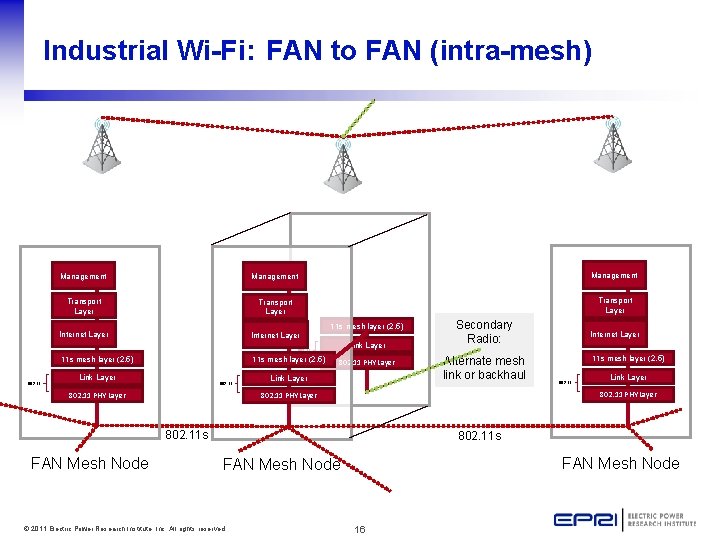
Industrial Wi-Fi: FAN to FAN (intra-mesh) Management Transport Layer Internet Layer 11 s mesh layer (2. 5) Link Layer 802. 11 PHY Layer 802. 11 PHY Layer Link Layer Alternate mesh link or backhaul Internet Layer 11 s mesh layer (2. 5) 802. 11 Link Layer 802. 11 PHY Layer 802. 11 s FAN Mesh Node Secondary Radio: 802. 11 s FAN Mesh Node © 2011 Electric Power Research Institute, Inc. All rights reserved. 16
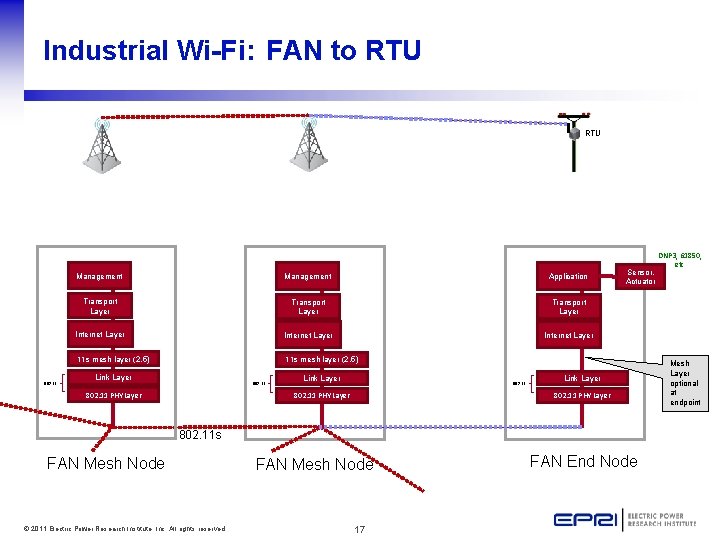
Industrial Wi-Fi: FAN to RTU 802. 11 Management Application Transport Layer Internet Layer 11 s mesh layer (2. 5) Link Layer 802. 11 PHY Layer Sensor, Actuator Link Layer 802. 11 PHY Layer 802. 11 s FAN Mesh Node © 2011 Electric Power Research Institute, Inc. All rights reserved. FAN Mesh Node 17 FAN End Node DNP 3, 61850, etc Mesh Layer optional at endpoint
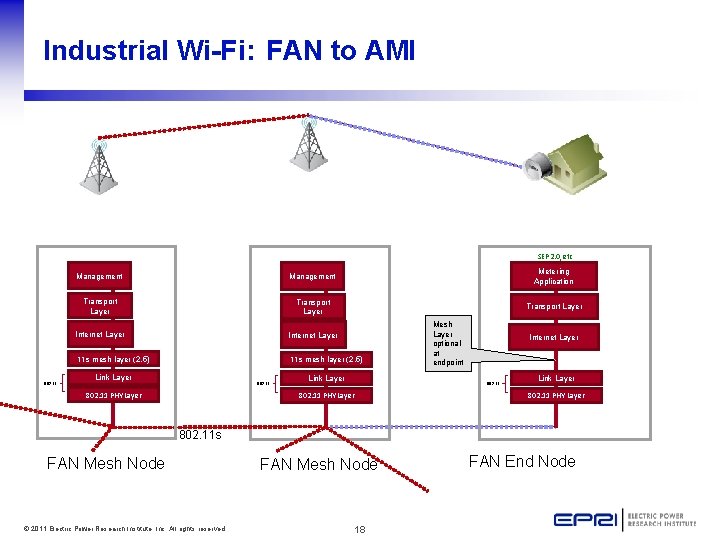
Industrial Wi-Fi: FAN to AMI SEP 2. 0, etc 802. 11 Management Metering Application Transport Layer Internet Layer 11 s mesh layer (2. 5) Link Layer 802. 11 PHY Layer Link Layer Mesh Layer optional at endpoint Internet Layer 802. 11 PHY Layer Link Layer 802. 11 PHY Layer 802. 11 s FAN Mesh Node © 2011 Electric Power Research Institute, Inc. All rights reserved. FAN Mesh Node 18 FAN End Node
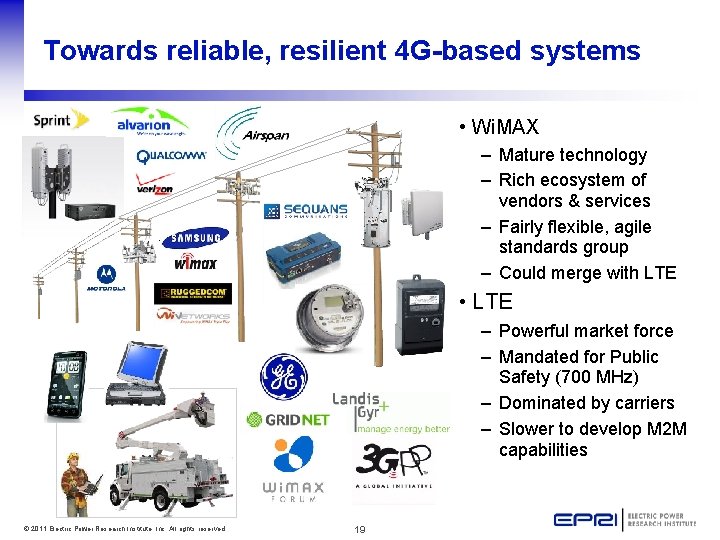
Towards reliable, resilient 4 G-based systems • Wi. MAX – Mature technology – Rich ecosystem of vendors & services – Fairly flexible, agile standards group – Could merge with LTE • LTE – Powerful market force – Mandated for Public Safety (700 MHz) – Dominated by carriers – Slower to develop M 2 M capabilities © 2011 Electric Power Research Institute, Inc. All rights reserved. 19
FAN Reliability • Redundancy – today’s approach, seems sub-optimal • Architecture – discrete elements vs. embedded reliability • Cost Implications – CAPEX but also OPEX • Public carrier vs. private utility infrastructure • Approaches to Smart Grid network reliability – SG Network Node (DAP) (‘extrinsic’ reliability) – Resilient cellular infrastructure (‘intrinsic’ reliability) • New architecture for public or private networks • EPRI Industry Technology Demonstration Project – Utility trials and evaluation of reliable FAN architectures © 2011 Electric Power Research Institute, Inc. All rights reserved. 20
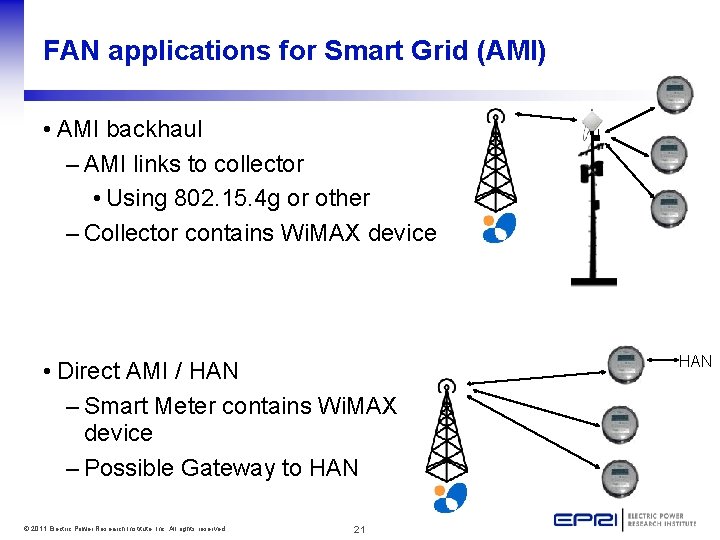
FAN applications for Smart Grid (AMI) • AMI backhaul – AMI links to collector • Using 802. 15. 4 g or other – Collector contains Wi. MAX device • Direct AMI / HAN – Smart Meter contains Wi. MAX device – Possible Gateway to HAN © 2011 Electric Power Research Institute, Inc. All rights reserved. 21 HAN
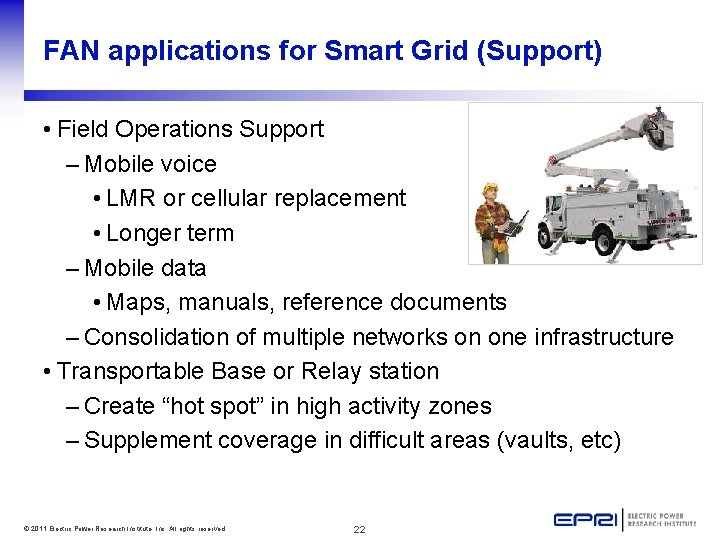
FAN applications for Smart Grid (Support) • Field Operations Support – Mobile voice • LMR or cellular replacement • Longer term – Mobile data • Maps, manuals, reference documents – Consolidation of multiple networks on one infrastructure • Transportable Base or Relay station – Create “hot spot” in high activity zones – Supplement coverage in difficult areas (vaults, etc) © 2011 Electric Power Research Institute, Inc. All rights reserved. 22
Disclaimer… “At lectures, symposia, seminars, or educational courses, an individual presenting information on IEEE standards shall make it clear that his or her views should be considered the personal views of that individual rather than the formal position, explanation, or interpretation of the IEEE. ” IEEE-SA Standards Board Operation Manual (subclause 5. 9. 3) 23 30 -Sep-20 © 2011 Electric Power Research Institute, Inc. All rights reserved. 23
GRIDMAN Purpose and Scope • GRIDMAN – “Greater Reliability in Disrupted Metropolitan Networks” – Improving metropolitan area and field area wireless network reliability and robustness by orders of magnitude • Applications / Stakeholders – Utilities: Smart Grid, Distribution Automation – Public Safety – Disaster Relief – Government applications – Critical Infrastructure © 2011 Electric Power Research Institute, Inc. All rights reserved. 24
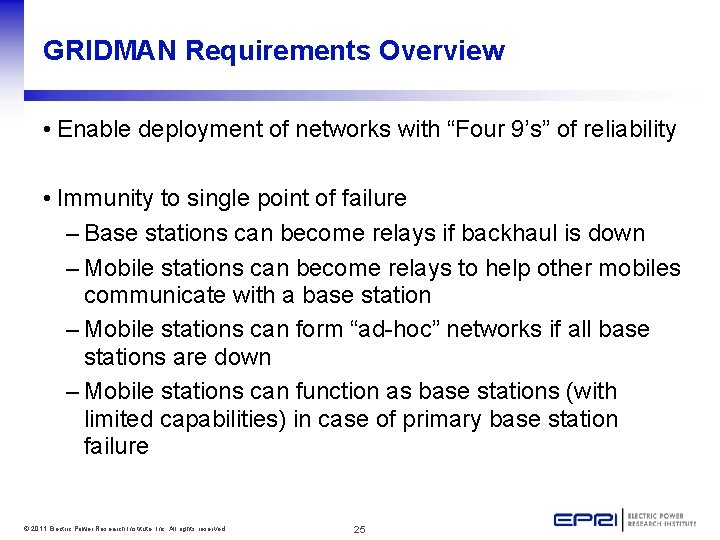
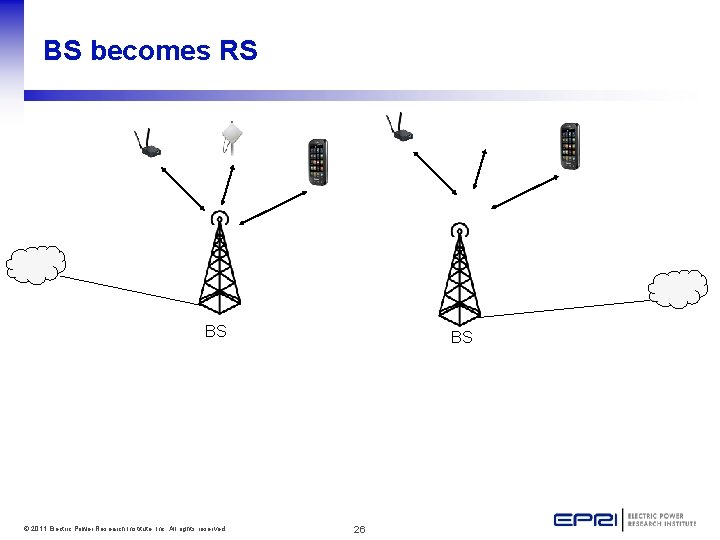
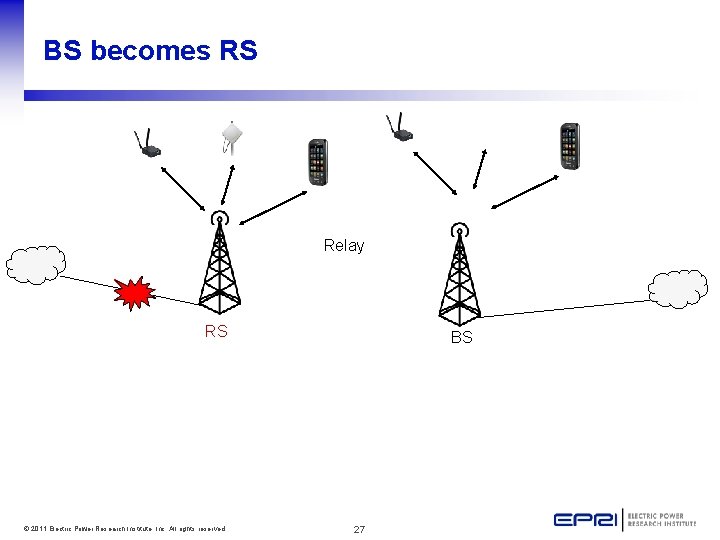
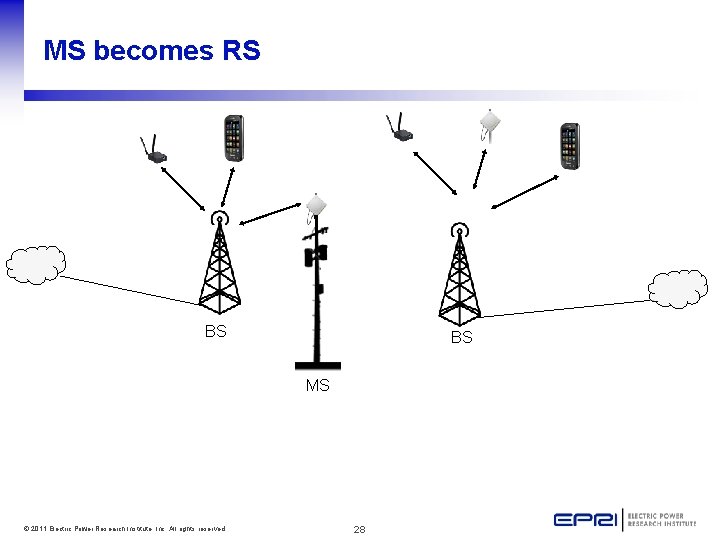
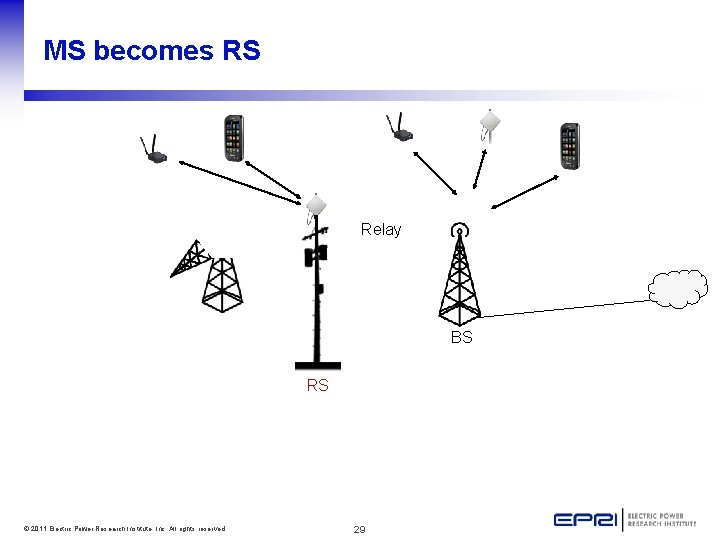
GRIDMAN Requirements Overview • Enable deployment of networks with “Four 9’s” of reliability • Immunity to single point of failure – Base stations can become relays if backhaul is down – Mobile stations can become relays to help other mobiles communicate with a base station – Mobile stations can form “ad-hoc” networks if all base stations are down – Mobile stations can function as base stations (with limited capabilities) in case of primary base station failure © 2011 Electric Power Research Institute, Inc. All rights reserved. 25
BS becomes RS BS © 2011 Electric Power Research Institute, Inc. All rights reserved. BS 26
BS becomes RS Relay RS BS © 2011 Electric Power Research Institute, Inc. All rights reserved. BS 27
MS becomes RS BS BS MS © 2011 Electric Power Research Institute, Inc. All rights reserved. 28
MS becomes RS Relay BS RS © 2011 Electric Power Research Institute, Inc. All rights reserved. 29
GRIDMAN Requirements Overview • Dynamic Network Architecture – Devices can change roles as required to deal with failure and disruption – Multiple path routing and neighbor discovery – Combination roles • For example a station can serve as a relay to other stations while also sending and receiving its own data. – Base stations and relay stations can form “chains” if needed to reach infrastructure (multi-hop) – Base stations and relay stations may become mobile © 2011 Electric Power Research Institute, Inc. All rights reserved. 30
GRIDMAN Requirements Overview • Multicast Group Support – Large group multicast support – Emergency voice calling and enhanced Vo. IP services • Flexible RF – Licensed, unlicensed, and “lightly” licensed bands – All radio frequencies where 802. 16 operates – Bandwidths of the Wireless. MAN-OFDMA or Wireless. MAN-Advanced Air Interfaces. – Single or multiple RF carriers. – Support of TDD and FDD. © 2011 Electric Power Research Institute, Inc. All rights reserved. 31
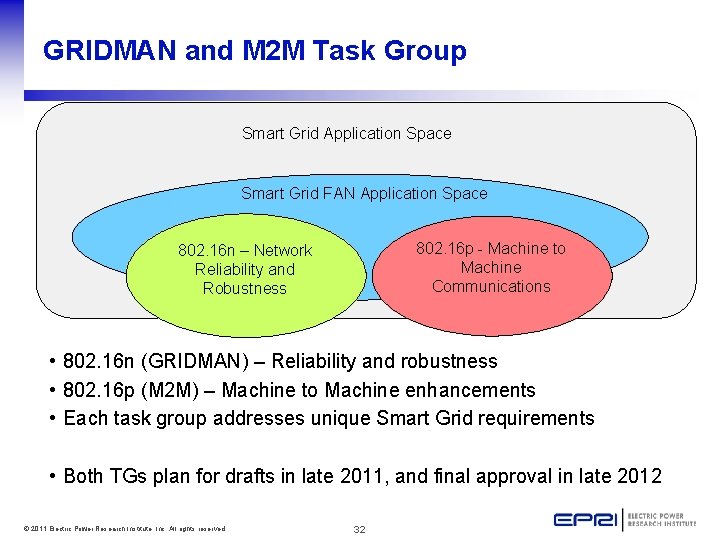
GRIDMAN and M 2 M Task Group Smart Grid Application Space Smart Grid FAN Application Space 802. 16 p - Machine to Machine Communications 802. 16 n – Network Reliability and Robustness • 802. 16 n (GRIDMAN) – Reliability and robustness • 802. 16 p (M 2 M) – Machine to Machine enhancements • Each task group addresses unique Smart Grid requirements • Both TGs plan for drafts in late 2011, and final approval in late 2012 © 2011 Electric Power Research Institute, Inc. All rights reserved. 32
Modeling cost and other practical aspects © 2011 Electric Power Research Institute, Inc. All rights reserved. 33
Context and Motivation • Utilities have limited access to licensed radio spectrum – No national coordination, niche markets for spectrum & equipment – Need is understood, some initiatives are being pursued, but the process may be long and arduous • Reliance on unlicensed spectrum is potentially risky – Experience shows congestion is inevitable, can be overwhelming – Methods for interference tolerance are specific to a standard • Not generally the intent or reality in unlicensed bands (ISM: 915 MHz, 2. 45 GHz) • Development of standards, products, certification/conformity, and the institution of cooperative behavior all takes time, effort © 2011 Electric Power Research Institute, Inc. All rights reserved. 34
Context and Motivation • EPRI’s programmatic approach – TU #1022421 launches a series of planned Technical Updates – A systematic basis for Smart Grid Communications Planning – To enable & inform custom and collaborative SG Comms projects • One under way, one in approval process, others in development • Preparing an Industry-wide Technology Demonstration Project focused on High Reliability Field Area Networks (HR-FAN) • Important distinction and notice! – Within EPRI mission and scope: research, analyze, and publish information on the technical and economic impacts of actual or potential spectrum allocations – Not within EPRI mission or scope: advocating or promoting any policy choices or recommendations regarding spectrum allocation © 2011 Electric Power Research Institute, Inc. All rights reserved. 35
Definitions and Assumptions • Field Area Network (FAN): “broadband wireless network providing essentially ubiquitous regional coverage” – Broadband: using 4 G cellular (Wi. MAX, LTE) technology to provide coverage for current and future (+10 yrs) utility applications – Essentially ubiquitous: coverage in well-defined urban/suburban and rural environments and population densities (morphologies) – Security: robust application- and medium access layer (MAC)-level encryption and device authentication; “government grade” security – Reliability: 99. 99% available (<2 hrs/yr unplanned outage) including disruptions (e. g. storms) in outdoor urban/suburban areas; may be somewhat less indoors or in rural areas – Latency: end-to-end <1 second worst case (can be up to 10 x faster) © 2011 Electric Power Research Institute, Inc. All rights reserved. 36
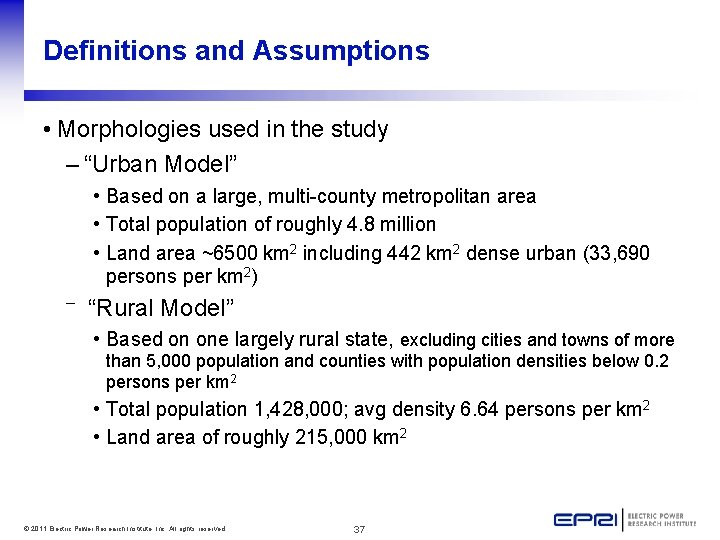
Definitions and Assumptions • Morphologies used in the study – “Urban Model” • Based on a large, multi-county metropolitan area • Total population of roughly 4. 8 million • Land area ~6500 km 2 including 442 km 2 dense urban (33, 690 persons per km 2) – “Rural Model” • Based on one largely rural state, excluding cities and towns of more than 5, 000 population and counties with population densities below 0. 2 persons per km 2 • Total population 1, 428, 000; avg density 6. 64 persons per km 2 • Land area of roughly 215, 000 km 2 © 2011 Electric Power Research Institute, Inc. All rights reserved. 37
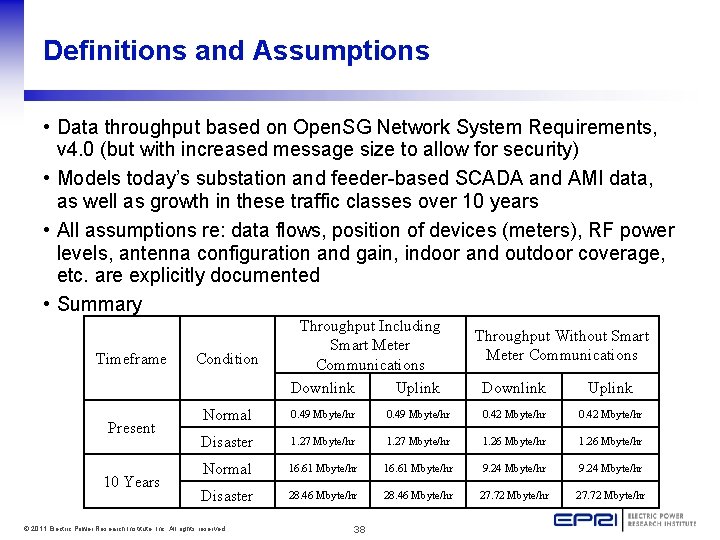
Definitions and Assumptions • Data throughput based on Open. SG Network System Requirements, v 4. 0 (but with increased message size to allow for security) • Models today’s substation and feeder-based SCADA and AMI data, as well as growth in these traffic classes over 10 years • All assumptions re: data flows, position of devices (meters), RF power levels, antenna configuration and gain, indoor and outdoor coverage, etc. are explicitly documented • Summary Timeframe Present 10 Years Condition Throughput Including Smart Meter Communications Downlink Uplink Throughput Without Smart Meter Communications Downlink Uplink Normal 0. 49 Mbyte/hr 0. 42 Mbyte/hr Disaster 1. 27 Mbyte/hr 1. 26 Mbyte/hr Normal 16. 61 Mbyte/hr 9. 24 Mbyte/hr Disaster 28. 46 Mbyte/hr 27. 72 Mbyte/hr © 2011 Electric Power Research Institute, Inc. All rights reserved. 38
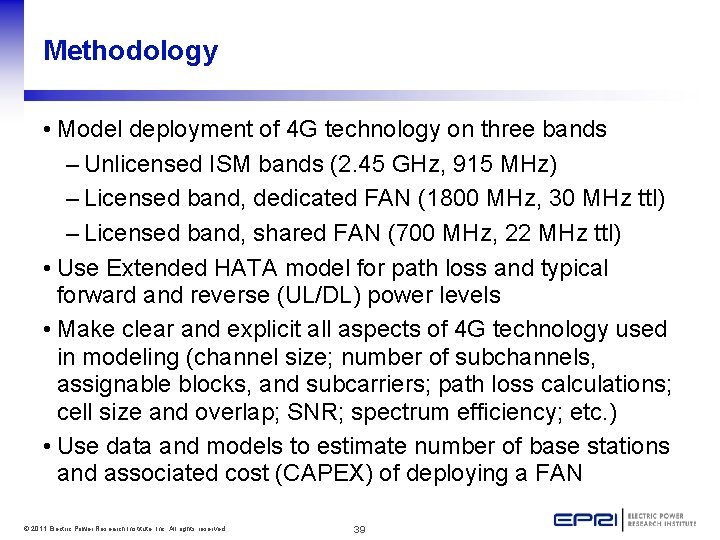
Methodology • Model deployment of 4 G technology on three bands – Unlicensed ISM bands (2. 45 GHz, 915 MHz) – Licensed band, dedicated FAN (1800 MHz, 30 MHz ttl) – Licensed band, shared FAN (700 MHz, 22 MHz ttl) • Use Extended HATA model for path loss and typical forward and reverse (UL/DL) power levels • Make clear and explicit all aspects of 4 G technology used in modeling (channel size; number of subchannels, assignable blocks, and subcarriers; path loss calculations; cell size and overlap; SNR; spectrum efficiency; etc. ) • Use data and models to estimate number of base stations and associated cost (CAPEX) of deploying a FAN © 2011 Electric Power Research Institute, Inc. All rights reserved. 39
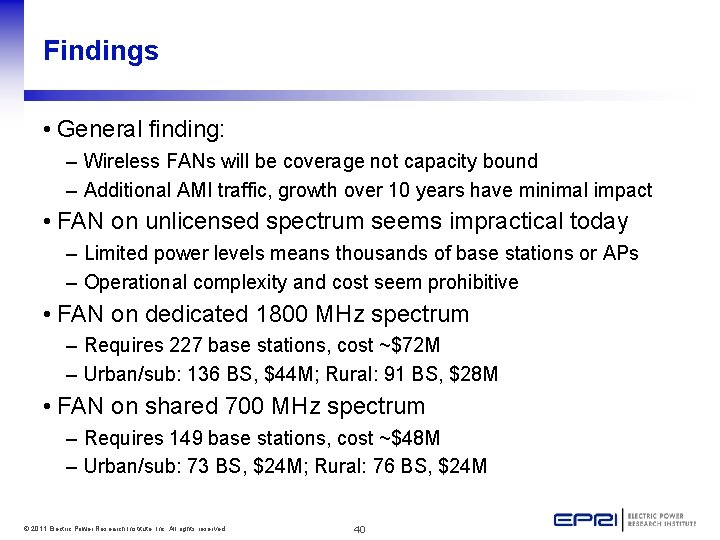
Findings • General finding: – Wireless FANs will be coverage not capacity bound – Additional AMI traffic, growth over 10 years have minimal impact • FAN on unlicensed spectrum seems impractical today – Limited power levels means thousands of base stations or APs – Operational complexity and cost seem prohibitive • FAN on dedicated 1800 MHz spectrum – Requires 227 base stations, cost ~$72 M – Urban/sub: 136 BS, $44 M; Rural: 91 BS, $28 M • FAN on shared 700 MHz spectrum – Requires 149 base stations, cost ~$48 M – Urban/sub: 73 BS, $24 M; Rural: 76 BS, $24 M © 2011 Electric Power Research Institute, Inc. All rights reserved. 40
Conclusion • Field Area Networks will provide critical infrastructure for the “second wave” of ICT-enabled utility systems • There are multiple vectors of R&D being explored – More robust unlicensed and lightly licensed radio networks – 4 G systems re-cast for reliable, scalable, critical utility infrastructure – Tiered architectures and more layered, distributed communications networks (reflecting and supporting new power system control design) • Business models will have to be developed in parallel to standards and technologies © 2011 Electric Power Research Institute, Inc. All rights reserved. 41
Q&A and discussion © 2011 Electric Power Research Institute, Inc. All rights reserved. 42
Together…Shaping the Future of Electricity © 2011 Electric Power Research Institute, Inc. All rights reserved. 43