
The Ferrymans Arms Literal the name of the
- Slides: 11
The Ferryman’s Arms
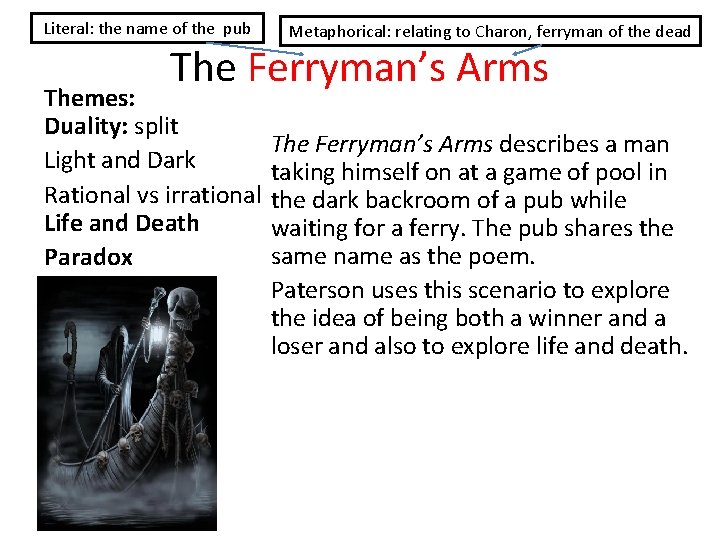
Literal: the name of the pub Metaphorical: relating to Charon, ferryman of the dead The Ferryman’s Arms Themes: Duality: split Light and Dark Rational vs irrational Life and Death Paradox The Ferryman’s Arms describes a man taking himself on at a game of pool in the dark backroom of a pub while waiting for a ferry. The pub shares the same name as the poem. Paterson uses this scenario to explore the idea of being both a winner and a loser and also to explore life and death.
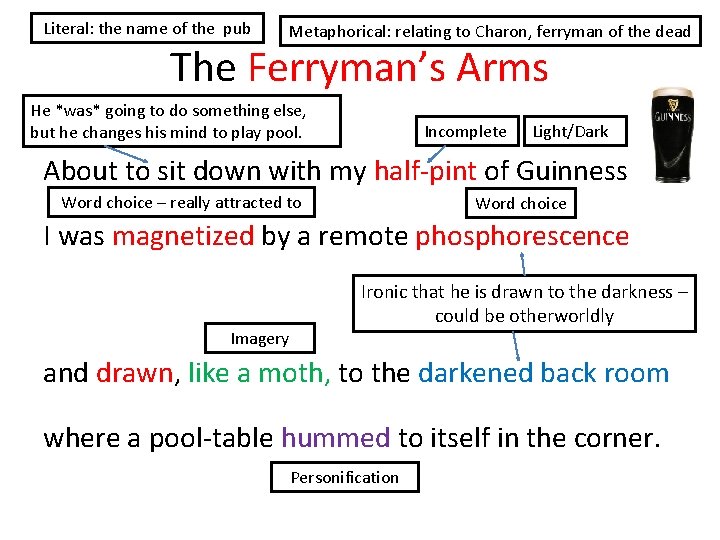
Literal: the name of the pub Metaphorical: relating to Charon, ferryman of the dead The Ferryman’s Arms He *was* going to do something else, but he changes his mind to play pool. Incomplete Light/Dark About to sit down with my half-pint of Guinness Word choice – really attracted to Word choice I was magnetized by a remote phosphorescence Imagery Ironic that he is drawn to the darkness – could be otherworldly and drawn, like a moth, to the darkened back room where a pool-table hummed to itself in the corner. Personification
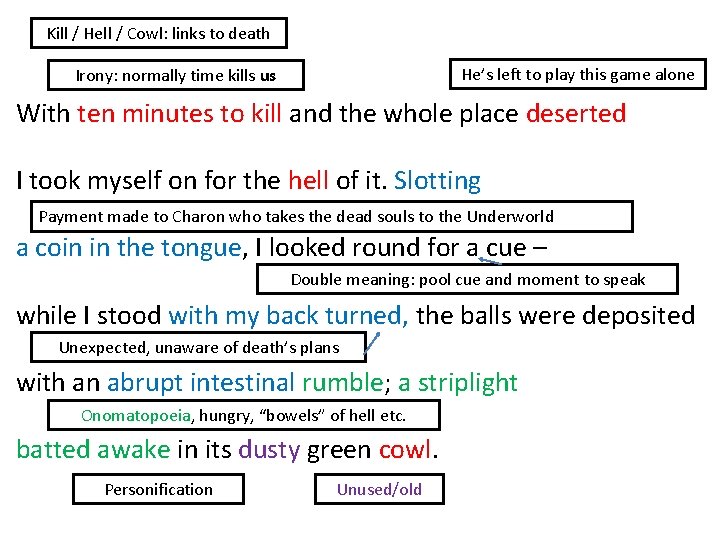
Kill / Hell / Cowl: links to death He’s left to play this game alone Irony: normally time kills us With ten minutes to kill and the whole place deserted I took myself on for the hell of it. Slotting Payment made to Charon who takes the dead souls to the Underworld a coin in the tongue, I looked round for a cue – Double meaning: pool cue and moment to speak while I stood with my back turned, the balls were deposited Unexpected, unaware of death’s plans with an abrupt intestinal rumble; a striplight Onomatopoeia, hungry, “bowels” of hell etc. batted awake in its dusty green cowl. Personification Unused/old
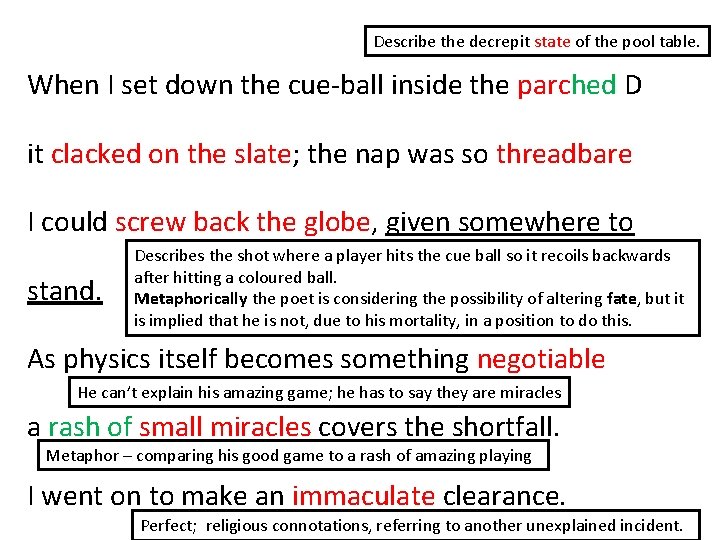
Describe the decrepit state of the pool table. When I set down the cue-ball inside the parched D it clacked on the slate; the nap was so threadbare I could screw back the globe, given somewhere to stand. Describes the shot where a player hits the cue ball so it recoils backwards after hitting a coloured ball. Metaphorically the poet is considering the possibility of altering fate, but it is implied that he is not, due to his mortality, in a position to do this. As physics itself becomes something negotiable He can’t explain his amazing game; he has to say they are miracles a rash of small miracles covers the shortfall. Metaphor – comparing his good game to a rash of amazing playing I went on to make an immaculate clearance. Perfect; religious connotations, referring to another unexplained incident.
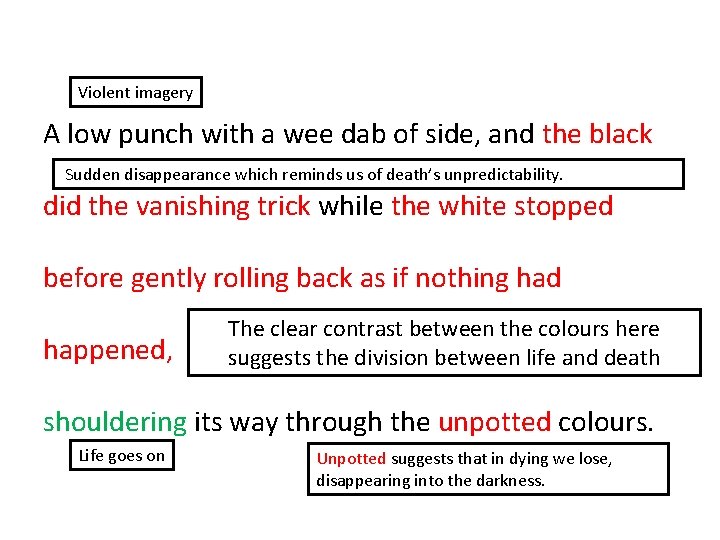
Violent imagery A low punch with a wee dab of side, and the black Sudden disappearance which reminds us of death’s unpredictability. did the vanishing trick while the white stopped before gently rolling back as if nothing had happened, The clear contrast between the colours here suggests the division between life and death shouldering its way through the unpotted colours. Life goes on Unpotted suggests that in dying we lose, disappearing into the darkness.
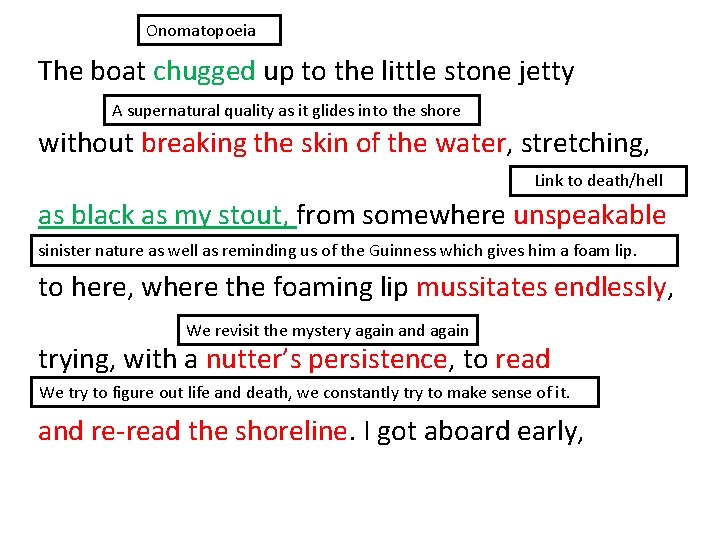
Onomatopoeia The boat chugged up to the little stone jetty A supernatural quality as it glides into the shore without breaking the skin of the water, stretching, Link to death/hell as black as my stout, from somewhere unspeakable sinister nature as well as reminding us of the Guinness which gives him a foam lip. to here, where the foaming lip mussitates endlessly, We revisit the mystery again and again trying, with a nutter’s persistence, to read We try to figure out life and death, we constantly try to make sense of it. and re-read the shoreline. I got aboard early,
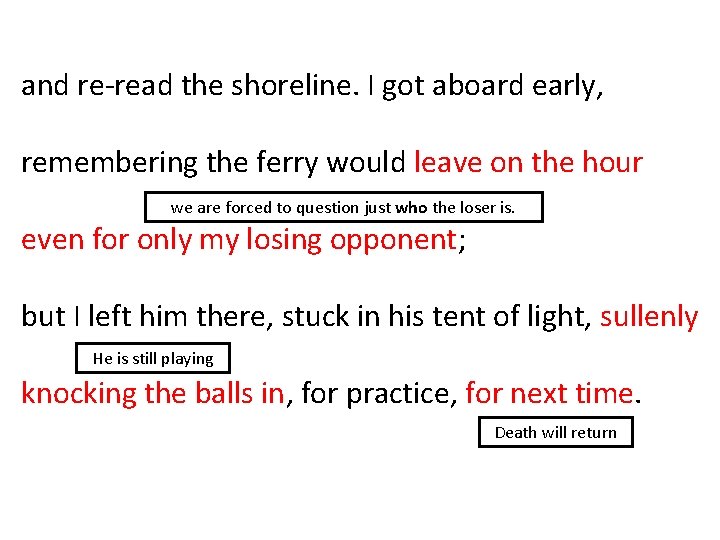
and re-read the shoreline. I got aboard early, remembering the ferry would leave on the hour we are forced to question just who the loser is. even for only my losing opponent; but I left him there, stuck in his tent of light, sullenly He is still playing knocking the balls in, for practice, for next time. Death will return
Theme: Death Paterson explores death throughout this poem. There are many images that imply death: • the worn coffin-like pool table where the potted balls go • the coin in the tongue of the slot • the striplight in its cowl • the black’s vanishing trick • the boat on the black water
Theme: Death The title itself is significant here, as it alludes to Charon and his ferry that carries the souls of the dead to the Underworld. As well as being the name of the pub, in death we are all 'in the ferryman’s arms' and there is nothing we can do to about it. The idea of the pool game appropriately portrays the haphazard nature of it. Sometimes you can predict it – the shots are set up – the ball will obviously be potted; but others it is random and unexplained – a sudden immaculate clearance that leaves us wondering what happened. The sense of fate is implied throughout, as if there is some ‘other’ that is dictating the game when our backs are turned.
Theme: Duality This is a common theme in Scottish literature and one that pervades this poem. In order to emphasise the opposites of life versus death, Paterson uses many other contrasts throughout the poem: • the half-pint of Guinness – a drink that is black with white foam at the top • the black and white pool balls • the presence and absence of the balls – the potted and unpotted • the winner and loser of the game • All these work to develop duality in the poem which reminds us of the ultimate paradox that amidst life we are in death.