
The Fermi Bubbles as a Scaledup Version of
The Fermi Bubbles as a Scaled-up Version of Supernova Remnants and Predictions in the Te. V Band YUTAKA FUJITA (OSAKA) RYO YAMAZAKI (AOYAMA) YUTAKA OHIRA (AOYAMA) Ap. JL in press (ar. Xiv: 1308. 5228)

Introduction

Fermi Bubbles • Huge gamma-ray bubbles discovered with Fermi Satellite Su et al. (2010) • Apparent size is ~50° • If they are at the Galactic center (GC), the size is ~10 kpc
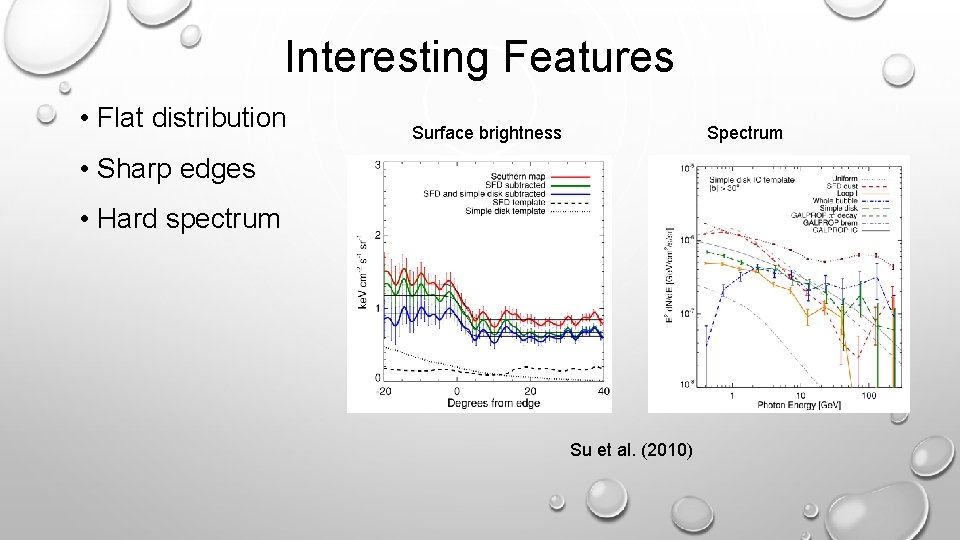
Interesting Features • Flat distribution Surface brightness Spectrum • Sharp edges • Hard spectrum Su et al. (2010)
Interesting Features • Flat distribution • Cosmic-rays (CRs) are distributed neither uniformly nor at the shells • Sharp edges • CRs do not much diffuse out of the bubbles • Hard spectrum (∝E -2) • Short electron cooling time (tcool, e ~106 yr) compared with the age of the bubbles (tage ~107 yr) • Ongoing acceleration? hadronic? • Standard diffusion (higher energy CRs escape faster) • Even if the spectrum is hard when CRs are accelerated, it becomes softer as time goes by
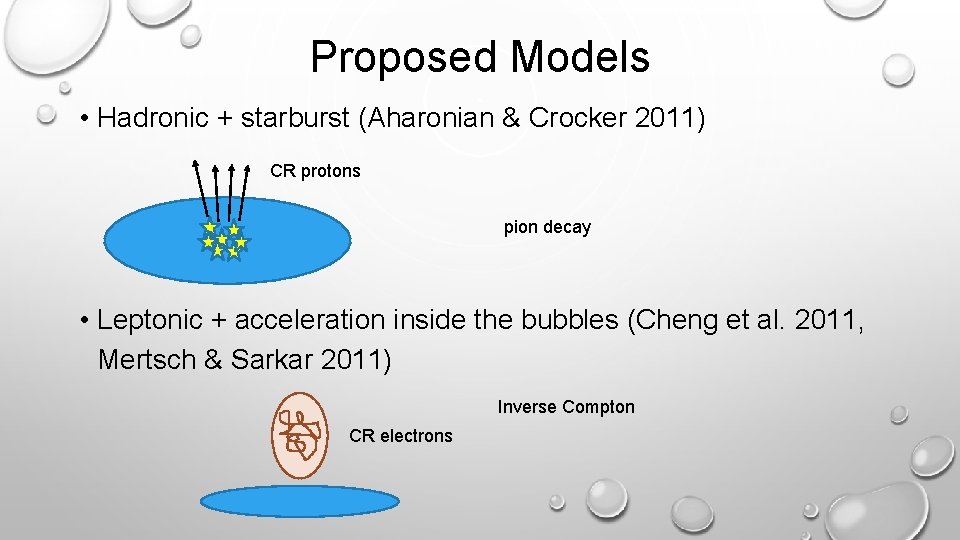
Proposed Models • Hadronic + starburst (Aharonian & Crocker 2011) CR protons pion decay • Leptonic + acceleration inside the bubbles (Cheng et al. 2011, Mertsch & Sarkar 2011) Inverse Compton CR electrons
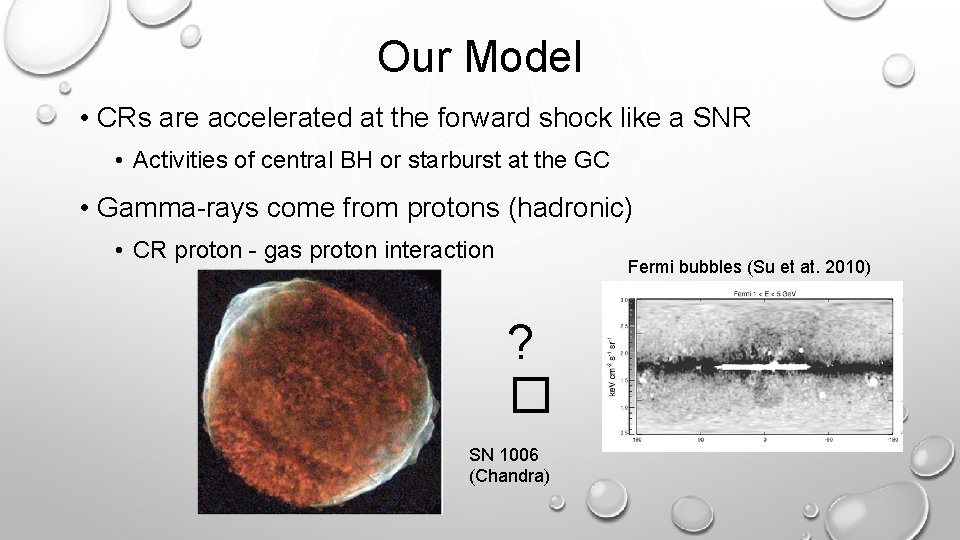
Our Model • CRs are accelerated at the forward shock like a SNR • Activities of central BH or starburst at the GC • Gamma-rays come from protons (hadronic) • CR proton - gas proton interaction Fermi bubbles (Su et at. 2010) ? � SN 1006 (Chandra)

Models
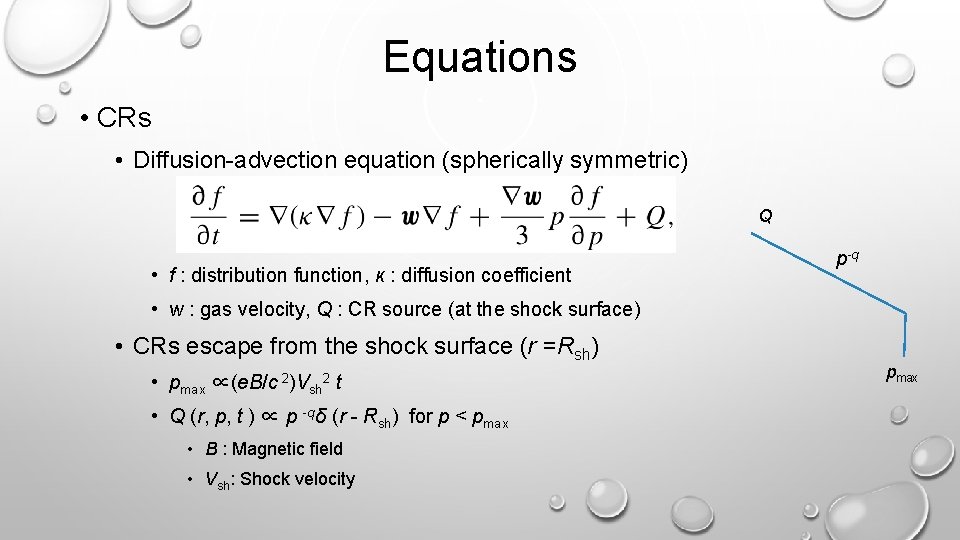
Equations • CRs • Diffusion-advection equation (spherically symmetric) Q • f : distribution function, κ : diffusion coefficient p-q • w : gas velocity, Q : CR source (at the shock surface) • CRs escape from the shock surface (r =Rsh) • pmax ∝(e. B/c 2)Vsh 2 t • Q (r, p, t ) ∝ p -qδ (r - Rsh) for p < pmax • B : Magnetic field • Vsh: Shock velocity pmax
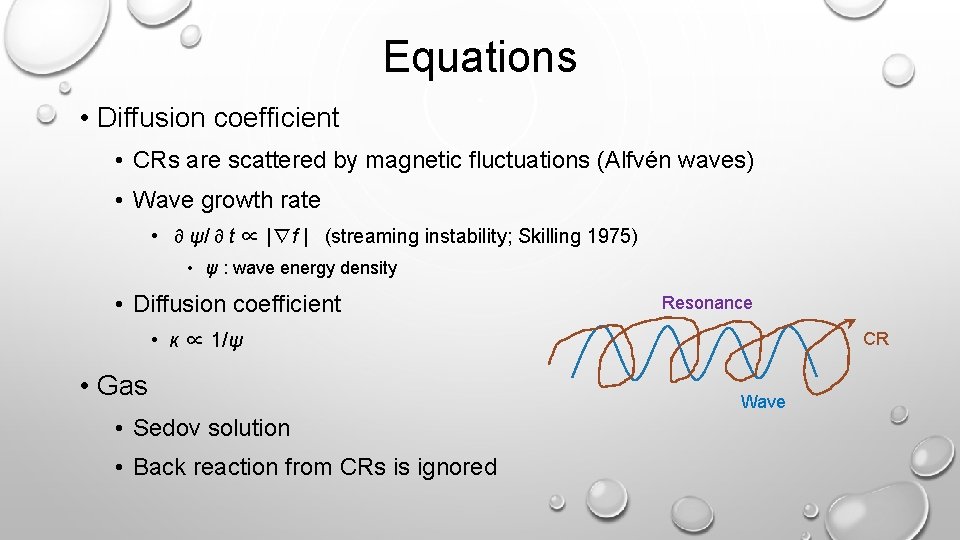
Equations • Diffusion coefficient • CRs are scattered by magnetic fluctuations (Alfvén waves) • Wave growth rate • ∂ψ/∂t ∝ |∇f | (streaming instability; Skilling 1975) • ψ : wave energy density • Diffusion coefficient Resonance • κ ∝ 1/ψ • Gas • Sedov solution • Back reaction from CRs is ignored CR Wave
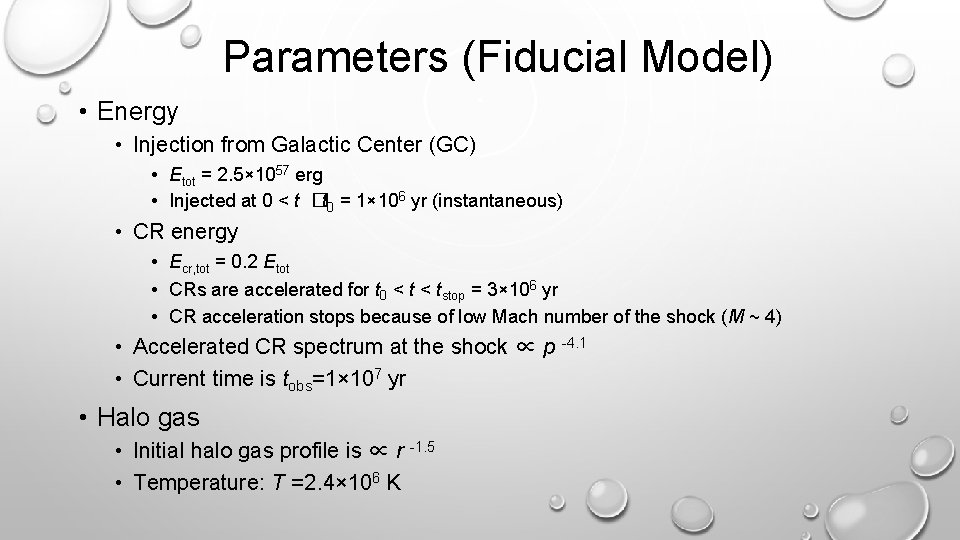
Parameters (Fiducial Model) • Energy • Injection from Galactic Center (GC) • Etot = 2. 5× 1057 erg • Injected at 0 < t �t 0 = 1× 10⁶ yr (instantaneous) • CR energy • Ecr, tot = 0. 2 Etot • CRs are accelerated for t 0 < tstop = 3× 10⁶ yr • CR acceleration stops because of low Mach number of the shock (M ~ 4) • Accelerated CR spectrum at the shock ∝ p -4. 1 • Current time is tobs=1× 10⁷ yr • Halo gas • Initial halo gas profile is ∝ r -1. 5 • Temperature: T =2. 4× 10⁶ K

Results
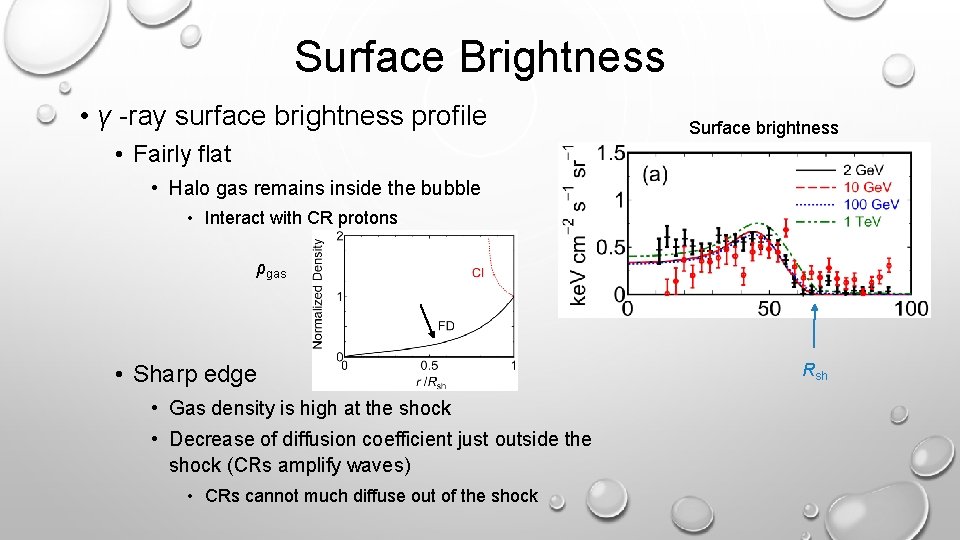
Surface Brightness • γ -ray surface brightness profile Surface brightness • Fairly flat • Halo gas remains inside the bubble • Interact with CR protons ρgas • Sharp edge • Gas density is high at the shock • Decrease of diffusion coefficient just outside the shock (CRs amplify waves) • CRs cannot much diffuse out of the shock Rsh
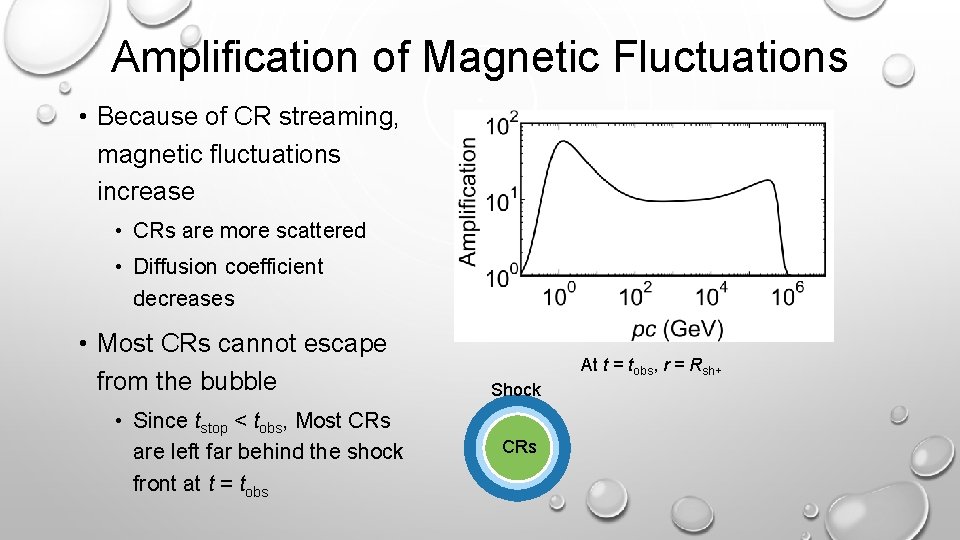
Amplification of Magnetic Fluctuations • Because of CR streaming, magnetic fluctuations increase • CRs are more scattered • Diffusion coefficient decreases • Most CRs cannot escape from the bubble • Since tstop < tobs, Most CRs are left far behind the shock front at t = tobs At t = tobs, r = Rsh+ Shock CRs
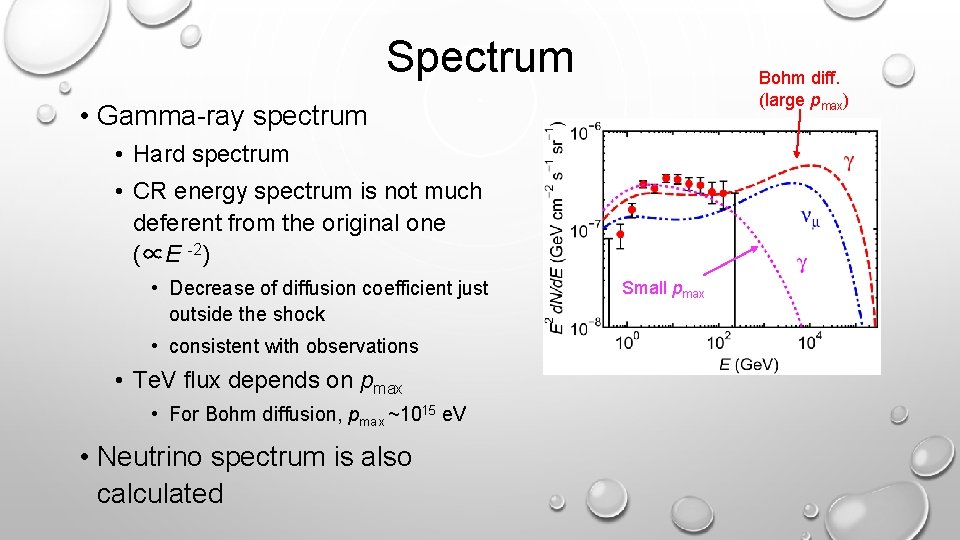
Spectrum Bohm diff. (large pmax) • Gamma-ray spectrum • Hard spectrum • CR energy spectrum is not much deferent from the original one (∝E -2) • Decrease of diffusion coefficient just outside the shock • consistent with observations • Te. V flux depends on pmax • For Bohm diffusion, pmax ~1015 e. V • Neutrino spectrum is also calculated Small pmax
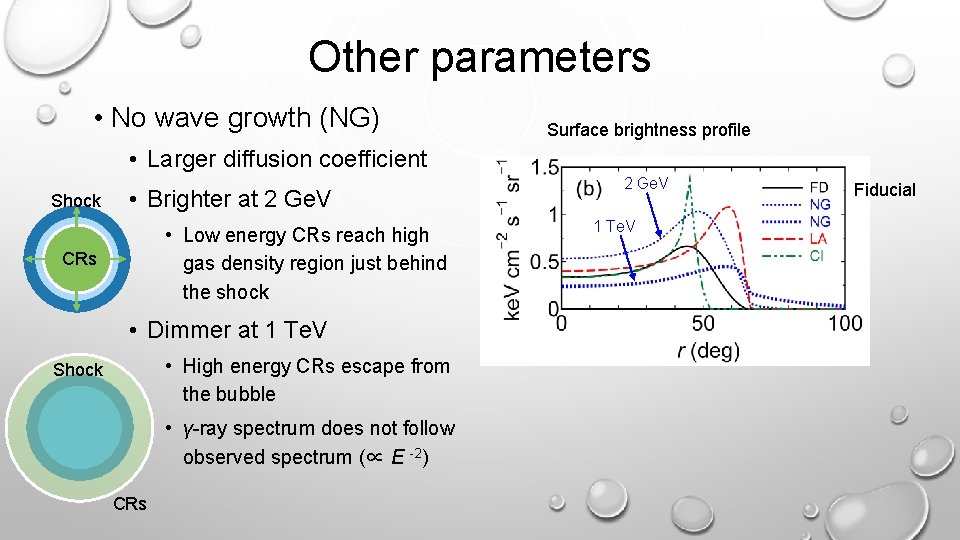
Other parameters • No wave growth (NG) Surface brightness profile • Larger diffusion coefficient Shock • Brighter at 2 Ge. V • Low energy CRs reach high gas density region just behind the shock CRs • Dimmer at 1 Te. V • High energy CRs escape from the bubble Shock • γ-ray spectrum does not follow observed spectrum (∝ E -2) CRs 2 Ge. V 1 Te. V Fiducial
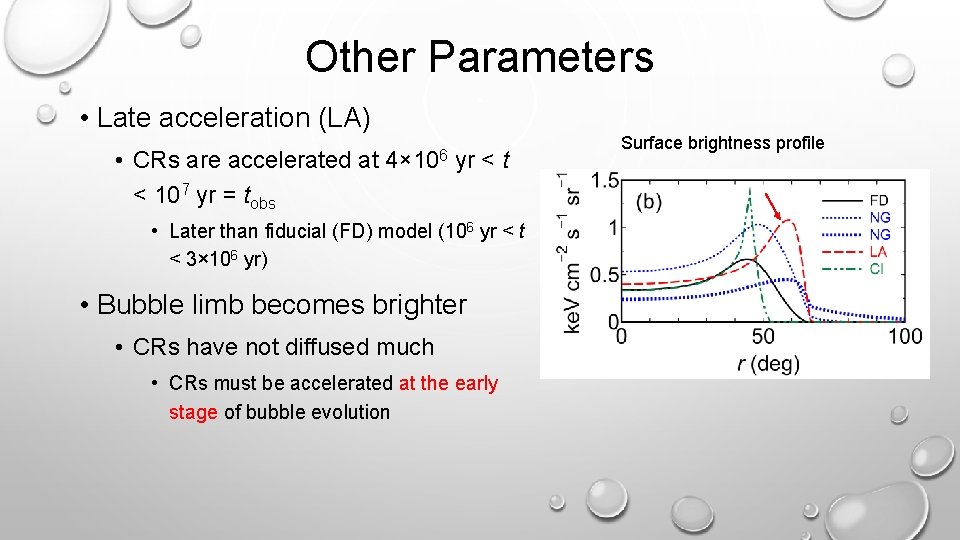
Other Parameters • Late acceleration (LA) • CRs are accelerated at < 107 yr = tobs 4× 10⁶ yr < t • Later than fiducial (FD) model (106 yr < t < 3× 10⁶ yr) • Bubble limb becomes brighter • CRs have not diffused much • CRs must be accelerated at the early stage of bubble evolution Surface brightness profile
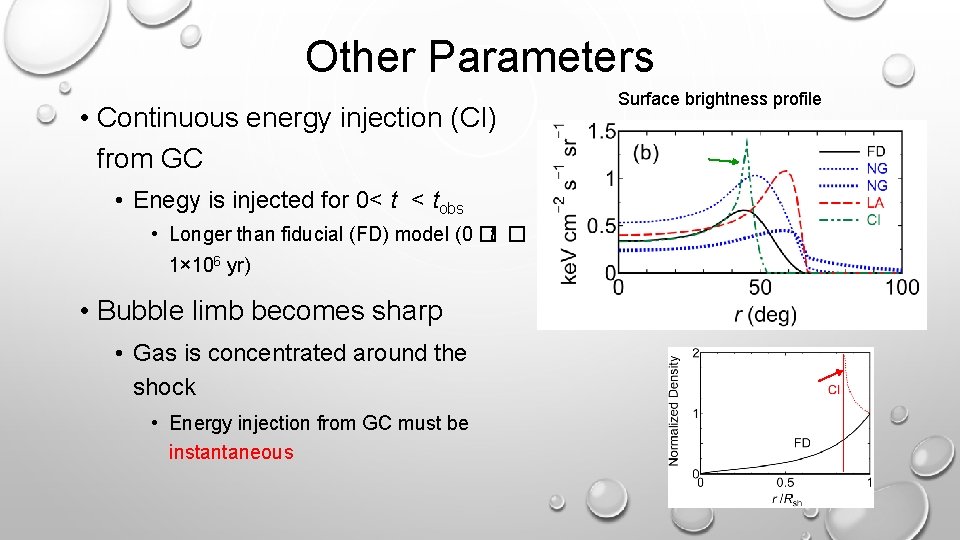
Other Parameters • Continuous energy injection (CI) from GC • Enegy is injected for 0< t < tobs • Longer than fiducial (FD) model (0 �t � 1× 10⁶ yr) • Bubble limb becomes sharp • Gas is concentrated around the shock • Energy injection from GC must be instantaneous Surface brightness profile
Summary • We treated the Fermi bubbles as a scaled-up version of a supernova remnant • CRs are accelerated at the forward shock of the bubble • We solved a diffusion-advection equation • We considered the amplification of Alfvén waves • Comparison with observations • Wave growth is required • CRs are accelerated at the early stage of bubble evolution • Energy injection from GC must be instantatious
- Slides: 19