
The Female Reproductive System Blood Supply of Endometrium

The Female Reproductive System • Blood Supply of Endometrium – Arcuate arteries • Encircle endometrium – Radial arteries • Supply straight arteries (to basilar zone) • Supply spiral arteries (to functional zone)
The Female Reproductive System • Cyclical Changes in Endometrium – Basilar zone remains relatively constant – Functional zone undergoes cyclical changes • In response to sex hormone levels • Produce characteristic features of uterine cycle
The Female Reproductive System • The Uterine Cycle (or menstrual cycle) – Is a repeating series of changes in endometrium – Lasts from 21 to 35 days • Average 28 days
The Female Reproductive System • Uterine Cycle – Responds to hormones of ovarian cycle – Menses and proliferative phase • Occur during ovarian follicular phase – Secretory phase • Occurs during ovarian luteal phase
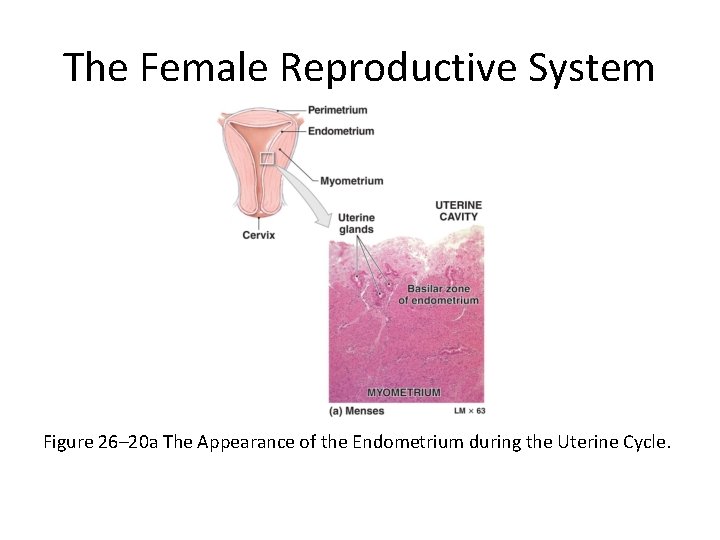
The Female Reproductive System • Menses – Is the degeneration of functional zone • Occurs in patches – Is caused by constriction of spiral arteries • Reducing blood flow, oxygen, and nutrients – Weakened arterial walls rupture • Releasing blood into connective tissues of functional zone
The Female Reproductive System • Menses – Degenerating tissues break away, enter uterine lumen – Entire functional zone is lost • Through external os and vagina – Only functional zone is affected • Deeper, basilar zone is supplied by straight arteries
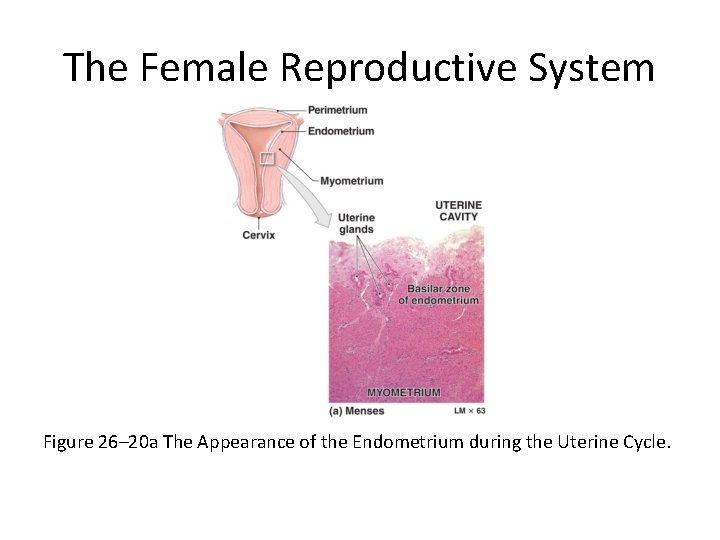
The Female Reproductive System Figure 26– 20 a The Appearance of the Endometrium during the Uterine Cycle.
The Female Reproductive System • Menstruation – Is the process of endometrial sloughing – Lasts 1– 7 days – Sheds 35– 50 m. L (1. 2 -1. 7 oz) blood
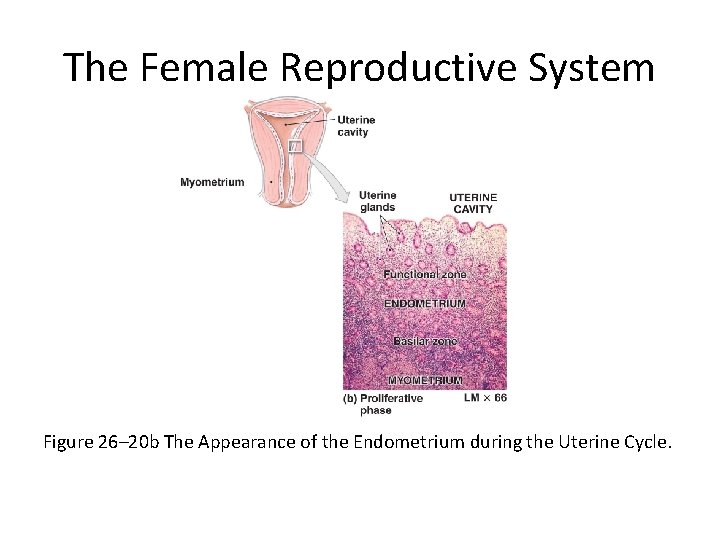
The Female Reproductive System • The Proliferative Phase – Epithelial cells of uterine glands • Multiply and spread across endometrial surface • Restore integrity of uterine epithelium – Further growth and vascularization • Completely restores functional zone – Occurs at same time as • Enlargement of primary and secondary follicles in ovary
The Female Reproductive System • The Proliferative Phase – Is stimulated and sustained by • Estrogens secreted by developing ovarian follicles – Entire functional zone is highly vascularized – Small arteries • Spiral toward inner surface • From larger arteries in myometrium
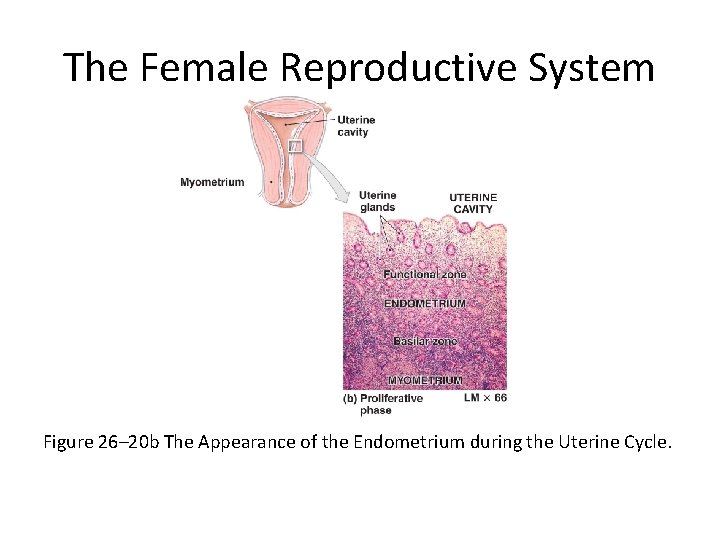
The Female Reproductive System Figure 26– 20 b The Appearance of the Endometrium during the Uterine Cycle.
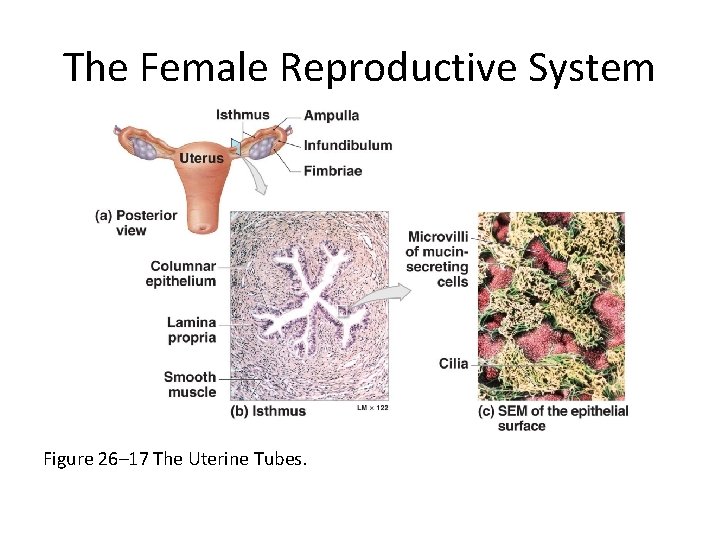
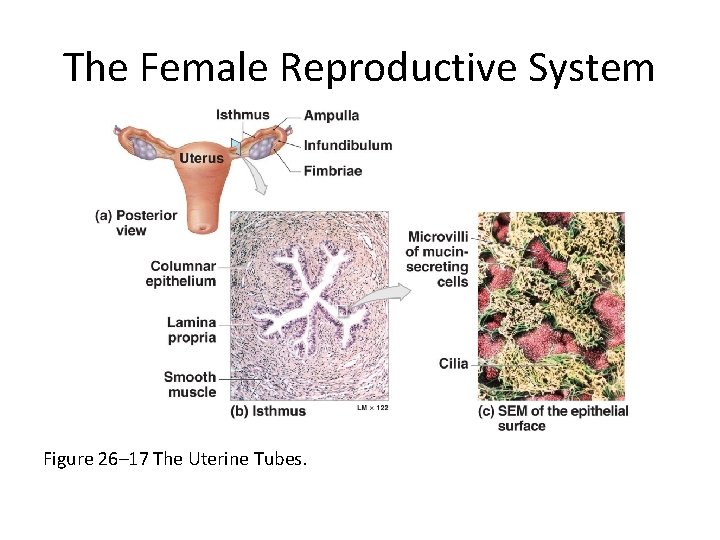
The Female Reproductive System Figure 26– 17 The Uterine Tubes.
The Female Reproductive System • Uterine Tube and Oocyte Transport – Involves ciliary movement and peristaltic contractions in walls of uterine tube – A few hours before ovulation, nerves from hypogastric plexus • “Turn on” beating pattern • Initiate peristalsis – From infundibulum to uterine cavity • Normally takes 3– 4 days
The Female Reproductive System • Uterine Tube and Fertilization – For fertilization to occur • Secondary oocyte must meet spermatozoa during first 12– 24 hours – Fertilization typically occurs • Near boundary between ampulla and isthmus
The Female Reproductive System • Uterine Tube and Nutrients – Uterine tube provides nutrient-rich environment • Containing lipids and glycogen – Nutrients supply spermatozoa and developing preembryo
The Female Reproductive System • The Uterus – Provides for developing embryo (weeks 1– 8) and fetus (week 9 through delivery): 1. Mechanical protection 2. Nutritional support 3. Waste removal
The Female Reproductive System • The Uterus – Is pear-shaped • 7. 5 cm long, 5 cm diameter (3 in. x 2 in. ) • Weighs 30– 40 g (1 -1. 4 oz) – Normally bends anteriorly near base (anteflexion) • In retroflexion, uterus bends backward
The Female Reproductive System • Uterine Tube and Fertilization – For fertilization to occur • Secondary oocyte must meet spermatozoa during first 12– 24 hours – Fertilization typically occurs • Near boundary between ampulla and isthmus
The Female Reproductive System • Uterine Tube and Nutrients – Uterine tube provides nutrient-rich environment • Containing lipids and glycogen – Nutrients supply spermatozoa and developing preembryo
The Female Reproductive System • The Uterus – Provides for developing embryo (weeks 1– 8) and fetus (week 9 through delivery): 1. Mechanical protection 2. Nutritional support 3. Waste removal
The Female Reproductive System • The Uterus – Is pear-shaped • 7. 5 cm long, 5 cm diameter (3 in. x 2 in. ) • Weighs 30– 40 g (1 -1. 4 oz) – Normally bends anteriorly near base (anteflexion) • In retroflexion, uterus bends backward
The Female Reproductive System • Three Suspensory Ligaments of Uterus – Uterosacral ligaments • Prevent inferior–anterior movement – Round ligaments • Restrict posterior movement – Cardinal (lateral) ligaments • Prevent inferior movement
The Female Reproductive System • Uterine Body (or corpus) – Is largest portion of uterus – Ends at isthmus • Fundus – Is rounded portion of uterine body • Superior to attachment of uterine tubes
The Female Reproductive System • Cervix – – Is inferior portion of uterus Extends from isthmus to vagina Distal end projects about 1. 25 cm (0. 5 in. ) into vagina External os • Also called external orifice of uterus • Is surrounded by distal end of cervix • Leads into cervical canal
The Female Reproductive System • Cervical Canal – Is a constricted passageway opening to uterine cavity of body • At internal os (internal orifice)
The Female Reproductive System • Blood Supply of the Uterus – Branches of uterine arteries • Arising from branches of internal iliac arteries – Ovarian arteries • Arising from abdominal aorta – Veins and lymphatic vessels
The Female Reproductive System • Nerves of the Uterus – Autonomic fibers from hypogastric plexus (sympathetic) – Sacral segments S 3 and S 4 (parasympathetic) – Segmental blocks • Anesthetic procedure used during labor • Target spinal nerves T 10–L 1
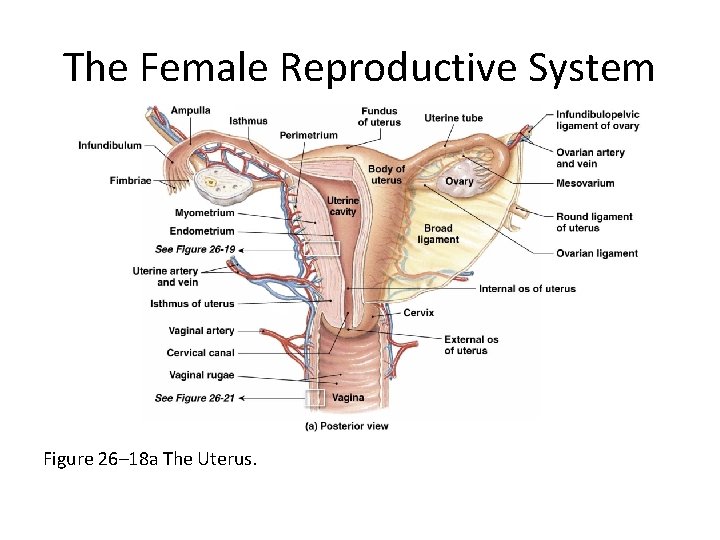
The Female Reproductive System Figure 26– 18 a The Uterus.
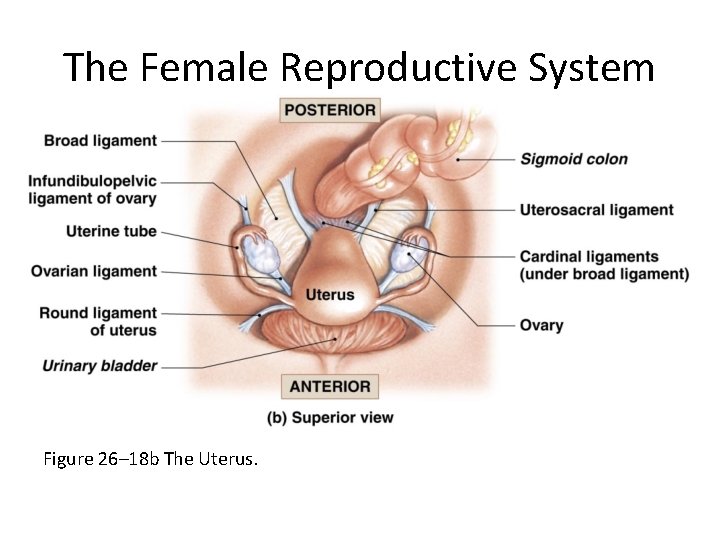
The Female Reproductive System Figure 26– 18 b The Uterus.
The Female Reproductive System • The Uterine Wall – Has a thick, outer, muscular myometrium – Has a thin, inner, glandular endometrium (mucosa)
The Female Reproductive System • The Perimetrium – Is an incomplete serous membrane • Continuous with peritoneal lining – Covers • Fundus • Posterior surface of uterine body and isthmus
The Female Reproductive System • The Endometrium – Contributes about 10% of uterine mass – Glandular and vascular tissues support physiological demands of growing fetus – Uterine glands • Open onto endometrial surface • Extend deep into lamina propria
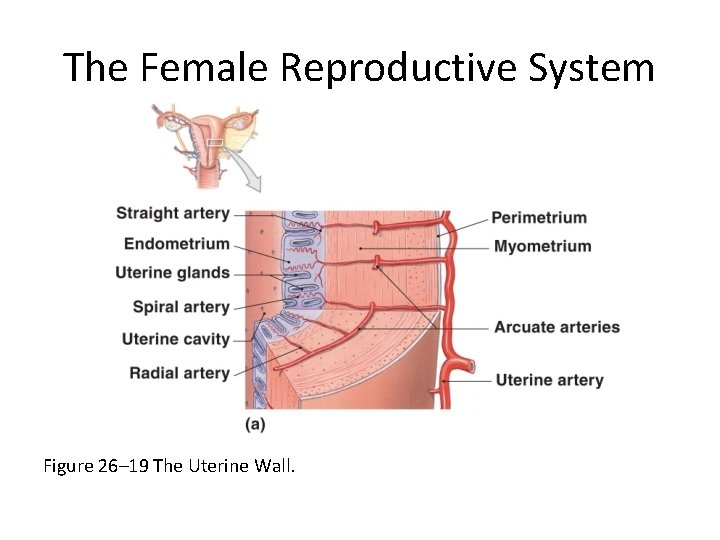
The Female Reproductive System Figure 26– 19 The Uterine Wall.
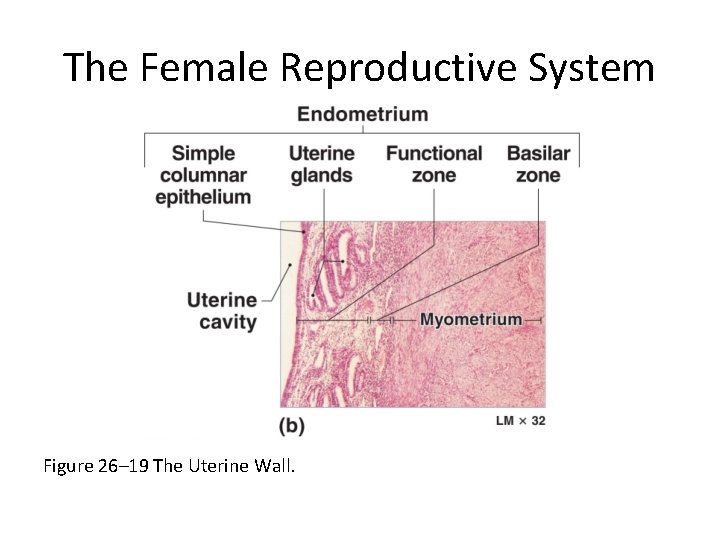
The Female Reproductive System Figure 26– 19 The Uterine Wall.
The Female Reproductive System • Estrogen – Causes uterine glands, blood vessels, and epithelium to change with phases of monthly uterine cycle
The Female Reproductive System • The Myometrium – The thickest portion of the uterine wall – Constitutes almost 90% of the mass of the uterus – Arranged into longitudinal, circular, and oblique layers – Provides force to move fetus out of uterus into vagina
The Female Reproductive System • Two Divisions of Endometrium – Functional zone • Layer closest to uterine cavity – Basilar zone • Adjacent to myometrium
The Female Reproductive System • The Functional Zone – Contains most of the uterine glands – Contributes most of endometrial thickness – Undergoes dramatic changes in thickness and structure during menstrual cycle
The Female Reproductive System • The Basilar Zone – Attaches endometrium to myometrium – Contains terminal branches of tubular endometrial glands
The Female Reproductive System • Blood Supply of Endometrium – Arcuate arteries • Encircle endometrium – Radial arteries • Supply straight arteries (to basilar zone) • Supply spiral arteries (to functional zone)
The Female Reproductive System • Cyclical Changes in Endometrium – Basilar zone remains relatively constant – Functional zone undergoes cyclical changes • In response to sex hormone levels • Produce characteristic features of uterine cycle
The Female Reproductive System • The Uterine Cycle (or menstrual cycle) – Is a repeating series of changes in endometrium – Lasts from 21 to 35 days • Average 28 days
The Female Reproductive System • Uterine Cycle – Responds to hormones of ovarian cycle – Menses and proliferative phase • Occur during ovarian follicular phase – Secretory phase • Occurs during ovarian luteal phase
The Female Reproductive System • Menses – Is the degeneration of functional zone • Occurs in patches – Is caused by constriction of spiral arteries • Reducing blood flow, oxygen, and nutrients – Weakened arterial walls rupture • Releasing blood into connective tissues of functional zone
The Female Reproductive System • Menses – Degenerating tissues break away, enter uterine lumen – Entire functional zone is lost • Through external os and vagina – Only functional zone is affected • Deeper, basilar zone is supplied by straight arteries
The Female Reproductive System Figure 26– 20 a The Appearance of the Endometrium during the Uterine Cycle.
The Female Reproductive System Figure 26– 20 b The Appearance of the Endometrium during the Uterine Cycle.
The Female Reproductive System Figure 26– 17 The Uterine Tubes.
The Female Reproductive System • Uterine Tube and Oocyte Transport – Involves ciliary movement and peristaltic contractions in walls of uterine tube – A few hours before ovulation, nerves from hypogastric plexus • “Turn on” beating pattern • Initiate peristalsis – From infundibulum to uterine cavity • Normally takes 3– 4 days
The Female Reproductive System • Uterine Tube and Fertilization – For fertilization to occur • Secondary oocyte must meet spermatozoa during first 12– 24 hours – Fertilization typically occurs • Near boundary between ampulla and isthmus
The Female Reproductive System • The Uterus – Is pear-shaped • 7. 5 cm long, 5 cm diameter (3 in. x 2 in. ) • Weighs 30– 40 g (1 -1. 4 oz) – Normally bends anteriorly near base (anteflexion) • In retroflexion, uterus bends backward
The Female Reproductive System • Three Suspensory Ligaments of Uterus – Uterosacral ligaments • Prevent inferior–anterior movement – Round ligaments • Restrict posterior movement – Cardinal (lateral) ligaments • Prevent inferior movement
The Female Reproductive System • Uterine Body (or corpus) – Is largest portion of uterus – Ends at isthmus • Fundus – Is rounded portion of uterine body • Superior to attachment of uterine tubes
The Female Reproductive System • Cervix – – Is inferior portion of uterus Extends from isthmus to vagina Distal end projects about 1. 25 cm (0. 5 in. ) into vagina External os • Also called external orifice of uterus • Is surrounded by distal end of cervix • Leads into cervical canal
The Female Reproductive System • Cervical Canal – Is a constricted passageway opening to uterine cavity of body • At internal os (internal orifice)
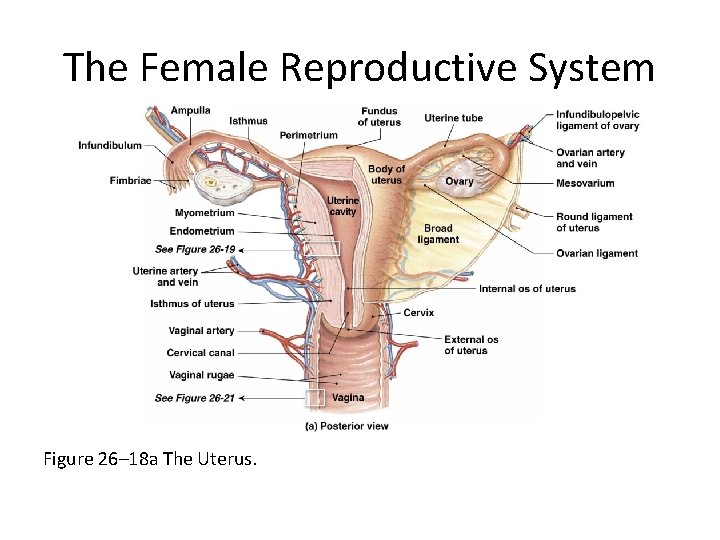
The Female Reproductive System Figure 26– 18 a The Uterus.
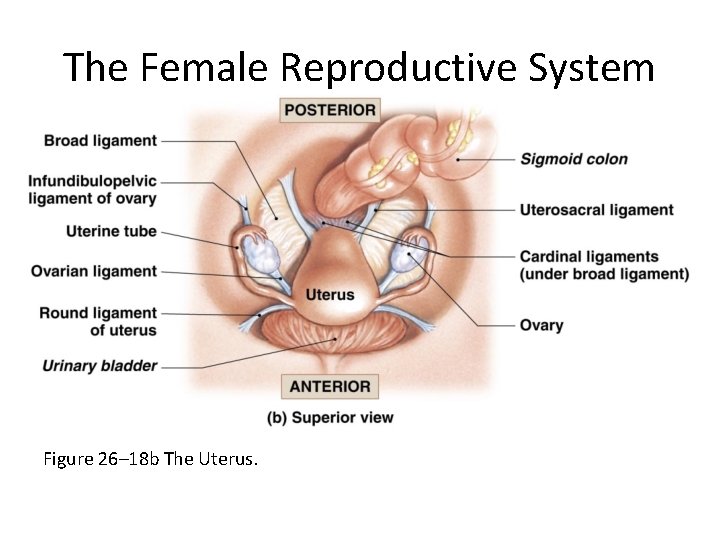
The Female Reproductive System Figure 26– 18 b The Uterus.
The Female Reproductive System • The Uterine Wall – Has a thick, outer, muscular myometrium – Has a thin, inner, glandular endometrium (mucosa)
The Female Reproductive System • Two Divisions of Endometrium – Functional zone • Layer closest to uterine cavity – Basilar zone • Adjacent to myometrium
- Slides: 60