
The Federal Technology Transfer Process Licenses and Cooperative
- Slides: 25
The Federal Technology Transfer Process: Licenses and Cooperative Research and Development Agreements ADVANCED LICENSING INSTITUTE AT FRANKLIN PIERCE LAW SCHOOL January 7, 2009 Jacob (Jesse) N. Erlich, Esq. Partner
Sources of Technology • Government • Universities • Industry
Major Reasons for Decline • There has been a decline in the technology lead possessed by the United States because: • Decrease in funding of research and development departments of U. S. corporations • Substantial increase in patent applications filed by foreign inventors in U. S. Patent and Trademark Office • 1960’s: Approximately 17% • 1995 -Present: Approximately 50%
U. S. Federal Laboratory Systems • Employs over 200, 000 engineers and scientists • Utilizes newest and most sophisticated technical equipment • Funding in excess of 40 billion dollars
U. S. Federal Laboratory Systems (cont’d) • Licenses • Authority to enter licenses • • 35 USC 207 37 CFR 404 15 USC 3710 a (b) (1) Agency implementing instructions • Cooperative research and development agreements • Authority to enter CRDAs • Public law no. 99 -502 (Federal Technology Transfer Act) • 15 USC 3710 a • Agency Implementing Instructions
Types of Federally Owned Technology/ Protection Afforded Government • Inventions (including software) • Patents (35 USC 207) • Proprietary information (including software) • Invention disclosure patent application (35 USC 205) • Written material (including software) • Work of U. S. government not protectable by copyright (17 USC 105) • Possible exception under FOIA (5 USC 552 exemption 5 b)
Overview of Government Licensing
What Is A License? • A contract between licensor and licensee • Licensor grants to licensee the right to practice the technology claimed in the licensed patent • Licensor agrees not to sue licensee for infringing licensor’s patent
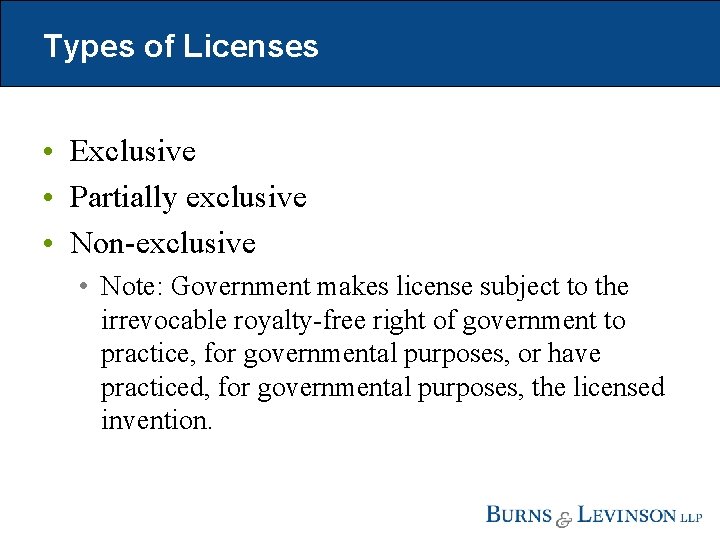
Types of Licenses • Exclusive • Partially exclusive • Non-exclusive • Note: Government makes license subject to the irrevocable royalty-free right of government to practice, for governmental purposes, or have practiced, for governmental purposes, the licensed invention.
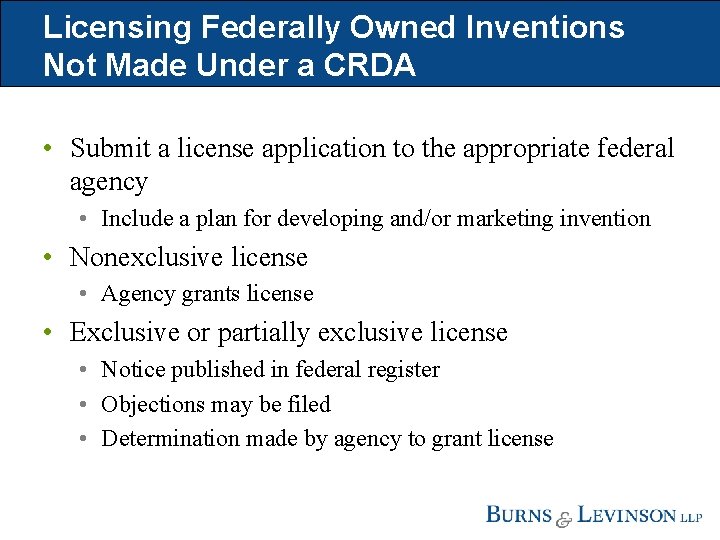
Licensing Federally Owned Inventions Not Made Under a CRDA • Submit a license application to the appropriate federal agency • Include a plan for developing and/or marketing invention • Nonexclusive license • Agency grants license • Exclusive or partially exclusive license • Notice published in federal register • Objections may be filed • Determination made by agency to grant license
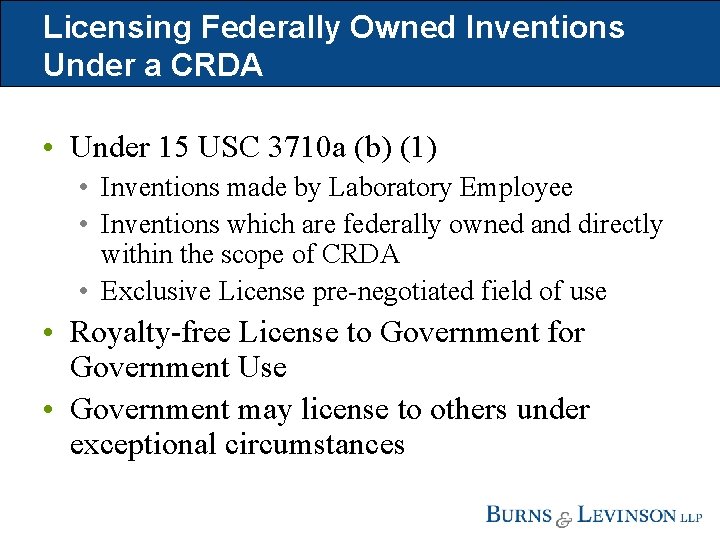
Licensing Federally Owned Inventions Under a CRDA • Under 15 USC 3710 a (b) (1) • Inventions made by Laboratory Employee • Inventions which are federally owned and directly within the scope of CRDA • Exclusive License pre-negotiated field of use • Royalty-free License to Government for Government Use • Government may license to others under exceptional circumstances
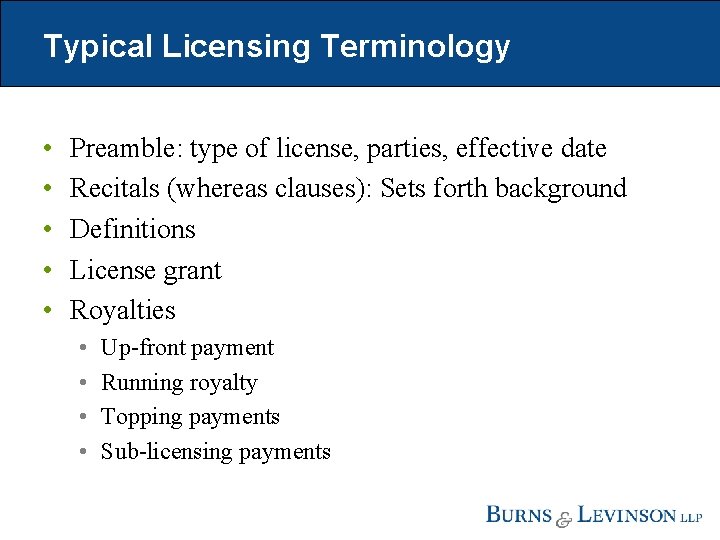
Typical Licensing Terminology • • • Preamble: type of license, parties, effective date Recitals (whereas clauses): Sets forth background Definitions License grant Royalties • • Up-front payment Running royalty Topping payments Sub-licensing payments
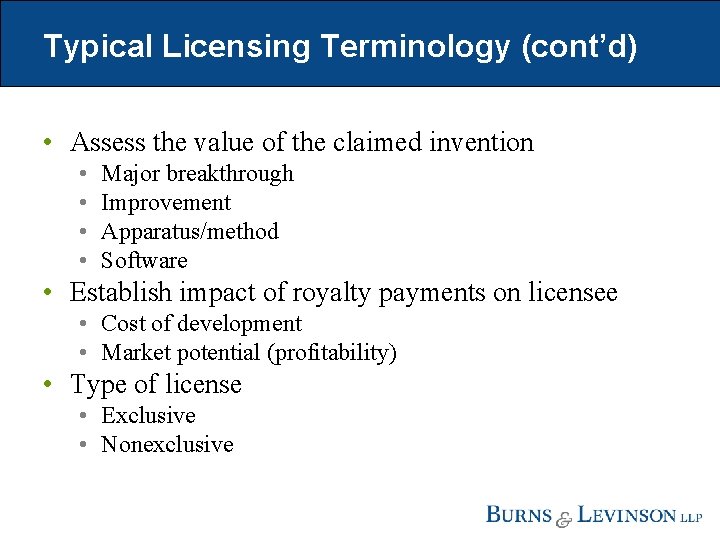
Typical Licensing Terminology (cont’d) • Assess the value of the claimed invention • • Major breakthrough Improvement Apparatus/method Software • Establish impact of royalty payments on licensee • Cost of development • Market potential (profitability) • Type of license • Exclusive • Nonexclusive
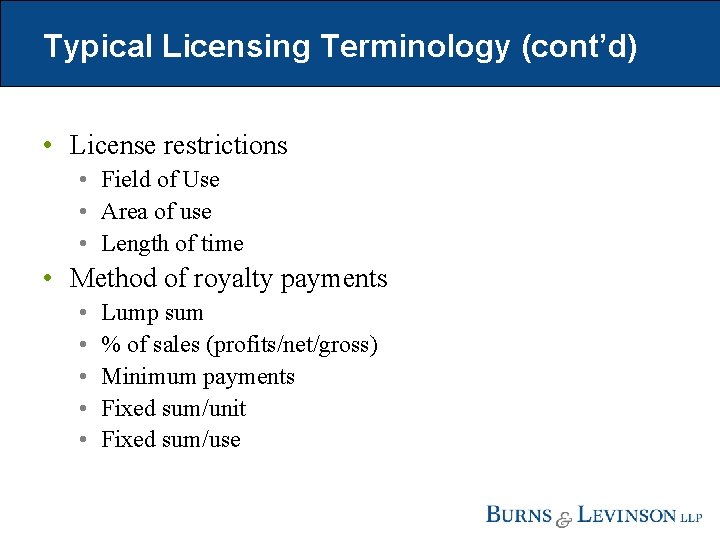
Typical Licensing Terminology (cont’d) • License restrictions • Field of Use • Area of use • Length of time • Method of royalty payments • • • Lump sum % of sales (profits/net/gross) Minimum payments Fixed sum/unit Fixed sum/use
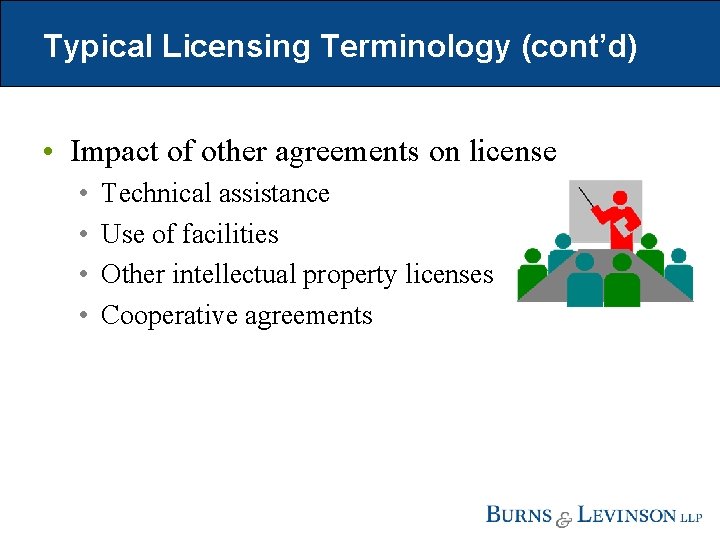
Typical Licensing Terminology (cont’d) • Impact of other agreements on license • • Technical assistance Use of facilities Other intellectual property licenses Cooperative agreements
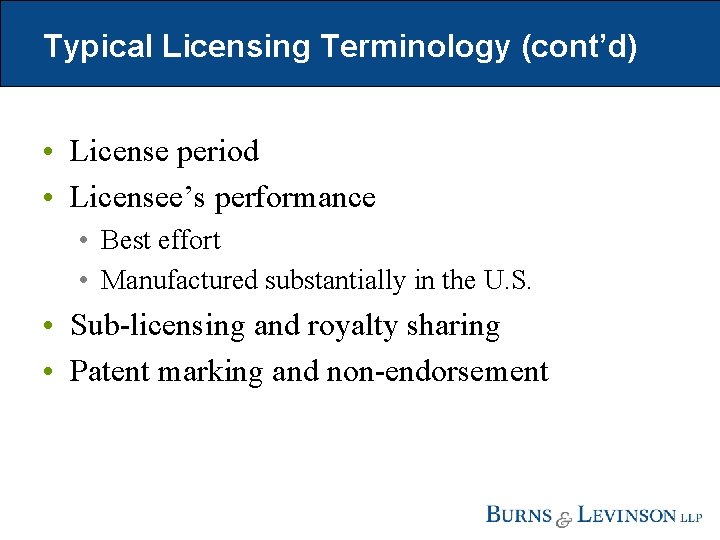
Typical Licensing Terminology (cont’d) • License period • Licensee’s performance • Best effort • Manufactured substantially in the U. S. • Sub-licensing and royalty sharing • Patent marking and non-endorsement
Typical Licensing Terminology (cont’d) • Reservation of rights • Subject to other licenses in force at time of agreement • Subject to irrevocable, royalty-free right of government to practice for governmental purpose or have practiced on behalf of the government the licensed invention • Representations and warranties • Licensor does not warrant validity of patent licensed • Licensor does not warrant that licensed patent will not infringe other patents • Progress reports
Typical Licensing Terminology (cont’d) • Infringement/Litigation • Licensee may be granted power to enforce • Sharing of royalties • Maintenance fees • Technical assistance • Under CRDA • Export controls
Overview of Cooperative Research and Development Agreements
Federal Technology Transfer Act of 1986 • Cooperative R&D Agreements • The Government has the right to: • Accept funds, personnel, services, and property from collaborating parties • Supply any of these, except funds, to collaborating parties • Grant (or agree to grant in advance) patent licenses, assignments or options for inventions of lab employees, retaining the right for the Government to use the invention for government purposes • Waive right of ownership, except for normally receiving royalty free license for Government use, with respect to inventions made by collaborators
Federal Technology Transfer Act of 1986 (cont’d) • The director of laboratory may be permitted to: • 1. Enter into cooperative R&D agreements • 2. Negotiate licensing agreements • Cooperative R&D agreements may be made with: • • • Other federal agencies Units of state and local government Industrial organizations Public and private foundations Non-profits (including universities) Other reasons
Federal Technology Transfer Act of 1986 (cont’d) • The laboratory director shall: • 1. Give special consideration to small businesses and consortia of small businesses • 2. Give preference to business units located in the U. S. and agree to manufacture in the U. S.
Typical CRDA Terminology • • • Definitions Obligations of parties Reports Term Financial obligation Protection and ownership of intellectual property • Patents • Copyrights • Proprietary information and trade secrets
Typical CRDA Terminology (cont’d) • Licensing options • Liability/no warranties • Government not responsible for property used • Government does not warranty • Research • Infringement of existing patents
Accessing Federal Technology • Major Data Bases • Federal Laboratory Consortium (FLC) • Telephone: 856. 667. 7727 • National Technology Transfer Center (NTTC) • Telephone: 800. 678. NTTC • Regional Technology Transfer Center for Massachusetts Center for Technology Commercialization • Telephone: 508. 870. 0042