
The Federal System National and State Powers US

- Slides: 29
The Federal System National and State Powers
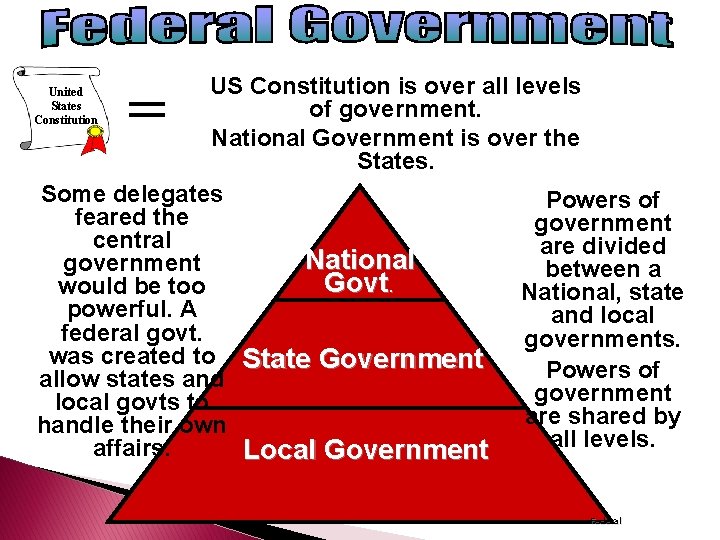
= US Constitution is over all levels of government. National Government is over the States. Some delegates Powers of feared the government central are divided National government between a Govt. would be too National, state powerful. A and local federal govt. governments. was created to State Government Powers of allow states and government local govts to are shared by handle their own all levels. affairs. Local Government United States Constitution Federal
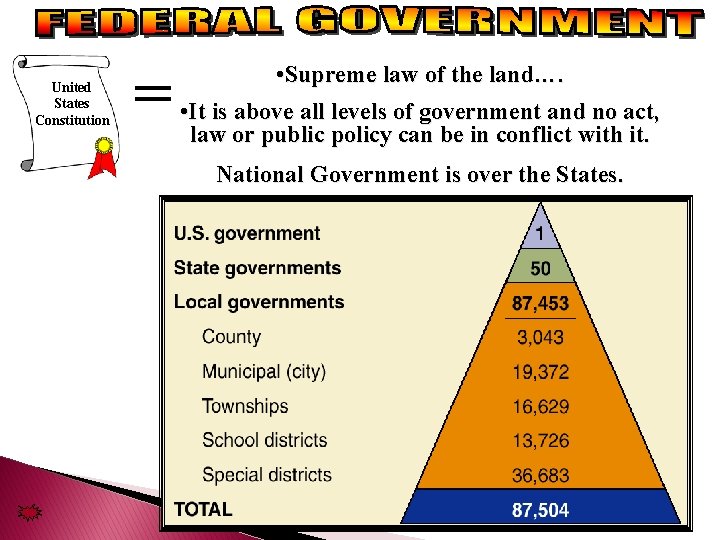
United States Constitution = • Supreme law of the land…. • It is above all levels of government and no act, law or public policy can be in conflict with it. National Government is over the States. Supreme law
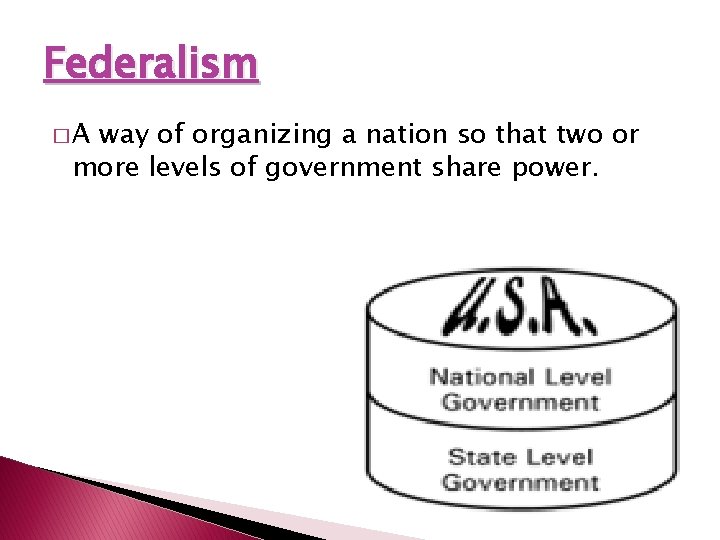
Federalism �A way of organizing a nation so that two or more levels of government share power.
Alternatives to Federalism Confederations- sovereign nations, through a constitutional compact, create a central government but carefully limit the power of the central government and do not give it the power to regulate the conduct of individuals directly. Ex. - Articles of Confederation and the European Union.
Alternatives to Federalism Unitary Government- All governmental power is vested in the central government. The central government may delegate authority to constituent units, but what it delegates it may take away. Ex. France, Israel, and in the U. S. state constitutions usually create this kind of relationship between the state and local governments.
Vocabulary � Delegated powers: powers the Constitution grants or delegates to the national government (expressed, implied, and inherent) � Expressed powers: powers directly expressed or stated in the Constitution by the Founders; also called enumerated powers (Art. I, III) � Levy and collect taxes, coin money, make war, raise an army and navy, regulate commerce among states � Implied Powers: authority that the national government requires to carry out the powers that are expressly defined in the Constitution ◦ Power to draft people into armed forces ◦ Elastic clause: allows powers of Congress to stretch; necessary and proper clause ( Art. I, Sect. 8)
Vocabulary � Inherent powers: powers of the national government may exercise simply because it is a government ◦ Gov’t must control immigration and establish diplomatic relations w/other countries � Supremacy clause: no state law or state constitution may conflict with any form of national law; acts and treaties of the U. S. are supreme (Art. VI, Sect. 2) � Concurrent powers: powers that both the national government and states have � Denied powers: powers the Constitution specifically denies to the states or national gov’t
Division of Federal and State Powers � http: //glencoe. com/sites/common_assets/so cialstudies/in_motion_10/usg/USG_097. swf
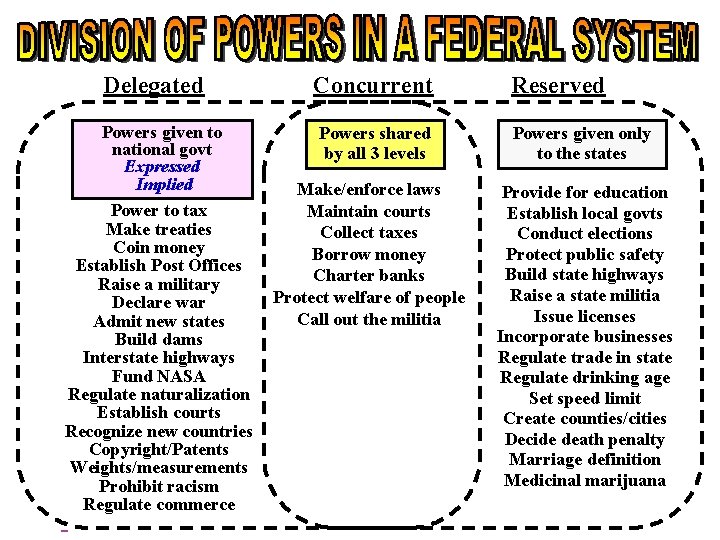
Delegated Concurrent Powers given to national govt Expressed Implied Power to tax Make treaties Coin money Establish Post Offices Raise a military Declare war Admit new states Build dams Interstate highways Fund NASA Regulate naturalization Establish courts Recognize new countries Copyright/Patents Weights/measurements Prohibit racism Regulate commerce Powers shared by all 3 levels Div of powers Make/enforce laws Maintain courts Collect taxes Borrow money Charter banks Protect welfare of people Call out the militia Reserved Powers given only to the states Provide for education Establish local govts Conduct elections Protect public safety Build state highways Raise a state militia Issue licenses Incorporate businesses Regulate trade in state Regulate drinking age Set speed limit Create counties/cities Decide death penalty Marriage definition Medicinal marijuana
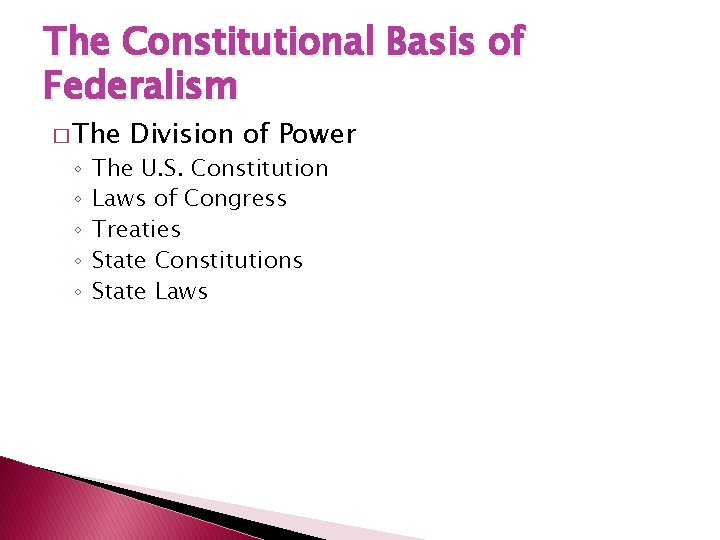
The Constitutional Basis of Federalism � The ◦ ◦ ◦ Division of Power The U. S. Constitution Laws of Congress Treaties State Constitutions State Laws
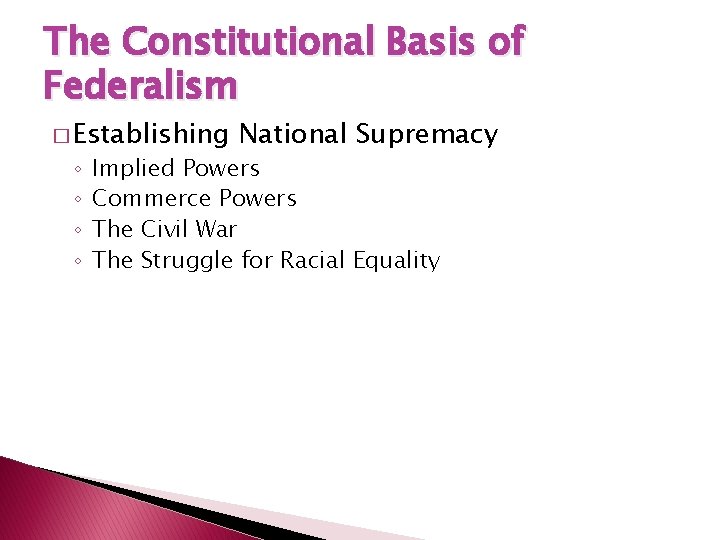
The Constitutional Basis of Federalism � Establishing ◦ ◦ National Supremacy Implied Powers Commerce Powers The Civil War The Struggle for Racial Equality
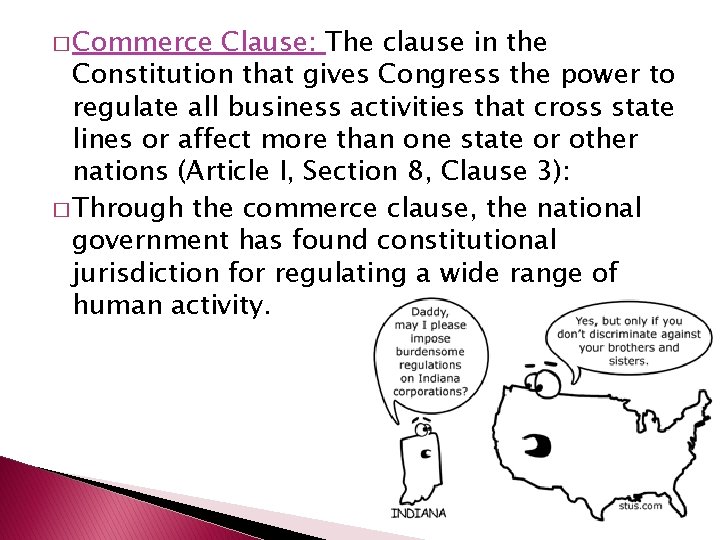
� Commerce Clause: The clause in the Constitution that gives Congress the power to regulate all business activities that cross state lines or affect more than one state or other nations (Article I, Section 8, Clause 3): � Through the commerce clause, the national government has found constitutional jurisdiction for regulating a wide range of human activity.
Tenth Amendment � “powers not delegated to the United States by the Constitution, nor prohibited by it to the states, are reserved to the states respectively, or to the people. ” � Tenth Amendment does not give states power superior to that of the national government for activities not mentioned in the Constitution as upheld in 1985 by Garcia v. San Antonio Metro
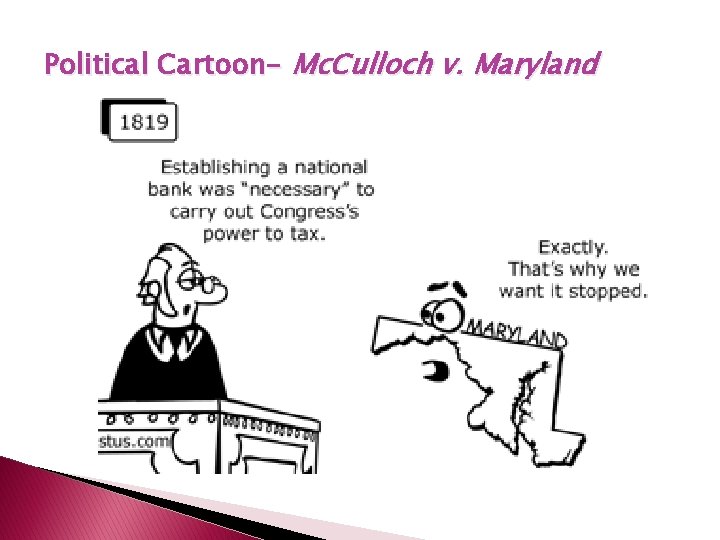
Establishing National Supremacy � Mc. Culloch v. Maryland: An 1819 Supreme Court dispute between Maryland 2 nd National Bank Cashier, James Mc. Culloch, in which Mc. Culloch refused to pay the $15, 000 tax imposed by the state of Maryland in its effort to oppose Federal power. Supreme Court ruled in favor of Mc. Culloch and established supremacy of national gov’t over the states � The national gov’t has certain implied powers that go beyond its enumerated powers through the Necessary and Proper clause
Political Cartoon- Mc. Culloch v. Maryland
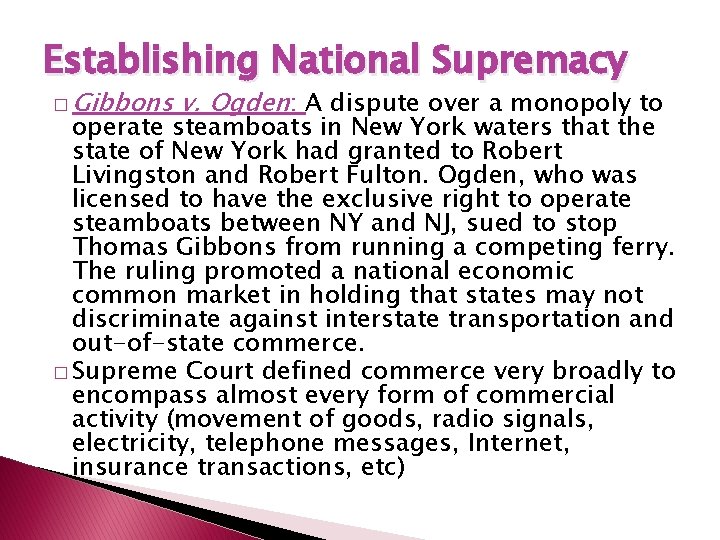
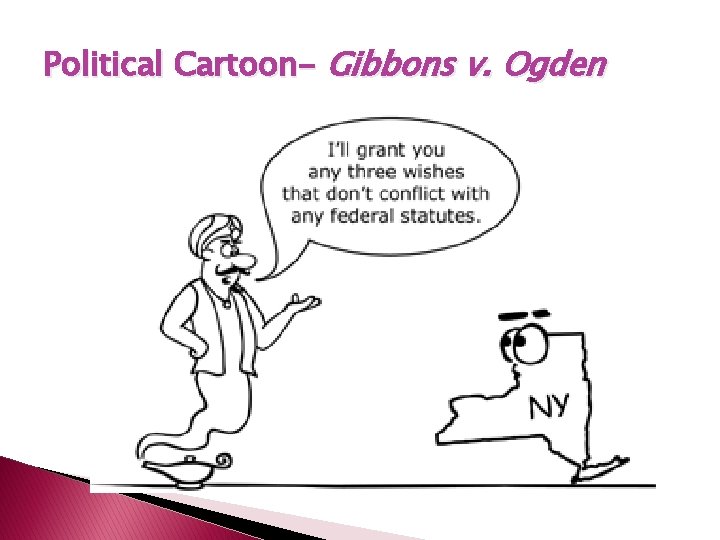
Establishing National Supremacy � Gibbons v. Ogden: A dispute over a monopoly to operate steamboats in New York waters that the state of New York had granted to Robert Livingston and Robert Fulton. Ogden, who was licensed to have the exclusive right to operate steamboats between NY and NJ, sued to stop Thomas Gibbons from running a competing ferry. The ruling promoted a national economic common market in holding that states may not discriminate against interstate transportation and out-of-state commerce. � Supreme Court defined commerce very broadly to encompass almost every form of commercial activity (movement of goods, radio signals, electricity, telephone messages, Internet, insurance transactions, etc)
Political Cartoon- Gibbons v. Ogden
Establishing National Supremacy � What Mc. Culloch pronounced constitutionally, the Civil War settled militarily- the national government is supreme to the states
Establishing National Supremacy � Brown � School v. Board of Education segregation was declared unconstitutional and the federal gov’t enforced its ruling despite massive state resistance. � National gov’t reigns supreme over states
Guarantees to the States � The Constitution requires the national government to do three things for the states � Republican form of government- enforce that each state has a republican form of gov’t � Protection- protect states from invasion and domestic violence � Territorial integrity- respect territorial integrity of each state
The Federal System Relations Among the States
Relations Among the States � Constitution set rules for how the states must interact with each other � Article IV ◦ ◦ ◦ Full faith and credit Privileges and immunities Extradition Interstate compacts Lawsuits between states
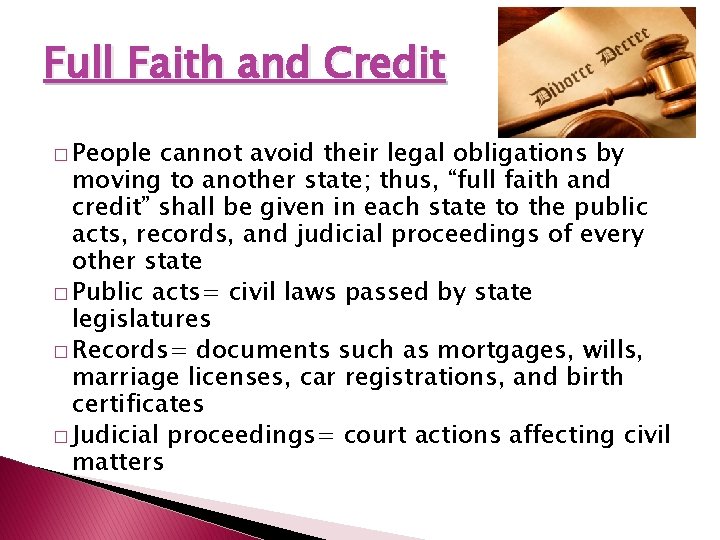
Full Faith and Credit � People cannot avoid their legal obligations by moving to another state; thus, “full faith and credit” shall be given in each state to the public acts, records, and judicial proceedings of every other state � Public acts= civil laws passed by state legislatures � Records= documents such as mortgages, wills, marriage licenses, car registrations, and birth certificates � Judicial proceedings= court actions affecting civil matters
Privileges and Immunities � “the Citizens of each State shall be entitled to all Privileges and Immunities as citizens of that state” � Meant to stop states from discriminating against citizens of other states ◦ Visitors pay same sales tax and receive same police protection � Generally, the more fundament the rights, such as owning property or receiving police protection, the less likely it is that a state can discriminate against a citizen of another state � Many exceptions ◦ Out of state tuition to state universities
Political Cartoon- Privileges and Immunities
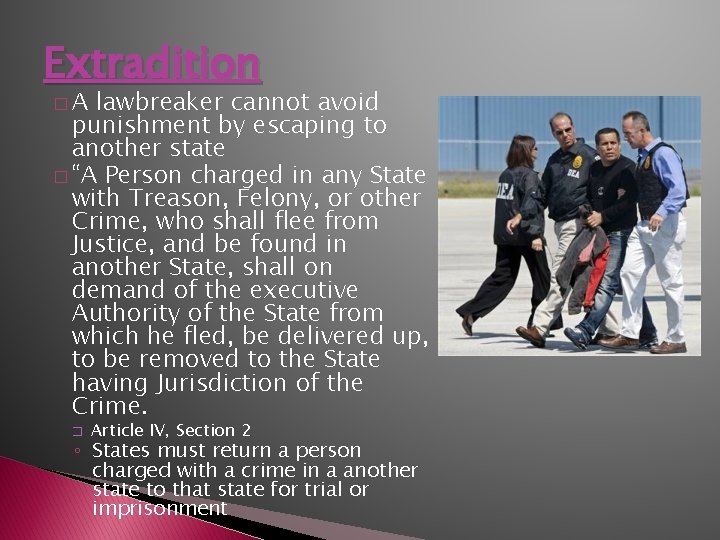
Extradition �A lawbreaker cannot avoid punishment by escaping to another state � “A Person charged in any State with Treason, Felony, or other Crime, who shall flee from Justice, and be found in another State, shall on demand of the executive Authority of the State from which he fled, be delivered up, to be removed to the State having Jurisdiction of the Crime. � Article IV, Section 2 ◦ States must return a person charged with a crime in a another state to that state for trial or imprisonment
Interstate Compacts � Written agreements between two or more states � One way in which states settle their disputes peacefully � Congress must approve interstate compacts to prevent states from making alliances among themselves and threatening union.
Lawsuits between states � States can bring one another to court for a variety of reasons. Many cases are over water rights. � 220 disputes have been brought to Supreme Court since 1789