
The Federal Reserve System What is the history
- Slides: 38
The Federal Reserve System • What is the history of American banking? • How did the Federal Reserve Act of 1913 lead to further reform? • How is today’s Federal Reserve System structured? Chapter 16 Section Main Menu
The Federal Reserve Act of 1913 – created to stabilize the nation’s banking system • The Federal Reserve System, often referred to as “the Fed, ” is a group of 12 regional, independent banks. Chapter 16 Section Main Menu
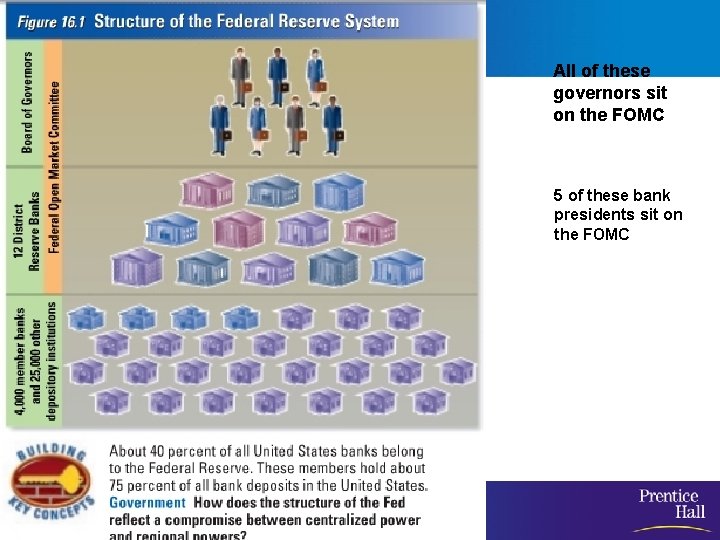
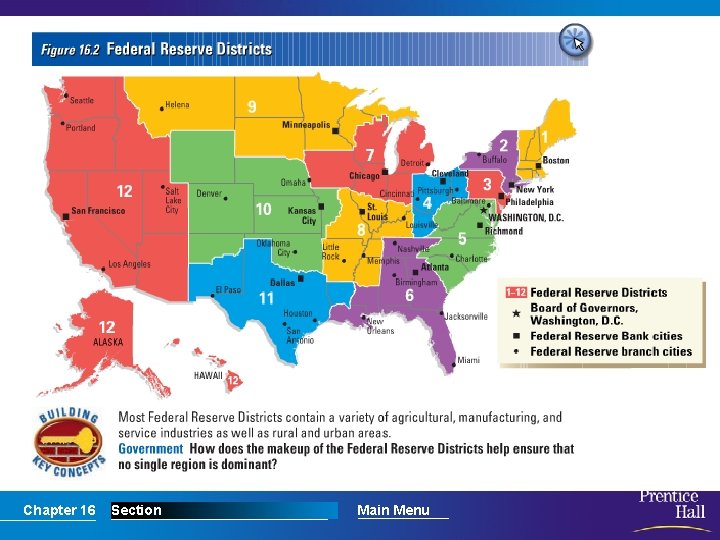
Structure of the Federal Reserve • The Board of Governors – The Federal Reserve System is overseen by the seven-member Board of Governors of the Federal Reserve. (appointed by the President) Actions taken by the Federal Reserve are called monetary policy. • Federal Reserve Districts – The Federal Reserve System consists of 12 Federal Reserve Districts, with one Federal Reserve Bank per district. The Federal Reserve Banks monitor and report on economic activity in their districts. Chapter 16 Section Main Menu
Monetary Policy • Refers to the actions the Fed takes to influence the level of GDP and the rate of inflation Chapter 16 Section Main Menu
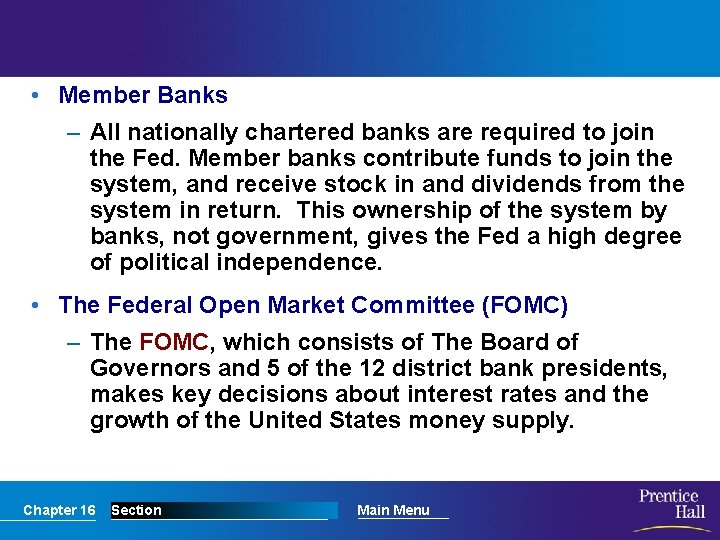
• Member Banks – All nationally chartered banks are required to join the Fed. Member banks contribute funds to join the system, and receive stock in and dividends from the system in return. This ownership of the system by banks, not government, gives the Fed a high degree of political independence. • The Federal Open Market Committee (FOMC) – The FOMC, which consists of The Board of Governors and 5 of the 12 district bank presidents, makes key decisions about interest rates and the growth of the United States money supply. Chapter 16 Section Main Menu
All of these governors sit on the FOMC 5 of these bank presidents sit on the FOMC Chapter 16 Section Main Menu
Chapter 16 Section Main Menu
Regulating the Money Supply The Federal Reserve is best known for its role in regulating the money supply. Stabilizing the Economy The Fed monitors the supply of and the demand for money in an effort to keep inflation rates stable. Chapter 16 Section Main Menu
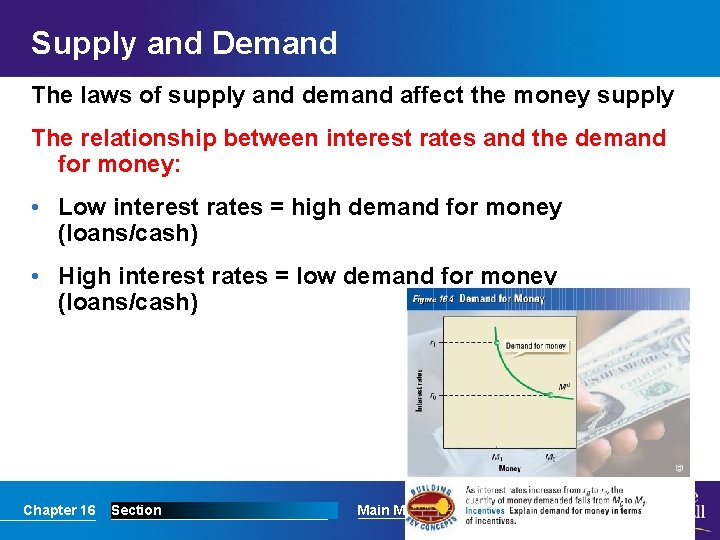
Supply and Demand The laws of supply and demand affect the money supply The relationship between interest rates and the demand for money: • Low interest rates = high demand for money (loans/cash) • High interest rates = low demand for money (loans/cash) Chapter 16 Section Main Menu
Section 1 Assessment 1. The Federal Reserve System was created to (a) undermine the American banking system. (b) extend the powers of government. (c) stabilize the American banking system. (d) destabilize the American banking system. 2. Monetary policy is (a) the research arm of the Federal Reserve. (b) the twelve banking districts created by the Federal Reserve Act. (c) the actions the Federal Reserve takes to influence the level of real GDP and the rate of inflation in the economy. (d) the actions taken by the Bank of the United States. Want to connect to the PHSchool. com link for this section? Click Here! Chapter 16 Section Main Menu
Section 1 Assessment 1. The Federal Reserve System was created to (a) undermine the American banking system. (b) extend the powers of government. (c) stabilize the American banking system. (d) destabilize the American banking system. 2. Monetary policy is (a) the research arm of the Federal Reserve. (b) the twelve banking districts created by the Federal Reserve Act. (c) the actions the Federal Reserve takes to influence the level of real GDP and the rate of inflation in the economy. (d) the actions taken by the Bank of the United States. Want to connect to the PHSchool. com link for this section? Click Here! Chapter 16 Section Main Menu
Monetary Policy Tools • What is the process of money creation? • What three tools does the Federal Reserve use to change the money supply? • Why are some tools of monetary policy favored over others? Chapter 16 Section Main Menu
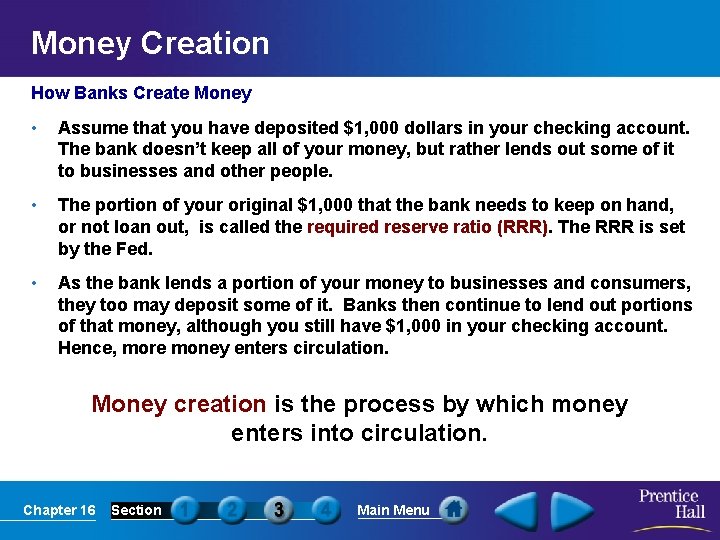
Money Creation How Banks Create Money • Assume that you have deposited $1, 000 dollars in your checking account. The bank doesn’t keep all of your money, but rather lends out some of it to businesses and other people. • The portion of your original $1, 000 that the bank needs to keep on hand, or not loan out, is called the required reserve ratio (RRR). The RRR is set by the Fed. • As the bank lends a portion of your money to businesses and consumers, they too may deposit some of it. Banks then continue to lend out portions of that money, although you still have $1, 000 in your checking account. Hence, more money enters circulation. Money creation is the process by which money enters into circulation. Chapter 16 Section Main Menu
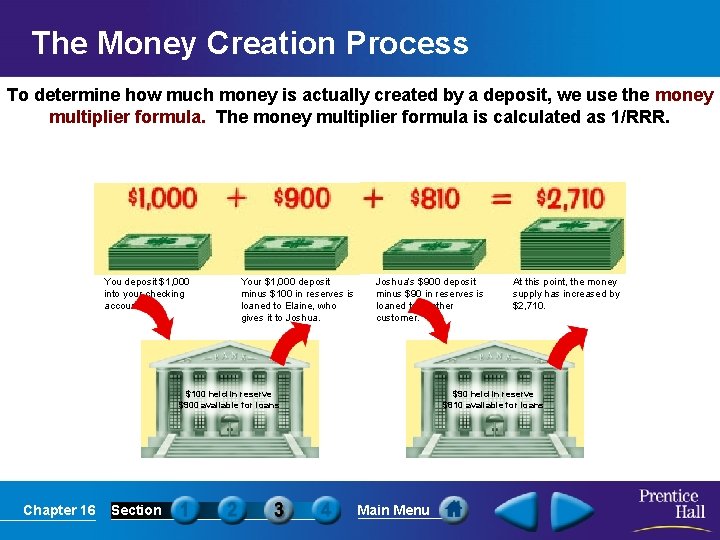
The Money Creation Process To determine how much money is actually created by a deposit, we use the money multiplier formula. The money multiplier formula is calculated as 1/RRR. Money Creation You deposit $1, 000 into your checking account. Your $1, 000 deposit minus $100 in reserves is loaned to Elaine, who gives it to Joshua’s $900 deposit minus $90 in reserves is loaned to another customer. $100 held in reserve $900 available for loans Chapter 16 Section At this point, the money supply has increased by $2, 710. $90 held in reserve $810 available for loans Main Menu
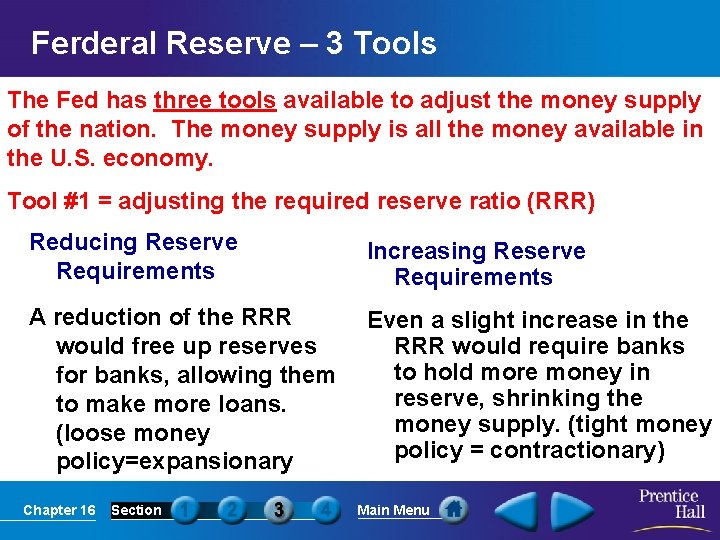
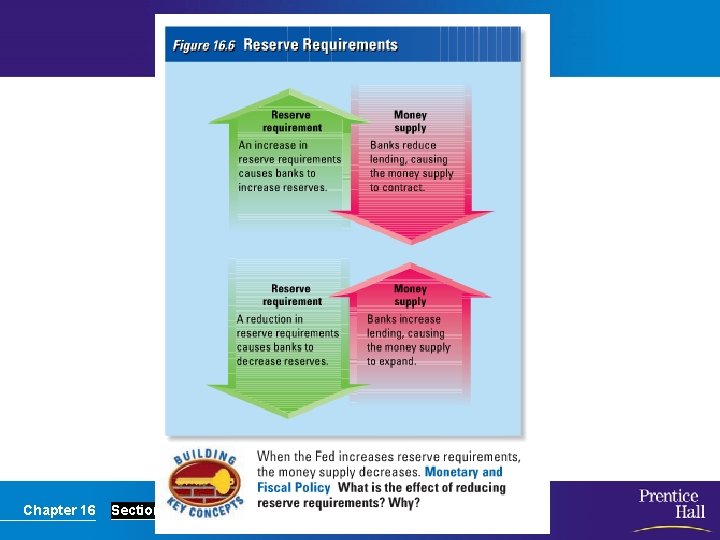
Ferderal Reserve – 3 Tools The Fed has three tools available to adjust the money supply of the nation. The money supply is all the money available in the U. S. economy. Tool #1 = adjusting the required reserve ratio (RRR) Reducing Reserve Requirements Increasing Reserve Requirements A reduction of the RRR would free up reserves for banks, allowing them to make more loans. (loose money policy=expansionary Even a slight increase in the RRR would require banks to hold more money in reserve, shrinking the money supply. (tight money policy = contractionary) Chapter 16 Section Main Menu
Chapter 16 Section Main Menu
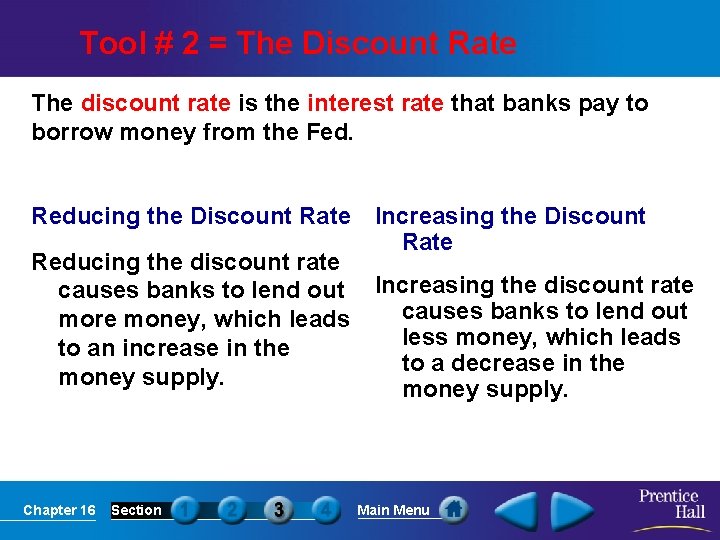
Tool # 2 = The Discount Rate The discount rate is the interest rate that banks pay to borrow money from the Fed. Reducing the Discount Rate Increasing the Discount Rate Reducing the discount rate causes banks to lend out Increasing the discount rate causes banks to lend out more money, which leads less money, which leads to an increase in the to a decrease in the money supply. Chapter 16 Section Main Menu
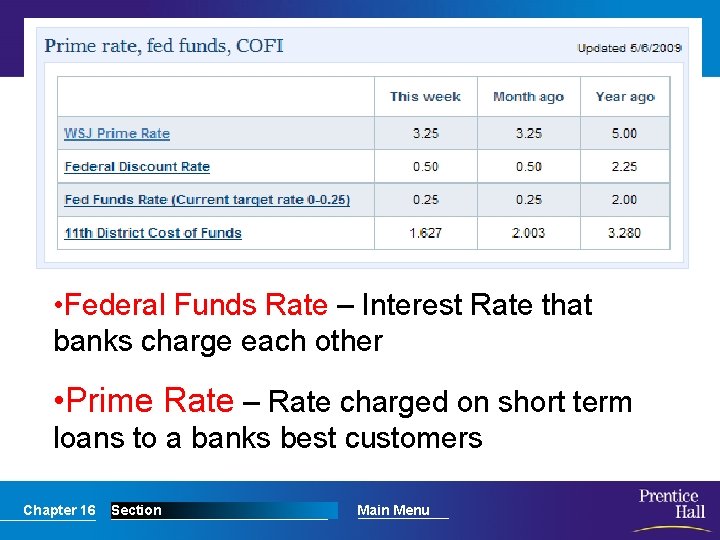
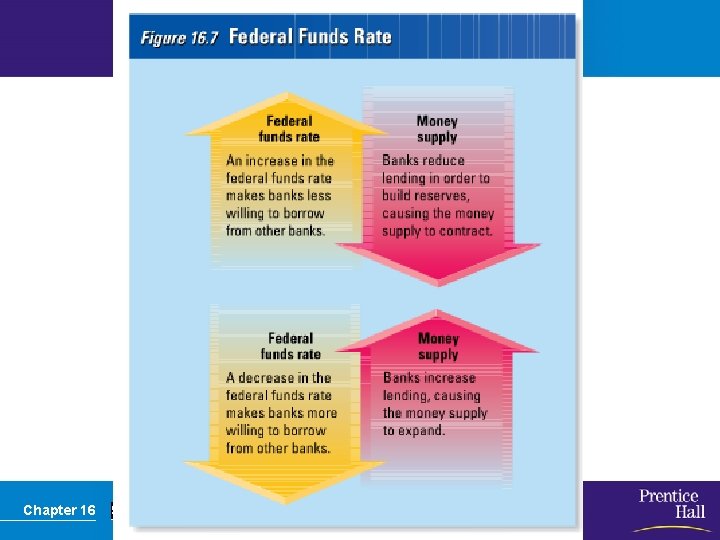
• Federal Funds Rate – Interest Rate that banks charge each other • Prime Rate – Rate charged on short term loans to a banks best customers Chapter 16 Section Main Menu
Chapter 16 Section Main Menu
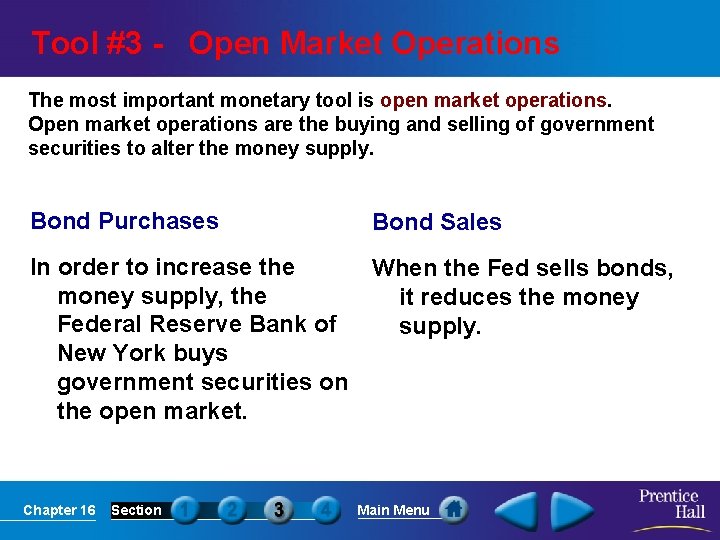
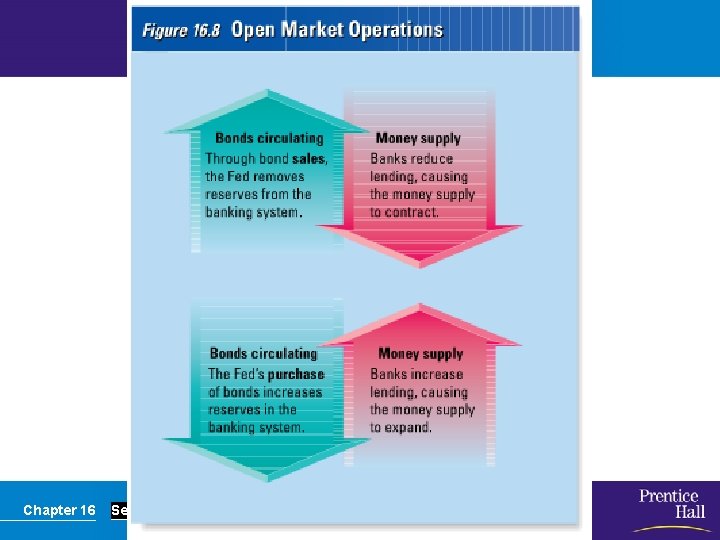
Tool #3 - Open Market Operations The most important monetary tool is open market operations. Open market operations are the buying and selling of government securities to alter the money supply. Bond Purchases Bond Sales In order to increase the When the Fed sells bonds, money supply, the it reduces the money Federal Reserve Bank of supply. New York buys government securities on the open market. Chapter 16 Section Main Menu
Chapter 16 Section Main Menu
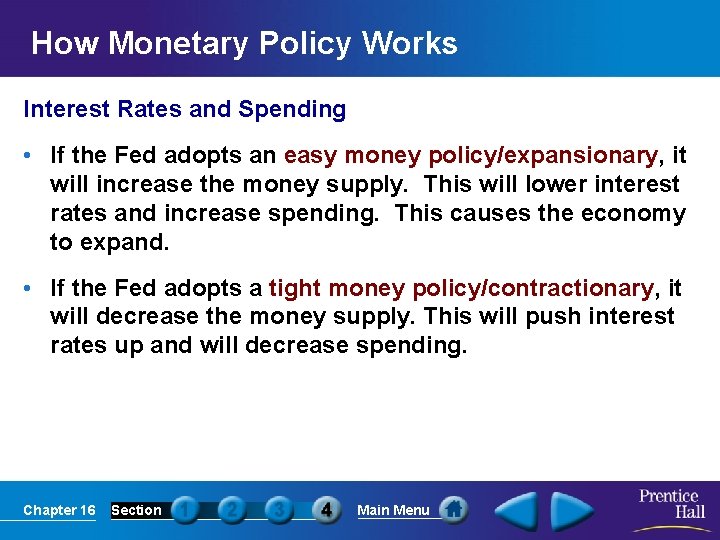
How Monetary Policy Works Interest Rates and Spending • If the Fed adopts an easy money policy/expansionary, it will increase the money supply. This will lower interest rates and increase spending. This causes the economy to expand. • If the Fed adopts a tight money policy/contractionary, it will decrease the money supply. This will push interest rates up and will decrease spending. Chapter 16 Section Main Menu
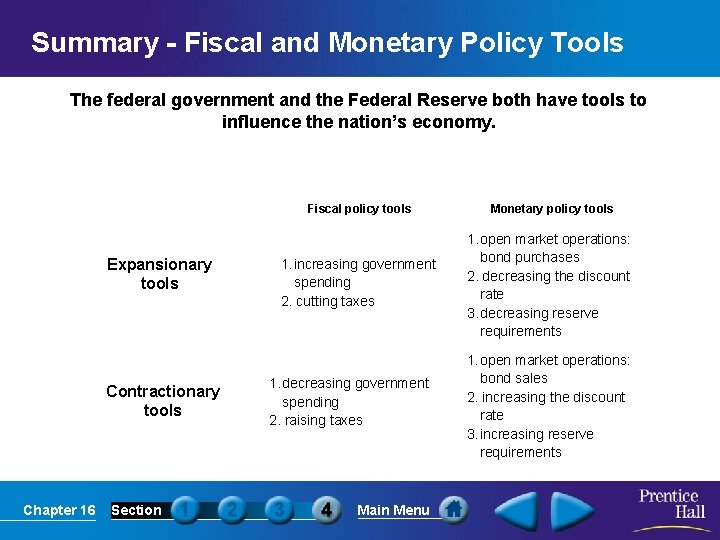
Summary - Fiscal and Monetary Policy Tools The federal government and the Federal Reserve both have tools to influence the nation’s economy. Fiscal and Monetary Policy Tools Expansionary tools Contractionary tools Chapter 16 Section Fiscal policy tools Monetary policy tools 1. increasing government spending 2. cutting taxes 1. open market operations: bond purchases 2. decreasing the discount rate 3. decreasing reserve requirements 1. decreasing government spending 2. raising taxes Main Menu 1. open market operations: bond sales 2. increasing the discount rate 3. increasing reserve requirements
Being Ben Bernanke—The Game • For each of the scenarios listed, you will be given one policy instrument. Explain what you would do with that policy instrument if you were Ben Bernanke. – Tell me whether that would be an example of easy or tight money policy Chapter 16 Section Main Menu
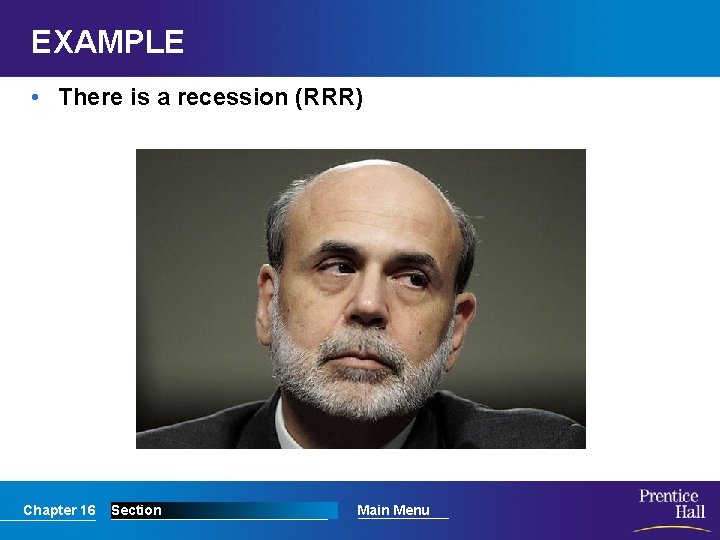
EXAMPLE • There is a recession (RRR) Chapter 16 Section Main Menu
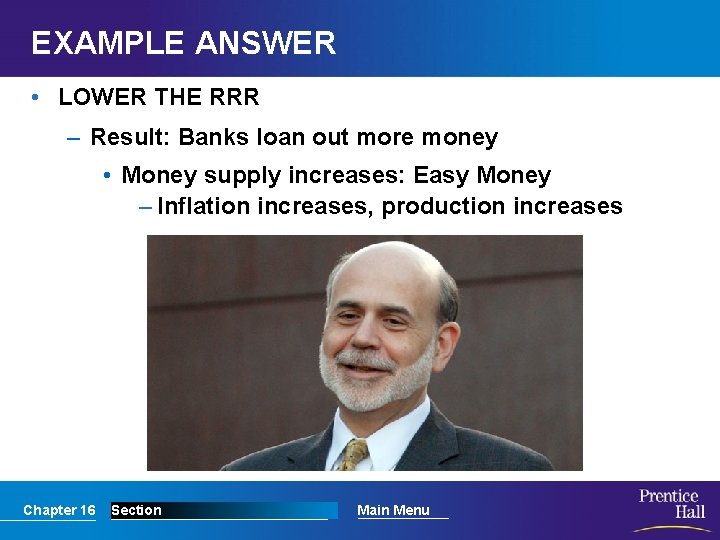
EXAMPLE ANSWER • LOWER THE RRR – Result: Banks loan out more money • Money supply increases: Easy Money – Inflation increases, production increases Chapter 16 Section Main Menu
Scenario 1 • The stock market has been buzzing for over two years. Many experts predict that the markets will never crash again. The price level is rising a little faster than normal. (Discount Rate) Chapter 16 Section Main Menu
Answer 1 • Raise the discount rate! – Decrease in inflation (price levels). – Decrease in productivity – Tight money Chapter 16 Section Main Menu
Scenario 2 Employment levels and productivity appear to be normal, but consumer confidence is low and there are fears that employment may slip if aggregate demand stays low (Open Market Operations) Chapter 16 Section Main Menu
Scenario 2 • BUY BONDS! – Increase in the money supply (easy money). – Should lead to an increase in aggregate demand. Chapter 16 Section Main Menu
Scenario 3 • A financial crisis has touched of an economic downturn. Unemployment is at its highest levels in years. (RRR) Chapter 16 Section Main Menu
Answer 3 • Lower the RRR – Easy money: Banks lend more money out • Increase in the money supply higher prices, but also higher productivity and, hopefully, lower unemployment. Chapter 16 Section Main Menu
Scenario 4 • A financial crisis has touched of an economic downturn. Unemployment is at its highest levels in years. (Tax Rates) Chapter 16 Section Main Menu
Answer 4 • Nothing! • The Federal Reserve has no direct control over taxes. – Maybe you could show up in Congress and tell them to cut taxes though. Chapter 16 Section Main Menu
Scenario 5 • The housing market is taking off like a rocket. More people than ever before are buying new homes. Banks are beginning to loan out to people with questionable credit histories; they are confident that spreading out the risk over many different borrowers will make lending safer (Discount Rate). Chapter 16 Section Main Menu
Answer 5 • Raise the discount rate! • Tight money policy: inflation decreases. – Fewer loans will be available. Chapter 16 Section Main Menu
Scenario 6 • The economy is at full employment. Inflation levels are normal. Stocks fell 3% today, mainly because the CEO of Google died tragically. Chapter 16 Section Main Menu
Answer 6 • Do absolutely nothing. • The economy is running as it should. Chapter 16 Section Main Menu