
The Federal Reserve System Structure and Policy Tools
- Slides: 22
The Federal Reserve System Structure and Policy Tools ECO 285 – Macroeconomics – Dr. D. Foster
The Origins of U. S. Central Banking 1791– 1836 v Bank of England v The Bank of North America (1781) v The First Bank of the United States (1791) v The Second Bank of the United States (1816) 1837– 1865 v The Free-Banking period. v The Civil War & Greenbacks - a fiat money.
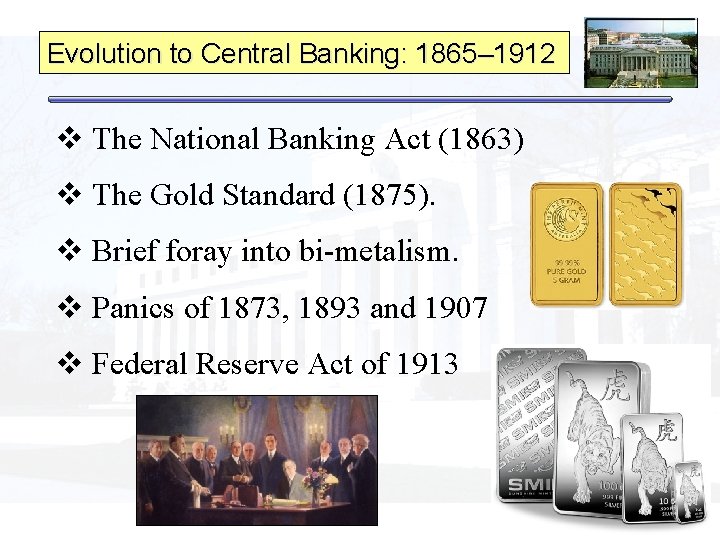
Evolution to Central Banking: 1865– 1912 v The National Banking Act (1863) v The Gold Standard (1875). v Brief foray into bi-metalism. v Panics of 1873, 1893 and 1907 v Federal Reserve Act of 1913
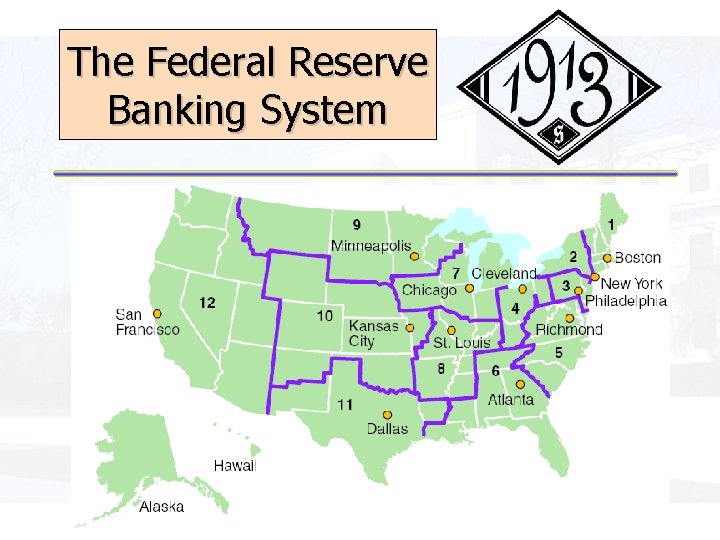
The Federal Reserve Banking System
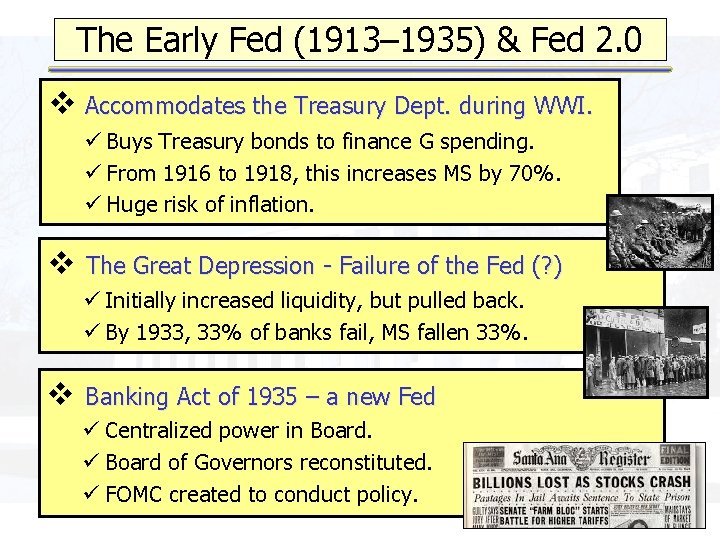
The Early Fed (1913– 1935) & Fed 2. 0 v Accommodates the Treasury Dept. during WWI. ü Buys Treasury bonds to finance G spending. ü From 1916 to 1918, this increases MS by 70%. ü Huge risk of inflation. v The Great Depression - Failure of the Fed (? ) ü Initially increased liquidity, but pulled back. ü By 1933, 33% of banks fail, MS fallen 33%. v Banking Act of 1935 – a new Fed ü Centralized power in Board. ü Board of Governors reconstituted. ü FOMC created to conduct policy.
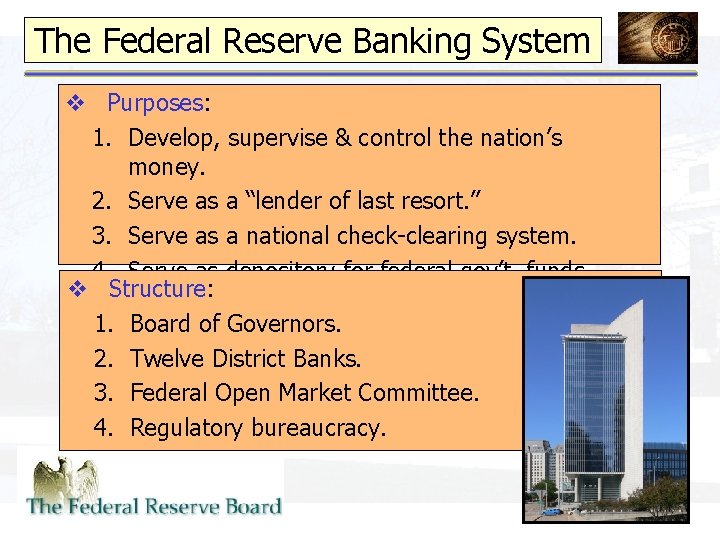
The Federal Reserve Banking System v Purposes: Purposes 1. Develop, supervise & control the nation’s money. 2. Serve as a “lender of last resort. ” 3. Serve as a national check-clearing system. 4. Serve as depository for federal gov’t. funds. v Structure: Structure 1. Board of Governors. 2. Twelve District Banks. 3. Federal Open Market Committee. 4. Regulatory bureaucracy.
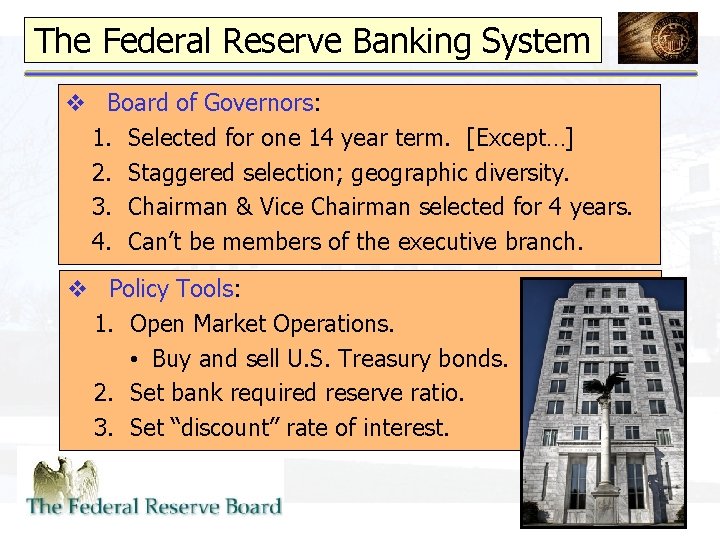
The Federal Reserve Banking System v Board of Governors: Governors 1. Selected for one 14 year term. [Except…] 2. Staggered selection; geographic diversity. 3. Chairman & Vice Chairman selected for 4 years. 4. Can’t be members of the executive branch. v Policy Tools: Tools 1. Open Market Operations. • Buy and sell U. S. Treasury bonds. 2. Set bank required reserve ratio. 3. Set “discount” rate of interest.
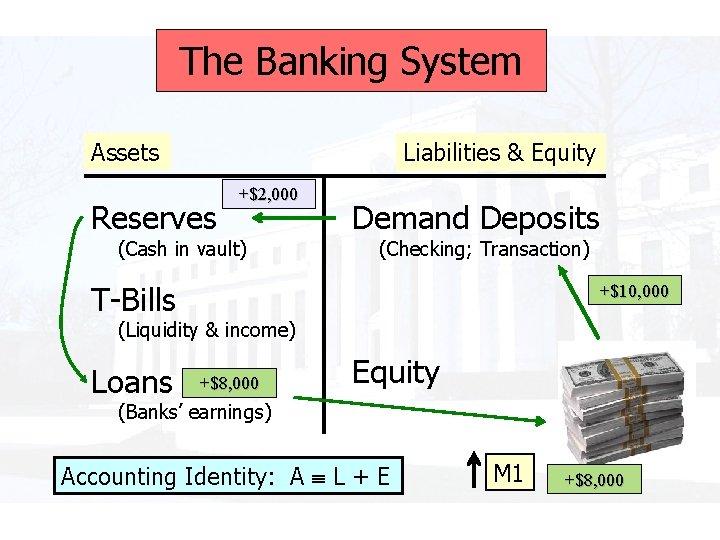
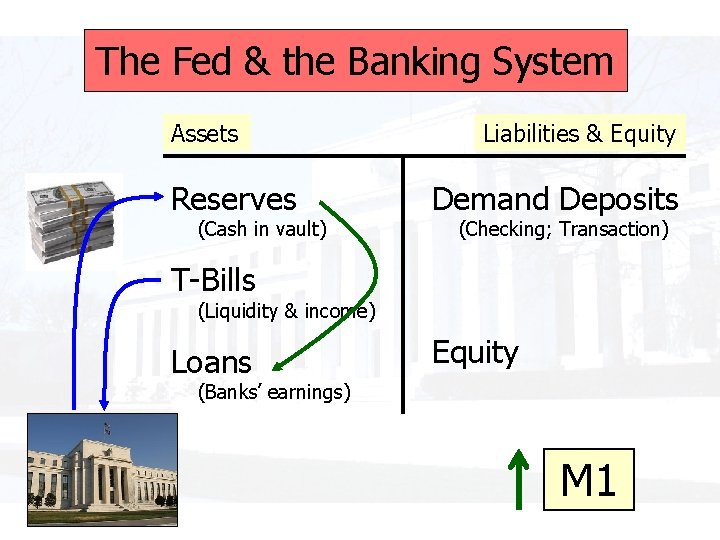
The Banking System Assets Liabilities & Equity Reserves +$10, 000 +$2, 000 (Cash in vault) Demand Deposits (Checking; Transaction) T-Bills +$10, 000 (Liquidity & income) Loans +$8, 000 Equity (Banks’ earnings) Accounting Identity: A L + E M 1 +$8, 000
The Fed & the Banking System Assets Reserves (Cash in vault) Liabilities & Equity Demand Deposits (Checking; Transaction) T-Bills (Liquidity & income) Loans Equity (Banks’ earnings) M 1
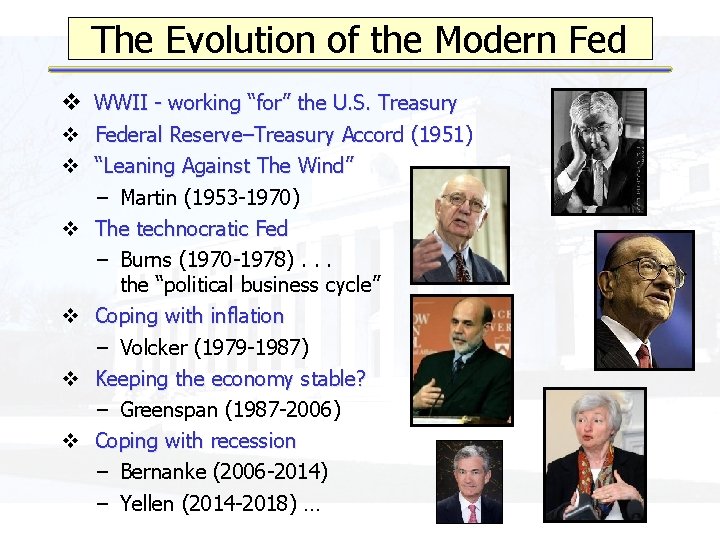
The Evolution of the Modern Fed v WWII - working “for” the U. S. Treasury v Federal Reserve–Treasury Accord (1951) v “Leaning Against The Wind” – Martin (1953 -1970) v The technocratic Fed – Burns (1970 -1978). . . the “political business cycle” v Coping with inflation – Volcker (1979 -1987) v Keeping the economy stable? – Greenspan (1987 -2006) v Coping with recession – Bernanke (2006 -2014) – Yellen (2014 -2018) …
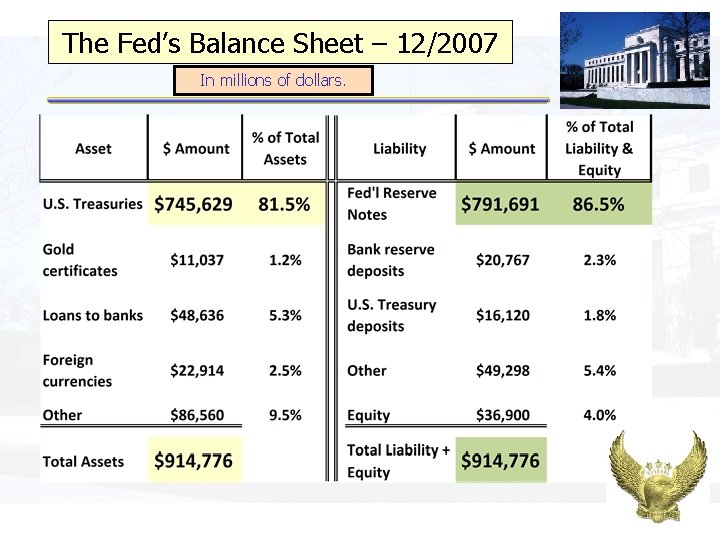
The Fed’s Balance Sheet – 12/2007 In millions of dollars.
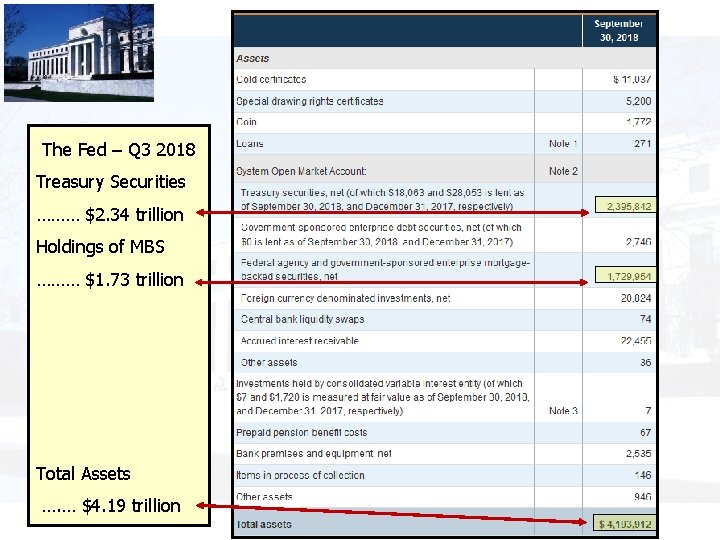
The Fed – Q 3 2018 Treasury Securities ……… $2. 34 trillion Holdings of MBS ……… $1. 73 trillion Total Assets …. … $4. 19 trillion
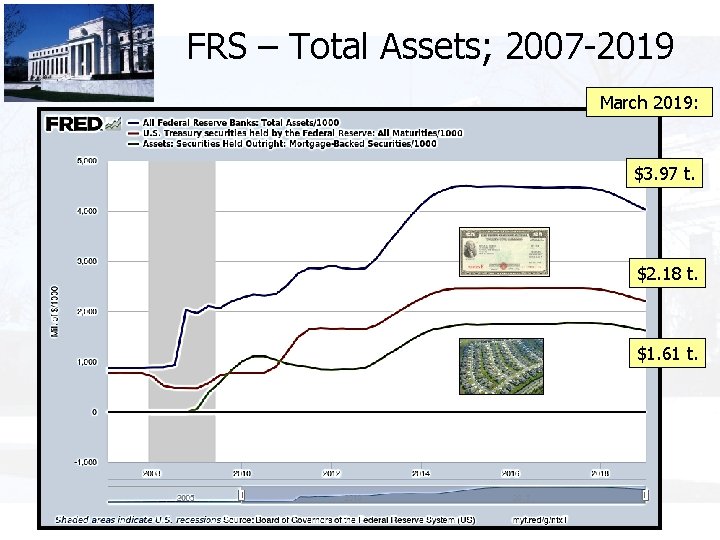
FRS – Total Assets; 2007 -2019 March 2019: $3. 97 t. $2. 18 t. $1. 61 t.
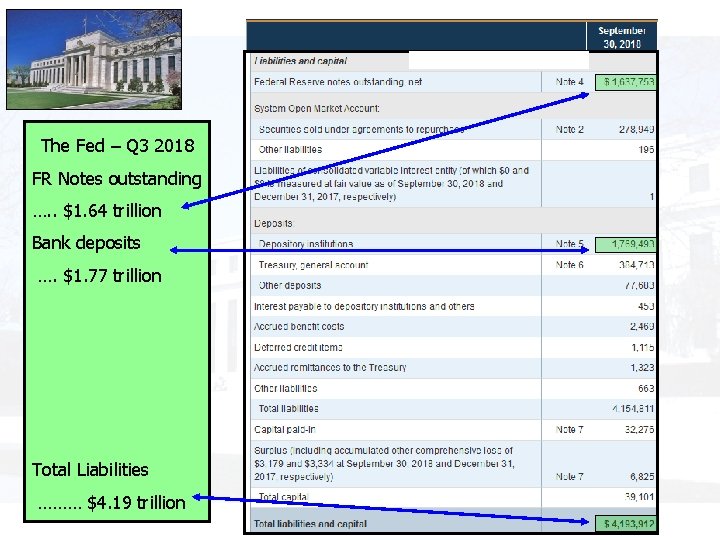
The Fed – Q 3 2018 FR Notes outstanding …. . $1. 64 trillion Bank deposits …. $1. 77 trillion Total Liabilities ……… $4. 19 trillion
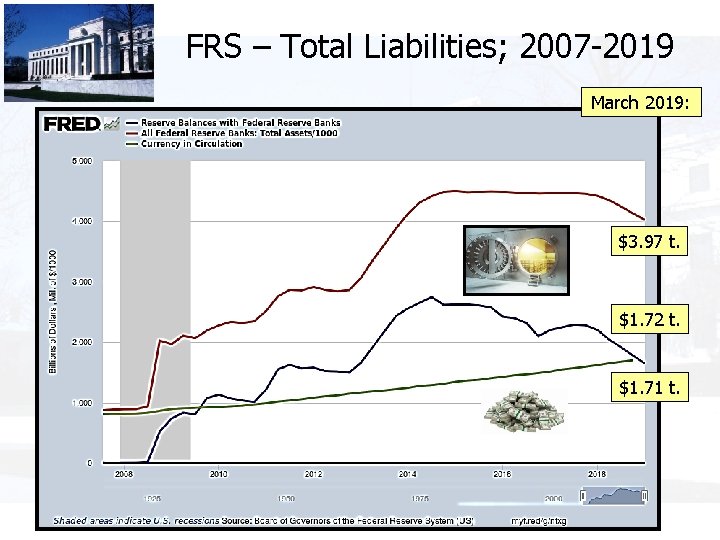
FRS – Total Liabilities; 2007 -2019 March 2019: $3. 97 t. $1. 72 t. $1. 71 t.
Federal Reserve Policy Tools • Open Market Operations – Buy/sell Treasury bonds to affect bank reserves. – The major form of monetary policy. – Since 2009, also buying MBS! • Discount Window – Lend to member banks to affect bank reserves. – Purpose is to target the “federal funds rate” – iff • This is the rate that banks charge each other for very short term loans. • Required Reserve Ratio (rr. D) – Changing this affects bank excess reserves directly. – Was used in 1937 and precipitates more Great Depression. New policy? – Pay banks interest on their Excess Reserves!
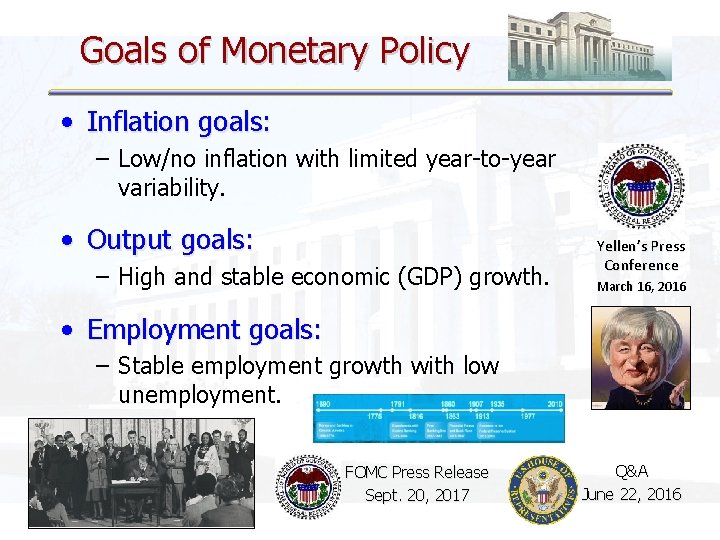
Goals of Monetary Policy • Inflation goals: – Low/no inflation with limited year-to-year variability. • Output goals: – High and stable economic (GDP) growth. Yellen’s Press Conference March 16, 2016 • Employment goals: – Stable employment growth with low unemployment. FOMC Press Release Sept. 20, 2017 Q&A June 22, 2016
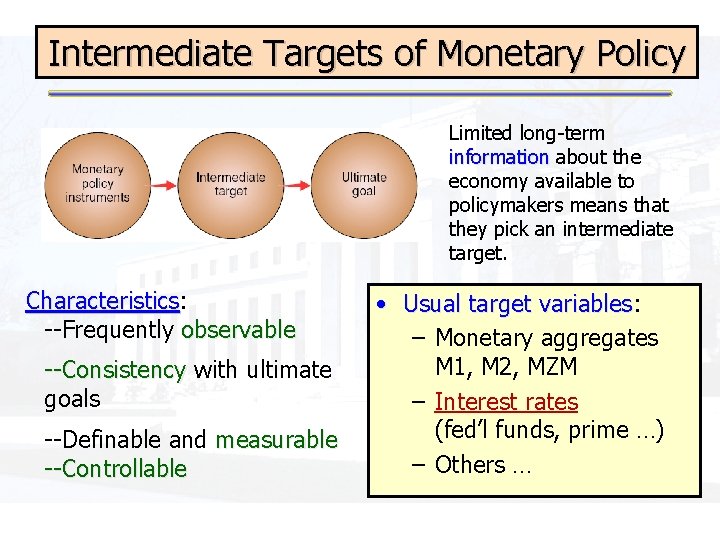
Intermediate Targets of Monetary Policy Limited long-term information about the economy available to policymakers means that they pick an intermediate target. Characteristics: Characteristics --Frequently observable --Consistency with ultimate goals --Definable and measurable --Controllable • Usual target variables: variables – Monetary aggregates M 1, M 2, MZM – Interest rates (fed’l funds, prime …) – Others …
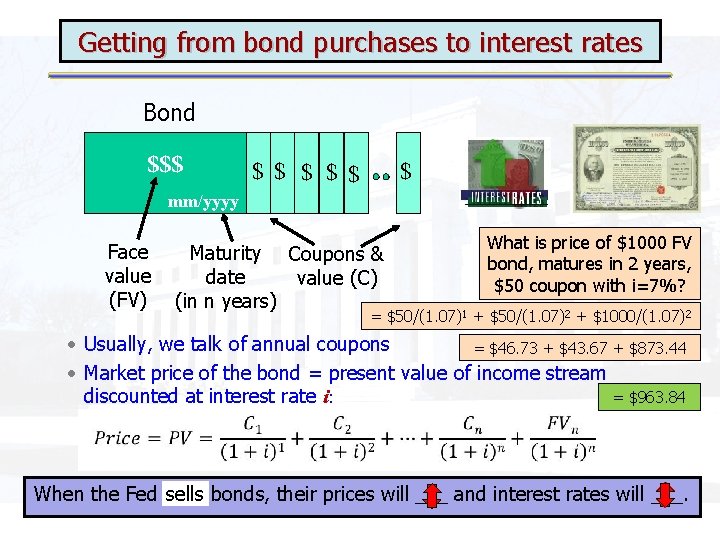
Getting from bond purchases to interest rates Bond $$$ $ $ $ mm/yyyy Face value (FV) Maturity Coupons & date value (C) (in n years) What is price of $1000 FV bond, matures in 2 years, $50 coupon with i=7%? = $50/(1. 07)1 + $50/(1. 07)2 + $1000/(1. 07)2 • Usually, we talk of annual coupons = $46. 73 + $43. 67 + $873. 44 • Market price of the bond = present value of income stream = $963. 84 discounted at interest rate i: When the Fed buys sells bonds, their prices will ___ and interest rates will ___.
What is interest? • Payment made to savers to compensate them foregoing consumption. • “The most powerful force in the universe is compound interest. ” • Interest rates embody our expectations of the future.
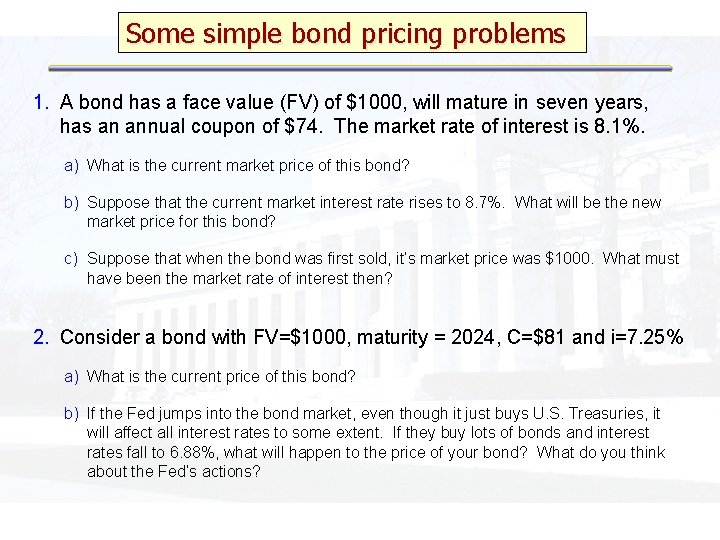
Some simple bond pricing problems 1. A bond has a face value (FV) of $1000, will mature in seven years, has an annual coupon of $74. The market rate of interest is 8. 1%. a) What is the current market price of this bond? b) Suppose that the current market interest rate rises to 8. 7%. What will be the new market price for this bond? c) Suppose that when the bond was first sold, it’s market price was $1000. What must have been the market rate of interest then? 2. Consider a bond with FV=$1000, maturity = 2024, C=$81 and i=7. 25% a) What is the current price of this bond? b) If the Fed jumps into the bond market, even though it just buys U. S. Treasuries, it will affect all interest rates to some extent. If they buy lots of bonds and interest rates fall to 6. 88%, what will happen to the price of your bond? What do you think about the Fed’s actions?
The Federal Reserve System Structure and Policy Tools ECO 285 – Macroeconomics – Dr. D. Foster