
THE FEDERAL LIFELINE PROGRAM Overview Lowincome consumers apply
- Slides: 14
THE FEDERAL LIFELINE PROGRAM
Overview • Low-income consumers apply for discounts for local telephone service through the telephone company. • Low Income support reimburses eligible telecommunications carriers (ETCs) for providing eligible low income customers with discounts. 2
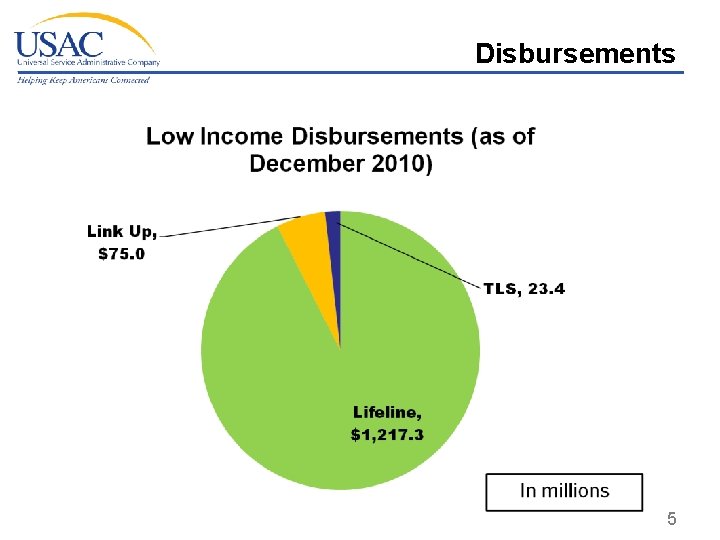
Overview Low Income support consists of three subcomponents: • Lifeline reimburses ETCs for discounting eligible customers’ monthly bill for basic, local telephone service. • Link Up reimburses ETCs for discounting connection charges incurred when an eligible customer commences service for the first time or at a new address. • Toll Limitation Service (TLS) reimburses ETCs for providing toll blocking and toll control to eligible customers at no cost to the customer. 3
Overview To participate, a carrier must be designated as an “eligible telecommunications carrier. ” • ETC status is granted by state public service commission, or FCC. • ETCs must provide service using, at least in part, its own facilities pursuant to section 214(e) of the Telecommunications Act. • A company can petition the FCC forbearance from the requirement to use its own facilities. 4
Disbursements 5
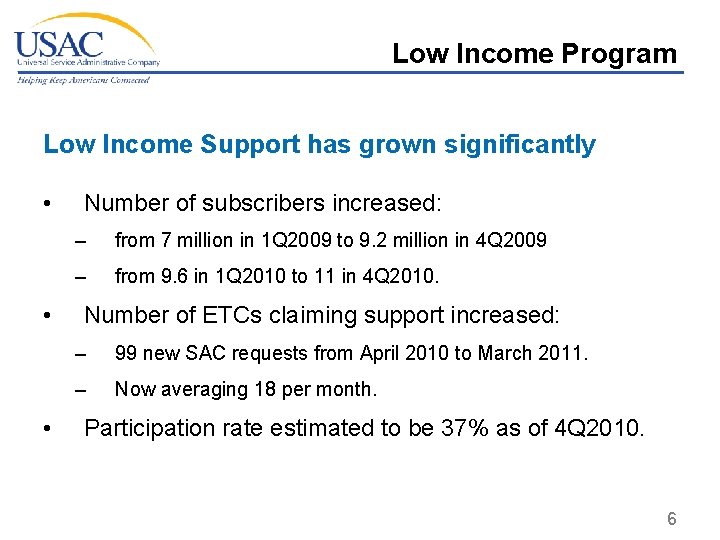
Low Income Program Low Income Support has grown significantly • • • Number of subscribers increased: – from 7 million in 1 Q 2009 to 9. 2 million in 4 Q 2009 – from 9. 6 in 1 Q 2010 to 11 in 4 Q 2010. Number of ETCs claiming support increased: – 99 new SAC requests from April 2010 to March 2011. – Now averaging 18 per month. Participation rate estimated to be 37% as of 4 Q 2010. 6
Factors Contributing to Growth • “Pre-paid wireless” carriers are non-facilities-based commercial mobile radio service (CMRS) operators that provide Lifeline service on a resold basis. – Trac. Fone Wireless is currently an ETC in 32 states, PR and DC. – Virgin Mobile is currently an ETC in 19 states. – Trac. Fone and Virgin Mobile claim Lifeline support only. 7
Pre-Paid Carriers Lifeline service provided by pre-paid carriers is different from that of other ETCs • Provide Lifeline customers free wireless handset. • Provide an established number of free minutes of use per month (both Trac. Fone and Virgin Mobile offer up to 250 per month in some states). • Advertise heavily (television ads, direct mailings) to attract low-income consumers. 8
Pre-Paid Carriers Additional regulatory requirements imposed on pre-paid carriers • Obtain certification that carrier is 911 and E 911 compliant. • Obtain annual certification that each consumer is head-of-household and receives Lifeline discounts only from the pre-paid carrier. • Enact safeguards to prohibit more than one subsidy from the same carrier going to one address. • Limited to claiming only Lifeline support (not eligible for Link Up or TLS). 9
Factors Contributing to Growth • The number of carriers offering traditional wireless service has also increased. – Nexus, Midwestern Telecommunications and Yourtel America are among the largest non-pre-paid wireless Lifeline providers. – Most traditional wireless carriers receive Link Up support. 10
Factors Contributing to Growth • The number of wireline competitors has increased significantly. – These companies have a switch or purchase UNEs, but also provide service to many consumers via resale. – Danger to consumers if these companies are cut off by the wholesale carrier due to a billing dispute. – These companies generally claim Link Up and TLS support. 11
Pending Regulatory Matters Duplicate Lifeline Subscribers • FCC addressing issue of consumers receiving Lifeline from two or more carriers. – USAC is conducting In-Depth Data Validations to identify consumers receiving Lifeline from multiple carriers. – FCC is establishing plan to ensure consumers receive subsidized service from only one carrier. 12
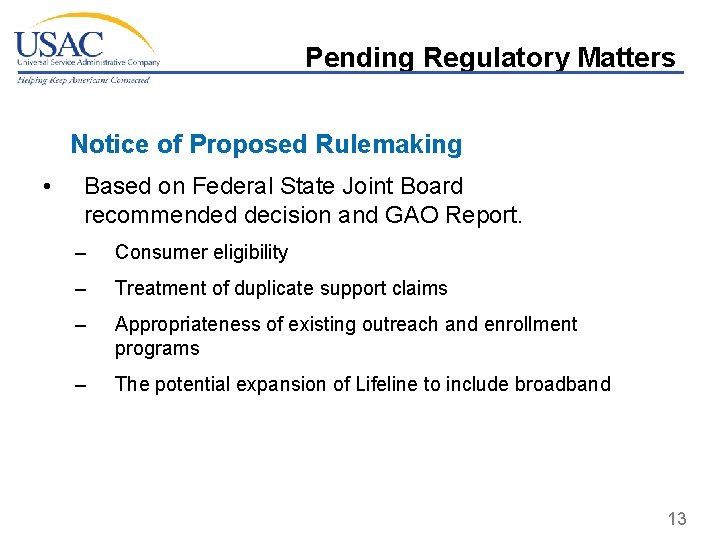
Pending Regulatory Matters Notice of Proposed Rulemaking • Based on Federal State Joint Board recommended decision and GAO Report. – Consumer eligibility – Treatment of duplicate support claims – Appropriateness of existing outreach and enrollment programs – The potential expansion of Lifeline to include broadband 13
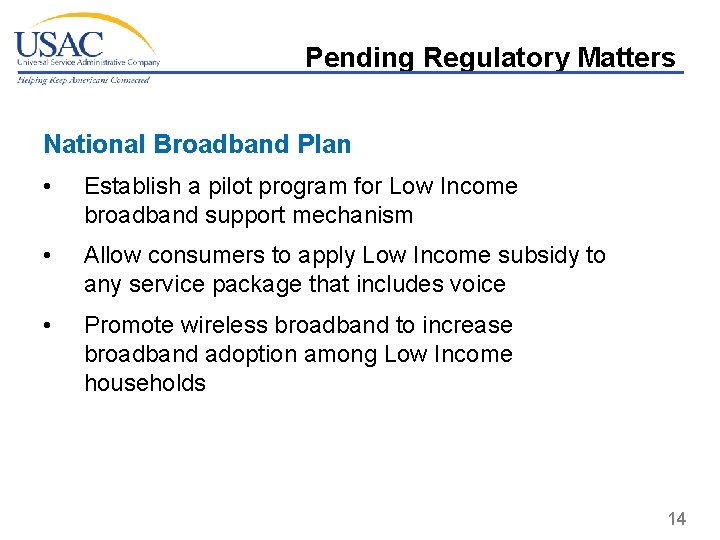
Pending Regulatory Matters National Broadband Plan • Establish a pilot program for Low Income broadband support mechanism • Allow consumers to apply Low Income subsidy to any service package that includes voice • Promote wireless broadband to increase broadband adoption among Low Income households 14