
THE FEDERAL LAWMAKING PROCESS or How a bill
THE FEDERAL LAWMAKING PROCESS (or, How a bill becomes a law)

Laws are like sausages. It's better not to see them being made. - Otto Von Bismarck, German (Prussian) politician Laws control the lesser man. . . Right conduct controls the greater one. - Mark Twain, American author and social critic 2

3
How Is Congress Organized? Terms and Sessions • A congressional “term” – sometimes simply called “a Congress” – is a 2 -year period following election of 435 Representatives and 1/3 of the Senators • Each term begins on January 3 and ends on same day January • Each term is divided into two, 1 -year-long 3 “sessions”. January 3, 2011 – January 3, 2013. • Congresses are numbered, beginning with the very first one in 1789; in the spring of 2011, the 112 th Congress, first session will begin on January 3. 4
How Is Congress Organized? Terms and Sessions The lame duck amendment – • 20 th Amendment – (1933) changed the date Congress convenes after elections, from March 4 th back to January 3 rd, in odd-numbered years • Critics of the original March 4 th date charged that “lame duck” members were passing self-serving laws and going on spending sprees just before their terms expired • Also moved president’s inauguration from March 4 back to January 20 Ooooooooh, OUCH, I’m a LAME DUCK! 5

How Is Congress Organized? Terms and Sessions Scheduled meetings of Congress – • Normal workweek of Senate and House is Monday through Friday, but… • Most floor action – when all members discuss, debate, and vote on bills – takes place Tuesdays, Wednesdays and Thursdays • When not involved in floor action – members are doing committee work or in home districts/states 6
How Is Congress Organized? Terms and Sessions Scheduled meetings of Congress, cont. • Neither house of Congress may adjourn for more than three days without consent of other chamber • Senate and House must agree on a final date to adjourn • If they cannot agree, President chooses date of adjournment • Either chamber may recess – take a break – when needed – often, for a few weeks during Christmas and Easter seasons 7
How Is Congress Organized? Terms and Sessions Special sessions of Congress – • In case of emergency (declaration of war, etc. ), Constitution allows President to call either or both houses of Congress into special session • Periodically, both houses meet together (in House chamber, where there is ample room) in joint sessions – for example – • when President gives State of Union Address each spring • when Congress gathers to count Electoral College votes and “certify” results of presidential election 8

Committees Play a Key Role in Lawmaking • Bills are examined by committees before being considered by the entire Congress • Committee system represents a division of labor – an efficient way of splitting up tasks to permit members to handle their particular areas of expertise • Committee appointments reflect members’ power and influence 9

Committees Play a Key Role in Lawmaking Types of Committees Standing committees – • most important, large congressional committees – more or less permanent, deal with bills about a particular subject area • subcommittees are smaller divisions of larger, standing committees, deal with more specific issues and subjects • most prized committees in Senate are • Foreign Relations Committee – responsible for ratifying treaties, confirming ambassadors, making foreign policy • Armed Services Committee – oversight on 10 military and weapons funding and veterans affairs

Committees Play a Key Role in Lawmaking Types of Committees Select committees – • created for a specific purpose – often, to investigate government wrong-doing or incompetence – • the Senate Select Committee on Watergate, 1973 • created for a specific period of time – often, for a year or two, only Sen. Sam Irvin, Chairman, Select Committee on Watergate 11

Committees Play a Key Role in Lawmaking Types of Committees Conference committee – a temporary panel of House and Senate negotiators • made up of members of both houses of Congress • meet together just long enough to reconcile Senate and House versions of same bill • normally formed at end of lawmaking process 12
How Does a Bill Become Law? Proposing a Law • All laws begin in the form of bills – or, proposed laws • The person who introduces a bill is known as is sponsor • More than one member can introduce, or sponsor, a bill • Co-sponsorship of bills is used by members of Congress to indicate wide support for a bill 13
How Does a Bill Become Law? Proposing a Law Sources of bills – most come from two sources – • the executive branch – the President and his advisors • interest groups – during recent Republican control of Congress and the presidency (1995 -2007), many bills were actually written by interest groups, especially those supporters of Republican causes from – • pharmaceutical (prescription drug) industry • insurance industry – especially HMOs • petroleum (oil) industry • industries that supply or service wars in Iraq and Afghanistan • pro-life, and religious interest groups 14
How Does a Bill Become Law? Proposing a Law Types of bills – generally, they fall into two categories – • public bills – apply to the general public • bills relating to federal highways, drug control, Social Security, national defense • private bills – concern the affairs of individual citizens, are usually of interest only to the member who sponsors them • confer a Congressional Medal of Honor on a soldier • grant citizenship to specific persons 15
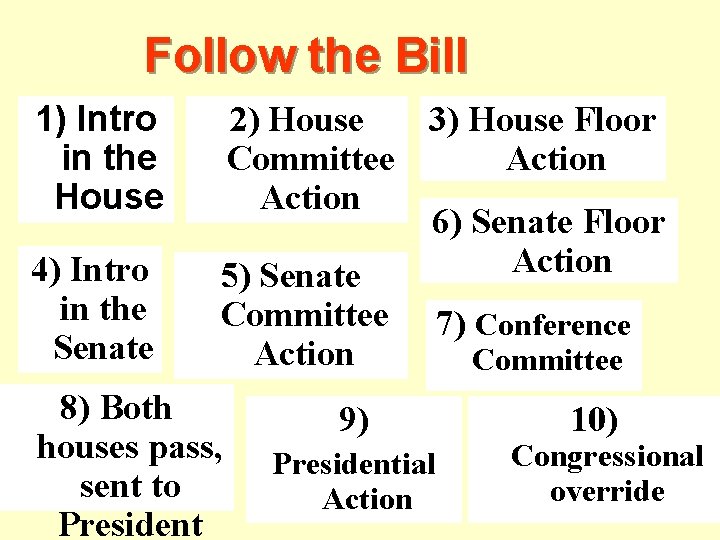
Follow the Bill 1) Intro in the House 4) Intro in the Senate 2) House 3) House Floor Committee Action 6) Senate Floor Action 5) Senate Committee 7) Conference Action Committee 8) Both houses pass, sent to President 9) Presidential Action 10) Congressional override

SCHOOL HOUSE ROCK • Teacher. Tube Videos - School House Rock
How Does a Bill Become Law? Consideration by Committee Assigning bills to committee – • after bill or resolution is introduced, it’s sent to standing committee for consideration • presiding officers of Senate, House make decision on assigning bills to committees 18
How Does a Bill Become Law? Consideration by Committee action, cont. After studying bill and debating its merits, committee has these options – • pigeonhole the bill – killing it by refusing to pass it out of committee (most bills) • “report bill out of committee favorably” with recommendation it be passed – returning it to floor of Senate or House • “mark up” bill – amend or change it • scrapping the bill – writing an entirely new one • “report a bill out unfavorably” – sending it to floor of Senate or House, not wanting responsibility for killing it 19
How Does a Bill Become Law? Floor Action Conducting business – • Article I, Section 5 of Constitution requires majority of members be present – a quorum – to do official business – very hard to do in House of Representatives, with 435 members – so, House meets this requirement by calling a Committee of the Whole • if at least 100 Representatives are present, the House simply declares itself one giant committee – the Committee of the Whole – • members can then conduct official business • all action taken this way must be approved, eventually, by entire House membership 20
How Does a Bill Become Law? Floor Action Rules for debate – • In House of Representatives – • only one bill can be considered at any time • debates for most bills is limited • all debate must be germane to subject – has to be relevant to bill under discussion • In Senate – • may consider several bills at the same time • Senators are allowed unlimited speaking time • debate does not have to be germane to subject 21
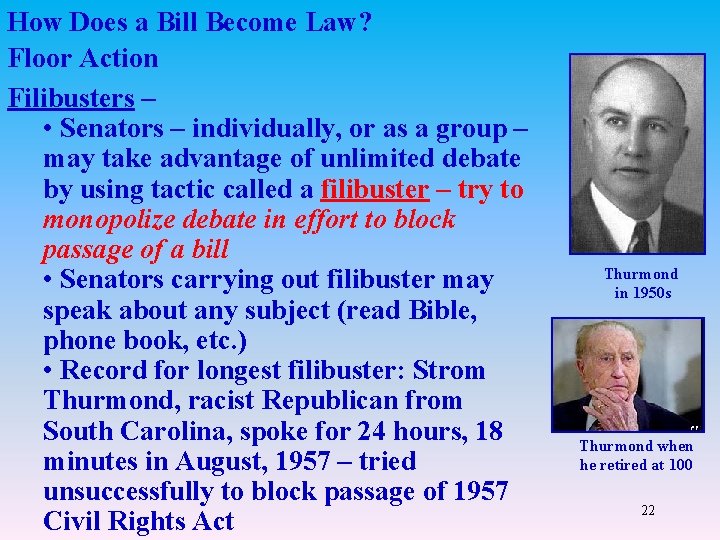
How Does a Bill Become Law? Floor Action Filibusters – • Senators – individually, or as a group – may take advantage of unlimited debate by using tactic called a filibuster – try to monopolize debate in effort to block passage of a bill • Senators carrying out filibuster may speak about any subject (read Bible, phone book, etc. ) • Record for longest filibuster: Strom Thurmond, racist Republican from South Carolina, spoke for 24 hours, 18 minutes in August, 1957 – tried unsuccessfully to block passage of 1957 Civil Rights Act Thurmond in 1950 s Thurmond when he retired at 100 22
How Does a Bill Become Law? Floor Action on bills – • During floor action on a bill, members of Congress have some options – • pass the bill as written, by simple majority vote, send it to other chamber for consideration • table the bill – by making a parliamentary motion to kill a bill – simple majority vote removes bill from further consideration • send bill back to committee for further consideration (effectively kills the bill) • amend bill, then decide whether to pass it or not – in Senate, amendments are called riders – and do not have to be germane to subject of bill 23
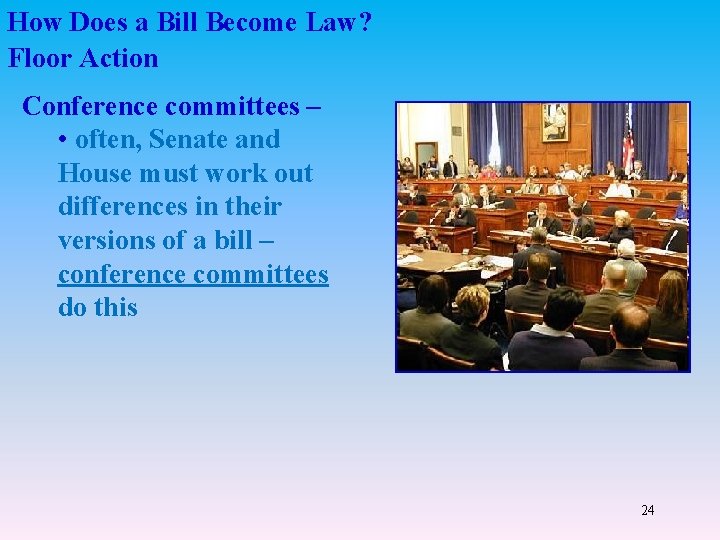
How Does a Bill Become Law? Floor Action Conference committees – • often, Senate and House must work out differences in their versions of a bill – conference committees do this 24
How Does a Bill Become Law? Floor Action Presidential approval – • President has these options, once he receives a bill passed by both houses of Congress: • sign the bill • veto the bill (veto = “I forbid” in Latin) • refuse to sign the bill – it becomes a law after ten days time without his signature • Overriding a presidential veto – requires 2/3 vote in both houses of Congress, considered “slap in the face” to president • Pocket veto: president’s indirect veto of a bill, by failing to act on it at the time Congress is adjourned (cannot be overridden by 2/3 vote) 25
How Does a Bill Become Law? Floor Action Presidential approval, cont. • Sometimes, Congress feels compelled to “make a statement” through overriding a presidential veto • Example: • 1986 – Congress passed a bill imposing economic and trade restrictions – sanctions – on Republic of South Africa, to show U. S. disapproval of that government’s racial policy of apartheid – strict, legal segregation of white and blacks; President Reagan vetoed the bill, both houses of Congress voted by 2/3 to override his veto 26
- Slides: 26