
The Federal Judiciary 1 2 3 4 5
- Slides: 60
The Federal Judiciary 1. 2. 3. 4. 5. 6. US Justice System and Federal Courts US Supreme Court Bill of Rights and Incorporation First Amendment Rights of the Accused Right to Privacy “The Supreme Court is the Constitution. ” -- Justice Felix Frankfurter
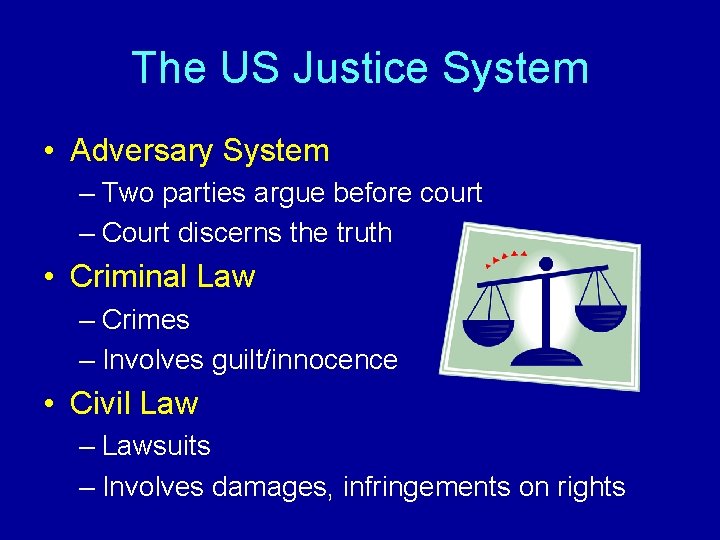
The US Justice System • Adversary System – Two parties argue before court – Court discerns the truth • Criminal Law – Crimes – Involves guilt/innocence • Civil Law – Lawsuits – Involves damages, infringements on rights
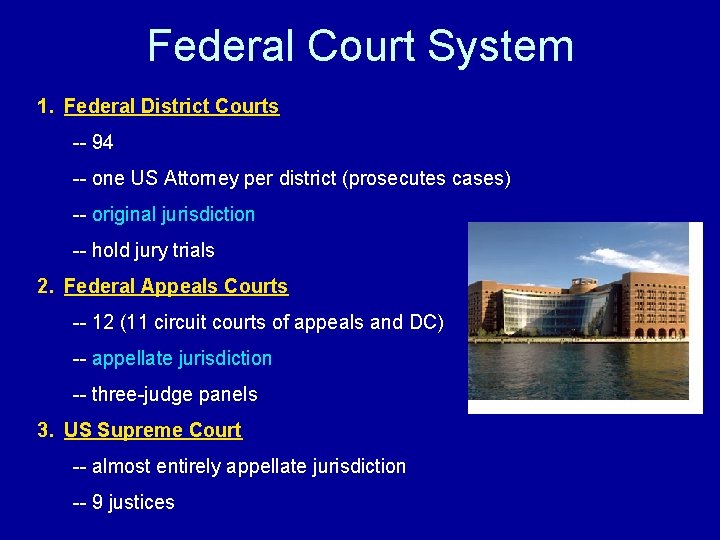
Federal Court System 1. Federal District Courts -- 94 -- one US Attorney per district (prosecutes cases) -- original jurisdiction -- hold jury trials 2. Federal Appeals Courts -- 12 (11 circuit courts of appeals and DC) -- appellate jurisdiction -- three-judge panels 3. US Supreme Court -- almost entirely appellate jurisdiction -- 9 justices
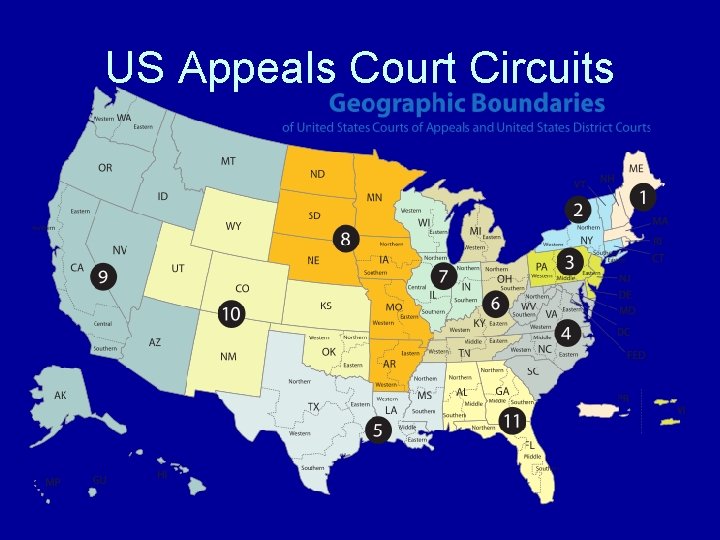
US Appeals Court Circuits
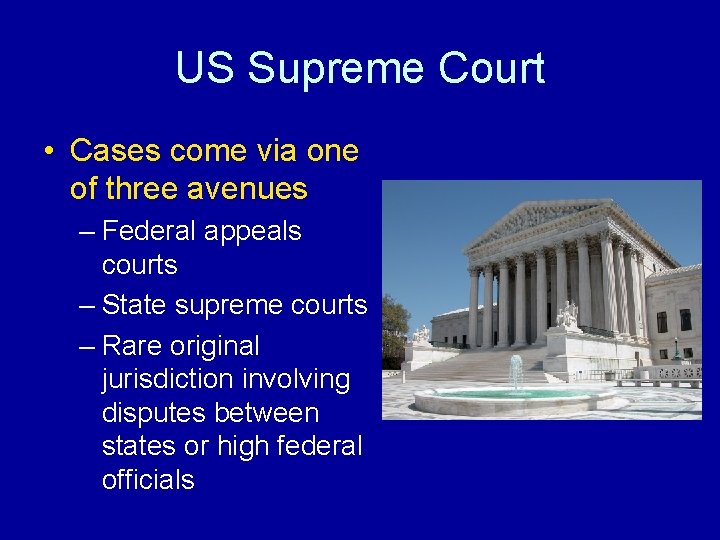
US Supreme Court • Cases come via one of three avenues – Federal appeals courts – State supreme courts – Rare original jurisdiction involving disputes between states or high federal officials
US Supreme Court • In most cases, the USSC must grant a writ of certiorari in order to hear a case. • Rule of Four – Four justices must agree to hear a case in order for a writ of certiorari to be granted. • Each year, the USSC hears only s small fraction of the cases appealed to it.
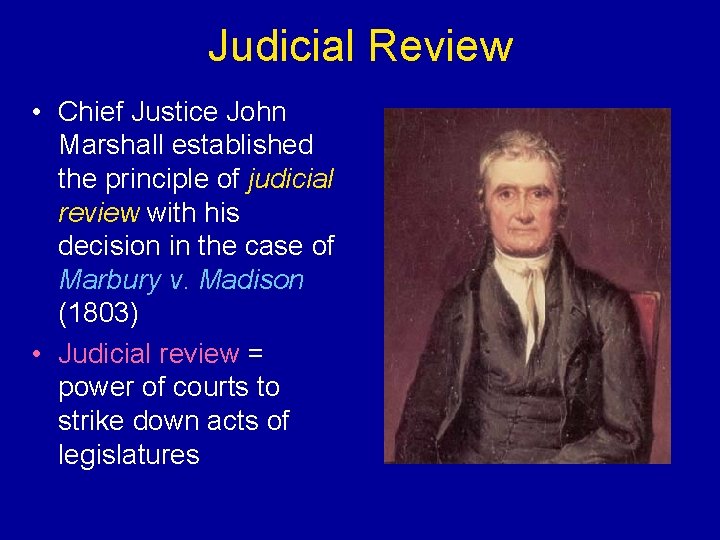
Judicial Review • Chief Justice John Marshall established the principle of judicial review with his decision in the case of Marbury v. Madison (1803) • Judicial review = power of courts to strike down acts of legislatures
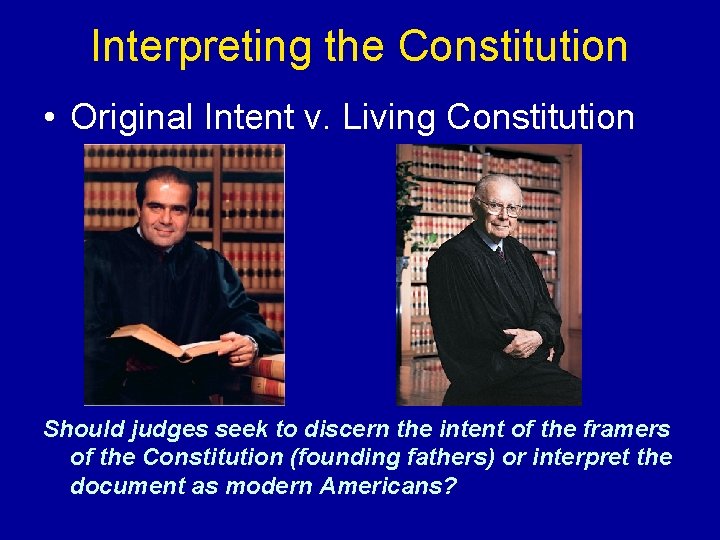
Interpreting the Constitution • Original Intent v. Living Constitution Should judges seek to discern the intent of the framers of the Constitution (founding fathers) or interpret the document as modern Americans?
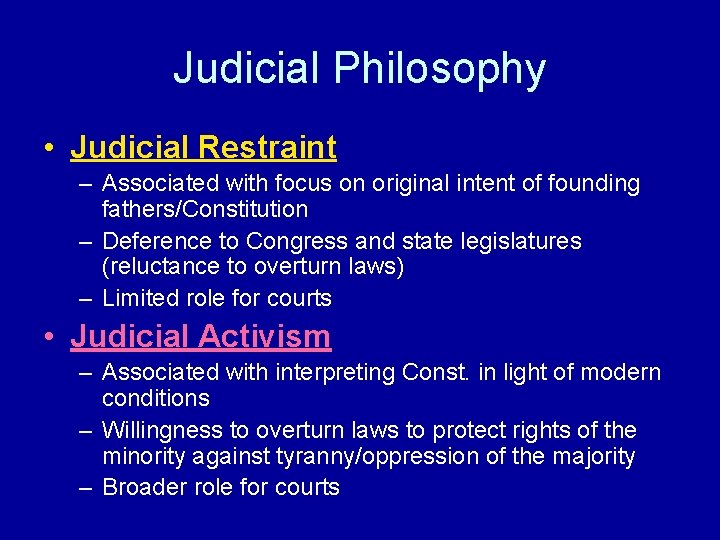
Judicial Philosophy • Judicial Restraint – Associated with focus on original intent of founding fathers/Constitution – Deference to Congress and state legislatures (reluctance to overturn laws) – Limited role for courts • Judicial Activism – Associated with interpreting Const. in light of modern conditions – Willingness to overturn laws to protect rights of the minority against tyranny/oppression of the majority – Broader role for courts
Supreme Court Cases • Two stages: – Written arguments – Oral arguments • Each side gets ½ hour • Attorneys’ presentations frequently interrupted by justices questions
Amicus Curiae Briefs • “friend of the court” briefs • Written arguments supporting one side of the case or the other • Submitted by interest groups or other interested parties
Bill of Rights • Amendments 1 -10 to the US Constitution • designed to protect fundamental rights of US citizens • directly applies only to acts of the federal government
14 th Amendment • Adopted in 1868 • Due Process Clause: – “No state shall. . . deprive any person of life, liberty, or property without due process of law. ” • intended to protect the fundamental rights of citizens against actions of state governments
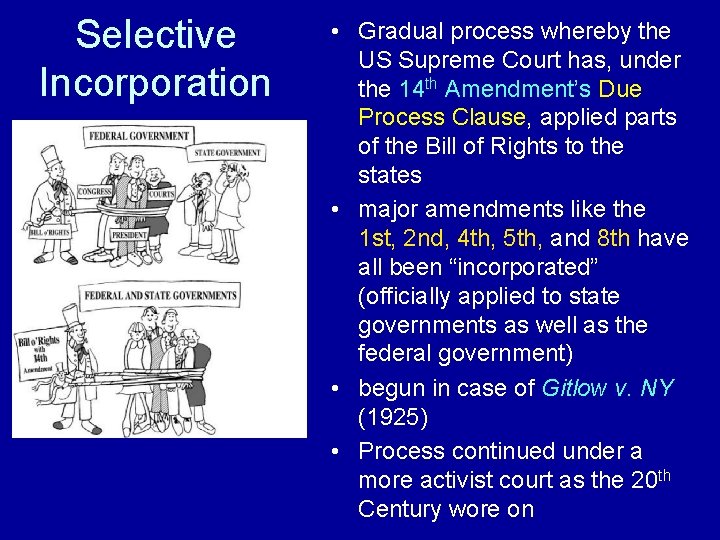
Selective Incorporation • Gradual process whereby the US Supreme Court has, under the 14 th Amendment’s Due Process Clause, applied parts of the Bill of Rights to the states • major amendments like the 1 st, 2 nd, 4 th, 5 th, and 8 th have all been “incorporated” (officially applied to state governments as well as the federal government) • begun in case of Gitlow v. NY (1925) • Process continued under a more activist court as the 20 th Century wore on
Selective Incorporation and the Warren Court • Gideon v. Wainwright (1962) – Incorporated 6 th Amendment right to counsel and started a chain-reaction of further incorporation during the 1960 s – Justice Hugo Black: “A provision of the Bill of Rights which is ‘fundamental and essential to a fair trial’ [according to the 6 th Am. ] is made obligatory upon the states by the Fourteenth Amendment. ”
Substantive Due Process • The incorporation of fundamental rights (parts of the Bill of Rights to be applied to states) through the 14 th Amendment’s Due Process Clause • Speech, religious freedoms, press, etc. were easily incorporated because they are spelled out in the Bill of Rights and, therefore, presumed “fundamental, ” BUT what about “rights” that might be considered “fundamental” but aren’t spelled out anywhere in the Constitution? • Marriage? , privacy?
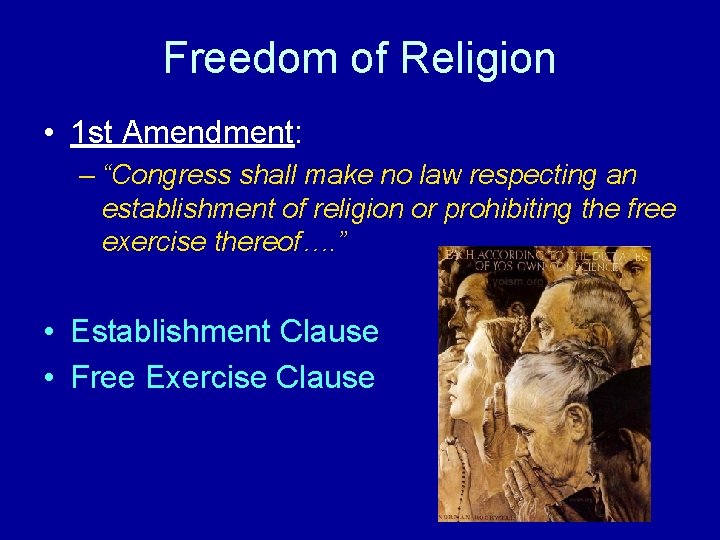
Freedom of Religion • 1 st Amendment: – “Congress shall make no law respecting an establishment of religion or prohibiting the free exercise thereof…. ” • Establishment Clause • Free Exercise Clause
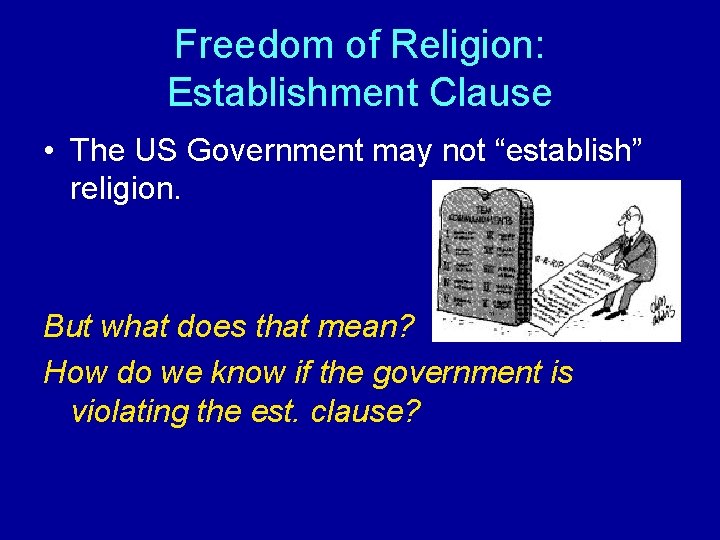
Freedom of Religion: Establishment Clause • The US Government may not “establish” religion. But what does that mean? How do we know if the government is violating the est. clause?
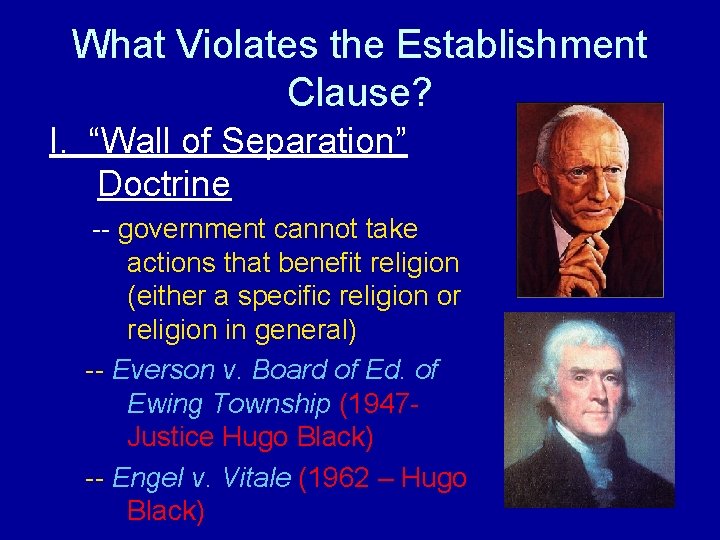
What Violates the Establishment Clause? I. “Wall of Separation” Doctrine -- government cannot take actions that benefit religion (either a specific religion or religion in general) -- Everson v. Board of Ed. of Ewing Township (1947 Justice Hugo Black) -- Engel v. Vitale (1962 – Hugo Black)
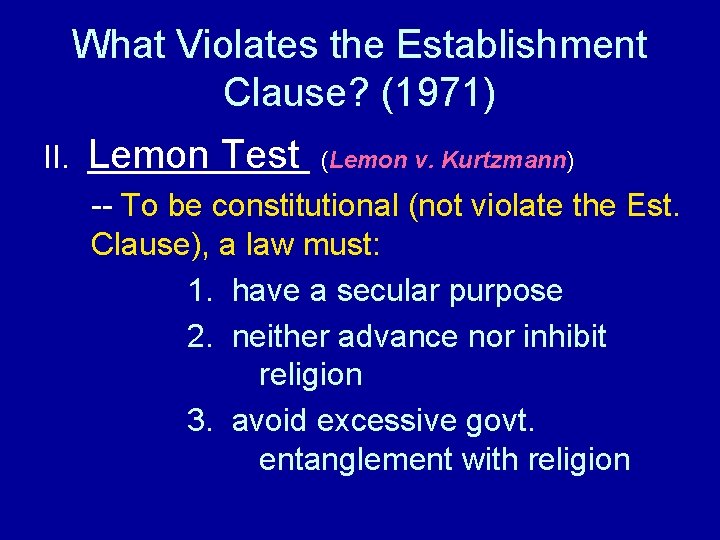
What Violates the Establishment Clause? (1971) II. Lemon Test (Lemon v. Kurtzmann) -- To be constitutional (not violate the Est. Clause), a law must: 1. have a secular purpose 2. neither advance nor inhibit religion 3. avoid excessive govt. entanglement with religion
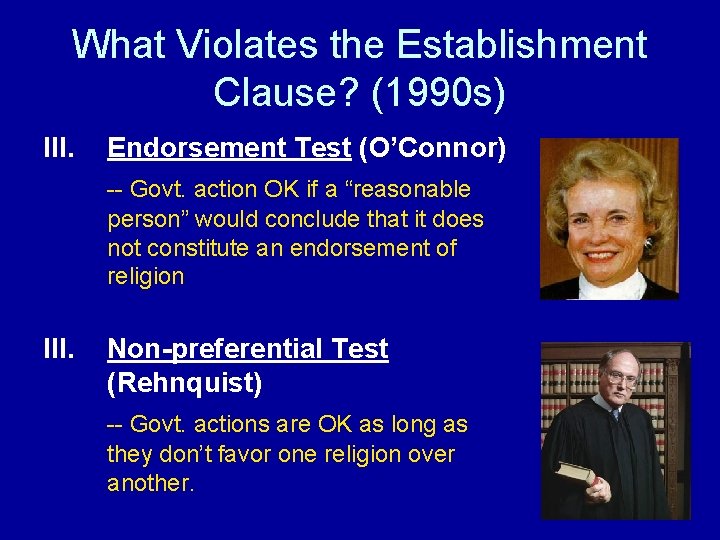
What Violates the Establishment Clause? (1990 s) III. Endorsement Test (O’Connor) -- Govt. action OK if a “reasonable person” would conclude that it does not constitute an endorsement of religion III. Non-preferential Test (Rehnquist) -- Govt. actions are OK as long as they don’t favor one religion over another.
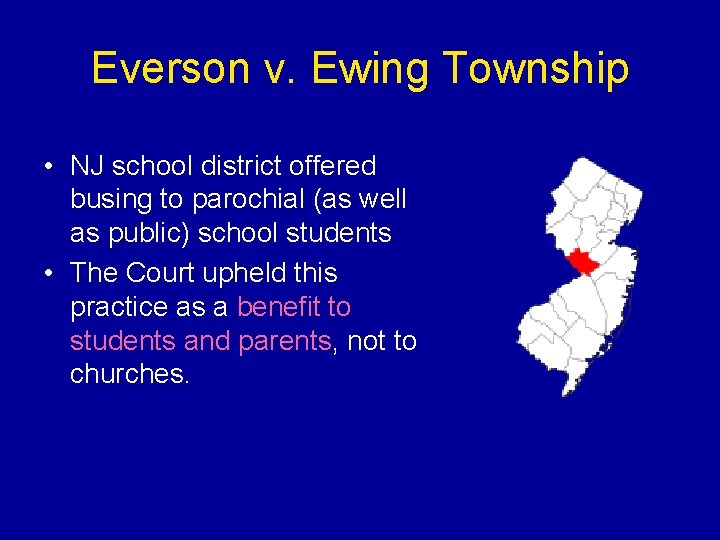
Everson v. Ewing Township • NJ school district offered busing to parochial (as well as public) school students • The Court upheld this practice as a benefit to students and parents, not to churches.
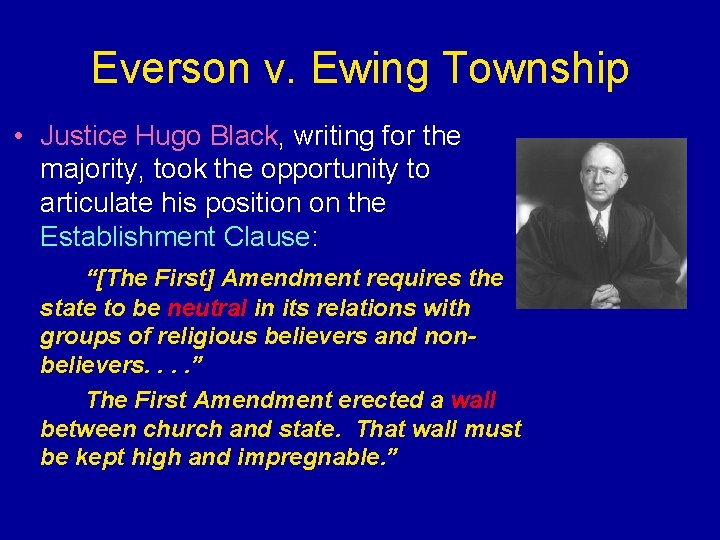
Everson v. Ewing Township • Justice Hugo Black, writing for the majority, took the opportunity to articulate his position on the Establishment Clause: “[The First] Amendment requires the state to be neutral in its relations with groups of religious believers and nonbelievers. . ” The First Amendment erected a wall between church and state. That wall must be kept high and impregnable. ”
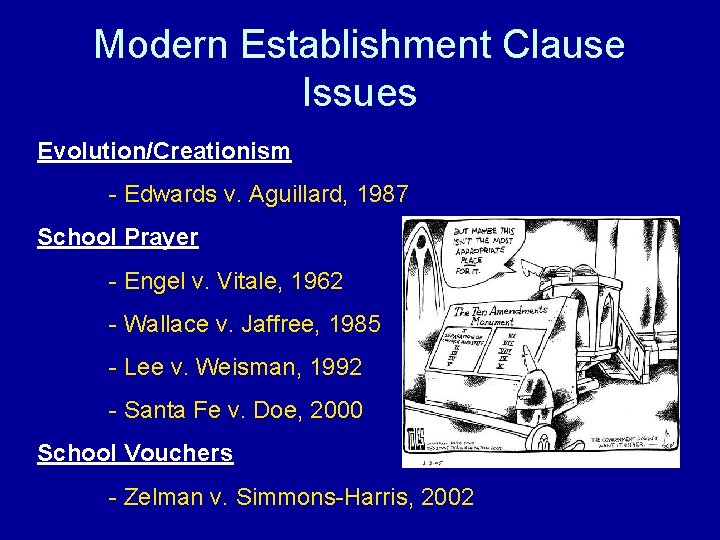
Modern Establishment Clause Issues Evolution/Creationism - Edwards v. Aguillard, 1987 School Prayer - Engel v. Vitale, 1962 - Wallace v. Jaffree, 1985 - Lee v. Weisman, 1992 - Santa Fe v. Doe, 2000 School Vouchers - Zelman v. Simmons-Harris, 2002
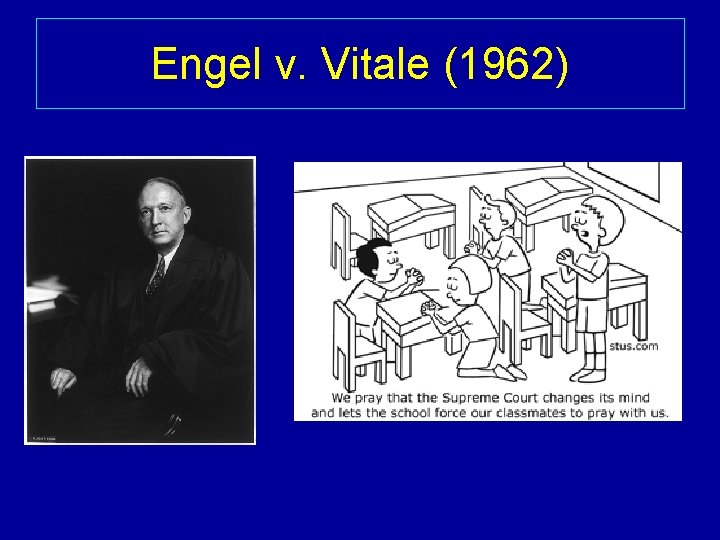
Engel v. Vitale (1962)
Wallace v. Jaffree (1985) “The record. . . reveals that the enactment of [the Alabama law] was not motivated by any clearly secular purpose – indeed, the statute has no secular purpose. ” “The sponsor of the bill, State Sen. Donald Holmes, in response to the question whether he had any purpose for the legislation other than returning voluntary prayer to public schools, stated, ‘No, I did not have no other purpose in mind. ’”
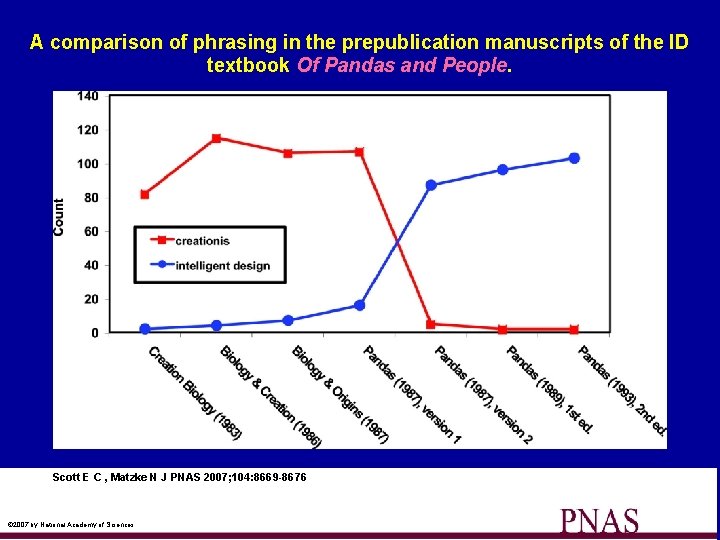
Edwards v. Aguillard (1987) • Louisiana law mandating the teaching of creationism struck down by USSC as violation of Establishment Clause • Justice William Brennan: “In this case, the purpose of the Creationism Act was to restructure the science curriculum to conform with a particular religious viewpoint. ” So what is “Intelligent Design, ” and is it related to the Court’s ruling in the Edwards case?
A comparison of phrasing in the prepublication manuscripts of the ID textbook Of Pandas and People. Scott E C , Matzke N J PNAS 2007; 104: 8669 -8676 © 2007 by National Academy of Sciences
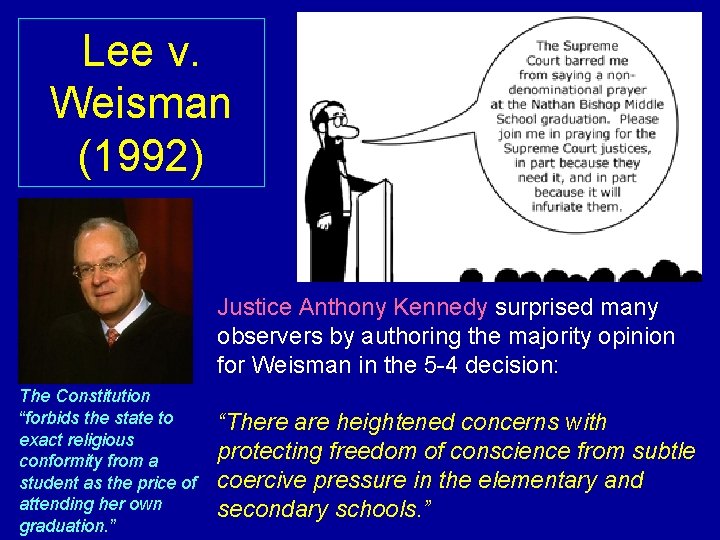
Lee v. Weisman (1992) Justice Anthony Kennedy surprised many observers by authoring the majority opinion for Weisman in the 5 -4 decision: The Constitution “forbids the state to exact religious conformity from a student as the price of attending her own graduation. ” “There are heightened concerns with protecting freedom of conscience from subtle coercive pressure in the elementary and secondary schools. ”
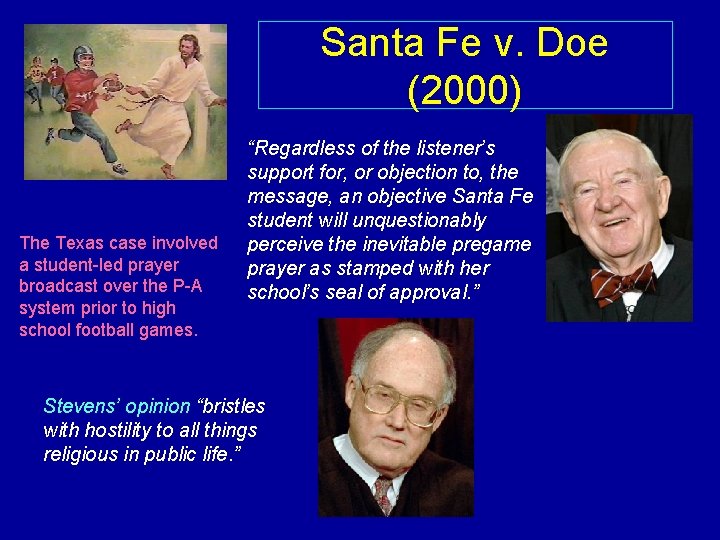
Santa Fe v. Doe (2000) The Texas case involved a student-led prayer broadcast over the P-A system prior to high school football games. “Regardless of the listener’s support for, or objection to, the message, an objective Santa Fe student will unquestionably perceive the inevitable pregame prayer as stamped with her school’s seal of approval. ” Stevens’ opinion “bristles with hostility to all things religious in public life. ”
Free Exercise Clause • Intended to protect the free practice of religion • Employment Division v. Smith (1992) – USSC upheld the denial of state unemployment benefits to an employee of the State of Oregon who failed a drug test when he tested positive for the illegal drug peyote and was fired -- The employee claimed that he used the drug as part of his membership in the Native American Church and that his use of it was, therefore, protected under the Free Exercise Clause. – USSC ruling: If a law has a legitimate secular purpose and doesn’t target a religious group, then it’s presumed to be Constitutional. (rational basis test)
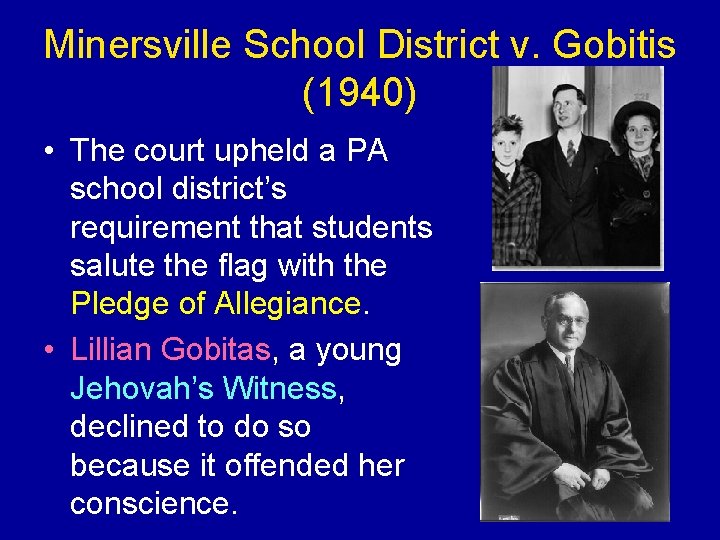
Minersville School District v. Gobitis (1940) • The court upheld a PA school district’s requirement that students salute the flag with the Pledge of Allegiance. • Lillian Gobitas, a young Jehovah’s Witness, declined to do so because it offended her conscience.
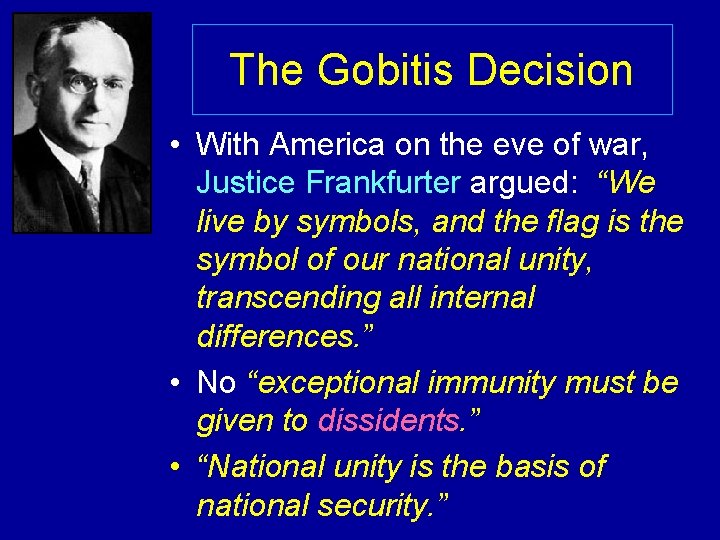
The Gobitis Decision • With America on the eve of war, Justice Frankfurter argued: “We live by symbols, and the flag is the symbol of our national unity, transcending all internal differences. ” • No “exceptional immunity must be given to dissidents. ” • “National unity is the basis of national security. ”
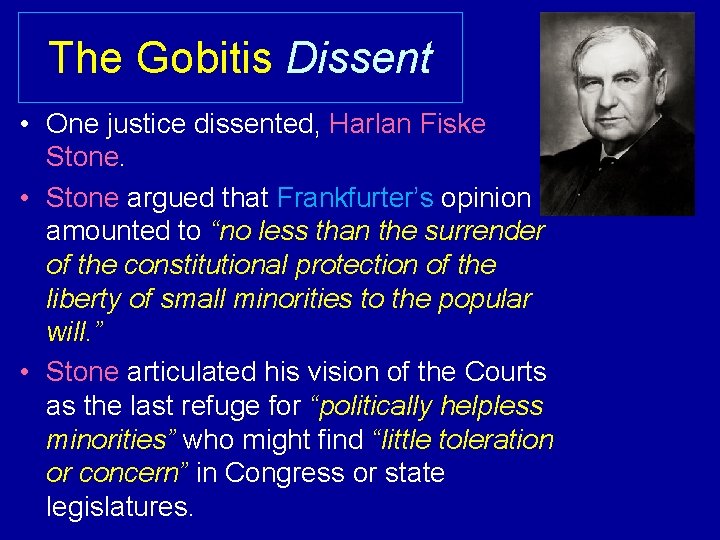
The Gobitis Dissent • One justice dissented, Harlan Fiske Stone. • Stone argued that Frankfurter’s opinion amounted to “no less than the surrender of the constitutional protection of the liberty of small minorities to the popular will. ” • Stone articulated his vision of the Courts as the last refuge for “politically helpless minorities” who might find “little toleration or concern” in Congress or state legislatures.
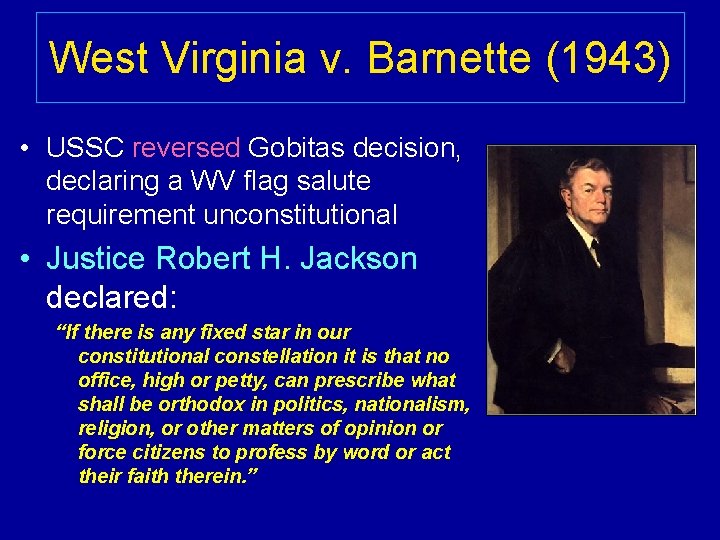
West Virginia v. Barnette (1943) • USSC reversed Gobitas decision, declaring a WV flag salute requirement unconstitutional • Justice Robert H. Jackson declared: “If there is any fixed star in our constitutional constellation it is that no office, high or petty, can prescribe what shall be orthodox in politics, nationalism, religion, or other matters of opinion or force citizens to profess by word or act their faith therein. ”
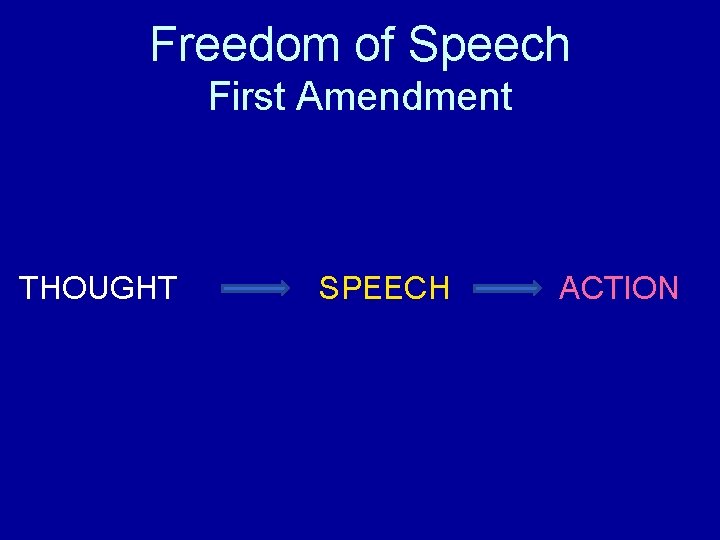
Freedom of Speech First Amendment THOUGHT SPEECH ACTION
Evolution of Free Speech Rights: Bad Tendency Test (early 1900 s) • Government may forbid speech that has a tendency to corrupt society
Evolution of Free Speech Rights: Clear and Present Danger Test • Developed by Justice Oliver Wendell Holmes in the case of Schenck v. US (1919) • “The question in every case is whether the words used are used in such circumstances and are of such a nature as to create a clear and present danger that they will bring about the substantive evils that Congress has a right to prevent. ”
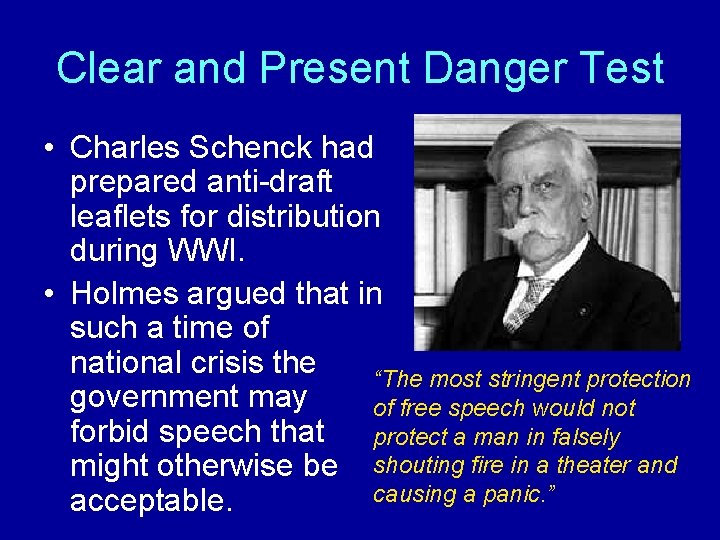
Clear and Present Danger Test • Charles Schenck had prepared anti-draft leaflets for distribution during WWI. • Holmes argued that in such a time of national crisis the “The most stringent protection government may of free speech would not forbid speech that protect a man in falsely might otherwise be shouting fire in a theater and causing a panic. ” acceptable.
Evolution of “Clear and Present Danger” Doctrine • In Abrams v. US (1919), Justice Holmes modified his own doctrine, arguing that the substantive danger posed by the speech in question must be “imminent” and probable. • Affirmed by the court in Brandenburg v. Ohio (1969)
Political Speech Today: Preferred Position Doctrine • Speech/expression should rarely be limited because it is so fundamental to a democratic society. • The courts should be especially suspicious of laws that limit free speech (especially if it involves political expression) and scrutinize them strictly. • Ordinarily, the govt. should only be allowed to regulate the time, place, and manner of speech.
Non-Protected Speech • • Fighting Words? Libel Obscenity Commercial Speech
Fighting Words • Words that themselves have the capacity to cause harm. – hate speech? – RAV v. St. Paul • Words that tend to directly incite illegal behavior – clear and persent danger? – Imminent and probable danger? The courts don’t really recognize the “fighting words” exception to free speech rights anymore, so it’s not actual law today.
Libel • Written defamation of another person • Different standard for public figures (“actual malice”) • Seditious Libel laws largely unconstitutional – NY Times v. Sullivan – It’s nearly impossible for a political figure/government official to win a libel suit.
Commercial Speech • Advertising, etc. • Commercial speech is being protected by the court more and more. • Laws against false/misleading advertising are still permissible.
Obscenity • Miller Test (Miller v. California, 1973) Limitation of expression is constitutionally permissible if the expression in question: 1. Appeals to “prurient” (sexual) interest 2. Depicts sexual conduct in a “patently offensive” (according to current community standards) way 3. Lacks serious literary, artistic, or scientific value
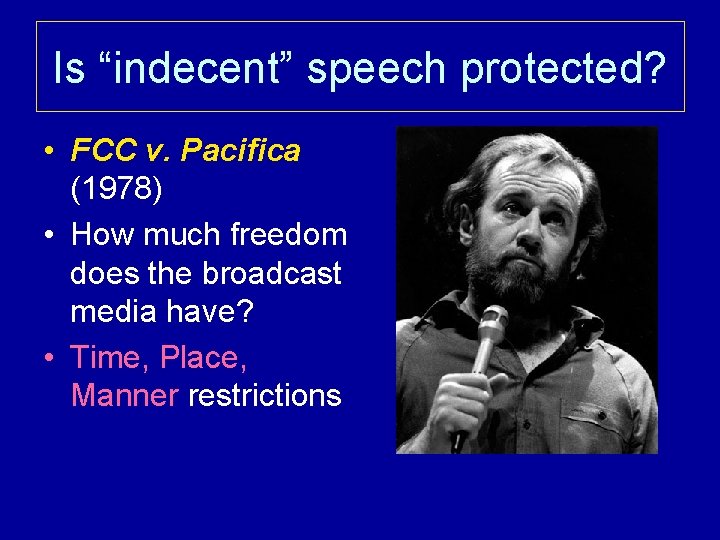
Is “indecent” speech protected? • FCC v. Pacifica (1978) • How much freedom does the broadcast media have? • Time, Place, Manner restrictions
“Equal Protection of the Laws” • The 14 th Amendment’s other really important clause. • Basically guarantees that the laws are applied to everyone equally and everyone has the same rights under the law (that is, equal protection of the laws)
Racial Equality • Brown v. Board of Education (1954) – USSC declared school segregation unconstitutional • Civil Rights Act of 1964 – Forbade segregation in “all public accomodations” – Forbade job discrimination • Voting Rights Act of 1965 – Allowed federal govt. (instead of states) to register voters to prevent racial discrimination in voting
Equal Protection Clause (14 th Amendment • In determining whether a law unconstitutionally discriminates against a group of people, the federal courts use one of two tests. . .
Equal Protection (14 th Amendment) • Rational Basis Test – Applied to most discrimination claims – The law in question need only have a legitimate basis/rationale and achieve its goals in a reasonable way • Strict Scrutiny Test – Used only for cases involving discrimination on the basis of race or national origin (so-called “suspect classifications” because they are groups that have historically suffered particularly severe discrimination – Govt. must have a compelling interest and accomplish it through the law by the least restrictive means possible
Equal Protection Gray Areas • Gender is not considered a suspect classification, but is considered a “quasisuspect classification” • Gender discrimination claims, therefore, are given “heightened scrutiny” (stricter than rational basis but not as strict scrutiny) by the courts.
Due Process Rights • 14 th Amendment: No state shall: “deprive any person of life, liberty, or property without due process of law. ” • Procedural due process – Concerns HOW govt. executes laws – Laws must be applied fairly • Substantive Due Process – Concerns WHAT laws govt. may create – Laws that violate “fundamental rights” of individuals are unconstitutional.
The Rise of Substantive Due Process Rights: Meyer v. Nebraska (1923) • USSC struck down Nebraska law forbidding teaching of German and other modern languages other than English • Justice James Mc. Reynolds: – Substantive Due Process rights include “the right of the individual to contract, to engage in any of the common occupations of life, to acquire useful knowledge, to marry, to establish a home and bring up children, to worship God according to the dictates of his own conscience, and generally to enjoy those common law privileges long recognized as essential to the orderly pursuit of happiness by free men. ”
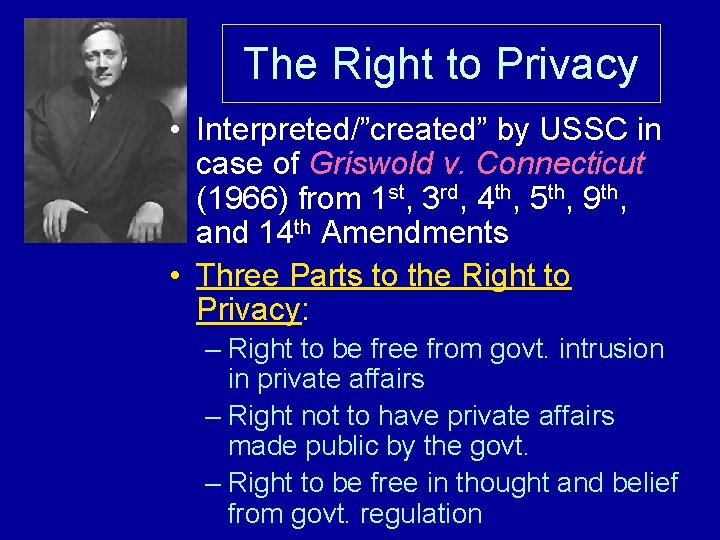
The Right to Privacy • Interpreted/”created” by USSC in case of Griswold v. Connecticut (1966) from 1 st, 3 rd, 4 th, 5 th, 9 th, and 14 th Amendments • Three Parts to the Right to Privacy: – Right to be free from govt. intrusion in private affairs – Right not to have private affairs made public by the govt. – Right to be free in thought and belief from govt. regulation
Abortion Rights (under the Right to Privacy) • Established in Roe v. Wade (1973) • Women have a constitutional right to choose to have an abortion. However, the govt. may limit that right. • Trimester System est. in Roe v. Wade: – 1 st Trimester: no regulation – 2 nd Trimester: reasonable regulation allowed – 3 rd Trimester: abortions, other than to preserve the life or health of the mother, may be prohibited
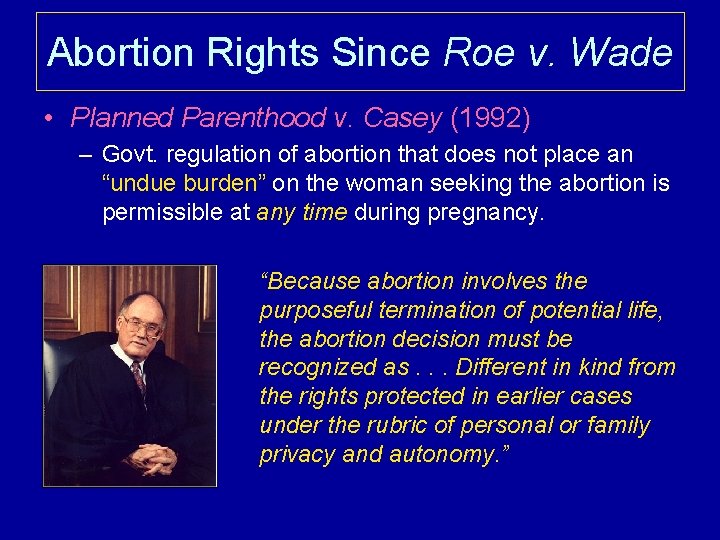
Abortion Rights Since Roe v. Wade • Planned Parenthood v. Casey (1992) – Govt. regulation of abortion that does not place an “undue burden” on the woman seeking the abortion is permissible at any time during pregnancy. “Because abortion involves the purposeful termination of potential life, the abortion decision must be recognized as. . . Different in kind from the rights protected in earlier cases under the rubric of personal or family privacy and autonomy. ”
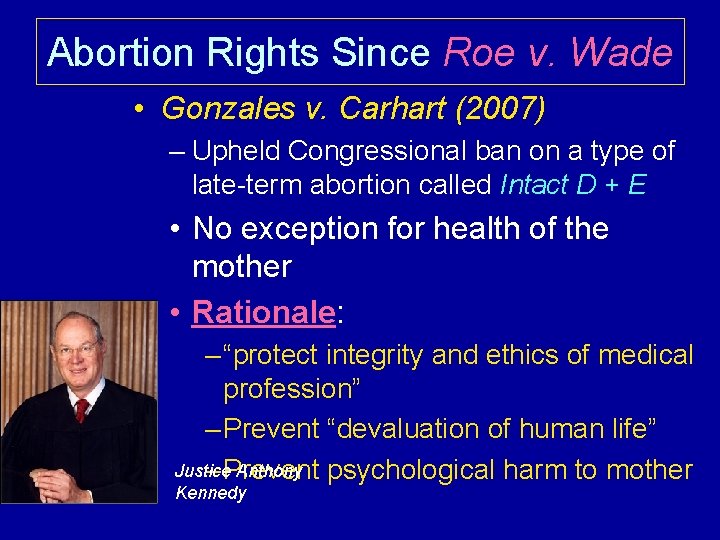
Abortion Rights Since Roe v. Wade • Gonzales v. Carhart (2007) – Upheld Congressional ban on a type of late-term abortion called Intact D + E • No exception for health of the mother • Rationale: – “protect integrity and ethics of medical profession” – Prevent “devaluation of human life” Justice Anthony psychological harm to mother – Prevent Kennedy
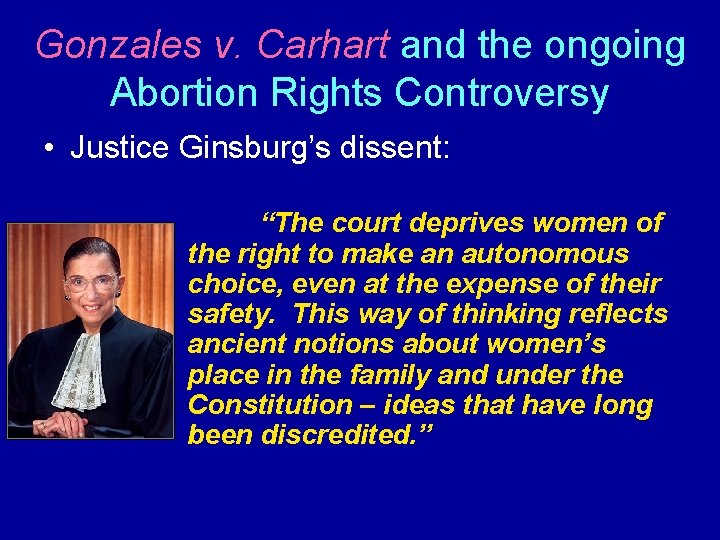
Gonzales v. Carhart and the ongoing Abortion Rights Controversy • Justice Ginsburg’s dissent: “The court deprives women of the right to make an autonomous choice, even at the expense of their safety. This way of thinking reflects ancient notions about women’s place in the family and under the Constitution – ideas that have long been discredited. ”