
The Federal Bureaucracy What does the word bureaucracy
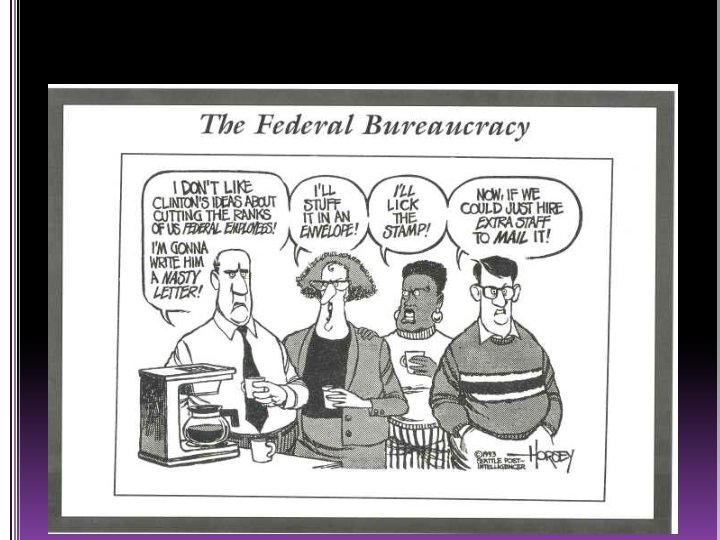
The Federal Bureaucracy What does the word “bureaucracy” mean? Bureaucracy = a large, complex organization composed of appointed officials. Complex means that authority is divided among several managers; no one person is able to make all the decisions. large corporations, universities and government agencies are examples of bureaucracies. With its sizeable staff, even Congress has become, to some degree, a bureaucracy.
The Federal Bureaucracy The American federal bureaucracy has its own set of characteristics that distinguish it from others: 1) Political authority over the bureaucracy is not in one set of hands but is shared among several institutions. 2) Most of the agencies of the federal government share their functions with related agencies in state and local governments. 3) Government agencies operate under close public scrutiny and with a greater prospect of court challenges to its authority than in almost any other nation.
The Federal Bureaucracy Who are the bureaucrats? Where do they work?
The Federal Bureaucracy Is…. • • • 4 million employees; 2. 8 million are civilians or “civil servants” President only appoints 3% (patronage or political appointments) 15 cabinet level departments 200+ independent agencies with 2, 000+ bureaus, divisions, branches, etc. Biggest - Department of Defense, U. S. Postal Service, Veterans Administration
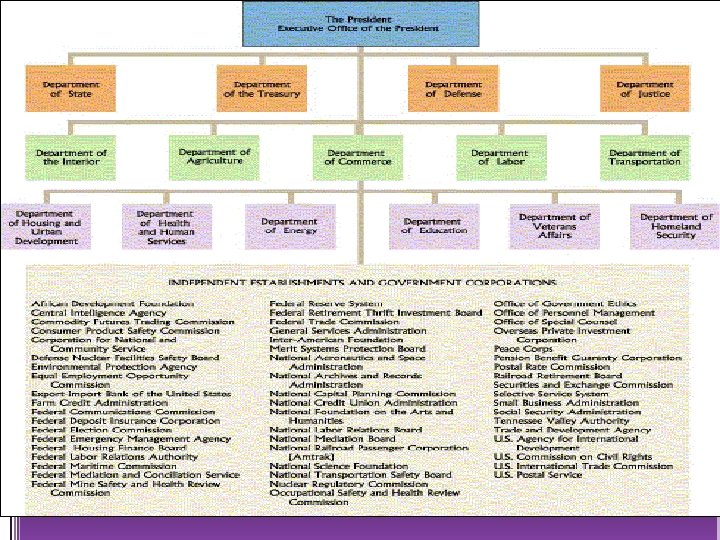
Cabinet Departments Each cabinet is headed by a secretary. Appointed by the President and must be confirmed by the Senate. Directly responsible to the President. Responsibility is further divided among undersecretaries and assistant secretaries. Total of 15 cabinet departments. The cabinet departments carry out the President’s policy in specific areas. Examples: �Department �Department of of of State Treasury Defense Justice Education Homeland Security
Independent Regulatory Agencies and Commissions Regulate almost every aspect of everyday life for most Americans. Make rules for specific areas of business or the economy and other areas that effect public interest. Each is directed by five to ten presidential appointees. Each agency or commission is usually balanced with members of both major political parties. They operate independently. Examples: �Interstate Commerce Commission �Federal Trade Commission �Securities & Exchange Commission �Federal Reserve Board �National Labor Relations Board
Independent Executive Agencies Smaller and less complex than cabinet departments and have narrower areas of responsibility Agency heads usually are appointed by and responsible to the President. Some of the agencies are responsible for specialized areas of policy but largely fulfill administrative responsibilities. Examples: �CIA (Central Intelligence Agency) �FEC (Federal Election Commission) �GSA (General Services Administration) �EPA (Environmental Protection Agency) �NASA (National Aeronautics & Space Administration)
Government Corporations Blend of a private corporation and government agency. More control over their budgets and more freedom and flexibility to decide how to use their earnings. Examples: �U. S. Postal Service �TVA (Tennessee Valley Authority) �Amtrak �Corporation for Public Broadcasting
- Slides: 13