
The Federal Bureaucracy The Fourth Branch of Government
The Federal Bureaucracy The Fourth Branch of Government Wilson- Chapter 15
Our American Bureaucracy • The agencies, departments, commissions, etc. in the Executive Branch • Executive Office of the President • Cabinet • Independent Agencies o o Organized like Cabinet depts. , but lack cabinet status NASA, SBA, FEMA o Post Office, FDIC, TVA • Govt Corporations
Our American Bureaucracy • Independent Regulatory Commissions o Created by Congress to regulate important aspects of the nation’s economy o Decisions are usually beyond presidential control (though Commissioners are appointed by the president) 1. Commissioners. Serve long terms (5 -14 years) 2. Only a bare majority of commissioners can be of same party 3. Staggered terms 4. Commish can only be fired by Prez for causes Congress has specified
Our American Bureaucracy • Independent Regulatory Commissions Continued o Commish has quasi-legislative power. Rules and regulations which have the force of law. o Quasi-judicial power: settle disputes in their fields (FCC fines of Howard Stern) o Some commissions: § Federal Reserve Board § FCC § NLRB § FEC § SEC § FTC
Growth of the Bureaucracy • Spoils system prior to late 19 th Century • Assassination of Prez. Garfield by disappointed office seeker in 1881 led to passage of Pendleton Act o Civil service created with exam-based merit system o Today, 90% of fed employees are civil service
Growth of the Bureaucracy • Size o 3 million plus = extremely LARGE! o Fairly consistent # since the 50 s § Does this mean bureaucrats are just more efficient since there are more programs and responsibilities? § Why or why not?
Growth of the Bureaucracy • Power o Discretionary Authority: Agencies have the power to choose various courses of action when Congress writes broadly-worded laws o Passing rules and regulations o Help Congress draft legislation o Advice to the WH o Settle disputes
Growth of the Bureaucracy • Reasons for Growth: o National growth o Technology o International Crises (Defense Dept) o Welfare Nation o Agencies perpetuate their own survival
Bureaucratic behavior • Recruitment and retention o Appointed by merit system exam § Ways around this (job qualification only one person can fill, temp appointment, lower job w/ responsibilities) o Bonus pts for vets, o Difficult to fire race, gender
Bureaucratic behavior • Recruitment and retention o Impact of policies § Loyalty to agency § Continuity of agency behavior § Expertise § Managers must have support of subordinates
Bureaucratic behavior • Personal Attributes o Representative of American people o Upper level: middle aged white males o Tendency to be more liberal o Activist agency workers are more liberal (EPA) o 30% in Defense o Less than 15% in welfare
Bureaucratic behavior • Legal Constraints o Freedom of Information Act o Hatch Act: limits political activity of Bureaucrats o Affirmative Action o Environmental Impact reports on projects
Services • Competitive Service – offices where one is appointed on the basis of merit, through test or credentials • Schedule C – jobs that have policy determining or confidential character below cabinet level – aide, special advisor • Expected – employees hired outside competitive service, NOT hired by OPM , CIA, FBI, Post office
Is It independent? • Can seem independent – Large – Specialized expertise – VERY difficult to fire people in the bureaucracy – Agencies are independent – Congress and prez delegate authority to bureaucracy • They can’t handle everything, so you handle it – Discretionary authority – legislation lacks detail, so bur. can fill it in
Controlling the Bureaucracy • Presidential Influence o Appoint/ Fire top-level o Propose reorganization of exec. Branch o Propose Agency budgets o 7000 senior appointments • Checks on Prez influence o Senate confirmation o Congress approves reorganization o Congress approves budgets
Controlling the Bureaucracy • Congressional Influences o Appropriations of agency budgets o Standing Committee oversight o Reorganization o Appointment confirmation o Sunset laws give agencies limited life • Checks on Congressional influence o Members benefit from agencies in state/district o Easier to have bur. work out details of laws o No legislative veto
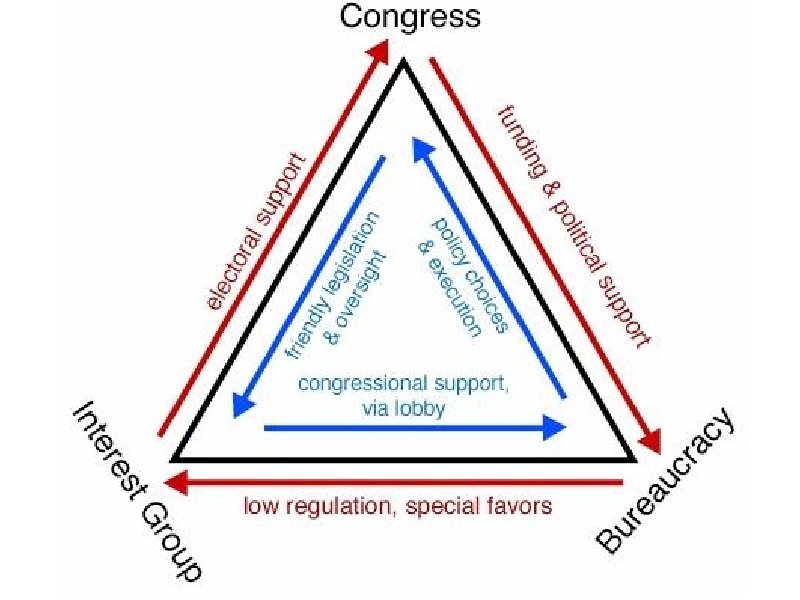
Controlling the Bureaucracy • Interest Group Influence o Revolving door o Client groups o Iron Triangles (Congressional Comm, Relevant Agency, Interest Group) • Media Influence • Courts • Privatization of some aspects (Concessions in national parks) • Gore’s 1993 National Performance Review
NPR • Found the bureaucracy was too centralized – Too rule bound – Too little concern with making programs work – Too much concerned with scandal • ALWAYS C. Y. A… • Bureaucracy is tied to gov’t problems
Weberian Model Weber’s essential features of a bureaucracy: • Hierarchical Authority Structure o power flows from top down and responsibility from the bottom up • • Task Specialization Extensive Rules Merit Principle Impersonality
How would you evaluate the Bureaucracy?
- Slides: 23