
The Federal Bureaucracy Chapter 15 The Bureaucrats What
The Federal Bureaucracy Chapter 15
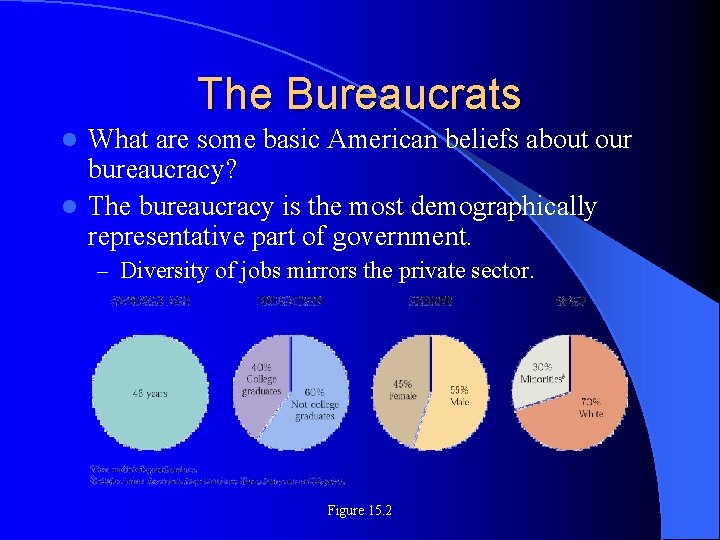
The Bureaucrats What are some basic American beliefs about our bureaucracy? l The bureaucracy is the most demographically representative part of government. l – Diversity of jobs mirrors the private sector. Figure 15. 2
The Bureaucrats l How did civil service reform change the bureaucracy? – Office of Personnel Management: The federal office in charge of most of the government’s hiring. l What jobs aren’t filled through the Civil Service System? – “Plum jobs”
Theories of Bureaucracy l The Weberian Model – Hierarchical, specialized, meritocracy l The Acquisitive, Monopolistic Bureaucracy – Competing bureaucracies control govt, expand spend l “Garbage Can” Bureaucracies – Trial and error, not well organized or supervised, ineffective

The Cabinet Departments 15 Cabinet departments headed by a Secretary (except DOJ under the Attorney General) l Each has its own budget, staff and policy areas l Expanded over time to deal with relevant issues – What is the most recent addition? l What is the difference between “Defense” and “Homeland Security”? l
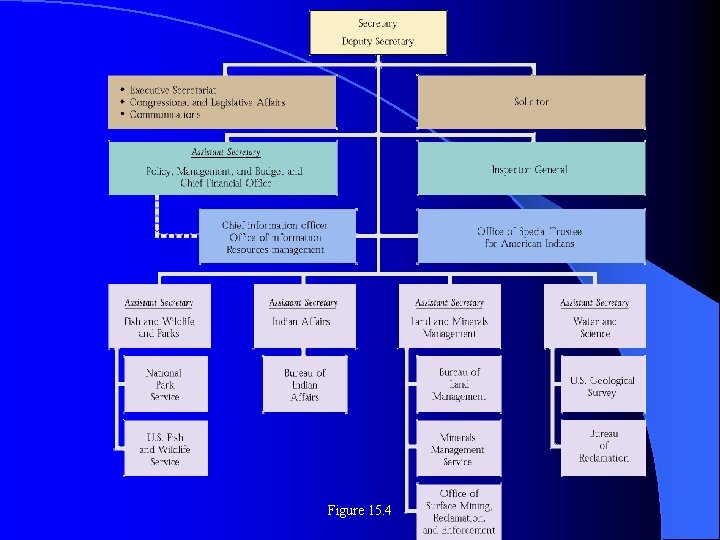
Figure 15. 4
Executive Agencies l Regulatory Agencies – Independent: Responsible for some sector of the economy, making rules and judging disputes to protect the public interest – Headed by commissions – What is meant by “regulatory capture”?
Executive Agencies l Government Corporations – Business-like: Provide a service like private companies and typically charge for services l Independent Executive Agencies – Serve a specific purpose, created and serve with support of the president
Implementation Translating the goals and objectives of a policy into an operating, ongoing program l Includes: – Creating / assigning an agency the policy – Turning policy into rules, regulations and forms. – Coordinating resources to achieve the goals. l Can fail due to program design, lack of clarity, lack of resources, or administrative routine l
Implementation: A Case Study l The Voting Rights Act of 1965 – Generally considered a success. – Had a clear, concise goal. – The implementation was clear. – Those carrying out the law had obvious authority and vigor to do so.
Regulation Use of governmental authority to control or change some practice in the private sector. l Command-Control Policy: Government tells business how to reach certain goals, checks the progress and punishes offenders. l Incentive System: Market-like strategies are used to manage public policy. l Some agencies are proactive, some are reactive. l
Deregulation l The lifting of restrictions on business, industry and professional activities. l Regulatory problems: – Raises prices – Hurts U. S. ’s competitive position abroad – Does not always work well l But why were regulations created?
Understanding Bureaucracies l Bureaucracy and Democracy – Presidents try to control the bureaucracy through appointments, executive orders, budget tinkering, reorganization – Congress tries to control the bureaucracy by influencing appointments, changing budget, holding hearings, rewriting legislation
Understanding Bureaucracies l Bureaucracy and Democracy – Iron Triangles and Issue Networks A mutually dependent relationship between bureaucratic agencies, interest groups, and congressional committees or subcommittees. l Some argue they are being replaced by wider issue networks that focus on more policies. l
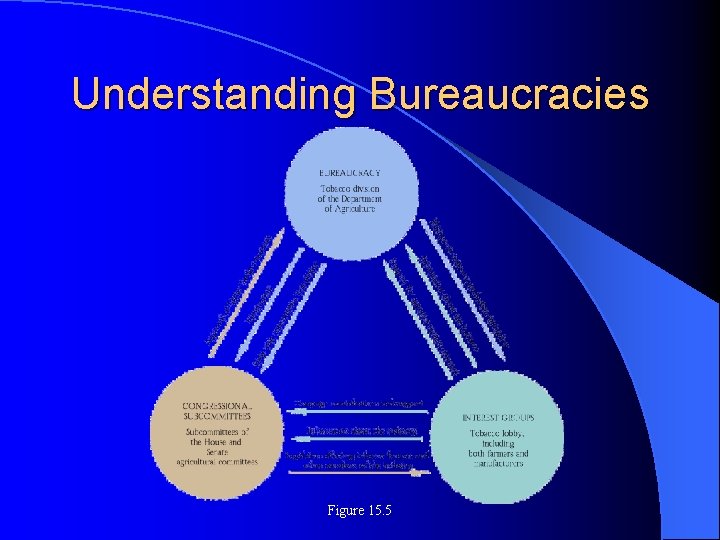
Understanding Bureaucracies Figure 15. 5
Understanding Bureaucracies l How does bureaucracy impact the size and scope of government?
- Slides: 16