
The Federal Budget And Fiscal Policy The Federal
The Federal Budget And Fiscal Policy
The Federal Budget Is composed by: 1. Government expenditures (Government spending). 2. Tax revenues Note: Government expenditures = Government purchases + Government transfer payments
Government Expenditures Government expenditures Table Page 222.
Government Tax Revenues o Table Page 223. o Income tax structures: 1. Progressive income tax. One’s tax rate rises as one’s taxable income rises. 2. Proportional income tax. One’s tax rate is the same no matter what one’s taxable income is. 3. Regressive income tax. One’s tax rate declines as one’s taxable income rises.
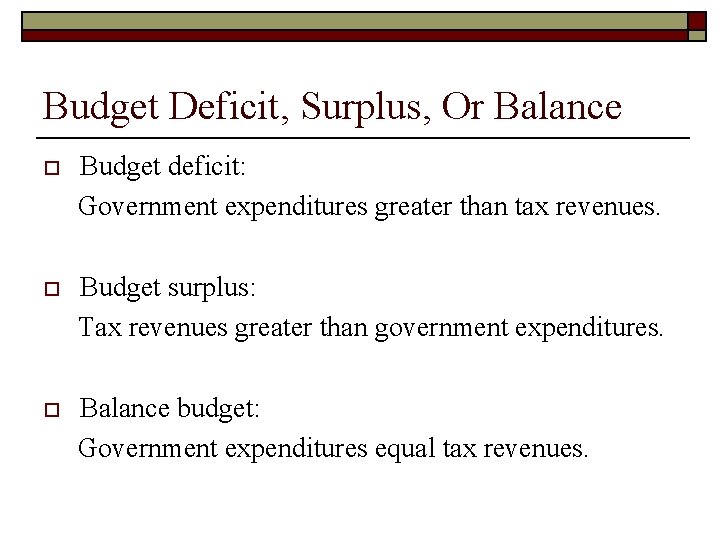
Budget Deficit, Surplus, Or Balance o Budget deficit: Government expenditures greater than tax revenues. o Budget surplus: Tax revenues greater than government expenditures. o Balance budget: Government expenditures equal tax revenues.

Cyclical Deficit: o The part of the budget deficit that is a result of a downturn in economic activity. Example: Budget is balanced, Real GDP drops, transfer payment rises, Government expenditure rises, Tax revenues fall, Budget deficit.
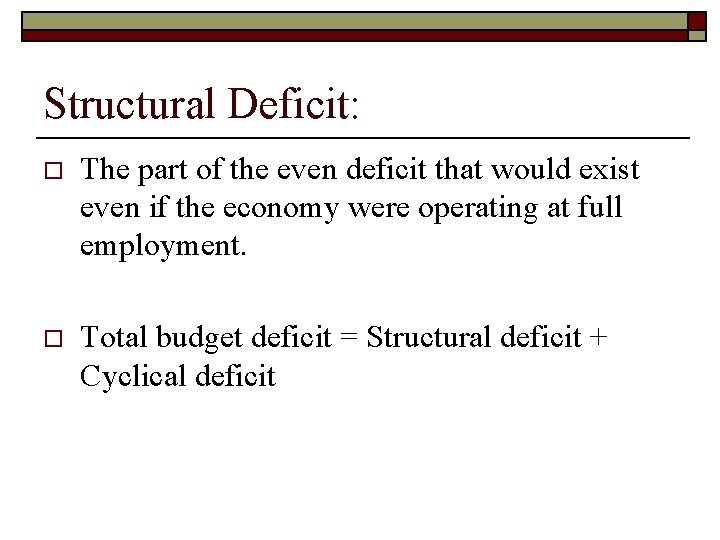
Structural Deficit: o The part of the even deficit that would exist even if the economy were operating at full employment. o Total budget deficit = Structural deficit + Cyclical deficit
Fiscal Policy: o Changes in government expenditures and/ or taxes to achieve particular economic goals (such as low unemployment, stable prices, and economic growth).
Some Relevant Fiscal Policy Terms: 1. 2. Expansionary fiscal policy. Increases in government expenditures and/or decreases in taxes. Contractionary fiscal policy. Decreases in government expenditures and/or increases in taxes.
Demand Side Fiscal Policy o Fiscal policy can affect demand side of the economy (Aggregate Demand).
Shifting The Aggregate Demand (AD) Curve o An increase in government purchases (G) increase AD and shift the AD curve to the right. o A decrease in G decreases AD and shifts the AD curve to the left.
Shifting The Aggregate Demand (AD) Curve (continued) o A change in taxes (T) can affect consumption (C) or investment or both an therefore can affect AD. o A decrease in income taxes increases disposable income (after tax income), increases the consumption, AD curve shifts to the right. o An increase in taxes decreases disposable income, lowers consumption, shifts the AD curve to the left.
Shifting The Aggregate Demand (AD) Curve (continued) o Exhibit 2 Page 228.
Crowding Out: Questioning Expansionary Fiscal Policy o Crowding out: The decrease in private expenditures that occurs as a consequence of increased government spending or the finance needs of a budget deficit.
o Crowding out can be: 1. Direct effect. Example: The government spends more on public libraries, and individuals buy fewer book at bookstores. 2. Indirect effect. Example: The government spends more on social programs and defense without increasing taxes, as a result, the size of budget deficit increases. Exhibit 3 Page 230.
Types Of Crowding Out: 1. 2. 3. Zero crowding out (no crowding out). Example: Government spends $ 2 billion more, and private sector spending stays constant. Complete crowding out. Example: Government spends $ 2 billion more, and private sector spends $ 2 billion less. Incomplete crowding out. Example: Government spends $ 2 billion more, and private sector spends $ 1. 2 billion less
Lags And Fiscal Policy o Would fiscal policy to be used to solve the problem of inflationary and recessionary gaps? The answer is not necessarily, because the lag exist, such as: 1. The data lag 2. The wait and see lag. 3. The legislative lag. 4. The transmission lag. 5. The effectiveness lag.
Supply Side Fiscal o A reduction in tax rates may alter an individual’s incentive to work and produce, altering AS. o Tax rates may affect AS and AD. o Lower marginal tax increases the incentive
- Slides: 18