
The Febrile Infant BY DRA Fatma s al
The Febrile Infant BY: DRA. Fatma. s. al zahrani
The Febrile Infant Definition: n Temperature >/= 38 C (100. 4 F ) n Rectal temp closely correlates with core body temperature n Ear/Axillary/Sticker temps are unreliable. n Temps vary depending upon time of day
The Febrile Infant Fever Without A Source (FWLF) Acute febrile illness in which the etiology of the fever is not localized after the history and physical examination.
The Febrile Infant Pathogenesisof fever: Pathogens → cytokine release →resets thermoregulation of hypothalamus→ maintains a higher body temperatur Infants < 3 months less likely to have fever
The Febrile Infant What to do? Obtaining detailed History n Age n Parents report of wellbeing n Parents report of specific symptoms n Height and presence of fever n Risk Factors (Prematurity, Immunocompromised) n Epidemiologic Factors (Sick contacts)
The Febrile Infant Physical Exam n Give anti pyretic to relax the child if irritable or in pain n Perform throughu physical examination. n Look for evidence of serious illness n Meningeal signs may not be apparent < 18 mo
The Febrile Infant Approach 1)The high risk age is: n 0 – 28 days n 28 – 90 days n 3 – 36 months
The Febrile Infant 2)Toxic Appearing n A clinical picture consistent with the sepsis syndrome: n Lethargy n Poor Perfusion n Hypoventilation n Hyperventilation n Cyanosis
The Febrile Infant 3)Lethargy: Poor eye contact &poor interaction with parents and people arround
The Febrile Infant Assessing Risk �Rochester Fever Criteria �Yale Observation Scale (Clinical)
The Febrile Infant Rochester Criteria for Febrile Infants Ages 60 – 90 Days Criteria n Well appearing/Full term n No skeletal, soft tissue, skin, or ear infections n Previously healthy n WBC 5000 – 15, 000 n Bands <1500 n UA: WBC’s < 10/hpf n If diarrhea: fecal Leukocytes <5/hpf Interpretation n Well appearing febrile infant risk: 7 -9% n All Rochester Criteria present: < 1%
The Febrile Infant Yale Observation Scale 3 - 36 Months n Quantifies “Toxic Appearance” n Quality of Cry n Reaction to parents n Arousability n Color n Hydration n Social Response Interpretation: Risk increases with higher scores
The Febrile Infant Low Risk Infants n Previously Healthy/Full term n No focal Bacterial Infection on PE n Good social situation n Nontoxic clinical appearance n Negative lab screening: n WBC 5000 – 15, 000 n < 1500 Bands n Normal UA n < 5 WBCs/hpf in stool if diarrhea present
The Febrile Infant Management: n Infants 0 – 28 Days n ALL infants should be admitted , with full sepsis workup (Blood, Urine, CSF) n Empiric parenteral antibiotic therapy pending negative cultures.
The Febrile Infant Management: Infants 0 – 28 Days Most common bacterial organisms (Group B Strep, E. Coli, Listeria) Antibiotic coverage n Ampicillin and Gentamicin OR n Ampicillin and Cefotaxime
The Febrile Infant Management: Infants 28 – 90 Days Febrile Infant n Toxic OR Nontoxic n High Risk OR Low Risk n Inpatient OR outpatient
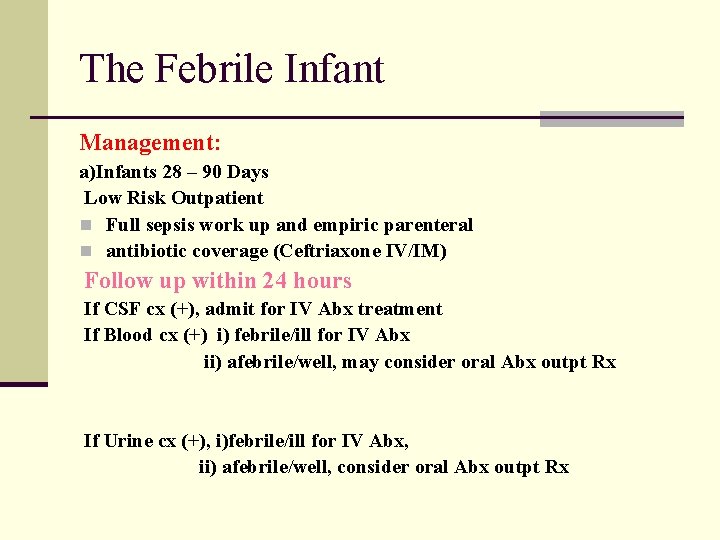
The Febrile Infant Management: a)Infants 28 – 90 Days Low Risk Outpatient n Full sepsis work up and empiric parenteral n antibiotic coverage (Ceftriaxone IV/IM) Follow up within 24 hours If CSF cx (+), admit for IV Abx treatment If Blood cx (+) i) febrile/ill for IV Abx ii) afebrile/well, may consider oral Abx outpt Rx If Urine cx (+), i)febrile/ill for IV Abx, ii) afebrile/well, consider oral Abx outpt Rx
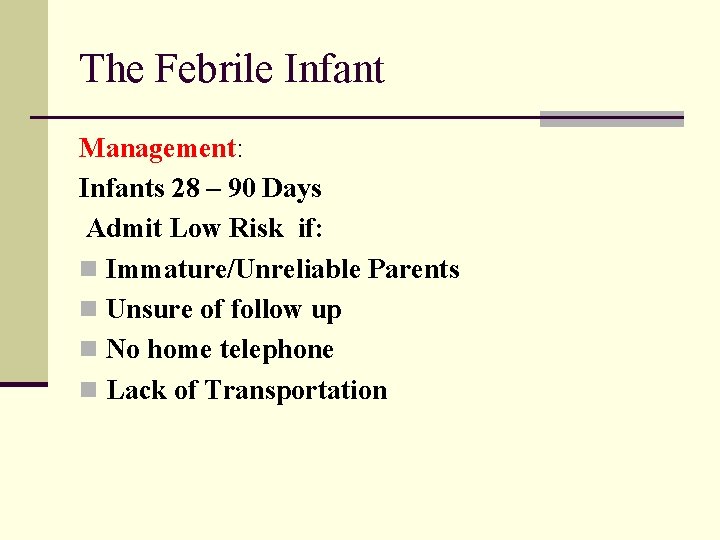
The Febrile Infant Management: Infants 28 – 90 Days Admit Low Risk if: n Immature/Unreliable Parents n Unsure of follow up n No home telephone n Lack of Transportation
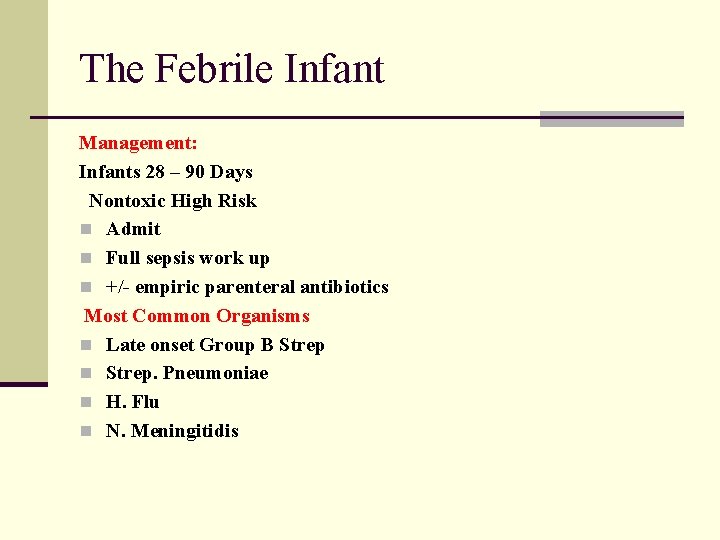
The Febrile Infant Management: Infants 28 – 90 Days Nontoxic High Risk n Admit n Full sepsis work up n +/- empiric parenteral antibiotics Most Common Organisms n Late onset Group B Strep n Strep. Pneumoniae n H. Flu n N. Meningitidis
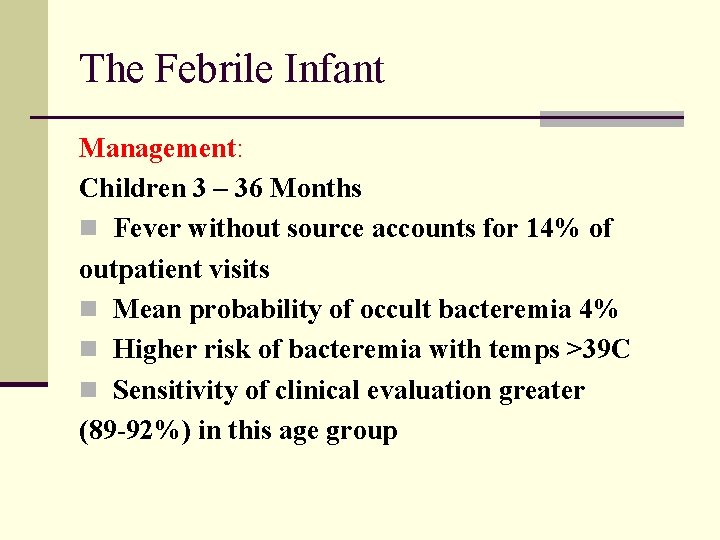
The Febrile Infant Management: Children 3 – 36 Months n Fever without source accounts for 14% of outpatient visits n Mean probability of occult bacteremia 4% n Higher risk of bacteremia with temps >39 C n Sensitivity of clinical evaluation greater (89 -92%) in this age group
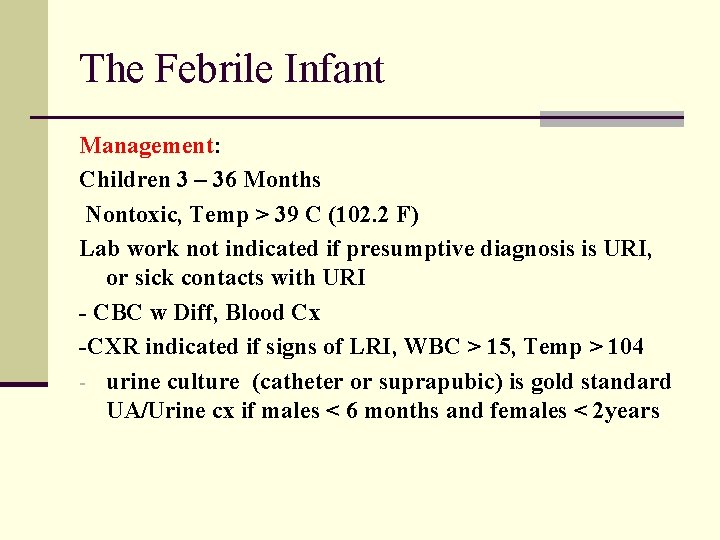
The Febrile Infant Management: Children 3 – 36 Months Nontoxic, Temp > 39 C (102. 2 F) Lab work not indicated if presumptive diagnosis is URI, or sick contacts with URI - CBC w Diff, Blood Cx -CXR indicated if signs of LRI, WBC > 15, Temp > 104 - urine culture (catheter or suprapubic) is gold standard UA/Urine cx if males < 6 months and females < 2 years
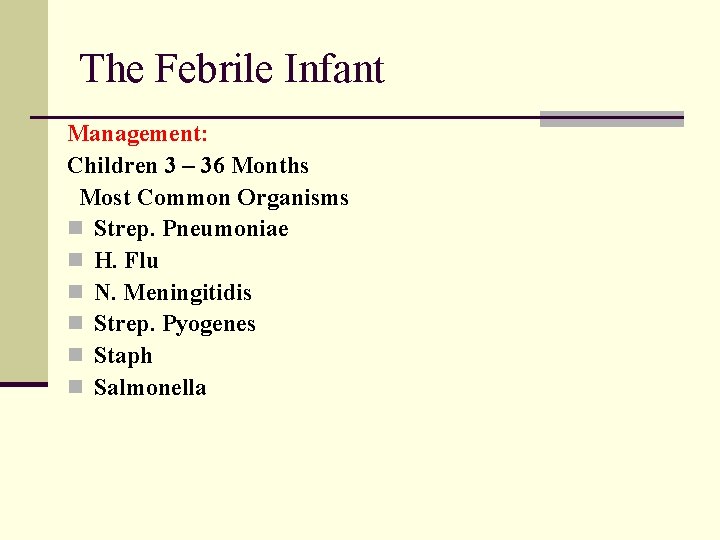
The Febrile Infant Management: Children 3 – 36 Months Most Common Organisms n Strep. Pneumoniae n H. Flu n N. Meningitidis n Strep. Pyogenes n Staph n Salmonella
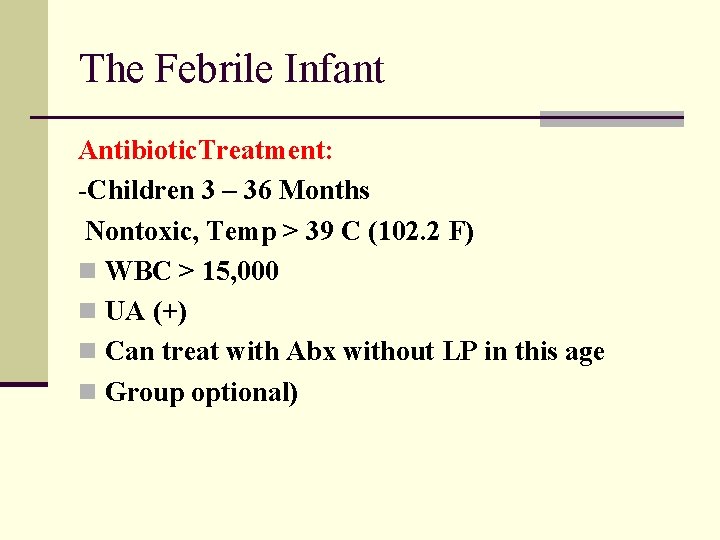
The Febrile Infant Antibiotic. Treatment: -Children 3 – 36 Months Nontoxic, Temp > 39 C (102. 2 F) n WBC > 15, 000 n UA (+) n Can treat with Abx without LP in this age n Group optional)
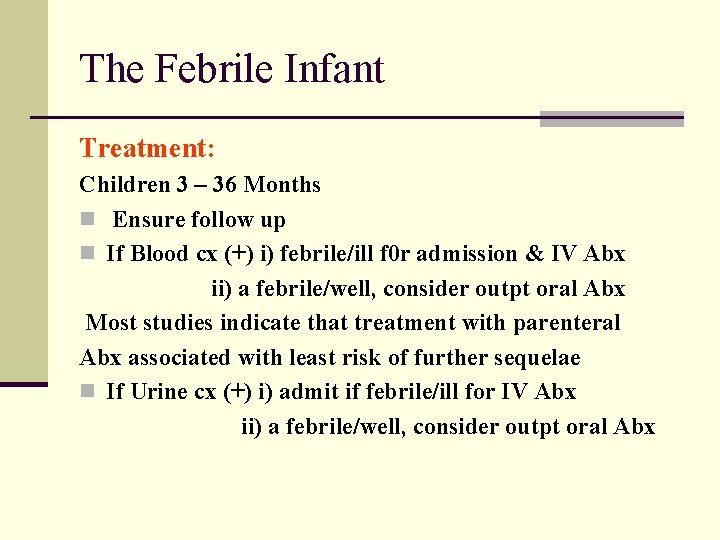
The Febrile Infant Treatment: Children 3 – 36 Months n Ensure follow up n If Blood cx (+) i) febrile/ill f 0 r admission & IV Abx ii) a febrile/well, consider outpt oral Abx Most studies indicate that treatment with parenteral Abx associated with least risk of further sequelae n If Urine cx (+) i) admit if febrile/ill for IV Abx ii) a febrile/well, consider outpt oral Abx
The Febrile Infant Summary Guidelines is one way to assist physicians in managing infants and children with fever without a source. They are flexible and management may be individualized according to the case.
- Slides: 25