
The FCC and Auctions for Radio Spectrum Licenses

- Slides: 45
The FCC and Auctions for Radio Spectrum Licenses 1
Today’s Lecture l Problem of allocating radio spectrum l Theory and practice of spectrum auctions l l l The simultaneous ascending auction Theoretical rationale and efficiency Evidence on how they work in practice What can go wrong, and why. Bid strategy in the FCC advanced wireless auction. Spectrum crunch and the FCC incentive auctions. 2
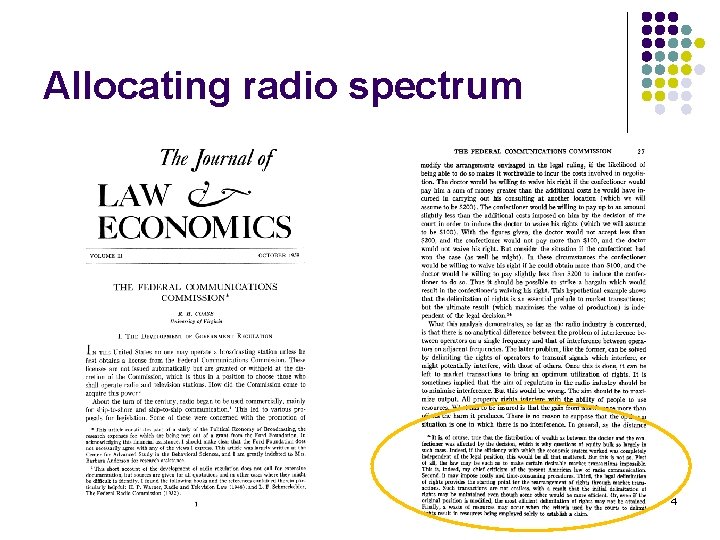
FCC Spectrum Auctions l Federal government allocates rights to use the radio spectrum for television, radio, cell phones, etc. – historically done by administrative process or lottery. l Auctions to allocate radio spectrum l l l Suggested by Coase (1959) – paper is most famous for a footnote in which he suggested the Coase Theorem! FCC switched to auctions in early 1990 s, with academics involved in the design, followed by other countries. Spectrum auctions have fostered a great deal of interest in auctions and auction design – a difficult problem, with high stakes for consumers, firm and governments. 3
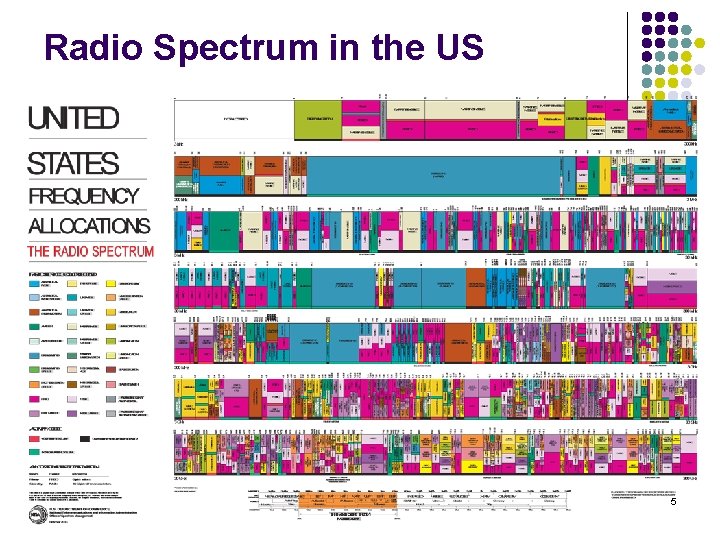
Allocating radio spectrum 4
Radio Spectrum in the US 5
Structure of the Problem l Potentially many different goods for sale l l Potentially bidders with different objectives l l E. g. license for San Francisco very different than license for Death Valley. Low frequency spectrum different than high. E. g. Verizon may want spectrum to add 4 G for data transmission; rural telco might have more modest plans. Substantial uncertainty about price/value l Illiquid secondary market, not many licenses or auctions, uncertainty about technology evolution. 6
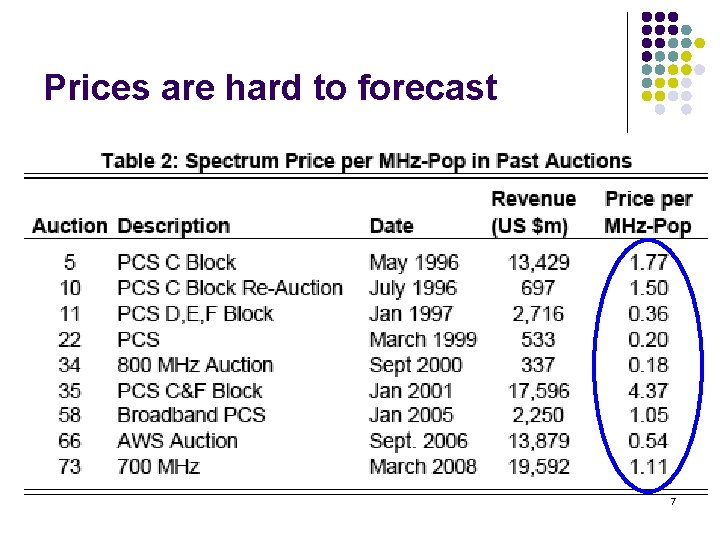
Prices are hard to forecast 7
Simultaneous Ascending Auction l Design due to Paul Milgrom, Bob Wilson, Preston Mc. Afee. l Auction consists of multiple rounds. l l Round begins with standing high bid on each license (initially the seller), and a minimum bid increment. l Each bidder can submit bids on any number of items, subject to an eligibility and activity rule. l If no bids on a license, standing high bidder remains. If multiple bids, one bid selected to be the new high bid. l Information about bids is revealed; move to next round. Auction ends when no new bids are submitted. 8
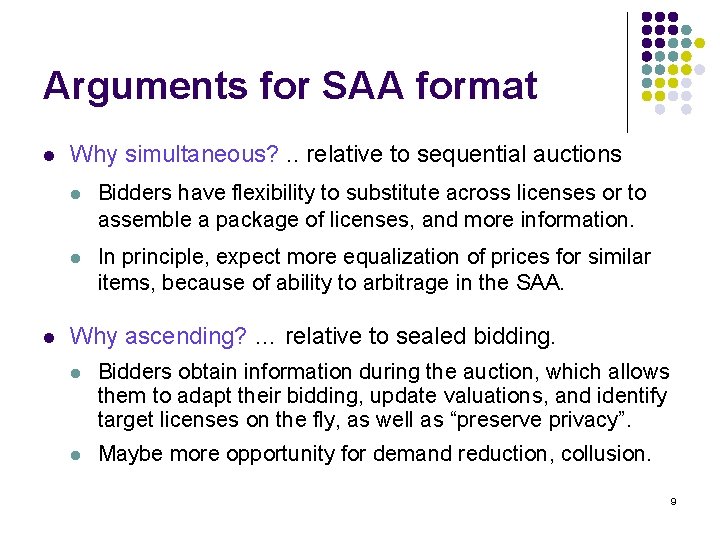
Arguments for SAA format l l Why simultaneous? . . relative to sequential auctions l Bidders have flexibility to substitute across licenses or to assemble a package of licenses, and more information. l In principle, expect more equalization of prices for similar items, because of ability to arbitrage in the SAA. Why ascending? … relative to sealed bidding. l Bidders obtain information during the auction, which allows them to adapt their bidding, update valuations, and identify target licenses on the fly, as well as “preserve privacy”. l Maybe more opportunity for demand reduction, collusion. 9
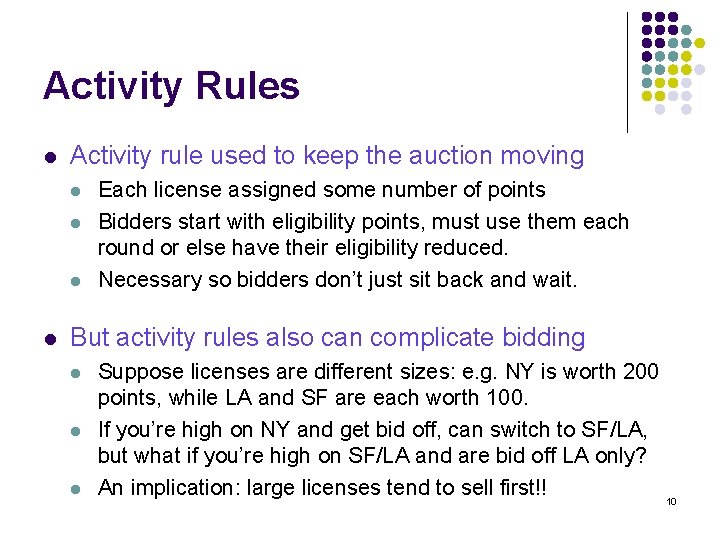
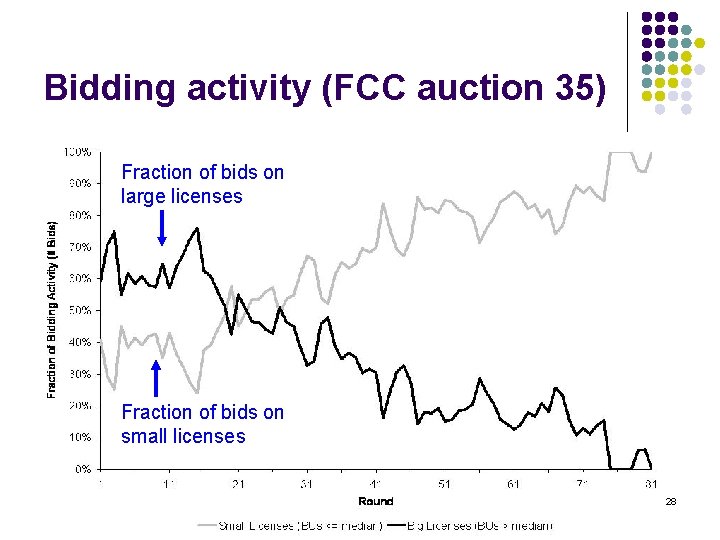
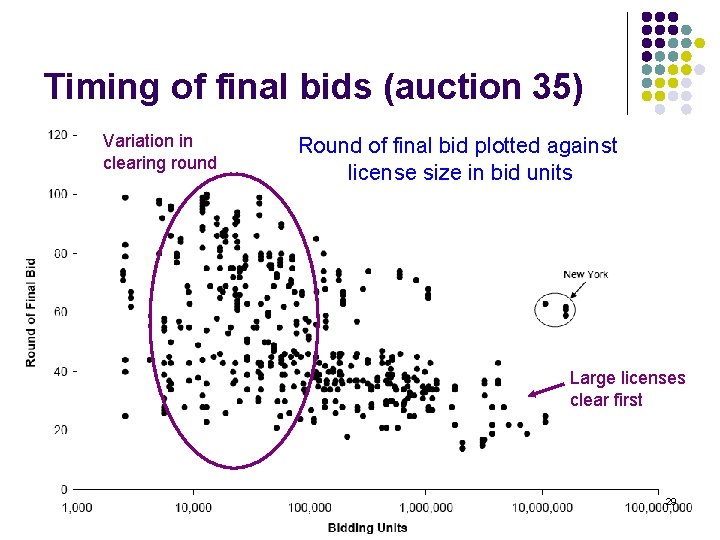
Activity Rules l Activity rule used to keep the auction moving l l Each license assigned some number of points Bidders start with eligibility points, must use them each round or else have their eligibility reduced. Necessary so bidders don’t just sit back and wait. But activity rules also can complicate bidding l l l Suppose licenses are different sizes: e. g. NY is worth 200 points, while LA and SF are each worth 100. If you’re high on NY and get bid off, can switch to SF/LA, but what if you’re high on SF/LA and are bid off LA only? An implication: large licenses tend to sell first!! 10
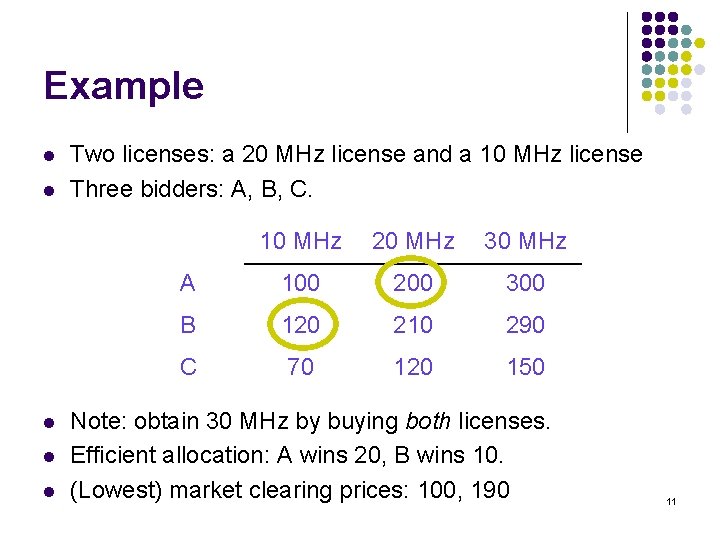
Example l l l Two licenses: a 20 MHz license and a 10 MHz license Three bidders: A, B, C. 10 MHz 20 MHz 30 MHz A 100 200 300 B 120 210 290 C 70 120 150 Note: obtain 30 MHz by buying both licenses. Efficient allocation: A wins 20, B wins 10. (Lowest) market clearing prices: 100, 190 11
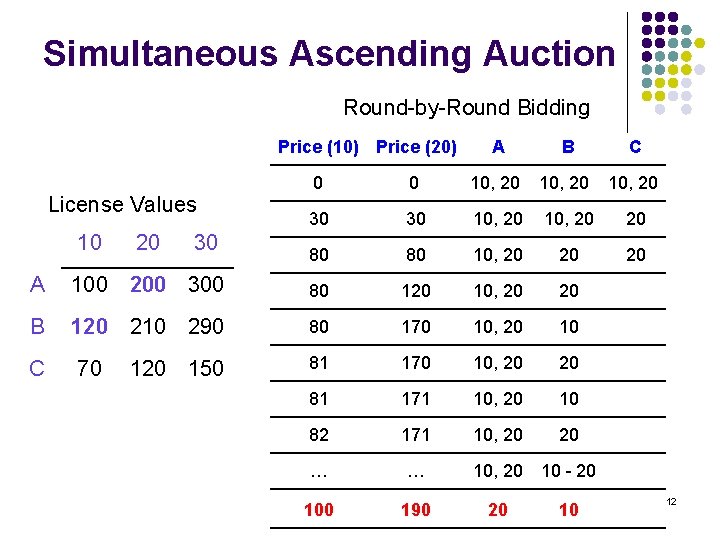
Simultaneous Ascending Auction Round-by-Round Bidding Price (10) Price (20) License Values 10 20 30 A B C 0 0 10, 20 30 30 10, 20 20 80 80 10, 20 20 20 A 100 200 300 80 120 10, 20 20 B 120 210 290 80 170 10, 20 10 C 70 81 170 10, 20 20 81 171 10, 20 10 82 171 10, 20 20 … … 100 190 120 150 10, 20 10 - 20 20 10 12
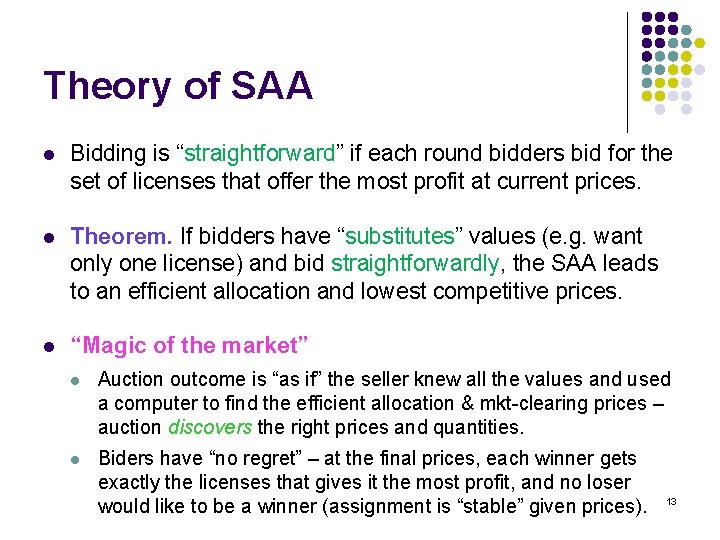
Theory of SAA l Bidding is “straightforward” if each round bidders bid for the set of licenses that offer the most profit at current prices. l Theorem. If bidders have “substitutes” values (e. g. want only one license) and bid straightforwardly, the SAA leads to an efficient allocation and lowest competitive prices. l “Magic of the market” l Auction outcome is “as if” the seller knew all the values and used a computer to find the efficient allocation & mkt-clearing prices – auction discovers the right prices and quantities. l Biders have “no regret” – at the final prices, each winner gets exactly the licenses that gives it the most profit, and no loser would like to be a winner (assignment is “stable” given prices). 13
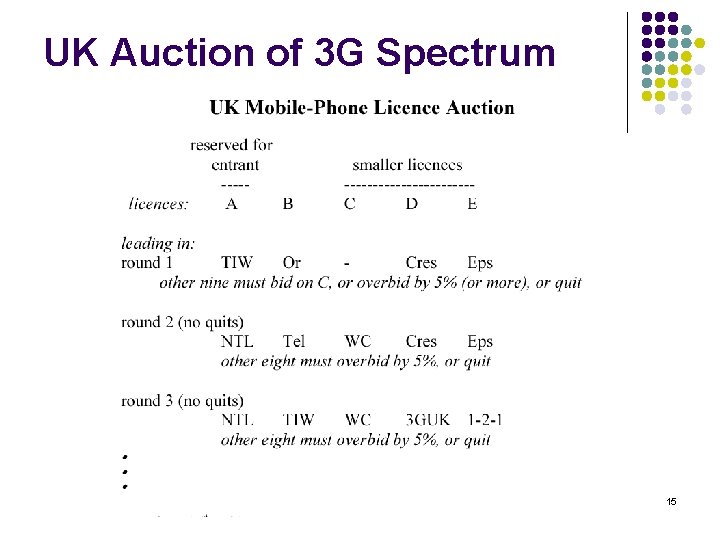
From theory to practice l UK auction of 3 G spectrum in 1998: British gov’t sells licenses for third generation (3 G) wireless services. l Banks estimated an auction might raise £ 500 million l Paul Klemperer (former Stanford GSB student); Jeremy Bulow (GSB prof) and Ken Binmore designed the auction. l There were four incumbents with “ 2 G” services, and several potential entrants interested in 3 G. l Crucially, the government decided to sell five licenses, with the restriction that license A was only for entrants and incumbents could only bid for one license at a time. 14
UK Auction of 3 G Spectrum 15
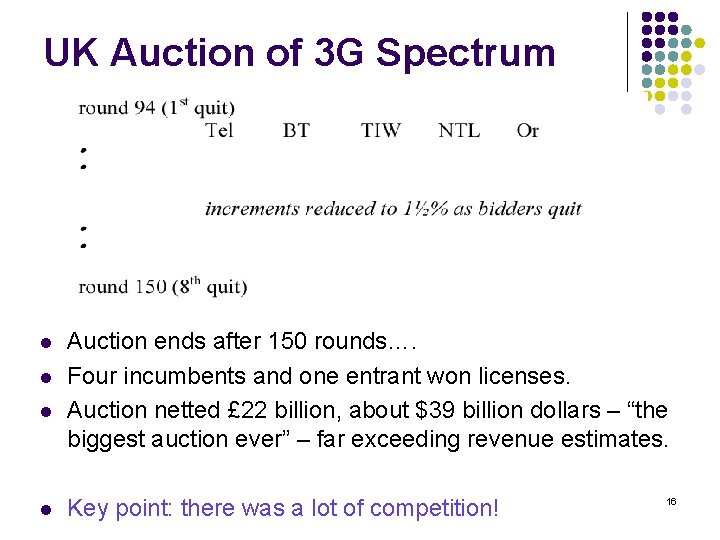
UK Auction of 3 G Spectrum l l Auction ends after 150 rounds…. Four incumbents and one entrant won licenses. Auction netted £ 22 billion, about $39 billion dollars – “the biggest auction ever” – far exceeding revenue estimates. Key point: there was a lot of competition! 16
Entry “Deterrence” l Netherlands auction of 3 G spectrum in 1999. l Following UK lead, Netherlands decided to sell five licenses using an identical SAA format. l However, there were some differences l l The Netherlands has five incumbent (2 G) operators. l There was no prohibition on bidding partnerships. What happened? 17
Netherlands auction l Prior to auction, major outside telecom firms (Deutsche Telekom, Do. Ko. Mo, Hutchinson Whampoa) all reach partnership agreements with an incumbent. l This left just one entrant, a startup called Versatel. l What happened in the auction l On day 1, Telfort (owned by BT) sends Versatel a letter saying that it “can’t win” and should drop out immediately! l Versatel shortly drops out: total revenue of 3 bn euros – at UK prices, auction would have raised 10 bn euros. 18
Demand Reduction l l German GSM auction in 2000. l Ten nationwide licenses. l Bidders allowed to win multiple licenses. l First bid at 10 m DM, then 10% price increments. l Two strong bidders, Mannesman and T-Mobile, potentially interested in buying a lot of spectrum. l Other bidders are much smaller. What might you be worried about here? 19
German GSM Auction l What happened in the auction l Round 1: Mannesman bids 36. 6 m for each of 5 bands, and reduces eligibility. l Round 2: T-Mobile (Deutsche Telekom) bids 40 m for the other five bands, reduces eligibilty. l No bids in round 3! 20
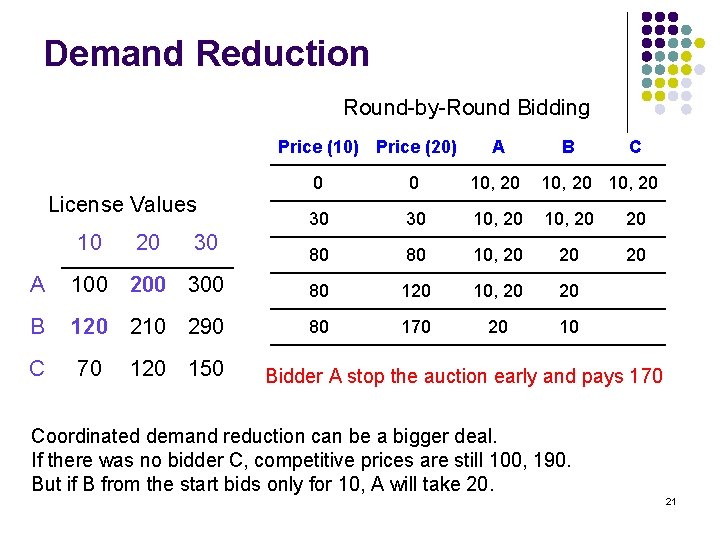
Demand Reduction Round-by-Round Bidding Price (10) Price (20) License Values 10 20 30 A B 0 0 10, 20 30 30 10, 20 20 80 80 10, 20 20 20 A 100 200 300 80 120 10, 20 20 B 120 210 290 80 170 20 10 C 70 120 150 C Bidder A stop the auction early and pays 170 Coordinated demand reduction can be a bigger deal. If there was no bidder C, competitive prices are still 100, 190. But if B from the start bids only for 10, A will take 20. 21
Exposure problems l l In many countries, incumbents have substantial spectrum and network build-out. A successful new entrant may need to buy many licenses to compete. l SAA format creates a danger: an entrant might end up winning some very expensive spectrum but not enough for viable entry. l This “exposure risk” can deter an entrant from competing aggressively, potentially biasing auction in favor of incumbents. l One reason this is a concern is that even an “efficient” auction allocation is efficient from standpoint of the firms, while consumers might prefer having more providers. The exposure problem has motivated a lot of work on “combinatorial” auction design. 22
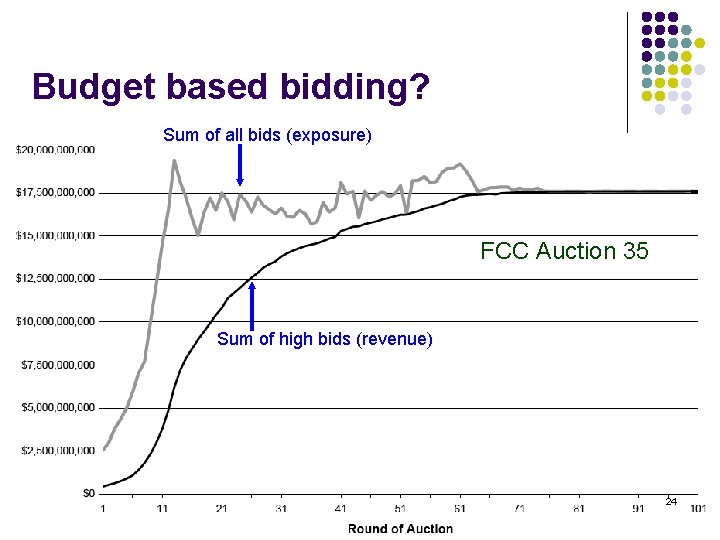
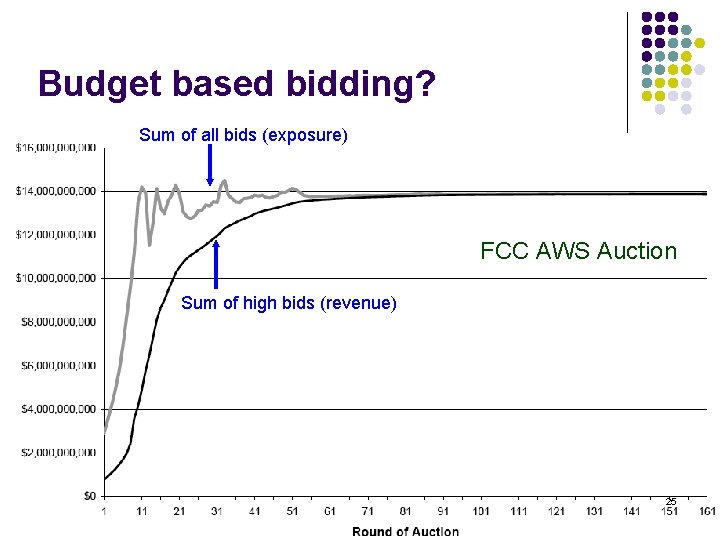
Bidder budgets l l A surprising observation in spectrum sales has been the importance of bidder budgets. l In our theoretical models, bidding behavior is determined by bidder values. Bidders don’t have limited cash. l In practice, firms often give their bidding team a budget and a set of objectives (why would this make sense? ). This shows up in the data: as prices rise in the auction, bidders reduce their demands, but may put a similar amount of money “on the table” in each round. 23
Budget based bidding? Sum of all bids (exposure) FCC Auction 35 Sum of high bids (revenue) 24
Budget based bidding? Sum of all bids (exposure) FCC AWS Auction Sum of high bids (revenue) 25
The AWS Auction l FCC sale of advanced wireless spectrum in 2006. l l l Large, complicated auction with a surprising outcome that has subsequently influenced auction design. Also useful to illustrate the value of economics to guide strategy. FCC offered several “sizes” of licenses: l Large regional licenses (three bands, 40 MHz) l Small EA/CMA licenses (three bands, 50 MHz) l Small licenses could be joined to equal large ones. Competitors included major incumbents (Verizon, ATT, TMobile), many smaller bidders, and two potential national entrants (Spectrum. Co and Wireless DBS). 26
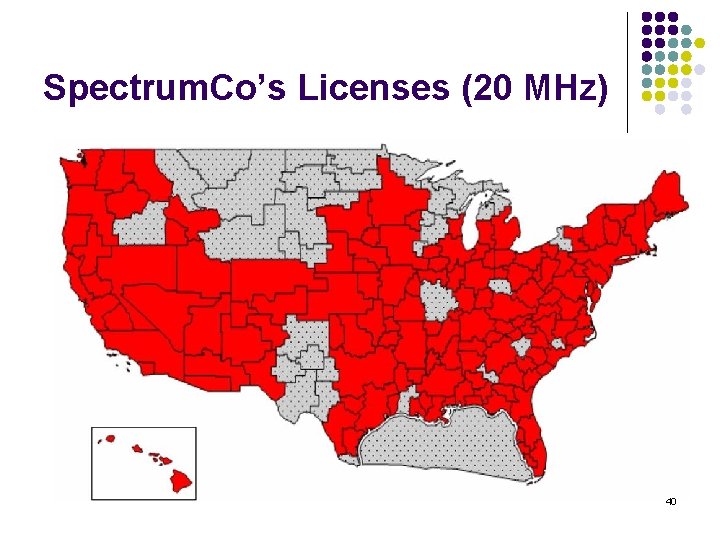
Spectrum. Co’s problem l Goals for the auction l l Acquire 20 MHz of spectrum covering 85% of US population, without spending more than budget. If that isn’t possible, don’t buy anything. Strategic thinking l l Beware the exposure problem! Try to figure out how much it will cost to buy target amount of spectrum… but how? Anticipate that bidding is likely to start on the large licenses and subsequently move to the smaller ones – strategic issue will be when to switch if re-switching is hard. 27
Bidding activity (FCC auction 35) Fraction of bids on large licenses Fraction of bids on small licenses 28
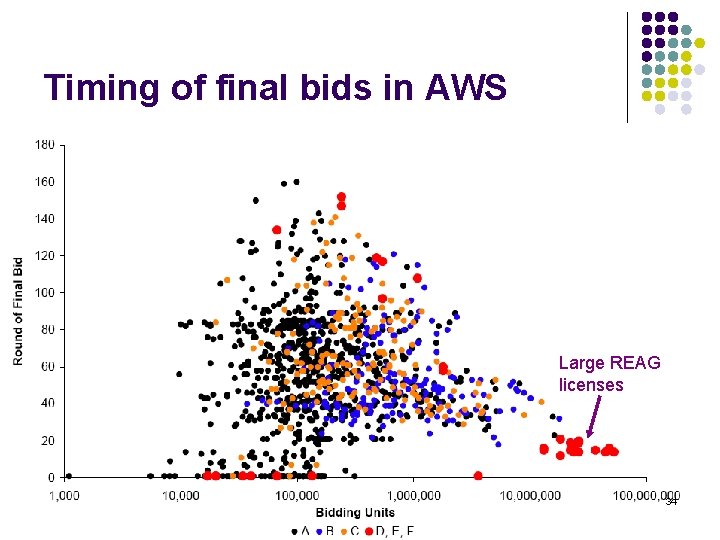
Timing of final bids (auction 35) Variation in clearing round Round of final bid plotted against license size in bid units Large licenses clear first 29
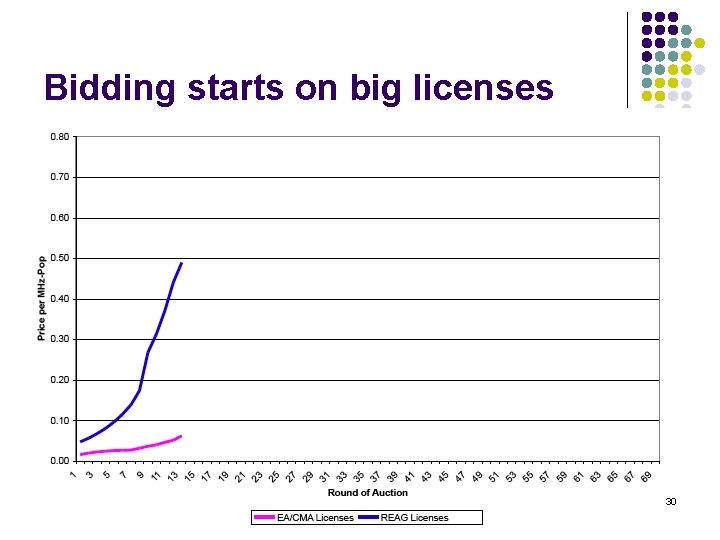
Bidding starts on big licenses 30
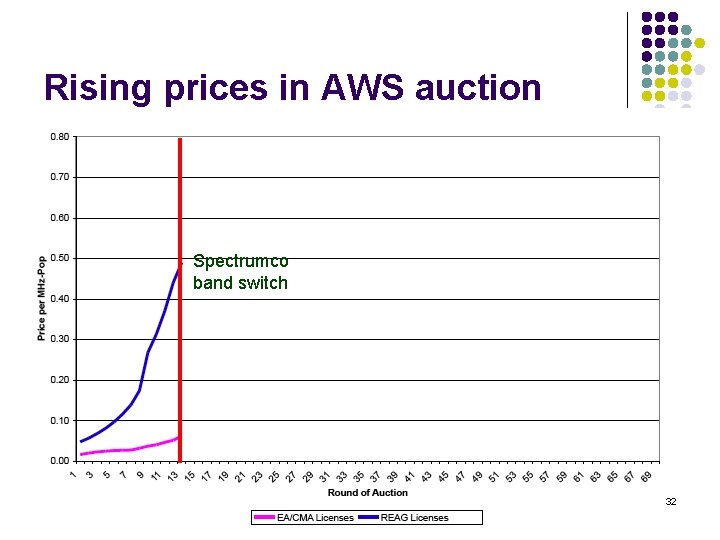
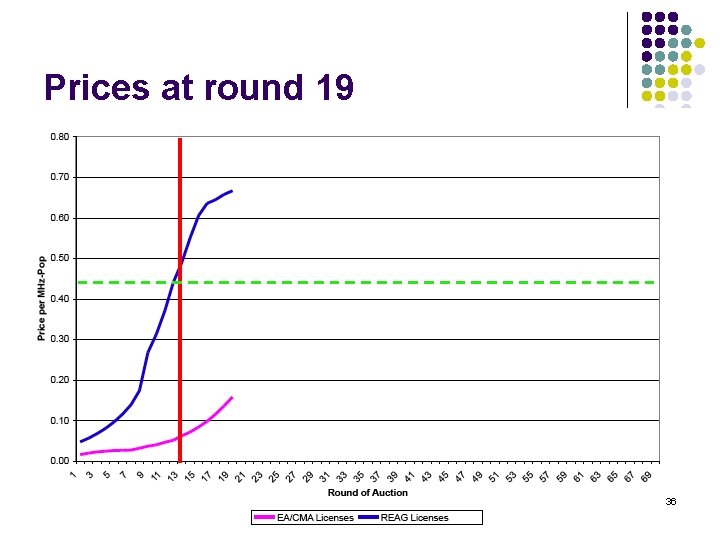
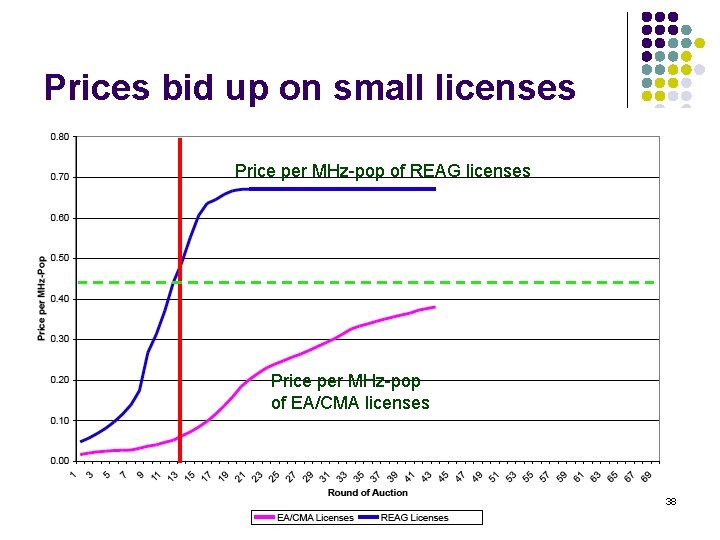
Deciding when to switch l Tempting to switch to small licenses because of lower prices, but activity rule makes it hard to switch back. l At round 13, the situation is l l l Large licenses covering country (40 MHz): $5. 0 bn Small licenses covering country (50 MHz): $0. 7 bn “Money on the table” had peaked at $14. 2 bn. l Spectrum. Co gives up on large licenses, figuring they are going to be too expensive, but small ones might be ok. l The other major bidders continue on the large ones. 31
Rising prices in AWS auction Spectrumco band switch 32
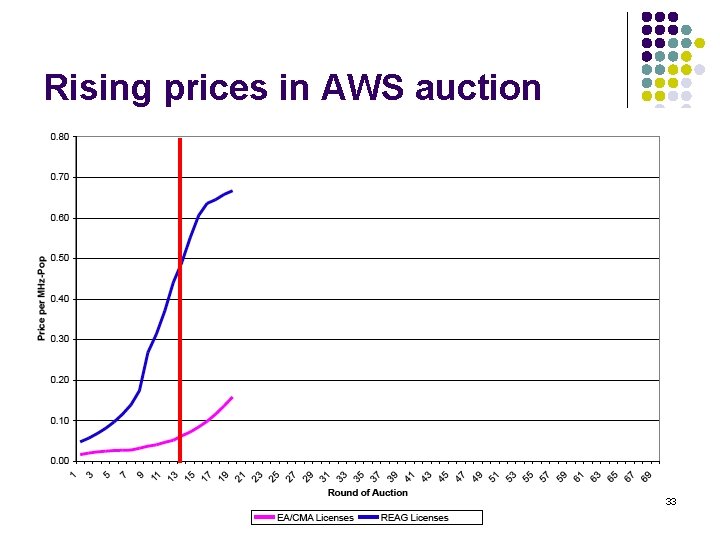
Rising prices in AWS auction 33
Timing of final bids in AWS Large REAG licenses 34
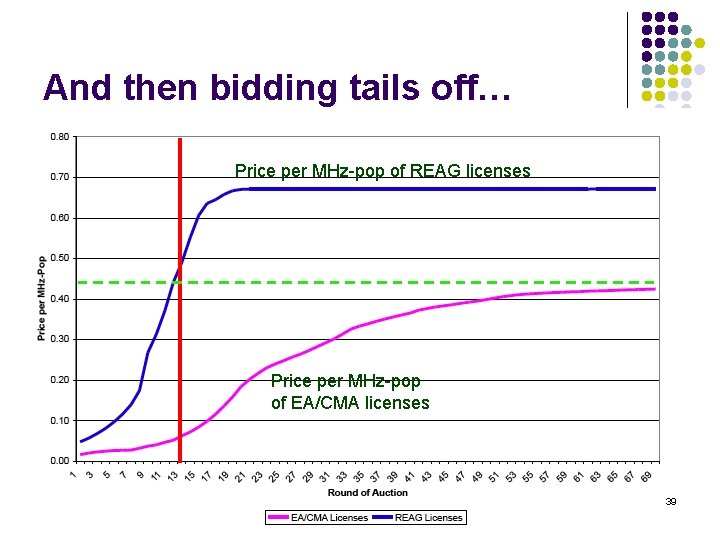
Budget forecasting l l At round 19, bidding ends on large licenses l Total high bids on large licenses: $7. 6 bn l Total high bids on small licenses: $2. 3 bn l Auction is “about to begin” for small licenses! Spectrumco’s concern: does it have enough budget to buy 40% of the small licenses (20 out of 50 MHz). l Total money in the auction appears to be $14. 2 bn. l With $7. 6 spent on large licenses, leaves $6. 6 bn for small. l Suggests that 20 MHz will cost $2. 6 bn – if that’s right, we’ll have just enough money and will get a great deal. If not… 35
Prices at round 19 36
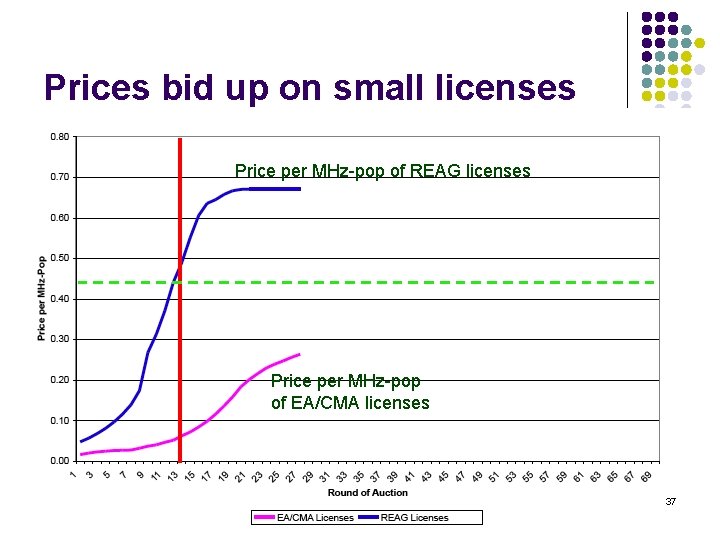
Prices bid up on small licenses Price per MHz-pop of REAG licenses Price per MHz-pop of EA/CMA licenses 37
Prices bid up on small licenses Price per MHz-pop of REAG licenses Price per MHz-pop of EA/CMA licenses 38
And then bidding tails off… Price per MHz-pop of REAG licenses Price per MHz-pop of EA/CMA licenses 39
Spectrum. Co’s Licenses (20 MHz) 40
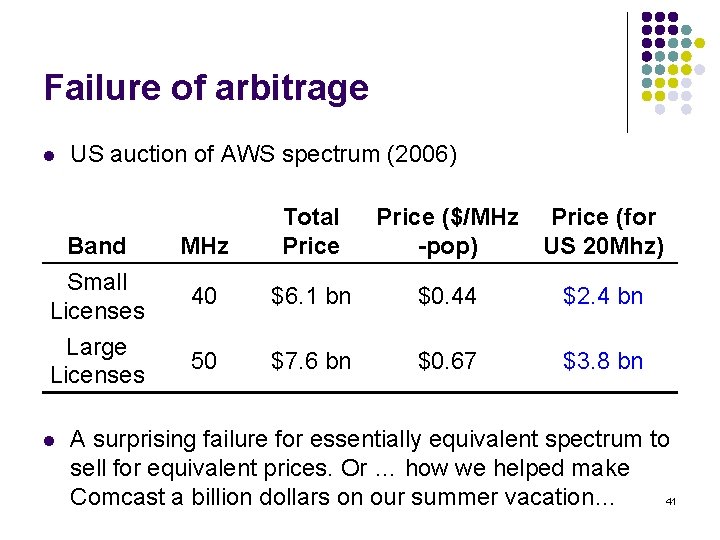
Failure of arbitrage l US auction of AWS spectrum (2006) Band Small Licenses Large Licenses l MHz Total Price ($/MHz Price (for -pop) US 20 Mhz) 40 $6. 1 bn $0. 44 $2. 4 bn 50 $7. 6 bn $0. 67 $3. 8 bn A surprising failure for essentially equivalent spectrum to sell for equivalent prices. Or … how we helped make Comcast a billion dollars on our summer vacation… 41
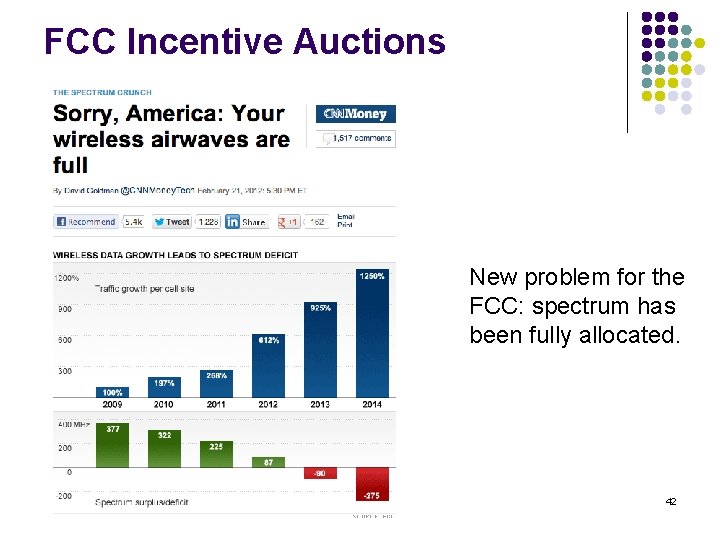
FCC Incentive Auctions New problem for the FCC: spectrum has been fully allocated. 42
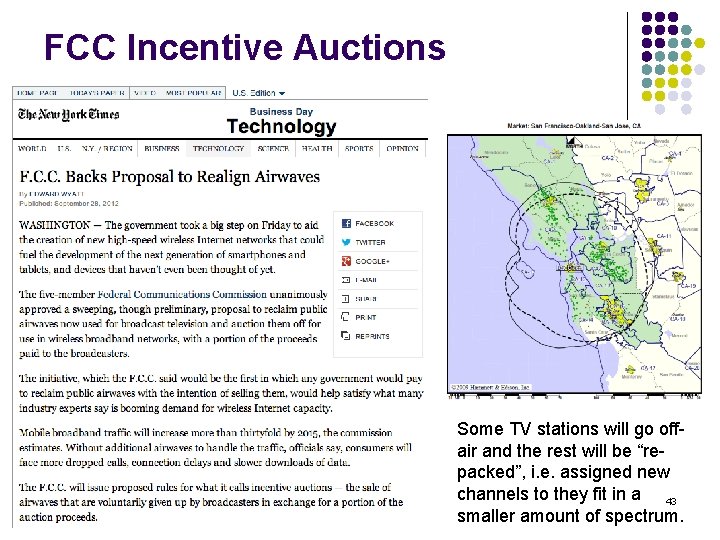
FCC Incentive Auctions Some TV stations will go offair and the rest will be “repacked”, i. e. assigned new channels to they fit in a 43 smaller amount of spectrum.
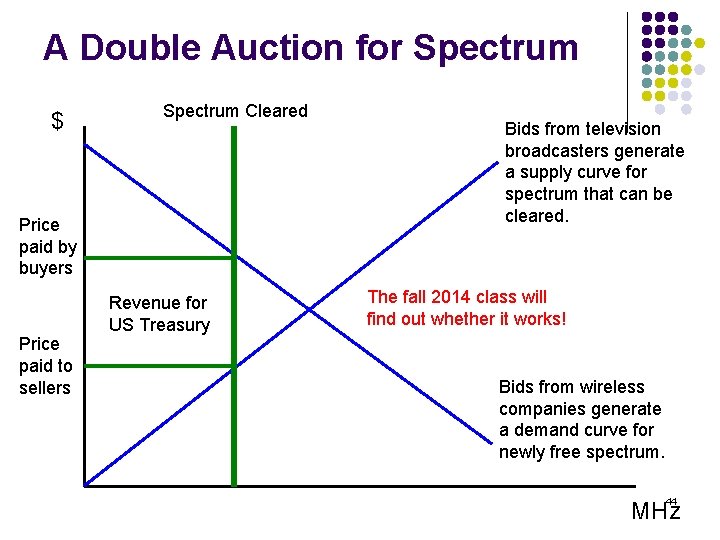
A Double Auction for Spectrum $ Spectrum Cleared Price paid by buyers Price paid to sellers Revenue for US Treasury Bids from television broadcasters generate a supply curve for spectrum that can be cleared. The fall 2014 class will find out whether it works! Bids from wireless companies generate a demand curve for newly free spectrum. 44 MHz
Conclusions l Allocation of radio spectrum has been a major impetus for modern auction design – complex, high-stakes problem where economic theory proves powerful. l Simultaneous ascending auction is commonly used l l Design has benefit that is gives bidders flexibility, reveals information, and in simple cases seems to promote efficiency. l Practical concerns include lack of entry, demand reduction. Complexities arise when bidders want packages, or if activity rules need to accommodate sale of many very different licenses. Designing better auctions for these circumstances is the current frontier. 45