
The father of computing history Charles Babbage by
The father of computing history: Charles Babbage by Anja Jentzsch jentzsch@inf. fu-berlin. de
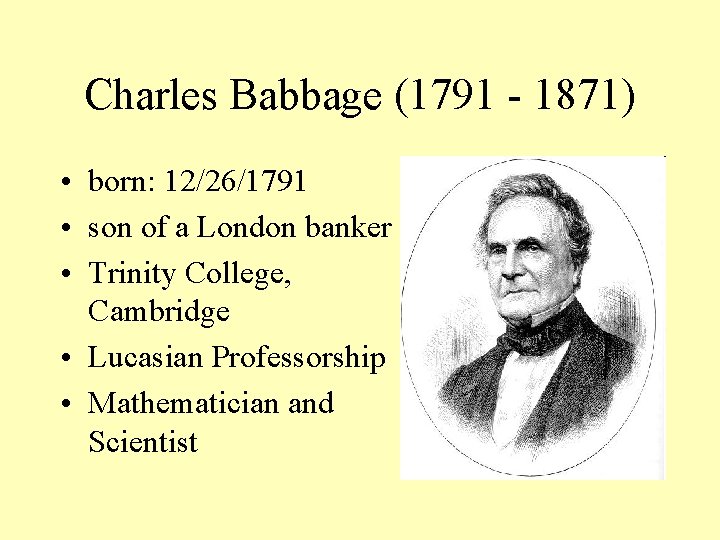
Charles Babbage (1791 - 1871) • born: 12/26/1791 • son of a London banker • Trinity College, Cambridge • Lucasian Professorship • Mathematician and Scientist
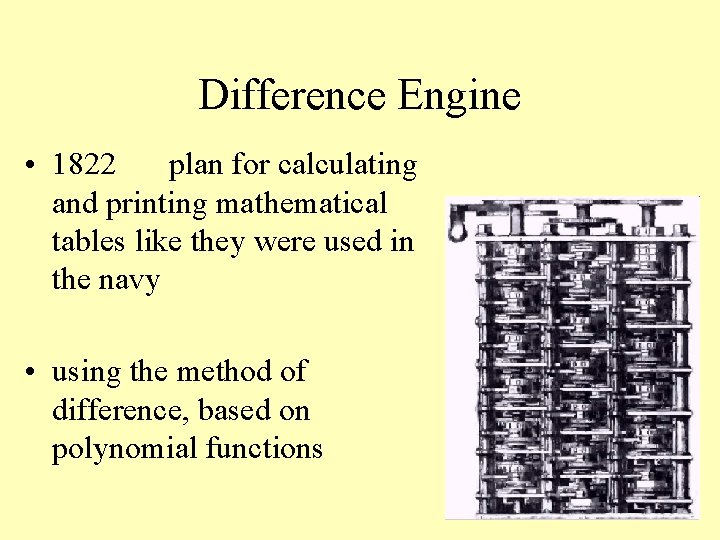
Difference Engine • 1822 plan for calculating and printing mathematical tables like they were used in the navy • using the method of difference, based on polynomial functions
Difference Engine • 1822 design 6 decimal places with secondorder difference • 1830 engine with 20 decimal places and a sixth-order difference • 1830 end of work on the difference engine because of a dispute with his chief engineer
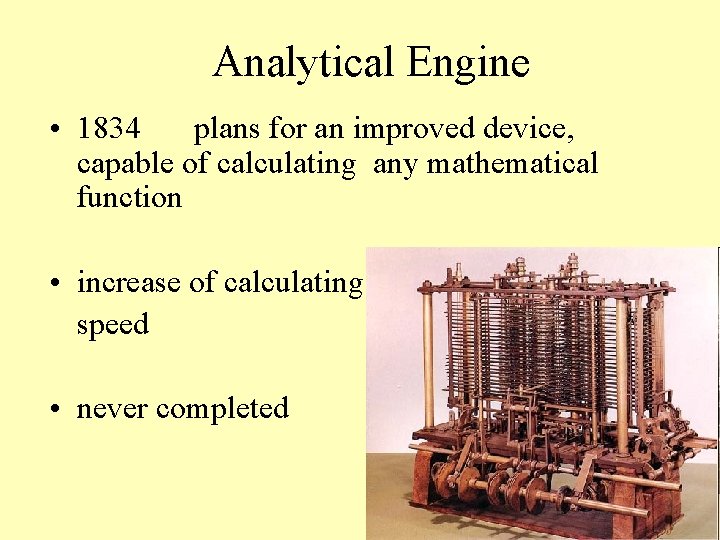
Analytical Engine • 1834 plans for an improved device, capable of calculating any mathematical function • increase of calculating speed • never completed
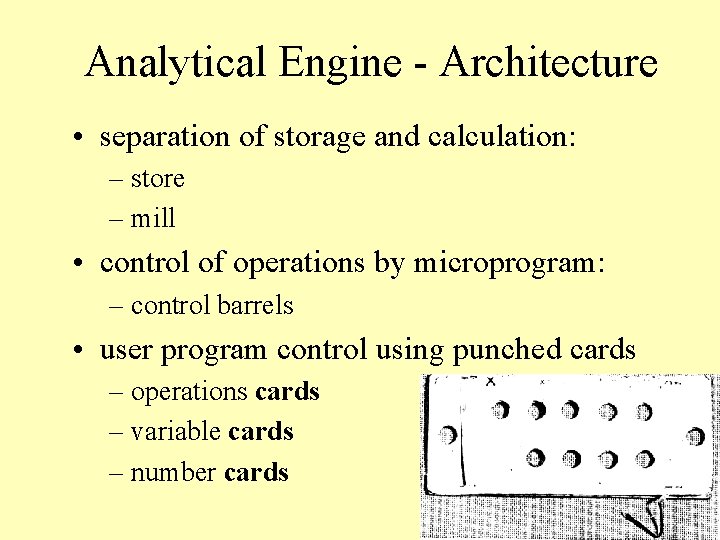
Analytical Engine - Architecture • separation of storage and calculation: – store – mill • control of operations by microprogram: – control barrels • user program control using punched cards – operations cards – variable cards – number cards

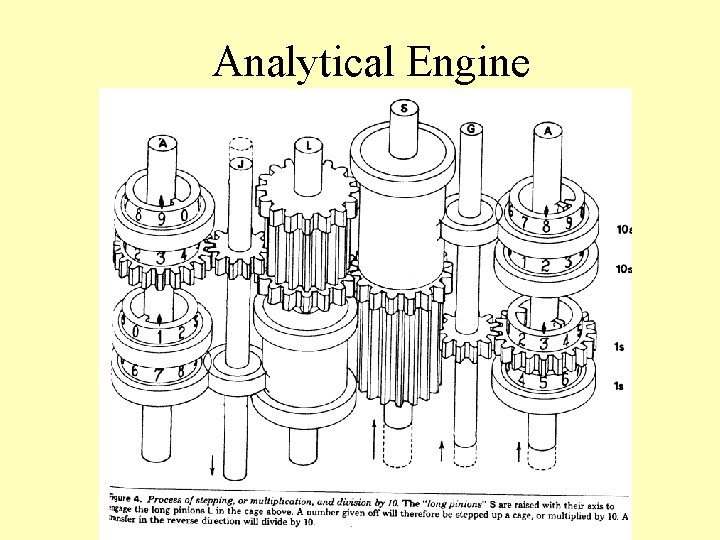
Analytical Engine • more than 200 columns of gear trains and number wheels • 16 column register (store 2 numbers) • 50 register columns, with 40 decimal digits of precision • counting apparatus to keep track of repetitions • cycle time: 2. 5 seconds to transfer a number from the store to a register in the mill • addition: 3 seconds • conditional statements
Analytical Engine
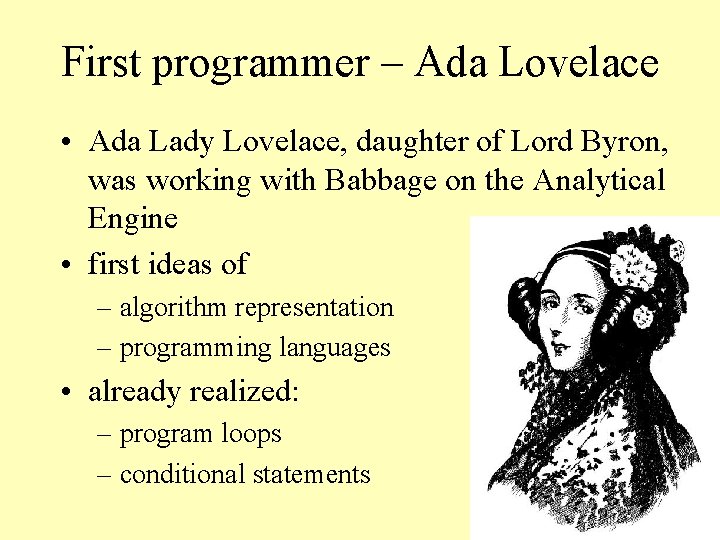
First programmer – Ada Lovelace • Ada Lady Lovelace, daughter of Lord Byron, was working with Babbage on the Analytical Engine • first ideas of – algorithm representation – programming languages • already realized: – program loops – conditional statements
Babbage’s meaning in history • John von Neumann (1903 - 1957): universal computing machine consisting of: – memory – input / output – arithmetic/logic unit (ALU) – control unit • based on Babbage‘s ideas • 95 % of modern computers are based on the von Neumann architecture
Babbage’s meaning in history • Howard Aiken (1900 – 1973) developed the ASCC computer (Automatic Sequence Controlled Calculator) – could carry out five operations, addition, subtraction, multiplication, division and reference to previous results • Aiken was much influenced by Babbage's writings • he saw the ASCC computer as completing the task which Babbage had set out on but failed to complete
- Slides: 11