
The FatFree Alternative to XML JSON as an

- Slides: 12
The Fat-Free Alternative to XML
JSON as an XML Alternative l JSON is a light-weight alternative to XML for data-interchange l JSON = Java. Script Object Notation – It’s really language independent – Most programming languages can easily read it and instantiate objects or some other data structure l Defined in – RFC 4627, IETF, July 2006 Current version is RFC 8259, December 2017 l http: //json. org/ has more information
JSON TL; DR l Lightweight data-interchange format l Easy for humans to read and write l Easy for machines to parse and generate l Not tied to Javascript or Web
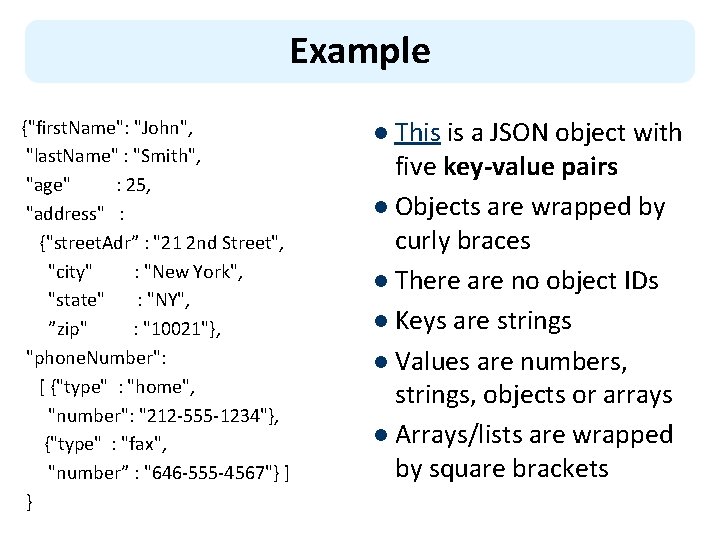
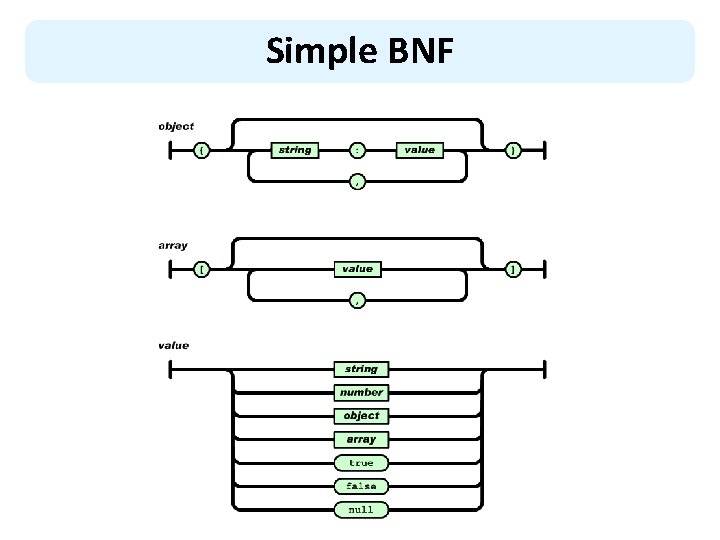
Example {"first. Name": "John", "last. Name" : "Smith", "age" : 25, "address" : {"street. Adr” : "21 2 nd Street", "city" : "New York", "state" : "NY", ”zip" : "10021"}, "phone. Number": [ {"type" : "home", "number": "212 -555 -1234"}, {"type" : "fax", "number” : "646 -555 -4567"} ] } l This is a JSON object with five key-value pairs l Objects are wrapped by curly braces l There are no object IDs l Keys are strings l Values are numbers, strings, objects or arrays l Arrays/lists are wrapped by square brackets
Simple BNF
Evaluation l JSON is simpler and more compact than XML – – – No closing tags XML parsing is hard because of its complexity Compressed the two are similar in size l JSON has a better fit for OO systems than XML l JSON is not as extensible as XML l Preferred for simple data exchange by many l Less syntax, no semantics l Schemas? We don’t need no stinkin schemas!* l Transforms? Write your own
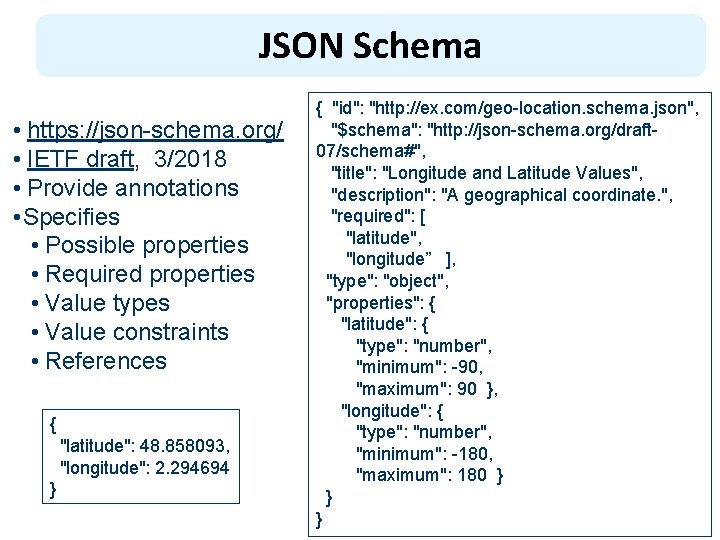
JSON Schema • https: //json-schema. org/ • IETF draft, 3/2018 • Provide annotations • Specifies • Possible properties • Required properties • Value types • Value constraints • References { "latitude": 48. 858093, "longitude": 2. 294694 } { "id": "http: //ex. com/geo-location. schema. json", "$schema": "http: //json-schema. org/draft 07/schema#", "title": "Longitude and Latitude Values", "description": "A geographical coordinate. ", "required": [ "latitude", "longitude” ], "type": "object", "properties": { "latitude": { "type": "number", "minimum": -90, "maximum": 90 }, "longitude": { "type": "number", "minimum": -180, "maximum": 180 } } }
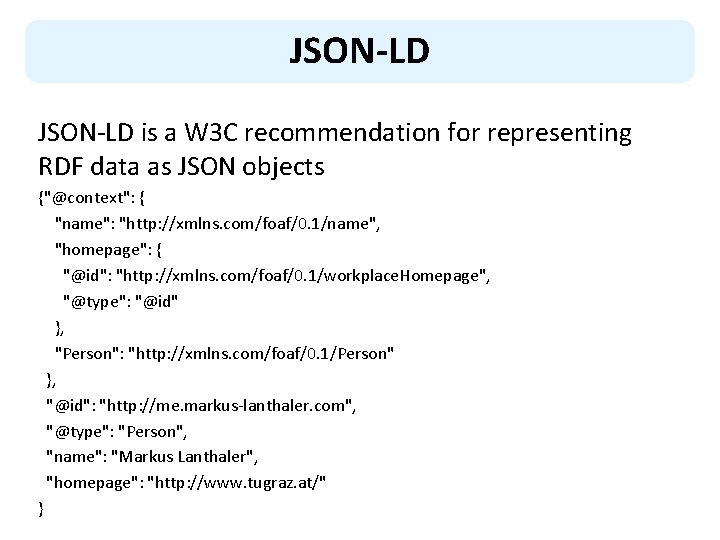
JSON-LD is a W 3 C recommendation for representing RDF data as JSON objects {"@context": { "name": "http: //xmlns. com/foaf/0. 1/name", "homepage": { "@id": "http: //xmlns. com/foaf/0. 1/workplace. Homepage", "@type": "@id" }, "Person": "http: //xmlns. com/foaf/0. 1/Person" }, "@id": "http: //me. markus-lanthaler. com", "@type": "Person", "name": "Markus Lanthaler", "homepage": "http: //www. tugraz. at/" }
Many popular systems use JSON l Mongo. DB objects – – is an open-source database for JSON Very popular No. SQL database A No. SQL DB is one that uses a model not based on relational tables l Elastic Search is a popular, scalable information retrieval engine that uses JSON as its native representation
Example: JSON in Python >>> import json >>> x = json. load(open('example. json')) >>> x {u'last. Name': u'Smith', u'age': 25, u'phone. Number': [{u'type': u'home', u'number': u'212 -555 -1234'}, {u'type': u'fax', u'number': u'646 -555 -4567'}], u'first. Name': u'John', u'address': {u'street. Adr': u'21 2 nd Street', u'state': u'NY', u'zip': u'10021', u'city': u'New York'}} >>> x['address']['state'] u'NY' >>> print json. dumps(x, sort_keys=True, separators=(', ', ': '), indent=2) {"address": { "city": "New York", "state": "NY", "street. Adr": "21 2 nd Street", "zip": "10021”}, "age": 25, "first. Name": "John", "last. Name": "Smith", "phone. Number": [ { "number": "212 -555 -1234", "type": "home”}, {"number": "646 -555 -4567", "type": "fax” } ] } >>> • Python’s JSON package reads & writes JSON from/to files & strings • Maps JSON objects to Python dictionaries • Maps JSON arrays to Python lists • Dump (write to file) and dumps (write to string) functions can do simple pretty printing
JSON vs. XML l JSON: The Fat-Free Alternative to XML json. org page laying out the case for JSON over XML l Stop Comparing JSON and XML Blog post arguing that they're very different things with their own areas of applicability l XML JSON There are many web tools and software packages that can convert between simple xml and JSON representations, e. g. : this one
Worse is Better? l JSON vs. XML can be viewed as an example of “Worse is Better” l In 1989 Dick Gabriel headed a company that had the best commercial version of Lisp – – Lisp was considered by programming language experts to be superior to the much more popular C Cf. today: Scheme vs. Python (w. r. t. mutable lists) l Gabriel explained it as worse is better software that's limited, but simple to learn/use, and flexible, can be more popular to most users