
The Fast Fourier Transform by Jorge M Trabal
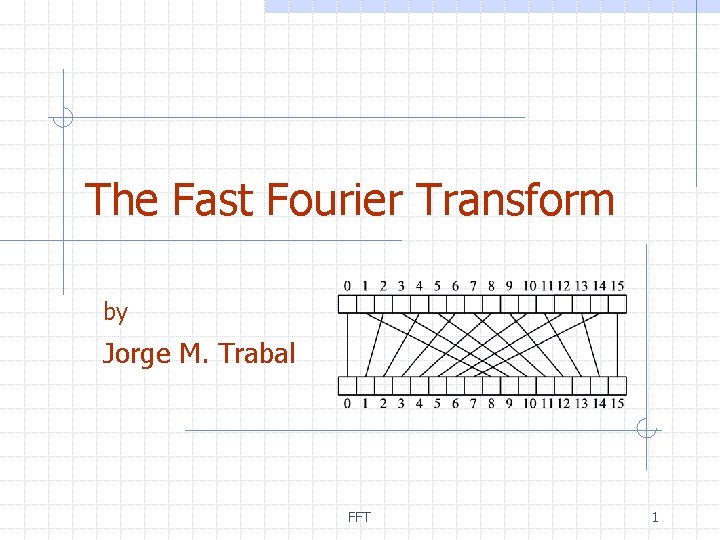
The Fast Fourier Transform by Jorge M. Trabal FFT 1
Outline and Reading Polynomial Multiplication Problem Primitive Roots of Unity (§ 10. 4. 1) The Discrete Fourier Transform (§ 10. 4. 2) The FFT Algorithm (§ 10. 4. 3) Integer Multiplication (§ 10. 4. 4) Java FFT Integer Multiplication (§ 10. 5) FFT 2
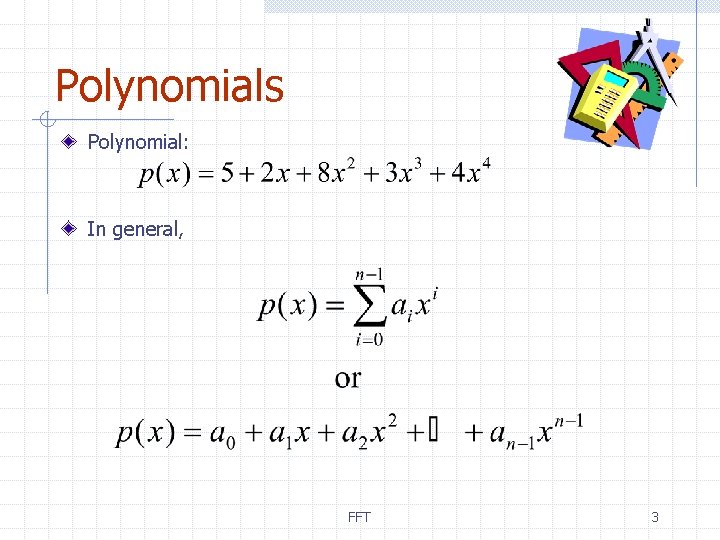
Polynomials Polynomial: In general, FFT 3
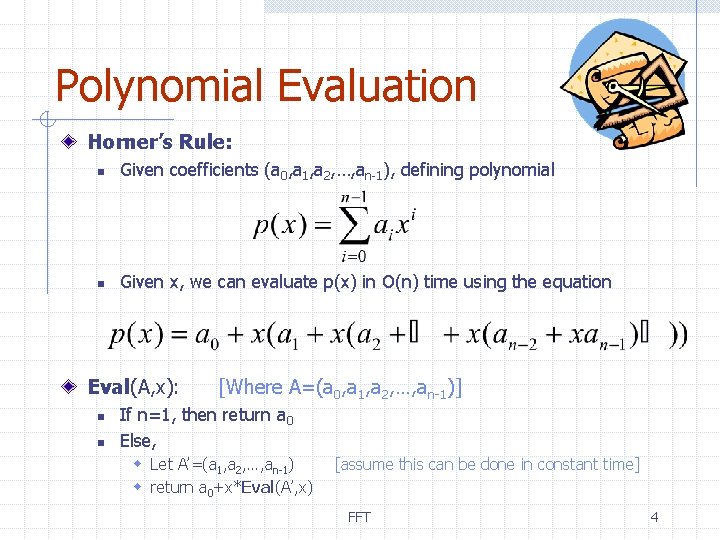
Polynomial Evaluation Horner’s Rule: n Given coefficients (a 0, a 1, a 2, …, an-1), defining polynomial n Given x, we can evaluate p(x) in O(n) time using the equation Eval(A, x): n n [Where A=(a 0, a 1, a 2, …, an-1)] If n=1, then return a 0 Else, w Let A’=(a 1, a 2, …, an-1) w return a 0+x*Eval(A’, x) [assume this can be done in constant time] FFT 4
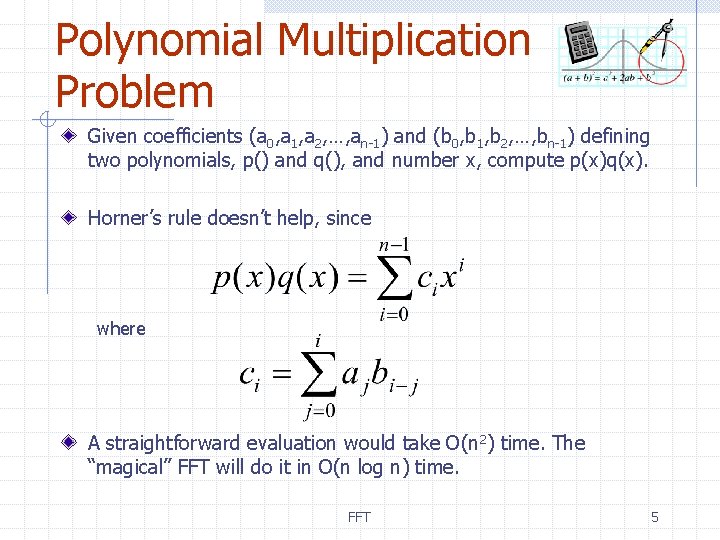
Polynomial Multiplication Problem Given coefficients (a 0, a 1, a 2, …, an-1) and (b 0, b 1, b 2, …, bn-1) defining two polynomials, p() and q(), and number x, compute p(x)q(x). Horner’s rule doesn’t help, since where A straightforward evaluation would take O(n 2) time. The “magical” FFT will do it in O(n log n) time. FFT 5

Polynomial Interpolation & Polynomial Multiplication Given a set of n points in the plane with distinct x-coordinates, there is exactly one (n-1)-degree polynomial going through all these points. Alternate approach to computing p(x)q(x): n n n Calculate p() on 2 n x-values, x 0, x 1, …, x 2 n-1. Calculate q() on the same 2 n x values. Find the (2 n-1)-degree polynomial that goes through the points {(x 0, p(x 0)q(x 0)), (x 1, p(x 1)q(x 1)), …, (x 2 n-1, p(x 2 n-1)q(x 2 n-1))}. Unfortunately, a straightforward evaluation would still take O(n 2) time, as we would need to apply an O(n)-time Horner’s Rule evaluation to 2 n different points. The “magical” FFT will do it in O(n log n) time, by picking 2 n points that are easy to evaluate… FFT 6
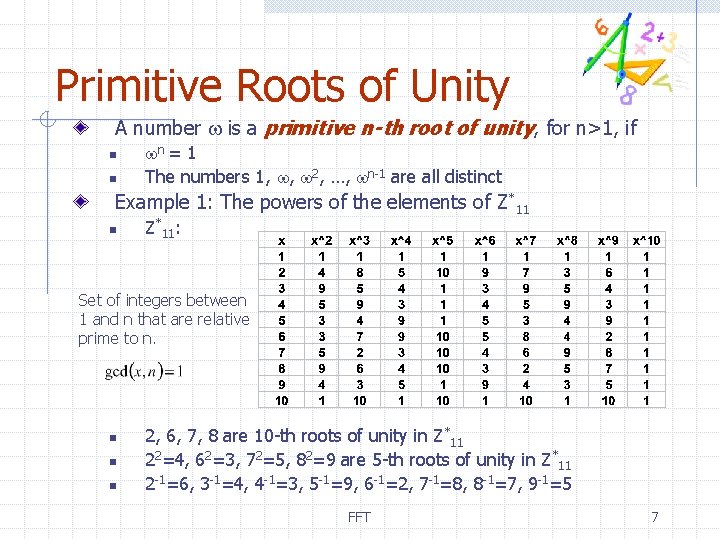
Primitive Roots of Unity A number w is a primitive n-th root of unity, for n>1, if n n wn = 1 The numbers 1, w, w 2, …, wn-1 are all distinct Example 1: The powers of the elements of Z*11 n Z*11: Set of integers between 1 and n that are relative prime to n. n n n 2, 6, 7, 8 are 10 -th roots of unity in Z*11 22=4, 62=3, 72=5, 82=9 are 5 -th roots of unity in Z*11 2 -1=6, 3 -1=4, 4 -1=3, 5 -1=9, 6 -1=2, 7 -1=8, 8 -1=7, 9 -1=5 FFT 7
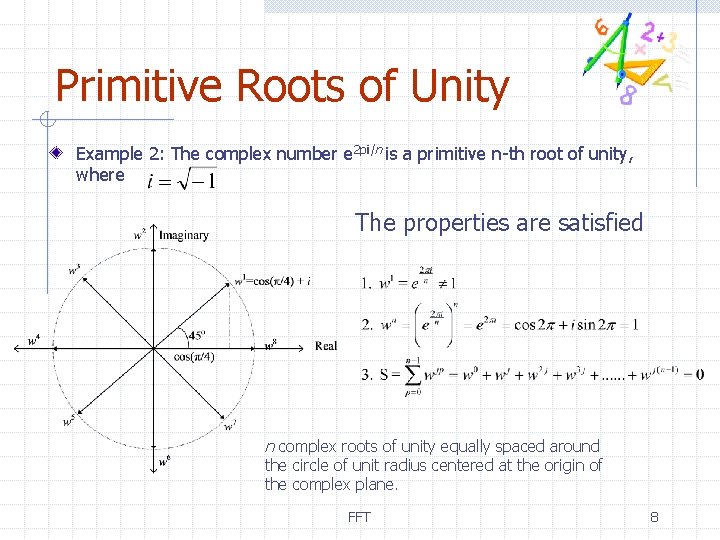
Primitive Roots of Unity Example 2: The complex number e 2 pi/n is a primitive n-th root of unity, where The properties are satisfied n complex roots of unity equally spaced around the circle of unit radius centered at the origin of the complex plane. FFT 8
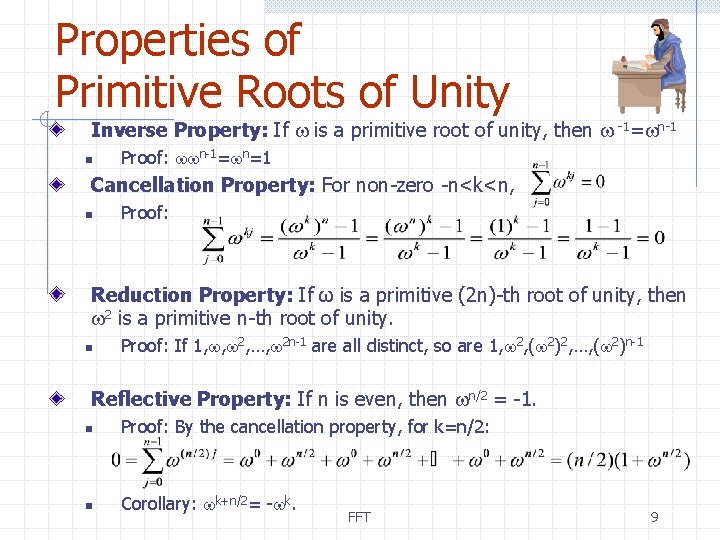
Properties of Primitive Roots of Unity Inverse Property: If w is a primitive root of unity, then w -1=wn-1 n Proof: wwn-1=wn=1 Cancellation Property: For non-zero -n<k<n, n Proof: Reduction Property: If ω is a primitive (2 n)-th root of unity, then w 2 is a primitive n-th root of unity. n Proof: If 1, w, w 2, …, w 2 n-1 are all distinct, so are 1, w 2, (w 2)2, …, (w 2)n-1 Reflective Property: If n is even, then wn/2 = -1. n Proof: By the cancellation property, for k=n/2: n Corollary: wk+n/2= -wk. FFT 9
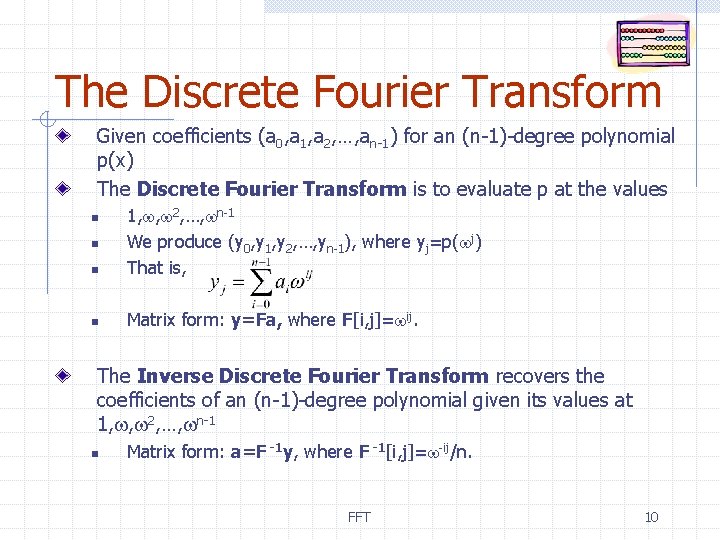
The Discrete Fourier Transform Given coefficients (a 0, a 1, a 2, …, an-1) for an (n-1)-degree polynomial p(x) The Discrete Fourier Transform is to evaluate p at the values n 1, w, w 2, …, wn-1 We produce (y 0, y 1, y 2, …, yn-1), where yj=p(wj) That is, n Matrix form: y=Fa, where F[i, j]=wij. n n The Inverse Discrete Fourier Transform recovers the coefficients of an (n-1)-degree polynomial given its values at 1, w, w 2, …, wn-1 n Matrix form: a=F -1 y, where F -1[i, j]=w-ij/n. FFT 10
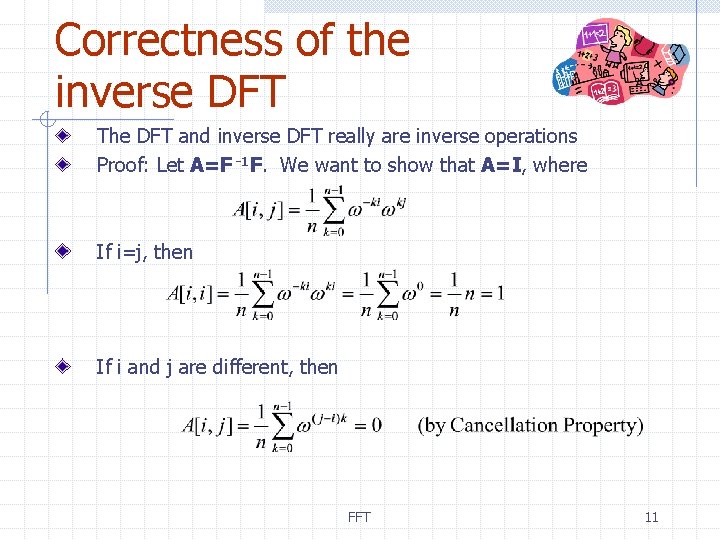
Correctness of the inverse DFT The DFT and inverse DFT really are inverse operations Proof: Let A=F -1 F. We want to show that A=I, where If i=j, then If i and j are different, then FFT 11

Convolution The DFT and the inverse DFT can be used to multiply two polynomials So we can get the coefficients of the product polynomial quickly if we can compute the DFT (and its inverse) quickly… FFT 12
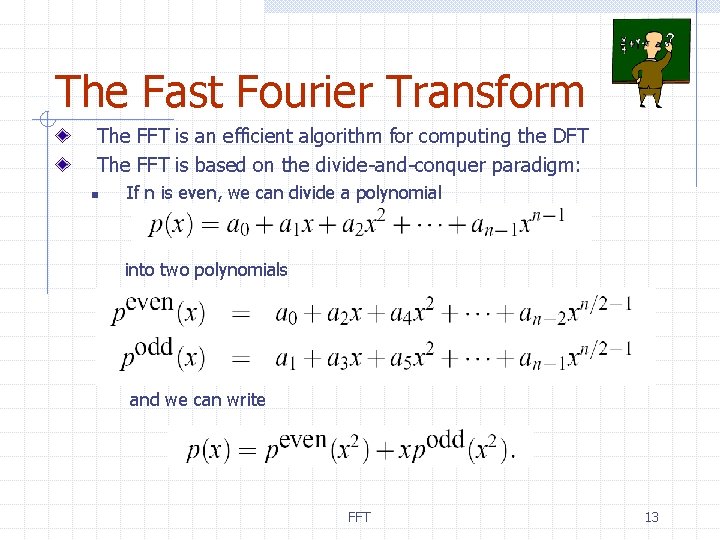
The Fast Fourier Transform The FFT is an efficient algorithm for computing the DFT The FFT is based on the divide-and-conquer paradigm: n If n is even, we can divide a polynomial into two polynomials and we can write FFT 13
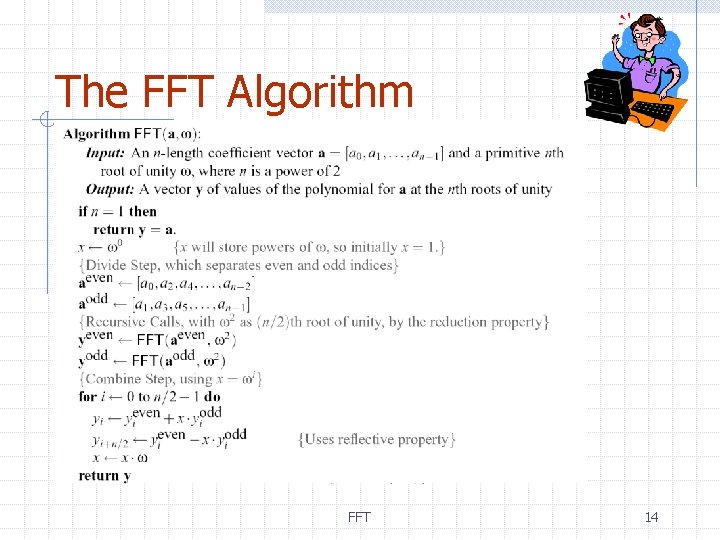
The FFT Algorithm FFT 14
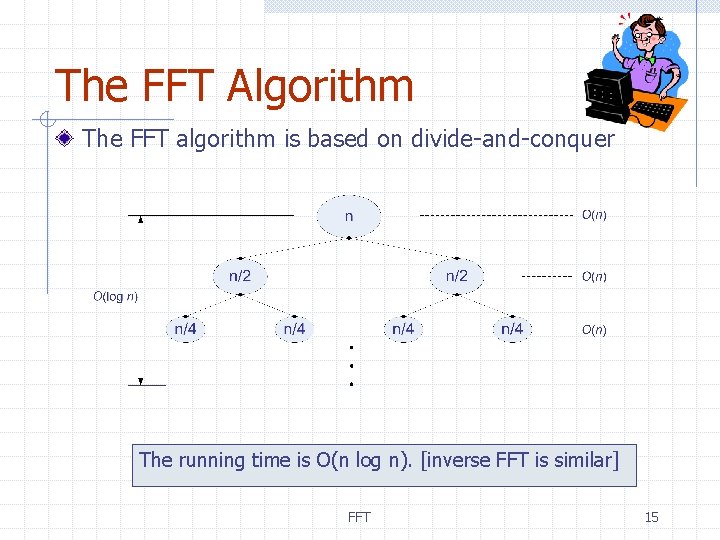
The FFT Algorithm The FFT algorithm is based on divide-and-conquer The running time is O(n log n). [inverse FFT is similar] FFT 15
Non-recursive FFT There is also a non-recursive version of the FFT n n n Performs the FFT in place Precomputes all roots of unity Performs a cumulative collection of shuffles on A and on B prior to the FFT, which amounts to assigning the value at index i to the index bit-reverse(i). The code is a bit more complex, but the running time is faster by a constant, due to improved overhead FFT 16
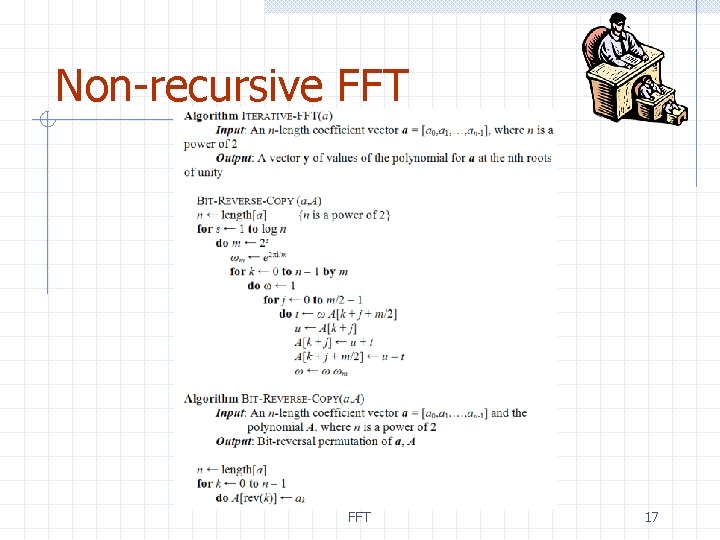
Non-recursive FFT 17
Multiplying Big Integers Given N-bit integers (N ≥ 64) I and J, compute IJ. Assume: we can multiply words of O(log N) bits in constant time. Setup: Find a prime p=cn+1 that can be represented in one word, and set m=(log p)/3, so that we can view I and J as n-length vectors of m-bit words. Finding a primitive root of unity. n n Find a generator x of Z*p. Then w=xc is a primitive n-th root of unity in Z*p (arithmetic is mod p) Apply convolution and FFT algorithm to compute the convolution C of the vector representations of I and J. Then compute K is a vector representing IJ, and takes O(n log n) time to compute. FFT 18
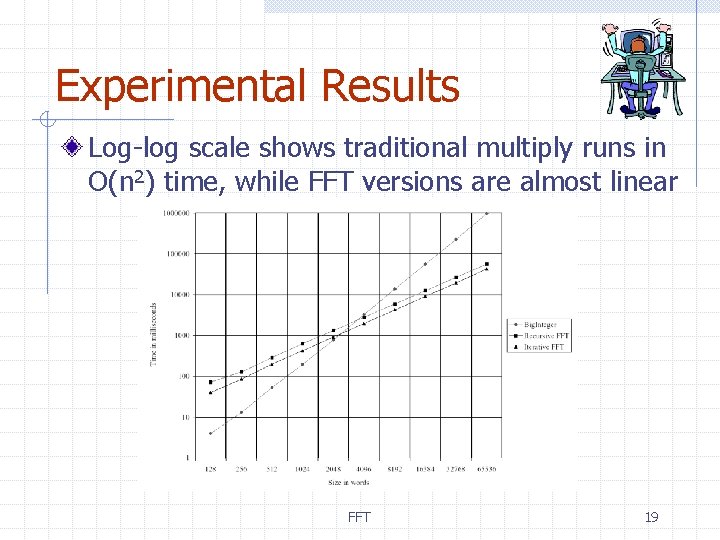
Experimental Results Log-log scale shows traditional multiply runs in O(n 2) time, while FFT versions are almost linear FFT 19
Conclusions Using the reduction property of the primitive roots of unity and the divide-and-conquer approach the DFT can be computed in O(nlogn) time by the FFT algorithm. With the FFT algorithm we can compute the big integers multiplication faster than the traditional multiplication when big size words are required. FFT 20
Bibliography 1) M. T. Goodrich and R. Tamassia, Algorithm Design, New York: John Wiley & Sons, 2002, Chapter 10. 2) T. H. Cormen, C. E. Leiserson, R. L. Rivest and C. Stein, Introduction to Algorithms, Massachusetts: The MIT Press, 2001, Chapter 30. FFT 21
- Slides: 21