
The Family Life Cycle What is family life
- Slides: 17
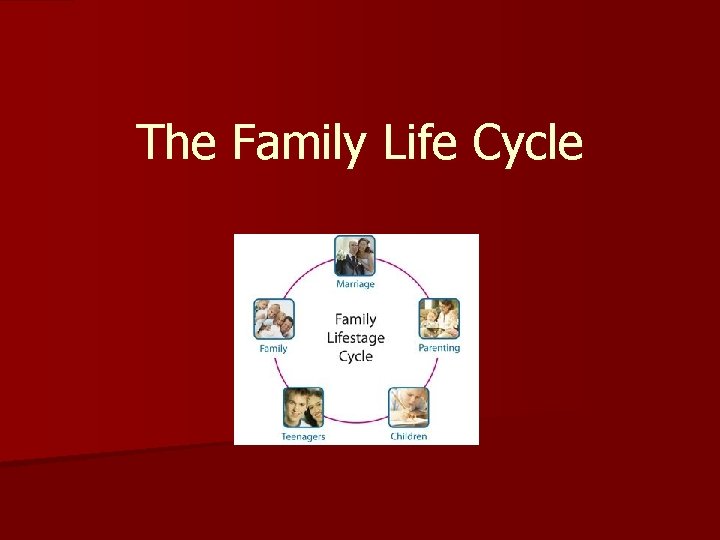
The Family Life Cycle
What is family life cycle theory? An approach to studying families. n Dates back to the 1930 s n Family developmental theory includes two basic concepts n § The life cycle – Emotional and intellectual stages from childhood to retirement as a member of a family. § The developmental task. – growth responsibilities that arise at certain stages in the life of the family.
Family Life Cycle n To be successful: members need to adapt to family changes to ensure family survival. n In each stage, challenges in family life cause you to build / gain new skills. n Not everyone passes through these stages smoothly.
Why study the family life cycle? n n Mastering the skills and milestones allows you to move from one stage of development to the next. If you don't master the skills: more likely to have difficulty with relationships and future transitions. Family life cycle theory suggests: successful transitioning may also help to prevent disease and emotional or stress-related disorders. Your experiences through the family life cycle will affect who you are and who you become.
What can disrupt the cycle? n Severe illness, stress, financial problems, or death can have an effect on how well you pass through the stages. n If you miss skills in one stage, you can learn them in later stages.
Terms to Know: n Family life cycle – Set of predictable steps or patterns and developmental tasks families experience over time. – The family life cycle concept facilitates studying the family from beginning to end. n Family stage – A time period in the life of a family that has a unique structure. n Transition – The shift from one family stage to another
Assumptions n n n Age does not matter… people enter the stages at different points, i. e. having a baby at 18 versus having a baby at 23 or 41. Development of group of interacting individuals is more important than of the individual. Developmental processes are inevitable and important in understanding families. Growth is going to happen. Families and individuals change over a period of time.
Stage 1: Beginning family n Married couple establish home but no children n Developmental Tasks: Establishing a satisfying home and marriage relationship and preparing for childbirth
Stage 2: Childbearing Family n From birth of 1 st child until that child is 2 ½ years old n Developmental Task: Adjusting to increased family size and providing a positive developmental environment
Stage 3: Family with Preschoolers n Oldest child is between 2 ½ and 6 n Developmental tasks (DT): coping with demands on energy and attention with less privacy at home
Stage 4: Family with School Children n When oldest child is between ages of 6 and 13 n DT: Promoting educational achievement and fitting in with the community of families with school-age children
Stage 5: Family with Teenagers n Oldest child is between ages of 13 and 20 n DT: Allowing and helping children to become more independent
Stage 6: Launching Centre n When oldest child leaves family until the youngest leaves home n DT: Releasing young adults and accepting new ways of relating to them; maintaining a supportive home base
Stage 7: Empty Nest n From time children are gone till couple retires n DT: Renewing and redefining marriage relationship; preparing for retirement years
Stage 8: Aging Family n From retirement till death of the marriage partner n DT: Adjusting to retirement; coping with death and living alone.
Reflection Questions: n Is the structure of the Family Life Cycle Changing? n If so, what is changing / impacting it?
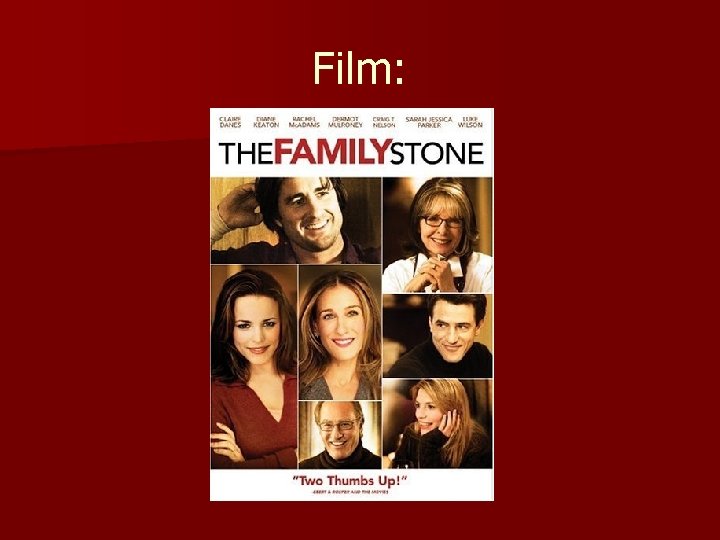
Film: