
The Family Life Cycle Individual and Family Dynamics
- Slides: 26
The Family Life Cycle Individual and Family Dynamics 120
Expectations of Teenagers • Make a list of 10 expectations you have of yourself for your future.
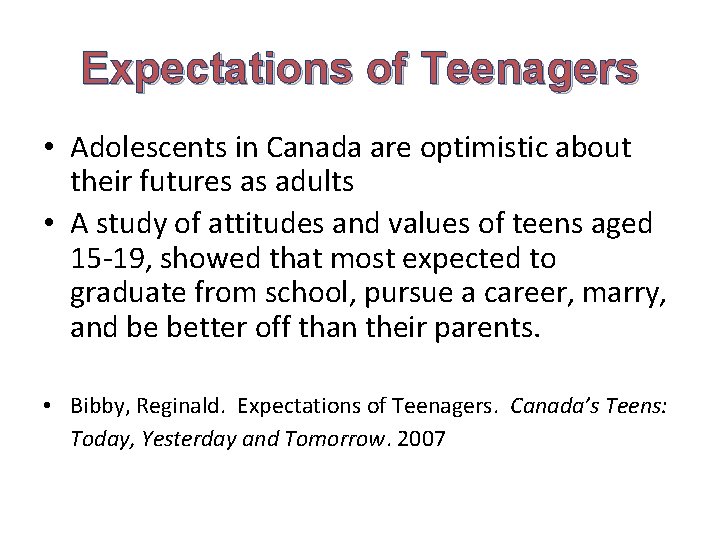
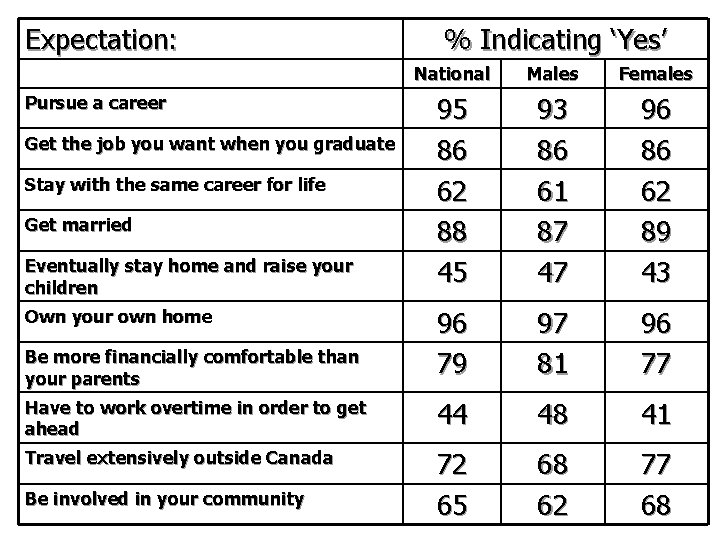
Expectations of Teenagers • Adolescents in Canada are optimistic about their futures as adults • A study of attitudes and values of teens aged 15 -19, showed that most expected to graduate from school, pursue a career, marry, and be better off than their parents. • Bibby, Reginald. Expectations of Teenagers. Canada’s Teens: Today, Yesterday and Tomorrow. 2007
Expectation: % Indicating ‘Yes’ National Males Females 95 86 62 88 45 93 86 61 87 47 96 86 62 89 43 96 79 97 81 96 77 Have to work overtime in order to get ahead 44 48 41 Travel extensively outside Canada 72 65 68 62 77 68 Pursue a career Get the job you want when you graduate Stay with the same career for life Get married Eventually stay home and raise your children Own your own home Be more financially comfortable than your parents Be involved in your community
The Family Life Cycle • The family life cycle is a series of emotional and intellectual stages you pass through in predictable order from childhood to retirement as a member of a society and a family.
Key Terms - The Family Life • Family of Orientation: The family into which you are born. Also Cycle called the family of origin. • Family of Procreation: The family you create once you launch from your family of orientation. • Stressor: An event that causes stress with the family. The ability of a family to overcome or cope with a stressor will depend on the family structure and the family personality. • Developmental Task: Challenges that force people to adjust their physical, emotional or intellectual state of being. These are prerequisites for a person to move on to the next stage in the cycle. For example, a newly married couple will learn how to negotiate and solve problems with each other. This gives them the skills needed to face the challenges of becoming parents. • Transition: The shift from one family stage to another.
The Family Life Cycle This theory includes two basic concepts: • The life cycle – Emotional and intellectual stages from childhood to retirement as a member of a family. • The Developmental Task – growth responsibilities that arise at certain stages in the life of the family.
The Family Life Cycle • To be successful members need to adapt to family changes to ensure family survival. • In each stage, challenges in family life cause you to build/gain new skills. • Not everyone passes through these stages smoothly.
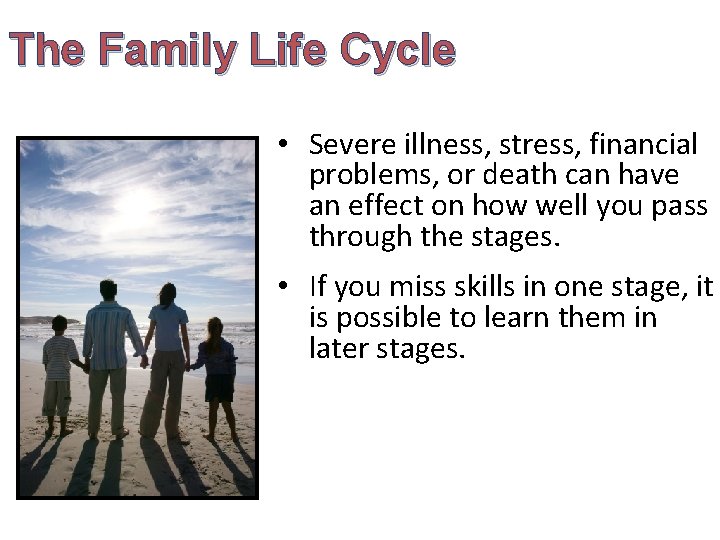
The Family Life Cycle • Severe illness, stress, financial problems, or death can have an effect on how well you pass through the stages. • If you miss skills in one stage, it is possible to learn them in later stages.
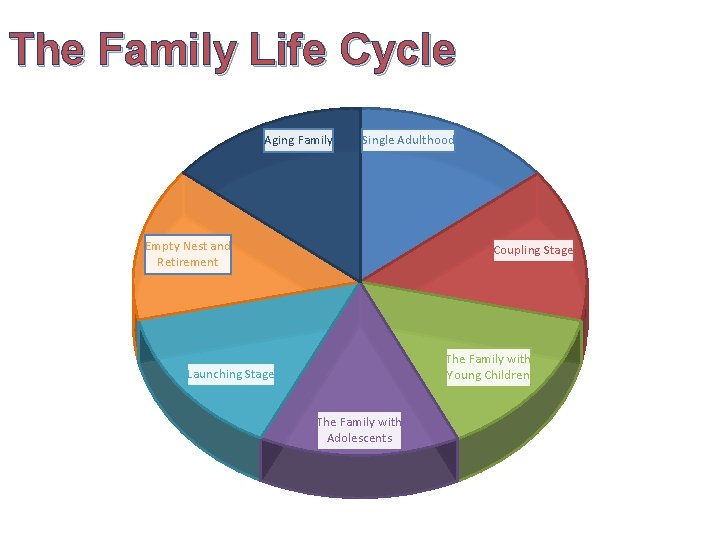
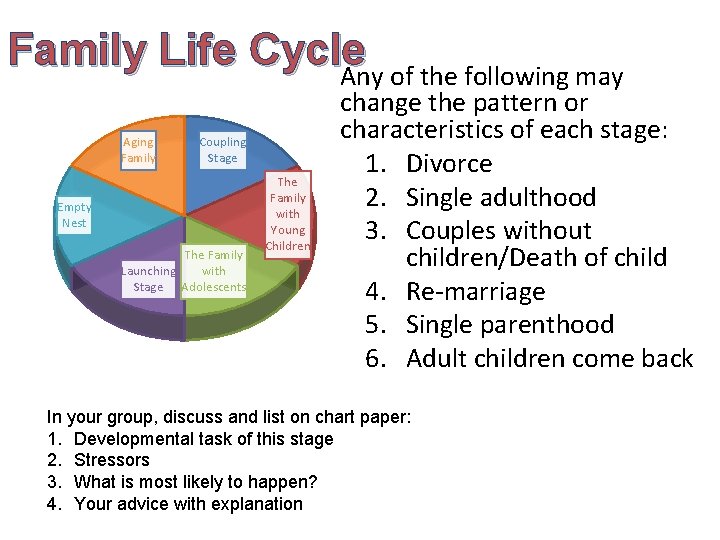
The Family Life Cycle Aging Family Single Adulthood Empty Nest and Retirement Coupling Stage The Family with Young Children Launching Stage The Family with Adolescents
1. Independence – Single Adulthood Developmental tasks: • Most critical stage – focus is on building your own identity • As a young adult, begin to separate emotionally from the family • Strive to become fully able to support yourself emotionally, physically, socially, and financially. • Intimacy is a vital skill to develop.
1. Independence – Single Adulthood • At this stage the young adult is out on his/her own maybe at college, working etc. • They are making decisions, maintaining their apartment, etc. • Often dating and developing relationships.
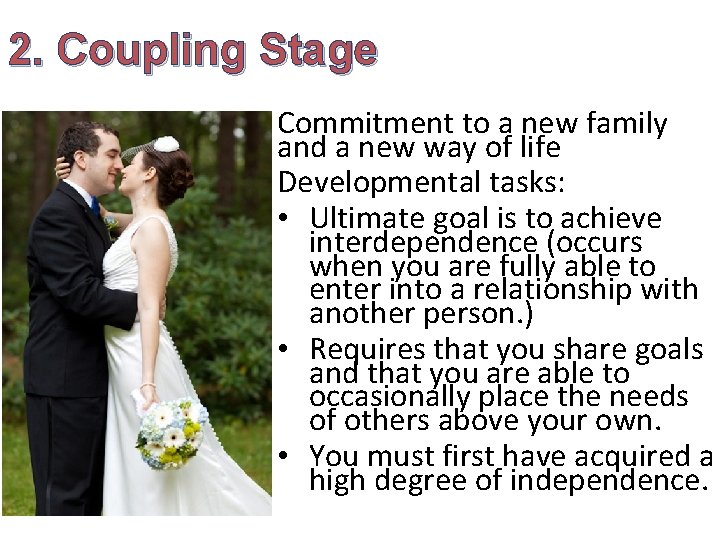
2. Coupling Stage Commitment to a new family and a new way of life Developmental tasks: • Ultimate goal is to achieve interdependence (occurs when you are fully able to enter into a relationship with another person. ) • Requires that you share goals and that you are able to occasionally place the needs of others above your own. • You must first have acquired a high degree of independence.
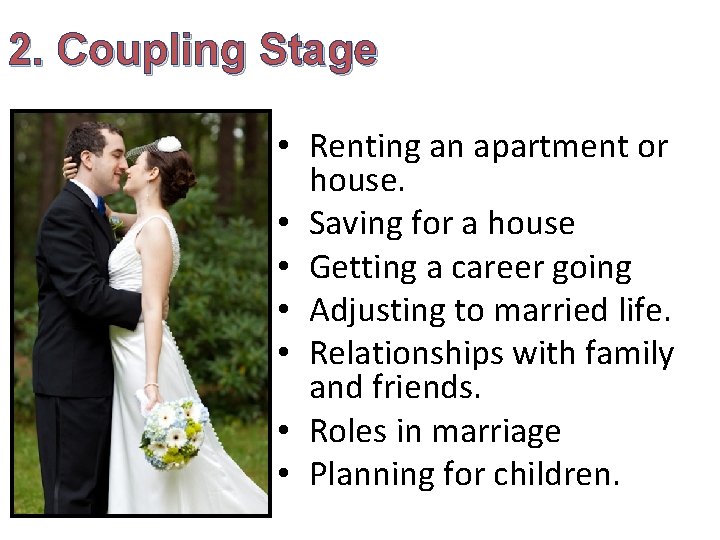
2. Coupling Stage • Renting an apartment or house. • Saving for a house • Getting a career going • Adjusting to married life. • Relationships with family and friends. • Roles in marriage • Planning for children.
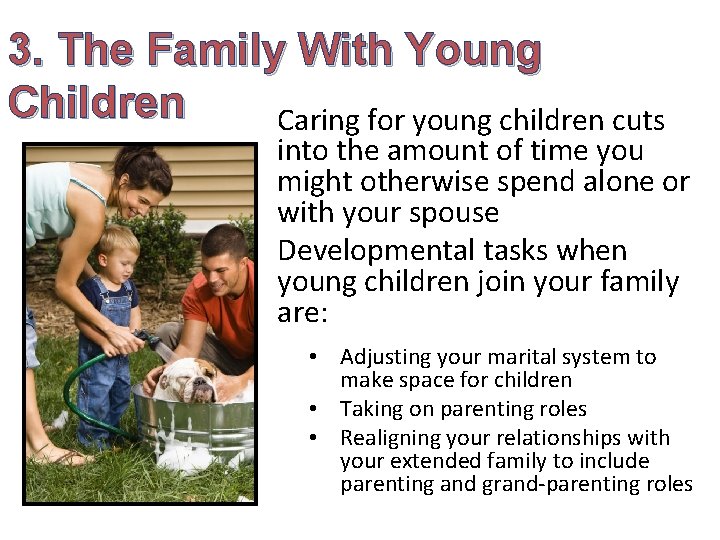
3. The Family With Young Children Caring for young children cuts into the amount of time you might otherwise spend alone or with your spouse Developmental tasks when young children join your family are: • Adjusting your marital system to make space for children • Taking on parenting roles • Realigning your relationships with your extended family to include parenting and grand-parenting roles
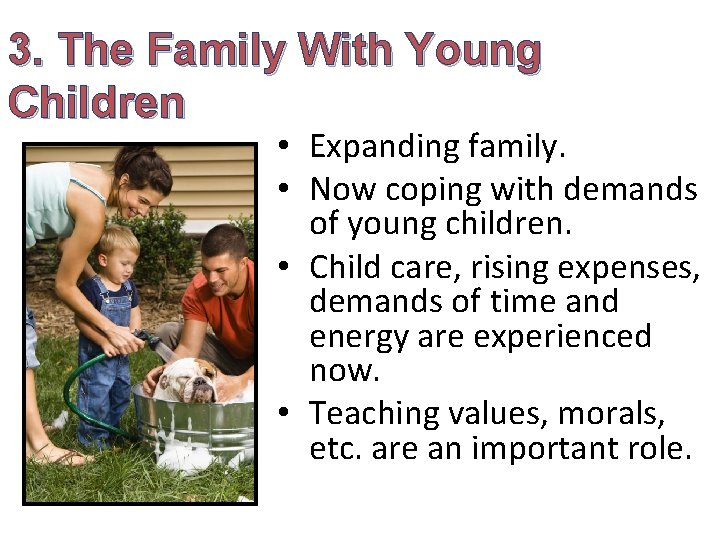
3. The Family With Young Children • Expanding family. • Now coping with demands of young children. • Child care, rising expenses, demands of time and energy are experienced now. • Teaching values, morals, etc. are an important role.
4. The Family With Adolescents When oldest child is between ages of 13 and 20 Developmental tasks during this stage of parenting adolescents include: • Shifting parent-child relationships to allow the child to move in and out of the family system. • Shifting focus back to your midlife marital and career issues. • Beginning a shift toward concern for older generations in your extended family.
4. The Family With Adolescents • Children are becoming more independent. • Peers play a larger role then when children were younger. • Parents and teens trying to balance responsibility, rules, preparing for when teens leave home.
5. Launching Stage When oldest child leaves family until the youngest leaves home. Developmental tasks to attain at this stage: – Refocusing on your marriage without children – Developing adult relationships with your children – Realigning relationships to include in-laws and grandchildren when your children begin their own families
5. Launching Stage • Children gradually leave home to go to college, university, work and support themselves. • This is a time of adjustment for everyone. • “Boomerang generation”
6. Empty Nest and Retirement From time children are gone until couple retires. Developmental tasks include: • Renewing and redefining marriage relationship • Preparing for retirement
6. Empty Nest and Retirement • Maintaining your own interests and physical functioning, along with those of your spouse. • Exploring new family and social roles. • Providing emotional support for your adult children and extended family members.
7. Aging Family From retirement until death of the marriage partner Developmental tasks to reach at this final stage include: • Adjusting to retirement • Loss of spouse, siblings and other peers, and preparing for your own death. • Reviewing your life and reflecting on all you have learned and experienced during your life cycle.
7. Aging Family • This is a time when husband wife can reconnect and spend more time together. • Retirement also means less demand on ones times and now may travel, go on trips, visit children and grandchildren. • Loneliness and living alone.
Variations in the Family Life Cycle • Any of the following may change the pattern or characteristics of each stage: 1. 2. 3. 4. 5. 6. Divorce Single adulthood Couples without children Single parenthood Re-marriage Adult children come back
Family Life Cycle Any of the following may Aging Family Coupling Stage Empty Nest The Family with Launching Stage Adolescents The Family with Young Children change the pattern or characteristics of each stage: 1. Divorce 2. Single adulthood 3. Couples without children/Death of child 4. Re-marriage 5. Single parenthood 6. Adult children come back In your group, discuss and list on chart paper: 1. Developmental task of this stage 2. Stressors 3. What is most likely to happen? 4. Your advice with explanation