
The Family Life Cycle Ecology of Human Development
- Slides: 11
The Family Life Cycle
Ecology of Human Development �Individual life cycle �Family life cycle �Socio-political culture and history
Bioecological Paradigm (Bronfenbrenner) �Ecology: branch of biology; study of the relationship between organisms and their environments �Microsystem: reciprocity (A B B A) � Mesosystem: interactions between settings �Exosystem: impact but no direct contact �Macrosystem: culture
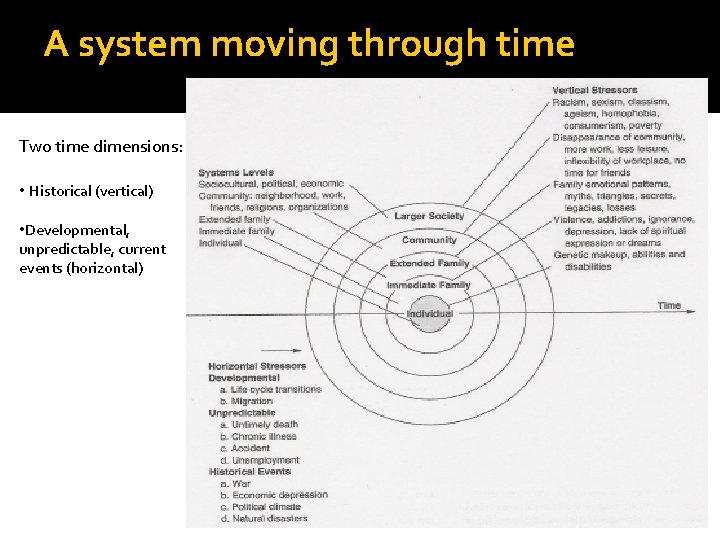
A system moving through time Two time dimensions: • Historical (vertical) • Developmental, unpredictable, current events (horizontal)
Family Life Cycle Stages 1. 2. 3. 4. 5. 6. Leaving Home Joining of families through marriage Families with young children Families with adolescents Launching children & moving on Families in later life
Leaving Home �Single young adults �Emotional process: accepting emotional and financial responsibility �Changes required: differentiation of self in relation to family of origin Development of intimate peer relationships Establishment of self in respect to work and financial independence
The Joining of Families �The new couple �Emotional process: commitment to a new system �Changes required: Formation of marital system Realignment of relationships with extended families and friends to include spouse
Families with Young Children �The new family �Emotional process: accepting new members into the system �Changes required: Adjusting marital system to make space for children Joining in childrearing, financial and household tasks Realignment of relationships with extended family to include parenting and grandparenting roles
Families with Adolescent Children �The family with adolescent children �Emotional process: increasing flexibility of family boundaries to permit adolescent independence and grandparent’s frailty �Changes required: Shifting parent/child relationships to permit adolescent to move into and out of system Refocus on midlife marital and career issues Beginning shift toward caring for older generation
Launching Children & Moving On �Emotional process: accepting a multitude of exits from and entries into family system �Changes required: Renegotiate marital system as a dyad Development of adult-to-adult relationships between adult children and parents Realignment of relationships to include in-laws and grandchildren Dealing with disabilities and death of parents (grandparents)
Families in Later Life �Emotional process: accepting the shifting generational roles �Changes required: Maintain own and/or couple functioning in face of physiological decline: exploration of new role options Support for more central role of middle generation Making room in system for the wisdom and experience of elderly; supporting without overfunctioning for them Dealing with loss and preparation for death