
The Fair Start Model of Family Planning Matthew
- Slides: 20
The Fair Start Model of Family Planning Matthew Hammity, Carter Dillard, Sarah Bexell, & Catharina Hughey
So, if we accept that something needs to change… …for the health of people, other species, and Earth, what are some options for moving forward?
Where are we now? The Parent-Centered Isolation Model and the Freedom to Harm • The current isolation model of family planning is one in which potential parents are seen as individual entities apart from their prospective children and the communities in which they live, whereby the rights of prospective children are not recognized and the voices of communities are not heard (Dillard, 2007). • Most continue to subscribe to the isolation model, often under the mistaken assumption that the alternative necessarily involves some level of governmental coercion.
• This current normative model of family planning • unsustainable, antisocial, and based solely on subjective parental choice Isolation Model • It ignores the thoughtful, carefully constructed, and limited right to found a family ensured by the Universal Declaration of Human Rights and instead creates an ad-hoc and arbitrary model that ensures would-be parents the unfettered subjective right to choose the timing, number and spacing of their children (Dillard, 2007) • It does not adopt a holistic and objective focus that includes the rights of prospective children and their communities, who have just as much, if not more, at stake in family planning. • The isolation model has largely been debunked as without a basis in ethics (Conly, 2016; Dillard, 2010 a) or law (Dillard, 2007; Dillard, 2010 b)
Isolation Model • Human rights are defined and limited in order to improve human wellbeing, not diminish it, which is why the Universal Declaration of Human Rights specifically recognizes that one person’s rights may be limited by others’ competing rights and/or in the interest of general welfare (United Nations General Assembly, 1948). • While reasonable people may disagree about where exactly the balance between competing rights should lie, that some balancing is in order cannot be disputed. • Yet the isolation model lacks such balance, endowing would-be parents with carte blanche to colonize the future, never mind the impacts on communities and the more-than-human world.
• Philosopher John Stuart Mill argued in 1859 that, in order to maximize liberty, the state had an obligation to control the liberty of those more powerful, in the case of familial relations, so children didn't suffer in the name of parental liberty (Mill, 1978). Wisdom from 1859 • According to Mill (1978), the state’s responsibility extended to prospective children because, “to bring a child into existence without a fair prospect of being able, not only to provide food for its body, but instruction and training for its mind is a moral crime, both against the unfortunate offspring and against society" (p. 239). • With the mounting environmental and social threats exacerbated by the isolation model, Mill’s arguments resonate even more strongly today.
Children who are already here • All of this is happening while literally millions of children around the world struggle through their days without love and security that better prepared parents afford. In the U. S. alone, the foster care system is overflowing with healthy children awaiting adoption, needing homes and loving adults. What if young parents instead said Parenting is not about making more people who look like us - it's about leading by example to make sure that every human is raised with the things they need and deserve. • The failure to ensure that these parentless children gain what they deserve in order to thrive is an egregious violation of human rights, made all the more so by the certainty that we will continue to create such deprived children by the thousands with each day that passes under the isolation model. • 400, 000 -440, 000 children in foster care each year, just in the U. S.
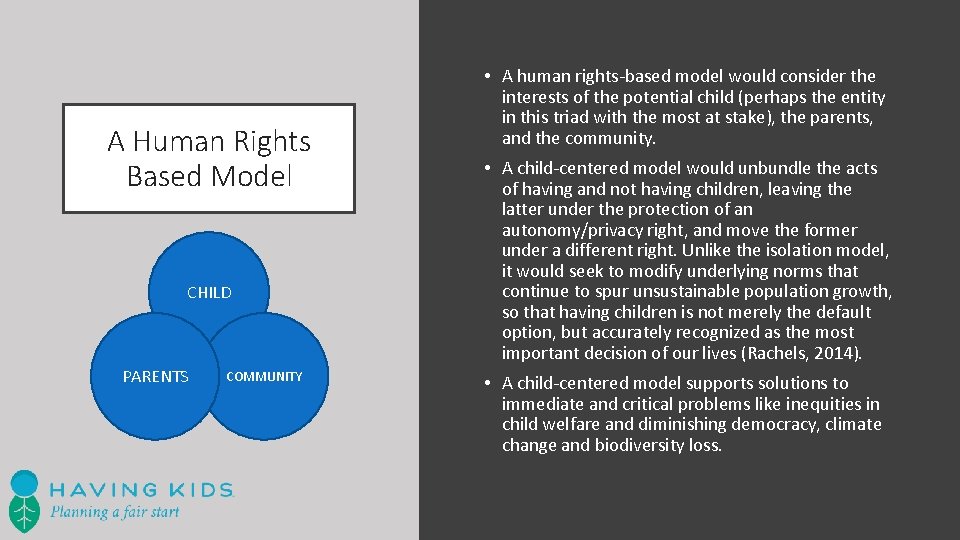
A Human Rights Based Model CHILD PARENTS COMMUNITY • A human rights-based model would consider the interests of the potential child (perhaps the entity in this triad with the most at stake), the parents, and the community. • A child-centered model would unbundle the acts of having and not having children, leaving the latter under the protection of an autonomy/privacy right, and move the former under a different right. Unlike the isolation model, it would seek to modify underlying norms that continue to spur unsustainable population growth, so that having children is not merely the default option, but accurately recognized as the most important decision of our lives (Rachels, 2014). • A child-centered model supports solutions to immediate and critical problems like inequities in child welfare and diminishing democracy, climate change and biodiversity loss.
An Alternative: A Child. Centered Model A model is needed that focuses on the objective interests of future children, parents, and their communities, with the collective goal of creating smaller families that work together to give every child fair opportunity. This model would orient the cluster of human rights involved in family planning around the core rights of every child. That means all children have the fundamental right to begin their lives in conditions that create equal resources relative to other children.
Minimum Threshold of Wellbeing • This could be achieved in large part through smaller families that promote a minimum threshold of wellbeing whereby (1) children enjoy opportunities that are both equal to others of their generation and sustainable for future generations, and, (2) future adults populate democratic communities bounded by, and respectful of, the more-than-human world. • In exchange, the community helps parents create those conditions by shifting resources that would have gone into supporting larger families instead toward creating more equitable communities.
The Fair Start Model: Promoting Five Fundamental Values • Orienting the core rights of every child answers crucial questions the isolation model ignores and promotes five objective values that are the building blocks of human freedom: • (1) improved continuity, • (2) wellbeing, • (3) fairness, • (4) nature, and • (5) democracy, • each of which is interconnected.
Improved continuity • An objective of parenting is that a person’s life continues through their children, such that those children enjoy a level of emotional and social fulfillment equal to or above that of the parents’ own lives (as fostered by a safer, supportive environment, and a fairer, more democratic community). • The universality of the value of continuity--as achieved by concerted attention to the health and development of offspring--serves as an anchor and baseline objective value that may serve to guide all parenting decisions. • A new model recognizes procreation as a human right, but one balanced against just as weighty and legitimate competing rights, chief among them, a child’s right to a healthy life.
Well-being • Since it is taken for granted that all parents should aim to provide some minimum level of wellbeing for their children (Freeman, 1997; Purdy, 1995) it stands to reason that communities should foster conditions that allow for the achievement of that minimum level of wellbeing. • This would necessarily include providing birth control to those who do not want children but lack the means to prevent pregnancies (Having Kids, 2016; Tavernese, 2015) as well as fairly allocating resources. • If providing a minimum level of wellbeing for all children were not its own reward, studies have shown that doing so is critical to creating a society of cooperative adults (Center for Disease and Prevention, 2013).
Fairness • It is similarly uncontroversial that a child born into a less wealthy family is just as deserving of opportunities to thrive as children born into wealthy families. Yet life in the U. S continues to be tragically unfair, with persistent economic inequality (Saez, 2016) and a corresponding sharp decline in economic mobility (Carr & Wiemers, 2016; Chetty et al. , 2017). Fairness is necessarily comparative and breaks the isolation model by asking families to work together to create the conditions every child deserves.
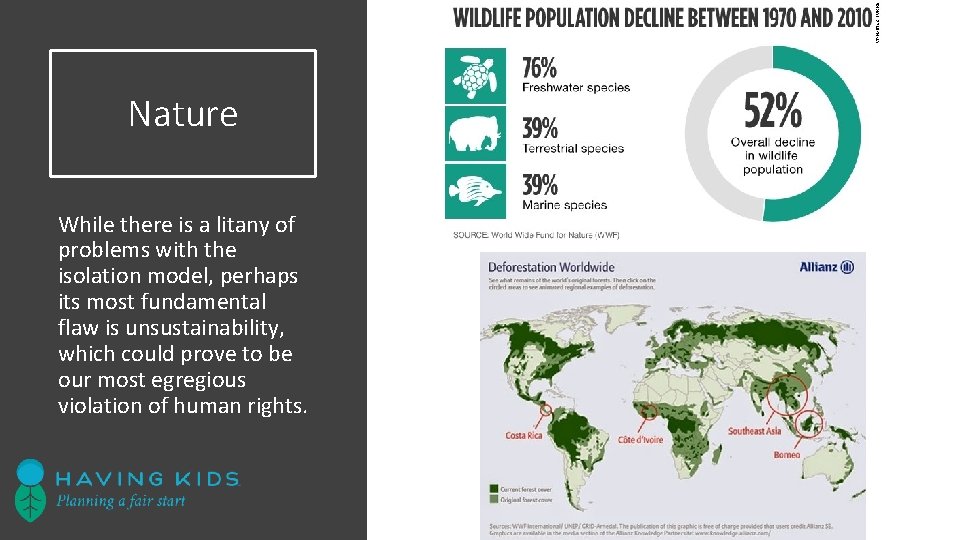
Nature While there is a litany of problems with the isolation model, perhaps its most fundamental flaw is unsustainability, which could prove to be our most egregious violation of human rights.
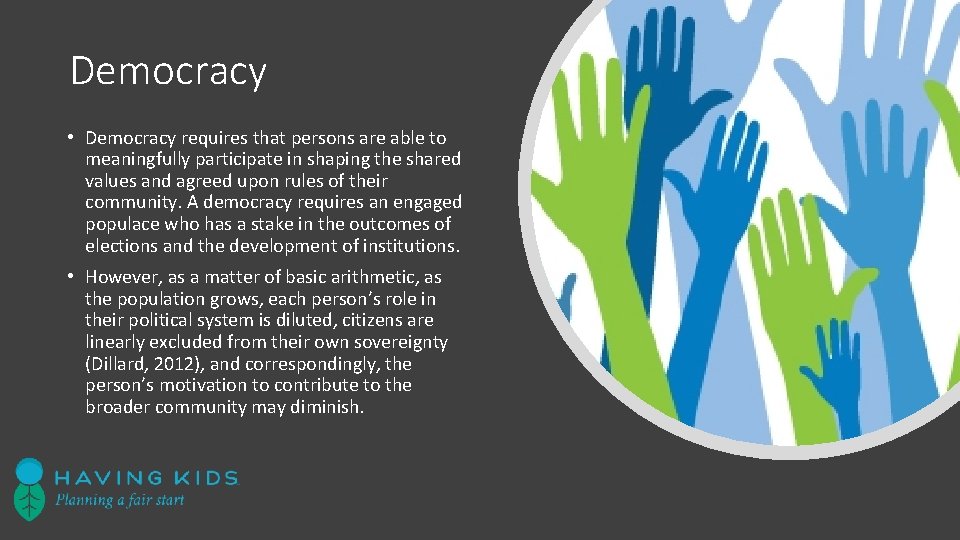
Democracy • Democracy requires that persons are able to meaningfully participate in shaping the shared values and agreed upon rules of their community. A democracy requires an engaged populace who has a stake in the outcomes of elections and the development of institutions. • However, as a matter of basic arithmetic, as the population grows, each person’s role in their political system is diluted, citizens are linearly excluded from their own sovereignty (Dillard, 2012), and correspondingly, the person’s motivation to contribute to the broader community may diminish.
In Sum • Rather than disconnecting the process of deciding to bring children into this world and the process of actually caring for those children, the model would connect the two. • Doing so will allow for cooperation between parents who will plan with their communities to bring children into this world so as to ensure that all receive the vital array of resources they need to develop into full democratic citizens living in a healthy, sustainable, and fair world. We call it The Fair Start Model
References • Carr, M. , & Wiemers, E. E. (2016). The Decline in Lifetime Earnings Mobility in the US: Evidence from Survey-Linked Administrative Data. Washington Center for Equitable Growth. Retrieved from http: //equitablegrowth. org/equitablog/the-decline-in-lifetime-earnings-mobility-in-the-us-evidence-from-survey-linked-administrative-data/ • CDC. (2013). Mental health surveillance among children — United States 2005– 2011. Morbidity and Mortality Weekly Report, 62(2), 1 -35. • Chetty, R. , Grusky, D. , Hell, M. , Hendren, N. , Manduca, R. , & Narang, J. (2017). The fading American dream: Trends in absolute income mobility since 1940. Science, 356(6336), 398 -406. • Conly, S. (2016). One child: Do we have a right to more? New York: Oxford University Press. • Dillard, C. (2007). Rethinking the procreative right. Yale Human Rights and Development Law Journal, 10, 1 63. • Dillard, C. (2010 a). Prospective parents and the Children's Rights Convention. American University International Law Review, 25(3), 485 -529. • Dillard, C. (2010 b). Antecedent law: The law of people-making. Mississippi Law Journal, 79(4), 873 -929. • Dillard, C. (2012). The Primary Right. Pace Environmental Law Review, 29, 860 -865. • Mill, J. S. (1978). On Liberty. In Rapaport, E. (Ed. ). [Original work published 1859]. Indianapolis, IN: Hackett Publishing Company, Inc. • Rachels, S. (2014). The immorality of having children. Ethical Theory and Moral Practice, 17(3), 567 -582. • World Wildlife Fund. (2016). Living planet report 2016: Risk and resilience in a new era. Gland, Switzerland: WWF International.
Mathew Hammity: mhamity@gmail. com Questions or Feedback Follow us Carter Dillard: carter@havingkids. org Sarah Bexell: Sarah. Bexell@du. edu Catharina (Kat) Hughey: chughey@merage. org