
THE FABULOUS FANBOYS Connectors of the Independent Clause
THE FABULOUS FANBOYS: Connectors of the Independent Clause! By Teachers Unleashed
Today, in the main Ladies and arena, you will Gentlemen, learn what a welcome to the compound BIG TOP sentence is, of and meet the sentence FABULOUS structure! FANBOYS!!!

Let’s start our introductions! The FANBOYS help us to connect independent clauses together. An independent clause is a phrase that can stand alone by itself as a sentence. It contains a subject and a predicate, and must be a complete thought.
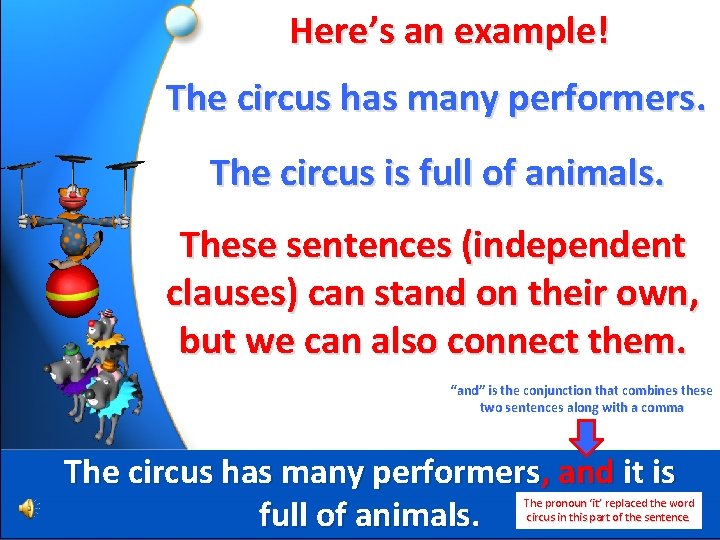
Here’s an example! The circus has many performers. The circus is full of animals. These sentences (independent clauses) can stand on their own, but we can also connect them. “and” is the conjunction that combines these two sentences along with a comma The circus has many performers, and it is full of animals. The pronoun ‘it’ replaced the word circus in this part of the sentence.

That’s an amazing compound sentence! When you combine two independent clauses together using a coordinating conjunction like ‘and’, it is called a compound sentence. Let’s see another example.

I am scared of clowns. I enjoy the circus. Each independent clause can stand on its own, OR I can combine them into a compound sentence with a conjunction. I am scared of clowns, but I enjoy the circus. Let’s meet these FABULOUS coordinating conjunctions.
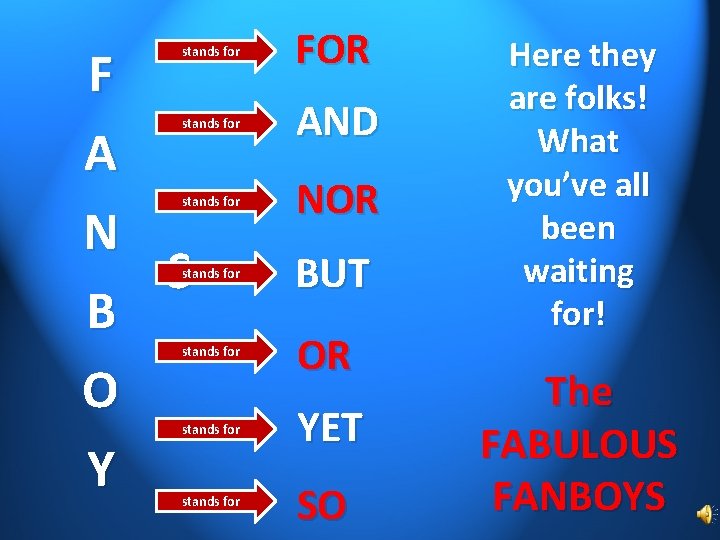
stands for FOR stands for AND stands for NOR stands for BUT stands for OR F A N S B O Y stands for YET stands for SO Here they are folks! What you’ve all been waiting for! The FABULOUS FANBOYS
Okay… Now that you have met the Fabulous FANBOYS, it is time to see how each of them work in a sentence! Hold onto your hats ladies and gents, and take good notes!
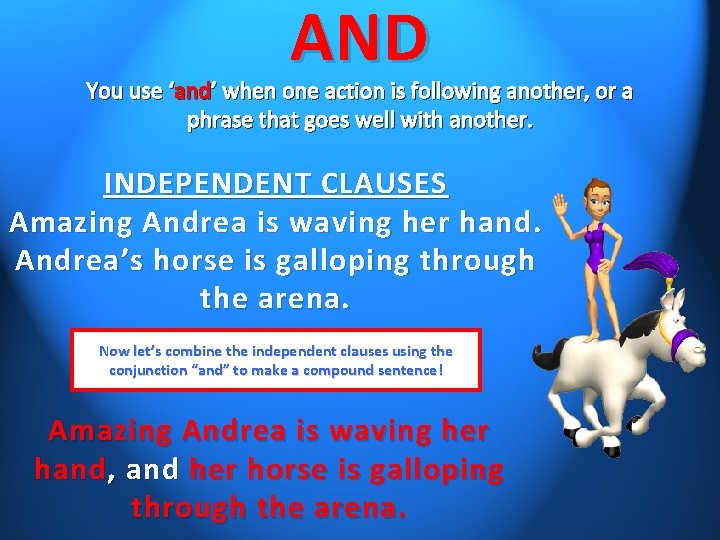
AND You use ‘and’ when one action is following another, or a phrase that goes well with another. INDEPENDENT CLAUSES Amazing Andrea is waving her hand. Andrea’s horse is galloping through the arena. Now let’s combine the independent clauses using the conjunction “and” to make a compound sentence! Amazing Andrea is waving her hand , and her horse is galloping through the arena.
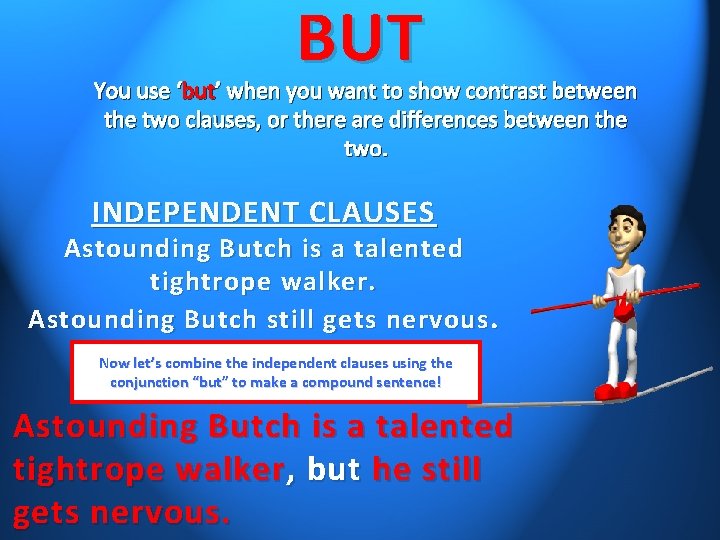
BUT You use ‘but’ when you want to show contrast between the two clauses, or there are differences between the two. INDEPENDENT CLAUSES Astounding Butch is a talented tightrope walker. Astounding Butch still gets nervous. Now let’s combine the independent clauses using the conjunction “but” to make a compound sentence! Astounding Butch is a talented tightrope walker , but he still gets nervous.
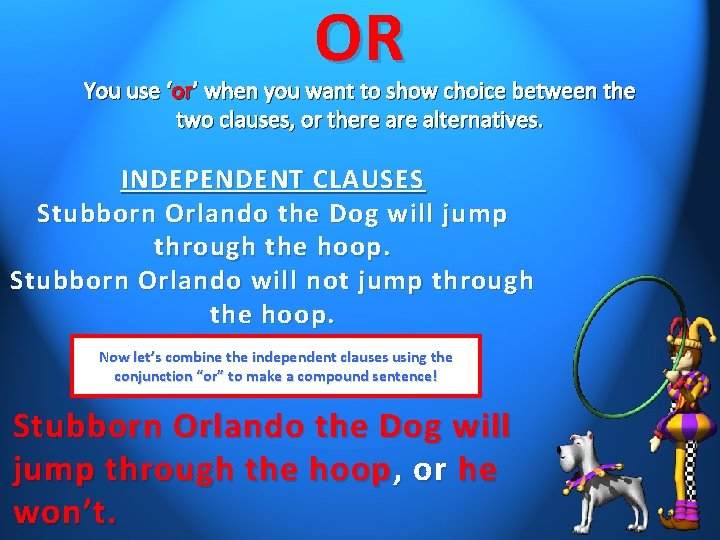
OR You use ‘or’ when you want to show choice between the two clauses, or there alternatives. INDEPENDENT CLAUSES Stubborn Orlando the Dog will jump through the hoop. Stubborn Orlando will not jump through the hoop. Now let’s combine the independent clauses using the conjunction “or” to make a compound sentence! Stubborn Orlando the Dog will jump through the hoop , or he won’t.
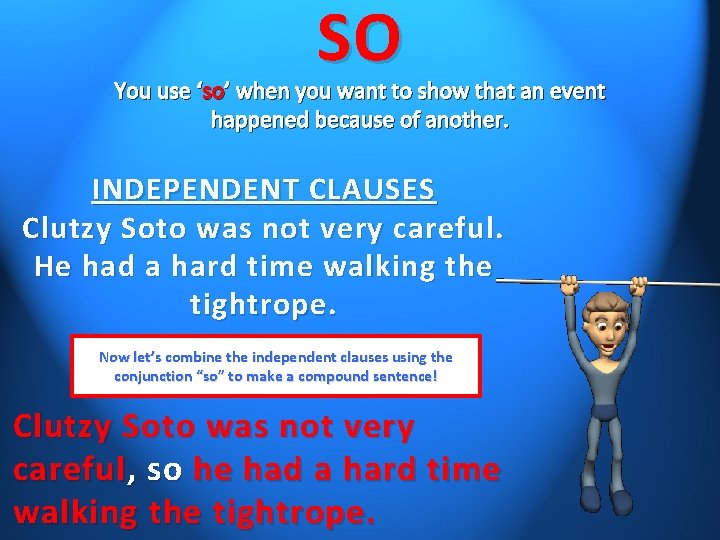
SO You use ‘so’ when you want to show that an event happened because of another. INDEPENDENT CLAUSES Clutzy Soto was not very careful. He had a hard time walking the tightrope. Now let’s combine the independent clauses using the conjunction “so” to make a compound sentence! Clutzy Soto was not very careful , so he had a hard time walking the tightrope.
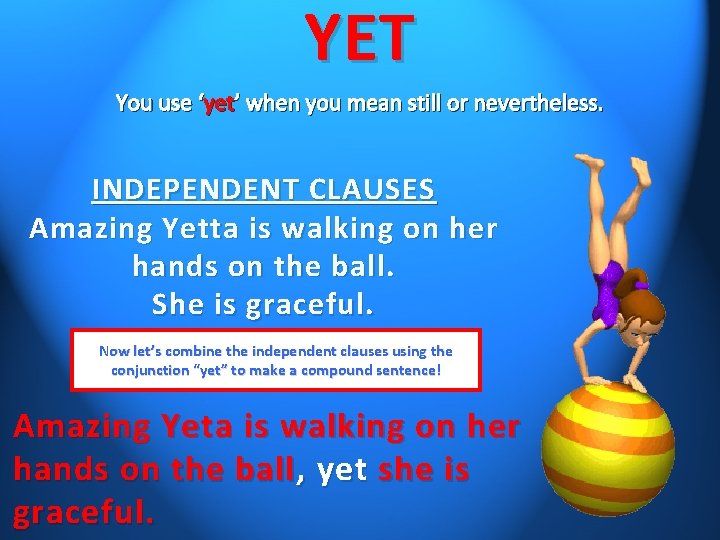
YET You use ‘yet’ when you mean still or nevertheless. INDEPENDENT CLAUSES Amazing Yetta is walking on her hands on the ball. She is graceful. Now let’s combine the independent clauses using the conjunction “yet” to make a compound sentence! Amazing Yeta is walking on her hands on the ball , yet she is graceful.
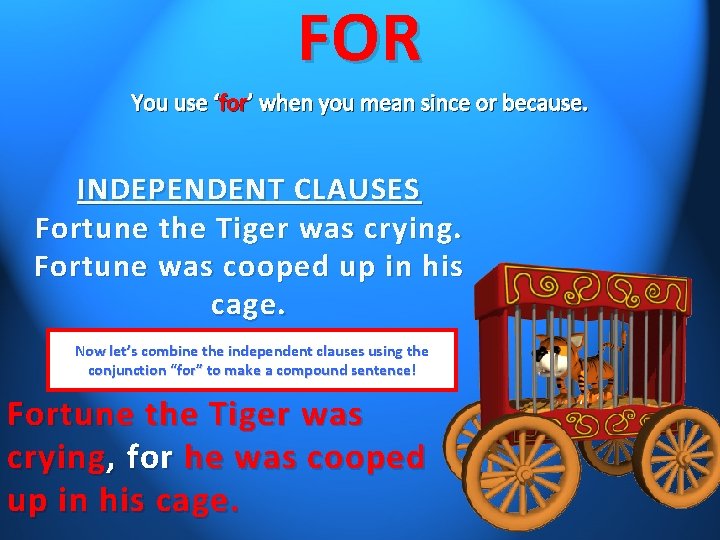
FOR You use ‘for’ when you mean since or because. INDEPENDENT CLAUSES Fortune the Tiger was crying. Fortune was cooped up in his cage. Now let’s combine the independent clauses using the conjunction “for” to make a compound sentence! Fortune the Tiger was crying , for he was cooped up in his cage.
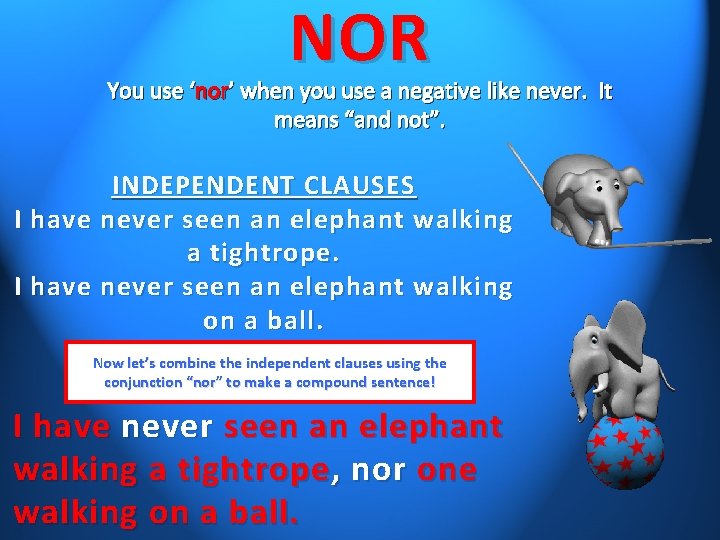
NOR You use ‘nor’ when you use a negative like never. It means “and not”. INDEPENDENT CLAUSES I have never seen an elephant walking a tightrope. I have never seen an elephant walking on a ball. Now let’s combine the independent clauses using the conjunction “nor” to make a compound sentence! I have never seen an elephant walking a tightrope , nor one walking on a ball.
Okay… Now it is time to practice finding the right conjunction to make a great compound sentence! Use your notes to help you!
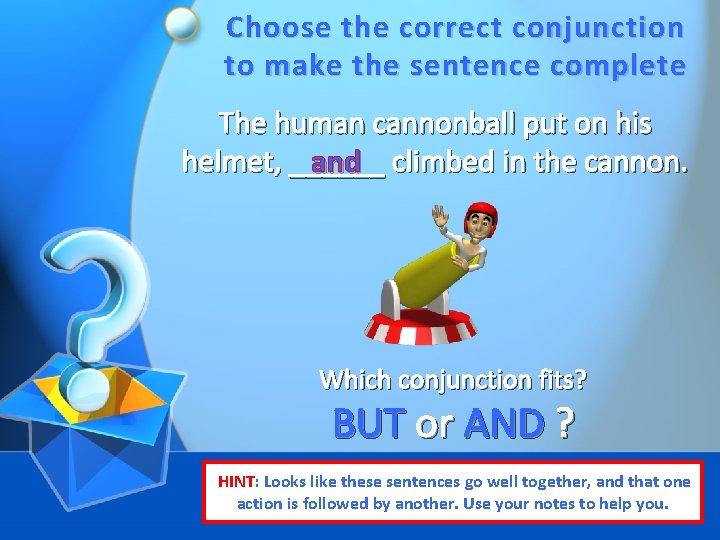
Choose the correct conjunction to make the sentence complete The human cannonball put on his helmet, ______ and climbed in the cannon. Which conjunction fits? BUT or AND ? HINT: Looks like these sentences go well together, and that one action is followed by another. Use your notes to help you.
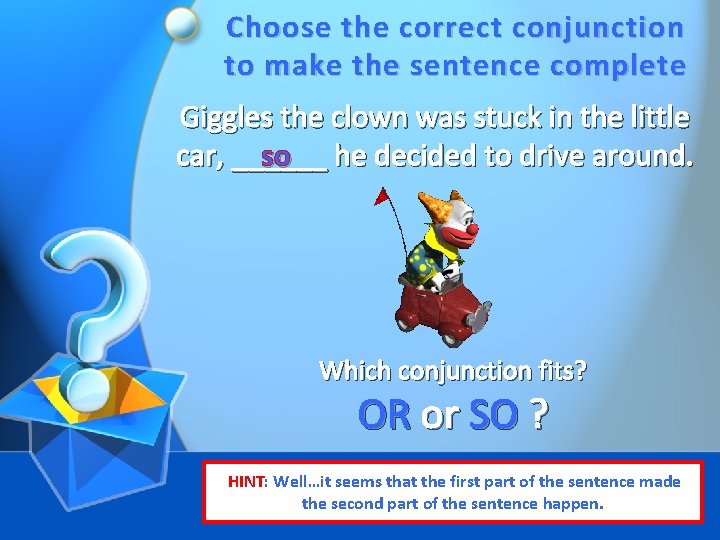
Choose the correct conjunction to make the sentence complete Giggles the clown was stuck in the little car, ______ so he decided to drive around. Which conjunction fits? OR or SO ? HINT: Well…it seems that the first part of the sentence made the second part of the sentence happen.
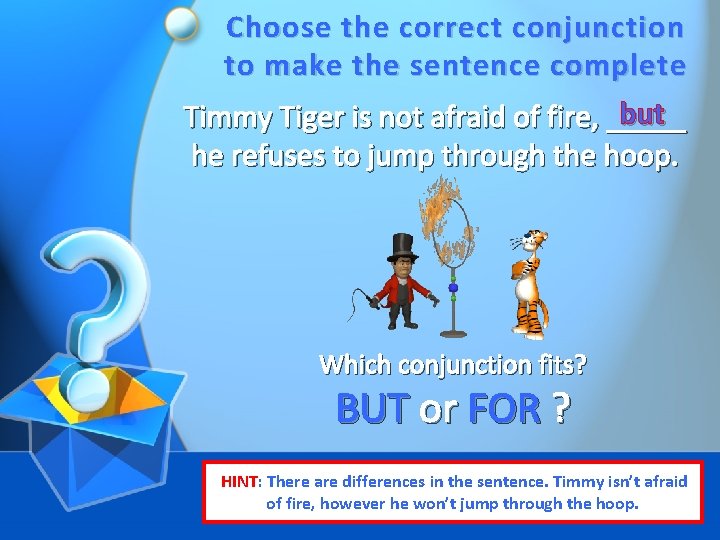
Choose the correct conjunction to make the sentence complete but Timmy Tiger is not afraid of fire, _____ he refuses to jump through the hoop. Which conjunction fits? BUT or FOR ? HINT: There are differences in the sentence. Timmy isn’t afraid of fire, however he won’t jump through the hoop.
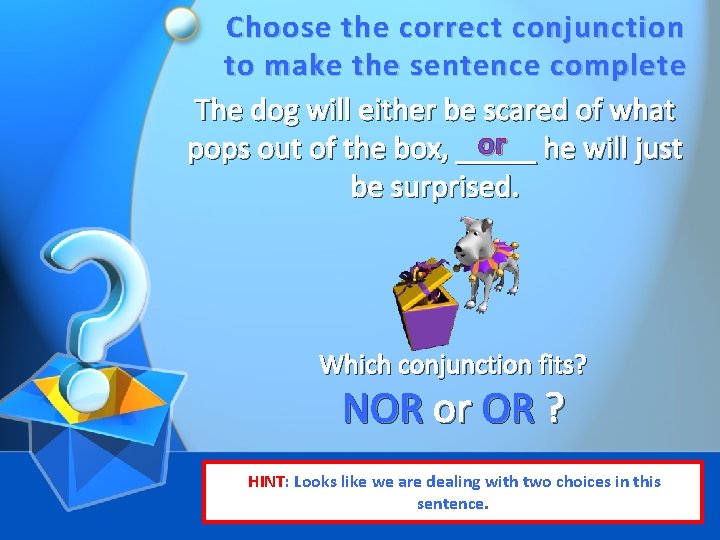
Choose the correct conjunction to make the sentence complete The dog will either be scared of what or he will just pops out of the box, _____ be surprised. Which conjunction fits? NOR or OR ? HINT: Looks like we are dealing with two choices in this sentence.
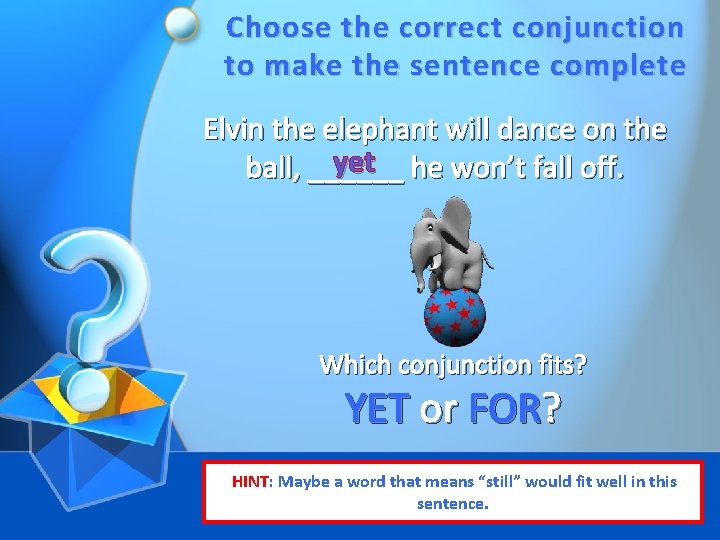
Choose the correct conjunction to make the sentence complete Elvin the elephant will dance on the yet he won’t fall off. ball, ______ Which conjunction fits? YET or FOR? HINT: Maybe a word that means “still” would fit well in this sentence.

Choose the correct conjunction to make the sentence complete for John stretched all his muscles, ______ he had been working hard all day. Which conjunction fits? BUT or FOR? HINT: I think because would fit there, but it isn’t one of the FANBOY words. Hmmm…
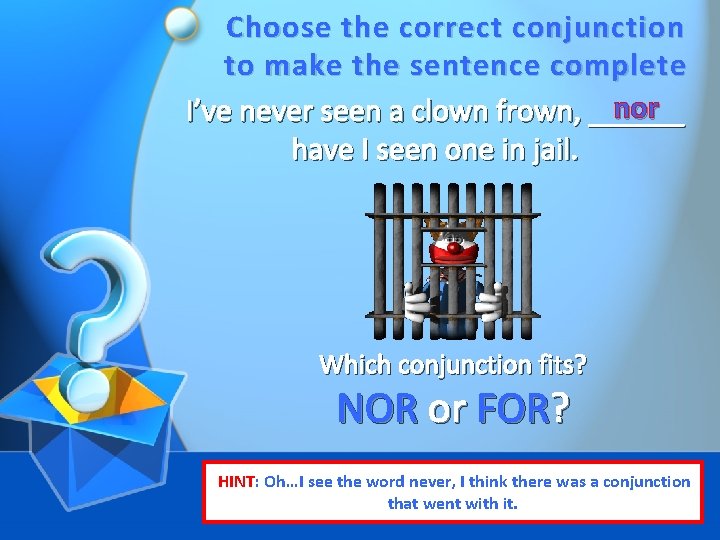
Choose the correct conjunction to make the sentence complete nor I’ve never seen a clown frown, ______ have I seen one in jail. Which conjunction fits? NOR or FOR? HINT: Oh…I see the word never, I think there was a conjunction that went with it.
Amazing! You did a great job identifying which word fit in the sentence. Now comes the “Big Top Test”! It’s time to test your circus skills, and see if you can answer some test questions!
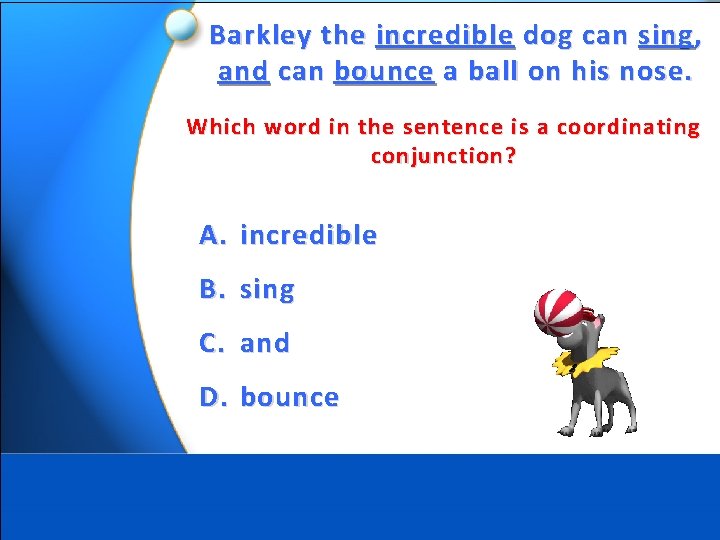
Barkley the incredible dog can sing , and can bounce a ball on his nose. Which word in the sentence is a coordinating conjunction? A. incredible B. s ing C. and D. bounce
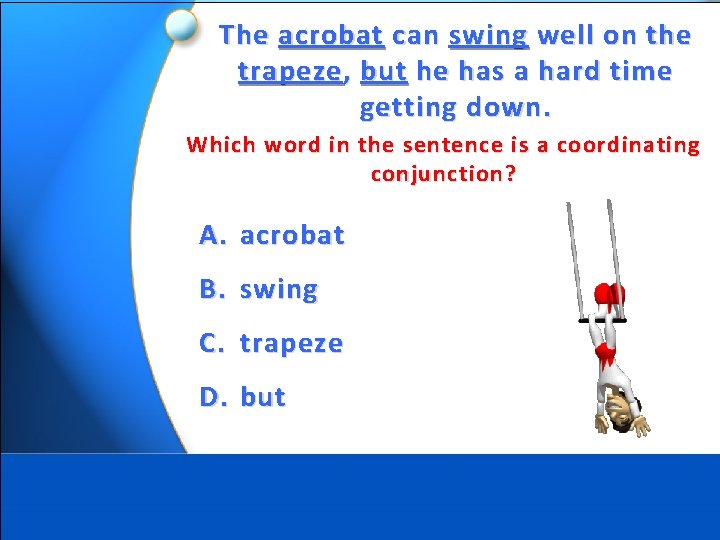
The acrobat can swing well on the trapeze , but he has a hard time getting down. Which word in the sentence is a coordinating conjunction? A. acrobat B. swing C. trapeze D. but
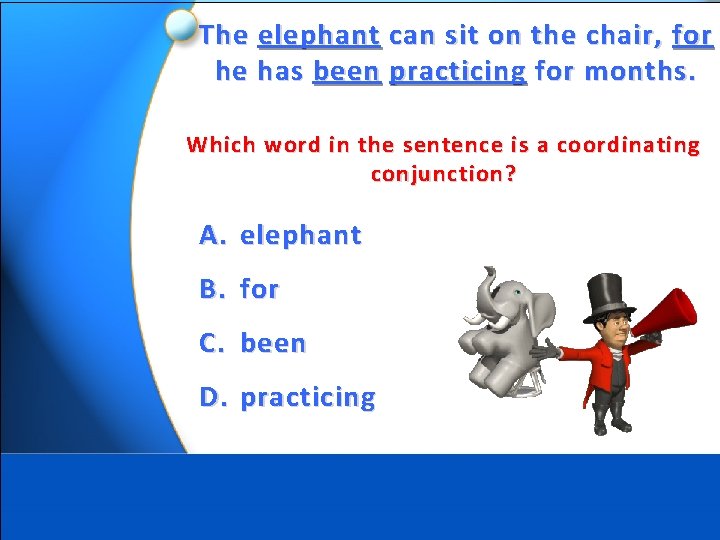
The elephant can sit on the chair, for he has been practicing for months. Which word in the sentence is a coordinating conjunction? A. elephant B. for C. been D. practicing

Emily brings out her beautiful white horse, so she can show her off. Which word in the sentence is a coordinating conjunction? A. brings B. beautiful C. so D. show

Buddy Bear can ride his unicycle on the ground, _____ he can ride on a tightrope. Which coordinating conjunction fits best in the sentence? A. but B. or C. yet D. nor

The ringmaster took a gigantic bow, _____ he could thank the crowd for their cheers. Which coordinating conjunction fits best in the sentence? A. so B. and C. but D. yet
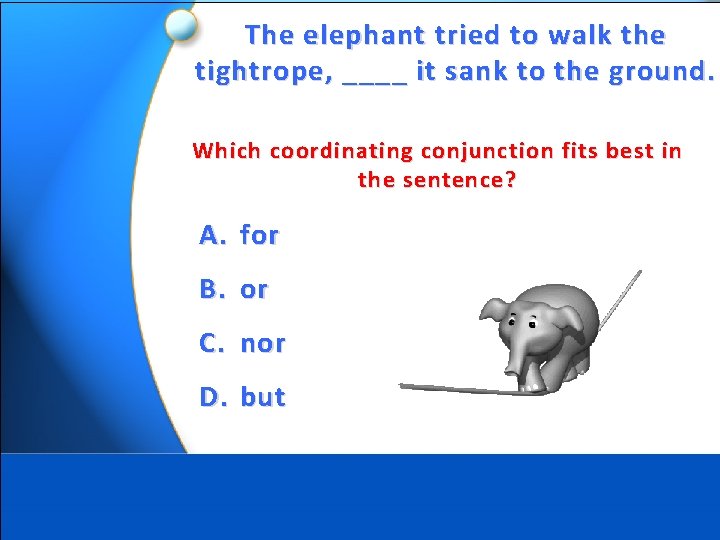
The elephant tried to walk the tightrope, ____ it sank to the ground. Which coordinating conjunction fits best in the sentence? A. for B. or C. nor D. but

Congratulations! You have passed the “Big Top Test”! You’re now ready to go out in search of coordinating conjunctions in everything that you read.

Thank you for choosing TEACHERS UNLEASHED to create a fun teaching environment! For more of our great products please visit: www. Teachers. Pay. Teachers. com/Store/Teachers-Unleashed
- Slides: 33