
The Fabulous 15 Literary Devices What are literary
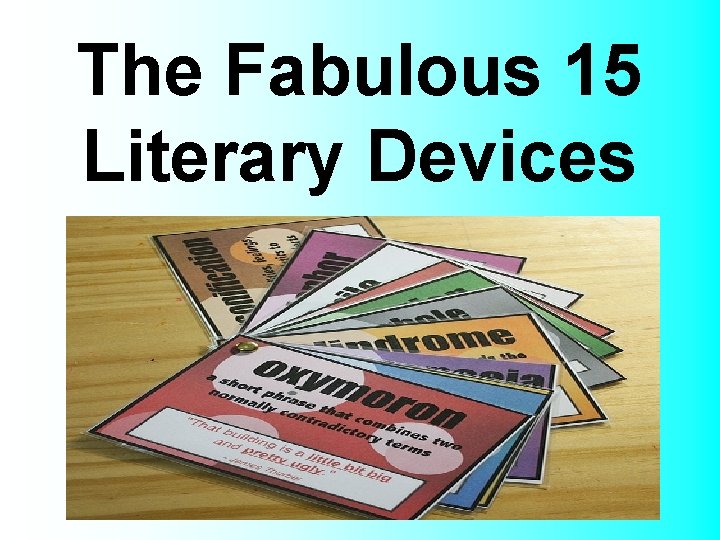
The Fabulous 15 Literary Devices
What are literary devices? Literary devices are techniques (ways) writers use to engage their readers (get them interested; help them to understand) beyond the literal meaning of the text.
PERSONIFICATION is when a writer gives human qualities to animals or objects. Examples: My car drank the gasoline in one gulp. The cat laughed. The newspaper headline glared at me.
Literal vs. Figurative Literal ● Taking words in their most common or most basic sense ● Example: Ms. Kristin is beautiful. Figurative ● Taking words in a more creative way ● Example: Ms. Kristin is a super model!
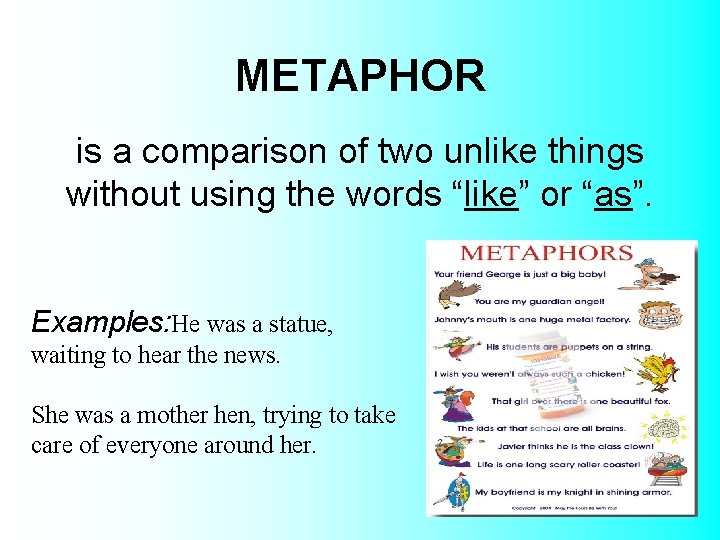
METAPHOR is a comparison of two unlike things without using the words “like” or “as”. Examples: He was a statue, waiting to hear the news. She was a mother hen, trying to take care of everyone around her.
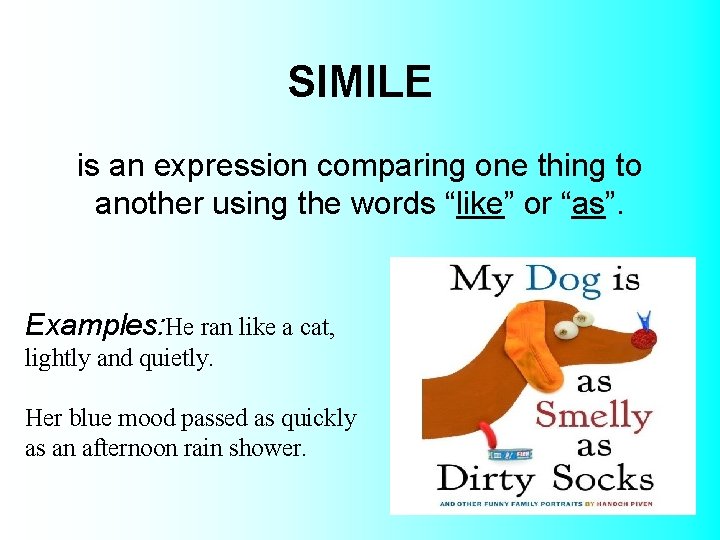
SIMILE is an expression comparing one thing to another using the words “like” or “as”. Examples: He ran like a cat, lightly and quietly. Her blue mood passed as quickly as an afternoon rain shower.
HYPERBOLE is an obvious exaggeration or overstatement. Examples: I’m so hungry I could eat the entire buffet at Golden Corral right now!
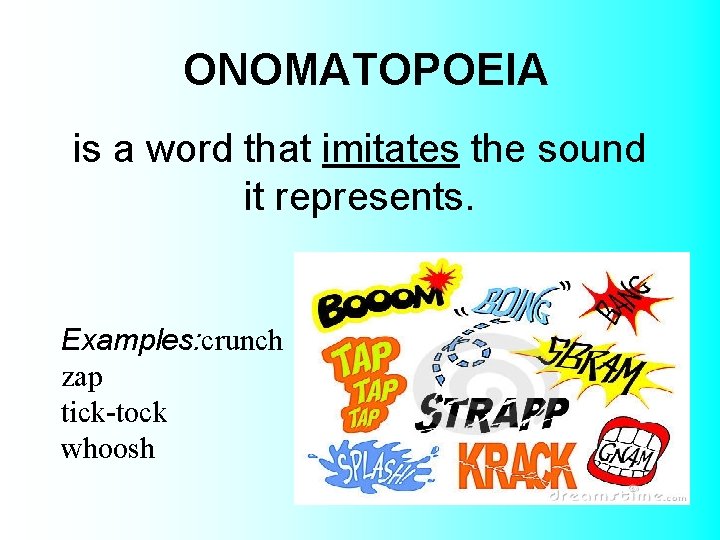
ONOMATOPOEIA is a word that imitates the sound it represents. Examples: crunch zap tick-tock whoosh
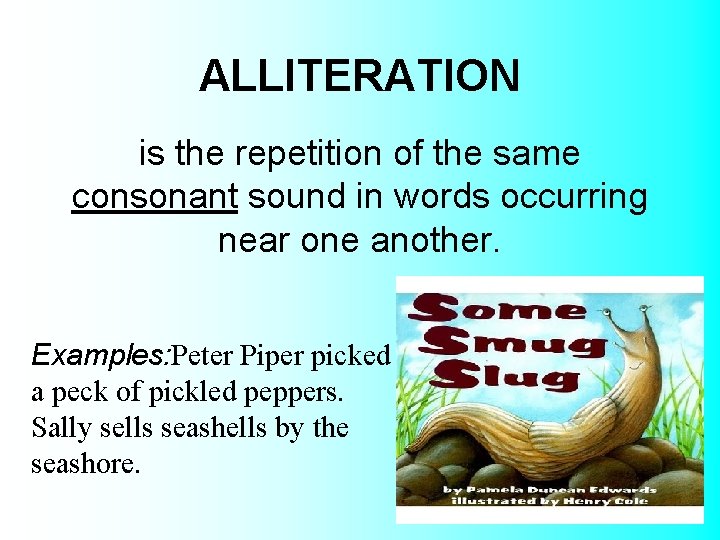
ALLITERATION is the repetition of the same consonant sound in words occurring near one another. Examples: Peter Piper picked a peck of pickled peppers. Sally sells seashells by the seashore.
SYMBOLISM is using an object or action that means something more than its literal meaning. Examples: Pink symbolizes the fight against breast cancer. The Statue of Liberty symbolizes freedom.
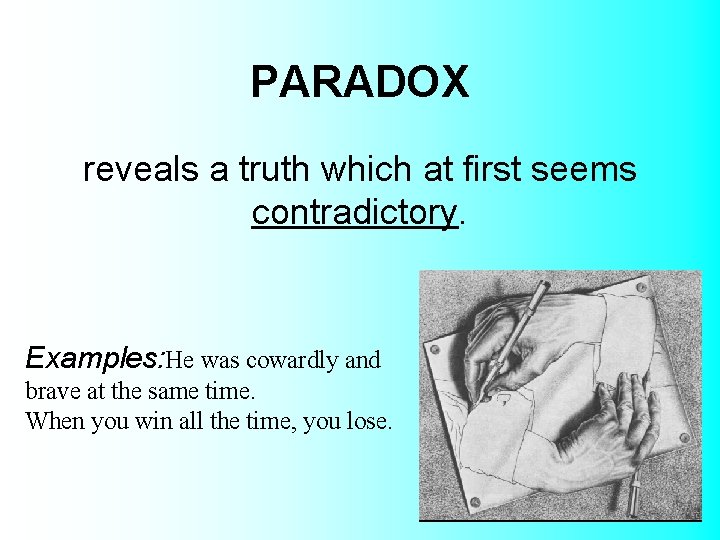
PARADOX reveals a truth which at first seems contradictory. Examples: He was cowardly and brave at the same time. When you win all the time, you lose.
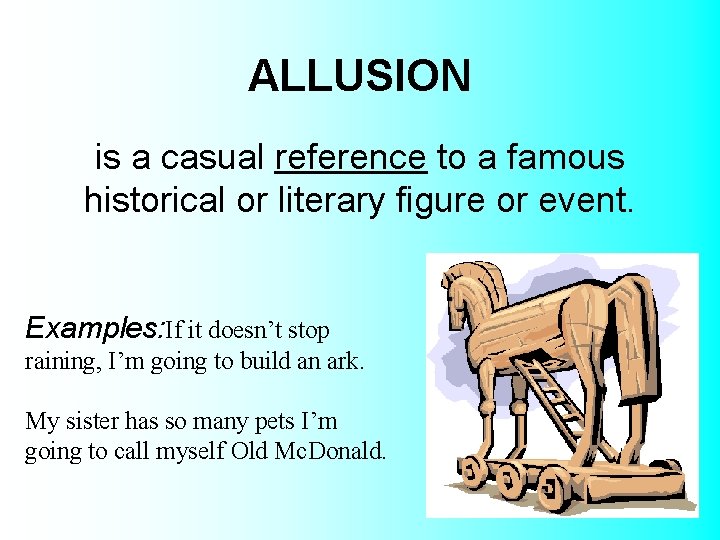
ALLUSION is a casual reference to a famous historical or literary figure or event. Examples: If it doesn’t stop raining, I’m going to build an ark. My sister has so many pets I’m going to call myself Old Mc. Donald.
IMAGERY is when a writer invokes the five senses. Examples: The smell reminded him of rotting tomatoes. The fence was uneven, like baby teeth growing awkwardly in. (also a simile!)
IDIOM is an expression with a meaning different from the literal meaning of the words. Examples: I got cold feet before my big date = I was scared My boss gave me the green light = My boss said yes
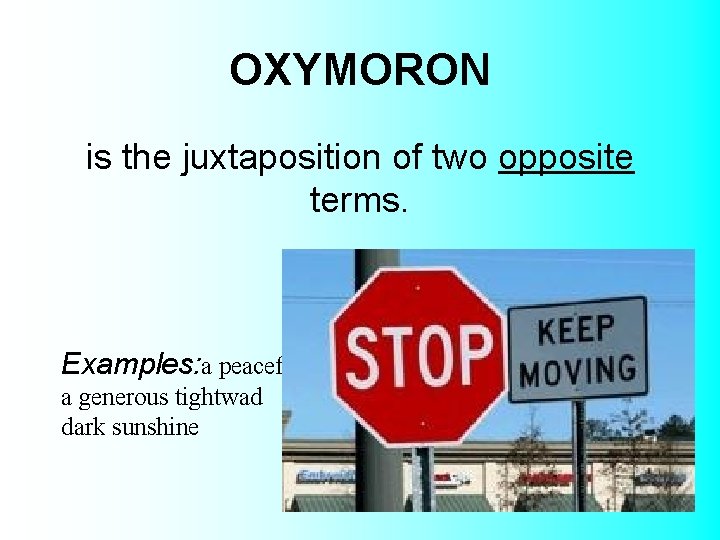
OXYMORON is the juxtaposition of two opposite terms. Examples: a peaceful war a generous tightwad dark sunshine
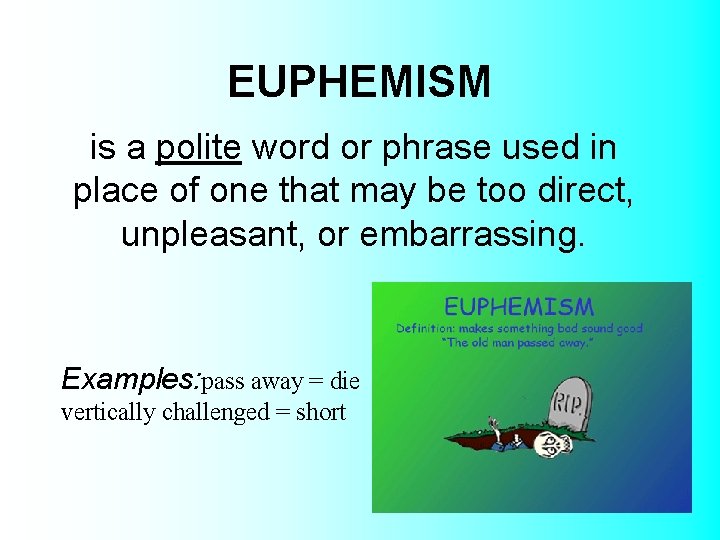
EUPHEMISM is a polite word or phrase used in place of one that may be too direct, unpleasant, or embarrassing. Examples: pass away = die vertically challenged = short
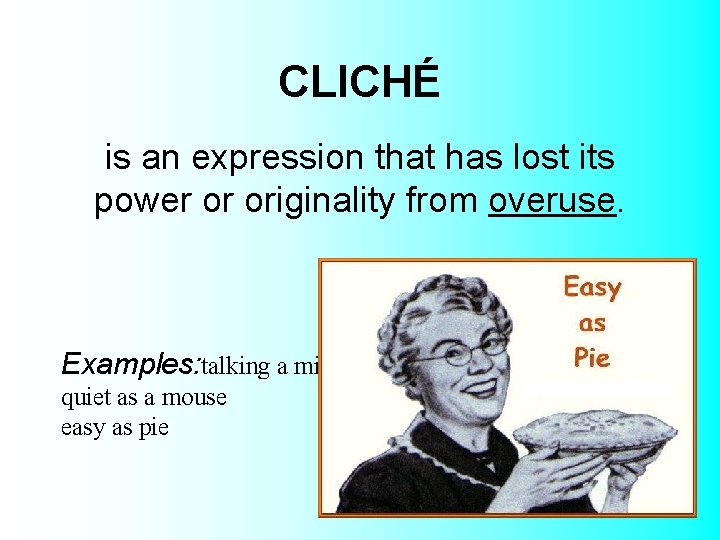
CLICHÉ is an expression that has lost its power or originality from overuse. Examples: talking a mile a minute quiet as a mouse easy as pie
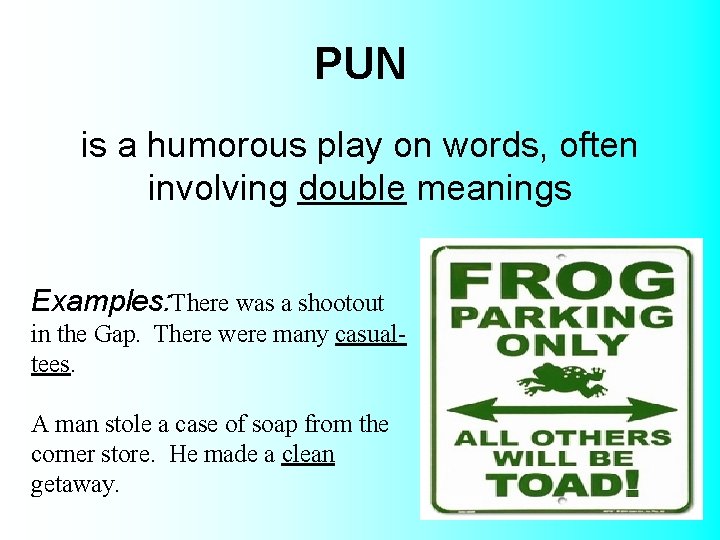
PUN is a humorous play on words, often involving double meanings Examples: There was a shootout in the Gap. There were many casualtees. A man stole a case of soap from the corner store. He made a clean getaway.
Literature (Stories) Vocab ●Vocabulay (Words) used to talk about/describe literature (stories)
Climax: The point at which the action in a story or play reaches its emotional peak. ^
Foreshadowing: A technique in which an author gives clues about something that will happen later in the story.
FLASHBACK ●A scene in a movie or book that is not currently happening…it happened earlier than the main story.
Foreshadowing: A technique in which an author gives clues about something that will happen later in the story.
Mood: The emotional atmosphere of a given piece of writing.
NARRATOR ●The person, or the point of view, from which the story is told
Parody: A humorous, exaggerated imitation of another work.
Satire: A work that makes fun of something or someone.
SETTING ●The time and place that a story takes place
DICTION ●The choice and use of words and phrases in a story
Theme: The central idea of a work.
Symbolism: The use of one things to represent another. For example, a dove is a symbol of peace.
Tone: The author’s attitude toward his or her subject. For example, a tone could be pessimistic, optimistic, or angry.
INFERENCE ●A conclusion reached on the basis of evidence and reasoning

ALLEGORY
- Slides: 34