
The EYFS Reforms Statutory Framework for the Early

- Slides: 58
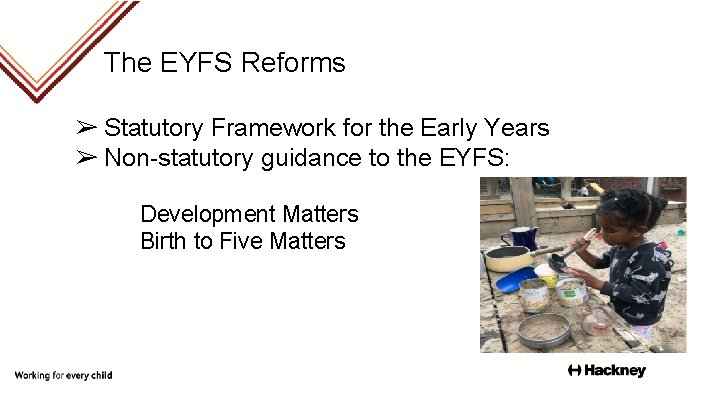
The EYFS Reforms ➢ Statutory Framework for the Early Years ➢ Non-statutory guidance to the EYFS: Development Matters Birth to Five Matters
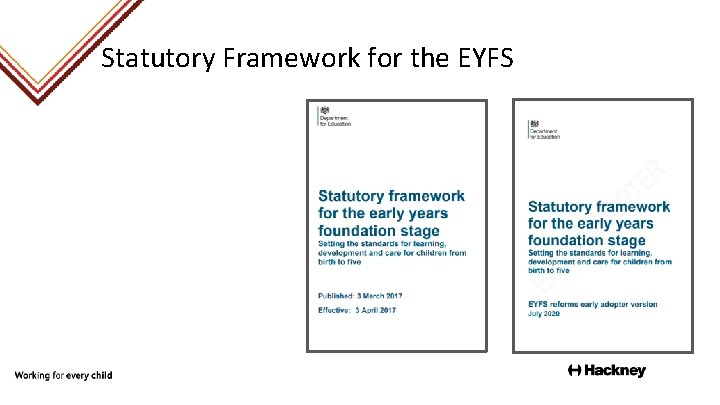
Statutory Framework for the EYFS
Statutory Framework for the EYFS The EYFS sets the standard for learning, development and care of children from Birth to 5 years old. It is mandatory in all EY settings, schools and childminders. There are three sections: 1. Learning and development 2. Assessment 3. Safeguarding and welfare requirements
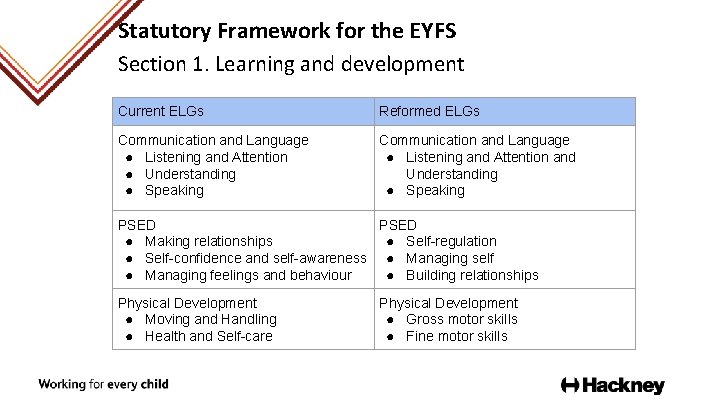
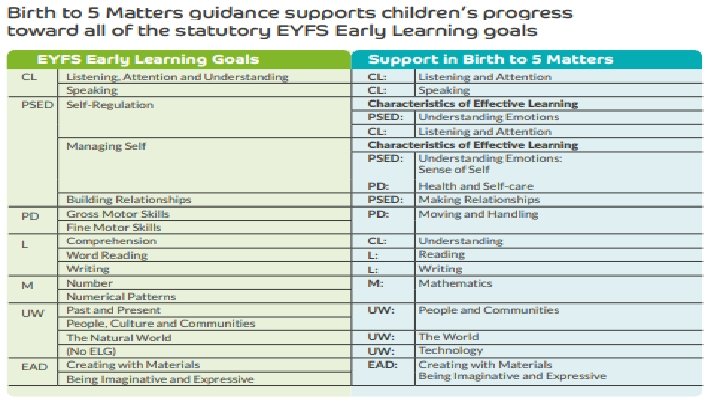
Statutory Framework for the EYFS Section 1. Learning and development Current ELGs Reformed ELGs Communication and Language ● Listening and Attention ● Understanding ● Speaking Communication and Language ● Listening and Attention and Understanding ● Speaking PSED ● Making relationships ● Self-regulation ● Self-confidence and self-awareness ● Managing self ● Managing feelings and behaviour ● Building relationships Physical Development ● Moving and Handling ● Health and Self-care Physical Development ● Gross motor skills ● Fine motor skills
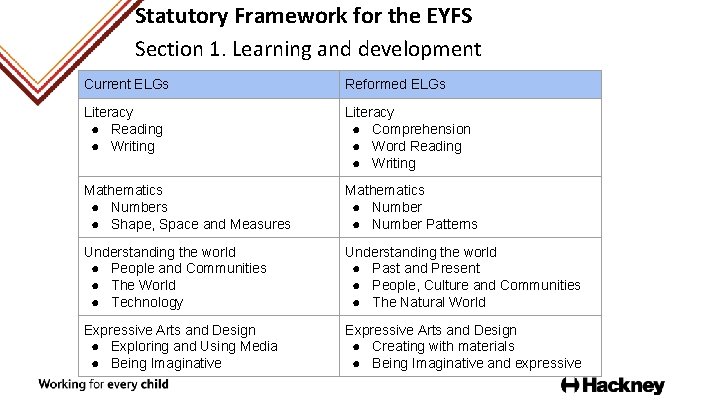
Statutory Framework for the EYFS Section 1. Learning and development Current ELGs Reformed ELGs Literacy ● Reading ● Writing Literacy ● Comprehension ● Word Reading ● Writing Mathematics ● Numbers ● Shape, Space and Measures Mathematics ● Number Patterns Understanding the world ● People and Communities ● The World ● Technology Understanding the world ● Past and Present ● People, Culture and Communities ● The Natural World Expressive Arts and Design ● Exploring and Using Media ● Being Imaginative Expressive Arts and Design ● Creating with materials ● Being Imaginative and expressive
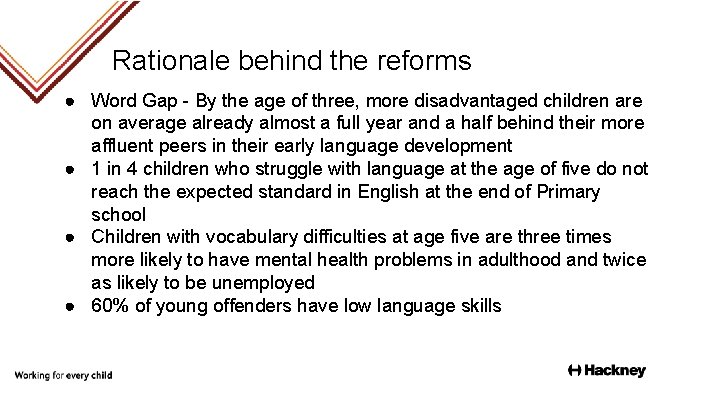
Rationale behind the reforms ● Word Gap - By the age of three, more disadvantaged children are on average already almost a full year and a half behind their more affluent peers in their early language development ● 1 in 4 children who struggle with language at the age of five do not reach the expected standard in English at the end of Primary school ● Children with vocabulary difficulties at age five are three times more likely to have mental health problems in adulthood and twice as likely to be unemployed ● 60% of young offenders have low language skills
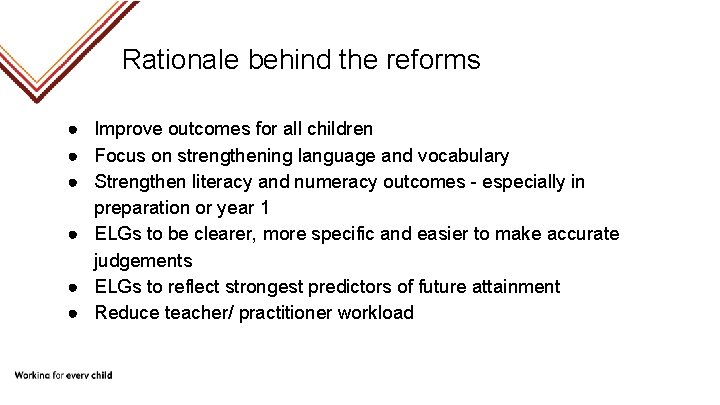
Rationale behind the reforms ● Improve outcomes for all children ● Focus on strengthening language and vocabulary ● Strengthen literacy and numeracy outcomes - especially in preparation or year 1 ● ELGs to be clearer, more specific and easier to make accurate judgements ● ELGs to reflect strongest predictors of future attainment ● Reduce teacher/ practitioner workload
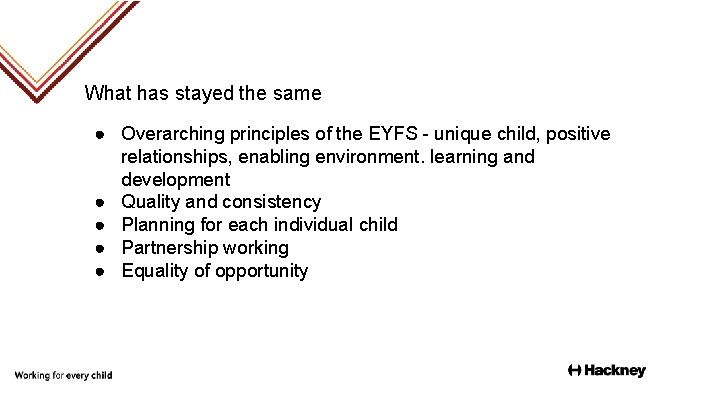
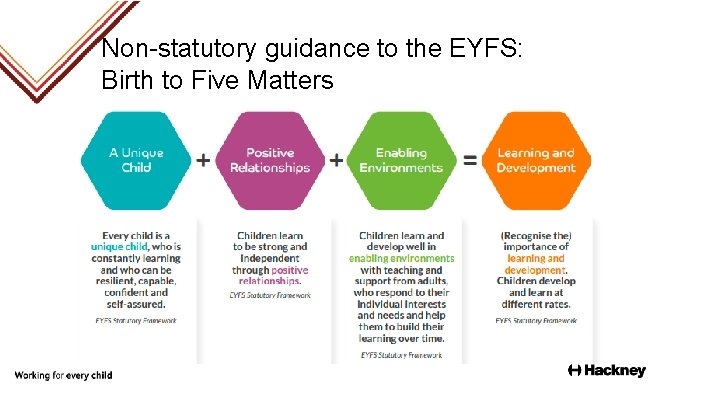
What has stayed the same ● Overarching principles of the EYFS - unique child, positive relationships, enabling environment. learning and development ● Quality and consistency ● Planning for each individual child ● Partnership working ● Equality of opportunity
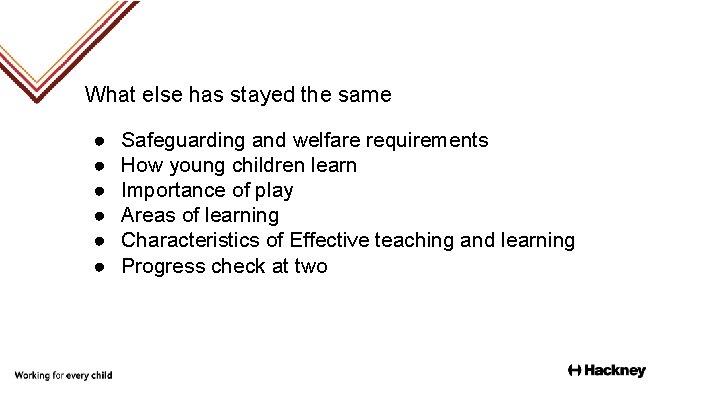
What else has stayed the same ● ● ● Safeguarding and welfare requirements How young children learn Importance of play Areas of learning Characteristics of Effective teaching and learning Progress check at two
Revised Educational Programmes The seven areas of learning and development are important and inter-connected. Educational programmes must involve activities and experiences for children, as set out under each of the areas of learning.
Communication and language ● The development of children’s spoken language underpins all seven areas of learning and development. Children’s back-andforth interactions from an early age form the foundations for language and cognitive development. ● The number and quality of the conversations they have with adults and peers throughout the day in a language-rich environment is crucial. ● By commenting on what children are interested in or doing, and echoing back what they say with new vocabulary added, practitioners will build children's language effectively.
Communication and language ● Reading frequently to children, and engaging them actively in stories, non-fiction, rhymes and poems, and then providing them with extensive opportunities to use and embed new words in a range of contexts, will give children the opportunity to thrive. ● Through conversation, storytelling and role play, where children share their ideas with support and modelling from their teacher, and sensitive questioning that invites them to elaborate, children become comfortable using a rich range of vocabulary and language structures.
Personal social and emotional development ● Children’s personal, social and emotional development (PSED) is crucial for children to lead healthy and happy lives, and is fundamental to their cognitive development. Underpinning their personal development are the important attachments that shape their social world. ● Strong, warm and supportive relationships with adults enable children to learn how to understand their own feelings and those of others. Children should be supported to manage emotions, develop a positive sense of self, set themselves simple goals, have confidence in their own abilities, to persist and wait for what they want and direct attention as necessary.
PSED contd ● Through adult modelling and guidance, they will learn how to look after their bodies, including healthy eating, and manage personal needs independently. ● Through supported interaction with other children, they learn how to make good friendships, co-operate and resolve conflicts peaceably. These attributes will provide a secure platform from which children can achieve at school and in later life
Self-regulation and executive function • Executive o o function includes the child’s ability to: hold information in mind focus their attention regulate their behaviour plan what to do next. • These contribute to the child’s growing ability to self-regulate: o monitor what they are doing and adapt o regulate strong feelings o be patient for what they want o bounce back when things get difficult.
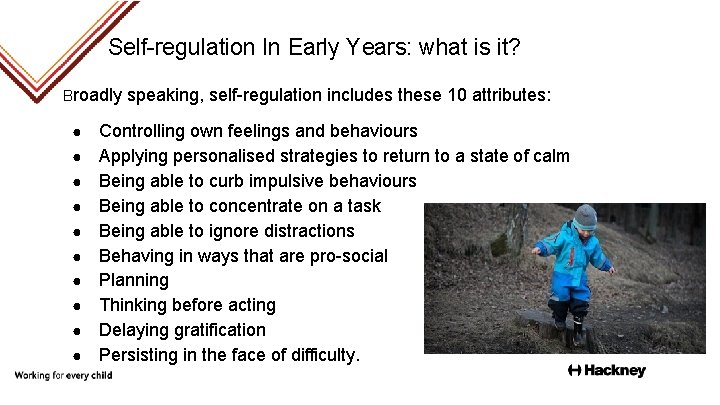
Self-regulation In Early Years: what is it? Broadly speaking, self-regulation includes these 10 attributes: ● Controlling own feelings and behaviours ● Applying personalised strategies to return to a state of calm ● Being able to curb impulsive behaviours ● Being able to concentrate on a task ● Being able to ignore distractions ● Behaving in ways that are pro-social ● Planning ● Thinking before acting ● Delaying gratification ● Persisting in the face of difficulty.
Physical development ● Physical activity is vital in children’s all-round development, enabling them to pursue happy, healthy and active lives. Gross and fine motor experiences develop incrementally throughout early childhood, starting with sensory explorations and the development of a child’s strength, coordination and positional awareness through tummy time, crawling and play movement with both objects and adults. ● By creating games and providing opportunities for play both indoors and outdoors, adults can support children to develop their core strength, stability, balance, spatial awareness, coordination and agility.
Physical development contd ● Gross motor skills provide the foundation for developing healthy bodies and social and emotional well-being. Fine motor control and precision helps with hand-eye coordination, which is later linked to early literacy. ● Repeated and varied opportunities to explore and play with small world activities, puzzles, arts and crafts and the practice of using small tools, with feedback and support from adults, allow children to develop proficiency, control and confidence.
Literacy ● It is crucial for children to develop a life-long love of reading. Reading consists of two dimensions: language comprehension and word reading. ● Language comprehension (necessary for both reading and writing) starts from birth. ● It only develops when adults talk with children about the world around them and the books (stories and non-fiction) they read with them, and enjoy rhymes, poems and songs together.
More Literacy ● Skilled word reading, taught later, involves both the speedy working out of the pronunciation of unfamiliar printed words (decoding) and the speedy recognition of familiar printed words. ● Writing involves transcription (spelling and handwriting) and composition (articulating ideas and structuring them in speech, before writing).
Mathematics ● Developing a strong grounding in number is essential so that all children develop the necessary building blocks to excel mathematically. ● Children should be able to count confidently, develop a deep understanding of the numbers to 10, the relationships between them and the patterns within those numbers. ● By providing frequent and varied opportunities to build and apply this understanding - such as using manipulatives, including small pebbles and tens frames for organising counting - children will develop a secure base of knowledge and vocabulary from which mastery of mathematics is built.
More Maths ● In addition, it is important that the curriculum includes rich opportunities for children to develop their spatial reasoning skills across all areas of mathematics including shape, space and measures. ● It is important that children develop positive attitudes and interests in mathematics, look for patterns and relationships, spot connections, ‘have a go’, talk to adults and peers about what they notice and not be afraid to make mistakes.
Understanding the world ● Understanding the world involves guiding children to make sense of their physical world and their community. ● The frequency and range of children’s personal experiences increases their knowledge and sense of the world around them – from visiting parks, libraries and museums to meeting important members of society such as police officers, nurses and firefighters.
Understanding the World contd ● In addition, listening to a broad selection of stories, non-fiction, rhymes and poems will foster their understanding of our culturally, socially, technologically and ecologically diverse world. ● As well as building important knowledge, this extends their familiarity with words that support understanding across domains. Enriching and widening children’s vocabulary will support later reading comprehension.
Expressive Arts and Design ● The development of children’s artistic and cultural awareness supports their imagination and creativity. It is important that children have regular opportunities to engage with the arts, enabling them to explore and play with a wide range of media and materials. ● The quality and variety of what children see, hear and participate in is crucial for developing their understanding, self-expression, vocabulary and ability to communicate through the arts. ● The frequency, repetition and depth of their experiences are fundamental to their progress in interpreting and appreciating what they hear, respond to and observe
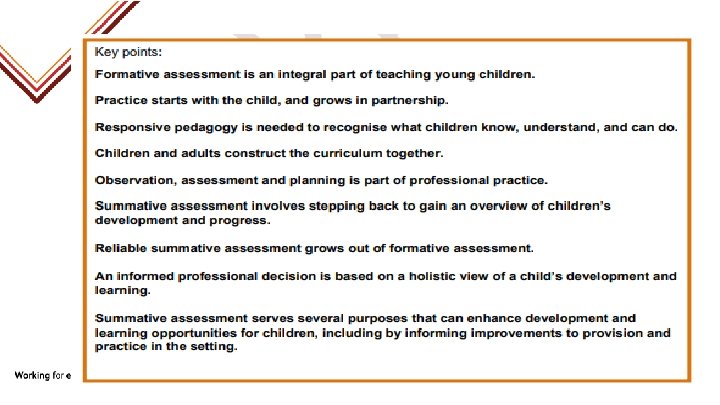
Section 2. Assessment The revised Framework champions a reduction in workload, particularly the need for ‘evidence’ to support practitioner judgements. Settings will still be required to provide ‘evidence’ to demonstrate progress. It is for settings to decide what this should look like, but is clear that there should no longer be an obsession with tracking and data at the expense of interaction with the children. Professional practitioners are expected to know their key children and how they are progressing, whilst identifying children who are not progressing as expected and require additional support.
Section 2. Assessment ● Assessment should not entail prolonged breaks from interacting with children nor require excessive paperwork ● Paperwork should be limited to that which is absolutely necessary to promote children’s learning and development ● When assessing children, practitioners should draw on their knowledge of the child and their own professional judgement - and should not be required to prove this through collection of physical evidence
Assessment ● Assessment is about noticing what children can do and what they know. It is not about lots of data and evidence. ● Effective assessment requires practitioners to understand child development. Practitioners also need to be clear about what they want children to know and be able to do. ● Accurate assessment can highlight whether a child has a special educational need and requires extra help. ● Before assessing children, it’s a good idea to think about whether the assessments will be useful.
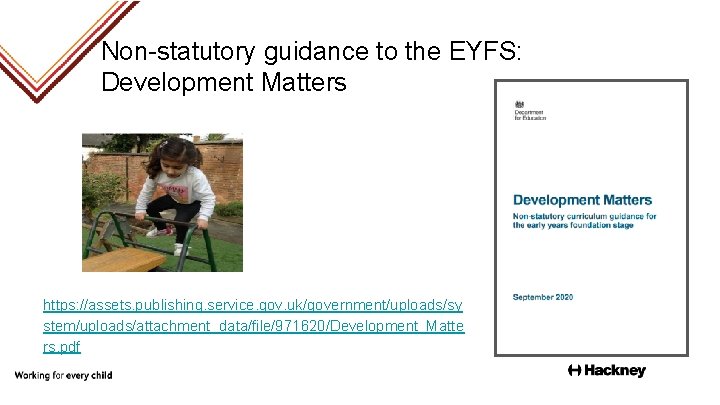
Non-statutory guidance to the EYFS: Development Matters https: //assets. publishing. service. gov. uk/government/uploads/sy stem/uploads/attachment_data/file/971620/Development_Matte rs. pdf
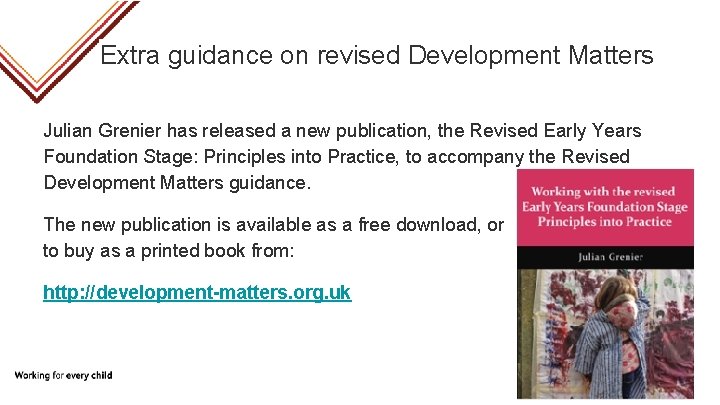
Extra guidance on revised Development Matters Julian Grenier has released a new publication, the Revised Early Years Foundation Stage: Principles into Practice, to accompany the Revised Development Matters guidance. The new publication is available as a free download, or to buy as a printed book from: http: //development-matters. org. uk
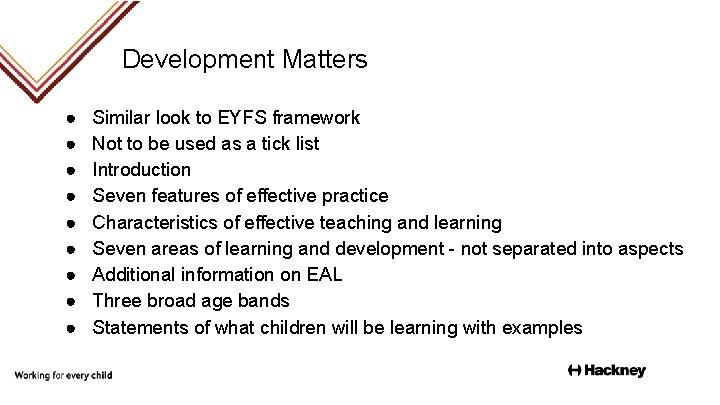
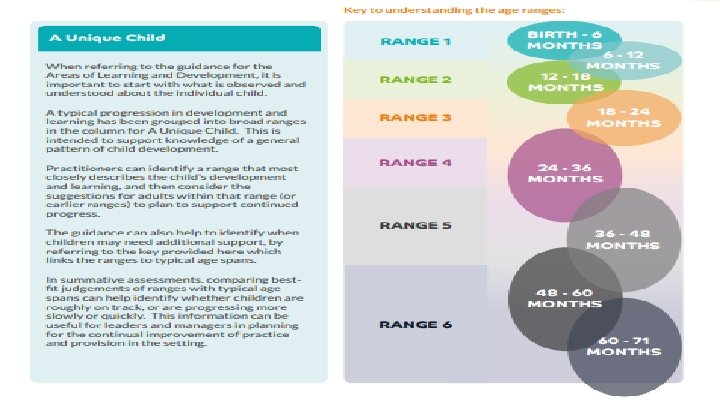
Development Matters ● ● ● ● ● Similar look to EYFS framework Not to be used as a tick list Introduction Seven features of effective practice Characteristics of effective teaching and learning Seven areas of learning and development - not separated into aspects Additional information on EAL Three broad age bands Statements of what children will be learning with examples
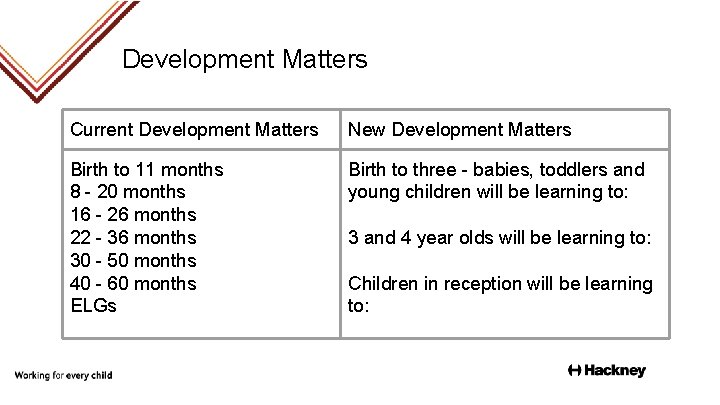
Development Matters Current Development Matters New Development Matters Birth to 11 months 8 - 20 months 16 - 26 months 22 - 36 months 30 - 50 months 40 - 60 months ELGs Birth to three - babies, toddlers and young children will be learning to: 3 and 4 year olds will be learning to: Children in reception will be learning to:
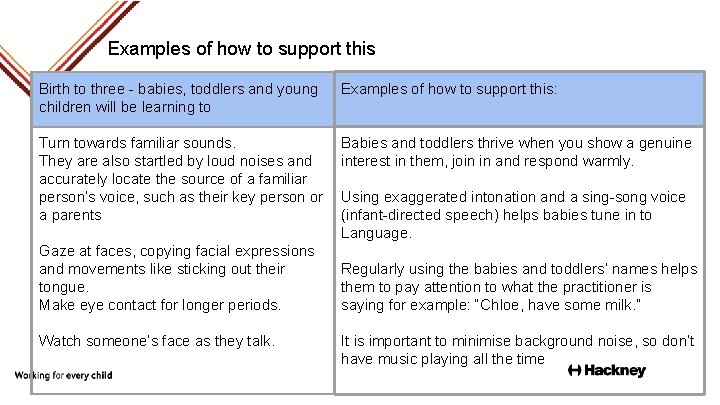
Examples of how to support this Birth to three - babies, toddlers and young children will be learning to Examples of how to support this: Turn towards familiar sounds. They are also startled by loud noises and accurately locate the source of a familiar person’s voice, such as their key person or a parents Babies and toddlers thrive when you show a genuine interest in them, join in and respond warmly. Gaze at faces, copying facial expressions and movements like sticking out their tongue. Make eye contact for longer periods. Watch someone’s face as they talk. Using exaggerated intonation and a sing-song voice (infant-directed speech) helps babies tune in to Language. Regularly using the babies and toddlers’ names helps them to pay attention to what the practitioner is saying for example: “Chloe, have some milk. ” It is important to minimise background noise, so don’t have music playing all the time
Observation checkpoints ● The observation checkpoints can help you to notice whether a child is at risk of falling behind in their development. ● You can make all the difference by taking action quickly, using your professional judgement and your understanding of child development. ● By monitoring the child’s progress more closely, you can make the right decisions about what sort of extra help is needed.
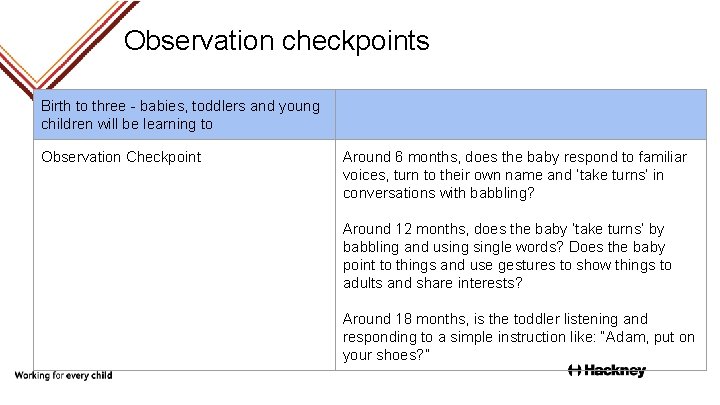
Observation checkpoints Birth to three - babies, toddlers and young children will be learning to Observation Checkpoint Around 6 months, does the baby respond to familiar voices, turn to their own name and ‘take turns’ in conversations with babbling? Around 12 months, does the baby ‘take turns’ by babbling and usingle words? Does the baby point to things and use gestures to show things to adults and share interests? Around 18 months, is the toddler listening and responding to a simple instruction like: “Adam, put on your shoes? ”
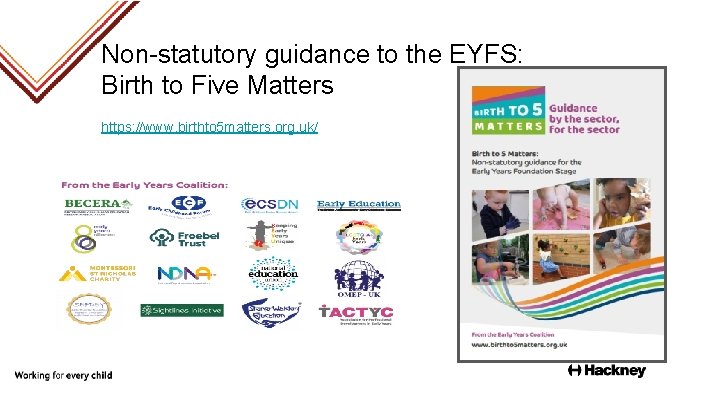
Non-statutory guidance to the EYFS: Birth to Five Matters https: //www. birthto 5 matters. org. uk/
Non-statutory guidance to the EYFS: Birth to Five Matters
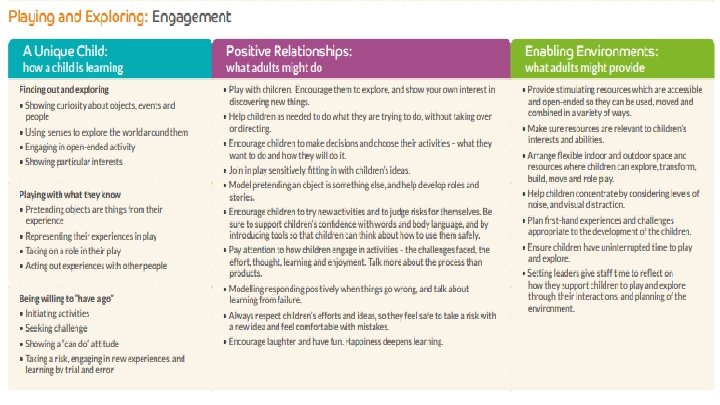
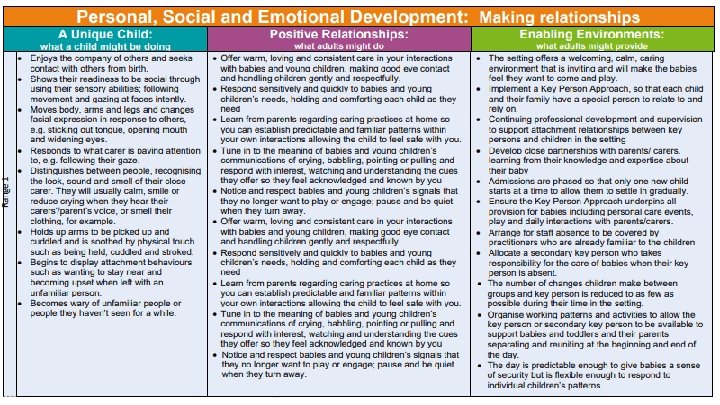
Non-statutory guidance to the EYFS: Birth to Five Matters ● ● Child Development Self-regulation Learner for life - Characteristics of Effective Learning Inclusive practice and equalities
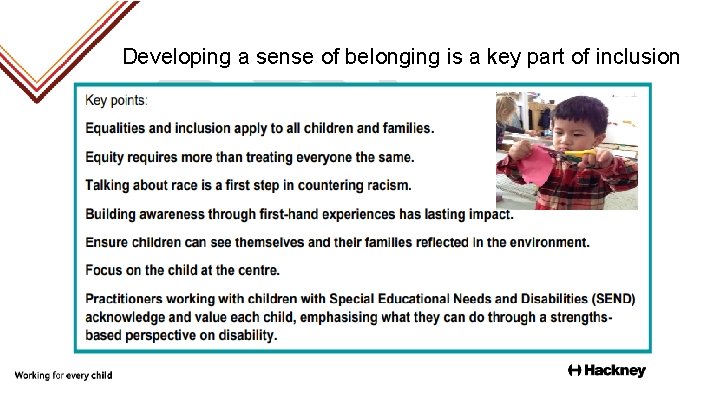
Developing a sense of belonging is a key part of inclusion
Non-statutory guidance to the EYFS: Birth to Five Matters ● Parents as partners ● Attachment and the role of key person ● Supporting development and learning
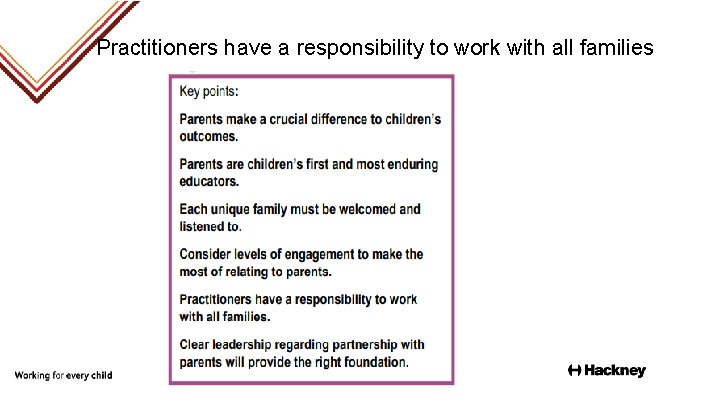
Practitioners have a responsibility to work with all families
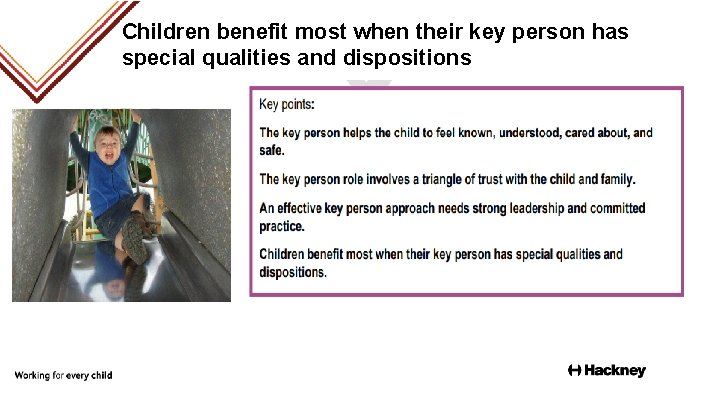
Children benefit most when their key person has special qualities and dispositions
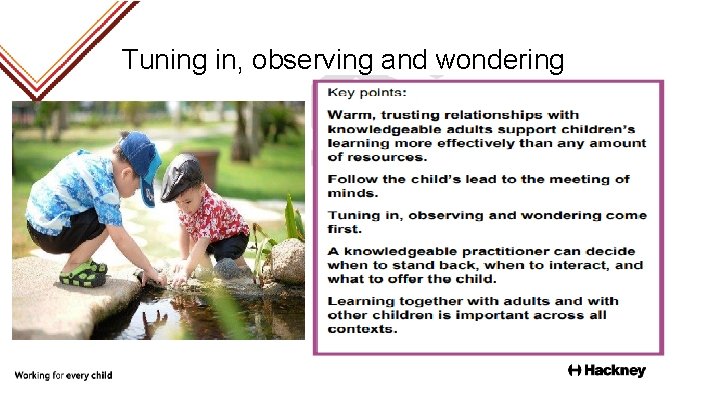
Tuning in, observing and wondering
Non-statutory guidance to the EYFS: Birth to Five Matters ● The learning environment ● The wider context
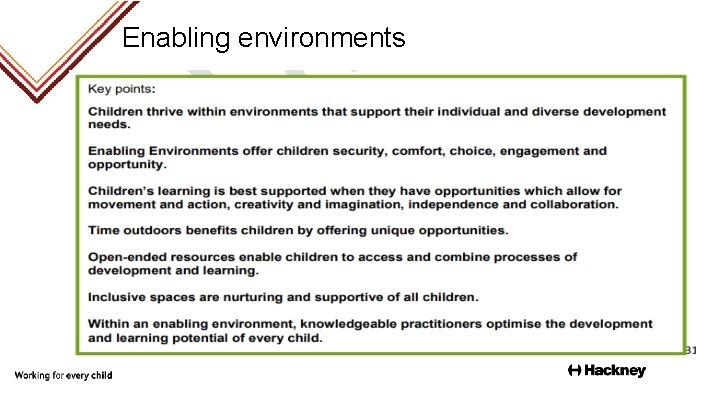
Enabling environments
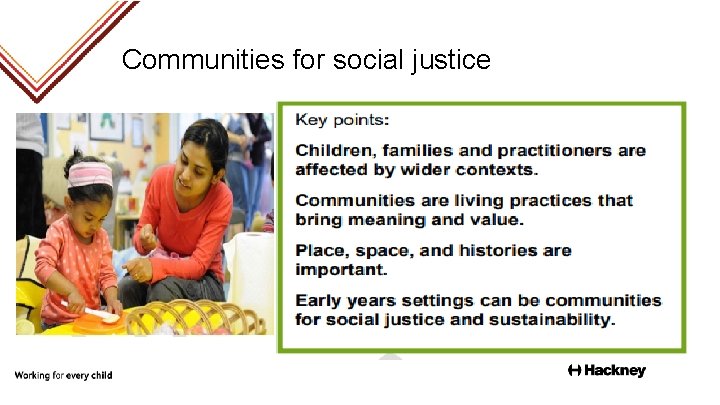
Communities for social justice
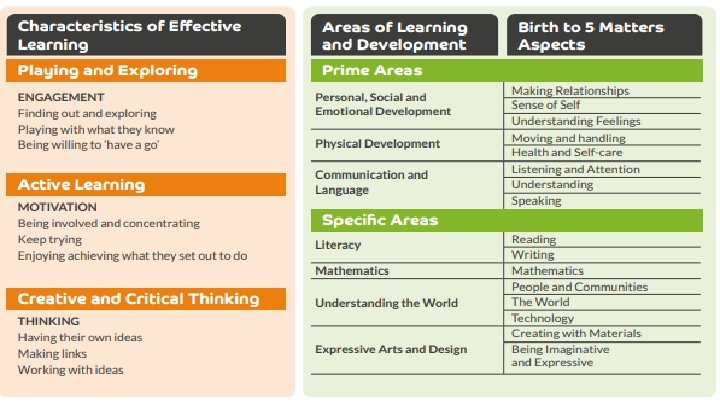
Non-statutory guidance to the EYFS: Birth to Five Matters ● Observation, Assessment and planning ● Overview of characteristics of effective learning and areas of learning and development ● Using birth to five matters to support development and learning ● Characteristics of Effective learning ● The seven areas of learning
https: //www. youtube. com/watch? v=HSs 4 U 77 d. ZLI
Further resources on the revised EYFS A whole range of vodcasts and videos from NCB: https: //www. youtube. com/channel/UCeb 4 IQMAYKPXmpg 8 f-ja. E-w/videos Early Years Alliance webinar: https: //www. youtube. com/watch? v=t. CY 4 znj. Za 5 Y FAQs: https: //foundationyears. org. uk/2021/03/eyfs-reforms-local-authorities/. Password: EYFS 2021!
To sum up…. . ● ● ● ● EYFS remains a play based curriculum Focus is Language, literacy and maths Importance of PSED for children and practitioners How young children learning remains unchanged Start with the child Reduce workload Focus on interactions Continue to focus on good practice ○ Don’t do for Ofsted, do it for the children