
The Eye Facts about the Eye Receptor organ
The Eye
Facts about the Eye • Receptor organ for light • About 2. 5 cm in diameter -Eye video (movie trailer)
ANATOMY
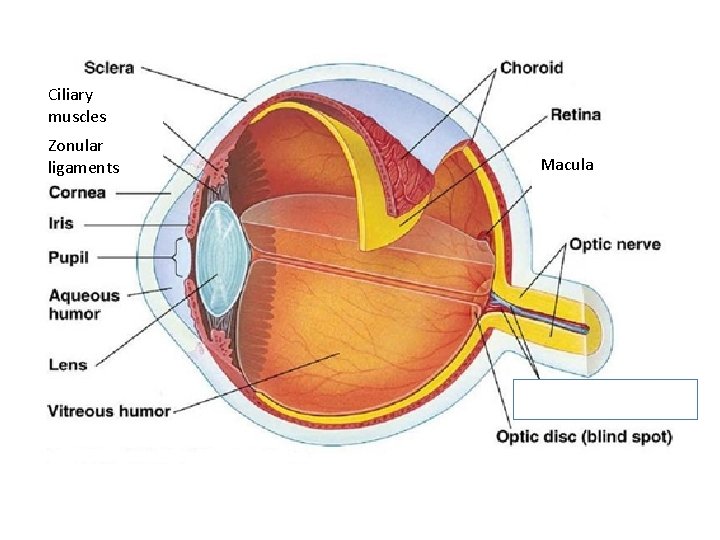
Ciliary muscles Zonular ligaments Macula
The 3 Layers of the Eye (from outside to inside) All 3 are opaque (not transparent) 1) Sclera • White of the eye • Gives the eye its shape • Protects the eye • Becomes transparent in front of the eye (cornea)
2) Choroid - Dark brown - Contains many blood vessels - Becomes the colour part of our eye (iris) in front of the eye -The iris is made up of 2 muscles and has an opening called the pupil -The iris controls how much light enters the eye through the pupil by contracting its muscles -The circular muscles close the opening of the pupil by contracting -The radial muscles open the opening of the pupil by contracting
3) The Retina -pinkish-beige membrane -the retina can sometimes detach due to violent shocks -composed of different types of the nerve cells, including the vision receptors -The two vision receptors (neurons) are rods and cones -there are 20 times more rods than cones
Cones: -the cones are concentrated in a small circular area called the macula in the middle of the retina -they can detect colour -three types of cones: red, green, and blue -certain colours stimulate one or more of the cones. -white light stimulates all 3 cones -cones provide the clearest image

Rods: -the rods are located around the macula and throughout the retina -detect contrasts not colours (ex. when you are in a dark room) -more sensitive to light
-the optic disc contains no rods or cones, it is where the optic nerve begins. -the optic disc is also called the blind spot
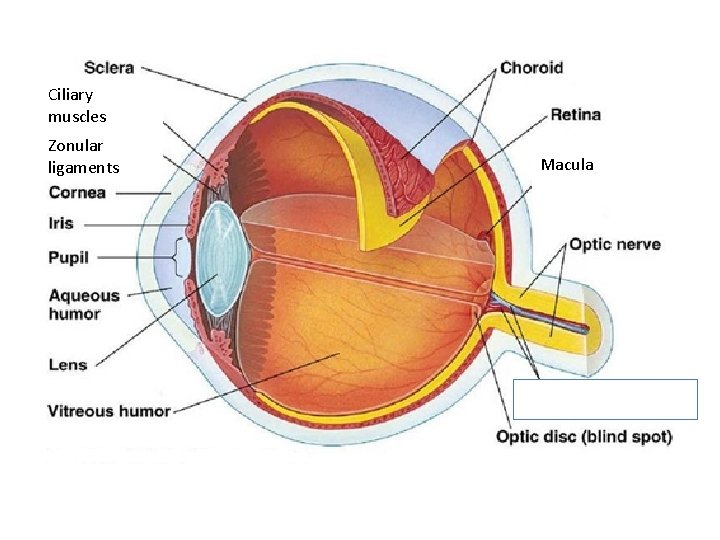
Ciliary muscles Zonular ligaments Macula

The Transparent Structures of the Eye How light travels through these structures Light -> cornea -> aqueous humour -> lens -> vitreous humor 1) Cornea: -extension of the sclera -its spherical shape helps transmit and converge light rays 2) Aqueous humour -liquid, consisting mostly of water and a bit of glucose -this liquid is continually replenished -supplies glucose and oxygen to the lens and cornea
3) Lens -lies behind iris -flexible -biconvex in shape -normally completely transparent, but with aging or illness can be come opaque (cataracts) -focuses the image onto the retina 4) Vitreous humor -lies between lens and retina -gelatinous liquid, mostly made of water -exerts pressure on the membranes which gives the eye its shape
Structures near the Eye and Their Functions Eyebrows: stop sweat from running into eyes Eyelashes: trap dust Eyelids: spread tears over surface of eyes Conjunctiva: covers the surface of the eye Lacrimal glands: secrete tears Tears protect the eyes by cleaning them with a bacterial agent • Excess tears run down your nose • • •
Physiolog. Y
Lens Accomodation • When light passes through transparent structures it refracts or bends • Lenses also do this to light • The lens of our eye changes in shape to accommodate what we are looking at
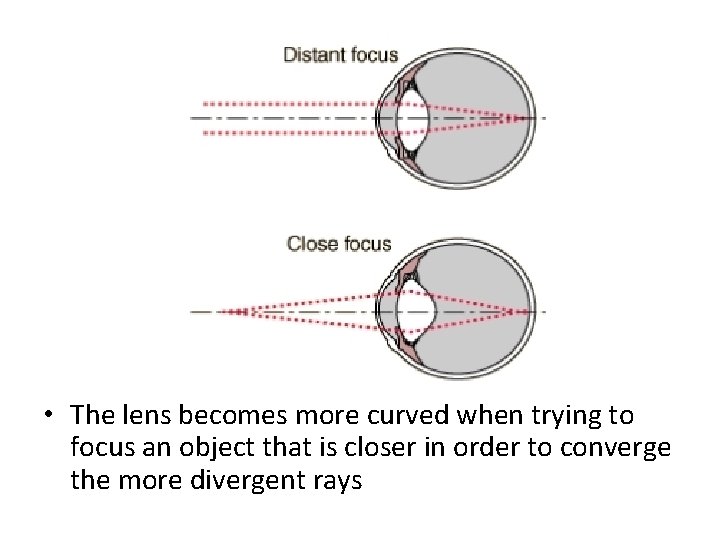
• The lens becomes more curved when trying to focus an object that is closer in order to converge the more divergent rays
• Even though the image we see is inverted on our retina, our brain interprets it as being upright
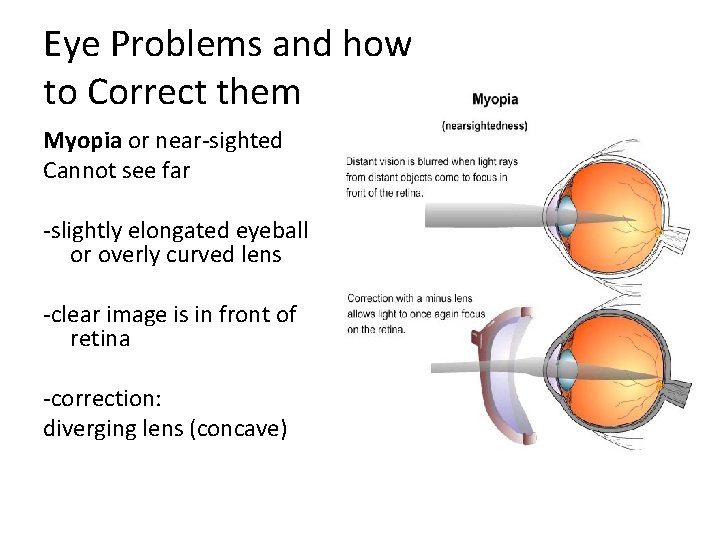
Eye Problems and how to Correct them Myopia or near-sighted Cannot see far -slightly elongated eyeball or overly curved lens -clear image is in front of retina -correction: diverging lens (concave)

Hypermetropia (far-sighted) -difficulty seeing close objects -slightly shortened eyeball or under curved lens -clear image is located behind the retina Correction: converging (convex) lens
• Presbyopia is similar to hypermetropia except that it is caused by loss of elasticity of the lens (usually related to agin) • Astigmatism is when your lens has an irregular curvature of cornea or lens – There is no clear image – You have difficulty seeing distant and nearby objects – Correction: cylindrical lenses
Nerve Impulse Pathway
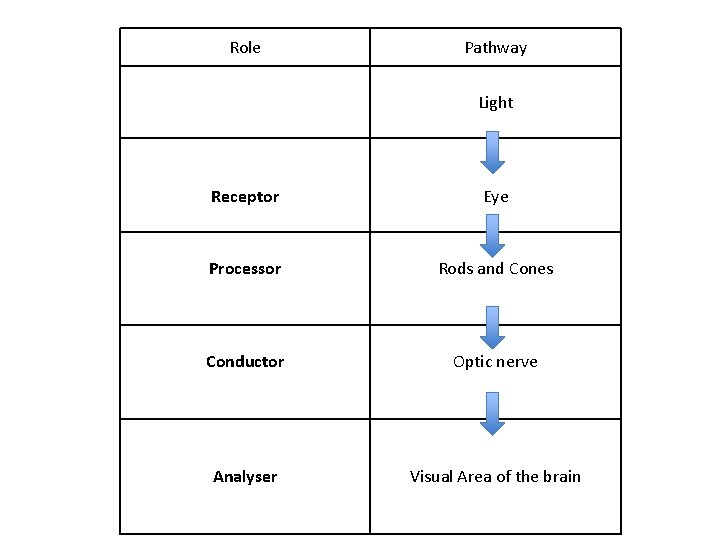
Role Pathway Light Receptor Eye Processor Rods and Cones Conductor Optic nerve Analyser Visual Area of the brain
- Slides: 23