
THE EYE AND VISUAL RECEPTORS II LECTURER IN

- Slides: 24
THE EYE AND VISUAL RECEPTORS II LECTURER IN CHARGE BAMIDELE OLUBAYODE 1
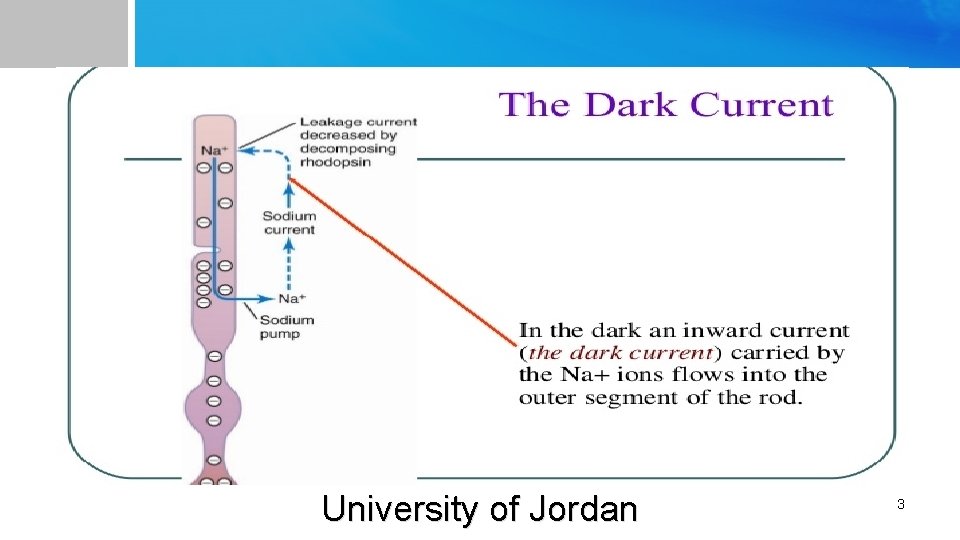
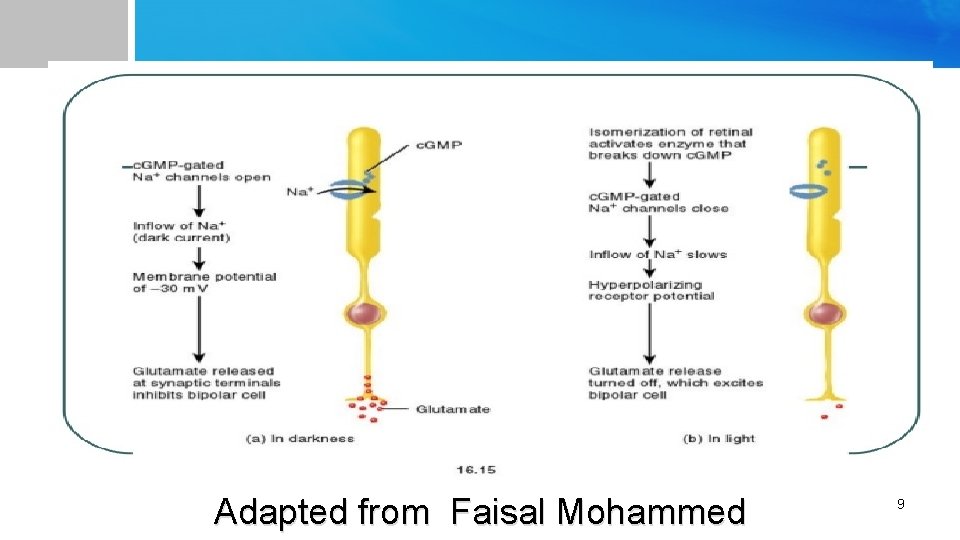
PHOTOTRANSDUCTION • Visual or phototransduction is the process by which light energy is converted into receptor potential in visual receptors. • Resting membrane potential (RMP) in other sensory receptor cells is usually between – 70 and – 90 m. V. • However, in the visual receptors during darkness, negativity is reduced and RMP is about – 40 m. V. It is due to influx of sodium ions. • Normally in dark, Na+ are pumped out of inner segments of rod cell to ECF. However, these sodium ions leak back into the rod cells through membrane of outer segment and reduce the electronegativity inside rod cell • Thus, Na influx maintains a decreased negative potential up to – 40 m. V. This potential is constant and it is also called dark current. 2
University of Jordan 3
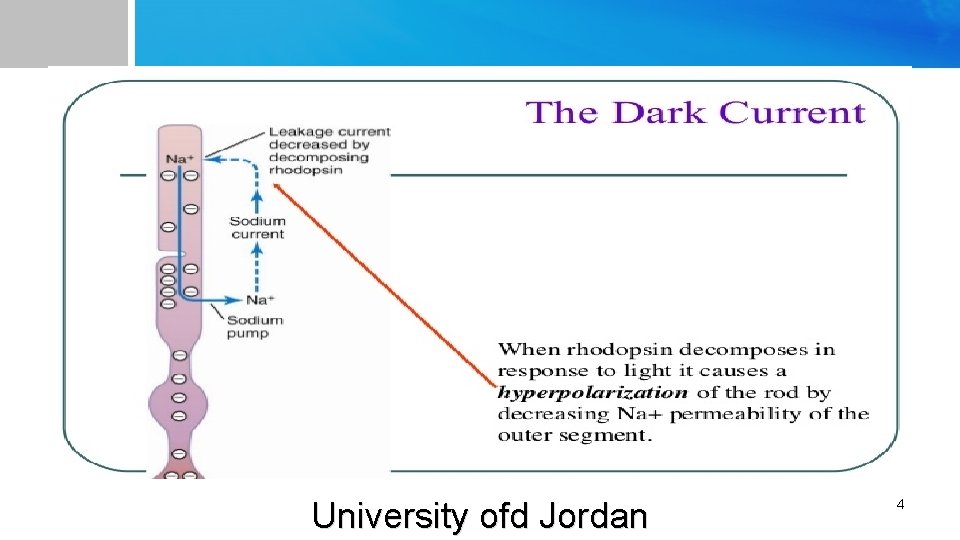
University ofd Jordan 4
PHOTOTRANSDUCTION CONT'D • Influx of Na+ into outer segment of rod cell occurs mainly because of cyclic guanosine monophosphate (c. GMP) present in the cytoplasm of cell. • The c. GMP always keeps the sodium channels opened. • Closure of sodium channels occurs due to reduction in c. GMP. • Concentration of Na+ inside the rod cell is controlled by Na+/K+ pump. • When light falls on retina, rhodopsin is st. Imulated leading to development of receptor potential in the rod cells. 5
PHOTOTRANSDUCTION CASCADE OF RECEPTOR POTENTIAL 1. When the minimum quantum of light energy (photon) is absorbed by rhodopsin, the 11 -cis retinal is decomposed into metarhodopsin through few reactions mentioned earlier. Metarhodopsin II is considered as the active form of rhodopsin. It plays an significant role in the formation of receptor potential. 2. Metarhodopsin II activates a G protein called transducin that is present in rod disks. 3. Activated transducin activates the enzyme called cyclic guanosine monophosphate phospho diesterase (c. GMP phosphodiesterase), which is also present in rod disks 6
PHOTOTRANSDUCTION CASCADE OF RECEPTOR POTENTIAL 4. Activated c. GMP phosphodiesterase hydrolyzes c. GMP to 5’-GMP 5. Now, the concentration of c. GMP is reduced in rod cell 6. Reduction in concentration of c. GMP immediately causes closure of sodium channels in the membrane of visual receptors 7. Sudden closure of sodium channels prevents entry of sodium ionsleading to hyperpolarization. The potential reaches – 70 to – 80 m. V. It is because of sodium-potassium pump 7
SIGNIFICANCE OF HYPERPOLARIZATION • The process of receptor potential in visual receptors is unique in nature. When other sensory receptors are excited, the electrical response is in the form of depolarization (receptor potential). But, in visual receptors, the response is in the form of hyperpolarization. • Hyperpolarization in visual receptor cells reduces the release of synaptic transmitter glutamate. It leads to development of response in bipolar cells and ganglionic cells so that, the action potentials are transmitted to cerebral cortex via optic pathway. 8
Adapted from Faisal Mohammed 9
PHOTOSENSITIVE PIGMENT IN CONES • Photosensitive pigment in cone cells is of three types and they are: porphyropsin, iodopsin and cyanopsin. • Only one of these pigments is present in each cone. • Photopigment in cone cell also is a conjugated protein made up of a protein and chromophore. • Protein in cone pigment is called photopsin. • However, chromophore of cone pigment is the retinal that is present in rhodopsin. • Each type of cone pigment is sensitive to a particular light and the maximum response is shown at a particular light and wave-length. • Various processes involved in phototransduction in cone cells are similar to those in rod cells. 10
DURATION AND SENSITIVITY OF THE RECEPTOR POTENTIAL • A single pulse of light causes activation of the rod receptor potential for more than a second. • In the cones these changes occur 4 times faster. • Receptor potential is proportional to the logarithm of the light intensity. • Very important for discrimination of the light intensity. 11
ROLE OF VITAMIN A • Vitamin A is the precursor of all-trans-retinal which is the pigment portion of rhodopsin. • Lack of vitamin A causes a decrease in retinal. • This results in a decreased prodction of rhodopsin and a lower sensitivity of the retina to light or night blindness. 12
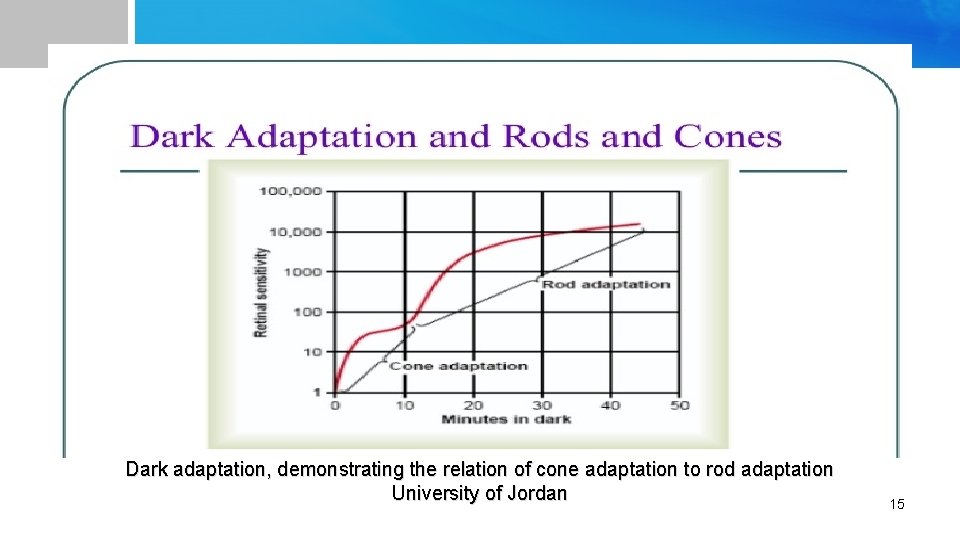
DARK ADAPTATION • Dark adaption is the process by which a person is able to see an objects in dim light. • If a person enters a darkroom from a bright-lighted area, he is blind for some time, i. e. he cannot see any object. • After a while, his eyes get adapted and he starts seeing the objects gradually. • Maximum duration for dark adaptation is about 20 minutes 13
CAUSES OF DARK ADAPTATION 1. Increased sensitivity of rods as a result of resynthesis of rhodopsin: In dim light, it requires some time for regeneration of certain amount of rhodopsin, which is necessary for optimal rod function. 2. Dilatation of pupil: This allows more light to enter the eye. 14
Dark adaptation, demonstrating the relation of cone adaptation to rod adaptation University of Jordan 15
LIGHT ADAPTATION • Light adaptation is the process in which eyes get adapted to increased illumination. • When a person enters a bright-lighted area from a dim-lighted area, he feels discomfort due to the dazzling effect of bright light. • After some time, when the eyes become adapted to light, he sees the objects around him without any discomfort. It is the mere disappearance of dark adaptation. • Maximum period for light adaptation is about 5 minutes. 16
CAUSES OF LIGHT ADAPTATION 1. Reduced sensitivity of rods: During light adaptation, the sensitivity of rods decreases. It is due to the breakdown of rhodopsin. 2. Constriction of pupil: Constriction of pupil reduces the quantity of light rays entering the eye. 17
NIGHT BLINDNESS • It is defined as the loss of vision when light in the environment becomes dim. It is otherwise called nyctalopia or scotopic vision. • Causes: - Deficiency of vitamin A which is essential for the function of rods. • Vitamin A occurs due to the following : • 1. Diet containing less amount of vitamin A • 2. Decreased absorption of vitamin A from intestine. • Vitamin A deficiency causes defective cone function. • Prolonged deficiency leads to anatomical changes in rods and cones and finally the degeneration of other retinal layers occurs. 18
ACUITY OF VISION • Acuity of vision is the ability of eye to determine the precise shape and details of the object. It is the resolving power of the eyes by which objects are distinguished clearly from the others. • It is also called visual acuity. Acuity of vision is also defined as the ability to recognize the separateness of two objects placed together. Cones of retina are responsible for acuity of vision. • It is highly exhibited in fovea centralis, which contains only cones. It is greatly reduced during the refractory errors. 19
FACTORS AFFECTING VISUAL ACUITY 1. Refractive error 2. Size of the pupil 3. Accommodation 4. The health and integrity of the eye 5. Illumination of the test object 6. The test target 7. Area of retina stimulated 8. State of adaptation of eye 9. Eye movement 10. Cognitive status 20
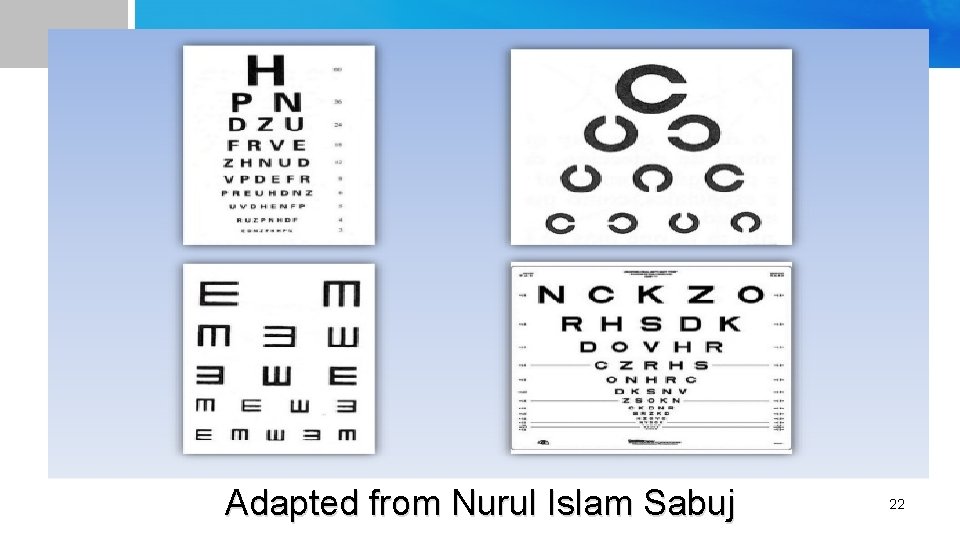
TEST FOR VISUAL ACUITY • Acuity of vision is tested for distant vision as well as near vision. • If there is any difficulty in seeing the distant object or the near object, the defect is known as error of refraction. • Distant Vision • Snellen chart is used to test the acuity of vision for distant vision in the diagnosis of refractive errors of the eye. • Near Vision • Jaeger chart is used to test the visual acuity for near vision 21
Adapted from Nurul Islam Sabuj 22
PRINCIPLE OF SNELLEN ACUITY • The 6/6 line is normal • The number above the line describe the distance of the patient from the chart • The number below the line denotes which line is seen • Each letter is desgned in a square with sides 5 times the width of the letter strokes. • The breath of black strokes and while spaces are equal. • The breadth of line and space produce 1 min of arc at nodal point when viewed from a certain distance • Each letter subtsends an of 5'of arc at nodal point when seen at a certain distance. 23
THANK YOU 24